
TimeGhost History
Published 7 Sept 2025Breadlines, quotas, and Stasi fear collide with propaganda promises as East Germany erupts. In June 1953, strikes on Stalinallee ignite a nationwide uprising — Soviet tanks roll into Berlin, thousands are arrested, and the GDR tightens control. How did the regime survive this shock?
(more…)
September 8, 2025
September 7, 2025
The BEF and the German Sichelschnitt of May, 1940
Dr. Robert Lyman rebuts the common-since-the-1950s adulation of the Wehrmacht‘s attacks of May-June, 1940 through the Low Countries that drove the British Expeditionary Force off the continent and destroyed the flower of the French army prior to the surrender of France in June:
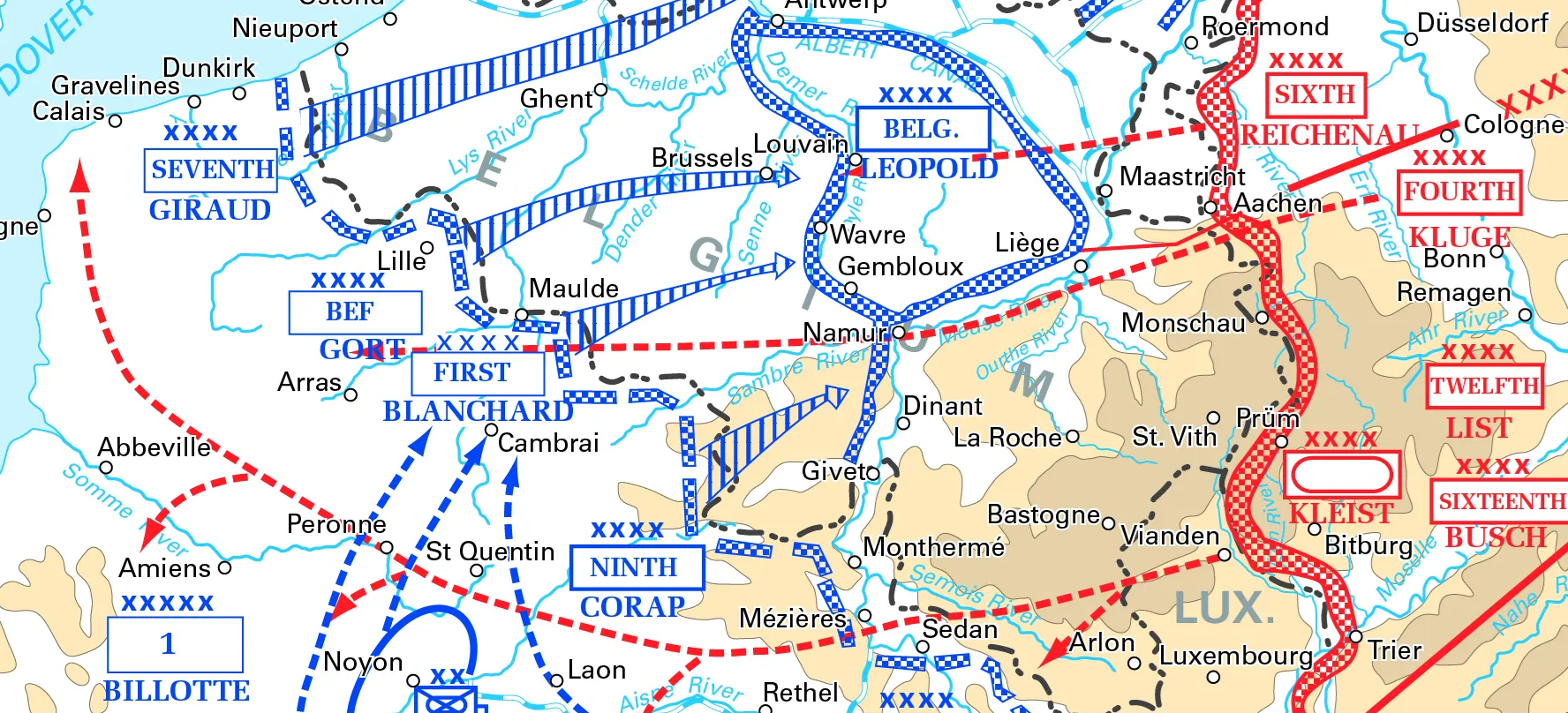
Detail from the West Point Military Atlas map of the “Campaign in the West, Disposition and Opposing Forces, 1940”
Full map.
The world has largely remembered Sichelschnitt as a brilliant German operation of war, but it was one that was fundamentally enabled by Allied ineptitude. Indeed, Blitzkrieg wasn’t particularly new, innovative or even a warfighting doctrine. It is best described, in the context of France 1940, as an event. It was simply the way that the Wehrmacht exerted its tactical and operational superiority over its more pedestrian enemies in 1940. In fact, it was the 1940 extension of what the German Army had first demonstrated in Flanders in March 1918, this time with tanks and Stukas. It was the Panzerwaffe (“tank force”) – combined with a tactical air force – which in 1940 would create the breakthrough that Ludendorff had been unable to achieve in 1918. Where it was applied, by Army Group A, it concentrated fast-moving armoured vanguards co-ordinated with tactical air power, such as 400 Ju 87 Stuka dive-bombers, to so overwhelm the enemy in both time and space that they were unable to respond quickly enough to the changing and challenging battlefield. In 1940 the panzer came into its own, the sound of clattering tracks on French cobblestones a new feature in the sound of battle and a key element in how France remembers its defeat in 1940.
It wasn’t the type of tank in the German inventory which mattered, but the way in which these tanks were employed. Only about 10 per cent of the army comprised tanks, the remainder relying on horse and wagons and the raw, painful feet of the marching infantry. Of the 2,539 tanks the Wehrmacht deployed in 1940, only 916, or 36 per cent were battleworthy, the remainder being clattering tin cans with machine guns (the obsolete Panzer Mark Is and Mark IIs). The only modern tanks were 683 Panzer Mark IIIs and Czech T38 tanks armed with a 37mm gun, and 278 of the larger Mark IVs with a short 75mm gun. But it was enough. The German operational strategy was to use this mass of armour not to fight a large confrontational tank battle, but to achieve breakthrough and breakout, bursting through the enemy’s linear defences. It was surprise and shock action that so discomforted the Allies, who had lazily and, given what we know of British failure to understand 1918, ignorantly assumed that the war would progress against a 1914 rather than a 1918 pattern. The armoured vanguard would surge through the outer skin of the enemy defences, concentrating heavy effort in one place, before driving hard into the heart of enemy territory. With an enemy intent on fighting a linear battle, the rear areas, behind this outer crust, would be weakly defended and full of rear-echelon, administrative and supply troops managing the lines of communication up to the front, not expecting to have to fight. It was by driving hard and fast behind the enemy front line, breaking the cycle of Allied battlefield decision-making, that Blitzkrieg was to achieve its psychological effect.
In contrast the Allies remained concerned about retaining the integrity of their defensive lines. The diaries of Major General Henry Pownall, for instance, are replete with concerns as the days spun past about the widening frontages on one defensive line or another. British concern was misplaced. It was to spread the ever-decreasing butter of the British infantry across ever-widening stretches of French and Belgian bread, without realising that the Germans were concerned not with rolling up a front line, but with driving hard to the rear. By so doing they would take risks with their flanks, but the discombobulatory effect on the enemy was considered to far outweigh any worry about the risk of counter- attack from an increasingly battered and disorganised enemy. Of course this operational concept was risky, but the risks taken were carefully calculated given what the German General Staff knew about British and French tactical doctrine, or the lack of it.
These German tactics were psychologically disconcerting for those not trained to expect them. As was demonstrated on the Meuse, artillery would batter a position in co-ordination with armoured columns bypassing fixed defences and attacking those it needed to clear from the flanks and the rear. The infantry accompanying the advancing armour – Panzergrenadiers (mechanised infantry) – arrived in tandem with the Stukas, which could drop their bombs from a screaming dive. Each Stuka seemed to those at the receiving end to be diving directly at them, personally. For untrained troops it was a terrifying experience. The panzers would sweep on while the truck-borne infantry would turn up to deal with survivors of this storm of fire and movement. By this time, of course, the disorientated French and British would now consider themselves cut off, behind their front line, with no prospect of being relieved. Surrender or a disorganised escape to the rear would seem to be a more sensible option than the forlorn hope of continued resistance when the surrounding fields were dotted with the grey-green uniforms and coal-scuttle helmets of their enemy. The psychological effect of Blitzkrieg was considerable. This wasn’t how their fathers had told them war was fought. How did the Germans manage to discomfort them on the battlefield so comprehensively? Were they inadequate soldiers, unable to meet the standards of campaigning set by the previous generation? Or was it that their tactics were simply not able to cope with the shock of a comprehensive assault by German infantry, armour and air power all descending on them at once? This was the battlefield that the British had entirely dominated, by virtue of their tactical innovations, in 1918. It was now Germany’s turn, a direct result of the failure of the British Army to develop its doctrine and approaches to warfighting at the end of the Great War. Brave men in 1940 did their duty, but against a battle-winning concept of their enemy, they were out-thought rather than out-fought. And critically, when an army thinks it is beaten, it is indeed beaten.
Comments Off on The BEF and the German Sichelschnitt of May, 1940
How Did Göring Get the Cyanide? OOTF Community Questions
World War Two
Published 6 Sept 2025In this episode of Out of the Foxholes, we dive into your community questions about World War II. How did Hermann Göring manage to get the cyanide capsule that ended his life at Nuremberg? What role did Slovakia really play in 1939? Why didn’t the Allies invade the Balkans instead of France, and why didn’t Japan use its submarines like Germany did?
(more…)
Comments Off on How Did Göring Get the Cyanide? OOTF Community Questions
Up on the Mountain: a History of the Ski Cap
HatHistorian
Published 1 May 2025The ski cap, sometimes also called by its german name of Bergmütze, is a visored cap with ear flaps secured to the front by buttons or a buckle. Allegedly descended from eastern bashlyks worn by Russian soldiers, it was popular in the alpine regions of Germanic countries. First adopted by the AUstro-Hungarian Empire as a field cap, it was infamously worn by the Wehrmacht during WWII. It continues to be used as a field or dress cap by German, Austrian, and Hungarian armed forces, and civilian versions can be found around Central and Eastern Europe.
(more…)
Comments Off on Up on the Mountain: a History of the Ski Cap
September 6, 2025
New Evidence on the loss of HMS Hood!
Drachinifel
Published 5 Sept 2025Today we take a look at a heretofore unpublished account from a sailor who saw the destruction of HMS Hood, and take a look at what this might tell us about the incident.
(more…)
Comments Off on New Evidence on the loss of HMS Hood!
September 4, 2025
Mussolini’s Blunder: Greece and North Africa 1940
Real Time History
Published 4 Apr 2025Hitler’s victories in 1940 present a historic opportunity to Italian dictator Benito Mussolini to expand the Italian Empire. Instead, Italy suffers a series of humiliating disasters in Greece and North Africa. So why did Mussolini declare war on the Allies at this moment, and could Germany be ultimately responsible for the Italian fiasco?
(more…)
Comments Off on Mussolini’s Blunder: Greece and North Africa 1940
September 3, 2025
“Once is happenstance. Twice is co-incidence” … but SIX?
I depend on eugyppius to keep me up to date on German affairs, and despite the eyebrow-raising total of six AfD candidates dying unexpectedly, he doesn’t think it’s actually “enemy action” as Ian Fleming once wrote in Goldfinger, but it is statistically boggling:
I had plans to write about something else today, and I even have a half-finished post, but the story of the mysteriously dying AfD candidates is everywhere …
… and I feel compelled to address it.
The West German state of Nordrhein-Westfalen (NRW) is slated to hold municipal elections in just under two weeks, on 14 September. Eighteen million Germans scattered across thirty-one districts and 393 municipalities will elect councillors, board members, mayors and district administrators.
It’s important to understand the scale of these elections and the enormous numbers involved: Tens of thousands are presently running for office in NRW. The exact number isn’t certain, but it may be as great as 90,000. Most of these candidates are totally ordinary people. They are not professional politicians and they are not widely known outside their communities.
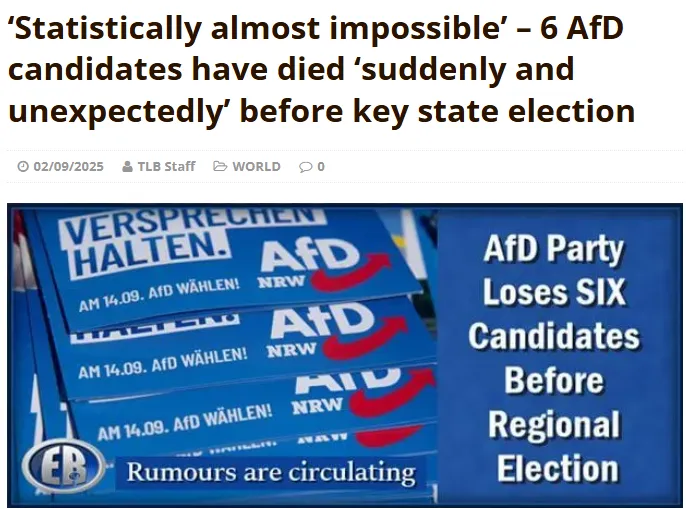
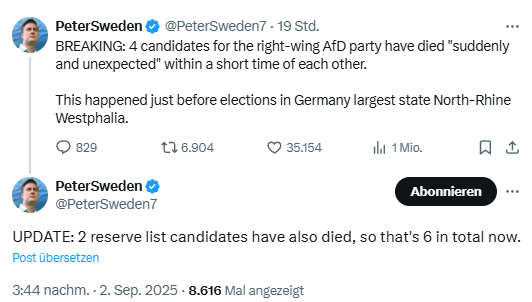
Four days ago, the German press began reporting on bureaucratic chaos stirred up by a series of unexpected deaths in late stages of the NRW campaign. Each of these deaths happened so late in the game that ballots had to be reprinted and the postal vote repeated. The German economist and social media personality Stefan Homburg picked up the story and called the deaths “statistically almost impossible“. AfD co-chair Alice Weidel retweeted Homburg’s suspicions, ultimately attracting the attention of Elon Musk.
Despite the widespread interest in this story, I really think it’s a nothingburger. We may be looking at an unusual cluster of AfD deaths in the upcoming elections, but we don’t know enough to say for sure how improbable this cluster is. All we can really say is that the deaths themselves are not unexplained and that their coincidence doesn’t look that improbable on its face.
Comments Off on “Once is happenstance. Twice is co-incidence” … but SIX?
German Occupation FN High Power Pistols
Forgotten Weapons
Published 28 Apr 2025When Germany occupied Belgium in the summer of 1940, the took over the FN factory complex and ordered production of the High Power pistol to continue. It was put into German service as the Pistole 640(b), and nearly 325,000 of them were made between 1940 and 1944. The first ones were simply assembled from finished Belgian contact parts, and included all the features like shoulder stock slots and 500m tangent rear sights. As the war continued, however, production was simplified. The stock slots disappeared first, then the tangent sights, then the wooden grips (replaced by bakelite) and eventually even the magazine safety was omitted. Resistance among Belgian factory workers increased as well, with deliberate sabotage in the form of incorrect heat treating, errors in fine tolerance parts, and sometimes even spending lots of time to give a very fine surface finish instead of making more pistols.
These are a particularly popular subject of collecting, and there are a lot of nuances of the production and inspection marks that are worth understanding if you want to take them seriously. I highly recommend Anthony Vanderlinden’s 2-volume book FN Browning Pistols for very good detail on these, as well as other FN handguns: https://amzn.to/42Bc541
(more…)
Comments Off on German Occupation FN High Power Pistols
August 30, 2025
German politicians in Cologne come up with a bold strategy … let’s see if it pays off for them
Whenever I think I’ve got a vague idea of what’s going on in German politics, eugyppius can be counted upon to show me I still don’t have the first clue:



From BILD:
Bizarre muzzling agreement in Cologne’s local election campaign!
The CDU, SPD, Greens, FDP, Die Linke, and Volt have signed an agreement initiated by the Cologne Round Table for Integration to refrain from speaking negatively about migration during the election campaign …
In consequence: the only relevant party in the Cologne campaign that will address the negative aspects of migration is the AfD.
That’s right:
Everybody from the rebranded ex-communists in Die Linke to the centre-right Christian Democratic Union have agreed to give Alternative für Deutschland a political monopoly over the most important issue of our era ahead of municipal elections in Cologne on 28 September.
Specifically, the dumbass signatories have agreed “to respect the diversity of our society”; “to promote … tolerance and peaceful coexistence among people of different origins, cultures, and religions”; “not to campaign at the expense of people with a migrant background”; “not to stir up prejudice” and “not to blame migrants and refugees for negative social developments such as unemployment or threats to domestic security”. They have done this because it makes them feel warm and fuzzy inside even though it is plainly and objectively retarded.
Should any signatory violate this agreement, the other signatories can cry to teacher by contacting designated “arbitrators”, in this case the chairman of the Cologne Catholic Committee or the superintendent of the Cologne Protestant Church Association. These people will then … I don’t know, have a sad and the tell the press about it, I guess.
Amusingly, the CDU already stand accused of violating the agreement for circulating flyers in which they critique state plans to establish a 500-spot refugee intake centre in Cologne. Their transgression has given the spokesman of the Cologne Round Table for Integration – the excessively named Wolfgang Uellenberg-van Dawen – occasion to publish the following
fatwapress release […]
Comments Off on German politicians in Cologne come up with a bold strategy … let’s see if it pays off for them
August 26, 2025
When Jagdpanther Fought Churchill
The Tank Museum
Published 18 Apr 2025Jagdpanther vs Churchill. Tank destroyer vs tank. New technology vs proven veteran. Who will emerge victorious?
It’s 6pm on 30th July 1944. Outnumbered 6 to 1, a platoon of 3 German Jagdpanthers is about to go into action for the first time. Facing them will be a squadron of 18 British Churchill tanks. Within 5 minutes, 11 tanks will be knocked out.
The Jagdpanther is the latest German armoured vehicle to arrive in Normandy. With a devastating gun, and a heavily armoured superstructure, this tank hunter is quick, reliable and deadly.
The Churchill has been fighting with Allied armies in North Africa, Italy and on the Eastern Front. The early marks struggled with a range of issues, but by 1944 it is an essential part of the British and Canadian tank force.
It’s during Operation Bluecoat where these two machines would come face-to-face for the very first time. The Churchills of S Squadron, 3rd Battalion, Scots Guards, have captured Hill 226 – a strategically important area to the south of Caumont. They are preparing for a German counterattack, but their infantry is yet to arrive – leaving their left flank dangerously exposed. And a platoon of Jagdpanthers is ready to take full advantage of their vulnerable state …
00:00 | Introduction
00:35 | The Jagdpanther
02:38 | The Churchill
05:43 | Operation Bluecoat
07:46 | A Turkey Shoot?
12:25 | Aftermath
17:40 | Roll of Honour
(more…)
Comments Off on When Jagdpanther Fought Churchill
August 24, 2025
August 21, 2025
Six Reasons Operation Market Garden FAILED
The Tank Museum
Published 3 April 2025Operation Market Garden failed because the tanks of XXX Corps did not reach the Paras in Arnhem in time. Many historians have argued that the British armoured column “let the side down”. But is this actually true?
We reckon there are six reasons why the operation was a total disaster. It was a poor plan from the get-go, relying on a rate of advance that would outmatch the German invasion of France in 1940. Bad weather prevented the deployment of badly-needed reinforcements, and the terrain Guards Armoured were expected to traverse – a single road with impassable conditions on either side – significantly hampered the efforts of the tank crews.
Poor intelligence also meant that the British column was not prepared for resistance from a retreating and desperate German Army. It was a combination of all these factors that caused Market Garden to unravel completely.
Despite the complications, many acts of valour were carried out by both the airborne and armoured divisions, including the legendary assault across the Waal by the US 82nd Airborne.
So, join us as we explore these six reasons why Operation Market Garden failed and decide for yourself whether XXX Corps could have done anymore.
00:00 | Introduction
02:23 | #1 – A Bad Plan
06:22 | #2 – Poor Intelligence
07:51 | #3 – Difficult Terrain
11:27 | #4 – Determined Resistance
13:45 | #5 – Bad Weather
14:38 | #6 – Loss of Surprise
19:45 | What Went Wrong?
(more…)
Comments Off on Six Reasons Operation Market Garden FAILED
August 19, 2025
Dieppe 1942: The Failed Raid That Shaped D-Day
Battle Guide
Published 2 May 2025On 19th August 1942, as dawn was breaking along the coast of occupied France, a force of just over 6,000 men stormed the beaches around the port town of Dieppe in the first major allied strike against Hitler’s Atlantic Wall. Within a matter of minutes hundreds lay dead or wounded, washed up against seawalls, hung on wire entanglements or incinerated in the burning landing craft. Over 60% of the mainly Canadian assault force were killed, wounded or captured by the end of the day, and the Dieppe Raid has, for the allies, gone down as one of the most infamous days of the Second World War.
(more…)
Comments Off on Dieppe 1942: The Failed Raid That Shaped D-Day
Operation Jubilee: Canada’s Devastating WWII Loss
WarsofTheWorld
Published 17 Jun 2023By 1942, the war was no longer another great European conflict. It was now a firmly global affair enveloping all of the world’s great powers as the Allies squared off against the tyranny and aggression of the Axis nations. Against such colossal forces, no one country could stand alone and events that affected one combatant would ultimately have consequences for the other further down the road.
To that end, while the western Allies and the Soviet Union were effectively fighting separate wars against the same enemy, there needed to be cooperation between the two fronts in order to squeeze the life out of Nazi Germany and insure victory against Fascism. However, the relationship was often a strained one as both Allied power blocks were suspicious of the other’s intentions once the war was over.
Thus, we come to the subject of today’s episode and a story of the war that is still the subject of much debate today. It was an operation with no specific military objective other than to experiment with conducting division-sized amphibious landings against a fortified beach and as a gesture to the Soviet Union who were starting to feel abandoned by their Allies. It is an operation that has become seared into the hearts and minds of the Canadian people for the sacrifice they were asked to make for it.
0:00 Introduction
3:26 A Red Request
7:50 Planning and Preparation
13:32 Operation Rutter – A False Start
18:10 Reviving Rutter
24:02 Operation Jubilee
35:52 A Necessary Lesson?
(more…)
Comments Off on Operation Jubilee: Canada’s Devastating WWII Loss
QotD: The fall of France: mass and defeat in detail
A reason to be cautious about anticipating attrition as the shape of future war is the danger of a “defeat in detail”. By failing to match mass against mass, your enemy has the chance to utterly destroy a part of your force. This offers the chance not only to shift the balance of force, but to subsequently overwhelm other elements caught off-guard by the initial defeat. In this way, one force may defeat another of comparable or even superior strength without the bloody cost typical of the clash of mass meeting mass. Prioritizing preparations for attritional struggle may allow your enemy to gain the seemingly small advantages that cascade into a defeat in detail.
As mentioned, for Clausewitz, the defeat of Prussia in the war of the Fourth Coalition was the template, but the more contemporary archetype is the Fall of France in WW2. French command and control was oriented towards a lengthy war of attrition and proved unable to react quickly enough to the German breakthrough at Sedan. Counterattacks were therefore only undertaken on the local level and without coordination. Despite German vulnerability, they were able to defeat the piecemeal commitment of superior forces and ultimately collapse Allied defenses.
The initial German breakthrough was made possible by local air superiority, enabled by the same principle. This was achieved despite an overall superiority by the Allies in aircraft (even when counting only modern planes) because the Allies kept many planes in reserve, anticipating a long war. By the time they realized the significance of the German concentration, the Germans had been able to move forward anti-aircraft guns and it was too late to destroy the bridgeheads over the Meuse (despite the desperate kamikaze-like efforts of a stricken bomber).
The case of France in 1940 gives a clear example of why a defeat in detail has been so feared. French strategy was premised on winning a lengthy war — the initial battle was assumed to be no more conclusive than the Battle of Frontiers had been in 1914 [Wiki]. The exact error of the French is unlikely to be replicated, but the nature of the mistake remains a universal peril. Dismissing the likelihood of an early decision and preparing for a “later” that never comes is the reciprocal mistake of assuming an early decision is inevitable (which can be identified with the “Cult of the Offensive” that preceded WWI).
Kiran Pfitzner, “In Defense of Taiwan: Attrition or Annihilation”, Dead Carl and You, 2025-05-14.
Comments Off on QotD: The fall of France: mass and defeat in detail


