
The Tank Museum
Published Mar 1, 2024A bigger tank is a better tank, right? Wrong.
Meet the Interwar Vickers A1E1 Independent: a failed prototype, a prototype that proved bigger isn’t always better. Impractical and expensive, it was never accepted into service – but it is said to have inspired equally cumbersome designs including the German Neubaufahrzeug and the Soviet T-35.
Join David Willey, The Tank Museum Curator, as he examines one of the more unusual vehicles in the collection – and discover how it became a focus for political espionage in the early 1930’s.
00:00 | Introduction
02:56 | Tank Design & Vickers
03:28 | Heavy Tank Requirements
05:38 | Initial Blueprints & Prototypes
11:08 | Test-bed Vehicle
14:50 | Myths, Issues and Life after Trials
19:25 | Does it lead to anything?This video features archive footage courtesy of British Pathé.
#tankmuseum #davidwilley #Interwar #heavytanks
June 10, 2024
Bigger Isn’t Always Better: A1E1 Independent | Tank Chats Reloaded
QotD: The British sweet tooth
It will be seen that British cookery displays more variety and more originality than foreign visitors are usually ready to allow, and that the average restaurant or hotel, whether cheap or expensive is not a trustworthy guide to the diet of the great mass of the people. Every style of cookery has its peculiar faults, and the two great shortcomings of British cookery are a failure to treat vegetables with due seriousness, and an excessive use of sugar. At normal times the average consumption of sugar per head is very much higher than in most countries, and all British children and a large proportion of adults are over-much given to eating sweets between meals. It is, of course, true that sweet dishes and confectionery – cakes, puddings, jams, biscuits and sweet sauces – are the especial glory of British cookery but the national addiction to sugar has not done the British palate any good. Too often it leads people to concentrate their main attention on subsidiary foods and to tolerate bad and unimaginative cookery in the main dishes. Part of the trouble is that alcohol, even beer, is fantastically expensive and has therefore come to be looked on as a luxury to be drunk in moments of relaxation, not as an integral part of the meal. The majority of people drink sweetened teas with at least two of their daily meals, and it is therefore only natural that they should want the food itself to taste excessively sweet. The innumerable bottled sauces and pickles which are on sale in Britain are also enemies of good cookery. There is reason to think, however, that the standard of British cookery – that is, cookery inside the home – has gone up during the war years, owing to the drastic rationing of tea, sugar, meats and fats. The average housewife has been compelled to be more economical then she used to be, to pay more attention to the seasoning of soups and stews, and to treat vegetables as a serious foodstuff and less a neglected sideline.
George Orwell, “British Cookery”, 1946. (Originally commissioned by the British Council, but refused by them and later published in abbreviated form.)
June 9, 2024
Rishi Sunak “promised to run Britain like a start-up. On that account, he has delivered. Over one-third of start-ups crash and burn within two years.”
Christopher Gage pokes a bit of goodnatured fun at British Prime Minister Rishi Sunak’s awful start to his re-election campaign:
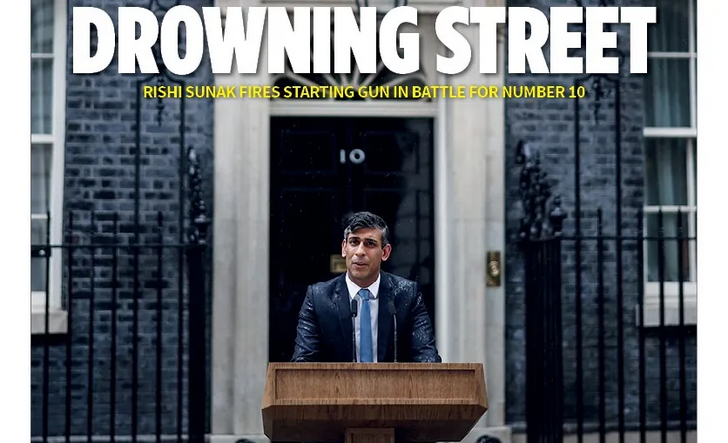
This week on the campaign trail might just enter the political history books. Rishi Sunak, the man who themed his cheese-melting campaign on national pride and security, slipped off home early from the D-Day commemorations in France.
World leaders gathered at the event on Thursday to honour the eightieth anniversary of the Normandy landings. You know, the one attended by a dwindling platoon of demigod veterans in what might be the final year graced by their presence. To riot in understatement, this Irish goodbye was inadvisable. Sunak might as well have fed Dame Judi Dench to a ravenous gang of XL bullies.
Our prime minister is one of life’s thoroughbred winners. From one of the most exclusive schools in the country, Sunak went on to Oxford and then to Stanford university. Cultured in our meritocratic petri-dish, Sunak has never failed a thing in his 44 years. Until now.
Twenty-odd points behind Sir Keir Starmer’s Labour, Sunak is on course to finish third in a two-horse race.
It gets worse. This week, Nigel Farage announced he would stand for election as the Reform Party candidate in Clacton. That Essex seat is the living, breathing symbol of pissed-off, left-behind, white-working-class, fucking furious Great Britain.
The polls have broken Tory brains. Clamped around the Conservative Party’s noodle neck is Reform’s roid-head paws. The right-wing upstarts trail the Tories by just two points. And that was before Sunak committed the social equivalent of tarmacking over the Princess Diana memorial garden on Mothering Sunday.
Sunak is a one-colour pie chart of hubris. After losing the Tory leadership election to the ludicrous Liz Truss, Sunak got handed the top job by knowing the right string-pullers.
Breathless commentary from back then christened Sunak as a Silicon Valley start-up guru, furnishing the boy wonder with LinkedIn adjectives such as “brilliant” and “dynamic”.
Sunak parrots the pediculous babble beloved of that skulk of Babbitts. With blue-sky thinking, and by sticking to core competencies, Sunak has a plan to deliver. He promised to run Britain like a start-up. On that account, he has delivered. Over one-third of start-ups crash and burn within two years.
What went wrong? Sunak’s indulgent reboots have crashed his operating system. Not so long ago, he was an anti-woke culture warrior reeling off tiresome jibes about trans people. Then came spartan Sunak, trusted centurion of the Telegraph comment section.
Too late. For the best part of two years, Sunak has circulated in meme-form around this teetering island, his existence a boundless source of second-hand embarrassment and ridicule.
With each reboot, Sunak sunk further. Ordinary people have a radar for bullshit. They don’t see such shapeshifting as necessary brand correction to meet market demands. They see duplicity and serpentine salesmanship bordering on fraud. In the plain English of my council-estate youth: Sunak is full of shit.
With his wings smeared in beeswax, Rishi Sunak is Icarus. And Nigel Farage is the sun.
Farage is more than the sun. Farage is Wetherspoon Man.
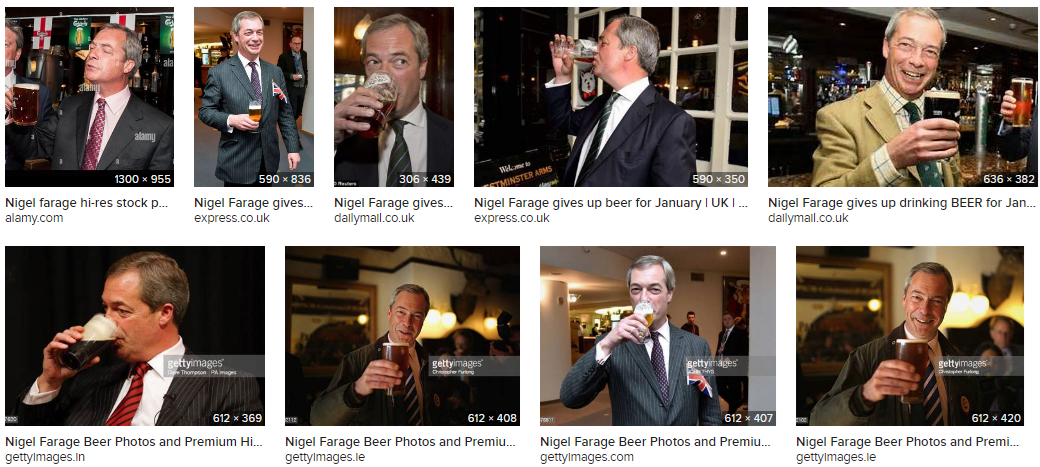
A quick image search for “Nigel Farage beer” provides lots of evidence for “Wetherspoon Man”During his visit to Clacton, Farage fittingly visited a Wetherspoon pub. For the unfamiliar, Wetherspoon pubs owe their undeniable success to their reliability and recognition. Wherever you may be in Britain, you know what you’ll get in one of Wetherspoons’ 800-odd cavernous boozers: A decent burger, chips, and a pint for half an hour on the minimum wage, alongside cheap, cheap booze.
Critics scoff. But they’ll never find a Wetherspoon empty at any time of day or on any day of the week.
Farage announced his plans and doubled the Reform vote in Clacton. His appeal relies on the Wetherspoon model. Farage is the same wherever he may be and to whomever he may talk. Dressed like a hobbyist gamekeeper, he sinks pints, smokes fags, and cracks jokes. “Nigel” says what a sizeable swathe of left-behind Britain thinks and wants to hear.
His many detractors don’t get it. How can a privately educated former metals trader claim to speak for the people? For the same reason that populist parties are lapping at the walls of power across Europe: their erstwhile champions are too busy peacocking their pronouns in their Twitter bios.
Men In Armour (1949) – The origins and operation of tanks
FWD Publishing
Published Feb 18, 2024Lengthy documentary made in 1949 about the men and tanks of the Royal Armoured Corps (RAC).
QotD: The biological importance of salt to humans
A population deprived of salt was thus one that was weaker and more prone to disease — and at a time when the vast majority of the economy’s energy supply came from the straining of muscle, both human and animal, that weakness in effect meant a severe energy shortage. Although the main fuels for muscle power were carb-heavy grains like wheat, rye, oats, and rice, the indispensable ingredient to getting the most out of these grains was salt — just as how nuclear power uses uranium as its fuel, but also requires a suitable neutron moderator. A population deprived of salt would quite literally be more lethargic and sluggish, making it less productive and poorer too.
Salt’s unique properties made it a serious tool of state. In 1633 king Charles I’s newly-appointed Lord Deputy for Ireland, Baron Wentworth, advised controlling its salt supply as a way to make the Irish utterly economically dependent on England. Given salt was “that which preserves and gives value to all their native staple commodities” — herrings, butter and beef — then “how can they depart from us without nakedness and beggary?” Salt would be a method of control, and a profitable one too, being “of so absolute necessity” that it could be sold to the Irish at inflated prices without much dampening demand: salt “must be had whether they will or no, and may at all times be raised in price”.2 Much like economists today, Wentworth saw revenue-raising potential in taxing goods with such unresponsive or “inelastic” demand.
Wentworth’s scheme to control the Irish never came to be. But a great many other countries did choose to tax it. Given a minimum amount of salt had to be consumed by absolutely everyone, monopolising its sale — and levying what was effectively a tax by inflating the price well above the costs of importing or producing it — could function as kind of indirect poll tax, levied more or less per head of both people and livestock, but without any of the administrative hassle of taking and maintaining an accurate census in order to impose such a tax directly.
When compared to other necessities like grain, salt did not need to be traded in especially large quantities either, meaning that its supply could be monopolised with relative ease. And it could not be produced everywhere. Salt tended to be lacking the further you got from the sea coast, unless there happened to be some relatively rare inland sources like salt lakes, brine springs, or rock salt mines. And it could even be lacking on the sea coast where it was either too humid or too cold to get salt cheaply by evaporating seawater using the sun, or where there was insufficient fuel for boiling the brine. These places were thus prone to being charged inflated prices, while the states that controlled places where the costs of production were low — in warmer and drier climes where the salty water of coastal marshes could cheaply be evaporated using only the heat of the summer sun — could extract especially large monopoly profits from the difference. The revenue from controlling solar salt thus became the basis of many kingdoms, some unusually powerful republics, and even empires.
Anton Howes, “The Second Soul”, Age of Invention, 2024-03-08.
1. Roy Moxham, “Salt Starvation in British India: Consequences of High Salt Taxation in Bengal Presidency, 1765 to 1878”, Economic and Political Weekly 36, no. 25 (2001): p.2270–74.
2. George O’Brien, The Economic History of Ireland in the Seventeenth Century (Maunsel and Company Limited, 1919), p.244, which has the transcription of Wentworth’s proposal
June 7, 2024
Nigel Farage’s challenge to the Conservatives
Ed West perhaps goes a bit far in comparing Nigel Farage and his Reform UK to Lenin’s Bolsheviks in the October Revolution, but he’s not wrong about what the rise of Farage’s party might mean to the already dim re-election hopes of Rishi Sunak’s bedraggled clown posse:
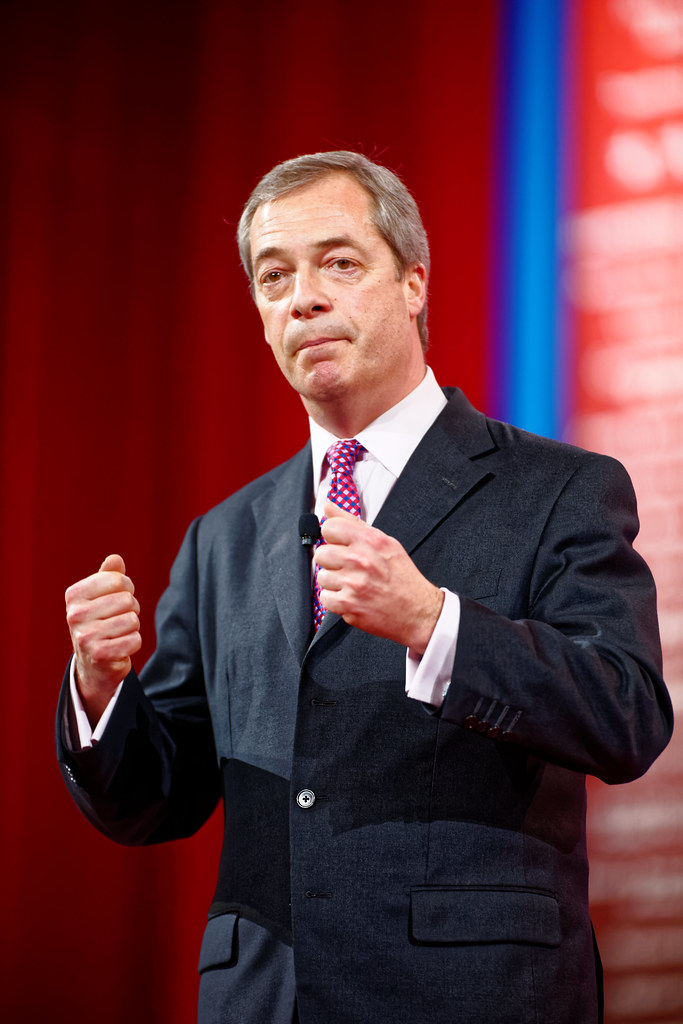
“Nigel Farage” by Michael Vadon is licensed under CC BY-SA 2.0 

 .
.
I imagine that the last remaining serotonin emptied from the bodies of the Tory election team when they heard that Nigel Farage was to return as leader of the Reform Party and stand at Clacton.
The likelihood is that Farage will win that seat, and the reception he received was certainly electric. And Clacton is not even among Reform’s top 20 targets, according to Matt Goodwin.
It’s possible that the party could overtake the Tories in some polls, although I doubt that they will beat them on election day. That is certainly Farage’s aim, and as he said on Monday: “I genuinely believe we can get more votes in this election than the Conservative Party. They are on the verge of total collapse … I’ve done it before. I’ll do it again. I will surprise everybody.”
Contrary to the jokes about Farage failing to get elected, or the criticism that he is a “serial loser“, he is arguably the most successful politician of the past decade. He built up a minuscule party of ‘fruitcakes and gadflies’ to win two successive European elections. He made Brexit happen, and then stood his candidates down in a number of seats to ensure the Leave alliance remained united in 2019, securing Boris Johnson a victory.
For which he didn’t get the thanks he felt was due, something he alluded to at Monday’s press conference. From what I understand the Tory establishment treated him with a snooty disdain which many an outsider has experienced with the British upper class. And for those making the old point that Farage’s private school background bars him from being a true outsider, that’s not how high society works. Populist movements claiming to represent the downtrodden or disenfranchised have invariably been led by people from highly educated or privileged backgrounds, whether of the Left or Right.
Farage’s targeted constituency certainly fits that bill. Clacton is the town that Matthew Parris called “Britain on crutches” in a piece warning the Tories not to desert their traditional middle-class voters. But the problem for the party is that, through a combination of authoritarian vibes and very liberal policies, they have managed to lose both. Rather than making moderate, soothing sounds while using the British executive’s immense power to shape the country around their will, they have done the exact opposite.
The Government’s disastrous polling figures are not some great mystery. Conservatives don’t tend to have the same emotional attachment to their party as the Labour family does. They vote Tory because they want them to do three things: cut immigration, put more criminals away, and lower taxes. It’s nothing more complicated than that, and they’ve failed on all three.
It is obviously the former that has provoked the most bitterness towards the party. I’m a great believer in Stephen Davies’s analysis of alignment in politics, and the central issue in British politics is immigration, multiculturalism and diversity. Labour are unquestionably on one side of this issue; the Tories are broadly pro-multiculturalism and, while issuing soundbites critical of high immigration, have raised it to record levels. If both main parties are seen to be on one side, something else will fill that gap in the market. Political parties are amoral bodies seeking voting coalitions, and the side which is most united in aligning its core groups around primary and secondary issues will win.
June 6, 2024
The reason Germany failed on D-Day (Ft. Jonathan Ferguson)
Imperial War Museums
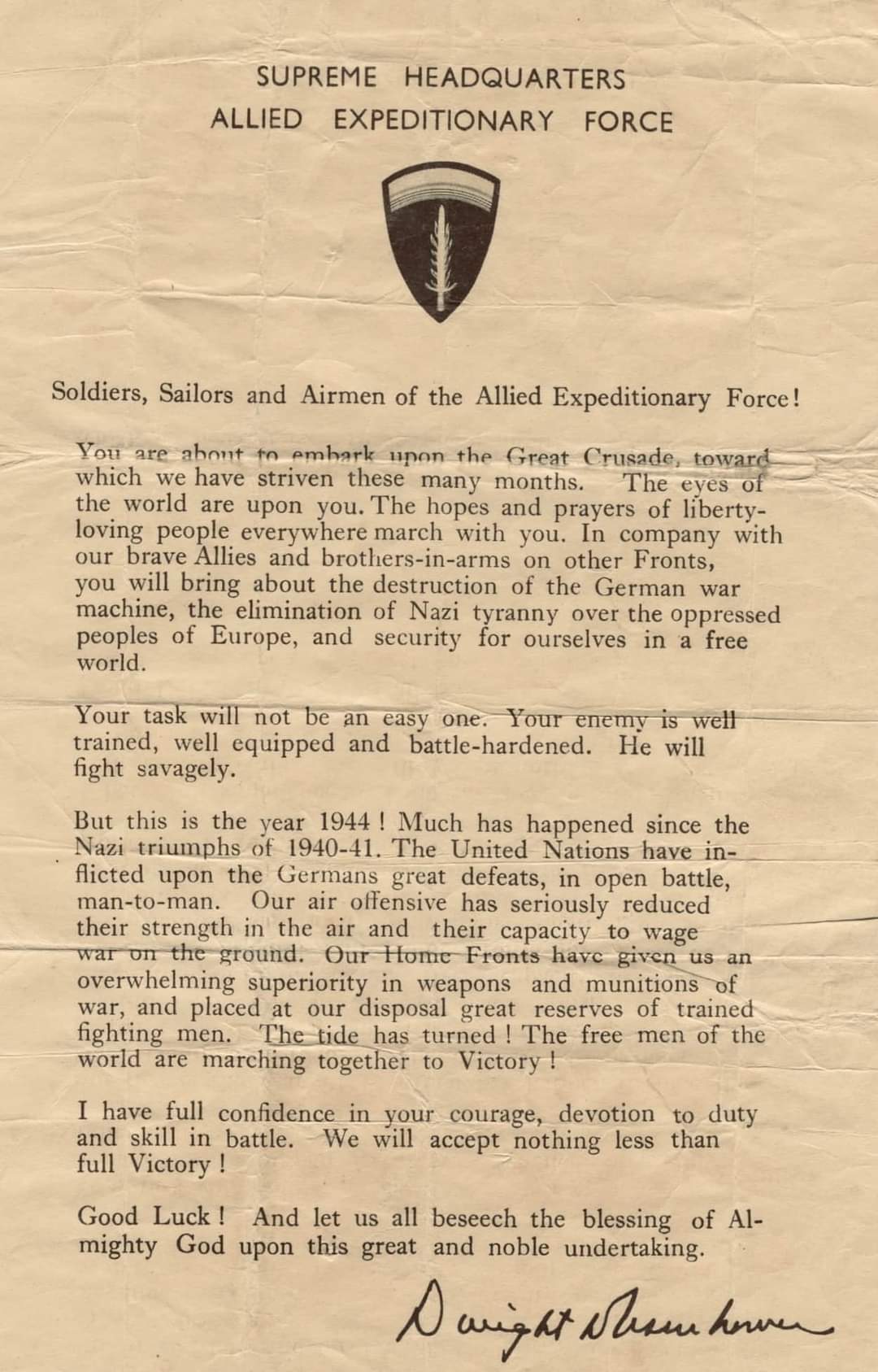
Published Jun 5, 2024Adolf Hitler was looking forward to D-Day. His plan was simple. Reinforce the western defences, launch a furious counterattack, and “throw the Allies back into the sea”. After that, he could turn his full strength against the Soviet Union and end the war. For Hitler, the outcome of this campaign would be decisive.
In the previous episode of our D-Day series we looked at the air battle for Normandy. This time IWM Curator Adrian Kerrison covers the fighting on land. Why were some beaches bloodier than others? Why did German counterattacks fail? And why did it take so long for the Allies to breakout?
To help us answer some of those questions we’ve brought in the Royal Armouries’ Jonathan Ferguson to look at some of the most important weapons of D-Day.
(more…)
June 5, 2024
HMCS Charlottetown: A formidable submarine-hunting force in Nato’s fleet
Forces News
Published Mar 1, 2024Conceived in the middle of the Cold War era, the Canadian Royal Navy frigate HMCS Charlottetown has evolved over three decades of service, becoming one of the most capable and adaptable ships in Canada’s navy.
After setting sail for Nato’s Exercise Steadfast Defender in the North Sea, she made a stop in Edinburgh en route to participating in the alliance’s largest training mission since the Cold War.
(more…)
June 4, 2024
J.K. Rowling’s most convincing and true-to-life villain in the Harry Potter stories
I’m with Jon Miltimore on this — J.K. Rowling’s most disturbing and best-written villain isn’t “He Who Must Not Be Named” or any of the other (frankly cardboard-y) magical villains … it’s Dolores Umbridge, a career bureaucrat who could have been drawn from any western civil service senior management position:

Umbridge, portrayed in the films by English actress Imelda Staunton, isn’t some apparition of the underworld or a creature of the Dark Forest. She’s the Senior Undersecretary to the Minister of Magic, the man who runs the government (the Ministry of Magic) in Rowling’s fictional world.
Umbridge wears pink, preaches about “decorum” in a saccharine voice, smiles constantly, and resembles a sweet but stern grandmother. Her intense, unblinking eyes, however, suggest something malevolent lurks beneath. And boy, does it.
“The gently smiling Dolores Umbridge, with her girlish voice, toadlike face, and clutching, stubby fingers, is the greatest make-believe villain to come along since Hannibal Lecter,” horror author Stephen King wrote in a review of Harry Potter and the Order of the Phoenix, the book in which Umbridge is introduced.
Umbridge’s “Desire to Control, to Punish”
What makes Umbridge so evil that King would compare her to Hannibal Lecter, the man widely considered the greatest villain of all time?
I asked myself this question, and I believe the answer lies in the fact that Dolores Umbridge is so real — and in more ways than one.
First, it’s noteworthy that Rowling based Umbridge on an actual person from her past, a teacher she once had “whom I disliked intensely on sight”.
In a blog post written years ago, Rowling explained that her dislike of the woman was almost irrational (and apparently mutual). Though the woman had a “pronounced taste for twee accessories” — including “a tiny little plastic bow slide” and a fondness for “pale lemon” colors which Rowling said was more “appropriate to a girl of three” — Rowling said “a lack of real warmth or charity” lurked below her sugary exterior.
The description reminded me of another detestable literary villain: Nurse Ratched, the despicable antagonist of Randle Murphy in Ken Kesey’s magnificent 1962 novel One Flew Over the Cuckoo’s Nest.
Kesey’s description of Nurse Ratched conjures to mind a character much like Umbridge.
“Her face is smooth, calculated, and precision-made, like an expensive baby doll, skin like flesh-colored enamel, blend of white and cream and baby-blue eyes, small nose, pink little nostrils — everything working together except the color on her lips and fingernails …”
While there are similarities in the appearances of Dolores Umbridge and Nurse Ratched, their true commonality is what’s underneath their saccharine exteriors.
Snipers in World War 1
The Great War
Published Feb 9, 2024In fall 1914, the British and French armies on the First World War’s Western Front were wrestling with a problem: unseen German riflemen were picking off any man who showed himself above the trench. Something had to be done about it – and the result was the birth of the modern sniper.
(more…)
June 3, 2024
Decoding Nigel Farage’s “hidden agenda” … that isn’t actually hidden at all
I’ve been theorizing that the reason Nigel Farage didn’t plunge immediately into the British election campaign was that he was expecting Rishi Sunak to do his very best Kim Campbell impersonation and utterly destroy the Conservatives as a viable political party. It turns out that that’s pretty much exactly what he’s doing:

Nigel Farage at the ULEZ protests in London, 30 August 2023.
Image from JoNova.
The biggest question of all, however, is what Farage wants to do after polling day. For months now, a growing band of Conservative MPs have been agitating openly for him to be admitted to the party; even Rishi Sunak now says he “respects” him.
Close friends of Farage believe his real plan is to wait for the Tories to implode, and in the aftermath arrive as a saviour in waiting. “He doesn’t want to be the person who puts the bullet in the back of their heads, why be seen to alienate Conservative voters?” said one, while a second, a senior Tory, said: “Our party needs to be able to come back with people like Nigel, where we basically go back to be that authentic Thatcherite party — his natural home.”
[Reform UK leader Richard] Tice says he wants to destroy and replace the Conservative Party, but when asked if he feels the same, Farage says: “I certainly don’t have any trust for them or any love for them”. So does he want to change it? “I want to reshape the centre-right, whatever that means.”
Asked directly if his friends are right and he wants to join the Tories, he adds: “Why do you think I called it Reform? Because of what happened in Canada — the 1992-93 precedent in Canada, where Reform comes from the outside, because the Canadian Conservatives had become social democrats like our mob here. It took them time, it took them two elections, they became the biggest party on the centre-right. They then absorbed what was left of the Conservative Party into them and rebranded.”
I suggest this sounds a lot like he’s floating a merger. “More like a takeover, dear boy,” he replies, grinning like a Cheshire Cat.
18th Century Spiced Hot Chocolate
Tasting History with Max Miller
Published Feb 23, 2024Rich, thick, dark hot chocolate spiced with cinnamon and cardamom
City/Region: England
Time Period: 1747Up until the 19th century, the most popular way to partake of chocolate was to drink it. Aztecs drank a very bitter chocolate, and when Europeans brought it back home, they paved the way for one of the most perfect of food pairings: chocolate and sugar.
This hot chocolate is fairly dark, so feel free to add more sugar if that’s to your taste. It’s super rich and much thicker than most hot chocolates you’d get today, so you may only want to make a small amount of the drink and save the rest of the chocolate for later. The spices jump out at you, and even though mine still had a bit of grittiness from the cocoa nibs (it’s basically impossible to get it completely smooth at home), it was really, really good.
(more…)
June 2, 2024
Japan vows to fight to the end! – WW2 – Week 301 – June 01, 1945
World War Two
Published 1 Jun 2024This week President Truman and his aides meet to discuss the use of the atomic bomb. In Japan, the Imperial government vows to fight on even as Yokohama is turned to ash by firebombing. On Okinawa, Japanese 32nd Army withdraws from the defences of Shuri Castle but there is still plenty of hard fighting left for the Americans. There are US Navy command reshuffles and the stage is set for an Allied conference in Potsdam.
Chapters
01:21 Recap
05:08 The Fight on Okinawa
08:38 The Interim Committee And The Bomb
14:02 Notes
(more…)
THIS is how Plastic Model Kits are MADE! I spent a day at the UK Airfix Factory!
Model Minutes
Published Nov 26, 2022In November 2022 a press day was held at the UK factory which manufactures quickbuild and the NEW Supermarine Spitfire Mk.IXc in 1/24 scale from @OfficialAirfix. During the visit we were given presentations from Luke (researcher) and Chris (designer) on the various elements that go into creating the designs of the tooling.
Join me in this video where I take a look at how plastic model kits are actually manufactured, focusing on the physical creation of the kits through injection moulding and quality control at the Plastech factory in Newhaven.
I’d like to extend my thanks to Airfix and Plastech for putting on this event.
Chapters:
00:00 Intro
00:48 Research & Design
01:36 Plastech Background
02:47 Tooling Prep
03:21 Injection Moulding
06:38 Quality Control
11:31 Boxes & Packaging
13:21 Packing a kit!
16:04 Conclusion
(more…)


