
This was the atmosphere in which I discovered Germany. It was a minor act of defiance to choose German instead of Latin for O-level, but with hindsight I was extremely fortunate to have the choice. There were two German teachers in my grammar school of just 600 pupils. Today, even the best state schools seldom offer the subject; not one of our four children has had the opportunity that I had to study German language and, especially, literature up to the high standard that was then expected at A-level.
Today, the texts are almost all recent and appear to be chosen partly with the film of the book in mind. In particular, Goethe has disappeared from the syllabus, presumably because the language is considered too archaic. Yet I recall the immense pleasure and satisfaction of mastering a Goethe play — Egmont. The story of the dashing Dutchman and his martial defiance of the sinister Duke of Alba, the courage of his beloved, Klärchen, who fantasises in song about how wonderful it would be to be a man and fight the Spaniards — “ein Glück sondergleichen ein Mannsbild zu sein“. Somehow I even obtained an LP of Beethoven’s incidental music for Egmont: seldom heard apart from the overture, but brilliantly evoking the grandeur of the drama.
Like Homer, Dante and Shakespeare, Goethe belongs not just to German literature, but to world literature, Weltliteratur — a term he coined. I am told that even in German Gymnasien, Goethe is little studied now. He is certainly a rare bird in English schools — or even universities. It is tragic that educated people, including students of literature, so seldom encounter the greatest of Germans even in translation. We might get on better with Germany if we did.
Daniel Johnson, “How I discovered Germany”, The Critic, 2020-08-02.
April 25, 2026
QotD: Goethe, the lost German master
April 24, 2026
Britain’s Green Party … not your weird cousin’s old Green Party
The Green Party have been more of a punchline than a party for decades in British politics, but the Green Party of today shares only a name with its earlier incarnations (the old UK party is now split into three separate Green Parties for England and Wales, Scotland, and Northern Ireland). Now, it’s become a significant threat to the Labour Party thanks to its unlikely fusion of socialist and green policies with strong support from Britain’s growing Muslim community:

The Green Party is a growing force in British politics. In February, they gained the Parliamentary constituency of Gorton and Denton in a by-election — a supposedly “safe” seat for the Labour Party. Local elections in May see them set to make big gains — perhaps sweeping to power in several town halls in London, perhaps including Camden, where Sir Keir Starmer is one of the local MPs. Opinion polls often show them roughly level with Labour and the Conservatives.
This is quite a change from previous decades when they were indulged as eccentrics on the political fringe. The Green Party (or the Ecology Party, as it was earlier named) were the sandal-wearing, muesli-munching environmentalists who wanted to go back to nature. They opposed economic growth — but their supporters tended to be affluent enough that they could afford to do so. Its leader was the aristocrat Sir Jonathon Porritt.
They were the breed George Orwell was thinking of when he wrote: “One sometimes gets the impression that the mere words ‘Socialism’ and ‘Communism’ draw towards them with magnetic force every fruit-juice drinker, nudist, sandal-wearer, sex-maniac, Quaker, ‘Nature Cure’ quack, pacifist, and feminist in England”.
Great fun. But there was a darker side to the quackery then and now. A totalitarian mentality which, as Orwell also vividly described, proves horrific when it prevails.
Increasingly, the Green Party has shifted its focus away from the environment. In the few towns and cities where it has gained power locally, such as in Bristol and Brighton, it has proved ineffective at practical work in this respect. Typical behaviour would be to pass a motion declaring a “climate emergency” but then perform lamentably when it comes to recycling or tree planting or any of the relevant matters they have the power to deal with.
There was always a distortion in its supposed concern for sustainability in that it was really an excuse to denounce capitalism. The Property and Environment Research Center, a US think tank which champions free-market environmentalism, has shown a more enlightened approach. Their work has included a comparison of privately-owned and state-owned forests. Another applies property rights to marine assets. But the role of property rights as a means of good stewardship of our planet is dismissed by the Green Party out of hand.
In any case, much of the campaigning by the Green Party now is on non-green issues. Its leadership talks a lot about foreign policy and a broader economic pitch focusing on class war rhetoric and an extreme programme of state control. Taxing the rich is always seen as the panacea, despite the reality that many entrepreneurs are already fleeing the United Kingdom due to its hostile fiscal environment.
Its Manifesto for the last election two years ago proposed a Wealth Tax, a pensions tax, and a big increase in Capital Gains Tax. A £90 billion carbon tax would have closed down much of British industry, which was probably the idea.
April 23, 2026
They put out propaganda because it works
I often find myself commenting on social media posts that the Canadian government’s direct subsidies to most of the mainstream media in Canada has created one of the most effective propaganda machines since 1930s Germany. “eLbOwS uP!” They keep doing it because it clearly is working fantastically well on a large enough share of Canadian voters that the polls (which may or may not be biased) keep touting that Dear Leader Carney and the Natural Governing Party are ever more popular. And most of the people consuming the propaganda message have their preferences re-inforced and the cycle starts again.
At Cracking Defence, Matthew Palmer discusses wartime propaganda during the 20th century, emphasizing that it’s the use to which it is put rather than the mechanism itself that has a moral value:
Propaganda is an absolute favourite subject of mine — probably not surprising considering that one of my roles in the military was psychological operations.1 Despite its very negative connotations thanks to the work of interwar writers like Frederick Ponsonby,2 propaganda really should be seen as a neutral term, perhaps best defined as “the deliberate attempt to persuade people to think and behave in a desired way”.3 Nor does it need to be state-driven; propaganda can come be generated from below as much as being driven top-down from the state or elites.
Some of the best propaganda comes out of wartime, and the First and Second World Wars were absolute goldmines. I also have a particular weakness for propaganda drawn up in early modernist and art deco styles, for which the first half of the 20th century was the high watermark. As such, here are a few of my all-time favourites for your delectation.4
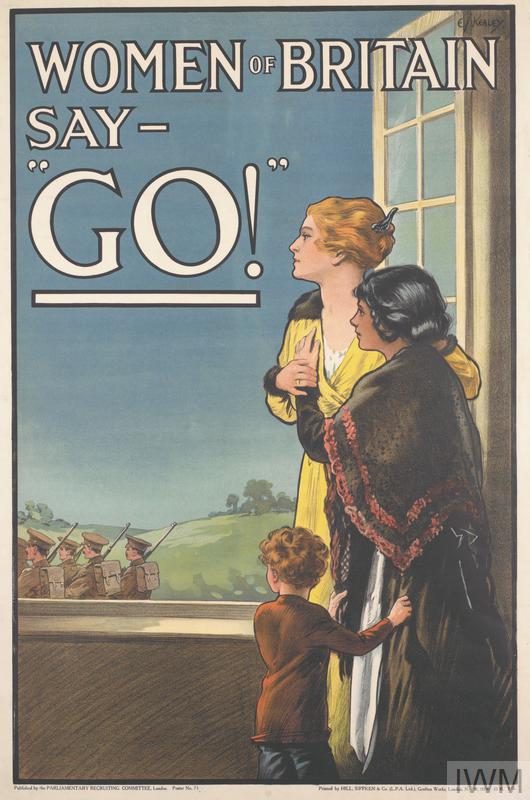
Women of Britain Say — Go!
Women of Britain Say ‘Go!’
Copyright: © IWM. Original Source: http://www.iwm.org.uk/collections/item/object/14592A true classic that has reverbrated through the ages. Despite First World War propaganda having the reputation of being crudely jingoistic, much of it was in fact consciously aware of the pain and sacrifice being endured by the warring population, and did not try to hide it. This one acknowledges the sacrifice undertaken by the women and children left behind, while the background reminds the viewer of the green and pleasant land of ‘old England’ that they are fighting for.
[…]
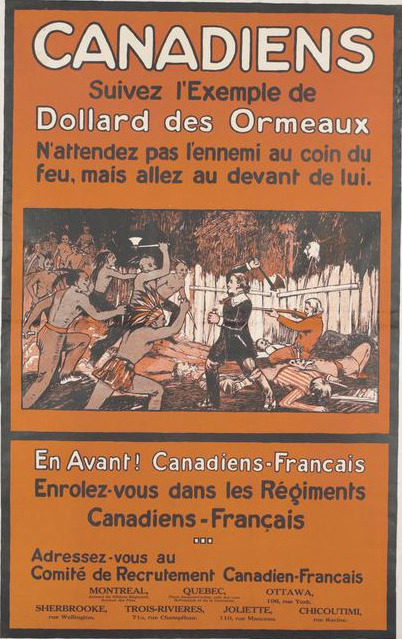
Canadiens, Suivez l’Exemple de Dollard des Ormeaux
Canadiens, Suivez l’Exemple de Dollard des Ormeaux [Canadians, Follow the Example of Dollard des Ormeaux] a depiction of Adam Dollard resisting an attack by Iroquois tribesmen. Dollard’s dead comrades lie at his feet.
Copyright: © IWM. Original Source: http://www.iwm.org.uk/collections/item/object/31027I find this one intriguing, not because I think it is actually a brilliant poster but for what it tells you about historical context and how propaganda was often tailored explicitly for local sensibilities. While Canadian support for the Allies in the First World War was generally fierce, the major exception was Quebec, which saw relatively poor levels of recruitment for overseas service. As such, propaganda aimed at Quebecois often tapped deeply into local traditions, in this case the (extremely dodgy!) myth of Adam Dollard, venerated in the period as a Catholic martyr who died defending Quebec from native Iroquois.5
[…]
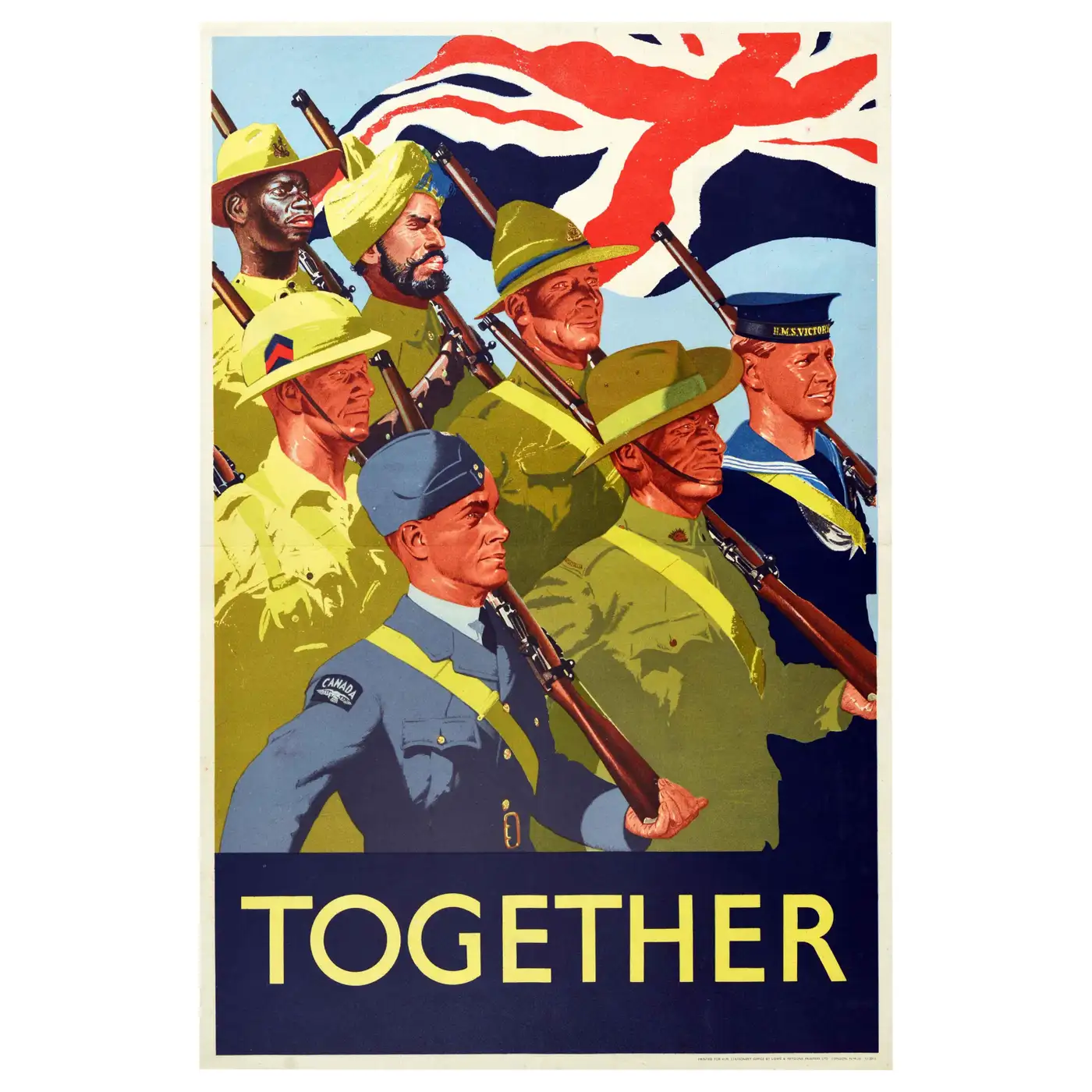
Together
Image courtesy of the IWM.
One can of course criticise the imperialism inherent in this poster, but I think it still works exceptionally well as a bold call for unity between the different nations of the British Empire. It shows how British propagandists took pains to highlight the Second World War as a global conflict against fascism.
- A job which, if I do say so myself, I was pretty bloody good at.
- Ponsonby wrote Falsehood in Wartime in which ironically he basically made up stories about British propagandists in a book supposedly about manufactured atrocity propaganda!
- Phillip Taylor, Munitions of the mind: A history of propaganda (Manchester University Press, 2013).
- I’m only going to present Allied propaganda. Because, frankly, fuck fascism.
- The story of Dollard is mostly myth, and he was more likely an idiot fur-trapper who got himself killed through stupidity.
April 20, 2026
QotD: The quality of evidence problem for historians
And yet, you can’t entirely discount them, either. Crecy (along with of course Agincourt) is supposed to be the triumph of the English longbow, and that’s the thing: We’ve reconstructed English longbows, and put them through all kinds of trials. The results, as I understand it — which, again, ain’t much — were highly variable. A very strong, well-fed, highly trained longbowman, firing an ideally constructed and maintained bow under optimal conditions, really can put X number of arrows up a flea’s ass at Y range in Z time.
Or they could miss the broad side of a barn at twenty feet, depending.
So: What was the weather like in Northern France on 26 August 1346? That’s not an idle question. Rather, it’s the central question. Assume perfect shooting conditions, and you’ve got a far, far different picture of the battle than if you assume poor ones. And if that seems to be giving too much credit to the weather, watch a few baseball games — you’ll quickly discover that quite often, the difference between a home run and a long out is just a few percentage points of relative humidity.
Ultimately it comes down to judgment. More importantly, it’s a judgment on how any particular event fits into the larger argument you’re trying to make. In a way, then, the details really don’t matter very much on their own — the mechanics of how the English won are almost irrelevant, except insofar as they feed into an analysis of why they won. Why did the French king attack uphill, in the mud? Was he stupid? Overconfident? Did he feel he had to, because of political problems inside his host? Did he have faulty information? Did he have accurate information, but just made a bad call?
That’s the art of History, and why, despite what the Peter Turchin (and Karl Marx) crowd keeps insisting, it will always be an art, not a science. We can have a high degree of confidence, most times, in what happened — there really was a battle at Crecy, and the English really did win it. It’s the why that is susceptible to radical reinterpretation.
Severian, “Friday Mailbag”, Founding Questions, 2022-06-17.
April 19, 2026
QotD: The (only?) man who didn’t fear Margaret Thatcher
Thatcher reacted with cold fury, but Hoskyns was unabashed. Another story tells of his arriving for a meeting with the PM only to be intercepted by Ian Gow, her personal secretary. “Our girl is tired,” said Gow, trying to bar his path. “I’m tired too,” muttered Hoskyns. “It goes with the bloody job. I’m going in.”
Such irreverence to the “Great She-Elephant”, “She who must be obeyed”, “Attila the Hen” is rare enough, but this isn’t the main thing to remember Hoskyns for. Far more interesting – and relevant to now – is the work he did with fellow conservative Norman Strauss in the mid-1970s to diagnose the exact sources of Britain’s economic malaise, and come up with clear policies about how the country could haul itself out of it.
Robin Ashenden, “Thatcher’s ‘Wiring Diagram’ and why we need it once again”, The Critic, 2020-08-25.
April 18, 2026
“The whole thing was one giant attempt to gaslight both young men and the public at large”
On the social media site formerly known as Twitter, Christian Heiens responds to a cover story in The New Statesman:
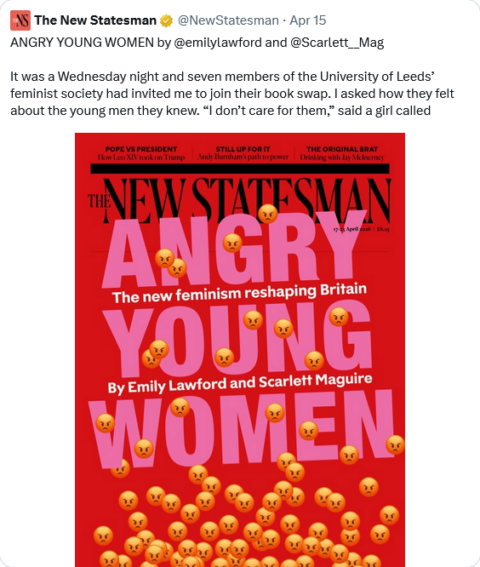
We were subjected to years of “young men are becoming radicalized, what’s driving this and how do we stop it?” discourse when in reality the typical young man saw practically zero change in his political outlook over the last 30 years.
The whole thing was one giant attempt to gaslight both young men and the public at large that they had suddenly moved well outside the Overton window and were either self-radicalizing or falling for extremist propaganda.
In reality, the problem was that young men were staying put rather than adopting increasingly radical progressive views. The real issue was that young women were flying off the rails, espousing views that would lead to the complete dissolution of civilization itself while acting like these were basic normal positions that completely sane people should hold.
That disconnect between what was being said and what was being done became so off kilter with reality that something finally began to break after 2020.
The problem isn’t with young men. The problem is that young women have gone certifiably insane. They’ve made radical progressivism their religion. They’re acting out on the perfectly healthy female tendency to act to uphold and preserve the existing social order.
Young women are trying to conserve an ideology they see as the stable bedrock of society, even if it’s actually an acidic collection of delusions that will inevitably destroy society itself. And they’re upset that young men aren’t doing what they see as their role to uphold that order as well.
In short, women are natural conservatives. They’re trying to conserve progressivism because it’s the reigning social order and theological governing system of Western civilization. And they’re upset and confused as to why young men aren’t stepping up to uphold it as well.
On Substack Notes, John Carter commented on the same New Republic The New Statesman cover story:
Women have never had it better than they do in modern Western countries. They are affluent, thanks to being given every advantage in education and employment; young women now hold more degrees, and make more money, than young men. They can marry whoever they want, from anywhere in the world, or they can marry no one at all. They can sleep with whoever they want, with however many people they want, with no risk of pregnancy, and if they get the ick later they can decide that it was rape and their abuser will be punished. Any opposition to their cultural or political preferences is automatically classified as hate, and every institution acts to denounce and punish this unacceptable hatred on their behalf … in no small part because they have taken over these institutions.
Women have never had it better, and they are absolutely incandescent with fury about that.
April 15, 2026
Do “combat-trained Islamists in Britain … now outnumber the British Army”?
In The Conservative Woman, Julian Mann asks Conservative party leader Kemi Badenoch if Britain’s immigration policies have imported enough “combat-trained Islamist” to outnumber the ever-decreasing number of soldiers in the British army:
You won’t find anyone less military-minded than me but Conservative leader Kemi Badenoch’s speech to the London Defence Conference last week prompted me to put these questions to her on X:
“How many combat-trained Islamists do you estimate there to be in Britain? Would they now outnumber the British Army and, if so, by how many?”
I very much doubt that I will get an answer. She is a busy woman and she might be reluctant to comment for fear of being drawn into an anti-Muslim conspiracy theory. She should note that the question is about Islamists, not about integrated and peaceable British Muslims.
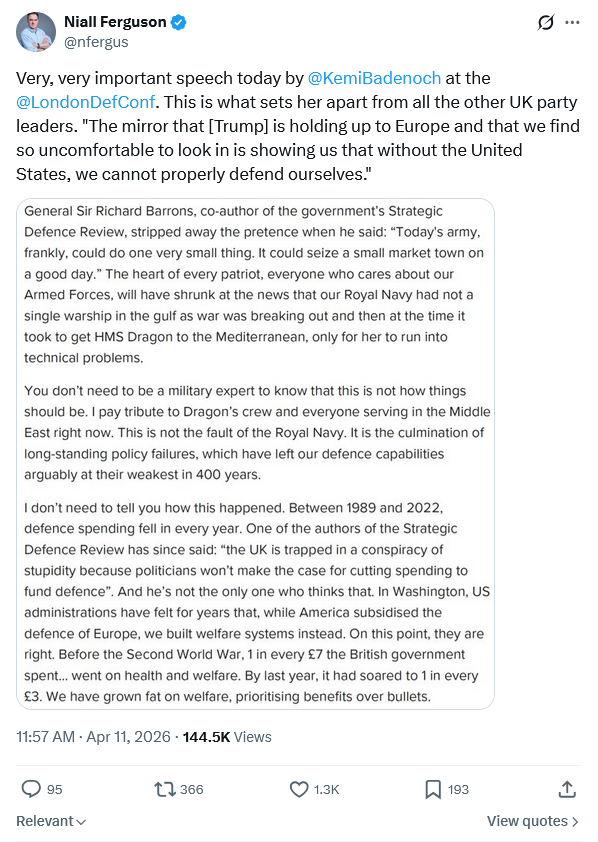
It was this part of her speech, highlighted by historian Niall Ferguson on X, that provoked the questions:
General Sir Richard Barrons, co-author of the Government’s Strategic Defence Review, stripped away the pretence when he said: “Today’s army, frankly, could do one very small thing. It could seize a small market town on a good day”.
Ms Badenoch also said: “Between 1989 and 2022, defence spending fell in every year. One of the authors of the Strategic Defence Review has since said: ‘The UK is trapped in a conspiracy of stupidity because politicians won’t make the case for cutting spending to fund defence’. And he’s not the only one who thinks that. In Washington, US administrations have felt for years that, while America subsidised the defence of Europe, we built welfare systems instead. On this point, they are right. Before the Second World War, one in every £7 the British government spent went on health and welfare. By last year, it had soared to one in every £3. We have grown fat on welfare, prioritising benefits over bullets.”
According to the House of Lords Library: “As at 1 April 2025, there were 181,890 people in the UK armed forces, a 1 per cent decrease compared with the previous year. This total includes:
- all full-time service personnel (known as the UK regular forces) and Gurkhas, who comprise 77.7 per cent of the total number of personnel
- volunteer reserves (17.5 per cent of the total personnel)
- other personnel, including the serving regular reserve, sponsored reserve and military provost guard service (4.8 per cent of the total personnel)
“The total size of the full-time UK armed forces, comprising the UK regular forces, Gurkhas and full-time reserve service, was around 147,000. Of these, 82,000 were Army personnel, 33,000 were members of the Royal Navy or Royal Marines, and 32,000 belonged to the Royal Air Force.”
So if there were 100,000 combat-trained Islamists in Britain, they would outnumber the British Army by about 20,000. I realise that there are various levels of combat training. It is possible that British Army personnel are better trained than any Islamist forces they might face on British soil. But would they be better motivated, given the way they are being treated by the Government? Why has the Government apparently failed to reckon with the appalling impact on morale and recruitment from the lawfare it is allowing against special forces and Northern Ireland veterans?
Update, 16 April: Welcome, Instapundit readers! Have a look around at some of my other posts you may find of interest. I send out a daily summary of posts here through my Substack – https://substack.com/@nicholasrusson that you can subscribe to if you’d like to be informed of new posts in the future.
April 14, 2026
Britain’s Green Party stakes out bold new immigration policies
With the ongoing shake-up in British politics — long-established “mainstream” parties losing support across the board — once-fringe parties are becoming electorally viable at least in the short term. On Substack Notes, Donna-Louise Flowers talks about the Green Party’s amazingly generous plans for immigrants to Britain should they be elected:
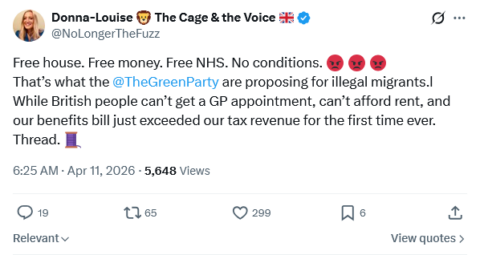
Someone on X just called me a scaremonger. 🙄
For quoting the Green Party’s own published immigration policy.
I’m a former Detective Constable. Serious sexual violence. CSE. I didn’t scaremonger for a living.
So let me be VERY clear about what the Green Party are actually proposing. In their own words. From their own published, member-voted policy document.
Every illegal arrival gets an automatic visa. No questions. No country of origin checks. Free legal advice to regularise their status. No penalty for being here unlawfully.
Guaranteed accommodation. Families get a house or flat with exclusive use. Free Universal Basic Income. No work required. Full NHS access from the moment they arrive — and their policy explicitly states these rights remain even if their asylum case is rejected.
And then — and I need you to read this carefully — they want to give every visa resident the right to vote in all elections and referendums.
All of this while our welfare bill has just exceeded our income tax revenue for the first time in British history.
All of this while we have a shortage of 6.5 million homes.
All of this while foreign nationals account for up to a quarter of all rape convictions in England and Wales. Up to 34% of sexual assault on a female convictions. Ministry of Justice data. Freedom of Information. Not opinion.
Not scaremongering.
Facts.
I’ve written a full thread on X breaking down every single point with sources. Link below.
Read it. Share it. Because this is what 18% of the country is apparently voting for.
April 13, 2026
20 Biplanes vs Six Battleships – The Battle of Taranto
TimeGhost Cartographic
Published 12 Apr 2026Follow up this episode with our North Africa Miniseries on our WW2 channel: • North Africa
November 1940. In the Mediterranean, the British Royal Navy launches a daring carrier strike against the Italian fleet at Taranto. In Operation Judgement, Fairey Swordfish torpedo bombers from HMS Illustrious attack the main base of the Regia Marina, crippling multiple battleships in a single night.
This is the story of the attack on Taranto: a bold naval air raid that changed the balance of power in World War 2 and showed what carrier-based air power could do. With Admiral Andrew Cunningham orchestrating a complex deception operation, the strike caught Italy off guard and reshaped naval warfare in the Mediterranean.
Watch this episode of TimeGhost Cartographic for a detailed breakdown of the Taranto raid, Operation MB8, and the battle for control of the Mediterranean Sea.
(more…)
April 11, 2026
Aussies & Tanks: The Story of Australian Armour
The Tank Museum
Published 30 Jan 2026Australia has always been an outlier when it comes to tanks. The first time Australians fought alongside tanks, it was such a disaster they almost gave up on the whole idea. And the first time they fought IN tanks, they were pinched from the enemy.
They’re the only Allied nation to reject the M4 Sherman. More than once, they’ve used their tanks very differently to how they were designed. Yet somehow, they’ve almost always been successful.
So, why do the Australians use tanks so differently to everybody else?
Join James and Fam as they explore the weird and wonderful ways that our Australian cousins have used their tanks. From captured tanks in the desert, to heavy metal in the jungle, the Aussie methods of armoured warfare have always seemed a little upside down from the outside.
While Australian interest in tanks has come and gone, when the need has arisen, the Australian tank force has been up to the challenge. Simply put, Australian soldiers usually use tanks differently because they usually fight differently. And despite long periods of neglect, tanks in the Australian Army always seem to find a way to bounce back.
00:00 | Introduction
00:36 | A Bad Start
03:44 | Tanks of their Own
06:19 | Welcome to the Jungle
11:07 | Lessons Relearned
13:53 | Defence of Australia
(more…)
April 10, 2026
A Brief History of GRAVY
Tweedy Misc
Published 2 Dec 2025For the next instalment of the series of classic British sauces we take a look at the history of gravy.
In this video I look into some of the earliest historical references to gravy, then some 18th Century recipes. I investigate whether gravy might be a derivative of a classic French sauce, and look in some detail into one important component of traditional gravy recipes: the roux, used for thickening.
I also investigate some products which have emerged since the 19th Century to help with the process of making gravy, from gravy salt and gravy browning, through Bisto’s original gravy powder of 1908, and their fully instant product in the form of “gravy granules”, launched in the 1970s.
Also, have you ever wondered why Bisto is called Bisto? We’ll get into that too.
0:00 Introduction
0:32 What is gravy?
1:27 Early history of gravy
2:01 18th Century gravy recipe
2:25 The importance of the roux
3:37 More 18th Century gravy recipes
4:07 Is gravy actually…. French?!?!
5:29 Gravy salt
6:47 Gravy browning
7:31 History of Bisto
9:19 Modern Bisto
10:25 Conclusion
QotD: William Cobbett
Cobbett was a scrapper on the same majestic scale as our Henry V and our Horatio, except he dished it out to Vested Interest rather than Jean-Pierre Foreigner. He is the faded star of the British Awkward Squad (Capt. Jon. Swift; Vice Capt. Geo. Orwell) and he needs a boost. He needs a blue plaque on every place he ever visited. In his long life — he was born in 1763 and died in 1835 — Cobbett was a farmer, Tory, soldier, Radical, MP, agony uncle (his books include Advice to Young Men), and the founder of Hansard.
His obituary in The Times, after categorising him as a “self-taught peasant”, declared Cobbett “by far the most voluminous writer that has ever lived for centuries”. The funniest, too: when some town council somewhere banned his anti-Malthusian play Surplus Population, he riposted with a drama entitled Bastards in High Places.
Above all, though, Cobbett was the champion of the rural poor, the village labourer and the small farmer. He was their one true tribune. He spoke at The King’s Head in 1820 because country folk were suffering a triple wham from agricultural depression, enclosure and the rise of agri-business. Or, to precis, “Hodge” (his name for the generic farm worker) was low-waged or unwaged and deprived of the bits of land he had once enjoyed under commoner’s rights.
Cobbett railed against “The Thing” (the capitalist, manufactory system) and the centrifugal, corrupting force of smoky London (“The Wen”, in Cobbettian). But he was no bloviator: he was a farm boy, and hence entirely empirical and properly pragmatic. He spent a decade travelling around the English sticks to discover the true state of affairs. His descriptions of his horseback journeys were published in 1830 as Rural Rides, the first sociological study of the English countryside.
No dry-as-dust tome by the way, the Rides: it brims with pinned-to-the-specimen-board descriptions of people and places, nature, wit. Cobbett knew beauty and, the proper Englishman that he was, he loved horses:
The finest sight in England is a stage coach ready to start. A great sheep or cattle fair is a beautiful sight; but in the stage coach you see more of what man is capable of performing. The vehicle itself, the harness, all so complete and so neatly arranged; so strong and clean and good. The beautiful horses, impatient to be off. The inside full and the outside covered, in every part with men, women, children, boxes, bags, bundles. The coachman taking his reins in hand and his whip in the other, gives a signal with his foot, and away go, at the rate of seven miles an hour.
One of these coaches coming in, after a long journey is a sight not less interesting. The horses are now all sweat and foam, the reek from their bodies ascending like a cloud. The whole equipage is covered perhaps with dust and dirt. But still, on it comes as steady as the hands on a clock.
Speaking at The King’s Head coaching inn in Monmouth must have been the dream gig for Cobbett the horseman.
John Lewis-Stempel, “Why Britain needs a peasants’ revolt”, UnHerd, 2020-08-06.
April 9, 2026
Aly & Kaufman AKB-23: Better Than the SA80 / L85
Forgotten Weapons
Published 19 Nov 2025The Aly & Kaufman AKB-23 is a set of parts that allows one to use a Brownells BRN-180 upper to create an SA80 / L85 lookalike. It’s a very clever adaptation, based on the fact that the original British L85A1 was essentially copied from the AR-180 design. By creating a new bullpup lower for Brownells’ modernized AR-180 (the BRN-180), the basic mechanics of the SA80 are used, but in a form that is well tested and reliable.
The parts include, of course, the new lower (which is legally a firearm, and requires FFL transfer). The lower is milled aluminum, and uses standard AR fire control parts. It also includes iron sights that mount onto the BRN-180 picatinny rail and a high quality 3D-printed cheek rest and front handguard.
This is a really fun rifle, and a very clever way to create an L85 analog that is affordable and accessible.
(more…)
April 8, 2026
“Queering the Past”
It sometimes seems as though modern historians are spending all their time postulating that pretty much every prominent figure in western history was gay or lesbian or trans*. The latest attempt to present someone from British history as being trans is Queen Elizabeth I (admittedly in a drama rather than a documentary):
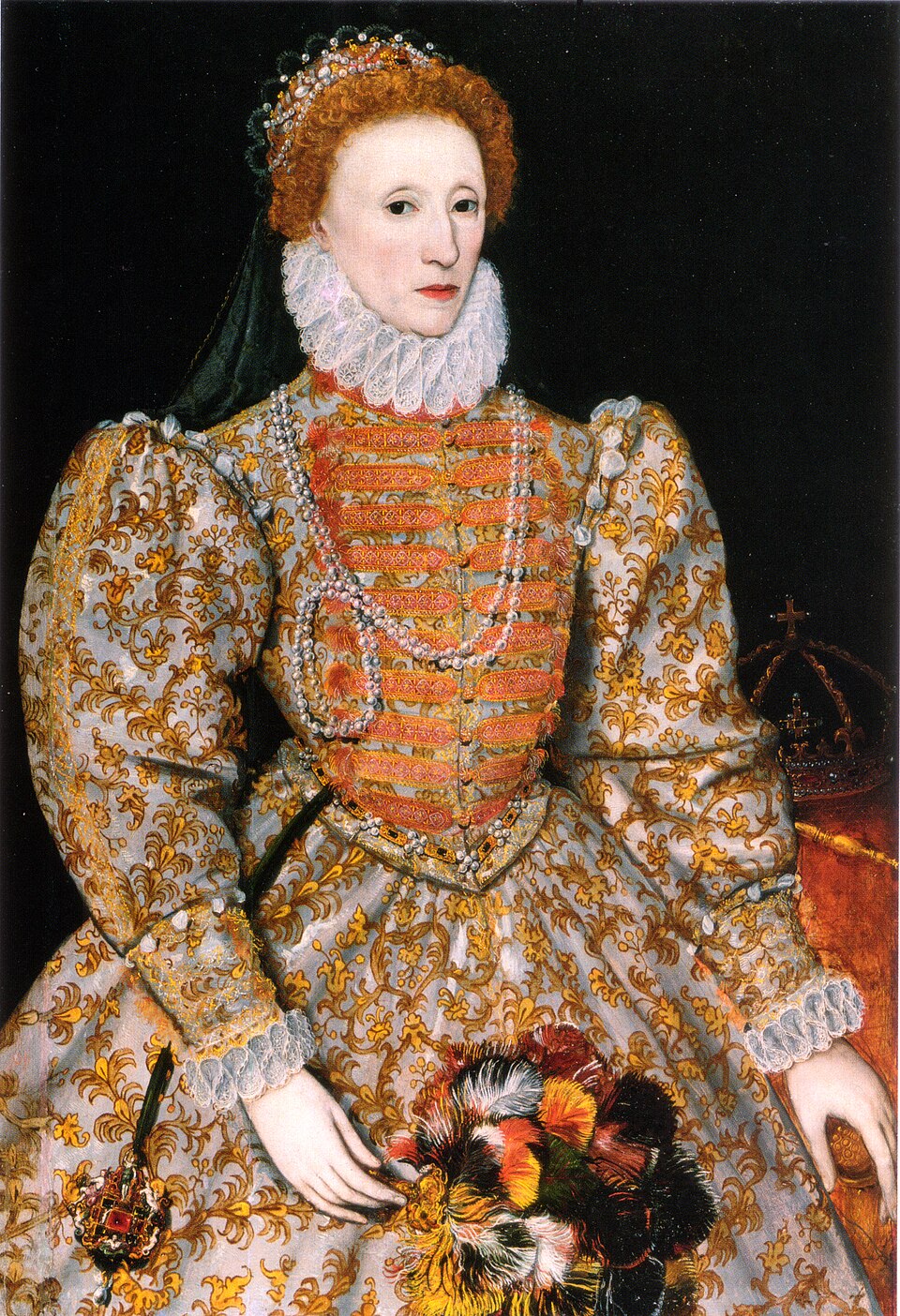
The “Darnley Portrait” of Elizabeth I of England (circa 1575).
National Portrait Gallery via Wikimedia Commons.
Appropriately, it was April Fool’s Day when I read that Queen Elizabeth I is to be portrayed as a cross-dressing man in a forthcoming television show. But we live in times when the more silly and outlandish a rumoured cultural or political plan, the more likely it is to be true. Majesty – an oddly “heritage” title for a project that clearly considers itself “transgressive” – is set to film this summer, and is seeking “trans actresses” (what we used to call cross-dressers, before they got really cross) to play the monarch.
The Sun, which first reported it, seemed drearily inclined to go along with the usual sexist claims of the trans lobby. “She is known for having traits associated with a male monarch”, it mouthed in a mealy manner in an article last week. What would those be – not getting her tits out for, if not the cameras, then the portrait painters of the era? “Some have speculated she had male pseudo-hermaphroditism, known as testicular feminisation”, the Sun continued, also noting that “others are obsessed with the Bisley Boy myth”. Yes, “obsessed” isn’t too extreme a word here – I often hear people at bus stops discussing the Bisley Boy myth. This is the claim that Princess Elizabeth died in her youth and was replaced by a local boy with red hair. It was popularised by Bram Stoker in his 1910 book, Famous Imposters – because Bram “Dracula” Stoker never made up far-fetched stories based extremely loosely on real people, did he?
The Sun quoted a “TV insider” who insists: “Most historians dismiss the claims as misogyny motivated by the idea no woman could be as strong or capable without actually being a man. But it’s a theory which captures the imagination and appears to answer a lot of other questions around the unique queen.”
What would these questions be? That Elizabeth never married and had no children? Must be a bloke, then – what real woman would forego such unqualified pleasures? It’s a sign that trans thought is so woefully conventional, so gender straitjacketed, that it just doesn’t seem able to grasp, in this case, why a woman would refuse to hand over her hard-won power to a man by marrying a stranger who didn’t even speak her language. Or that she said on the eve of the Spanish Armada invasion: “I know I have the body of a weak and feeble woman, but I have the heart and stomach of a king”? It’s called wordplay, I believe, and was extremely common until people with Tin Ear Syndrome – a disease affecting the “trans community” and their inordinate number of “allies” – became so prevalent among those in the arts and media.
This, of course, is our old mate “Queering the Past” (or “lying” as those not educated beyond all common sense and honesty know it) beloved of universities, museums and other beclowned institutions. There have been some truly rib-tickling examples of it, such as the claim that “trans Vikings” existed, which sounds like a Monty Python sketch; sometimes the whole circus gets too much even for the most proudly gay public figure. In 2023, the museum dedicated to conserving the Mary Rose hosted a blog, promising to understand the collection of everyday objects found on the 16th-century ship “through a queer lens”. This prompted the great Philip Hensher to post on X: “I am as keen as anyone on gay sex, but I have to say to these curators – you’re fucking mental”.
April 7, 2026
“The Eight Hundred Years of Oppression”
On Substack, Upper Canadian Cavalier examines “The Irish Question”:
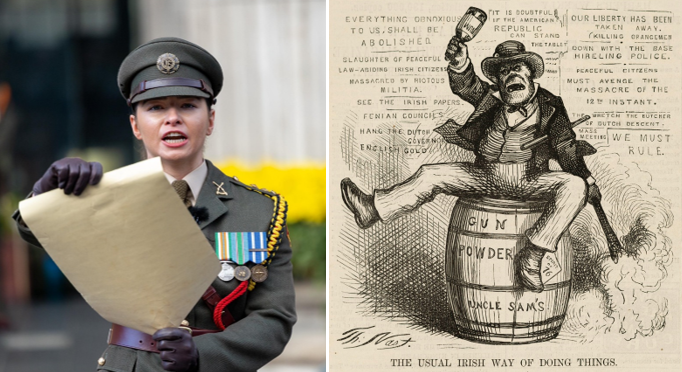
Every confidence scheme requires three things. A mark who is sympathetic. A grievance real enough to be credible. And an operator whose entire livelihood depends on ensuring the grievance is never actually resolved. Resolution ends the game. The operator does not want justice. He wants the next fundraising dinner.
Irish nationalism, in its mature institutional form, is one of the longest-running confidence schemes in the history of democratic politics. This is not to say the underlying grievances were invented. English rule in Ireland produced genuine catastrophes, and anyone who tells you otherwise has not read much history. The point is not that the wounds were fake. The point is that a very specific class of people discovered, sometime in the nineteenth century, that a bleeding wound is worth considerably more than a healed one, and they have been salting it professionally ever since.
The operators of this scheme are not a conspiracy in any tidy sense. They do not meet in a room. They are, rather, an ecosystem: the Sinn Féin political class, the Irish-American fundraising establishment, the Gaelic cultural bureaucracy with its language boards and arts councils and grant committees, and undergirding all of it for most of its history, the Catholic Church, which managed the remarkable trick of positioning itself as the spiritual soul of Irish resistance while simultaneously running the country’s schools, hospitals, orphanages, and laundries with the administrative efficiency of a medium-sized colonial power. They share no common mailing list. They share something considerably more durable: a common interest in a people who define themselves entirely by what was done to them, because such a people will always need someone to explain what it means.
That someone, naturally, has a salary. Sometimes several.
Part One: The Invoice That Never Clears
The foundational text of Irish identity is not a poem or a legal document or a philosophical treatise. It is an invoice. The Eight Hundred Years of Oppression, presented at every available occasion, never stamped paid, accruing interest at a rate that defies actuarial calculation. It is invoked at pub tables and university seminars and Boston fundraisers and Sinn Féin press conferences with the solemn regularity of a liturgical response, which is appropriate, since it has become one.
Eight hundred years. Let us sit with that number for a moment, because it deserves scrutiny rather than reverence.
The Poles were partitioned entirely out of existence for a hundred and twenty-three years, absorbed simultaneously by three empires, had their language banned, their nobility liquidated, their clergy persecuted, and their country removed from the map of Europe with a finality that the Irish situation never approached. They rebuilt it. They were then invaded again from both sides at once within living memory, occupied by The Nazis and Soviets losing somewhere between five and six million citizens in six years. They do not, as a general rule, organize their entire national identity around the experience. They built things instead.
The Armenians experienced something so total it required the coinage of an entirely new word to describe it. The Acadians were physically deported. The Welsh had their language suppressed for centuries by a state apparatus that regarded Welsh-speaking children as candidates for corrective intervention, which is considerably more systematic than anything the Penal Laws produced. The Greeks spent nearly four centuries under actual Ottoman administration, not the notional suzerainty that characterized much of the Anglo-Irish relationship, and emerged and got on with being Greeks.
None of them made Eight Hundred Years into a brand.
What distinguishes the Irish accounting of oppression is not the severity of the oppression, which was real but not historically singular, but the extraordinary care with which it has been packaged, maintained, and exported. The Famine, which ended in the 1850s, is still discussed in certain Irish-American circles as a recent bereavement requiring ongoing condolences and, more usefully, ongoing donations. The emotional statute of limitations has never been permitted to run. Each generation receives the invoice freshly printed, as though the debt were personally owed to them and personally owed by someone who can still be made to feel bad about it.


