Quotulatiousness

June 11, 2023

The Invasion of Normandy begins! – WW2 – Week 250 – June 10, 1944

World War Two
Published 10 Jun 2023

The Allies’ gigantic amphibious invasion of France begins and by the end of the week they’ve carved out a decent-sized beachhead. Meanwhile in Italy the Allied advance takes Rome. The Soviets are launching new attacks of their own — now against the Finns, and the Japanese at Kohima … have just plain had enough.
(more…)

June 10, 2023

Remember the Freedom Convoy of 2022?

The media worked very hard to demonize the grassroots protests that coalesced into the Canadian Freedom Convoy in early 2022, and they’ve continued to push the notion that either the movement was an utter failure or that it was a maple-flavoured January 6 “insurrection” righteously suppressed by our beloved Dear Leader and his stormtroops. Someone using the handle “Kulak” wants to remind you that the convoy wasn’t a failure and in fact was the catalyst for great changes both in Canada and around the world:

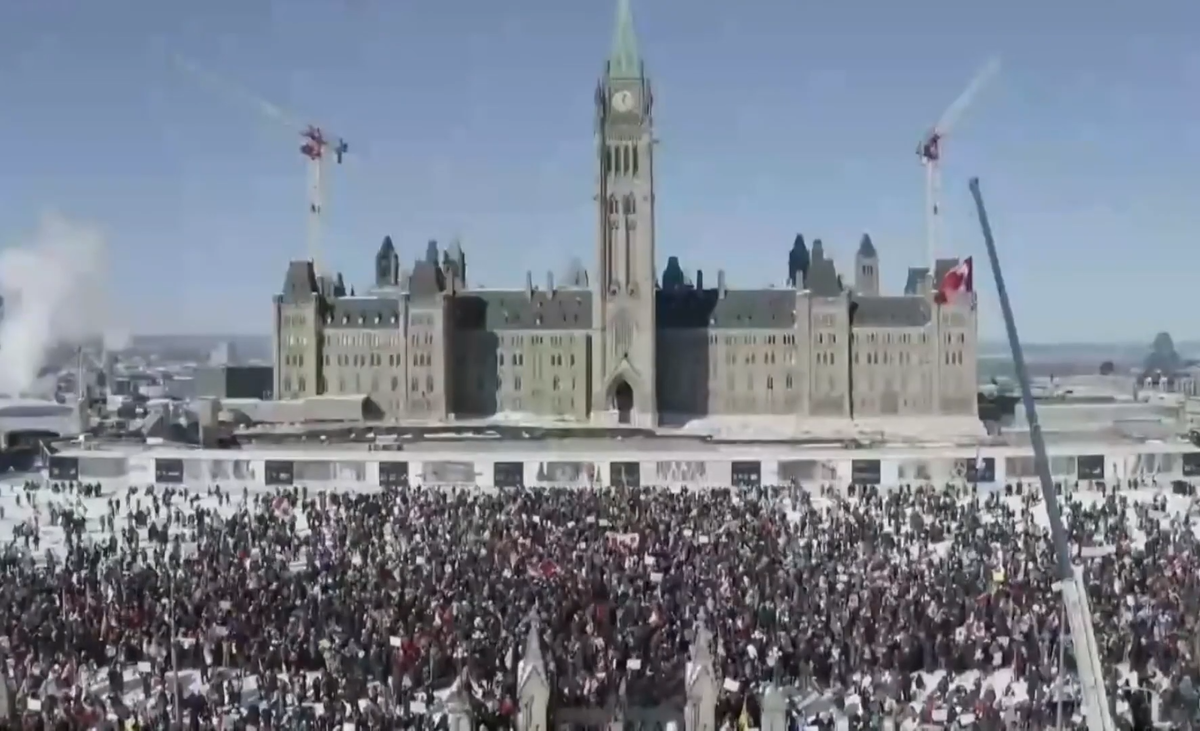
A screenshot from a YouTube video showing the protest in front of Parliament in Ottawa on 30 January, 2022.
Photo via Wikimedia Commons.

I keep encountering this misconception from people who don’t follow Canadian politics …

That somehow the Trucker convoy was defeated.

The Freedom Convoy was the most wildly immediately successful protest in Canadian history, maybe WORLD history.

People remember Trudeau’s crackdown, old ladies having their skulls cracked with batons, Disabled indigenous grandmothers trampled by police horses, Bank accounts frozen and public employees investigated for mere donations …

And there’s a big reason people remember this … It was dramatic, and the media and the regime certainly wanted you to think resistance was futile …

What people don’t remember is what happened in the immediate aftermath: The government caved on absolutely everything within a week for the most important things, and then a month or so for the rest.

First off there was the massive political shift that happened as the convoy was occurring:

Jason Kenny, the pro-lockdown Premiere of Alberta (Canada’s most conservative province) was forced to announce his resignation, and Alberta immediately lifted all its lockdown impositions.

Erin O’Toole the pro-lockdown leader of the Conservative Party was likewise forced to resign, his temporary replacement Candice Bergen (not to be mistaken with the actress) being a longtime rival opposed to lockdowns, and his main rival who replaced her after intra-party elections was Pierre Poilievre, the politician after Maxime Bernier who was quickest to embrace the Truckers and their cry for freedom.

As the convoy was ongoing Trudeau invoked the Emergencies Act (the Act which replaced the War Measures Act for invoking Martial Law) … Now these grant the government almost unlimited powers, famously the War Measures Act was invoked by Trudeau’s Father to detain Quebeckers and raid hundreds of homes without warrants during the FLQ separatist crisis of 1972 … the catch is that while the follow on Emergencies Act can be invoked by a Prime Minister Parliament has to sign off on the act’s continued use within one week.

Well skulls were cracked, accounts frozen, and as the week passed things came down to the deadline … On the very last night … Trudeau managed to get sign-off (without the Conservative opposition) from the House of Commons, but it had to go to the Upper House, the Canadian Senate.

NOW. The Canadian Senate is a shameful institution.

It’s like the British House of Lords but without the nobility.

A Senate seat is a lifetime appointment, by the Prime Minister … and that’s it. Little to no review, no democratic input, and this is supposed to be equivalent or superior to our elected House of Commons …

Naturally the go-to use of the Senate is as a spoils system for cronies. Do some shameful favour for a Prime Minister, raise a lot of money for the party, be politically connected to a provincial gov the PM wants to buy off … get a Senate seat.

One of the longest-standing political agreements in Canada is how badly the Senate needs to be abolished … but can’t be because Quebec is nominally overrepresented in the Senate, and abolishing it would cause a constitutional crisis.

H/T to Donna Laframboise for the link.

June 9, 2023

Rush – The Making of “YYZ”

Filed under: Cancon, Media — Tags: , , , — Nicholas @ 02:00

marvincandle815
Published 17 Apr 2011

From the Classic Albums: 2112 & Moving Pictures special. Made some minor cuts to avoid repetition and to keep it under 10 minutes.

(more…)

June 7, 2023

German Counterattack – D-Day [Part 4]

Filed under: Britain, Cancon, France, Germany, History, Military, USA, WW2 — Tags: , , , — Nicholas @ 04:00

World War Two
Published 6 Jun 2023

When the amphibious landings begin, they run straight into Hitler’s Atlantic Wall. Eisenhower has predicted a third of his troops may fall. While they land, the news breaks across the world.
(more…)

Piercing the Atlantic Wall – D-Day [Part 3]

Filed under: Britain, Cancon, France, Germany, History, Military, USA, WW2 — Tags: , , — Nicholas @ 03:00

World War Two
Published 6 Jun 2023

With wide gaps struck in the Atlantic Wall, it is now up to the Allies to secure the beachheads and move inland. There they will face off with new German defenses, and the Norman geography.
(more…)

June 6, 2023

Through The Gates of Hell – D-Day [Part 2]

Filed under: Britain, Cancon, France, Germany, History, Military, USA, WW2 — Tags: , , — Nicholas @ 20:20

World War Two
Published 6 Jun 2023

When the amphibious landings begin, they run straight into Hitler’s Atlantic Wall. Eisenhower has predicted a third of his troops may fall. While they land, the news breaks across the world.
(more…)

Invasion by Air – D-Day [Part 1]

Filed under: Britain, Cancon, France, Germany, History, Military, USA, WW2 — Tags: , , , — Nicholas @ 04:00

World War Two
Published 5 Jun 2023

In the early hours it is up to the Allied airborne troops to secure the battlefield perimeter, and protect the operation. Now they will find out if the Germans have been deceived, or are ready and waiting with mortal force.
(more…)

Juno Beach: The Fighting Canadians on D-Day | History Traveler Episode 194

Filed under: Cancon, France, Germany, History, Military, WW2 — Tags: , , , , — Nicholas @ 02:00

The History Underground
Published 6 Feb 2022

When one thinks about where the most violent fighting took place on D-Day, you wouldn’t be wrong in citing Omaha Beach where the highest number of casualties were inflicted. But as a percentage of the landing force, the Canadians on Juno Beach suffered more than any other Allied nation. In this episode, we’re joined by Paul Woodadge of @WW2TV to explore a few of the areas along Juno Beach where men to the 3rd Canadian Infantry Division landed on June 6th.
(more…)

June 5, 2023

Claim: 92% of Canadian women will suffer traumatic brain injury from an intimate partner

Filed under: Cancon, Health, Media, Politics, Sports — Tags: , , , , , , — Nicholas @ 05:00

Did that headline grab your attention? Certainly the graphic from which it was drawn grabbed my attention. But, as Janice Fiamengo explains, it’s a vast exaggeration in pursuit of a political goal:

    Linden called on men and boys to educate themselves on violence and to call out one another for perpetrating or dismissing abusive behavior of any kind.

It’s not hard to understand why National Hockey League personality Trevor Linden, former captain of the Vancouver Canucks, has lent his star power to a YWCA campaign about women’s injuries from domestic violence. Hockey players have long been targets of feminist accusation for their association with a sport that allegedly promotes misogyny, racism, and violence against women. Even a beloved icon of the sport must continually strive to prove how much he despises his fellow men.

In this case, the campaign of vilification targets the purported frequency with which female victims of intimate partner violence (IPV) experience traumatic brain injury, and demands “increased support for diagnosis and treatment”. To do so, the campaign asserts some of the most dramatic numbers I’ve ever seen.

No stranger to concussions, Linden is said in a CBC report to have been “stunned” to learn that female victims are injured at a much higher rate than professional hockey players. “For every concussion incurred by an NHL player,” the report states, “approximately 7,000 women and girls in Canada are concussed because of intimate partner and domestic violence, according to a new estimate from YWCA Metro Vancouver and researchers at the University of British Columbia.”

Linden’s shock is understandable. We’ve all seen the hits meted out to professional hockey players. The thought of thousands upon thousands of Canadian women every year being treated in like manner — and suffering the consequences in traumatic brain injury (TBI) — is disturbing even to those of us who have learned to be skeptical of feminist research and inflammatory reports by Canada’s state-funded news agency.

The key paragraph in the story that justifies the staggering numbers tells us that

That sounds as if more than 3 in 10 women and girls in Canada (92% of 4 in 10) will at some point in their lives suffer brain injury from battering.

The statement might just qualify as the most outstanding exaggeration of violence against women ever made by a feminist organization. The good news for women and girls in Canada — and the bad news for the ever-declining credibility of feminist advocates and reporters — is that the numbers being promoted are flat-out false. They’re false even if we take note of the operative word “approximately” in the above statement. They’re false even if we accept the extraordinarily elastic definition of violence employed by the feminists who work for Statistics Canada. And they’re false even if we accept that a small study of black female victims of extreme violence can be generalized to all girls and women in Canada.

The numbers are false, ultimately, because the literature review from which the 92% number was extracted does not actually claim that 92 per cent of all IPV victims experience brain injury. A fundamental misreading and misrepresentation of data is at the heart of the campaign’s extraordinary claim.

Let’s trace, as much as possible, how the numbers have been manipulated and fudged. At the center of the hoopla is a report from Statistics Canada (“Intimate partner violence in Canada, 2018: An overview”) based on a large survey conducted by online questionnaire and telephone interview. This government-funded survey sought to measure the experience and frequency of intimate-partner violence as reported by victims — both men and women — over the previous year and over the lifetime of each victim. The sample size was large (43,296) but the response rate was low, at 43.1% overall in the Canadian provinces. (It is worth noting that response rates lower than 60% are considered by some researchers to produce unreliable and invalid results.)

“… if I were a teenager and I read on a cigarette the words, ‘Poison in every puff!’ I’d think it was a catchy marketing jingle”

Filed under: Cancon, Health — Tags: , , , — Nicholas @ 03:00

Christopher Gage on the Canadian government’s ludicrous next anti-smoking campaign, putting scary messages on every single cigarette in a pack:

I resisted smoking until age ten. Back then, the local boys and I would tramp over the local fields in search of dried ferns upon which to practise the deadly, seductive art of smoking.

By high school, we’d graduated onto the proper cancer sticks. Every morning, we’d pool together our lunch money, and skulk outside the off-license in wait for a nameless reprobate to slip into the shop and, for buyer’s rights of one cigarette, smuggle us ten Lambert and Butler.

Since then, save four years of misguided, anti-smoking zealotry, I’ve smoked with a sinful enthusiasm. Few share my woeful pursuit.

This week, Canada announced a “world-first”. They’ll soon begin printing health warnings directly onto cigarettes.

Neophiles with an addiction to “progress” laud this wearisome world-first. Giddy are the pink-lunged puritans.

Sorry to be facetious, but if I were a teenager and I read on a cigarette the words, “Poison in every puff!” I’d think it was a catchy marketing jingle. I’d happily sign up for a lifetime of chuffing away my health.

Perhaps they should market specifically to Millennials. “Who cares? You’ll never buy your own home,” is particularly resonant.

This is all part of a scheme to cut smoking rates to below five percent by 2035.

Reader, what happens then? Once the health fascists defeat us smokers, from whom shall they siphon their righteous fix?

The irony: as smoking declines, obesity balloons. Between 2003 and 2017, obesity deaths spiked by a third. One in four deaths is now related to one’s weight. Corpulence chalks more bodies than the cancer stick.

I’m yet to see a warning label plastered on the side of a family bucket of KFC. But give it time.

You can live as long as you like, as long as you don’t like living.

June 4, 2023

The Allies are Driving for Rome – WW2 – Week 249 – June 3, 1944

World War Two
Published 3 Jun 2023

The Allies head north in Italy after the fall of Monte Cassino last week; the Japanese head south in China in a new phase of their offensive; and the Soviets and the Western Allies make ever more concrete plans for their huge offensives, to go off very soon.
(more…)

D-Day Series: RCN and Operation Neptune

Filed under: Cancon, France, Germany, History, Military, WW2 — Tags: , , , , , — Nicholas @ 02:00

Valour Canada
Published 28 Dec 2015

This video describes the Royal Canadian Navy’s (RCN) invaluable contributions to the invasion on D-Day, June 6, 1944. Operation Neptune was the name of the English Channel-crossing portion of the larger Normandy invasion (named Operation Overlord).

1. Overview (0:00)
Dawn. June 6, 1944. D-Day. Operation Overlord, the largest amphibious invasion in history, is about to begin. This is a description of the battlefield prior to the attack and also tells how the RCN played an important role both in the English Channel and along the French coast.

2. Stop the U-boats (2:55)
Churchill said that the only thing that scared him during the war were the U-boats. This describes the problematic German U-boats and how the British and Canadian Navies (Operation Neptune) worked together to find, track, and destroy the underwater menace prior to D-Day.

3. Clear the Mines (6:27)
“There is no doubt that the mine is our greatest obstacle to success” – British Admiral Bertram Ramsay. The size and effectiveness of the German minefield that guarded the D-Day beaches and how the Allied Navies worked together to prepare a route through which the invasion could occur.

4. Cover the Beaches (9:49)
The Canadian Tribal-class destroyers played a significant role in eliminating the German Navy’s major surface warships’ threat to the invasion fleet. The RCN destroyer squadron and their mission of clearing the English Channel of German ships before, during, and after the invasion. A battle between the Canadian destroyers Haida and Huron and four German ships near the port of Brest on June 9 is discussed. Also covered are the two Canadian destroyers, Algonquin and Sioux, that were tasked with shore bombardment at Juno Beach.

5. Land the Troops (13:01)
Shortly after dawn and following a forty-minute naval barrage at Juno Beach, the first Canadian soldiers came ashore. By noon, the beach was held by the Canadians and millions of tons of supplies were being brought ashore. This section describes the first waves of the invasion and the tanks, artillery, vehicles, and supplies that were soon to follow.
(more…)

June 3, 2023

“Rather than having a culture of transparency, we have a culture of secrecy”

Filed under: Bureaucracy, Cancon, Government — Tags: , , — Nicholas @ 03:00

In The Line, Philippe Lagassé writes about Canada’s remarkably non-transparent approach to classified information and the very limited ability of our elected representatives to see anything the government chooses to deem “a secret”:

Institutions are tough to change, Canadian institutions especially. But change is possible. Gradual change can happen when we reinterpret existing rules or add new ones on top of old ones that are deeply entrenched. In other cases, a crisis happens that leads to rapid and significant change. These crises either destroy old ways of doing things, or they open a window of opportunity to shake things up. Revelations of Chinese interference in Canadian elections, and David Johnston’s first report on the matter, have opened one of these windows when it comes to Parliament and classified information.

Two sets of Canadian parliamentarians have access to classified information: Privy Councillors (though usually only those currently serving as ministers of the Crown), and those who sit on the National Security and Intelligence Committee of Parliamentarians (NSICOP). In both cases, they have access to classified information in an executive capacity, not their parliamentary capacity. Put differently, they have access to this information by virtue of an executive office they hold in addition to their parliamentary one. Parliament doesn’t have a body that has access to classified information, nor do parliamentarians have access to that information unless they hold an executive office.

Keeping classified information squarely within the executive, or in limited cases within the judiciary, reflects deep-seated Canadian pathologies. As our pathetic Access to Information system highlights, the Canadian government over-classifies things or deems too many of them subject to cabinet confidence. Rather than having a culture of transparency, we have a culture of secrecy. This secrecy culture exists for a number of reasons. Public servants don’t want their ministers to be embarrassed. Information is power within the bureaucracy and giving it out easily diminishes its value. Risk aversion is rewarded and admitting failure is frowned upon. We can’t disclose anything that might rub an ally the wrong way. The list goes on.

Above all, though, Canadian government encourages the strange notion that our secrets are super-super-secret. What do I mean by that? When you look at our allies, Canadian is an outlier in terms of what we disclose and to whom we disclose it. Canadian officials have convinced themselves that they are applying a well-established set of norms around classified and sensitive information, when in fact we’re an outlier. This is particularly notable with it comes to sharing national security information with Parliament.

In the United Kingdom, there’s a statutory committee of Parliament that has access to classified information, called the Intelligence and Security Committee. Since the United Kingdom’s Public Accounts Committee is also expected to oversee all the government’s spending, the chair of that committee has had access to classified information as well to review secret agency budgets. Australia has a similar committee, the Parliamentary Joint Committee on Security and Intelligence. This is a very active and important body. It allows Australia to regularly update its national security legislation to meet new threats and to ensure that the powers conferred on the executive are not abused. New Zealand has a parliamentary Intelligence and Security Committee, too. The Kiwi committee is a bit of an odd duck, since it’s chaired by the prime minister and has the leader of the official opposition as a member. Given that New Zealand is probably one of the most zealous countries when it comes to government transparency, though, it isn’t too surprising. They release stuff that would lead the Privy Council Office to have a collective head explosion if we did the same.

Why Was Normandy Selected For D-Day?

Filed under: Britain, Cancon, France, Germany, History, Military, USA, WW2 — Tags: , , , — Nicholas @ 02:00

Real Engineering
Published 28 Mar 2020

In the debut episode of the Logistics of D-Day we explore the logic and planning that resulted in Normandy being chosen as the location for the largest amphibious invasion in the history of human kind.
(more…)

May 28, 2023

Thanks to geography, Canada has “been able to neglect national security for decades”

Filed under: Cancon, Government, Military, Politics — Tags: , , , — Nicholas @ 05:00

In the weekly Dispatch post from The Line‘s editors, an almost unremarkable comment comes into close focus:

Continuing with the Johnston report fallout, The Line has been pondering a tweet by Thomas Juneau, one of the country’s relatively few genuine experts in Canadian intelligence and national security. Let’s state this up front: The Line likes Thomas Juneau. He’s written for us before, we hope he’ll write for us again. Nothing that follows should be seen as disagreeing with or nitpicking the professor, because The Line broadly agrees with the point he was making, and found his entire thread on Twitter worth the read. But let’s zoom on this particular comment:

What specifically caught us was this part: “We have been able to neglect national security for decades”.

Again, no disagreement here. Both your Line editors would have made that literal exact argument countless times before in their careers, because it’s true, and likely with essentially identical language. But we read Juneau’s tweet when the Johnston report, and the POEC report before it, were much on our minds. And we’ve been unable to shake the feeling ever since that perhaps “neglect” isn’t the right word for how Canadians approach security. Maybe, we’re wondering, it’s something closer to “disdain”.

Canada has “neglected” a lot of things, after all. And we don’t even mean that in the sense of a lament or criticism. There’s a ton of policy areas or even simply fields of knowledge and expertise that Canada hasn’t paid any particular attention to or made a priority. As Line editor Gurney cracked on the podcast this week, we’ve also neglected botany as a national endeavour. But if some strange international development or social change required Canada to up its botany game, we suspect we’d just … do that. We’d recruit botanists from abroad, schools would open botany colleges, we’d create a Progressive Feminist Botanical Middle-Class Tax Credit (though you’d probably need to attest that you are pro-choice to apply for it). Pivoting to botany wouldn’t be a problem. We’d just emphasize botany, and let a thousand flowers bloom. As it were.

Whenever the issue is anything even remotely proximate to national defence and security, though, the mere suggestion that we should maybe do better, spend more money, allot greater resources, pay more attention, and build up current and future capabilities, is met with something that goes beyond neglect. Neglect implies a degree of apathy. The default Canadian response to any push for a greater emphasis on national defence and security is something closer to hostility.

“Like, why would we care about that weird stuff,” the default Canadian response goes. “That’s dumb. What, do you think Russia is going to invade us or something? What does Canada even need an army or spies for? Why would we even want to have experts on this stuff? This is Canada. We don’t need that stuff. Are you just some kind of weirdo or just some wannabe American?”

Your Line editors agree it’s a problem, but we aren’t sure exactly the root of it. Gerson thinks it might be more just an aversion to thinking about unpleasant things; we quipped on our podcast that talking about defence and security in Canada results in the kind of aghast stares a first-class passenger during the last dinner on the Titanic would have received from his dining companions if he’d casually mentioned he’d been counting the number of lifeboats and had noticed something interesting.

Whoa, dude, we’re having a lovely dinner here. Why you gotta be bringing that up? You think the ship is gonna sink or something?

Gurney thinks there’s truth to that, and would add that if that’s the problem, it goes beyond what we would think of as defence and security, and go all the way into emergency preparedness. Canada and Canadians are chronic under-investors on emergency preparedness and underpreparers because Bad Things Don’t Happen Here, They Happen Somewhere Else, Thank You Very Much. Our typical emergency response plan is “Don’t worry, that won’t happen.” Gurney also thinks this all might be related to how Canadians continually define themselves in opposition to Americans: since the Americans do invest heavily in national defence and security, there’s probably some Canadians out there who have concluded, even subconsciously, that that is an American thing to do, and we don’t do American things.

The above is all a bit theoretical, we grant, but we can’t stop thinking about it all the same. What if the problem isn’t that we neglect security so much as actively dislike thinking and talking about it? If so, that’s a bad habit that may prove difficult, and ultimately expensive, to break free from.

« Newer PostsOlder Posts »

Powered by WordPress