Drachinifel
Published 15 Sept 2023Today we look take a quick tour through Canada’s naval history as exemplified by the RCN Naval Museum in Halifax, Canada.
(more…)
January 4, 2024
The Halifax Naval Museum – A Hidden Treasure
January 2, 2024
Nobody will like the new rules
Chris Bray points out just how bad the “new rules” are going to be … and not just for the Bad Orange Man:
The danger is that you concede an argument about a personality or an event, then find at some future point that you’ve accepted new systems and structures that are far more broadly applicable than you noticed at the moment you accepted the new rules. Everyone of every political persuasion should see the weapon on the table, because it’s going to be pointed at you and yours: libertarians, anti-war leftists, populists, paleocons, others too weird to name. Outliers. If your votes and your views fall outside an extremely narrow band of corporate-state “centrism”, what follows is about you.
So.
Bill Mitchell, a media figure and DeSantis supporter, doesn’t see the big deal:
The problem is that Trump is “super toxic”, so whatever. Orange Man is bad, so the things you do to Orange Man are unobjectionable. Of course you can take him off the ballot — he’s a jerk. That’s, like, the Constitution.
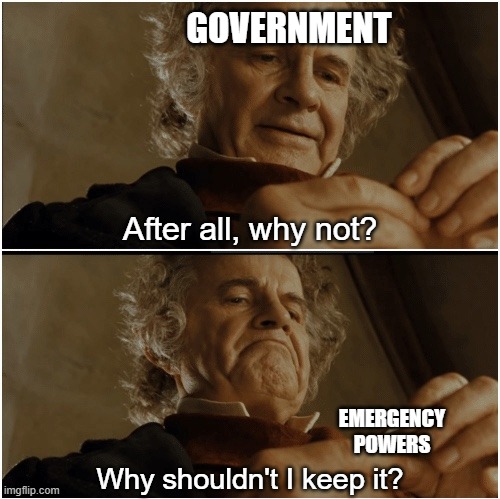
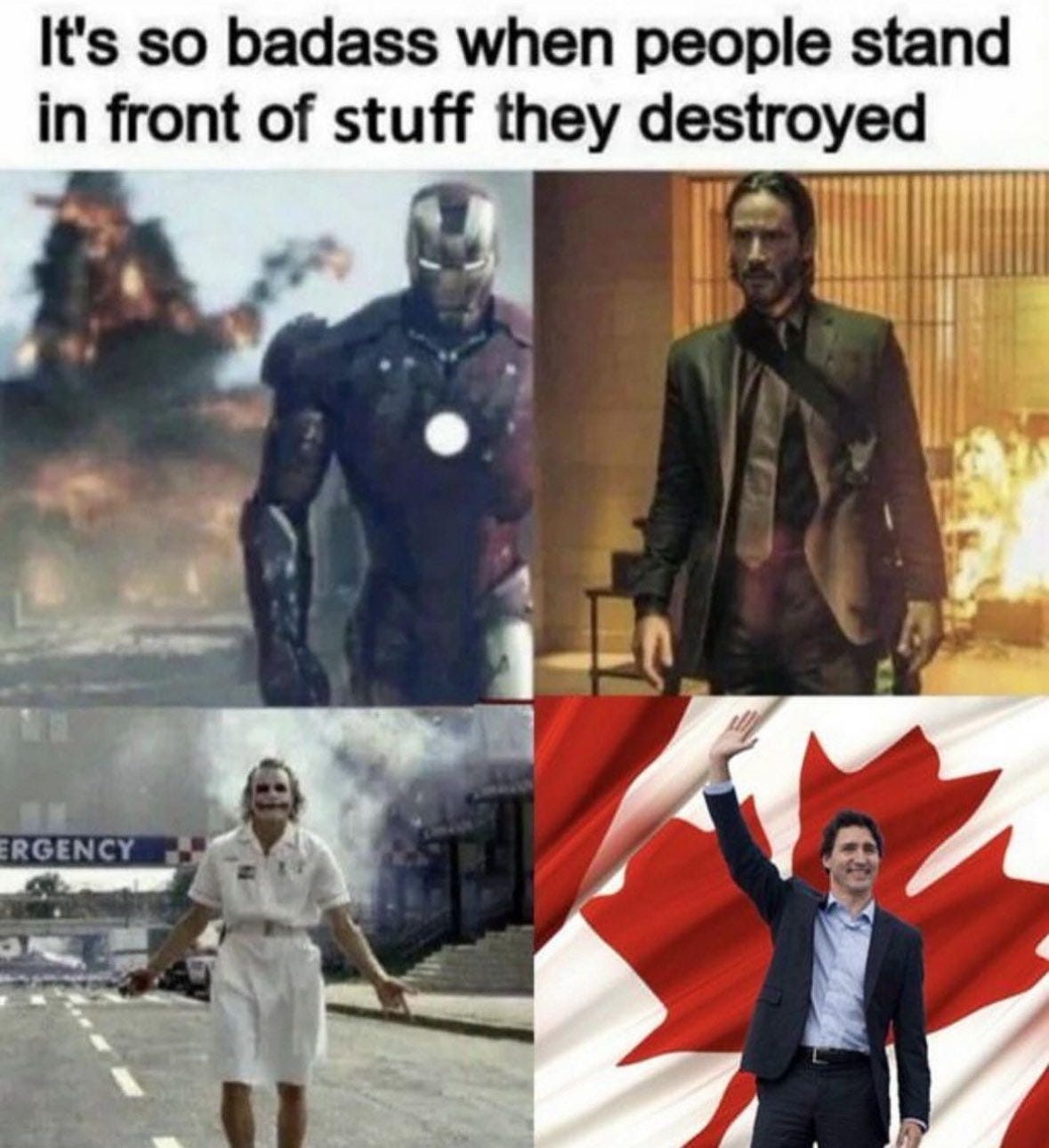
But the constant background music for me in these discussions is that the government of Canada construed a peaceful protest against vaccine mandates as a national emergency, on par with a foreign invasion, and started freezing bank accounts and mobilizing force for mass arrests. A “Western democracy”, hearing dissent, started turning off the dissenters’ money, which means that government took away the ability of peaceful protesters to pay for things like housing and food. The patience of the global political class for disagreement is narrowing, fast and hard. (Cf. e.g. Ardern, Jacinda.)
So see what’s happening in the United States, and see where it points. On January 6, thousands of protesters turned into maybe hundreds of rioters; many people at the Capitol were peaceful and calm, while some weren’t. Almost none were armed, none used guns, and the question of law enforcement infiltration, provocation, and entrapment remains open.
But no one published a manifesto calling for the violent overthrow of the United States government, and the crowd didn’t line up at the Capitol with rifles and homemade bombs to launch waves of armed attacks on Congress. Compare: here’s Bernardine Dohrn of the Weather Underground declaring war on the United States, and announcing on the radio that “our job is to lead white kids into armed revolution”. Find me that moment on January 6, the explicit declaration of armed revolution aimed at the destruction of the federal government. No one has been charged under the Insurrection Act because no one has violated the Insurrection Act. The “insurrection” is a political construction, not a legal case.
So a riot can be an “insurrection”, in the complete absence of insurrection charges and convictions, if Maine Secretary of State Shenna Bellows (D-Longhouse) feels like an insurrection happened. She can “rule” on that.
Lone officials can unilaterally declare that American citizens are ineligible for participation in elections, because the activities of [insert name of bad people here] can be politically construed as insurrectionist — in the absence of due process and a jury trial.
December 29, 2023
Rubaboo – Pemmican Stew of Canadian Mounties
Tasting History with Max Miller
Published 12 Sept 2023
(more…)
December 28, 2023
The Liberals may be bad at “deliverology”, but they’re world-beaters at pouring money into black holes
Tristin Hopper explains the apparent paradox that the federal government is spending money faster than it can be printed, yet the things the government is responsible for are perennially underfunded:

From back when The Onion was allowed to be funny – https://youtu.be/JnX-D4kkPOQ
This may surprise the average Canadian given that so much of the government is noticeably threadbare and underfunded. Canadians are dying in hospital waiting rooms due to unprecedented shortages in health care. The navy’s so strapped for cash that it can only deploy one offshore patrol vessel at a time. The RCMP’s federal policing is so under-resourced that Parliamentarians are now calling it a threat to national security. And even $600 billion in cumulative debt hasn’t been enough for the Liberals to honour their 2015 campaign promise to ensure universal clean water on First Nations reserves.
It’s popular to blame all this on some easy-to-identify example of government profligacy, such as Ukraine aid, free hotel rooms for refugee claimants or Prime Minister Justin Trudeau’s noted penchant to rack up outsized travel bills. But Canada’s fiscal problems are well beyond anything like that. At the current rate of spending, the cumulative $2.4 billion in military aid that Canada has sent to Ukraine represents less than a month’s worth of new debt.
So where’s all the money going? Below, a cursory guide to how Canada is able to spend so much while seemingly obtaining so little.
Debt servicing just got way more expensive
First, an easy one: The Trudeau government borrowed an obscene amount during the COVID-19 pandemic, and with rising interest rates the treasury is getting hammered with debt-servicing costs.
As recently as 2021, interest charges on federal debt cost $20.3 billion per year. In the current fiscal year, it’s probably going to blow past $46.5 billion. Ottawa now spends about as much on debt management as it does on health care transfers to the provinces.
The phenomenon of pricier debt is not limited to Canada: Virtually every government in the world ran up record-breaking debts during COVID and are now facing the consequences. But if Canada is different, it’s that our rate of pandemic debt accumulation was at least $200 billion higher than it needed to be. And in justifying all this extra spending at the time, Trudeau argued that it was a good time to take out extra debt since “interest rates are at historic lows”.
The corporate welfare is just unbelievable
Canada has a long history of government signing over grants and bailouts to politically connected corporations. As far back as 1972, then NDP Leader David Lewis famously championed the cause of stopping Canada’s “corporate welfare bums”.
But the Trudeau government has taken corporate welfare to new heights. It was only a few years ago that Bombardier was the undisputed champion in collecting federal grants, bailouts and interest-free loans. Over 50 years, according to an analysis by the Montreal Economic Institute, Bombardier received a cumulative “$4 billion in public funds”.
In just the last calendar year, the Trudeau government has signed two subsidy agreements that would dwarf that $4-billion figure several times over. In the spring, both Stellantis and Volkswagen agreed to build EV plants in Ontario in exchange for federal subsidy packages that could cost as much as $18.8 billion (plus another $9 billion from the Ontario government).
And that new $18.8 billion liability on the books doesn’t even account for the massive ramp-up in the corporate welfare everywhere else. To name just a couple: In 2021, Air Canada got a $5.4 billion loan package. And the Trudeau-founded Strategic Innovation Fund gets about $1.5 billion per year in handouts to green energy companies.
December 26, 2023
Canada is the unchallenged international champion of “the gesture” and “the pose”, yet always manages to be out of the room when the bill needs to be paid
Sorry for being several days behind on this, but Matt Gurney‘s message — while necessary and timely — does not have a “best-before” or an expiration date … it’s going to be valid for a long time to come:
On the military front, Canada has actually made some meaningful investments since that speech was given. We have announced deals for new transport and refuelling jets — desperately needed and long overdue. We more recently announced a plan to sole-source new surveillance planes, also desperately needed and long overdue. We also, just this week, announced that we are procuring a fleet of large, long-ranged, armed surveillance drones, to patrol our remote air and sea frontiers, after a mere two decades of mulling it over.
There ends the good news, sadly. Most of these procurements are many years away from actually being in service. And even once we have them, as good as the new equipment will be, the biggest problem for the military today is a crippling personnel shortage. The military is, to be blunt, a disaster. Far worse than is generally known. I’ve been covering military and defence issues for longer than I care to recount, and I can tell you plainly, dear readers, that the level of panicked leaking and lamenting coming out of the Canadian Armed Forces is like nothing I’ve ever seen. We don’t have the troops, sailors and aircrew to meet even basic obligations. Training is falling behind. The in-service availability of equipment and vehicles is appallingly low for lack of trained maintenance personnel and money for spare parts and equipment.
This is showing up in operations. The army doesn’t have enough soldiers to meet every commitment. The air force has cut back on operations. The navy’s top admiral is openly speaking, in public, about the crisis in his service.
We at The Line often talk about the Canadian love of talking about inputs instead of outputs. It’s easier to say “Our government has committed X dollars over Y years to address Societal Problem Z” than it is to actually ever have to answer to the public about why Z is somehow still getting worse. New procurements are an input; the desired output is a functional Canadian Armed Forces, capable of meeting its domestic obligations, honouring our treaty commitments and also being prepared for any unexpected contingencies. We do not have that military today. We cannot have that military for years. It would take massive investments and sustained effort to begin fixing this problem.
That is not happening. Hell, we took Anita Anand, one of Justin Trudeau’s better ministers and replaced her with Blair, a man for whom that has never been said. I can tell you with certainty that our allies, and our senior military commanders, had no trouble reading between those lines. Trudeau thought the military mattered, briefly, but then he stopped thinking that, and here we are.
So, 14 months out from Freeland’s speech and on the military front, well … Merry Christmas, or something?
But wait! There’s more!
Freeland’s speech also talked about other ways Canada could support its allies, and democracies in general. Some of it was vague and aspirational — hard to measure or follow-up on. But she was specific about two things: providing our threatened allies and the democracies broadly with a stable, democratic and reliable source of critical strategic resources. Energy, for example. And minerals.
Fourteen months later, how are we doing on those fronts?
I’m not an expert in either area, but I know experts in both. Andrew Leach is an energy and environmental economist at the University of Alberta (I literally copied that bio right off his webpage there). He is also, simply put, one of the smartest guys on the energy file in this country. I called him this week and found him grading papers, which is probably why he was so willing to talk with me. I explained to him what I was doing with the Brookings speech, and asked him if there was anything he could point to over the last 14 months as signs that we’d gotten serious and were doing as Freeland had said we would and must.
Nope!
“By any metric, it’s worse today,” Leach said. Two months ago, he noted, the Supreme Court ruled against the Trudeau government’s energy policies. “Now, there are no clear processes to get approvals for anything,” he added, except, somewhat ironically, pipelines, whose approvals process wasn’t included in the court ruling. I asked him if this was something the Trudeau government had done to itself, or if it was a victim of happenstance, and he said that some of the legislation they were dealing with dated back to the Harper era — before their time — but that in general, the Trudeau government hadn’t handled this well. “They messed up. They assumed they had powers they didn’t have, and didn’t make the arguments for those powers. They didn’t think about the framing. They had to earn that. They didn’t.”
December 21, 2023
The Battle of Ortona
Army University Press
Published 20 Dec 2023Between 20 and 28 December 1943, the idyllic Adriatic resort town of Ortona, Italy was the scene of some of the most intense urban combat in the Mediterranean Theater. Soldiers of the First Canadian Infantry Division fought German Falschirmjager for control of the city, the eastern anchor of the Gustav Line. The Army University Films Team is proud to present, The Battle of Ortona, as told by Major Jayson Geroux of the Canadian Armed Forces.
December 19, 2023
Behind enemy lines at the WPATH symposium
Eliza Mondegreen reports her experiences at the World Professional Association for Transgender Health gathering in Montreal last year:
This was no ordinary medical conference. Over the course of three days, I learned a great many things. That eunuchs are one of the world’s oldest gender identities and that doctors should not judge their strange desires for castration but fulfil them. That, “ideally, patients wouldn’t be actively psychotic” when they initiated testosterone, but that psychotic patients consent to take medication like stool softeners and statins all the time and “people don’t pay that much attention”. That it would be “ableist” to question an autistic girl’s insistence on a double mastectomy. That patients who claim to have multiple personalities that disagree about which irreversible steps to take toward transition can find consensus — or at least obtain a quorum — using a smartphone app.
It is hard to shock me these days — but as I moved around the World Professional Association for Transgender Health’s symposium in Montreal in September 2022, I often felt as if I’d slipped sideways into some strange universe that operated in accordance with other laws: where up is down and girls are boys and medicine has left its modest brief — healing — far behind in its breathless pursuit of transcendence.
I wasn’t really supposed to be there. I hadn’t misrepresented myself — I am what I claimed to be: a graduate student researching gender identity — but this was a convocation for believers and I’m a sceptic. When WPATH, the world’s most prestigious and influential gathering in transgender healthcare, came to Montreal, I couldn’t resist the opportunity to see up close the people and ideas I had pursued through so many articles and books.
[…]
It’s difficult to imagine clinicians practising in other areas of medicine not asking such basic questions, especially when the basis for treatment is so murky. But a good gender clinician, looking at a patient, does not see what non-believers like you or I might see. A good clinician falls under the sway of the same fantasy as the patient and conspires with her to bring her transgender self into existence. Under this framework, there is no “really trans” or not. There is only what the patient says and the readiness of the clinician to put herself at the service of the patient’s vision.
A bad gender clinician, by contrast, feels an “entitlement to know” why a patient feels the way she does or why she seeks a particular intervention. She clings to a traditional conception of her role as a “gatekeeper” who evaluates and prescribes. She thinks she can “discern a ‘true’ gender identity beyond what is articulated by the patient”. She may believe she can “identify the ‘root cause’ of a transgender identity”, which is seen as pathologising. She may try to leave the door open to desistance — the most common outcome before gender clinicians started interfering with normal development by deploying puberty-blocking drugs — in which case she is guilty of “valuing cis lives over trans lives”.
A bad gender clinician is easily “intimidated” by complicated patients, while a good gender clinician knows how to secure consent even in the trickiest cases. Mental health difficulties become “mental health differences”. Severe autism or thinking you have multiple personalities living inside your head become empowering forms of “neurodiversity”. When it comes to assessment, “careful” and “comprehensive” have become dirty words: “The answer always seems to be more assessment and more time. That’s gatekeeping.”
During the Denver conference, presenters role-played how to secure informed consent for a hysterectomy and phalloplasty in the case of a schizophrenic, borderline autistic, intellectually disabled “demiboy” with a recent psychiatric hospitalisation. At no point do the role-players encounter any real barriers. Instead, they persevere. At first, the patient struggled to understand why a phalloplasty might require multiple surgeries, but then the clinicians “explained everything” and the patient understood. This is called “lean[ing] into the nuance of capacity”.
The moral of this story is clear: failure to achieve informed consent is a failure on the part of the clinician, a failure of imagination and flexibility, not a recognition that some patients — whether because of age or mental illness or intellectual disability — will simply not be able to consent.
Christmas Message from the Museum – MERRY TANKMAS 2023
Ontario Regiment Museum
Published Dec 17, 2023Merry Christmas from the volunteers and staff of the Ontario Regiment RCAC Museum and our friends at World of Tanks. Please enjoy this festive message and get a look into Santa’s Tank Workshop!
This segment originally aired in the TANKMAS 2023 – LIVE Stream on 8 December 2023. Hosted by The Tank Museum (Bovington), and sponsored by our friends at World of Tanks.
https://worldoftanks.com/en/news/live…Full video and stream can be found on The Tank Museum YouTube channel here:
https://www.youtube.com/live/_5cMsW5Z…Meet our hosts from World of Tanks and Wargaming.net:
Nicholas “The Chieftain” Moran and Cmdr_AFMeet our Executive Director: Jeremy N Blowers AKA Tank_Museum_Guy
Wishing you and yours a Very Merry Christmas, and a safe and Happy Holiday season.
PLAY NOW at www.worldoftanks.com
FREE to play and build your own “Tank Museum” garage.Thank you to Wargaming.net for the video production and sponsorship of this museum centered Christmas streaming event.
Henry Dundas, cancelled because he didn’t do even more, sooner to abolish slavery in the British Empire
Toronto’s usual progressive suspects are still eager to rename Dundas Street because (they claim) Henry Dundas was involved in the slave trade. Which is true, if you torture the words enough. His involvement was to ensure the passage of the first successful abolitionist motion through Parliament by working out a compromise between the hard abolitionists (who wanted slavery ended immediately) and the anti-abolitionists. This is enough, in the views of the very, very progressive activists of today to merit our modern version of damnatio memoriae:

Henry Dundas, 1st Viscount Melville.
Portrait by Sir Thomas Lawrence. National Portrait Gallery via Wikimedia Commons.
Henry Dundas never travelled to British North America and likely spent very little of his 69 years ever thinking about it. He was an influential Scottish career politician whose name adorns the street purely because he happened to be British Home Secretary when it was surveyed in 1793.
But after 230 years, activists led an ultimately successful a push for the Dundas name to be excised from the 23-kilometre street. As Toronto Mayor Olivia Chow said in deliberations over the name change, Dundas’s actions in relation to the Atlantic slave trade were “horrific“.
Was Dundas a slaveholder? Did he profit from the slave trade? Did he use his influence to advance or exacerbate the business of slavery?
No; Dundas was a key figure in the push to abolish slavery across the British Empire. The reason activists want his name stripped from Dundas Street is because he didn’t do it fast enough.
[…]
The petition was piggybacking off a similar anti-Dundas movement in the U.K. – which itself seems to have been inspired by Dundas’s portrayal as a villain in the 2006 film Amazing Grace, a fictionalized portrayal of the British anti-slavery movement.
Dundas was responsible for inserting the word “gradually” into an iconic 1792 Parliamentary motion calling for the end of the Atlantic slave trade. A legislated end to the trade wouldn’t come until 1807, followed by an 1833 bill mandating the total abolition of slavery across the British Empire.
The accusation is that – if not for Dundas – the unamended motion would have passed and the British slave trade would have ended 15 years earlier.
But according to the 18th century historians who have been brought out of the woodwork by the Cancel Dundas movement, Henry Dundas was a man working within the political realities of a Britain that wasn’t yet altogether convinced that slavery was a bad thing.
The year before Dundas’ “gradual” amendment secured passage for the motion, the House of Commons had rejected a similar motion for immediate abolition.
“Dundas’s amendment at least got an anti-slavery statement adopted — the first,” wrote Lynn McDonald, a fellow of the Royal Historical Society, in August. McDonald added that, in any case, it was just a non-binding motion; any actual law wouldn’t have gotten past the House of Lords.
The parliamentary record from this time survives, and Dundas was open about the fact that he “entertained the same opinion” on slavery as the famed abolitionist William Wilberforce, but favoured a more practical means of stamping it out.
“Allegations … that abolition would have been achieved sooner than 1807 without his opposition, are fundamentally mistaken,” reads one lengthy Dundas defence in the journal Scottish Affairs.
“Historical realities were much more nuanced and complex in the slave trade abolition debates of the 1790s and early 1800s than a focus on the role and significance of one politician suggests,” wrote the paper, adding that although Wilberforce opposed Dundas’ insertion of the word “gradually,” the iconic anti-slavery figure “later admitted that abolition had no chance of gaining approval in the House of Lords and that Dundas’s gradual insertion had no effect on the voting outcome.”
Meanwhile, the British abolition of slavery actually has some indirect ties to the road that bears Dundas’s name.
The road’s construction was overseen by John Graves Simcoe, the British Army general that Dundas had picked to be Lieutenant Governor of the colony of Upper Canada.
The same year he started building Dundas Street, Simcoe signed into law an act banning the importation of slaves to Upper Canada – and setting out a timeline for the emancipation of the colony’s existing slaves. It was the first anti-slavery legislation in the British Empire, and it was partially intended as a middle finger to the Americans’ first Fugitive Slave Act, passed that same year.
December 17, 2023
How RFK, Jr. helped destroy British Columbia’s resource-based economy
Elizabeth Nickson found herself added to one of Robert F. Kennedy Jr.’s fundraising mailing lists:

Robert F. Kennedy, Jr. speaking in Urbana, Illinois on October 14, 2007.
Photo by Daniel Schwen via Wikimedia Commons.
I am on RFKJr’s campaign mailing list, probably through Children’s Health Defence and they asked me for money, and I said sure, just as soon as he fixes the catastrophe he caused in the province where I live.
Got a message back!
It read, “Elizabeth, I am sure Robert would fix whatever harm he caused, can you explain?”
No problem, I said.
1. In British Columbia, we had the largest industrial forest in the world
2. It paid for education and universal “free” health care.
3. The environmental left decided to shut it down.
4. The reason for their protest was that the government, as was common practice, had sold cutting permits with long leaseholds. A new socialist government announced it was pulling the permits and taking those forests back.
5. In order not to lose all the invested money, which they had not only paid for upfront and in annual leasing charges, but paid taxes on, some for decades, lessees immediately clear cut their lands. Clear cuts are ugly. (but they are fire breaks)
6. That triggered the protest.
7. RFK Jr came in under RiverKeepers and supercharged the protest. His celebrity and glamour made the protest major international news. I was in London, I heard about it. More kids joined the protest. And then more and more. Until the government caved. Would it have happened without his presence? I do not think so. He gave very young people who had no access to power, nor any hope of it, ever, a very heady hit of significance and their lives took on huge huge meaning. For many it remains the high point of their lives. Because for the province, it was all downhill from there. All promise vanished and a grinding slow growth followed.
8. Over the ensuing ten years, cutting was diminished and heavy regulation covered the rest. By 2002, written regulations piled on top of each other stood seven feet high, taller than a man.
9. Forested communities died.
10. 100,000 families lost their livelihood.
11. Resource jobs have huge multipliers, not only forested towns died, so did regional metropolitan centers. Greens, replete with success, hit other resource industries – mining, ranching – which died. More families bankrupted.
12. They were told to go into tourism.
13. Which pays minimum wage and can only support a family if everyone, even the children, work. And, it’s seasonal.
14. Over time, the unmanaged forests became clogged with overgrowth, little trees like carrots pulled all the water from the forest floor, desiccated the soil and then pulled water from aquifers. The forests became tinder. And increasingly every summer, they explode in fire.
15. The government needed money.
16. Casinos provided it.
17. Asian cartels – you cannot imagine how violent they are – moved in and used the casinos to launder most of the drug money from North America. They bribed immigration, they bribed city government, they threatened anyone who tried to stand in their way.
18. They were so successful, human trafficking and child sex trafficking shot up. We have the second largest port on the west coast of North and South America. Through it streams container loads of drugs and trafficked children and women. At the port, you just stand aside, if you want to live. You think most of the fentanyl comes in through Mexico? Nope. It comes in through us.
19. The cartels do pay taxes. You think Black Rock is bad? These guys kill if they don’t get what they want. They are buying every business they can, to launder money through. The cartels also launder money through real estate in the city. That means housing is insanely expensive and property taxes are sky high. Canadians can’t afford to buy houses or live in the ones they own. A family making a median income has to pay 100% of income to buy a median priced house.
20. Crime is a) a driver of the economy and b) a principal source of government revenue.
21. Green has destroyed the province.
And that, I am afraid, is what celebrities do. It is why they are so hated, and one of the reason Hollywood is dying. They destroy the lives of ordinary men and women, and then move on to greater heights. Their lives are so privileged, they have absolutely no idea how people make money. And RFKJr, mind-numbingly privileged from birth, is the same. When asked about climate change, he says it’s happening but taxes won’t work. “Regenerative agriculture” he says, vaguely. It is true, regenerative agriculture could capture a lot of carbon, the amount debatable but it has promise. But cutting regulation? He has no, zero, absolutely no idea of how regulation punishes the non-elites. His is a black hole of ignorance and that is common; a majority have zero idea. Zero.
December 16, 2023
It was forty years ago today
Elizabeth and I got married in Toronto on this date in 1983. It was a bit of a race to get to the courthouse on time — my so-called best man decided that he had to go back to Mississauga “for a shower” that morning, and was quite late getting back into Toronto. Trying to get a cab to hurry in downtown Toronto traffic was a waste of effort, so I very nearly missed my own wedding. Elizabeth was not pleased with me holding up the show (even though I could rightfully claim it wasn’t my fault). The rest of the day is rather a blur to me now.
We had the reception that evening at a lovely house in the Playter Estates (during which my father tried to pick a fight with Elizabeth’s uncle), and then set off for our very brief honeymoon in Niagara-on-the-Lake the next day. We could only afford two nights at the Prince of Wales hotel, and because we got married on Saturday, we were in NOTL for Sunday and Monday nights. Back in 1983, Ontario still had fairly restrictive Sunday closing laws, so there was very little to do — almost everything was closed. (And that was probably for the best, as we had almost no money to spend anyway…)
One of the few businesses we found open in the area was the original Chateau des Charmes estate winery (not the huge, imposing facility of today: a small industrial-looking building a few kilometres away), where the only person on duty was Mme Andrée Bosc who gave us an exhaustive tasting experience and showed us around the winery. Neither of us were experienced wine drinkers, so this was wonderful for both of us. I’d love to say that we started our wine cellar that day, but that would only be partially true: we bought about a dozen bottles of various Chateau des Charmes wines, but we couldn’t afford to restock after those had been opened. We visited the winery every year on our anniversary for about a decade, until we got out of the habit of going back to NOTL (which was around the time our son was born).
After our brief honeymoon, we both had to go back to our jobs. Very shortly after that, my employer (the almost-unknown-to-Google Mr Gameway’s Ark) went bankrupt, which was financially bad timing for us, having just spent most of our tiny cash hoard on our honeymoon.
December 15, 2023
December 13, 2023
Ontario discovers that even “great ideas” with the “best of intentions” sometimes go wrong
In The Line, Adam Zivo reports on Ontario’s “safe supply” drug program running into another one of those pesky human nature problems that couldn’t possibly have been foreseen:
New research from Ontario has yielded further evidence that Canada’s “safer supply” drug programs are being widely defrauded and putting addicts’ lives at risk.
These programs claim to reduce overdoses and deaths by providing drug users with pharmaceutical alternatives to potentially tainted illicit substances. In Canada, that typically means distributing large volumes of hydromorphone, an opioid as potent as heroin, in the hope of reducing consumption of illicit fentanyl.
Addiction experts have widely reported that, based on their clinical experiences, drug users regularly trade or sell (“divert”) some (perhaps much) of their safer supply on the black market to fund the purchase of stronger substances. This has flooded some communities with hydromorphone, crashing its street price by up to 95 per cent over the past three years while spurring new addictions, especially among youth.
The federal government denies that these problems exist and has said that any evidence of harm is “anecdotal” — but two addiction experts working in a hospital in London, Ontario recently used patient data to show that the problem is indeed very real.
Dr. Sharon Koivu and Allison Mackinley (a nurse practitioner) examined the charts of 200 patients who had been referred to Victoria Hospital’s addiction medicine consultation service between January and June 2023.
The review showed that 32 per cent of patients who were not in a safer supply program had self-reported using diverted hydromorphone — the vast majority of these patients indicated that their hydromorphone came from purchasing drugs provided to someone else as part of a safer supply program.
“It was more common for them to actually specify safer supply than to say they didn’t know the source,” said Dr. Koivu in an interview. “They said things like, ‘The person in the apartment beside me goes and picks up her safer supply and when she comes back I get 20 of her pills’. It was quite specific.”
Diversion was not the only problem that was validated.
The chart data suggested that safer supply clients were roughly five-to-10 times more likely to be hospitalized than drug users receiving traditional, evidence-based addiction medications, such as methadone or buprenorphine (these medications are known as “opioid agonist therapy“, or “OAT”). Compared to OAT patients, drug users on safer supply were more than 15 times more likely to be hospitalized for serious infections.
These findings were so concerning that when a group of 35 addiction physicians recently wrote an open letter calling upon the federal government to reform safer supply, they included this data in their accompanying evidence brief.
(This chart, included in a recent evidence brief, compares the number of hospitalized patients with the number of drug users in London, Ontario who receive safer supply (250), methadone (2,000), and buprenorphine (300).)
Safer supply patients also had a slightly higher hospitalization rate, and only slightly lower infection rate, than patients who were receiving no addiction treatment at all, which suggests that the health benefits of safer supply may actually be negligible.
Dr. Koivu said that the hospitalization rate seen among safer supply patients was “alarmingly high” considering that safer supply programs provide significant wraparound supports (i.e. access to doctors, housing and social assistance) in conjunction with free hydromorphone. Any patient who receives such supports should see substantially improved health outcomes.
December 12, 2023
Canadian politics – if you don’t like something, call it some kind of “genocide”
Tristin Hopper on the political mis-use of the technical term “genocide”, to the point that it’s almost become routine to describe something you oppose as a “genocide”:
In recent weeks, it’s become popular among Canada’s activist groups and even mainstream politicians to accuse Israel of “genocide”. In a since-deleted Thursday evening social media post, for one, NDP MP Don Davies accused Israel of “cultural genocide” against Palestinians. The United Church of Canada has also begun using the g-word in its official literature.
The charge doesn’t hold up on any material grounds. Unlike most genocided people, the Palestinian population has been soaring dramatically ever since the 1960s — all while retaining their traditional language and religion. Israel’s prosecution of its current conflict against Hamas, meanwhile, has featured any number of factors that are markedly out-of-step with an attempted genocide, including detailed evacuation orders and a rate of civilian casualties markedly lower than the global average.
But the charge doesn’t need to make sense, because it turns out Canada has been abusing the term “genocide” for quite some time. Coined amidst the Second World War by Polish lawyer Raphael Lemkin, “genocide” refers to the intentional destruction of an entire demographic of people.
While the most notable genocides involve systematized mass-murder, it’s not a requirement. As per the official definition struck in the immediate aftermath of the Holocaust, genocide can also include attempts to erase a people via birth control or indirect methods such as famine. It’s on these grounds that Canada has officially accused China of genocide regarding its Uyghur minority. Although Beijing is not mass-murdering the Uyghurs, they are rounding them up into “re-education” camps and mandating forced sterilization with the explicit intention of destroying the Uyghur way of life.
But among Western academic and activist circles, “genocide” has now been stretched to apply to almost anything, from emissions policy to the ethnic ratios in prisons. Below, a not-at-all comprehensive list of just how much of Canadian life has been accused of being genocidal.