
If entrepreneurs see value in the […] economic landscape, and perceive there are rich profits to be made in turning around businesses and then flogging them off, it is very good news indeed for the country’s economy. By releasing capital from uneconomic areas and focussing it on lucrative new bits, the overall pie gets bigger, jobs get created, and productivity is also increased.
In fact, one could almost create a new economic law: the amount of abuse raining down on entrepreneurs is directly proportional to the good they do. I haven’t seen much reason to doubt this law yet.
Johnathan Pearce, “Gordon Gekko goes to Germany”, Samizdata.net, 2005-05-05.
October 5, 2021
QotD: Entrepreneurship
Comments Off on QotD: Entrepreneurship
October 3, 2021
The Triumph Spitfire Story
Big Car old account
Published 8 Mar 2019To help me continue producing great content, please consider supporting me: https://www.patreon.com/bigcar
Help support my channel through these Amazon US affiliate links:
Triumph Spitfire t-shirt: https://amzn.to/2KdY33m
Triumph Spitfire baseball cap: https://amzn.to/2U1SrZF
Triumph sweatshirt: https://amzn.to/2KgGIXq
Triumph Spitfire model car: https://amzn.to/2U4gnvo
Triumph keyfob: https://amzn.to/2YTeKV4
Triumph Spitfire metal sign: https://amzn.to/2U2u4ejThe Spitfire is a beautiful automobile, a thing of wonder penned by an Italian genius, but it almost never happened. If not for a chance find in the dusty corner of a factory it would have remained merely a “could have been”. But Triumph produced a car that still inspires new creations today and has a strong and loyal fan base around the world, nearly sixty years since it burst on the scene.
#TriumphSpitfire

Comments Off on The Triumph Spitfire Story
September 23, 2021
QotD: The problem with “free” tech stuff
It has gotten so bad lately that they don’t just barrage you with ads, they’re now starting to force-feed you content. I used to have Amazon Music — the free one, of course — because it was a good way to listen to The Z Man’s podcasts and my classical library during my commute. I’d download albums to my phone, switch to “offline” mode, and listen that way. Which Amazon obviously considers no good, because they pushed out some “car mode” bullshit that now automatically turns your wifi on, then starts blasting hip hop at you. And that’s not all! A few weeks back, while trying to figure out a way to turn the damn thing off, I noticed that it now has a “your playlist” feature, based on “your” music … which is, of course, the same force-fed rap shit I’ve been trying so desperately to avoid. It has decided that not only shall I listen to Young Jeezy, Big Weezy, and MC Funetik Spelyn, I will also like it, to such a degree that they will start force-feeding me other shit based on my “likes”.
Yeah. Uninstalled. Fuck you, Bezos. I’ve got a CD player. And when Microsoft decides that I’m not listening to the right music on that, and uninstalls the driver, I’ve got a tape deck. And when that breaks, I will sing to myself as I go down the highway. 99 bottles of beer on the wall, motherfucker, just like bus trips back in Boy Scouts. Enough is enough.
Severian, “Mailbag / Grab Bag”, Rotten Chestnuts, 2021-06-18.
Comments Off on QotD: The problem with “free” tech stuff
September 7, 2021
Fallen Flag — the New York, New Haven & Hartford Railroad

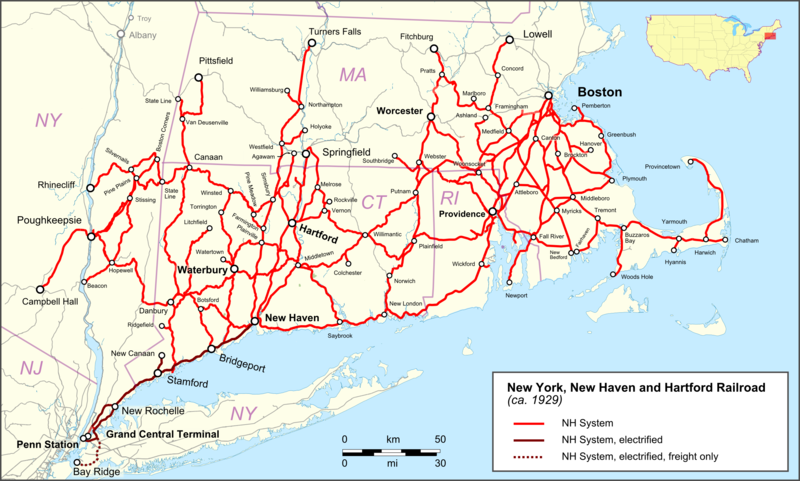
Around the beginning of the 20th century, New York investors led by J. P. Morgan gained control, and in 1903 installed Charles S. Mellen as President. Charles Francis Murphy’s New York Contracting and Trucking company was awarded a $6 million contract in 1904 to build rail lines in the Bronx for the New York, New Haven, and Hartford Railroad. An executive at the railroad said the contract was awarded to avoid friction with New York City’s Tammany Hall political machine. In response to this contract, the New York State Legislature amended the city’s charter so that franchise-awarding power was removed from the city council and given to the Board of Estimate and Apportionment, which only recently became defunct in 1989. Morgan and Mellen achieved a complete monopoly of transportation in southern New England, purchasing other railroads and steamship and trolley lines. More than 100 independent railroads eventually became part of the system before and during these years, reaching 2,131 miles at its 1929 peak. Substantial improvements to the system were made during the Mellen years, including electrification between New York and New Haven. […] Morgan and Mellen went further and attempted to acquire or neutralize competition from other railroads in New England, including the New York Central’s Boston and Albany Railroad, the Rutland Railroad, the Maine Central Railroad, and the Boston and Maine Railroad. But the Morgan-Mellen expansion left the company overextended and financially weak.
In 1914, 21 directors and ex-directors of the railroad were indicted for “conspiracy to monopolize interstate commerce by acquiring the control of practically all the transportation facilities of New England.”
J.W. Swanberg carries on the story of the railroad’s woes during and after the First World War:
The New Haven was a financial powerhouse at the start of the 20th century, but from 1903 to 1913, the road was driven to near bankruptcy under President Charles S. Mellen and financier J.P. Morgan. One gain in this period, though, was control of the Central New England Railway, which included the Hudson River bridge at Poughkeepsie, N.Y., and the link to Maybrook and nearby Campbell Hall. This was New Haven’s gateway to the west, also served by trunk lines Erie; New York, Ontario & Western; and bridge lines Lehigh & Hudson River and Lehigh & New England.
World War I government control and the Roaring 1920s boom times saved the New Haven, but not enough to survive the Great Depression, and bankruptcy came in 1935. World War II traffic allowed recovery and rebuilding, but soon all was lost by mismanagement and bankruptcy came again in 1961. The postwar New Haven faced not only highway and airline competition but also the almost total erosion of New England’s heavy industrial base. Just a shell of the once-mighty railroad was forced into a reluctant Penn Central on Jan. 1, 1969.
One of the line’s claim to fame was the early electrification program the New Haven embarked on in 1907:
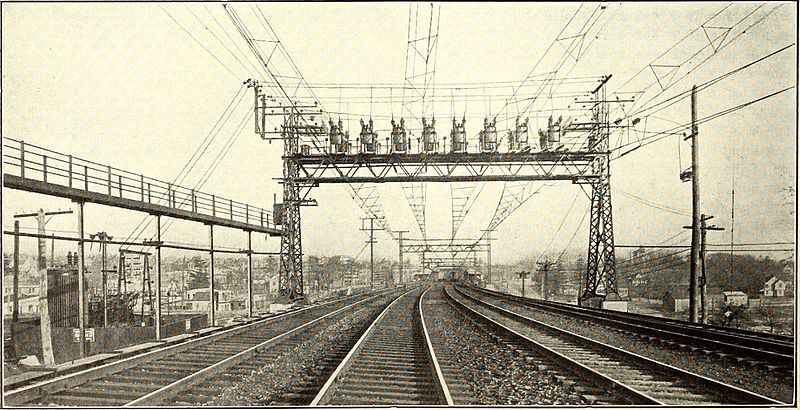
“View of Typical Sectionalizing Bridge, Auto-Transformer Installation and Cable Runway May 2, 1914.”
Photo and original caption from Electric Railway Journal via Wikimedia Commons.
The New York, New Haven and Hartford Railroad pioneered electrification of main line railroads using high-voltage, alternating current, single-phase overhead catenary. It electrified its mainline between Stamford, Connecticut, and Woodlawn, New York, in 1907, and extended the electrification to New Haven, Connecticut, in 1914. While single-phase AC railroad electrification has become commonplace, the New Haven’s system was unprecedented at the time of construction. The significance of this electrification was recognized in 1982 by its designation as a National Historic Engineering Landmark by the American Society of Mechanical Engineers (ASME).
[…]
The New Haven’s system was extended across the Hell Gate Bridge to the New York Connecting Railroad upon the line’s construction. The system of electrification was an extension of the New Haven’s revised 11/22 kV autotransformer architecture. The original electrification extended from the New Haven’s main line, across the Hell Gate Bridge, to the Bay Ridge yard. The line south of Bowery Bay Junction was de-electrified in the 1950s. The line between New Rochelle and the Harold Interlocking was transferred to Amtrak in 1976 upon dissolution of Penn Central. The electrification system continued to be controlled as a portion of the ex-New Haven system until the 1987 conversion to 60 Hz operation.
When the New Haven main line was converted by Metro-North to 60 Hz operation, the Amtrak Hell Gate line was also converted, but as an isolated system powered from the Van Nest substation. Control of the catenary system was transferred from Cos Cob to the Load Dispatcher at New York Penn Station. Although conversion occurred subsequent to the PRR-era electrification, Amtrak substation numbers 45-47 were assigned for consistency with the rest of the PRR numbering scheme.
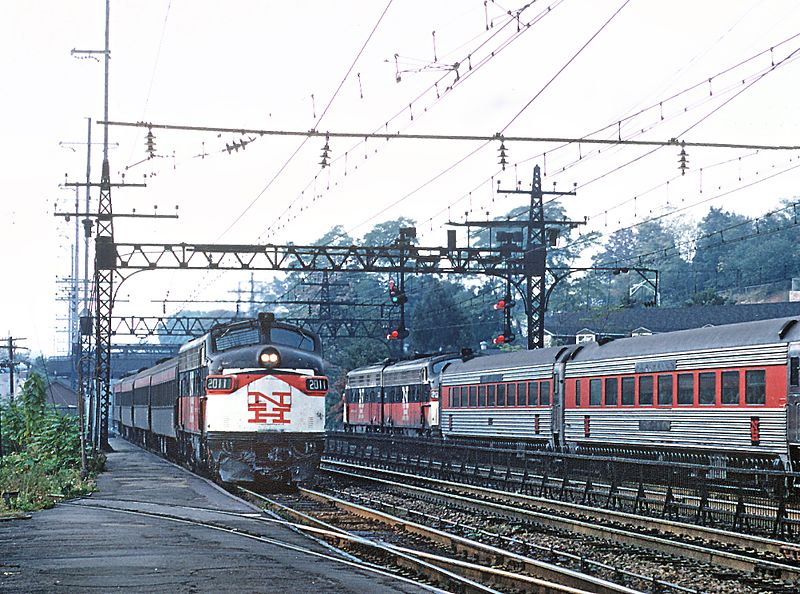
New Haven dual-power diesel-electric FL9 locomotive 2011 with train #138, a NYC – Pittsfield train, at South Norwalk, CT on October 13, 1968. The stub of the former branch to the docks is in the foreground.
Photo by Roger Puta via Wikimedia Commons.
Comments Off on Fallen Flag — the New York, New Haven & Hartford Railroad
September 2, 2021
Charles Stross predicts that Elon Musk will become a multi-trillionaire
Charles Stross isn’t exactly a fan of Musk’s, but he outlines why he thinks Musk is on a potentially multi-trillion dollar path:

Elon Musk at the 2015 Tesla Motors annual meeting.
Photo by Steve Jurvetson via Wikimedia Commons.
So, I’m going to talk about Elon Musk again, everybody’s least favourite eccentric billionaire asshole and poster child for the Thomas Edison effect — get out in front of a bunch of faceless, hard-working engineers and wave that orchestra conductor’s baton, while providing direction. Because I think he may be on course to become a multi-trillionaire — and it has nothing to do with cryptocurrency, NFTs, or colonizing Mars.
This we know: Musk has goals (some of them risible, some of them much more pragmatic), and within the limits of his world-view — I’m pretty sure he grew up reading the same right-wing near-future American SF yarns as me — he’s fairly predictable. Reportedly he sat down some time around 2000 and made a list of the challenges facing humanity within his anticipated lifetime: roll out solar power, get cars off gasoline, colonize Mars, it’s all there. Emperor of Mars is merely his most-publicized, most outrageous end goal. Everything then feeds into achieving the means to get there. But there are lots of sunk costs to pay for: getting to Mars ain’t cheap, and he can’t count on a government paying his bills (well, not every time). So each step needs to cover its costs.
What will pay for Starship, the mammoth actually-getting-ready-to-fly vehicle that was originally called the “Mars Colony Transporter”?
Starship is gargantuan. Fully fuelled on the pad it will weigh 5000 tons. In fully reusable mode it can put 100-150 tons of cargo into orbit — significantly more than a Saturn V or an Energiya, previously the largest launchers ever built. In expendable mode it can lift 250 tons, more than half the mass of the ISS, which was assembled over 20 years from a seemingly endless series of launches of 10-20 ton modules.
Seemingly even crazier, the Starship system is designed for one hour flight turnaround times, comparable to a refueling stop for a long-haul airliner. The mechazilla tower designed to catch descending stages in the last moments of flight and re-stack them on the pad is quite without precedent in the space sector, and yet they’re prototyping the thing. Why would you even do that? Well, it makes no sense if you’re still thinking of this in traditional space launch terms, so let’s stop doing that. Instead it seems to me that SpaceX are trying to achieve something unprecedented with Starship. If it works …
There are no commercial payloads that require a launcher in the 100 ton class, and precious few science missions. Currently the only clear-cut mission is Starship HLS, which NASA are drooling for — a derivative of Starship optimized for transporting cargo and crew to the Moon. (It loses the aerodynamic fins and the heat shield, because it’s not coming back to Earth: it gets other modifications to turn it into a Moon truck with a payload in the 100-200 ton range, which is what you need if you’re serious about running a Moon base on the scale of McMurdo station.)
Musk has trailed using early Starship flights to lift Starlink clusters — upgrading from the 60 satellites a Falcon 9 can deliver to something over 200 in one shot. But that’s a very limited market
As they say, read the whole thing.
Comments Off on Charles Stross predicts that Elon Musk will become a multi-trillionaire
August 31, 2021
Isambard Kingdom Brunel: The Genius of the Industrial Revolution
Biographics
Published 23 Mar 2020Check out Brilliant: https://brilliant.org/biographics
Check out Business Blaze: https://www.youtube.com/channel/UCYY5…
This video is #sponsored by Brilliant.
TopTenz Properties
Our companion website for more: http://biographics.org
Our sister channel TopTenz: https://www.youtube.com/channel/UCQ-h…
Our Newest Channel about Interesting Places: https://studio.youtube.com/channel/UC…Credits:
Host – Simon Whistler
Author – Morris M.
Producer – Jennifer Da Silva
Executive Producer – Shell HarrisBusiness inquiries to biographics.email@gmail.com
Source/Further reading:
Oxford National Dictionary of Biography: https://www.oxforddnb.com/view/10.109…
Interesting podcast on his life: https://www.bbc.co.uk/programmes/b04n…
Britannica: https://www.britannica.com/biography/…
History Today: https://www.historytoday.com/archive/…
The Thames Tunnel: https://www.smithsonianmag.com/histor…
The atmospheric railway: https://www.theguardian.com/science/t…
SS Great Britain accident: https://www.ssgreatbritain.org/about-…
Comments Off on Isambard Kingdom Brunel: The Genius of the Industrial Revolution
August 27, 2021
QotD: Music corporations, musicians, and hypocrisy
So says Tom Morello, guitarist for the Los Angeles-based band Rage Against the Machine. He and his bandmates are not simply against cops and the suburbs, of course. They also stand for the Zapatistas and the Shining Path, for freeing Mumia Abu-Jamal and Leonard Peltier, for giving California back to Mexico, and for destroying stores where rich people like themselves shop.
That’s pretty strong stuff coming from work-for-hire employees of one of the great cogs in the global capitalist machine, the megaconglomerate Sony, which wholly owns and distributes Rage’s music and even is a co-owner of the group’s publishing. Since 1992, Rage has sold nearly 7 million records, and it’s safe to say that nobody has benefitted more from that commerce than the band’s unabashedly capitalist paymaster.
Brian Doherty, “Rage On: The strange politics of millionaire rock stars”, Reason, 2000-10.
Comments Off on QotD: Music corporations, musicians, and hypocrisy
August 21, 2021
Indigo in the red
In the latest edition of his SHuSH newsletter, Kenneth Whyte looks at the dire financial situation of Canada’s big box bookstore chain:

“Indigo Books and Music” by Open Grid Scheduler / Grid Engine is licensed under CC0 1.0

Indigo just released its first-quarter financial results, covering the period April-June 2021, which can be compared to its pre-pandemic results from the same quarter in 2019.
Back then, Indigo had revenues of $193 million and no profit. Seventy percent of its revenue, or $136 million, came from the firm’s eighty-nine Chapters and Indigo superstores. Only $25 million came from its 115 smaller stores (Coles and Indigo Spirit), and another $29 million from online sales at chapters.indigo.ca. Not only did the company book no profit, but all three of those revenue channels were down from the previous year, with online sales falling the most (15%).
This is to say that Indigo, in financial terms, was immunocompromised before COVID-19 hit.
The decline in digital sales was especially alarming. It seemed that CEO Heather Reisman was giving up on the web, an impression reinforced by her frequent renovations of in-store environments and her not terribly successful launch of a so-called cultural department store […] in New Jersey, Indigo’s first international gambit. She was all about bricks and mortar.
One also got the sense that Heather was giving up on books. She was building up the candles and blankets side of the business — it represented almost 40% of 2019’s total revenue. She also launched Thoughtfull.co, an effort to graze on Hallmark grass, and another step away from the book business.
I’d certainly despaired of finding much in the way of actual books at Chapters or Indigo stores … more and more of the floorspace that used to be devoted to books had been given over to housewares, candles, hostess gift items, decorative throw cushions and other such non-book items. Even before the Wuhan Coronavirus shut down the western world, it had been at least a year since the last time I’d found anything worth buying in one of their stores.
Two years and several pandemic waves later, Indigo is down to 88 superstores and 88 small-format stores, a net reduction of twenty-eight. I don’t know the significance of 88. Maybe the company’s new retail guru — Indigo always has a new retail guru — is a pianist, or Chinese, or a white supremacist.
The remaining stores are now open to foot traffic, and the company is wrangling with its various landlords over how much rent it should pay for the pandemic months when most of its outlets were closed. Indigo received almost $3 million in federal emergency rent subsidies, and almost $4 million in payroll subsidies, which seems like a lot but isn’t for a company as big as Indigo. As we noted in an earlier post, Heather also received a $25 million “liquidity enhancement”, or bailout, from billionaire husband Gerry Schwartz.
Which brings us to the present. Revenues for Indigo’s most recent quarter are $172 million (down $21 million from two years ago), and it lost $15 million (before depreciation, amortization, etc.).
Indigo doesn’t release enough detail on its operations to give us a clear idea of how the company lost only $15 million when its revenue fell $21 million, but costs were down across the board, probably reflecting the closed stores, reduced staffing levels, and fewer books on the shelves, among other savings.
Comments Off on Indigo in the red
QotD: Why do government workers need unions?
Sure, we can understand this if she’s working for the bastard capitalists. They merely want to maximise their profit and screw the workers while doing so – as we all know. But government is omniscient, omnipresent and omnibenevolent. It cannot be true that someone working for government is in need of protection from government. Because all those fine folks that make up government simply could not allow it to be that state workers don’t gain adequate wages.
Seriously, come on, this is the Progressive insistence. That getting government to do things saves us from the ravages we endure if the capitalists do them.
But now survey the actual American workplace. Unions in the private sector pretty much don’t exist any more. It is the government workforces that are unionised, making up the vast majority of union members in the country. From that pattern of union existence we have to conclude that government screws the workers rather more than the capitalists do. Otherwise why would people desire let alone need the protection of unions when working for government?
Tim Worstall, “The Public Union Proof That The Progressive State Doesn’t Work”, Expunct, 2021-05-11.
Comments Off on QotD: Why do government workers need unions?
August 10, 2021
QotD: Government workplace regulations still envision the unionized 1930s factory as “normal”
Warren Meyer, “When Regulation Hammers Those It is Supposed to Benefit — A Real Example in California”, Coyote Blog, 2021-05-06.
Comments Off on QotD: Government workplace regulations still envision the unionized 1930s factory as “normal”
August 9, 2021
The modern-day threat of being made an “unperson” is real and very dangerous
Sean Gabb explains why even libertarians need to consider the non-state power in the hands of corporations that can — and does — force people out of their jobs, their homes, and even deprive them of the ability to communicate or to access financial services merely for expressing unpopular opinions. As I said in a different venue, it’s a short step from “no fly lists” to “no eat lists”, especially when the enforcing entity is a nominally private organization:
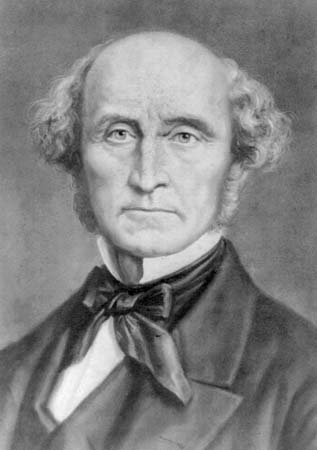
John Stuart Mill (1806-1873)
The old pressures to conform were wrong. So are the new. And they are wrong simply because they are pressures to conform. I find myself at last appreciating a part of Mill’s essay On Liberty for which I never used to have much time. Until recently, I would insist that the only real oppression was by the State: all else was the working of private choice. If the authorities fined a man £5 for having sex with another man, that was outrageous tyranny. If his tastes became public knowledge, and he was unable to find work, that was merely unfortunate. This is, I still believe, essentially true. Indeed, I could argue that, without a State having centralised and corporatised powers of discrimination that ought to be widely distributed, there would be no problem — or there would be a problem that was bearable. But these powers were centralised and corporatised a long time ago. They are now being used to achieve a uniformity of opinion outside the home in which the formal organs of compulsion have no obvious part. This is not the “tyranny of the majority” that worried Mill. I find it inconceivable that anything close to a majority could believe the insane drivel pouring from the regime media. Neither, though, is it the kind of oppression against which liberal bills of rights have traditionally been written. Because of this —
when society is itself the tyrant …, its means of tyrannising are not restricted to the acts which it may do by the hands of its political functionaries. Society can and does execute its own mandates: and if it issues wrong mandates instead of right, or any mandates at all in things with which it ought not to meddle, it practises a social tyranny more formidable than many kinds of political oppression, since, though not usually upheld by such extreme penalties, it leaves fewer means of escape, penetrating much more deeply into the details of life, and enslaving the soul itself. Protection, therefore, against the tyranny of the magistrate is not enough: there needs protection also against the tyranny of the prevailing opinion and feeling; against the tendency of society to impose, by other means than civil penalties, its own ideas and practices as rules of conduct on those who dissent from them …
(J.S. Mill On Liberty, 1859, “Introductory“)
We need protection indeed. But the protection we need is not yet another law telling the police to leave dissidents alone. We already have a stack of these, and they are protections against a threat that largely does not exist. The answer, I suggest, is an amendment to the anti-discrimination laws to outlaw discrimination on the grounds of what may be loosely called political opinion.
I say hardly anyone read my original essay. Sadly, most of those who did read it stand in the more wooden reaches of the libertarian movement, and these set up a cry that I had become a Communist. I was suggesting that private organisations should be coerced in their choices of whom and whom not to employ, and even in their choices of customer and supplier. I had abandoned the non-aggression principle. Here, briefly expressed, is my answer to these claims.
I run the Centre for Ancient Studies. This provides a range of tuition services in Greek and Latin. It is a sole tradership. As such, I reserve the unconditional right to decide what services I offer and to whom. If I dislike the colour of your face, or the status of your foreskin, or your tastes in love, or anything else that I may think relevant, it should be my right not to do business with you. It may be that only a fool turns away customers with money to spend, and I am not that sort of a fool. Even so, I do claim at least the theoretical right, and I ground it on my right to do as I please with my own. But I claim these rights as a human individual. A limited company is not a human individual. Whatever entrepreneurship may exist in them, these companies are artificial persons and creatures of the State. Their owners have the privilege of limited liability. That is, they have the right, in the event of insolvency, not to pay the debts of a company if these are greater than the assets of the company. If this were not a valuable right, there would not be so many limited companies. There are almost no large companies, and none lasting more than a single generation, that do not have limited liability.
This being so, limited companies benefit from a grant of privilege from the State, and are legitimate subjects of regulation by the State for as long as they are receipt of this privilege. No doubt, some forms of state regulation are bad in their objects, or bad as regards the means to their objects. But regulation is not in itself an aggression by the State. It follows that, whether or not we can get it, libertarians should not feel barred from demanding laws to prevent limited companies from discriminating against their employees on the grounds of political opinion, and to require them to do business with customers and suppliers regardless of political opinion.
I appreciate that I am asking for more than the regulation of limited companies. The anti-discrimination laws we have make no distinction between incorporated and unincorporated associations. Even so, the extension of these laws to cover political opinion would mainly affect only the larger limited companies. At the same time, there is an obvious and overriding public interest in the protection of political opinion. People are now scared to speak their minds. Whether intended or just revealed, this is part of the strategy. The reason why the collapse of both freedom and tradition is gathering pace is because no one dares stand up and protest. In the absence of protest, everything will carry on as it is. Given a restored right of protest, there is a chance of stopping the collapse. The only way to lift the blanket of fear that now lies over all but approved opinion is somehow or other to get a law making it clear that no one who speaks his mind can be loaded with shadow punishments.
“Somehow or other!” In a sense, I am making a fool of myself. I am asking the politicians to make a law against what they themselves may not be doing, but that has no effect on their main reason for being in politics, which is to fill their pockets. I am asking them to take on the entire mass of the non-elected Establishment. I am asking a lot of these people. On the other hand, the politicians still need to be elected, and that was the weak point in the Establishment’s plan to stay in the European Union. We had to spend four years voting and revoting, but we did eventually get what we wanted. It is conceivable that, if enough of us call loudly enough for protection, some kind of protection will be granted.
Short of that, we are lost.
Comments Off on The modern-day threat of being made an “unperson” is real and very dangerous
August 6, 2021
Fallen Flag — the Western Pacific Railroad

The Western Pacific company magazine Mileposts included this historical snippet in their 50th anniversary issue (courtesy of the Western Pacific Railroad Museum):
Virgil Bogue had become George Gould’s consulting engineer and recalling his surveys for the Union Pacific in the ’80’s, recommended Beckwourth Pass and the Feather River route. Remembering also an unhappy experience he had once had in locating any other road, only to find the whole route plastered with mining claims of dubious mineral value but through which rights of way must be negotiated, he advised Gould to form a “mining company” first. Accordingly the North California Mining Company was organized and soon nearly 600 placer claims were staked out, blanketing the entire proposed route across the mountains.
Gould turned the job over to the Denver and Rio Grande and its president, E.T. Jeffery, sent a field party under H.H. Yard west to locate the line. It was all top secret. The transit men and stake artists were forbidden even to let their wives know where they were. Letters could only be exchanged through the Denver office of the railroad. Two California corporations, the Butte and Plumas Railway and the Indian Valley Railway, were set up to be the figureheads.
[…]
George Gould still remained completely out of the picture and denied all connection with the project. Although he financed the new surveying parties that were immediately sent out to make the final location, he was forced, in the interests of this secrecy, to keep the Rio Grande engineers in the field as well. The absurd result was two hostile groups struggling to outwit each other and often on the point of exchanging pot shots, though both were actually on the same payroll.
After much chicanery and effort, the railway’s right of way through the Feather River Canyon, the next historically significant fight was securing access to the waterfront along San Francisco Bay, where the legal department of the Southern Pacific believed they had an ironclad monopoly of all the potentially useful access routes to salt water:
… the S.P. was fully confident that it would have but little difficulty in isolating the Western Pacific from a practical outlet on the Bay. The Santa Fe, only a few years before, had built its ferry slip way up at Point Richmond rather than attempt to crack the S.P. stronghold. Bartnett, after a hard struggle against the older railroad’s influence, did secure a small site on the mudflats of the Oakland Estuary. It would have made a miserably cramped ferry terminal but, from all appearances, the WP promoters had concluded it was the best they could do. Harriman’s forces sneered and relaxed. Gould’s were just beginning. Every move was carefully rehearsed and logistics figured to the last detail.
As the Oakland tidelands had gradually been filled in, the Government had extended the banks of San Antonio Estuary with rock quays called “training walls” in order to prevent silt from washing into the Oakland inner harbor channel. A dredger was often necessary to prevent the formation of a bar at the entrance of the channel. This dredger became the Trojan horse of the Gould attack.
On the night of January 5, 1906, the Western Pacific forces under Bartnett struck.
With 200 workmen and 30 guards armed with carbines and sawed-off shotguns, he used the dredging company as a front, and seizing the north training wall, began feverishly to lay a rough track. Most of the guards took up positions at the shore end of the U. S. training wall and maintained them night and day. Laborers snatched their sleep in shelter tents on the wave-washed rocks and the WP commissary department fed them. Scows rushed more rails and ties across the Bay to the end of the wall. Soon there was a mile of track on top of the rock wall.
Of course the Southern Pacific did not quietly accept this outrageous trespassing on domains it had held undisputed for more than half a century. Its legal department, fairly in convulsions, was whipping out the necessary papers for immediate appeal to the law. This was exactly what Bartnett had told Gould would happen and exactly what they both desired. For the courts, as Bartnett had felt sure they would, held that the Southern Pacific title to the waterfronts had not progressed westward with the shoreline as the tidelands and marshes had been filled in, but was valid only to the low tide line of 1852. The S.P.’s “waterfront” therefore was by now well inland, and the new marginal land surrounding it was the property of the city.
The city government was duly grateful to the new railway for almost literally liberating the city’s shoreline from the grip of the Southern Pacific. With most of the legal complications (and paramilitary solutions) out of the way, construction of the full line began in earnest, as Arthur L. Lloyd picks up the story:
Construction started in Salt Lake City. The line would be all 90-lb. rail and have no curve exceeding 10 degrees. To keep to the 1-percent maximum grade, the full-circle Williams Loop was built between Massack and Spring Garden, Calif., and another partial one, Arnold Loop, west of Wendover, Nev.
Work also went from Oakland eastward, and the last spike marking completion was driven on the bridge over Spanish Creek at Keddie, Calif., on Nov. 1, 1909. There was no ceremony. Section foreman Leonardo de Tomasso, age 25, did the honors with a standard steel spike. Arthur Keddie was still around, though. He rode WP’s first passenger train, and he spoke from the Plumas County Courthouse steps in Quincy, Calif., on Nov. 21, 1910.
WP was dispatched completely by train orders and timetable; its only block signals were on the paired track between Weso (Winnemucca) and Alazon (Wells) in Nevada, where eastbound WP and Southern Pacific trains used WP, while both roads’ westbounds used SP.
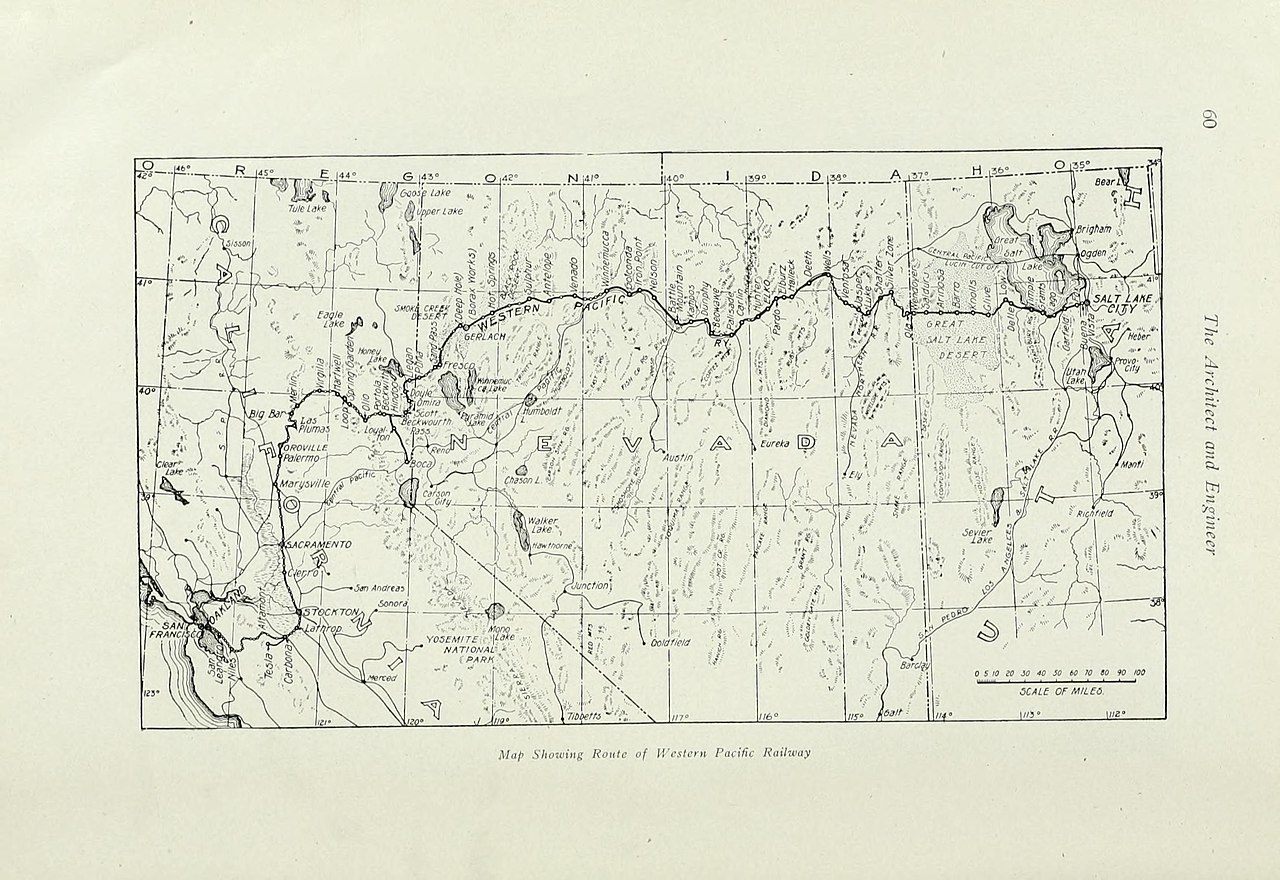
Route map of the Western Pacific, published in The Architect & Engineer of California and the Pacific Coast, 1905.
WP’s map was simplicity itself, highlighted by a main line from San Francisco Bay to Salt Lake City and a connection with the Rio Grande. The branch to Bieber, Calif., completed in the 1930s, connected to a Great Northern line.
Comments Off on Fallen Flag — the Western Pacific Railroad
August 2, 2021
Who is Colt? A History of the Colt Patent Firearms Manufacturing Company
Forgotten Weapons
Published 23 Feb 2017Today we will take a look at the history of the Colt company, from Sam Colt’s first efforts in Paterson (and before) to the West Hartford remnants that survive today. If you enjoy this type of history, please let me know in the comments!
http://www.patreon.com/ForgottenWeapons
Cool Forgotten Weapons merch! http://shop.bbtv.com/collections/forg…
If you enjoy Forgotten Weapons, check out its sister channel, InRangeTV! http://www.youtube.com/InRangeTVShow
Gun display racking provided by Matrix Armory: http://www.matrixarmory.com

Comments Off on Who is Colt? A History of the Colt Patent Firearms Manufacturing Company
July 31, 2021
QotD: The dangers of “hipster fuckery” in the craft beer business
Hipster fuckery is a great way to alienate potential craft beer fans.
So how about we all just agree to be innovative as hell, but stop well short of hipster fuckery? Excellent! But, umm, where is that line exactly?
Rebecca Whyman, “Beer gimmicks, pretentious nonsense and other hipster fuckery”, The Growler: Ontario Craft Beer Guide, Volume 1, Issue 3, 2018.
Comments Off on QotD: The dangers of “hipster fuckery” in the craft beer business
July 30, 2021
The British government reaches deep into the bag of “nudge” tricks yet again
Britain’s public health boffins have got the government agitated enough to try major incentives to encourage British shoppers to buy healthier, lower-calorie foods. Tim Worstall explains that, because those shoppers are human beings, this suite of incentives won’t do at all what Nanny expects them to do:
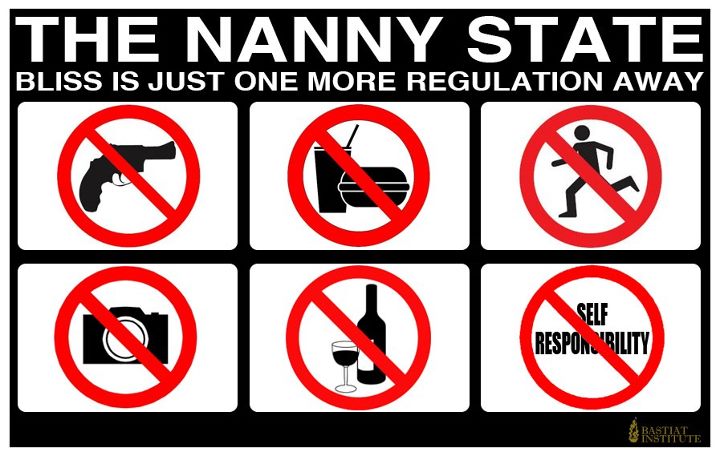
Now consider how it has to work. You go shopping, you present your DimbleCard and gain points for the healthiness of that shopping basket. Lettuce and carrots galore, super, free ticket to London on the choo choo.
So, where are the chocco biccies? If you buy them when presenting your card then no choo choo for you. What happens?
The lettuce and the carrots are bought on the card, the chocco biccies are not. Everyone simply does two transactions, with DimbleCard and sans. Lots of free choo choo and no change, whatsoever, in diet.
Yes, of course people will do this. For that’s what people do. Survey the landscape of incentives in front of them then maximise their utility, the outcome, in the face of them. It’s a restricted rationality, restricted by knowledge, but it is there. Everyone will fiddle the system because that’s what it is to be human. Collecting the fire from the lightning strike is fiddling the universe, that’s just what we do.
This being why so many clever schemes to encourage or deter this or that just don’t work. This being why those detailed plans for men, if not mice, gang aft into idiocy. Because we out here, hom sap, will play whatever system there is to our benefit.
No, this will not work out like supermarket loyalty cards. Yes, it’s true, most of us do use them. But the incentive is for us to do so. The more we do use them then the more discounts we gain, the better off we are, even at the cost of that data. How does this new government one work? The less we buy of certain things the better off we are. So, less of those things will be bought using the cards.
It is not possible to insist that people must use the card to buy things. Well, not unless we’re about to descend into the dystopia desired by Caroline Lucas it’s not. There might be a card reader at the point of purchase but the supermarkets will not demand that a sale can only happen when a card is read.
Therefore there will be those sales which gain points which make prizes. There will also be those DimbleCardless sales which do not gain points, or even demerits, and are done without their being registered in the system.
Comments Off on The British government reaches deep into the bag of “nudge” tricks yet again


