
I’ve done a few tours of duty behind a cash register. The job takes your soul, twists it like a wet chamois and runs it through the shredders they use to turn car hoods into tinfoil strips. […] When I lived out east, the relationship between cashier and customer was the same as that between a German gunner and the troops disembarking at Normandy.
James Lileks, “Backfence: Beyond new store’s hype, genuine smiles”, Minneapolis Star Tribune, 2004-08-03.
December 26, 2021
QotD: Boxing Week Sales
Comments Off on QotD: Boxing Week Sales
December 23, 2021
QotD: Stupid Commercials
Alan McLeod, “1 + 0 = 2”, Gen X at 40, 2005-11-15.
Comments Off on QotD: Stupid Commercials
December 22, 2021
Repost – “Merry Christmas” versus “Happy Holidays” versus “Happy Midwinter Break”
L. Neil Smith on the joy-sucking use of terms like “Happy Midwinter Break” to avoid antagonizing the non-religious among us at this time of year:
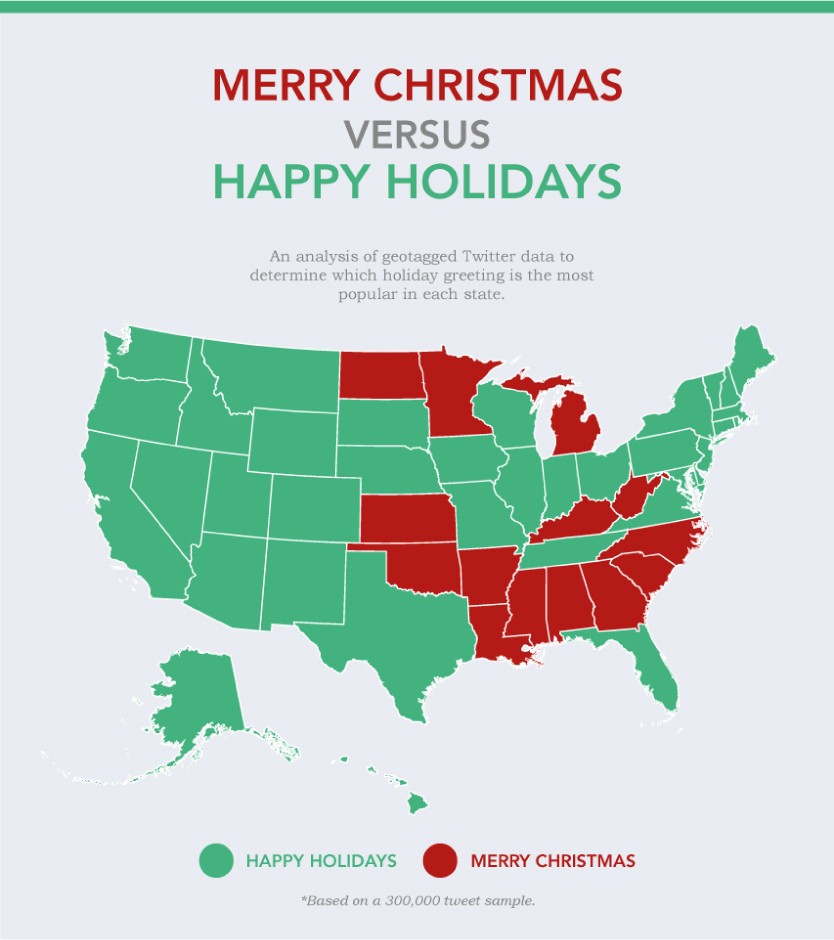
Original infographic from Treetopia – https://www.treetopia.com/Merry-Christmas-vs-Happy-Holidays-a/304.htm
Conservatives have long whimpered about corporate and government policies forbidding employees who make contact with the public to wish said members “Merry Christmas!” at the appropriate time of the year, out of a moronic and purely irrational fear of offending members of the public who don’t happen to be Christian, but are Jewish, Muslim, Hindu, Buddhist, Sikh, Jain, Rastafarian, Ba’hai, Cthuluites, Wiccans, worshippers of the Flying Spaghetti Monster, or None of the Above. The politically correct benediction, these employees are instructed, is “Happy Holidays”.
Feh.
As a lifelong atheist, I never take “Merry Christmas” as anything but a cheerful and sincere desire to share the spirit of the happiest time of the year. I enjoy Christmas as the ultimate capitalist celebration. It’s a multiple-usage occasion and has been so since the dawn of history. I wish them “Merry Christmas” right back, and I mean it.
Unless I wish them a “Happy Zagmuk”, sharing the oldest midwinter festival in our culture I can find any trace of. It’s Babylonian, and celebrates the victory of the god-king Marduk over the forces of Chaos.
But as anybody with the merest understanding of history and human nature could have predicted, if you give the Political Correctness Zombies (Good King Marduk needs to get back to work again) an Angstrom unit, they’ll demand a parsec. It now appears that for the past couple of years, as soon as the Merry Christmases and Happy Holidayses start getting slung around, a certain professor (not of Liberal Arts, so he should know better) at a nearby university (to remain unnamed) sends out what he hopes are intimidating e-mails, scolding careless well-wishers, and asserting that these are not holidays (“holy days”) to everyone, and that the only politically acceptable greeting is “Happy Midwinter Break”. He signs this exercise in stupidity “A Jewish Faculty Member”.
Double feh.
Two responses come immediately to mind, both of them derived from good, basic Anglo-Saxon, which is not originally a Christian language. As soon as the almost overwhelming temptation to use them has been successfully resisted, there are some other matters for profound consideration…
Comments Off on Repost – “Merry Christmas” versus “Happy Holidays” versus “Happy Midwinter Break”
December 19, 2021
Remember the megabucks Andrew Cuomo received for his (ghostwritten) book? It’s going to New York State instead
Back in November, Kenneth Whyte reported on the unlikely pay-off for Andrew Cuomo and his American Crisis. In this week’s SHuSH newsletter he’s delighted to report that the state government — which effectively funded the research and writing of the book — will be the eventual recipient of the whole advance:
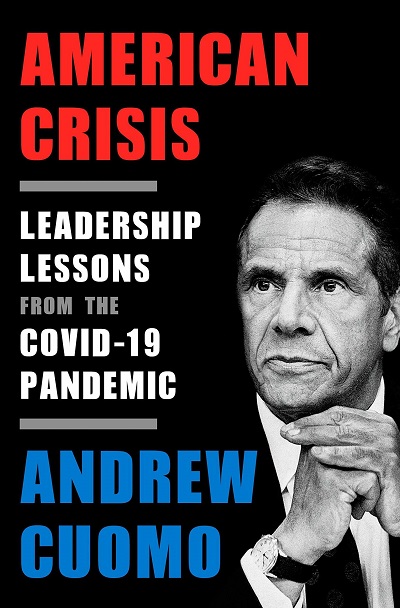
Sorry to keep harkening back to previous SHuSHs but I can’t overlook the latest on the Andrew Cuomo shambles.
You’ll remember that now-disgraced former governor of New York, Andrew Cuomo, played dirty with his publisher and the public while landing a lucrative book contract. More specifically, he suppressed bad news about pandemic deaths in his state while coaxing a $5.1 million advance out of Penguin Random House for a book about his heroic activities as a COVID-19 fighter.
I mentioned that it was astonishing that the governor of America’s hardest-hit pandemic state could produce a fat manuscript in just three months, and that media reports suggested his staff and a ghostwriter authored the book for him. The same reports said he was in danger of violating state ethics prohibitions against the use of state resources or personnel in producing his book.
I also noted that weeks after the grandly titled American Crisis: Leadership Lessons from the COVID-19 Pandemic was released in October 2020, Cuomo was hit with the first in a long series of sexual harassment allegations. He was forced to resign his office in August 2021. By then, it had also emerged that Cuomo’s office had covered up roughly half of the fatalities among state nursing home residents during the pandemic.
Penguin Random House took a bath on the project. American Crisis has sold only about 50,000 copies, about a tenth of what the publisher needed to cover the advance it paid the author.
This week it was Cuomo’s turn in the tub. An ethics panel ruled that he had broken his promises not to use state resources or government staff to write his self-congratulatory book, and gave him thirty days to hand over to the State of New York the $5.1 million he earned with the book.
‘Tis the season to be jolly
Fa-la-la-la-la, la-la-la-la
Comments Off on Remember the megabucks Andrew Cuomo received for his (ghostwritten) book? It’s going to New York State instead
December 15, 2021
Why Real Wasabi Is So Expensive | So Expensive
Business Insider
Published 19 Jan 2019The green paste you’ve been eating with your sushi isn’t really wasabi. If you check the ingredients on the packet, you might see a mixture of sweetener, horseradish and perhaps a small percentage of the real thing. Real wasabi is hard to come across and it can cost $250 per kilo. So what actually is wasabi, and why is it so expensive?
For more from The Wasabi Company, go to: https://www.thewasabicompany.co.uk/
——————————————————
#Wasabi #Expensive #BusinessInsider
Business Insider tells you all you need to know about business, finance, tech, retail, and more.
BI on Instagram: https://read.bi/2Q2D29T
BI on Twitter: https://read.bi/2xCnzGF

Comments Off on Why Real Wasabi Is So Expensive | So Expensive
December 14, 2021
Michael Nesmith, RIP
In Monday’s NP Platformed newsletter, Colby Cosh paid tribute to the late Michael Nesmith:

Michael Nesmith, the Monkees’ toqued Texan, died on Friday at the age of 78. It’s probably fitting that Nesmith died at a moment when the Beatles are back in the forefront of public consciousness: being hired as a fake Beatle for a television show was the beginning, for him, of an epic American life. It’s a sequence of events that defies belief in retrospect.
The Monkees were a corporate creation — four guys pulled together in order to be vaguely Beatles-like and serve as the public face of a series of glorious hit singles written (and largely played) by others. They had a period of truly enormous stardom, but they began to attract criticism when word of their sham-like nature filtered out into a world of increasing concern with authenticity. Meanwhile, they were themselves revolting against the Monkees machine and its Svengali, Don Kirshner — a revolt of which the sharply intelligent Nesmith was the acknowledged leader.
The Monkees got control of their performing lives — and began to make distinctly inferior records. There is a reason “Last Train to Clarksville” went to number 1 on the charts, and “I’m a Believer” (written by Neil Diamond) went to number 1, and “Daydream Believer” went to number 1, and Nesmith’s “Listen to the Band” went to number 63. Nobody really had much use for authentic Monkees. By all rights they ought to have ended up as Milli Vanilli.
Yet Nesmith had one rock-‘n’-roll standard, one bright gemlike classic, in him. This was “Different Drum”, a record Nesmith had written in 1964 before anyone had invented the Monkees. He couldn’t get Kirshner and his hired tastemakers and arrangers to turn it into an actual Monkees record. It did appear on an episode of the show in 1966, but in an astonishingly humiliating way: Nesmith’s character, “Mike Nesmith”, plays a few bars of it very haltingly while pretending to be an inept country-folk singer, “Billy Roy Hodstetter”.
A country-folk singer was, of course, what Nesmith actually was when not in front of the cameras. The result is a media puzzle worthy of the brainpower of a dozen French deconstructionists. Nesmith, in this handful of seconds, is a real musician in a fake TV band pretending to be a real TV musician on a fake show-within-a-show, mangling his own genuine material.
Comments Off on Michael Nesmith, RIP
December 5, 2021
Will publishers move back to actually printing their own books?
In the latest SHuSH newsletter, Kenneth Whyte explains some of the issues publishers face in getting their books printed, as most publishers outsourced the actual physical work of printing and binding many years back:
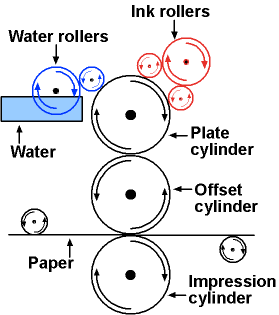
Offset printing.
Image from Wikimedia Commons.
I had a serious conversation with another publisher this week about the need for publishers to start printing their own books.
Those familiar with publishing history will know that from the fifteenth to the nineteenth century, most publishers printed their own books. Ownership of a press, as much as anything, was what made a publisher a publisher. In the course of the twentieth century, it was decided that publishing books and printing books were different businesses. Virtually all publishers outsourced their printing to high-volume printing specialists who were constantly upgrading their equipment, and who, theoretically, at least, were better, faster, and cheaper than in-house printing operations.
[…]
Apart from that handful of artisans, today’s book publisher can no more operate a printing press than a backhoe. He or she outsources printing to specialists on a project-by-project basis.
The options for large-scale quality printing are increasingly scarce, thanks to a lot of consolidation in the printing business. Smaller shops (like the artisans) only do paperbacks; hardcovers require a lot of expensive binding equipment. If a publisher wants a big run of a hardcover title, the most likely printers are the industry giants: R.R. Donnelley (above) or CJK Group in the US; Friesens and Marquis in Canada. These companies all use huge offset web presses that are big as gymnasiums and only economically efficient at higher quantities (i.e., in the thousands). The technology involves metal plates and rubber mats and massive rolls of paper (if you’re interested, read more here) and the quality is first rate.
I should have said that the only options for a big run of hardcovers in Canada are Friesens in Altona, Manitoba and Marquis in Montmagny, Quebec. There are no hardcover printing options in Ontario, where so many publishers are concentrated (although Marquis does have a plant in Toronto).
[…]
The reason publishers are now talking about doing their own printing is that it is increasingly difficult to get time on any kind of press. Friesens, when Sutherland House started a few years ago, could usually do a job for us in eight weeks. There were seasons — the dead of winter, the height of summer — when they could deliver even faster and we’d get a discount because their presses weren’t especially busy. COVID-19 changed all that.
People have been buying more books during the pandemic, and publishers have been printing more. Friesens is now fully booked six to eight months out; its fall 2022 schedule is already crowded. The US printers we use as alternatives to Friesens are similarly backed up.
It’s making the decision to print in hardcover hazardous. It used to be that if you printed a few thousand copies of a new book in hardcover and it was in danger of selling out, you could get back on press in six to eight weeks, maybe less, and continue to fill orders. Now, if that original press run is selling fast, you might have to wait six to eight months to print a second edition. You’ll be out-of-print for most of that time, and all momentum will be lost. Some publishers are thus moving immediately to digital paperback formats (none of the digital printers have hardcover binderies) for their second editions, even if it’s only weeks into a book’s life. There is more availability at digital printers, so resorting to the digital paperback format allows you to keep your momentum.
Comments Off on Will publishers move back to actually printing their own books?
QotD: The oddity about online ads
David Thompson commenting on “Thrilling Content Goes Here”, DavidThompson, 2021-08-30.
Comments Off on QotD: The oddity about online ads
December 3, 2021
A bureaucratic mandate for never-ending intervention — induced offensensitivity
Theodore Dalrymple notes the increasing reach of the bureaucracy in policing everyday language in a supposed attempt to protect the easily offended feelings of minority groups, but really in yet another way to increase the role of bureaucrats (and their staffing and budget allocations):
Original infographic from Treetopia – https://www.treetopia.com/Merry-Christmas-vs-Happy-Holidays-a/304.htm
Underlying the bureaucratic desire to reform language are two assumptions: first that it is the duty of bureaucrats to prevent offense to people occasioned by the use of certain words, and second that they know what words will give offence to people.
Of course, there are only certain categories of people who needed to be protected from taking offence: that is because, in the estimate of their would-be and self-appointed protectors, they are very delicate and can easily be tipped into depression or states of mind even worse than depression.
Whether it is flattering, condescending or downright insulting to consider people so delicate that they cannot hear certain words that were hitherto considered innocuous, I leave to readers to decide. For myself, I think that to regard people as psychological eggshells is demeaning to them, but other may think differently.
But the question still arises as to whether the people supposedly in need of bureaucratic intervention actually do take offence at the allegedly offensive words, such as Christmas, when they are uttered.
This is not as straightforward a question as might at first appear, for people can be taught or encouraged to be easily offended, especially if they will derive certain advantages, political, social or even financial, from being, or claiming to be, offended. If you pay someone to be ill, he will be ill; if you pay someone to be offended, he will be offended.
It is in the interests of bureaucracies that the population should become hypersensitive, for then it will run to the bureaucrats for so-called protection from offensiveness.
A hypersensitive population creates endless work for the bureaucrat to do: he will have constantly to adjudicate between the claims of those who have taken, and those who have allegedly given, offence. Conflict and stoked-up anger are to him what fertilizer is to corn.
For much of the population, hypersensitivity becomes a duty, a pleasure and a sign of superiority of mind and moral awareness. In addition, it is an instrument of power. And, of course, habit becomes character. What may have started out as play-acting becomes, with repetition, deadly sincerity.
People who have had to be taught what microaggressions are because they have not noticed them eventually come to believe in their reality and that that they have been subjected to them. Then they start to magnify them in their minds until they seem to them very serious: they become self-proclaimed victims.
There are two things that victims seek in our law-saturated world: revenge and compensation. Neither of these things can be achieved without the aid of a large apparatus of bureaucrats (civil-litigation lawyers are bureaucrats of superior intelligence who are usually endowed also with a modicum of imagination).
Comments Off on A bureaucratic mandate for never-ending intervention — induced offensensitivity
November 28, 2021
QotD: Hidden political pay-offs as “book advances”
True advances are, well, advances against expected future royalties. That’s why they’re called “advances”.
People expect that a J.K. Rowling book will produce at least $5 million in royalties, so you give her a $5 million advance on those royalties. You’re giving her a payment on her royalties in advance of actually seeing those sales.
But you do expect them.
You don’t pay her fresh royalties until the royalties she generates exceeds the initial advance on royalties you paid her.
When she makes $5 million and one hundred dollars, you send her a fresh check for one hundred dollars.
When these major media conglomerates, all left-leaning and most with business before the government, give millions to Hillary Clinton and Hunter Biden and Andrew Cuomo, there is no one at that company that expects the books will ever make that much in royalties.
They’re just payoffs. Or disguised political donations.
It’s not an “advance” if you cannot show a plausible stream of sales which will meet or exceed that “advance”.
Personally, I’d love to see some kind of law on this subject to force these large media corporations to prove that they have a genuine, rational belief that a Hunter Biden book will make $10 million in sales (which would justify a million dollar advance, assuming a royalty of 10%).
And I’d like to see their corporate officers sign certifications for the government that they’re not fudging the numbers. And that they understand that there might be prosecutions for perjury if they do lie about expected future royalties.
Much like people in the financial sector are constantly required to sign.
Why should media corporations be immune from such requirements?
And I’d love to see these disguised campaign donations treated and limited just like actual campaign donations.
Or, better yet: No “advances” for serving politicians, declared politicians who are running, or any politician ten years after his term of service ends. They can just take their royalty checks as royalties actually accrue.
If Hunter Biden really sells $10 million in books — LOL — then he’ll get that million dollars eventually in royalty payments. They’ll just come over the course of a year or two rather than all at once in an “advance” on future earnings.
If not — then not.
This isn’t stopping them from getting paid for books they sell — it’s to stop mega-media-corporations with business before the government, and a strong desire to pay off politicians they like, from giving “advances” to favored politicians that bear no relationship whatsoever to the actual expected royalties the books will generate.
Ace, “Ethics Agency Might Claw Back Cuomo’s $5 Million ‘Advance’ For His ‘Book'”, Ace of Spades H.Q., 2021-08-27.
Comments Off on QotD: Hidden political pay-offs as “book advances”
November 27, 2021
Americans fear the power of “Big Oil” and other cartels. Canadians rejoice under the buttery thumb of “Big Dairy”
Jen Gerson hates Canada’s supply management “system” with the heat of a thousand suns. And she’s perfectly right to do so:
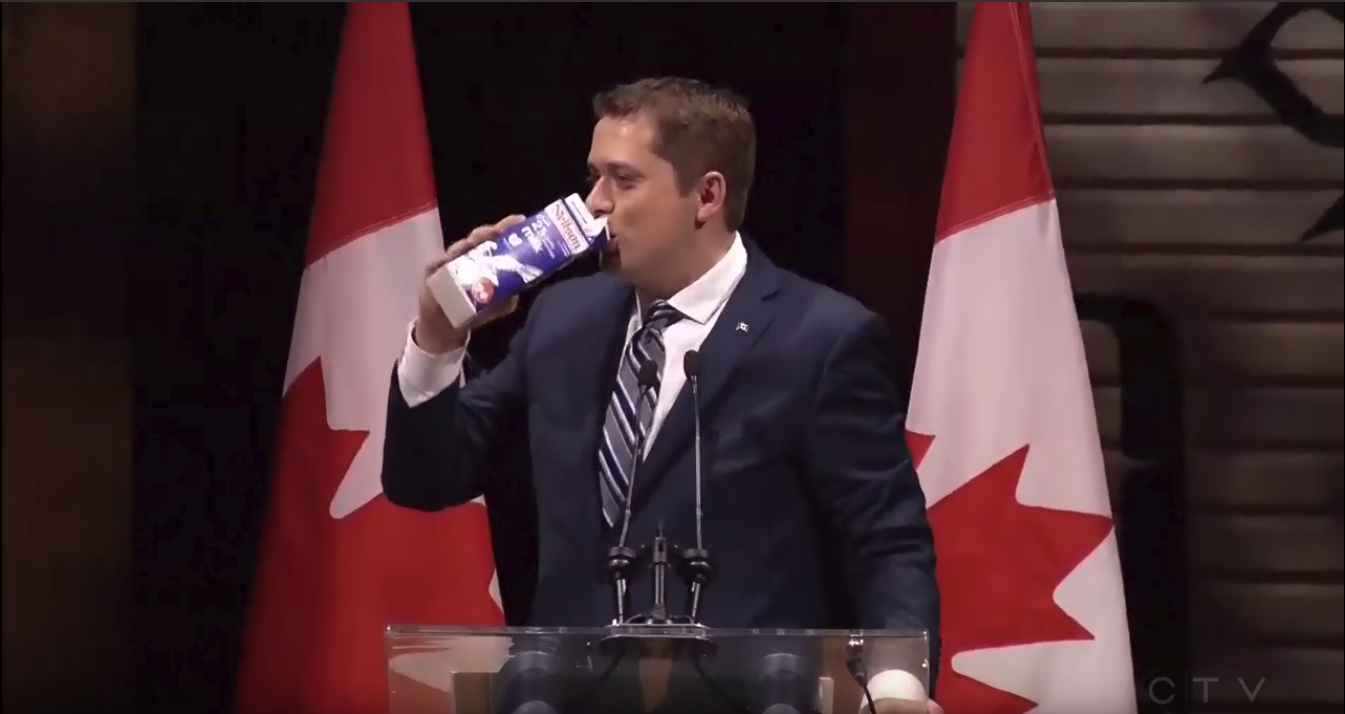
Former federal Conservative Party leader Andrew Scheer, paid tool of Big Dairy, chugs some milk during a Press Gallery speech in 2017. I’ve called him the “Milk Dud” ever since.
Screencapture from a CTV video uploaded to YouTube.
Many of you readers have listened to the likes of me complain about supply management over the years, but for those of you whose eyes glazed over until you started to notice your rent money disappearing into your grocery bill, here’s a very quick primer.
The supply management system insulates eggs, dairy, and poultry from the vicissitudes of the free market, assuring established farmers in these few sectors a guaranteed return to produce a pre-ordained supply of these products. The federal and provincial governments oversee the system via various dairy commissions.
Some government involvement in dairy has been a feature of our agricultural system since the late 19th century, however the system as it exists today came into effect in the ’70s. It consists, broadly, of three policy mechanisms. Prices are set internally to assure farmers receive a healthy profit for their labour, farmers are protected from competition though ruinous import tariffs, and then supply is managed via a quota system.
As one might expect, this has created extraordinary economic distortions, assuring that a container of milk in Canada is radically more expensive than an identical product south of the border. (Yes, American milk is subsidized too, although less than it once was. And from a consumer’s perspective, so what? If the Americans want to subsidize cheap milk to send north, all the better for shoppers.)
In order to keep production at a steady level, the system has to keep newer, cheaper players from entering the market, and this is accomplished via a quota system that has led to absurd economic incentives and outcomes. According to this report from the Canadian West Foundation from 2016, the quota was valued at about $28,000 per cow. That means that the value of the right to own one milk-producing cow far outweighed the actual value of the animal — and someone seeking to start a dairy farm would need to pay for millions of dollars worth of quota in addition to cows, land, food, and farm equipment.
The quotas themselves are a multi-billion dollar racket; this is roughly akin to the way a license to run a taxi costs hundreds of thousands of dollars in some cities, many multiples of the value of the car itself. When a government creates a regulatory system that imposes artificial scarcity, the value of the thing regulated radically increases.
Since the supply management system was introduced, much of the agriculture has consolidated; this, combined with the value of the quotas they possess mean that most dairy farms — far from being quaint, picturesque family homesteads — are multi-million dollar operations, with farmers themselves making six-figure profits after paying their own wages.
The system has also proved a obstacle in multiple free-trade deals, arguably making it difficult for other agriculture sectors to compete globally.
And who pays for all of this?
Well, of course, you do.
Comments Off on Americans fear the power of “Big Oil” and other cartels. Canadians rejoice under the buttery thumb of “Big Dairy”
How Andrew Cuomo got megabucks for his (ghostwritten) book on the pandemic
In the latest issue of the SHuSH newsletter, Kenneth Whyte details how former New York state Governor Andrew Cuomo managed to get a $5.1 million advance from Random Penguin for a book that was mostly written by Cuomo staff members and an outside ghostwriter:
Penguin Random House contacted Cuomo’s agent about writing a book on March 19, 2020, about three weeks after the first COVID-19 case landed in New York. Cuomo was a TV darling in the early days of the pandemic. On July 1, his agent got back to Penguin Random House to say he’d written 70,000 words and he was ready to make a deal. How did a governor of America’s hardest-hit pandemic state produce a fat manuscript in three months flat? It appears he had his staff and a ghostwriter author the book for him, in violation of state ethics prohibitions against the use of any state resources or personnel to produce the book.
Meanwhile, Cuomo’s office was churning out doctored statistics to make his pandemic policies, particularly around nursing homes, look better than they deserved.
July 8, Cuomo’s book went to auction. Penguin Random House kicked things off with a $750,000 offer and wound up winning with a bid of $5.1-million. It was a triumph for Cuomo, and not his first in the publishing world: about seven years ago, he took HarperCollins for a $700,000 advance on what the New Republic called an “overlong … cliché-ridden, and hopelessly dull” memoir, All Things Possible. That one sold 4,000 copies in hardcover, a number that would warrant an advance of maybe $10,000.
Several weeks after the auction, Cuomo was asked by the media if he got a lot of money to write the book. “Well,” he replied. “Only if I sell a lot of copies.” Which is not how it works. Advances are non-returnable, and he’d banked $3.1 of the $5.1 before publication. The rest of Cuomo’s advance was spread out over two more years, presumably for tax purposes.
Weeks after the grandly titled American Crisis: Leadership Lessons from the COVID-19 Pandemic was released in October 2020, Cuomo was hit with the first of a long series of sexual harassment allegations. He was forced to resign in August 2021. By then, it had also emerged that Cuomo’s office had covered up roughly half of the fatalities among state nursing home residents during the pandemic.
American Crisis managed to sell at least ten times more copies than Cuomo’s previous book, which is progress, I suppose, but still a nightmare for his publisher. A sale of 50,000 copies might warrant a solid six-figure advance. But $5.1 million? Disastrous.
Comments Off on How Andrew Cuomo got megabucks for his (ghostwritten) book on the pandemic
QotD: The zombie that used to be Abercrombie & Fitch
The name changed hands repeatedly and was revived in the late 1990s as a completely different kind of entity. The new revival markets sissy fashions to metrosexuals. It’s rather as if after Papa Hemingway shot himself, his name was sold repeatedly, and revived decades later as “Ernestine Hemingway”, an authoress of Gay Romance Novels.
David Zincavage, “From the Good Old Days: Abercrombie & Fitch, Change Sucks”, Never Yet Melted, 2021-08-24.
Comments Off on QotD: The zombie that used to be Abercrombie & Fitch
November 25, 2021
QotD: Corporate coercion can be just as dangerous as state coercion
And in an ideal world, yes, that makes sense. We do not live in anything resembling an ideal world.
In an era when three (two really) credit card companies and a handful of payment processors have an off-switch for pretty much any on-line business they take a dislike to (unless they are called Apple or Amazon), as more and more of the economy goes virtual, what we have is turn-key tyranny for sale to the highest bidder, and the highest bidder is always going to be a state. I am uncertain what the solution is, but as we do not live in a “free market”, not convinced “so go set up your own global credit card and payment processing network” adds anything meaningful to the discussion. It is a bit like saying when the local electric provider turns off the power in your office (or home) because they disapprove of what you are doing “so go set up your own electric supply company”, as if that would be allowed to happen.
Perry de Havilland, “This is what so many libertarians cannot understand …”, Samizdata, 2021-08-22.
Comments Off on QotD: Corporate coercion can be just as dangerous as state coercion
November 21, 2021
QotD: Britain’s middle class after WW1
England is a country in which property and financial power are concentrated in very few hands. Few people in modern England own anything at all, except clothes, furniture and possibly a house. The peasantry have long since disappeared, the independent shopkeeper is being destroyed, the small business-man is diminishing in numbers. But at the same time modern industry is so complicated that it cannot get along without great numbers of managers, salesmen, engineers, chemists and technicians of all kinds, drawing fairly large salaries. And these in turn call into being a professional class of doctors, lawyers, teachers, artists, etc., etc. The tendency of advanced capitalism has therefore been to enlarge the middle class and not to wipe it out as it once seemed likely to do.
But much more important than this is the spread of middle-class ideas and habits among the working class. The British working class are now better off in almost all ways than they were thirty years ago. This is partly due to the efforts of the Trade Unions, but partly to the mere advance of physical science. It is not always realized that within rather narrow limits the standard of life of a country can rise without a corresponding rise in real-wages. Up to a point, civilization can lift itself up by its boot-tags. However unjustly society is organized, certain technical advances are bound to benefit the whole community, because certain kinds of goods are necessarily held in common. A millionaire cannot, for example, light the streets for himself while darkening them for other people. Nearly all citizens of civilized countries now enjoy the use of good roads, germ-free water, police protection, free libraries and probably free education of a kind. Public education in England has been meanly starved of money, but it has nevertheless improved, largely owing to the devoted efforts of the teachers, and the habit of reading has become enormously more widespread. To an increasing extent the rich and the poor read the same books, and they also see the same films and listen to the same radio programmes. And the differences in their way of life have been diminished by the mass-production of cheap clothes and improvements in housing. So far as outward appearance goes, the clothes of rich and poor, especially in the case of women, differ far less than they did thirty or even fifteen years ago. As to housing, England still has slums which are a blot on civilization, but much building has been done during the past ten years, largely by the local authorities. The modern council house, with its bathroom and electric light, is smaller than the stockbroker’s villa, but it is recognizably the same kind of house, which the farm labourer’s cottage is not. A person who has grown up in a council housing estate is likely to be – indeed, visibly is – more middle class in outlook than a person who has grown up in a slum.
George Orwell, “The Lion And The Unicorn: Socialism and the English Genius”, 1941-02-19.
Comments Off on QotD: Britain’s middle class after WW1


