
Old-school Commies were consummate players of the long game. They knew they’d have to completely undermine bourgeois society before they could carry off The Revolution, so they did. Antonio Gramsci laid it all out theoretically, if you feel like slogging through that gunk, but the Commies had been doing it in practice for decades before that. Starting with the educational “reformers” surrounding John Dewey at the turn of the 20th century, they took over our grade schools. Then they took over the universities, working their way up from the community colleges (often Commie fronts from the get-go; there’s a reason the number of jucos nationwide went from 20 to 170 in just ten years, from 1909 to 1919).
Once they were in, they of course credentialized everything, such that the cultural-transmission professions — journalism, education, even art and music — suddenly required college training … and all the trainers were Reds. Ever wonder why you seemingly have to have a fucking Master’s Degree to get your lit-wank novel published? Seriously: read the author bio of any of the flavor-of-the-minute wunderkinder that get their painfully quirky dreck blurbed in the New York Times Review of Books — every blessed one of them has some kind of advanced degree in “creative writing”. All those graduate-level “creative writing” programs aren’t just make-work for otherwise unemployable Eng-Lit PhDs, in other words. They’re what the Union of Soviet Writers was in the USSR: The guarantors of politically-reliable content.
That’s the setup. Ready for the twist?
They won, but they don’t know it. Not only was the Revolution televised, it’s still being televised, 24 hours a day, on 587+ satellite cable channels and umpteen digital streaming services. Eugene V. Debs’s wettest wet dream couldn’t compare to Current Year America. The SJWs are like the Seekers, out there desperately trying to prepare the world for the UFOs … but the UFO already landed in their backyard, and they were too busy trying to save the world to see it.
That’s why widespread political violence is inevitable, and damn soon. Nancy Pelosi may be the nastiest evil old bitch to ever slime through the halls of Congress, but she’s not stupid. She’s just in an impossible situation. She’s the leader of an organization that didn’t manage its True Believers, and now she’s fucked either way. […]
That’s what the old-school Commies didn’t see coming. Those poor deluded fools really thought that “intellectual” was an adjective. The Russian word for the noun version is intelligentsia, and they gave the Soviet Union no end of trouble — Stalin had to send boxcars of them to Siberia fairly regularly to keep them in line. In the West, though, they really thought that you can have an “intellectual” steelworker, or dockhand, or farmer, and the like. They were counting on it, in fact — see “community colleges were all Red fronts”, above.
Instead, “intellectual” is the True Believer’s self-chosen job description. You can meet some fearsomely learned people in your day-to-day, but the only people you’ll ever meet who use the word “intellectual” without sneering are Media types and their panty-sniffers in the ivory tower. They’re extremely useful idiots, which is why none of Palsy Pelosi’s predecessors sent them to Siberia like they should’ve. And now it’s too late.
Severian, “If the UFO Actually Comes, Part II”, Rotten Chestnuts, 2019-09-26.
June 25, 2022
QotD: The Left’s long march through the institutions
June 19, 2022
Kursk: Soviets Dig-In for Blitzkrieg – WW2 – 199 – June 18, 1943
World War Two
Published 18 Jun 2022The Soviets have put civilians to work by the hundreds of thousands, building line after line of defenses in the Kursk salient, where they are sure the Germans are soon to attack. Meanwhile the Allies are making moves in preparations for two big upcoming offensives of their own — in Sicily and the Central Solomon Islands.
(more…)
June 15, 2022
Istanbul: City of Spies – WW2 – Spies & Ties 18
World War Two
Published 14 Jun 2022Neutral Turkey appears to be an island of peace in a sea of war. But if you look a little closer though and there’s another story. Assassins ply their deadly trade. Spies slip in and out of occupied Europe. The Allies and Axis battle for influence. The secret war is in full swing.
(more…)
June 12, 2022
Eisenhower Lays Out His Plans for Sicily – WW2 – 198 – June 11, 1943
World War Two
Published 11 Jun 2022The Allies bomb Mediterranean islands in preparation for their invasion of Sicily next month; they also prepare a lot of deceptions to mislead the enemy as to where they will attack. The German plans for the summer offensive against the Kursk salient are ever more concrete, and in the field this week, the Chinese stop the Japanese offensive cold.
(more…)
June 10, 2022
QotD: Talinn, Estonia
My second impression was that it stinks, stinks of diesel exhaust. It seems they have found a way to power everything with diesel, including bicycles and pets. When I walked out of the tunnel from the ferry to land, I was engulfed in a cloud of diesel exhaust from a passing truck. I’m surprised the EU permits it, but maybe they look the other way for the former communist countries. Maybe the Estonians just cheat. Either way, it reminded me of what it was like in America in the 80’s when city buses were like crop dusters …
Rather than follow the crowd to Old Town, I went the other direction and walked a dozen blocks to the east, then another dozen blocks or so south. If you look at a map, the tourist area is to the west, so I figured the real Tallinn was to the east. Given the history and layout of the city, my guess is the east is mostly built in the 20th century, but a lot of it dates to previous centuries. Estonia was a battle ground fought over by Danes, Russians, Germans, Swedes and Poles for most of its history, so it is tough to know.
For example, I walked past an apartment building, probably built in the middle of the last century. It was the drab concrete style popular with communists. Next to it was a cool looking old wood structure that would look at home on Cape Cod. Upon closer inspection, I saw it had undergone a recent renovation, so maybe it was old, but maybe it was just made to look like it dates to the 19th century. You can’t trust anything now. Even in a place like Estonia, everything is becoming a reproduction of a long gone culture of a foreign people.
If you want to get a sense of what life was like under the Soviets, walking around this part of Tallinn is a good way to do it. You see the old buildings and dilapidated old houses. It’s not a slum, but it has that aesthetic the Soviets were so famous for back during the Cold War. Lots of concrete and gray paint. The materialism of the Bolsheviks was really just the total lack of spiritual beauty. They were ugly people and that ugliness was made manifest their building and city planning. They were vulgar and depraved.
The Z Man, “Travelogue: Talinn”, The Z Blog, 2019-04-03.
June 5, 2022
Banzai Charges in Alaska – WW2 – 197 – June 4, 1943
World War Two
Published 4 Jun 2022The Chinese defeat the Japanese at Shipai Fortress and the Americans maul the Japanese in the Aleutians. The Japanese are also worried about the possibility of the USSR joining the war against them. Meanwhile the Allies still plan to invade Sicily, but have no idea what they’ll do after that.
(more…)
June 3, 2022
QotD: Snobbery and spying
Oxford and Cambridge became notorious hunting grounds for the Soviet Union, as they sought out clever young lefties who they might convince to go full retard into communism and then spy for the Motherland.
They had some success with some dapper young gentlemen called Philby, Maclean, Burgess, Blunt and Cairncross – that’s a story for another day.
It was notable that during the whole affair, British intelligence simply refused to believe that one of their own had been corrupted. They could not entertain such a notion, and so the Cambridge Five remained able to betray their country over and over again.
Alex Noble, “Hero Of The European Union”, Continental Telegraph, 2019-04-15.
June 1, 2022
Vintage Russian T62 tanks reported in Ukraine
As with all discussions of the ongoing fighting between Russian and Ukrainian troops, it’s very difficult to be sure that what is being reported is in any way accurate — both sides pulled out all the stops on the PR/propaganda/disinformation machinery months ago. At Thin Pinstriped Line, Sir Humphrey seems to be convinced that the reports that the Russians have been dis-interring mothballed Soviet-era T62 tanks to send into combat in Ukrane are believable enough:
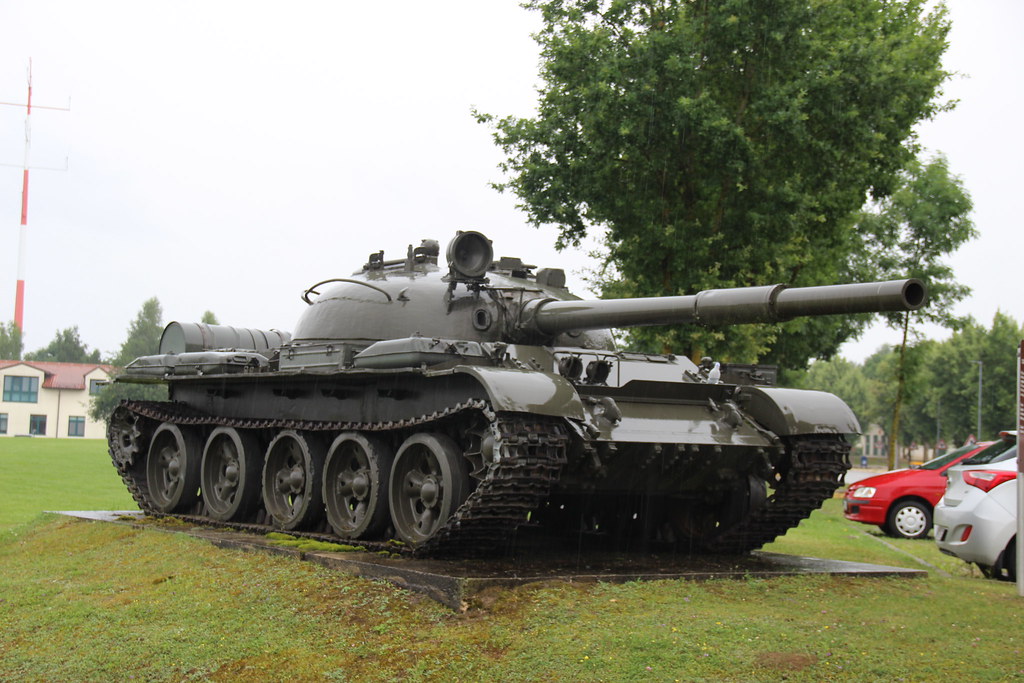
“Soviet T-62M MBT Standard Battle Tank” by Gary Lee Todd, Ph.D. is marked with CC0 1.0. To view the terms, visit https://creativecommons.org/publicdomain/zero/1.0/?ref=openverse.
The Russian Army has taken such significant losses of materiel that it has been forced to pull vintage T62 tanks from reserve, and commit them to front line operations. This statement makes plain just how costly the Russian advances have been in the Donbas area, and raises questions about what, if any, value, there is from retaining a war reserve of vehicles and equipment.
It is difficult to get an accurate picture on just how disastrous the Russian losses have been so far in the war, but most estimates suggest that at least 700 tanks have been destroyed, with many more damaged or captured. Each loss represents not only a small reduction in combat capability to Russia, but usually a far more valuable, and irreplaceable crew.
Russia is not a nation that likes to throw military equipment away, far from it. Their equipment is designed to be simple, reliable and last a very long time. As the outstandingly good website WW2 after WW2, which keeps track of what happened to military equipment after the war, lovingly documents, Soviet era equipment from WW2 just kept going (note, do not click on the link unless you wish to be sucked into a very big time sink!).
With huge reserves of people, no constraints on space or spending, and a mentality of “stores are for storing, not scrapping”, Russia has long kept ancient and utterly obsolete equipment in storage depots long past the point of being of any meaningful value. It is almost certain that there are still Russian Army depots out there with WW2 era equipment waiting for a recall to the colours if required.
The challenge facing Russia though is that due to the rampant corruption, the inability to hold units to account and ensure that readiness is tested, and just the sheer scale of the stockpile, most of the vehicles in their arsenal are probably not combat ready, and have probably been cannibalized beyond repair. Despite having thousands of T72 and T80 in service and storage, it seems that they are not deployable.
This poses a real challenge for Russia on two fronts – firstly, to bring the T62 out of retirement and into front line service as attrition reserves poses a significant support challenge. The vehicle is not compatible with later models of Russian tanks, so will require bespoke logistics support – placing further pressure on the already creaking supply chain.
Additionally, although simple to operate, it still requires crew to use it – with four, instead of three crew needed, this poses an additional headache for the Russian Army, which will have to find 25% uplift in tank crews to operate them properly. At a time when the Russians are low on people, and have churned through a significant proportion of their main army, it will require extraordinary efforts to find bodies to crew these tanks.
Bodies is perhaps the operative word here, for this is likely to be the fate of the crew in these vehicles. The T62 is utterly outclassed and completely obsolete for the environment in which it is operating. It may be good for gunning down demonstrators or strangling democratic protests in third world nations (the joy of socialist dictatorships), but against a highly experienced army, fighting with advanced equipment to defend its homeland, it is utterly hopeless. While it can still have some effect, the T62 units going into action are certain to be outclassed, outgunned and out of time when they face the Ukrainian Armed Forces.
Update: After I scheduled this post for publication, I saw that Berhard Kast (Military History Visualized) had posted a video analyzing the evidence, which you can check out here.
Update, 1 June: Apparently it helps when you include the link to the original post. Who knew?
May 29, 2022
Black May, Nazi Subs Defeated – WW2 – 196 – May 28, 1943
World War Two
Published 28 May 2021German Grand Admiral Karl Dönitz orders the U-Boats to leave the Atlantic this week; the losses lately have just been too great for their patrols to continue there. There is active fighting in China, the Aleutians, and the Kuban, and there are special weapons tests in the skies over Germany.
(more…)
May 15, 2022
The End of the War in Africa – WW2 – 194 – May 14, 1943
World War Two
Published 14 May 2022With the end of the Tunisian Campaign, the Allies have won the war for the African Continent. What next? They meet at the Trident Conference in Washington DC to try and figure that out. Meanwhile, the fight in the field continues — in Burma, the Aleutians, China, and the Kuban.
(more…)
May 8, 2022
Kilroy was Here! The fall of Tunis – WW2 – 193 – May 7, 1943
World War Two
Published 7 May 2022Tunis falls to the Allies, but the Axis are still fighting back from their little corner of Tunisia. There is more of the seemingly endless fighting in the Kuban in the Caucasus, and the Chinese Theater comes to life with a new Japanese offensive.
(more…)
May 1, 2022
The race for Tunisia turns into a crawl – WW2 – 192 – April 30, 1943
World War Two
Published 30 Apr 2022The Allies launch a deception operation to hide their intent of soon attacking Sicily, but first, they’ll actually have to secure Tunisia, and it is slow going. A German offensive in the Caucasus grinds to a halt, and German U-boats are suddenly finding themselves unable to destroy Allied shipping in the Atlantic.
(more…)
April 24, 2022
Ladies and Gentlemen, We Got Him – Yamamoto – WW2 – 191 – April 23, 1943
World War Two
Published 23 Apr 2022The mastermind of Pearl Harbor meets his fate this week in the Solomons, as do a great many Italian airmen and sailors in the Mediterranean in the Palm Sunday Massacre trying to supply the desperate Axis forces in Tunisia.
(more…)
April 20, 2022
Khrushchev – Stalin’s Loyal Enforcer?
World War Two
Published 19 Apr 2022Nikita Khrushchev has served Joseph Stalin faithfully for the past decade. He’s a career commissar and party man. So, when war breaks out, are commissars like Khrushchev little more than Stalinist enforcers? Or is there more to the institution than that?
(more…)
April 19, 2022
When the Germans had to surrender twice
The end of the war in Europe is usually noted as being the 8th of May, 1945, when General Eisenhower received the surrender of German forces, but the Soviets (and now the Russians) mark the anniversary on the 9th:
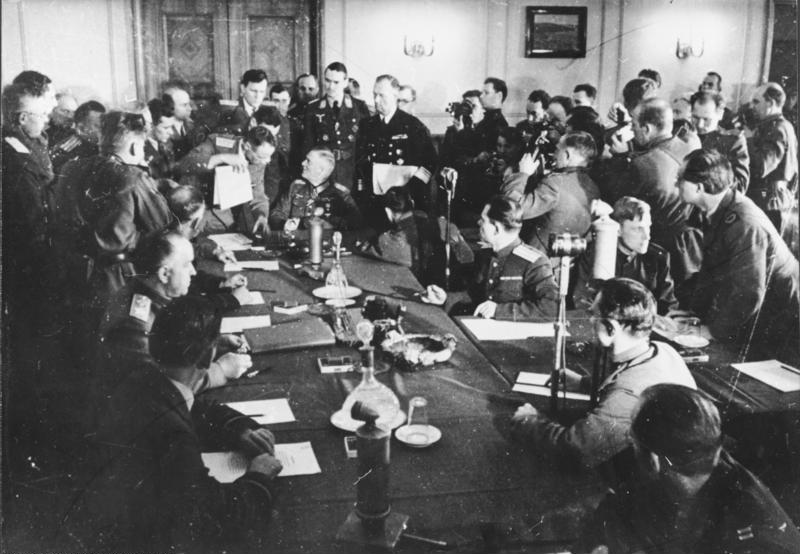
ADN-ZB/Archiv
II.Weltkrieg 1939-1945
Die bedingungslose Kapitulation der faschistischen deutschen Wehrmacht wird am 8. Mai 1945 in Berlin-Karlhorst unterzeichnet.
Links: Der Vertreter des Oberkommandos der Roten Armee, Marschall der Sowjetunion G. K. Shukow, am Tischende Generalfeldmarschall Wilhelm Keitel.
J 0422/600/2 N
It was at three in the morning on Tuesday, 8 May 1945, that Generaloberst Alfred Jodl of the German High Command, signed a surrender document at General Dwight Eisenhower’s headquarters in Rheims, France. The European war was over. It was VE-Day. Stalin’s representative, General Ivan Susloparov, cabled his chief the great news.
However, the Russian leader flew into a rage. He wanted his own observance and insisted on a further ceremony at the Soviet military HQ in Karlshorst, a former Wehrmacht officers’ mess, six miles south-east of central Berlin. Chosen simply because it was one of the few buildings in the capital left with windows and a roof, the formalities were presided over by the captor of the city, Marshal Georgy Zhukov.
This time, it was Generalfeldmarschall Wilhelm Keitel, Jodl’s superior, who read over a near-identical document. Susloparov was again present, along with Carl Spaatz for the Americans and Jean de Lattre de Tassigny, representing France. Newsmen were unaware of the diplomatic spat that delayed proceedings.
De Lattre refused to sign unless the French tricolore was in evidence among the standards and pennants decorating the surrender room. The first Soviet solution hilariously produced a Dutch flag. To pacify an even-more outraged de Lattre, a Red Army seamstress was summoned to run up the appropriate banner. More delays ensued while the Allies bickered over the order of signatures and witnesses, only agreed after the mollifying effects of vodka and some food.
This is why the final ceremony began shortly after midnight. Cameras captured Keitel in full dress uniform, arriving in pompous mood. Flashlights caught the glint of his many medals, and the arrogant flourish of his marshal’s baton, held with gloved hands. He gazed around the room, haughty contempt written across his face. The field marshal removed only his right glove, screwed his monocle into his left eye and applied a fountain pen to the two-page, typewritten document. It was 00:16 local time on Wednesday, 9 May, which became Soviet Victory Day and remains so in Eastern Europe.
Each subsequent year on Victory Day, Red Square has echoed to the “Hurrahs” of vast numbers of Russian soldiers, sailors, marines and paratroopers, national guardsmen and airmen. They are drawn up to listen to their commander-in-chief and inspected by generals. Banners are saluted; swords flash through the air. Serenaded by massed bands playing stirring tunes, they march past the top brass, assembled on the roof of Lenin’s Mausoleum.


