
As noted here many times, it helps if you think of Antifa not as a political movement but as a metastasising personality disorder, a Cluster B contagion. An attempt to dominate by deranged and spiteful egos, rendered in shattered glass and burning livelihoods. They will never be satisfied and can never be appeased, merely encouraged and emboldened by any concession, any excuse, any hesitation.
They destroy and burn and intimidate, and beat people senseless, because they enjoy it. It’s something they wish to do, and choose to do, repeatedly. It makes them feel powerful. Everything else is a pretext, a rationalisation, a lie:
This is us taking the high road. This is us trying to create a world filled with love.
David Thompson, commenting on “Files of the Severely Educated”, DavidThompson, 2021-04-18.
July 19, 2021
QotD: Antifa
July 17, 2021
“Now I am become Twitter, the destroyer of worlds”
In UnHerd, Douglas Murray remembers what it was like before Twitter ruined everything:
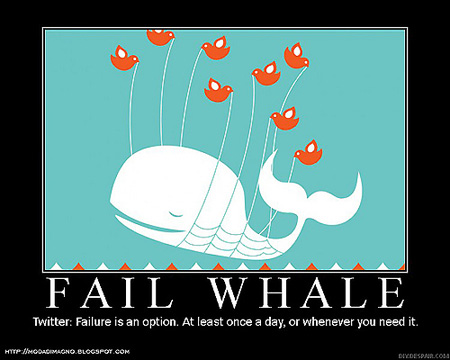
Fifteen years ago today, an innovation was unveiled that has probably changed our lives as much as any other this century. It was on 15 July 2006 that software developer Jack Dorsey and his team launched an online platform where text messages of 140 characters could be shared in a group; six days later Dorsey sent his first tweet, launching a new age of reasoned debate and engagement.
There are some who want to celebrate today — principally Dorsey, along with the small number of other people who have become unimaginably rich off the platform. But for everybody else on the planet, I suspect we should welcome the anniversary with roughly the same enthusiasm that we would the emergence of the Ebola virus. For the further away we have come from Twitter’s birth, the clearer it has become that the platform is a source of unimaginable harm to almost every aspect of society.
In the early days, it didn’t feel like this. Like Facebook, Amazon, Google and the other Big Tech monoliths, it all started out so well. Twitter was actually fun back then. People said whacky things. There were cat videos. There was Follow Friday and friendships were made. As professional and amateur newshounds took to the platform, it became the fastest way to learn about any developing story.
If something was going on, Twitter was there first, certainly ahead of the BBC or any of the other news establishments who had to lumber through the old legal and editorial hurdles, rather than enjoying the lightning-quick response time of social media. Politics is a drug, and the most successful drugs provide an instant hit. But they are also the most dangerous, and the downsides soon started to assert themselves.
Soon many started using the site in a game of competitive grievance, or competitive sanctimony. They took obvious glee in targeting victims who had transgressed some moral code; the obvious righteousness of these online crusaders meant they rarely recognised themselves as the aggressors or bullies.
And soon it became apparent that, while everyone was on the site, everyone also hated it. Those on the ideological Left began to turn against the platform when it became clear that it allowed their opponents on the Right to spread “hate”, a scourge which they defined generously. Just as they used it themselves to spread their message.
This all reached its nadir with Donald Trump, whose presidency is to many people the most concrete result of Twitter. The world watched aghast as Trump was able to say often the craziest of things to millions upon millions of followers, speaking unfiltered and directly — in a way the old news media would never have allowed. When he won the presidency and then thanked Twitter for the helping him to get it, many of these natural Twitter followers lost their faith in the platform. How could they have let it happen? It was their platform, after all, this noisy minority of the American and British electorate. Indeed, if you had read UK Twitter ahead of the 2019 election, you would have been absolute certain of a Jeremy Corbyn landslide. Where were these millions of Tory voters who didn’t like Jeremy?
July 9, 2021
QotD: Woke fanaticism
Whether they realize it or not, Wokists themselves combine the lunatic loyalty of the Manson family with the hollow pseudo-joy of Jonestown residents, the racism of National Socialists, the inhumanity of Mao Tse-Tung, the bratty tantrums of Veruca Salt, the nihilism of Bakunin-style anarchists, the totalitarianism of Stalin’s Soviet Union, the child torture and sacrifice of the Mayans, the derangement of Heaven’s Gate followers, the sadistic violence of the Jacobins, and the ruthless control-freakism of the current Chinese Communist Party.
Now add to that noxious syncretic blend the Wokist use of powerful communication technologies to shape narratives and meta-narratives, destroy opponents, and recruit new converts, and you’ve got yourself a thing.
Through it all, a counterfeit moral imperative with a deceptively appealing name (“social justice”) drives the cult. That counterfeit imperative casts all existence as one great battle between Good (Wokism) and Evil (everything that is not Woke). It denies any constraints on efforts to win that battle. It entails an obsessive totalitarianism. It forbids critical self-examination of itself. Adherents of the cult are Knowers of the One True Truth. They are crusaders in righteous battle. Only victory matters. Anyone so much as questioning the One True Truth, inside or out, must be destroyed.
Tal Bachman, “We Have Met the Enemy”, Steyn Online, 2021-04-06.
July 1, 2021
QotD: Life at “Flyover State” in the 1990s
“Blandly utilitarian” was about the best that one could say about the least offensive campus architecture; “brutalist monstrosities” was closer to the truth for most of it. And as with the campus, so with the town — the off-campus housing was beautiful old Victorian houses ripped up and made into “efficiency” apartments, crammed cheek by jowl with poured-concrete boxes that looked like barracks for low-ranking Party members in the Pyongyang suburbs. The public parks were nicely landscaped, but each featured some publicly-subsidized “art” that made you want to gouge your eyeballs out. Every single space had wheelchair ramps, and was festooned with enough signs to give M. Night Shyamalan wood. It was hideous.
As with the built environment, so with human behavior. Everyone on the faculty looked like a refugee from 1968, but instead of toking righteous bud, they’d been taking sriracha enemas. The shopkeepers who catered to them were seemingly locked in a contest to out-obnoxious each other over their leftwing politics, and as for the few tradesmen who provided vital services, they had the warm and welcoming vibe of a DMV supervisor. Not that I blame them for this — I ended up hanging out with a lot of those guys at a townie bar, and trust me, being called out to work at a professor’s home is exactly the kind of experience you think it is. Hurry up and fix the leaky pipe, bigot, while I lecture you about your privilege … then try to stiff you on the bill. (Same thing in reverse for the students). So they came off like cops, assuming that everyone they met was a dyed-in-the-wool asshole until proven otherwise.
Life in a college town, then, is soulless, instrumentalist, transactionalist — everything’s for sale, but everything had best be spelled out, in writing, in triplicate. Nobody’s from there, nobody stays there, so everything is always on the arm. No one and nothing is ever on the level; everyone is always looking to chisel everyone else. And, ironically, the longer someone stays there, the more likely xzhey are to push this attitude to near-platonic perfection — eggheads all believe, with all their hearts and souls, that they deserve to be at Harvard, so when Harvard doesn’t come calling, the days and months and years become an intolerable insult. How dare they expect me to live like this, in a place designed to cater to my every whim, making only 100 large per year! It’s an outrage!!
Looking back on it, I see now why I hated the 1990s so much. Eggheads are incredibly conservative about everything but their politics, but in this one case, they really were as “progressive” as they fancy themselves. Before just about anyone else, they embraced the globohomo ethos of rootless piracy. Then as now, they all claimed to hate “sportsball” (if you’ll forgive an anachronism for clarity’s sake) with the heat of a thousand suns, but they could’ve given LeBron James lessons on how to be a backstabbing, glory-hogging, money-chasing, utterly mercenary douchebag. As early as the late 1980s, they found the idea of remaining loyally in one institution, building it up as a service to the community, as laughable as modern sportsballers find sticking in one city in order to be a role model. Fuck that, give me mine!!!
Severian, “Everything Is Ugly New”, Rotten Chestnuts, 2021-02-15.
June 28, 2021
Warren’s terminal law of progress
David Warren considers the sudden rash of “revelations” about UFOs we’re getting in the dying media:

Yeah, I know: wrong UFO
This is a demonstration of Warren’s terminal law of progress. As it extends towards “infinity”, all technical progress becomes terminally boring. This also applies to more modest attainments. A civilization that has merely made itself comfortable, and remained so for too long, must find a pretext to demolish itself. Antifa, Black Lives Matter, and the various more advanced “human rights” campaigns, simply expand in a vacuum of irreparable ennui. Their revolutionary demands can only be answered with wilful destruction — until the offending society is erased.
It follows that everything on this planet, made with human hands, however beautifully, must eventually come to a bad end, even though the majority of its inhabitants have good intentions, and are simply trying to get on with their lives, and would if the aggressive would leave them alone.
For instance, the Portland, Oregon police estimate it took only 200 insurrectionists to turn that city into a revolutionary hell-hole.
Perhaps our alien visitors came to discover the secret of our self-destruction. Or they were bored with the place they came from, but decided to leave before they were tempted to destroy it.
June 26, 2021
QotD: Surfing the waves of resentment as a political career
This is to the great advantage of political entrepreneurs who surf resentment as surfers ride waves in Hawaii; and such resentment, the most damaging of all emotions, can easily become a self-reinforcing loop. It is not that past oppression or crime should be forgotten, much less denied, but that past achievements and change for the better must also be recognised, lest oppression and crime come to occupy minds entirely and distort decisions.
It is the same with injustice. It is important to oppose injustice, but just as important not to see it everywhere. To ascribe everything that you think undesirable to injustice may blind you to its real causes.
Theodore Dalrymple, “History and Self-Perpetuating Resentment”, The Iconoclast, 2021-03-20.
June 24, 2021
“[M]any of the woke genuinely do not understand why anyone finds their politics, or their political tactics, threatening”
In The Line, Joseph Heath tries to explain why many adherents of the wokist ideology fail to understand why anyone could possibly be against their policies or their tactics:
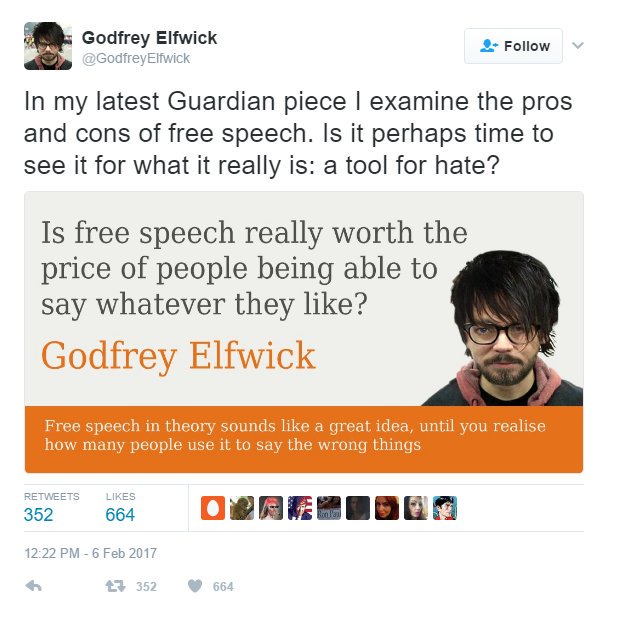
Godfrey Elfwick’s disturbingly accurate summary of free speech support among the woke.
After several years of creeping illiberalism under the guise of progressive politics, American liberals are finally getting their act together. They are pushing back, creating several organizations committed to combating the influence of “woke” politics and ideology. They have momentum, not just because many woke mantras like “defund the police” have proven spectacularly unpopular, but also because there is genuine growing alarm about the intolerant and authoritarian brand of politics that has become associated with the woke left.
Unfortunately, many of the woke genuinely do not understand why anyone finds their politics, or their political tactics, threatening. In particular, the accusation that they are being authoritarian, or that “cancel culture” is a threat to freedom of expression, is one that they are simply unable to process.
There is a reason for this — and one that’s worth understanding. There are several key phrases that play an enormously important role in woke politics (e.g. “safety”, “mental health”, “microaggression”, “bullying” and even “human rights”) which they use to deflect the accusation of authoritarianism. If you adopt the right words, it’s easier to convince yourself that you’re the good guys even as you’re acting like the bad ones.
I want to take a shot at explaining how this works.
The most important thing to understand about woke politics is that it is not a conventional form of illiberalism, it is better thought of as a type of “illiberal liberalism”. It involves making a set of political demands that are fundamentally illiberal, but then articulating them in a way that fits the conventional structure of liberal political discourse. Because of the way that their complaints are packaged, the woke are able to brush off criticism of their tactics.
Take an issue like freedom of speech. There are various versions of this traditionally liberal virtue; predominant among them, is that those who hold this belief are opposed to content-based restrictions on speech. In the old days, lots of politicians didn’t really believe in freedom of speech, as many among the ruling class maintained straightforwardly illiberal views.
June 21, 2021
“… the GOP needs an inflammatory issue to rile their racist base, and so this entire foofaraw is really just an astro-turfed, ginned-up partisan gambit about nothing”
An excerpt from Andrew Sullivan’s most recent Weekly Dish looks at the burgeoning fight over the use of Critical Race Theory in public schools:
The stories in the mainstream media this past week about the broadening campaign to ban critical race theory in public schools have been fascinating — and particularly in how they describe what CRT is. Here’s the Atlantic‘s benign summary of CRT: “recent reexaminations of the role that slavery and segregation have played in American history and the attempts to redress those historical offenses.” NBC News calls it the “academic study of racism’s pervasive impact.” NPR calls CRT: “teaching about the effects of racism.” The New York Times calls it, with a straight face, “classroom discussion of race, racism” and goes on to describe it as a “framework used to look at how racism is woven into seemingly neutral laws and institutions.”
How on earth could merely teaching students about the history of racism and its pervasiveness in the United States provoke such a fuss? No wonder Charles Blow is mystified. But don’t worry. The MSM have a ready explanation: the GOP needs an inflammatory issue to rile their racist base, and so this entire foofaraw is really just an astro-turfed, ginned-up partisan gambit about nothing. The MSM get particular pleasure in ridiculing parents who use the term “critical race theory” as shorthand for things that just, well, make them uncomfortable — when the parents obviously have no idea what CRT really is.
When pushed to describe it themselves, elite journalists refer to the legal theories Derrick Bell came up with, in the 1970s — obscure, esoteric and nothing really to do with high-school teaching. “If your kid is learning CRT, your kid is in law/grad school,” snarked one. Marc Lamont Hill even tried to pull off some strained references to Gramsci to prove his Marxian intellectual cred, and to condescend to his opponents.
This rubric achieves several things at once. It denies that there is anything really radical or new about CRT; it flatters the half-educated; it blames the controversy entirely on Republican opportunism; and it urges all fair-minded people to defend intellectual freedom and racial sensitivity against these ugly white supremacists.
What could be more convenient? NBC News “reporter”, Brandy Zadrozny, even decried parents’ attempts to discover through FOIA requests just what their children are being taught — and argued this week that, “for longtime ultra conservative activists, CRT is the opportunity of a lifetime.” CRT, she explains, is not a threat at all, and there is no proof that it is even being taught. It’s “just a catch-all term repurposed as a conservative boogeyman.” She goes on: “it harnesses pushback against 2020’s racial justice movement, covid denialism, and depends on a base still energized by Trump and misinformation, looking for political power.”
I’m sure the MSM will continue to push this narrative indefinitely. They are still insisting, after all, that “white supremacy” is behind hateful attacks on Asian-Americans, and that soaring murder rates are purely a function of Covid19. And you can see why: this dismissive take is extremely helpful in avoiding what is actually happening. It diverts attention from the stories and leaks and documents that keep popping up all over the place about extraordinary indoctrination sessions that have become mandatory for children as early as kindergarten.
June 20, 2021
QotD: Cargo cult thinking in education
The problem of course is that college is not the cause of prosperity, but a marker (with prosperity) of other traits — focus on long-term goals, discipline, hard work, and yes knowing 2+2=4. This sort of woke BS just makes it worse, because it attacks the real roots of prosperity. There are real barriers to poor blacks achieving prosperity — eg how do you focus on long-term goals when you don’t know where you are sleeping tonight or when you have no role models who do so — but the purity and objectivity of math is not among these.
This sort of cargo cult thinking can be seen all the time in Progressive economic proscriptions. The government push for home ownership is another — middle class people own homes so if low income people owned homes they would become middle class. Now, this has a bit of accuracy in that, like the stock market, the elite have goosed the housing market to always go up. But leaving that aside for a moment, owning a home vs renting is a terrible decision for many people — it piles on a lot of financial risk but perhaps more importantly it limits geographic mobility which used to be critical to lower-income people improving their lot.
Warren Meyer, “Are the Woke a False Flag Operation of White Supremacists?”, Coyote Blog, 2021-02-16.
June 11, 2021
The concept of philanthropy is another one with conflicting meanings to the left and to the right
In the Daily Chrenk, Arthur Chrenkoff has a bit of fun outlining the recent kerfuffle over Alexandria Ocasio Cortez’s attempt to use her grandmother’s situation in Puerto Rico for scoring political points, and then explains why the notion of philanthropy is a very different thing to progressives than it is to conservatives:
“Charity in the dictionary” by HowardLake is licensed under CC BY-SA 2.0


Well may we laugh about (and be disgusted by) the hypocrisy, corruption and indifference shown by prominent members of the left towards the very people they supposedly care about. But it would be to miss the broader point relating to how the left views the world, the role of politics, and the place of the individual.
It might surprise many that the caring and compassionate left isn’t actually all that big on philanthropy and charity, i.e. people helping other people. What could be wrong with that? Wouldn’t the world be a better place if even more people helped even more other people? Well, no, the left would say, because it’s not something that people should be doing in the first place; it’s not their responsibility. It is up to the state to solve all the social and economic problems; our role as citizens (as well as, thanks to the open borders advocates, non-citizens) is to be the grateful recipients of the government’s largesse. For the more elite group (no pun intended) – “the rich” – their role is to pay for all this with their taxes. Private initiative is by its very nature limited and patchy; only the all-seeing and all-powerful state can ensure that everyone who needs “free” assistance (and that’s literally everyone) gets it in a comprehensive, uniform and fair way. Hence, AOC won’t lift a finger to help her grandmother because it’s the state’s duty to help everyone rebuild their lives after a natural disaster. Occasional Cortex already contributes with her taxes on the hard-earned Congressional salary, and in any case, she’s not some billionaire, you know.
With that attitude, needless to say, you won’t be surprised to learn that much of what goes for the left-wing philanthropy does not actually go to help those in need to solve their problems and provide them what they are lacking. Instead, it is largely channels to finance political agitation by the activist-industrial complex to make the government (whether through lobbying, campaigning or helping elect sympathetic law-makers) take responsibility instead. That’s what people like Soros, Laurene Powell-Jobs (Steve Jobs’ widow) and MacKenzie Scott (Jeff Bezos’ ex) are all about – billions spent to create more activist jobs to agitate for the state to create more public sector jobs to run the “Big Daddy”.
But it goes deeper than that, back to Marx himself in fact and to his analysis of what’s wrong with the world and how to fix it. According to Marxism, both in its original class-based iteration and the more recent race/gender/sexuality variants, every society is divided into two mutually antagonistic groups: the powerful oppressors and the powerless oppressed, with the society structured in the interest of the former by facilitating in every possible way the exploitation and keeping down of the latter. Thus, all the problems, ills and injustices are “systemic” in nature; they are a feature, not a bug. To solve them and so to help the downtrodden you need to overthrow the entire old unjust system and build a new one that benefits the masses. Based on this sort of understanding of the world – to which, coincidentally, people like AOC and BLM founders all subscribe – any private charity is bound to be ineffectual and shortcoming. After all, what can a person, however generous with their money and time – even if there are multitudes of them – do to solve problems that are the direct (and intended) consequence of the way the society has been set up? Nothing, of course. You can’t mend it, you have to end it. But not only is it naïve and pointless to try, it’s actually counter-productive and therefore positively wrong. Because while no philanthropic effort can solve systemic problems, it can actually provide some limited and temporary relief. Such relief, however, by its very nature is a band-aid solution, i.e. not a solution at all. All it does it momentarily numbs the pain, and that is bad, because the oppressed masses need to feel the pain and feel it good in order to spur them into revolutionary action to overthrow their oppressors and on the ruins of the old build the utopian new society of equality and justice. This is the far-left’s accelerationism: the worse it gets, the better it gets (for the prospects of radical change).
June 7, 2021
QotD: Toronto in summertime
On the other hand, the raccoon population appears to be dwindling. It would seem that the skunks are driving them away. Perhaps they will turn on the coyotes, next.
The geese and swans along the Lakefront are also acting unionized, having long nursed a powerful dislike for the city’s other inhabitants. They are large, and forceful in expressing their opinions. Ditto, the trolley drivers. And the schoolchildren are about to be released from their cages, in time for what is now called “Canada Day.” Monstrous little creatures in the main, especially after they have shot up their drugs. (The older-looking ones are their teachers.)
David Warren, “Sumer is icumen in”, Essays in Idleness, 2018-06-16.
June 6, 2021
Decoding NPR’s revised approach to reporting in a social justice age
At Ace of Spades H.Q., K.T. listens to some NPR broadcasts (so you don’t have to) including an insight into how NPR and probably other media organizations are changing how they report the news:

We Hold These Truths: How Newsroom Leaders Wrestled With Covering A Tumultuous Year
This was sort of a panel discussion (light on the “discussion”), with commentary on things like how social media pressured newsrooms, for example, to say that “police murdered George Floyd” rather than “George Floyd died”.
But I kind of homed in on an academic phrase that bothers me. Sara Just from PBS:
Yeah, I think that you’re absolutely right. There’s been a deeper understanding and deeper conversation about how much our lived experiences play into the reporting that we do. And there’s no question that it does for each and every one of us in different ways. And I think that lived experience we especially highlight now is valuable, whether it’s race or gender or the challenges. I don’t think people with those lived experiences have to carry the burden, though, of being the only ones to report on it by any means. And so that’s something that we are always balancing. (emphases mine)
So, are they balancing whether or not people without “lived experiences” can report on issues involving “lived experiences”? Like Lori Lightfoot deciding she would only do one-on-one interviews with journalists of color? Will white people be allowed to report on stories involving black people? Will men be allowed to report on stories involving women?
This is partly about local sources, but it is largely about people thought of as being in “oppressed groups”. This panel is informing us that news reporting will now be filtered through the language and perspective of Critical Social Justice, whether we realize it or not.
The indispensable Translations from the Woke at New Discourses provides the following information on Lived Experience:
In the Theory of Critical Social Justice, for what turn out to be surprisingly deep and philosophically (almost) sophisticated reasons, lived experience is the overwhelmingly primary way in which knowledge can be obtained. This should not be mistaken to mean one’s firsthand experience, which most of us already recognize to provide a rather weak claim upon knowledge, though it is both implied and claimed that this is what “lived experience” refers to in Critical Social Justice. Lived experience, as Critical Social Justice uses the term, refers more specifically to one’s life experiences in allegedly systemic power dynamics of dominance and oppression that shape society structurally as understood with a critical consciousness and interpreted through Theory. That is, one’s “lived experience” refers to the interpretation that Critical Social Justice Theory gives for the anecdotal accounts of experiences one has had.
Because “lived experience” refers to an interpretation through Theory, it is only the “lived experience of oppression,” as Theory will have it, that counts …
It appears that you can’t really understand the reporting on PBS, and probably NPR, now unless you have studied Critical Social Justice.
Certainly, the claimed “lived experience” of members of dominant groups cannot be in any way used to challenge or dispute the assertions of Theory or those claiming to speak from it …
This restriction extends to members of “minoritized” groups who disagree with Theory as well — Theory cannot be authentically disagreed with. One might think that the lived experience of a member of oppressed groups would be admissible as a valid challenge to the claims of Theory, but this not so. They may be talking about their own experiences in life, but they aren’t appealing to lived experience, which must comport with Theory …
This is all very confusing and appears to be exactly what it is — a form of manipulating knowledge and epistemology as a means of asserting power and rigging the system such that those assertions of power cannot be challenged. Nevertheless, it isn’t merely an application of power and has a rather interesting and deep philosophical explanation that must be understood to understand why “lived experience” holds the status that it does and why it must comport with Theory to be granted veridical status and epistemic weight. This has everything to do with the fact that the roots of Critical Social Justice are in critical theories and, especially, postmodern philosophy.
There is much more, but it is way too deep to include here.
The NPR panel goes on to discuss new understandings of “balance” and “objectivity”. They do not intend to be objective. “Balance” will mean something different than what it has meant in the past in the news business.
Many people have found the way that TV news shows report on events since 2016 to be rather different than what they’d been used to before that. Some changes are subtle and others are quite blatant and hard to ignore unless you already agree with the viewpoint of the presenter. TV news used to at least pretend to present the news objectively but from the start of the Trump presidency most media outlets abruptly changed from a pseudo-objective (but leaning progressive) to an outright full-on progressive stance from start to finish with little or no attempt to provide other points of view for balance.
QotD: The Soviet Union in the Cold War, China today
Needless to say, it was gibbering nonsense. The late ’80s Soviet collapse revealed that the USSR was never any kind of power at all – an economy that didn’t produce, weapons that didn’t work, a populace addicted to drink and overwhelmed with despair. “Bulgaria with nukes” is how someone characterized it, and truer words were never spoken. That remains the case today, despite Vlad Putin’s chest-beating, and it’s likely to remain the case as far ahead as anyone can see.
The same trope is being repeated regarding China. China, we are told, is the coming nation. The second largest economy on Earth, soon to be the first. A billion and a half people, each more educated than any American; a military power second to none, with advanced weapons of a nature that we can only gape at. A country exercising its power over vast reaches of the Pacific and moving into the Indian Ocean, Africa, and the Mideast with no one to oppose it.
We hear this from the likes of Thomas Friedman, who has spent much of his career looking for his personal Mussolini. It’s repeated by deeper figures across the political spectrum. In fact, it can be said without exaggeration to have become received wisdom.
There’s no point in asking how true this is. The proper question to ask is whether it embodies any truth at all.
J.R. Dunn, “The Myth of China as Superpower”, American Thinker, 2019-01-09.
May 30, 2021
New frontiers in cultural appropriation
John McWhorter considers the notion that white people shouldn’t be allowed to use “black” words and phrases because it’s a form of cultural appropriation and therefore another aspect of white supremacy:

Screencap from NBC’s Saturday Night Live highlights for “Gen-Z Hospital” skit.
A little while ago, a Saturday Night Live skit depicted a multiracial group of teens communicating in what was depicted as “Gen Z slang”, with the doctor they were talking with having to “translate” his thoughts into it to communicate with them.
A lot of people didn’t like it, because the slang in question was mostly of Black English origin. The complaint is that the skit was denying the black roots of these terms, and instead ascribing them to Americans in general – i.e. (shudder) white persons. As in, yes – the problem was cultural appropriation.
As I write, there are still people grousing on social media in the wake of that skit about whites “stealing” black language, with a leitmotif being that we should apply our N-word taboo more widely. To wit, many propose that whites should not be allowed to use Black English terms because they are “ours”. Many who haven’t outright proposed this give the notion Likes, which suggests that a considerable group of people – and from what I can see, quite a few of them are white – concur with this line of reasoning.
Let’s break this down. To do so we must understand the sorts of terms in question. The SNL skit included, among others, yo, bestie, vibes, feels for feelings, salty for irritated, bro / bruh and no cap for “I’m not kidding” (as in, these are actual whole gold teeth, not golden caps on teeth).
Is there a case that you should only use these terms if you’re black, or that if you use them as a white person you should “do the work” of thinking hard about whether or not it is problematic (blasphemous)?
May 29, 2021
QotD: Academia and capitalism
One of the mistakes folks on the Left make about capitalism is to describe capitalism as mostly about competition. In fact, capitalism is mostly about cooperation, it’s a self-organizing process where people who don’t even know each other cooperate to deliver products and services, facilitated by markets and the magic of prices. Sure, competition exists but it is not the fundamental feature, but an enabler that makes sure the cooperation occurs as efficiently as possible. Capitalism in fact is about zillions of voluntary trades and transactions every day that each make both parties better off — or else both sides would not have agreed to it. Capitalism in fact is a giant positive sum game, a fact that many on the Left simply do not grasp.
Warren Meyer, “Does the Zero-Sum Nature of Academic Success Contribute to the Left-wards Bias of Academia?”, Coyote Blog, 2018-11-09.


