Quotulatiousness

January 5, 2022

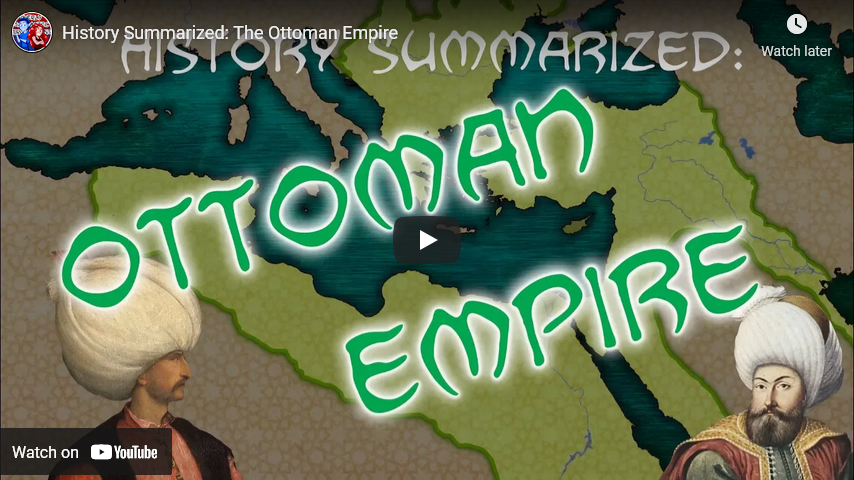
History Summarized: The Ottoman Empire

Overly Sarcastic Productions
Published 5 Oct 2018

Leave it to the furniture boys to pioneer a Comfort-First attitude towards Imperialism.

Join Blue in investigating the history of the Ottoman empire, and find out why “The Sick Man of Europe” is more than their nickname implies.

Further reading: Osman’s Dream by Caroline Finkel

Famous Turkish Song — Gunduz Gece: https://www.youtube.com/watch?v=2UcbH…

PATREON: www.patreon.com/OSP

MERCH LINKS:
Shirts – https://overlysarcasticproducts.threa…
All the other stuff – http://www.cafepress.com/OverlySarcas…

Find us on Twitter @OSPYouTube!

December 29, 2021

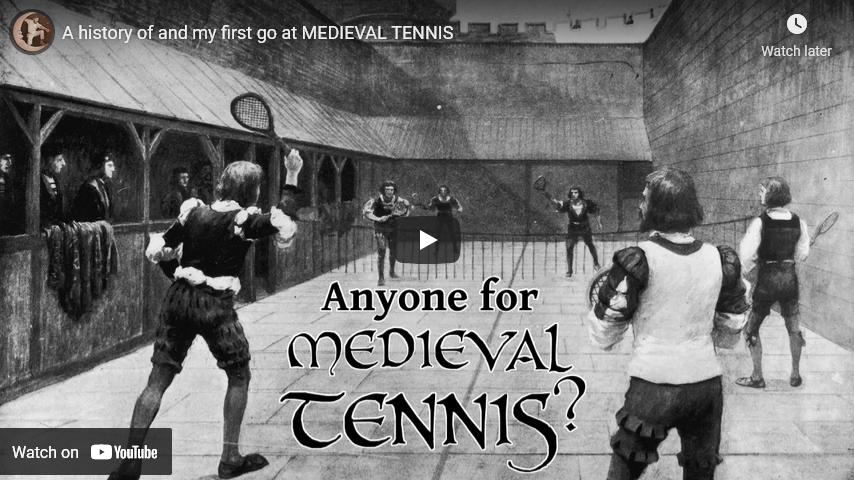
A history of and my first go at MEDIEVAL TENNIS

Filed under: Britain, France, History, Sports — Tags: , , , , , — Nicholas @ 02:00

Lindybeige
Published 28 Sep 2021

Thanks to Audible for sponsoring this video. New Audible members get a 30-day free trial. Visit http://audible.com/lindybeige or text “lindybeige” to 500 500 to try Audible today.

Tennis is a very old sport, going back at least to the 1200s. Here I try my hand at it for the very first (but not last) time, and talk about the history of it a bit.

Many thanks to Jesmond Dene Real Tennis Club (https://www.jdrtc.co.uk) where this was shot.

Editing this took a LONG time. We had three cameras recording at the same time, and synching the footage up took an age. The sound consisted mainly of echoing footsteps and ball bounces, and the fact that the main microphone kept glitching did not help (you will notice some of the patches to the sound using other mics, but most I made fairly smooth).

Court map by Atethnekos at English Wikipedia, CC BY-SA 3.0, https://commons.wikimedia.org/w/index…

Anne Boleyn picture by English school – https://thetudortravelguide.com/2019/…, Public Domain, https://commons.wikimedia.org/w/index…

Support me on Patreon: https://www.patreon.com/Lindybeige

Buy the music – the music played at the end of my videos is now available here: https://lindybeige.bandcamp.com/track…

Buy tat (merch):
https://outloudmerch.com/collections/…

Lindybeige: a channel of archaeology, ancient and medieval warfare, rants, swing dance, travelogues, evolution, and whatever else occurs to me to make.

▼ Follow me…

Twitter: https://twitter.com/Lindybeige I may have some drivel to contribute to the Twittersphere, plus you get notice of uploads.

My website:
http://www.LloydianAspects.co.uk

December 27, 2021

Prince Philip was born in Greece, but was never “of Greece”

Filed under: Britain, Europe, Greece, History, Middle East, Military — Tags: , — Nicholas @ 03:00

Aris Roussinos outlines the surprisingly complex history of Prince Philip’s family in Greece and explains why His Royal Highness could never really be considered Greek, despite the tabloid nickname “Phil the Greek”:

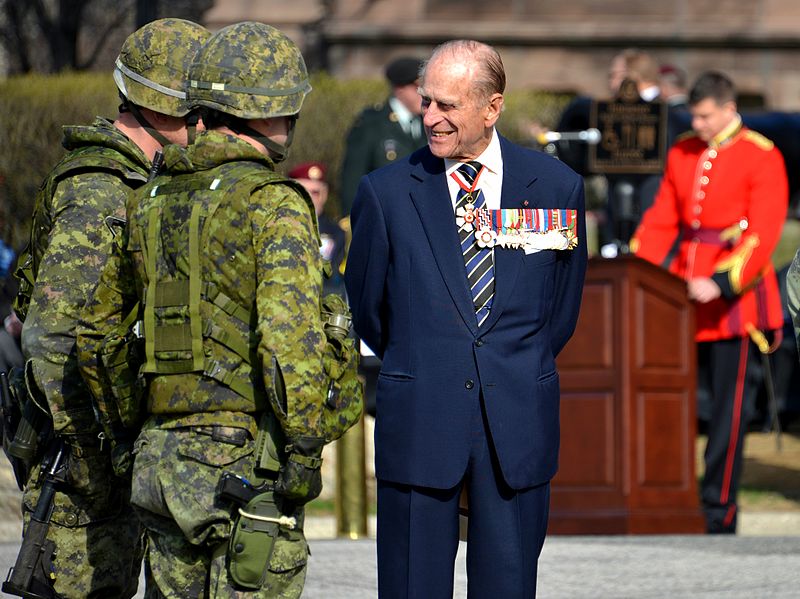
HRH Prince Philip, the Duke of Edinburgh, Colonel-in-Chief of the Royal Canadian Regiment, presenting the 3rd Battalion with their Regimental Colours, 17 April 2013. (via Wikipedia)

Though most people know that Prince Philip was born in Greece and almost immediately exiled, the precise circumstances of this leaving of his native country are surprisingly obscure. How many are aware, for example, that if Ataturk had lost the 1921 Battle of the Sakarya River, outside Ankara, not only would modern Turkey not exist, but neither would Princes Charles, William and Harry?

The existence of our future kings is the chance product of the tumult accompanying the collapse of the Ottoman Empire. It is a dramatic illustration of the Butterfly Effect, whereby random events on one corner of the European continent totally reshaped timelines on the other: indeed, we could declare the prime mover in the events that placed the Duke of Edinburgh as our Queen’s consort to be an aggrieved Greek monkey.

On 2 October, 1920, Prince Philip’s uncle, King Alexander of Greece, was taking the air in the grounds of the royal palace of Tatoi, outside Athens. His German Shepherd dog, Fritz, attacked a Barbary Macaque belonging to a member of his staff. As the King rushed to extract the screaming monkey from Fritz’s jaws, the macaque’s furious mate sunk its teeth into the king’s leg. Alexander contracted sepsis, and died just over three weeks later, throwing Greece into a succession crisis, and totally reordering the subsequent history of the Near East. As Churchill later wrote, “it is perhaps no exaggeration to remark that a quarter of a million persons died of this monkey’s bite”.

King Alexander’s septic leg, like the rest of the Greek royal family, possessed not a drop of Hellenic blood — something Prince Philip reportedly made clear to a Greek visitor to Buckingham Palace who dared to claim ethnic kinship with his host. Back when the small Balkan nation finally won its independence from the Ottoman Empire, in 1831, the European Great Powers had decided on the Bavarian Wittelsbach dynasty to rule the poor and volatile Greeks. When the Wittelsbach King Otto was forced from his throne by the revolution of 1862, the Great Powers reconvened, and chose the 17-year old Prince William of Denmark, Prince Philip’s grandfather, as Greece’s new king. As he would later instruct his children, “You must never forget that you are foreigners in this country, but you must make them [the Greeks] forget it.”

After the disastrous war against the Turks, six military leaders were tried and executed by firing squad, and Prince Philip’s father Prince Andrew, was accused of disobeying an order while in command of a Greek corps:

As the historian Michael Llewellyn-Smith noted in his excellent book on Greece’s Asia Minor campaign Ionian Vision, “whether or not Andrew had been guilty of insubordination, it was an absurd charge to bring fifteen months after the event, given that he had not been relieved of his command at the time.” On 3 December, Andrew took the stand. A staff officer, Colonel Kalogeras, stated that Andrew had refused to attack despite direct orders. Colonel Sariyannis and General Papoulas both attested that if Andrew had carried out Papoulas’ orders, the Greeks would have won the day at Sakarya. Andrew was unanimously found guilty of disobedience and abandoning his post and sentenced to be stripped of his rank and banished permanently from Greece.

Andrew expected to be executed in his cell at any moment. However, in the background, the Greek revolutionary General Nikaloaos Plastiras, a future three-time Prime Minister of Greece, had been negotiating with the British government, which had broken off formal diplomatic relations with Greece since the execution of the Six. They agreed that Andrew would be permitted to leave Greece on a British warship.

And so, a few months after his birth, Prince Philippos of Greece left Mon Repos, Corfu and Greece on the British destroyer HMS Calypso, along with his mother and father and into a life of exile. Philippos was, famously, carried onto the warship in an orange crate instead of a cot. His father Prince Andrew settled into a life of exile in France, writing a book Towards Disaster, translated by Philip’s mother Princess Alice, which aimed to justify his actions at Sakarya as necessary to avoid a pointless loss of life in a losing battle. When the monarchy was restored in Greece, Andrew refused a commission for Philip in the Hellenic Navy, saying “Never the Greek Navy! In the Greek Navy after a bit they would throw him out – that’s what they did to me, not once, as you know, or twice, but three times!”

Instead, Philip served gallantly in the Royal Navy during the Second World War, and was awarded the Greek War Cross for his actions at Cape Matapan. While his son Prince Charles became a benefactor of the Greek monastic republic of Mount Athos and frequent visitor to Corfu, and who is widely considered to be a Phillhellene with a strong mystical attachment to the Greek Orthodox faith of his grandparents, Prince Philip described himself as “a discredited Balkan prince of no particular merit or distinction”. For despite his nickname as “Phil the Greek”, he felt no great affection for the country and the uneasy crown it offered its foreign rulers. As he once said of the land of his birth and the mercurial people it contains, “I certainly never felt nostalgic about Greece. A grandfather assassinated and a father condemned to death does not endear me to the perpetrators.”

December 23, 2021

Cheshire and Durham in the English Parliament

Filed under: Britain, Government, History — Tags: , , , , , — Nicholas @ 05:00

In his end-of-the-year Age of Invention newsletter, Anton Howes looks at two of the historic counties of England that lacked Parliamentary representation until surprisingly late dates:

Cheshire and Durham (post-medieval boundaries: English county boundaries have varied wildly over the centuries).
Base map by Hogweard at Wikimedia Commons.

England, compared to other parts of Europe, is often said to have been remarkably centralised early on. France, for example, in the late eighteenth century had some thirteen or so regional parliaments, while Britain just had the one. Scotland’s separate parliament was famously dissolved in 1707, with the official union of Scotland with England. Wales gained representation at the English parliament at Westminster from 1536. So far so expected.

But less well-known is that the county of Cheshire — some of it now disappeared under Greater Manchester — used to have an entirely separate parliament of its own, and was not represented at Westminster until 1543. Arguably, it has about as much historical claim to a national assembly today as Wales. Rule of Cheshire was even, very briefly, included among the various titles of the monarch. Richard II, as well as being king of England, was in 1397-99 also styled “Prince of Chester”. He drew his personal bodyguard from among the men of Cheshire too. So whatever happened to Cheshire nationalism?

On a related note: the mantra “no taxation without representation” looms large in the history of American independence. But parts of England itself had gone unrepresented for decades too. County Durham, traditionally ruled by its prince-bishop, was not represented by any MPs in the House of Commons at all until 1654. And as it only gained representation under the revolutionary Protectorate, this was undone upon the restoration of the monarchy in 1660. The county would not be represented again until 1675.

Why? One might argue that the bishop of Durham, who sat in the House of Lords, could be considered its parliamentary representative. But he was not elected, and most importantly had little say over the matter of parliamentary taxation, which was controlled by the Commons. Before 1603 this was not much of an issue, as county Durham was exempt from various taxes because it was near the hostile Scottish border. But the accession of James VI of Scotland to become king of England meant that the hostile border suddenly disappeared. County Durham thus became subject to parliamentary taxation without having any say over those taxes at all — a situation that they then had to bear for over sixty years! Where were the Durham revolutionaries?

December 21, 2021

QotD: The Royal Victimhood Olympics

Filed under: Britain, Humour, Media, Quotations — Tags: , , , — Nicholas @ 01:00

It’s funny to think that, when I was a child, the Queen’s Christmas speech was the cue for the nation to fall into a collective postprandial slumber. For the past few years, her nearest and dearest have seen to it that her life has outdone any Bond film when it comes to anticipation of what fresh hell awaits our battle-sore yet unbowed hero(ine) around the next corner. Is she going to ignore her favourite son’s alleged association with a dead paedophile? Her grandson’s allegation that her family contains a racist?

It’s certainly been a bumpy old ride of a year, making Her Majesty’s annus horribilis look like a teddy bears’ picnic. But though I’m not a royalist, I’m counting on this most stiff-upper-lipped of ladies not to mention those two little words which were inescapable this year: “mental health”, or the Mental Elf, as I’ve come to think of him.

Remember our old friends Elf and Safety? They’ve been replaced by Mental Elf, and he’s even more annoying, a nasty little imp intent on making every single member of this once-stoic island race confess to hidden sorrows.

The Royal Victimhood Olympics are now an open-season event, like tennis. The Prince of Wails had a head start, moaning about being sent to boarding school by his “distant” mother who – shame on her! – was a young woman doing her very best in a role she had neither wanted nor expected. Meghan Markle famously fled Frogmore Cottage with the Mental Elf in hot pursuit. Prince William, who appeared to be the sensible one, revealed this week he felt as if “the whole world was dying” after he helped save the life of a child while working as a helicopter pilot for the air-ambulance service.

And of course Sarah Ferguson has referred to herself as “the most persecuted woman in the history of the royal family”. All we need now is for Duchess Kate to weigh in with a detailed account of, say, her PMS problems and we’ve collected the full set of Unhappy Royal Families!

Yes, I know Princess Diana started it. But neurosis was just a part of her emotional repertoire. She realised that one of the best guarantees of good mental health is helping others rather than contemplating one’s navel. Or in the case of the wretched Fergie, one’s novel. The writing of Her Heart for a Compass was reportedly “therapeutic” and boosted her “self-esteem”. Is the world big enough for a more self-loving Fergie?

Julie Burchill, “The Queen is the last sane royal standing”, Spiked, 2021-12-09.

December 18, 2021

King James and the search for ready cash

Filed under: Britain, Economics, Government, History — Tags: , , , — Nicholas @ 03:00

In the latest Age of Invention newsletter, Anton Howes outlines how and why England’s new Stuart king found himself in desperate financial straits very early in his reign:

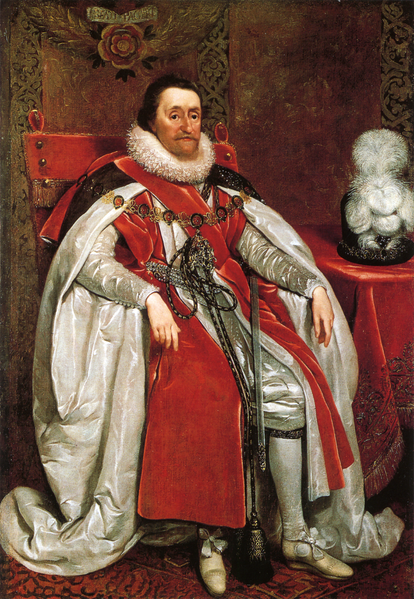
King James I (of England) and VI (of Scotland)
Portrait by Daniel Myrtens, 1621 from the National Portrait Gallery via Wikimedia Commons.

… after a generous honeymoon period of about a year, he and his government soon discovered that they were leaking cash. Despite eliminating the costly wars in Spain and in Ireland, James still had to pay off the debts that his predecessor Elizabeth I had incurred in fighting them. And he had a more extensive, and expensive, royal family to support. He traded the one-off expenses of war for the ongoing expenses of a profligate court.

This may sound like a good deal. James effectively stopped the English Crown splashing out money on really big but infrequent expenses, while increasing its ongoing expenditure — like refraining from buying a new car every few years, while spending a lot more each month eating out at restaurants.

But the Crown’s sources of revenue were ill-suited to this change. The funding for wars had been voted to Elizabeth by Parliament, usually as and when the need arose. Such expenditures were matters of national interest, and she otherwise just relied on other sources of income — ongoing taxes like customs duties, or simply the rent from her lands. When the one-off “subsidies” granted to her by Parliament had not quite been sufficient to cover the costs of the wars, Elizabeth had made up the difference by keeping her own ongoing expenses as low as possible, and took out loans to fill any gaps. It also helped that in the years before crises, Elizabeth had tried to run a surplus, building up a war-chest of cash to dip into.

So switching to the new pattern of expenditure was not straightforward. To increase the Crown’s ongoing expenses, it would have to find more sources of ongoing income, especially as it was already in deficit and had loans to pay off. It was politically impossible for James to ask Parliament for extra one-off subsidies to help him bridge the gap, as some of Elizabeth’s subsidies from 1601 had yet to even be collected. He did actually test the waters about what would happen if he did ask, just in case, but when the matter was raised by some would-be sycophants, it was met with outrage. As one member of Parliament angrily put it, “we have no sheep that yields two fleeces in the year.”

The country was already feeling over-taxed, there were no looming crises to justify such extra taxation, and even if there were, such one-off measures would be unsustainable. James needed to find revenue streams to match his spending leak — and ideally, to even exceed it. His ministers fretted about getting the Crown back into surplus again, to build up another war-chest. Who knew when the next war or rebellion might arise.

So when James called his first Parliament in 1604, it was not really to ask for one-off subsidies as Elizabeth had so often done. Instead, he and his ministers focused on outlining a series of financial deals.

December 17, 2021

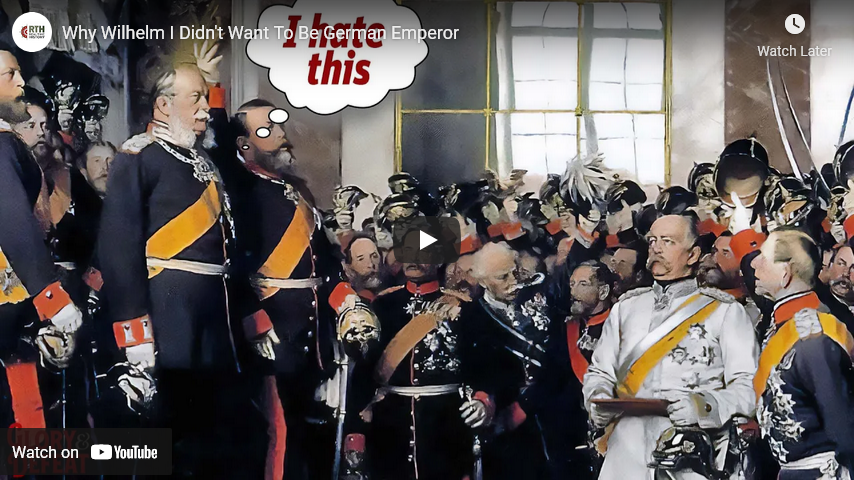
German States Vote For Unity – Battle of Nuits-St. Georges 1870 I GLORY & DEFEAT Week 23

Filed under: France, Germany, History, Military — Tags: , , , , , — Nicholas @ 06:00

Real Time History
Published 16 Dec 2021

Sign up for Curiosity Stream and get Nebula bundled in and SAVE 26%: https://curiositystream.com/realtimeh…

While the German delegations arrive in Versailles to set in motion the unification of the German states into a German Reich, the people in nearby Paris are starving and their army is still fighting in the countryside.

» THANK YOU TO OUR CO-PRODUCERS
John Ozment, James Darcangelo, Jacob Carter Landt, Thomas Brendan, Kurt Gillies, Scott Deederly, John Belland, Adam Smith, Taylor Allen, Rustem Sharipov, Christoph Wolf, Simen Røste, Marcus Bondura, Ramon Rijkhoek, Theodore Patrick Shannon, Philip Schoffman, Avi Woolf,

» OUR PODCAST
https://realtimehistory.net/podcast – interviews with historians and background info for the show.

» LITERATURE
Arand, Tobias: 1870/71. Der Deutsch-Französische Krieg erzählt in Einzelschicksalen. Hamburg 2018

Gouttman, Alain: La grande défaite. 1870-1871. Paris 2015

» SOURCES
Hérisson, Maurice d’: Journal d’un officier d’ordonnance. Paris 1885

Kriegsgeschichtliche Abteilung des Großen Generalstabs (Hrsg.): Der deutsch-französische Krieg 1870-71. 2.2. Berlin 1880

Kürschner, Joseph (Hrsg.): Der große Krieg 1870-71 in Zeitberichten. Leipzig o.J. (1895)

Meisner, Heinrich Otto (Hrsg.): Kaiser Friedrich III. Das Kriegstagebuch von 1870/71. Berlin, Leipzig 1926

Pietsch, Ludwig: Von Berlin nach Paris. Kriegsbilder 1870-71. Berlin 1871

Schikorsky, Isa (Hrsg.): “Wenn doch dies Elend ein Ende hätte”. Ein Briefwechsel aus dem Deutsch-Französischen Krieg 1870/71. Köln, Weimar, Wien 1999

» OUR STORE
Website: https://realtimehistory.net

»CREDITS
Presented by: Jesse Alexander
Written by: Cathérine Pfauth, Prof. Dr. Tobias Arand, Jesse Alexander
Director: Toni Steller & Florian Wittig
Director of Photography: Toni Steller
Sound: Above Zero
Editing: Toni Steller
Motion Design: Philipp Appelt
Mixing, Mastering & Sound Design: http://above-zero.com
Maps: Battlefield Design
Research by: Cathérine Pfauth, Prof. Dr. Tobias Arand
Fact checking: Cathérine Pfauth, Prof. Dr. Tobias Arand

Channel Design: Battlefield Design

Contains licensed material by getty images
All rights reserved – Real Time History GmbH 2021

December 10, 2021

History Summarized: Britain and the Empire

Overly Sarcastic Productions
Published 20 Aug 2021

How is it that the history of some islands off the northern coast of Europe balloons into a worldwide history? Empire is how! Let’s dig into the history of Britain since Union of the Crowns of England and Scotland in 1603, and follow that narrative through the monumental rise and precipitous fall of the British Empire.

Special thanks to the community members on Discord who assisted me with my script: Corvin the Crow, Johnny, Jdedredhed, Joud, Jéuname, Klieg, RileyTheProcrastinator, The Missing Link, and thesleepingmeerkat

SOURCES & Further Reading: The Great Courses Lecture series Foundations of Western Civilization II: A History of the Modern Western World by Robert Buchols lectures 11, 12, 13, 14, 15, 18, 19, 20, 21, 22, 30, The History Of England volumes 3 Rebellion, 4 Revolution & 5 Dominion by Peter Ackroyd, Scotland: A Concise History by Fitzroy MacLean, The Great Cities in History by John Julius Norwich, A Concise History of Wales by Geraint H. Jenkins, Sea Power: The History and Geopolitics of the World’s Oceans by James Stavridis.

Our content is intended for teenage audiences and up.

PATREON: https://www.Patreon.com/OSP

PODCAST: https://overlysarcasticpodcast.transi…

DISCORD: https://discord.gg/osp

MERCH LINKS: http://rdbl.co/osp

OUR WEBSITE: https://www.OverlySarcasticProductions.com
Find us on Twitter https://www.Twitter.com/OSPYouTube
Find us on Reddit https://www.Reddit.com/r/OSP/

December 7, 2021

The Byzantine Army, Dark To Golden Age

Filed under: Europe, History, Middle East, Military, Religion — Tags: , , , , , , , — Nicholas @ 04:00

Epimetheus
Published 22 Mar 2019

The Byzantine army, Dark to Golden age

This video was sponsored by Skillshare

Sources
Romano-Byzantine armies 4th-9th Centuries (David Nicolle)
Larousse Encyclopedia of Ancient and Medieval History (Marcel Dunan)
The Late Roman Infantryman (Simon MacDowall)
Byzantium Beyond the Golden Gate
Fall of the West (John Lambshead)
The Late Roman Cavalryman (Simon MacDowall)

Tags:
Byzantine history, Byzantine, Byzantine documentary, Eastern Roman, Byzantine army, ancient history, Byzantine Cataphract, Byzantine Roman, history, Bulgaria Byzantium, Byzantine military, Byzantine legion, Byzantine empire, fall Byzantine, ancient, Rome, Constantinople, Byzantine empire documentary, crash course Byzantine empire, Byzantium, Byzantine army structure, Byzantine vs Roman, theme system, theme Byzantine, Roman tactics, Byzantine tactics, eastern Roman empire

From the comments:

Epimetheus
2 years ago (edited)
Notes/additional info:

1. Should the empire be called Byzantine, Roman or Greek? I see people arguing for each of these in the comments and there is merit to each of these; but it is important to note that they called themselves Roman, they were majority Greek in population and language spoken, and the term Byzantine is useful in differentiating the time period and has been colloquially used for a long time (although not during the empire) Being a reference to the earlier name of Byzantium for the city of Constantinople.

2. When I refer to “native troops” this includes many other ethnic groups living within the empire, notably the Armenians who lived in Anatolia for hundreds of years and had assimilated in many ways but maintained different views on aspects of the Christian faith which was the most striking differentiating factor between them and the rest of the population of the empire.

3. The Strategos and Domestikos label should be switched on the captions at 6 mins 17 secs in. A Strategos led a Thema(ta) and a Domestikos led a Tagma(ta). Unfortunately I switched those by accident and stared at the screen for a while and did not notice that … sorry guys ;(

4. The Varangian Guard was a personal bodyguard unit to the emperor which are pretty cool, they were mostly comprised of Norsemen (Scandinavians), Rus and Saxons. They are the unit I refer to when I mention a Scandinavian unit.

5. The coolest unit (in my opinion) that I did not mention was the Akritai which were kinda like the Cossacks in that they were a loosely controlled border guard on the eastern side of the empire; and were the subject of much folklore and poems and such.

December 4, 2021

When King James VI became King James I and VI

Filed under: Britain, History — Tags: , , , , — Nicholas @ 03:00

In his latest Age of Invention newsletter, Anton Howes discusses how the King of Scotland succeeded to the English throne as well:

King James I (of England) and VI (of Scotland)
Portrait by Daniel Myrtens, 1621 from the National Portrait Gallery via Wikimedia Commons.

It’s late March 1603, and an exhausted messenger arrives in Edinburgh bearing a sapphire ring. He has ridden for over two days straight, over hundreds of miles, and his hair and clothes are matted with blood — on the way he had fallen from his horse, a hoof striking him directly in the head. It’s a miracle he’s alive, but he knows it has been worth it. He is the very first to tell you that your childless first cousin twice removed — the killer of your mother, whom you never knew — is finally dead. You, King James VI of Scotland, are James I of England as well.

[…]

James’s accession was a frenzy. From the very moment of Elizabeth’s death, her entire patronage network was turned on its head. Her chief ministers, the Privy Council, were relatively safe. Some of them had been corresponding with James for years. But they could only look on, anxiously, as a rush of would-be cronies went north to meet their new king. The exhausted messenger with the sapphire ring, Sir Robert Carey, was just the first. Carey had been related to Elizabeth I on her mother’s side — he was her first cousin once removed. (Carey’s grandmother was the “other Boleyn girl”, played by Scarlett Johansson in the 2008 film — although there’s no solid evidence, it’s not totally impossible that Carey was actually related to Elizabeth on her father’s side instead …) But that family connection meant nothing now that the queen was dead.

The sudden reset of the source of all patronage meant that the earlier the access to the new king’s person, the greater the chance of gaining his favour. Carey may have angered the Privy Council by riding ahead of their formal letters to James, but his exertion won him an on-the-spot appointment as a gentleman of the bedchamber, and his wife became a lady in waiting to James’s queen. The Careys were soon charged with the care of the royal couple’s younger sickly child, and when that child eventually became Charles I, Carey was made Earl of Monmouth. Not a bad result for a head wound and a two days’ ride, though I’m sure the horses would disagree. An old proverb about England was that it was “a paradise for women, a purgatory for servants, and a hell for horses” — something that James’s accession really put to the test. One teenage noblewoman reported how she and her mother killed three horses in a single day, pushing them hard despite the heat, in their rush to meet the new queen.

Just as courtiers flocked to James, however, the king wanted to win friends and allies too. So he handed out favours like confetti. Before he had even reigned a single year, he had created 934 knighthoods — already more than the 878 that Elizabeth I, her generals, and her lord deputies in Ireland had created over the course of her entire 45-year reign. One morning, during his journey down to London, James knighted more people than Elizabeth had in her first five years — all before he’d even had his breakfast. The sheer volume of new knighthoods prompted Francis Bacon — one of about 300 to be knighted in London ahead of the coronation — to call it a “divulged and almost prostitute title”.

The same went for peerages. Elizabeth, over her long reign of almost half a century, had created only 18 new titles. James, before he had even been crowned, had already created 12 — mostly turning knights into lords, and raising some lords into earls. Along with the honours came grants of land, annual pensions, and one-off gifts — not only to James’s new English courtiers, but to his old Scottish favourites too. James’s arrival was an explosion of largesse. (Not all were happy about the relative loss of favour, of course […] at least one pro-invention courtier got involved in a treasonous plot against the new king and ended up losing his head.)

James’s largesse even extended to policy. As he triumphantly marched into London, he issued a proclamation to immediately suspend all of Elizabeth’s patent monopolies, to be re-granted pending review. (This did not apply to patents for trading corporations or guilds.) Rather than leaving the validity of patents to be tested in the common-law courts, at great legal cost to those affected, he would have his Privy Council systematically examine them first, only allowing them if they were in the public interest. He characterised it as a continuation — even a “perfecting” — of Elizabeth’s partial measures a couple of years earlier, which we discussed in Part II. With his proclamation also condemning various other unpopular things, like high court fees, his new subjects were overjoyed.

But the honeymoon was not to last.

December 3, 2021

French Breakout Attempt During The Siege of Paris 1870 – Battle of Villiers-Champigny

Filed under: France, Germany, History, Military — Tags: , , , , , — Nicholas @ 06:00

Real Time History
Published 2 Dec 2021

Sign up for Curiosity Stream and get Nebula bundled in and SAVE 26%: https://curiositystream.com/realtimeh…

The Siege of Paris has been going on for months in November 1870 and the population is starving. The French Army has previously tried and failed to break out but this week they are starting their biggest attempt yet — not knowing that it has been doomed from the start.

» THANK YOU TO OUR CO-PRODUCERS
John Ozment
James Darcangelo
Jacob Carter Landt
Thomas Brendan
James Giliberto
Kurt Gillies
Albert B. Knapp MD
Tobias Wildenblanck
Richard L Benkin
Scott Deederly
John Belland
Adam Smith
Taylor Allen
Jim F Barlow
Rustem Sharipov

» OUR PODCAST
https://realtimehistory.net/podcast – interviews with historians and background info for the show.

» LITERATURE
Arand, Tobias: 1870/71. Der Deutsch-Französische Krieg erzählt in Einzelschicksalen. Hamburg 2018

Ders.: “Rogerowski oder Rasumowsky? Überlegungen zur nationalen ‘Meistererzählung’ in Fontanes ‘Kriegsgefangen’“, in: Fontane-Blätter 105 (2018). S. 61-86

Ders.: “‘… dazu find ich keine Worte’ – Der Blick auf den Krieg von 1870/71 in Erinnerungsbüchern deutscher Veteranen“, in: Nation im Siegesrausch. Württemberg und die Gründung des Deutschen Reichs 1870/71, hrsg. u. bearb. von W. Mährle. Stuttgart 2020. S. 85-98

Bourguinat, Nicolas and Gilles Vogt: La guerre franco-allemande de 1870. Une histoire globale. 2020

Gouttman, Alain: La grande défaite. 1870-1871. Paris 2015

Lecaillon, Jean-François: Les Femmes et la Guerre de 1870/71. Histoire d’un engagement occulté. Paris 2020

» SOURCES
Hérisson, Maurice d’: Journal d’un officier d’ordonnance. Paris 1885

De Trailles, Paul et Henry: Les femmes de France pendant la guerre et les deux sièges de Paris. Paris 1872

Fontane, Theodor: Der Krieg gegen Frankreich. Bd. 3. Berlin 1874

Fontane, Theodor: Kriegsgefangen. Erlebtes 1870. Briefe 1870/71. Berlin (Ost) 1984

Kühnhauser, Florian: Kriegs-Erinnerungen eines Soldaten des königlich bayerischen Infanterie Leibregiments. Partenkirchen 1898

N. N. (Hrsg.): Bismarcks Briefe an seine Gattin aus dem Kriege 1870/71. Stuttgart, Berlin 1903

Schikorsky, Isa (Hrsg.): “Wenn doch dies Elend ein Ende hätte”, Ein Briefwechsel aus dem Deutsch-Französischen Krieg 1870/71. Köln, Weimar, Wien 1999

Wöllwarth, Julie von: Unter den Verwundeten von 1870/71. Aufzeichnungen aus einer großen Zeit. o.O, o.J. (1890)

Zola, Émile: La Débacle. Paris 1892

» OUR STORE
Website: https://realtimehistory.net

»CREDITS
Presented by: Jesse Alexander
Written by: Cathérine Pfauth, Prof. Dr. Tobias Arand, Jesse Alexander
Director: Toni Steller & Florian Wittig
Director of Photography: Toni Steller
Sound: Above Zero
Editing: Toni Steller
Motion Design: Philipp Appelt
Mixing, Mastering & Sound Design: http://above-zero.com
Maps: Battlefield Design
Research by: Cathérine Pfauth, Prof. Dr. Tobias Arand
Fact checking: Cathérine Pfauth, Prof. Dr. Tobias Arand

Channel Design: Battlefield Design

Contains licensed material by getty images
All rights reserved – Real Time History GmbH 2021

November 27, 2021

Making a Medieval TART DE BRY (Brie Tart) | Brie: The King of Cheese

Filed under: Britain, Food, France, History, Humour — Tags: , , , , , — Nicholas @ 02:00

Tasting History with Max Miller
Published 28 Apr 2020

This Tart de Bry, or Brie Tart, comes from The Forme of Cury and was served at the table of King Richard II (1367 – 1400). Its flavor is nearly as rich as the history of the cheese that goes into it, and in this episode I will explore both.

Help Support the Channel with Patreon: https://www.patreon.com/tastinghistory

Follow Tasting History with Max Miller:
Instagram: https://www.instagram.com/tastinghist…
Twitter: https://twitter.com/TastingHistory1

Episodes mentioned in this video:
Medieval Cheesecake (for tart dough) – https://youtu.be/GCCJ2Qpr1nM
Medieval Cheese (for straining cheese) – https://youtu.be/vlQZ3NPnoLk
Rapé Fig Spread: https://youtu.be/_o7Oq-OjKu8

LINK TO INGREDIENTS & TOOLS**
SAFFRON THREADS – https://amzn.to/2yTwoPS
PIE SHIELD – https://amzn.to/2YeTnjh
TART TIN – https://amzn.to/2yPbUrC

LINK TO SOURCE:
The Forme of Cury: https://amzn.to/31frAAy

**Amazon offers a small commission on products sold through their affiliate links, so each purchase made from this link, whether this product or another, will help to support this channel with no additional cost to you.

TART DE BRY
RECIPE (1390 – The Forme of Cury)
Take a crust ynch depe in a trape. Take yolkes of ayren rawe and chese ruayn and medle it and the yolkes together. And do thereto powdor gynger, sugar, safron and salt. Do it in a trape, bake it, and serve it forth.

MODERN RECIPE (Based on Lorna J Sass’s adaptation from To The King’s Tastehttps://amzn.to/3bNg2XE)
INGREDIENTS
– 1 pound of Brie cheese, the younger the better
– 6 egg yolks
– ⅛ tsp saffron (about 10 threads ground up)
– ¾ tsp light brown sugar or more if you want a sweeter tart.
– ⅜ teaspoon powdered ginger
– A pinch of salt
– A sprinkle of nutmeg or cinnamon (optional)

METHOD
1. Preheat the oven to 425°F / 220°C.
2. Roll out your tart dough to about an ⅛ inch thick and line your tin. Add pie weights and set in the oven to blind bake for 10 minutes. Remove the crust and remove the pie weights. If the bottom of the crust is not fully cooked, return it to the oven without the weights for 5 minutes. Once out of the oven, press down the bottom of the crust if it has risen. Allow crust to cool completely and reduce the oven temperature to 350°F / 175°C.
3. Remove the rind from the brie saving some to the side. Then cut the brie into small pieces and place in a blender with the egg yolks. Blend together. Then add the saffron, brown sugar, ginger, and salt and blend to combine.
4. Place a bit of the rind on the bottom of the tart and add the cheese mixture and smooth the top. If you are using cinnamon or nutmeg, sprinkle a bit on top now.
5. Bake at 350°F / 175°C for 30 to 40 minutes or until the top is set and begins to brown. Serve warm or at room temperature.

SOURCES
The Forme of Cury – By Samuel Pegge – https://amzn.to/3cXBycA
To The King’s Taste – Lorna J. Sass – https://amzn.to/3bNg2XE
The Course of History: 10 Meals that Changed the Worldhttps://amzn.to/2yWuIoL
Brie Cheese History – https://www.thespruceeats.com/history…

PHOTOS
Abbaye Notre-Dame-de-Jouarre – Fredlesles CC BY-SA (https://creativecommons.org/licenses/…)
By J. Chéreau – Musée de la Révolution française, CC BY-SA 4.0, https://commons.wikimedia.org/w/index…
A carriage underside has broken sending the occupants flying Wellcome / CC BY (https://creativecommons.org/licenses/…)
Blue Stilton – Coyau / Wikimedia Commons / CC BY-SA 3.0
Limberger Cheese – Original photo by John Sullivan
Gruyere – © Rolf Krahl / CC BY (https://creativecommons.org/licenses/…)
Stracchino – Cvezzoli / CC BY-SA (https://creativecommons.org/licenses/…)
Brie cheese with fresh thyme on black background – Marco Verch / CC BY-SA 2.0 (https://flickr.com/photos/160866001@N…)

#brie #cheese #medieval #medievalfood #tastinghistory #medievalrecipes

November 26, 2021

The Battles of Amiens and Beaune-La-Rolande 1870 – Bismarck Wants His Kaiser

Filed under: France, Germany, History, Military — Tags: , , , , — Nicholas @ 06:00

Real Time History
Published 25 Nov 2021

Support us on Patreon: https://patreon.com/realtimehistory

After a brief break in the fighting, the Franco-Prussian War continues in late November with the Battles of Amiens and Beaune-La-Rolande. Both sides are exhausted and the casualties are mounting. In the meantime Bismarck is trying to convince the German states of a new German Emperor.

» THANK YOU TO OUR CO-PRODUCERS
John Ozment
James Darcangelo
Jacob Carter Landt
Thomas Brendan
James Giliberto
Kurt Gillies
Albert B. Knapp MD
Tobias Wildenblanck
Richard L Benkin
Scott Deederly
John Belland
Adam Smith
Taylor Allen
Jim F Barlow
Rustem Sharipov

» OUR PODCAST
https://realtimehistory.net/podcast – interviews with historians and background info for the show.

» LITERATURE
Arand, Tobias: 1870/71. Die Geschichte des Deutsch-Französischen Krieges erzählt in Einzelschicksalen. Hamburg 2018

Arand, Tobias: Gestorben für “Vaterland” und “Patrie”. Die toten Krieger aus dem Feldzug von 1870/71 auf dem “Alten Friedhof” in Ludwigsburg. Ludwigsburg 2012

Barry, Quintin: The Franco-Prussian War 1870-71. Vol 2 After Sedan. Solihull, 2007

Gouttman, Alain: La grande défaite. 1870-1871. Paris 2015.

Howard, Michael: The Franco-Prussian War. London, 1961

» SOURCES
Braun, Lily (Hrsg.): Kriegsbriefe aus den Jahren 1870/71 von Hans von Kretschman. Berlin 1911

Bundesgesetzblatt des Norddeutschen Bundes, Band 1867, Nr. 1, Seite 1–23

Fontane, Theodor: Kriegsgefangen. Erlebtes 1870. Briefe 1870/71. Berlin (Ost) 1984

Haus der Bayerischen Geschichte (Hrsg.): Gründung des Deutschen Kaiserreichs 1871. Unterrichtsmaterialien. o. O. 2011

Königliche Geheime Ober-Hof-Druckerei (Hrsg.): Verlust-Listen der Königlich-Preußischen Armee und der Großherzoglich Badischen Division aus dem Feldzuge 1870-1871. Berlin 1871

Kühnhauser, Florian: Kriegs-Erinnerungen eines Soldaten des königlich bayerischen Infanterie Leibregiments. Partenkirchen 1898

Kürschner, Joseph (Hrsg.): Der große Krieg in Zeitberichten. Leipzig o.J. (1895)

Moltke, Helmuth von: Geschichte des deutsch-französischen Krieges von 1870-71. Berlin 1891

Zeitz, Karl: Kriegserinnerungen eines Feldzugsfreiwilligen aus den Jahren 1870 und 1871. Altenburg 1905

» OUR STORE
Website: https://realtimehistory.net

»CREDITS
Presented by: Jesse Alexander
Written by: Cathérine Pfauth, Prof. Dr. Tobias Arand, Jesse Alexander
Director: Toni Steller & Florian Wittig
Director of Photography: Toni Steller
Sound: Above Zero
Editing: Toni Steller
Motion Design: Philipp Appelt
Mixing, Mastering & Sound Design: http://above-zero.com
Maps: Battlefield Design
Research by: Cathérine Pfauth, Prof. Dr. Tobias Arand
Fact checking: Cathérine Pfauth, Prof. Dr. Tobias Arand

Channel Design: Battlefield Design

Contains licensed material by getty images
All rights reserved – Real Time History GmbH 2021

November 19, 2021

Bismarck Gets Closer To German Unification – A New Spanish King I GLORY & DEFEAT

Real Time History
Published 18 Nov 2021

Sign up for Curiosity Stream and get Nebula bundled in and SAVE 26%: https://curiositystream.com/realtimeh…

While the Franco-Prussian War is continuing its messy guerilla phase, the German leaders are negotiating towards a united Germany. Hesse and Baden join the promptly renamed German Confederation — but Württemberg and Bavaria still want more concessions. Meanwhile the question of Spanish succession that started the war is solved in Madrid.

» THANK YOU TO OUR CO-PRODUCERS
John Ozment
James Darcangelo
Jacob Carter Landt
Thomas Brendan
James Giliberto
Kurt Gillies
Albert B. Knapp MD
Tobias Wildenblanck
Richard L Benkin
Scott Deederly
John Belland
Adam Smith
Taylor Allen
Jim F Barlow
Rustem Sharipov

» OUR PODCAST
https://realtimehistory.net/podcast – interviews with historians and background info for the show.

» LITERATURE
Arand, Tobias: 1870/71. Der Deutsch-Französische Krieg erzählt in Einzelschicksalen. Hamburg 2018

Gouttman, Alain: La grande défaite. 1870-1871. Paris 2015

Koch, Roland : “Les canons à balles dans l’armée du Rhin en 1870” in Revue historique des armées, 255 (2009), p. 95-107.

» SOURCES
Braun, Lily (Hrsg): Kriegsbriefe aus den Jahren 1870/71 von Hans von Kretschman weiland General der Infanterie. Berlin 1911

Carr, Raymond: Spain 1808–1939. Oxford: At the Clarendon Press, 1975

Deuerlein, Ernst: Die Gründung des Deutschen Reichs 1870/71 in Augenzeugenberichten. Düsseldorf 1970

Goncourt, Edmond de: Journal des Goncourts. II.1. 1870-1871. Paris 1890

Kühnhauser, Florian: Kriegs-Erinnerungen eines Soldaten des königlich bayerischen Infanterie Leibregiments. Partenkirchen 1898

Lowndes, Emma: Récits de femmes pendant la guerre franco-prussienne (1870-1871). Paris, 2013.

Meisner, Heinrich Otto (Hrsg.): Kaiser Friedrich III. Das Kriegstagebuch von 1870/71. Berlin, Leipzig 1926

N.N: + Amadeus von Savoyen in: Neue Presse v. 19. Januar 1890. S. 2

N. N. (Hrsg.): Bismarcks Briefe an seine Gattin aus dem Kriege 1870/71. Stuttgart, Berlin 1903

Schikorsky, Isa (Hrsg.). “Wenn doch dies Elend ein Ende hätte”. Ein Briefwechsel aus dem Deutsch-Französischen Krieg 1870/71. Köln, Weimar, Wien 1999

» OUR STORE
Website: https://realtimehistory.net

»CREDITS
Presented by: Jesse Alexander
Written by: Cathérine Pfauth, Prof. Dr. Tobias Arand, Jesse Alexander
Director: Toni Steller & Florian Wittig
Director of Photography: Toni Steller
Sound: Above Zero
Editing: Toni Steller
Motion Design: Philipp Appelt
Mixing, Mastering & Sound Design: http://above-zero.com
Maps: Battlefield Design
Research by: Cathérine Pfauth, Prof. Dr. Tobias Arand
Fact checking: Cathérine Pfauth, Prof. Dr. Tobias Arand

Channel Design: Battlefield Design

Contains licensed material by getty images
All rights reserved – Real Time History GmbH 2021

November 5, 2021

QotD: The Dame of Sark

Filed under: Books, Britain, History, Humour, Quotations — Tags: , , — Nicholas @ 01:00

The death at ninety of Dame Sibyl Hathaway, the Dame of Sark, removed the only person in the British Isles whom I still wanted to meet. Unfortunately, she rejected all my advances. She was a model ruler for out times, forbidding not only cars and aircraft on her island, but also trade unions, taxation, female dogs, divorce, and most of the troublesome manifestations of our age. I had always hoped to persuade this admirable lady to take England under her rule when our parliamentary system finally disintegrates. Now she is dead I think I shall leave the country for a time — probably for a very long time. I can see no hope.

Auberon Waugh, Diary, 1974-07-25.

« Newer PostsOlder Posts »

Powered by WordPress