toldinstone
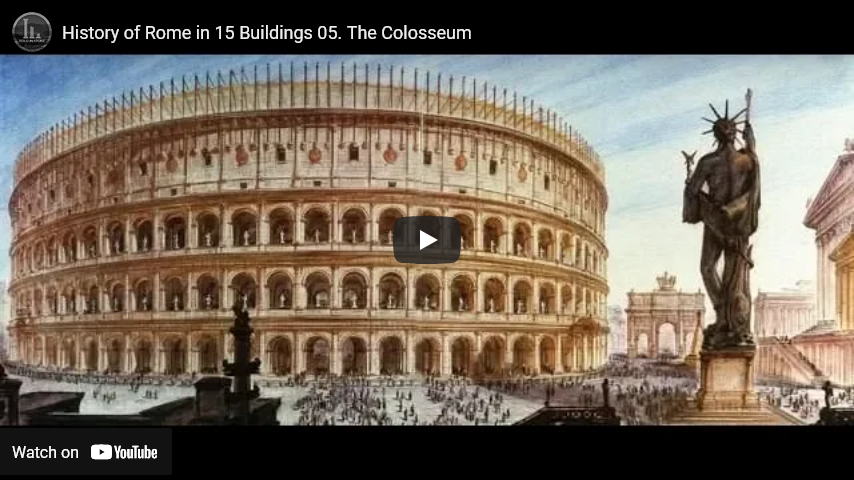
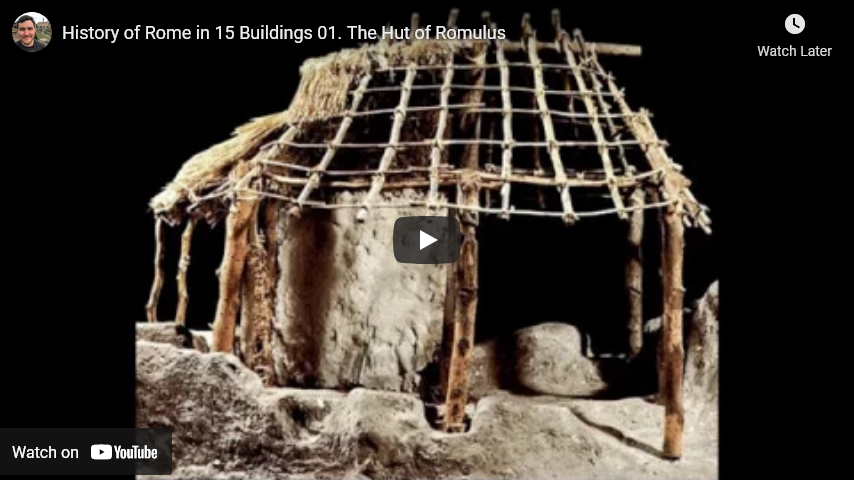
Published 27 Sep 2018This first episode of my History of Rome in Fifteen Buildings discusses the origins of Rome in relation to the enigmatic and frequently-rebuilt structure known as the Hut of Romulus. Along the way, we’ll encounter a floating phallus, a remarkably accommodating she-wolf, and, of course, the homicidal demigod who founded the city of Rome.
If you enjoyed this video, you might be interested in my forthcoming book Naked Statues, Fat Gladiators, and War Elephants: Frequently Asked Questions about the Ancient Greeks and Romans.
https://toldinstone.com/naked-statues…
If you’re so inclined, you can follow me elsewhere on the web:https://www.reddit.com/r/AskHistorian…
https://www.instagram.com/toldinstone/To see the story and photo essay associated with this video, go to:
https://toldinstone.com/the-hut-of-ro…
Thanks for watching!
March 19, 2022
History of Rome in 15 Buildings 01. The Hut of Romulus
March 12, 2022
QotD: Defining an empire
… an empire is a state where the core ruling population exercises control and extracts resources from a periphery which is composed of people other than the core group (linguistically/culturally/ethnically/religiously distinct). So an empire is a state where one set of people (the core) extract resources (typically by force) from another set of people (the periphery).
That definition goes back to the root of the word in Latin: imperium, literally meaning a command or control; imperium comes from the Latin verb imperio (lit: “to order or command”). Thus imperium was a sphere of command over others. In Roman politics, this could mean an individual had the authority to command an army or to set up courts (consuls, praetors and dictators had this sort of imperium), but the Romans understood their empire as a sort of command exercised by the Senate and People of Rome over non-Roman people, thus they called that too imperium – an imperium of the Roman people (imperium populi Romani), crucially over the non-Roman people; once cannot, after all, have imperium over one’s self. An imperium of the Roman people must be an imperium over someone else.
Contrary to the venerable Wikipedia, empire does not require a monarchy. Rome was an empire while it was still a Republic, and France continued to hold an empire after it stopped being a monarchy. Athens, famously, converted the Delian League into an Athenian Empire (the Greek word used is ἀρχή (“arche“, pronounced ar-KHAY) while it was still, internally, a democracy. Often, when discussing the internal politics of these states (especially for Rome and France) we will distinguish between a period of “empire” and “republic” to note the shift from a republic to a monarchy or vice-versa, but that sort of nomenclature should not be taken to disguise the fact that, for instance, the Roman Republic in 150 B.C. was very much possessed of an empire, while still functioning as a republic.
Empire, I should note, seems to be one of – if not the – dominant form of large-scale human social organization since at least the bronze age (which is to say: since as far back as our sources let us see clearly). Ideas like loose federations of states (e.g. the EU) or nation-states are relatively new; in many cases, our modern nation-states are merely the consolidated form of what were originally empires of various sizes (e.g. China, Russia, but also France (see: Crusade, Albigensian), etc.). We don’t think about them that way anymore, because the steady application of state power created the shared culture that subsequently formed the foundation for the nation […] In many respects, empire is normal (which, please note, does not mean it is good), whereas this modern world composed primarily of nation-states is an unusual aberration.
Bret Devereaux, “Collections: Why Are There No Empires in Age of Empires?”, A Collection of Unmitigated Pedantry, 2019-11-22.
February 26, 2022
“The [House of] Commons of 1621 would get completely out of control — all thanks to beer”
In the latest Age of Invention newsletter from Anton Howes, we’re still back in the reign of King James I of England (also at the same time King James VI of Scotland), and the king has a financial woe that has forced him once again to try getting Parliament to vote him the funds he needs to wage war:

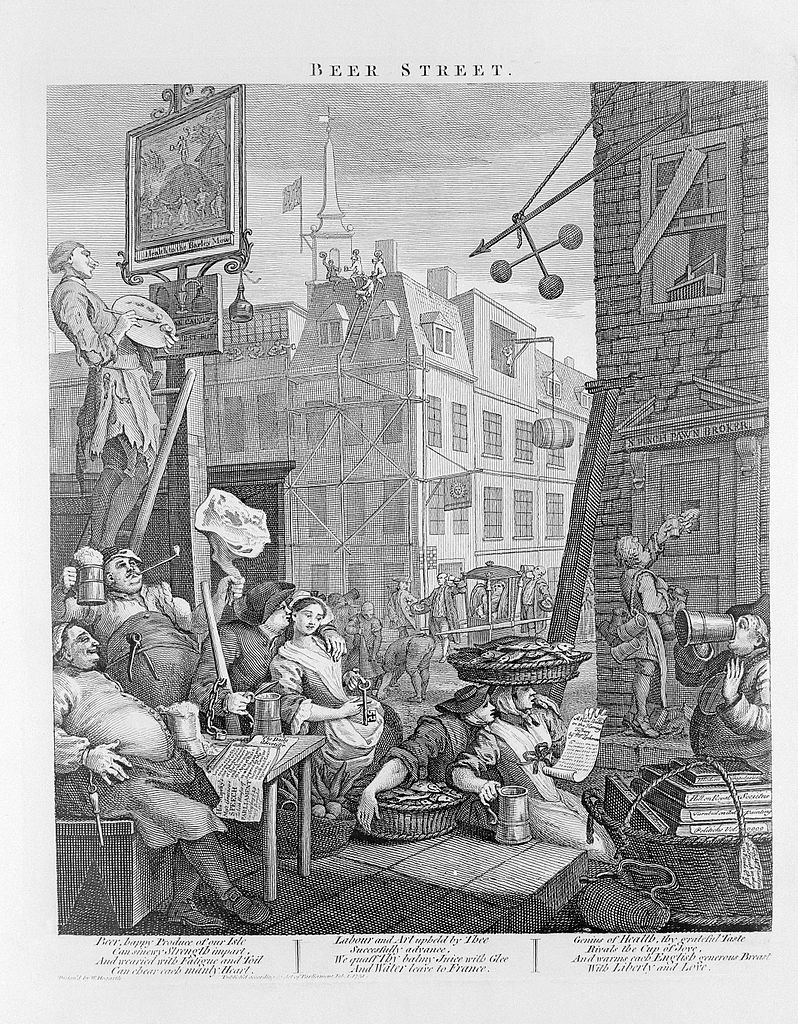
Beer Street, from Beer Street and Gin Lane by William Hogarth. The picture is a counterpoint to the more powerful Gin Lane — Hogarth intended Beer Street to be viewed first to make Gin Lane more shocking — but it is also a celebration of Englishness and depicts of the benefits of being nourished by the native beer.
Wikimedia Commons.
1620 was a dramatic year for England. As I mentioned last time, the rashness of the king’s son-in-law threatened to pull the country into a major European conflict. Religion, honour, and family — James I’s grandchildren were set to lose their inheritance, the Palatinate of the Rhine — dictated that the king should break his decades-long habit of peace. But war was hugely expensive, and the king already heavily in debt. He was forced to summon Parliament so that it could vote him the taxes he would need to wage war.
Parliament was already a major source of annoyance to James I. After 1610, he had done everything in his power to rule without its aid, at one point even comparing its lower house, the Commons, to a “House of Hell”. Yet the MPs of 1610 would come to seem almost angelic compared to those who assembled in Westminster in 1621. The Commons of 1621 would get completely out of control — all thanks to beer.
Beer (and ale, made without hops) was the most important source of calories after bread, and the first choice for hydration — cheaper than wine and safer than water, with coffee, tea, and spirits only becoming popular much later. It financially supported inns, the crucial infrastructure for travellers. Alehouses also provided a major focal point for socialising. If you controlled beer, you controlled society — second only, perhaps, to religion.
If beer was too strong, it could lead to drunkenness and unrest. If inns went unpoliced, they could become havens for criminals, heretics, sinners, and rebels. If brewers used too much malt, made from grains like barley, they could drive up the price of bread and cause famine. If beer-brewers demanded too many hops — used as both a preservative and a source of bitterness compared to sweeter ale — they could also put pressure on otherwise scarce land for food. Regulating the drinks industry correctly was thus a major priority for those in charge.
The making and selling of ale had originally been dominated by brewsters — that is, by female brewers. (Compare with the more persistent word spinster, to mean a woman who spins thread. Spinning remained women’s work long after the brewsters had been driven out of their industry. Only later, because of the independence that earning one’s own money brought, did spinster gain the more general meaning of a woman who was unmarried.) Meanwhile, hopped beer had been the preserve of immigrants. As one popular ditty put it, “Hops, Reformation, baize, and beer, Came into England all in one year”, though it had actually happened more gradually over the course of the late fifteenth and early sixteenth centuries.
Yet with population growth, and the dramatic expansion of London in particular, the drinks market became larger and more concentrated, while hop-less ale gave ground to the rise of beer. Male, English ale-brewers seized an opportunity to suppress their competition. London’s Ale Brewers’ Guild, for example, abandoned the use of hucksters — predominantly female ale-sellers — and then in 1556 absorbed the Beer-Brewers’ Guild, which had largely consisted of immigrants. The newly-amalgamated Worshipful Company of Brewers then barred immigrants from becoming members, while the English ale-brewers switched to producing beer. In 1574, they even successfully lobbied for the city to bar foreigners from being members of any guilds at all, including even second-generation immigrants born in England. The bigger the business, the more ruthless it became.

February 15, 2022
King James I and his court favourites
In the latest Age of Invention newsletter, Anton Howes continues the tale of King James I of England (also King James VI of Scotland at the same time, the crowns still being legally separate) and his use of favourites to help him avoid going back to Parliament to ask for money:

Portrait of George Villiers, First Duke of Buckingham, 1625.
Oil painting by Peter Paul Rubens (1577-1640) via Wikimedia Commons.
At the same time, James found a way to filter many of the petitions before they even reached him. This was something he already did in his original kingdom, Scotland, occasionally sending a noble “favourite” — like his kinsmen the duke of Lennox and the marquess of Hamilton — to dispense patronage and manage its parliament. Yet he increasingly, and even scandalously, relied on favourites in England too.
Using a favourite could make some sense from a political standpoint. Favourites often owed everything they had in terms of wealth, protection, titles and standing to the king personally. As creatures of the king, their loyalty was assured. They served an important practical function by dispensing patronage and absorbing pesky petitions, and could insulate the king himself from blame. Should the king make a mistake, his favourite was the obvious man to take the fall.
But for James, the use of favourites went beyond mere practicality, if they were ever practical at all. His interest could also be romantic.
Although James was married with kids, his favourite by 1607 was one Robert Kerr, the younger son of a minor Scottish laird. A mere groom of the bedchamber, about twenty years James’s junior, he had fallen from his horse in a jousting accident and broken his leg. The king helped nurse him back to health, and was soon besotted. Kerr — often anglicised to Carr — was very rapidly given money, titles, and lands. Within a year he had been knighted, after four years made a viscount, and in 1613 an earl.
But what had been so rapidly gained, could be just as rapidly lost. In 1614, a rival faction at court made sure that another, even younger and more attractive man would catch the king’s eye. This was George Villiers, the 22-year-old younger son of an obscure knight. With his “effeminate and curious” hands and face, as well as a remarkable physique — a clergyman, later a bishop, marvelled at his “well compacted” limbs — Villiers’s rise made Kerr’s seem slow. Every year brought him a new title: in 1615 Villiers was made a knight, 1616 a viscount, 1617 an earl, and 1618 a marquess — a very rare title in England, last given to an influential co-regent of Edward VI, and before that to Anne Boleyn so that she could marry king Henry VIII.
Eventually, incredibly, in 1623 James made Villiers a duke. This was a title that was typically reserved for members of the royal family, or else given by very powerful regents to themselves — Villiers was the first in neither of those categories to be made a duke in 140 years. And he hadn’t even been born into the nobility! The apparent lesson: working on your triceps can really, really pay off.
Yet Villiers had more than just an angelic face and muscles. He seems to have had a real talent for politics, very quickly asserting independence from the faction that had put him before the king. And he would somehow remain the favourite even after James died and was succeeded by his heterosexual son, Charles I. In the dangerous waters of courtly faction — Robert Kerr had meanwhile been found guilty of murder and was imprisoned in the Tower — Villiers knew how to keep himself afloat, and even to chart a course of his own.
And he was extraordinarily corrupt.
February 12, 2022
From the “it could actually be worse” file — royal succession alternatives
Chris Selley and Colby Cosh had an exchange on Twitter where Colby actually somehow made me appreciate Prince Charles a tiny bit:
For some reason, the Twitter UI is only showing a portion of the exchange here:
And here’s the part that ever-so-slightly improved my opinion of Charles, not for his own sake, but for succession reasons:
February 8, 2022
Semlor: The Dessert That Killed A King
Tasting History with Max Miller
Published 16 Feb 2021For information on Svensk Hyllningsfest in Lindsborg, KS, visit https://www.visitlindsborg.com/
Help Support the Channel with Patreon: https://www.patreon.com/tastinghistory
Tasting History Merchandise: crowdmade.com/collections/tastinghistoryFollow Tasting History here:
Instagram: https://www.instagram.com/tastinghist…
Twitter: https://twitter.com/TastingHistory1
Tiktok: TastingHistory
Reddit: r/TastingHistory
Discord: https://discord.gg/d7nbEpyLINKS TO INGREDIENTS & EQUIPMENT**
Sony Alpha 7C Camera: https://amzn.to/2MQbNTK
Sigma 24-70mm f/2.8 Lens: https://amzn.to/35tjyoW
Silpat: https://amzn.to/3rFIFxM
KitchenAid 8-Quart Stand Mixer: https://amzn.to/3cTfbs1LINKS TO SOURCES**
Hjelpreda I Hushållningen För Unga Fruentimber by Cajsa Warg: https://gupea.ub.gu.se/handle/2077/41…
A Journey Through Swedish history by Herman Lindqvist: https://amzn.to/2Z0D3Sb
The world of Cajsa Andersdotter by Bengt Hällgren: https://amzn.to/3jKNMKl**Amazon offers a small commission on products sold through their affiliate links, so each purchase made from this link, whether this product or another, will help to support this channel with no additional cost to you.
Subtitles: Jose Mendoza
#tastinghistory #semlor #semla #fattuesday
February 2, 2022
The Congress of Vienna (Part 1) (1814)
Historia Civilis
Published 29 Jan 2022Patreon | http://historiacivilis.com/patreon
Donate | http://historiacivilis.com/donate
Merch | historiacivilis.com/merch
Mailing List | http://historiacivilis.com/mailinglist
Twitter | http://historiacivilis.com/twitter
Website | http://historiacivilis.comSources:
Wolfram Siemann, Metternich: Strategist and Visionary | https://amzn.to/3Glc5c8
Eric Hobsbawm, The Age of Revolution, 1789-1848 | https://amzn.to/3zOQWV4
Adam Zamoyski, Rites of Peace: The Fall of Napoleon and the Congress of Vienna | https://amzn.to/3zSpcir
Richard J. Evans, The Pursuit of Power: Europe 1815-1914 | https://amzn.to/3qhFE8G
A. Wess Mitchell, The Grand Strategy of the Habsburg Empire | https://amzn.to/332Sorj
Robert K. Massie, Dreadnought: Britain, Germany, and the Coming of the Great War | https://amzn.to/3r6jllP
—
N. Gash, “After Waterloo: British Society and the Legacy of the Napoleonic Wars”, from Transactions of the Royal Historical Society, vol. 28, 1978, pp. 145-157. | https://www.jstor.org/stable/3679205
The Annual Register, 1815, Preface | https://hdl.handle.net/2027/mdp.39015…
Voltaire, “An Essay on Universal History, the Manners, and Spirit of Nations” | https://amzn.to/34BGbtL
The History of Parliament: The 5th Parliament of the United Kingdom | https://www.historyofparliamentonline…Music:
“Like,” by Nctrnm
“But Enough About Me Bill Paxton,” by Chris Zabriskie
“I Don’t See the Branches, I See the Leaves,” by Chris Zabriskie
“Orion,” by Josh Stewart
“CGI Snake,” by Chris Zabriskie
“Gown,” by Nctrnm
“Hallon,” by Christian BjoerklundWe are a participant in the Amazon Services LLC Associates Program, an affiliate advertising program designed to provide a means for us to earn fees by linking to Amazon.com and affiliated sites.
January 24, 2022
David Starkey – The Churchills episode 3
Whitehall Moll History Clips
Published 29 May 2019How did Winston Churchill draw on the lessons of his ancestor John Churchill to fight World War II? The Duke of Marlborough’s influence is apparent as Dr David Starkey explains
January 23, 2022
The Abandoned Hill With Two Members Of Parliament
Tom Scott
Published 6 Jul 2020Old Sarum, in Wiltshire, is a now-desolate hillfort run by English Heritage. But it was once one of the most important sites in southern England: so important that it had two members of Parliament. Then, it became a “rotten borough”: and a warning about power.
Thanks to English Heritage: more information and how to visit: https://www.english-heritage.org.uk/v…
Research and script assistance from Jess Jewell
Drone camera by Jamie Bellinger
Edited by Michelle Martin: https://twitter.com/mrsmmartin
Audio mix by Graham Haerther: https://haerther.netFilmed safely, following all local and national guidance: https://www.tomscott.com/safe/
SOURCES:
Corfield, P. (2000). Power and the professions in Britain 1700-1850. London: Routledge.Dodsworth, W. (1814). An historical description of the cathedral church of Salisbury: including an account of the monuments, chiefly extracted from Gough’s “Sepulchral Monuments,” and other authentic documents: also, biographical memoirs of the Bishops of Salisbury, from the earliest period by W. Dodsworth, verger of the Cathedral
English Heritage’s own research page: https://www.english-heritage.org.uk/v…
http://www.historyhome.co.uk/c-eight/…
I’m at https://tomscott.com
on Twitter at https://twitter.com/tomscott
and on Instagram as tomscottgo
January 22, 2022
James I and his experiment with “personal rule”
In the latest Age of Invention newsletter, Anton Howes explains why King James I grew frustrated in his dealings with Parliament and decided to avoid calling that body into session and ruling the kingdom directly:

King James I (of England) and VI (of Scotland)
Portrait by Daniel Myrtens, 1621 from the National Portrait Gallery via Wikimedia Commons.
By the end of 1610, James’s disillusionment with the House of Commons was complete — it was, he said, after six years of fruitlessly wrangling for parliamentary taxes, like a “House of Hell”.
So, despite failing to reach a permanent financial settlement, James decided to try to rule without it. His debts were huge, and his deficit substantial. But after the failure of 1610 he would do everything he could to never have to summon a Parliament again. Although he couldn’t actually afford it, he decided to try ruling as an absolutist monarch anyway — to embark on “personal rule”.
This extraordinary decision, to be an absolutist ruler without adequate financial support, would have dramatic consequences for England’s foreign policy, and perhaps on the whole balance of Europe too. James had already tried to reduce the costs of war when he came to the throne in 1603, by immediately concluding a peace with the vast Spanish Empire. Yet peace now became a necessity — if he couldn’t even plug the deficit during peacetime, he could not possibly pay for a war. Recognising this, Spain intervened freely in the affairs of the Protestant German states, confident that England would not be able to come to their aid.
To make matters worse, James’s financial woes made him especially susceptible to foreign influence. A poor king could be bought. Some of the smaller but wealthier European dynasties began to offer James large sums for his children’s hands in marriage. In 1611, the duke of Savoy offered a vast dowry of £210,000 for his daughter to marry James’s eldest son and heir, Prince Henry. The notoriously wealthy grand duke of Tuscany even put in a bid for £300,000. France then offered £240,000 — not as high, but it had the greater status as a kingdom. Any of these amounts would have plugged the deficit for a few years, even if they were nowhere near to eliminating James’s debt. Yet Henry died in 1612 at the age of eighteen, before any match was agreed, and James’s new heir Charles was much younger and sickly. There was now no rush, so the bidding war ceased. Indeed, by 1616 Charles had given England’s rivals yet another way to influence its king. The Spanish Hapsburgs dangled the prospect of a gigantic dowry of £600,000, but dragged their feet in negotiations, keeping James focused for as long as they could on trying to keep them sweet.
In the meantime, with Henry’s death denying him an immediate windfall, James in 1613 turned [to] Ireland. The Irish Parliament had not been summoned for over a quarter of a century, but it could be a way to reduce the costs of the occupation of Ireland and even raise some funds. The Parliament was initially a disaster. James had flagrantly gerrymandered a Protestant majority by chartering dozens of new towns, particularly in the English plantations in Ulster. Each new town was a borough constituency able to choose its own MPs, and James could even select their initial members — especially in cases where the towns were actually only tiny villages. In protest, the Catholic MPs refused to even recognise the new borough MPs, so each side elected their own Speaker. The Catholic Speaker was only forced out of the chair when the Protestant Speaker was hoisted onto his lap. Nonetheless, although James was legally entitled to create as many new boroughs as he liked, he soon compromised and in 1615 the Irish Parliament ended up voting him some cash.
But the delays forced James’s hand, and in 1614 he briefly suspended his foray into personal rule by summoning the English Parliament again. He needn’t have bothered. Having embarked on personal rule, James had doubled down on legally dubious ways of raising cash, like imposing new customs duties without parliamentary approval — measures that had already been deeply unpopular with MPs in 1610. This time, the Parliament lasted just two months and two days before James dissolved it in a rage — the House of Hell had proved even more impudent than before. One of the veteran opposition leaders, Sir Edwin Sandys, went so far as to explicitly compare James’s impositions on trade to tyranny, before reminding the Commons that tyrants often met a bloody end. When the Parliament was dissolved, the king had MPs’ notes on impositions burned, and a few of the ringleaders were even briefly imprisoned. But with the dissolution of Parliament, which had not voted him any cash, he was still none the richer.
January 21, 2022
Why Wilhelm I Didn’t Want To Be German Emperor
Real Time History
Published 20 Jan 2022Get the Smartest Bundle in Streaming: https://smartbundle.com/thegreatwarsb
The proclamation of the German Empire on 18 January 1871 is usually portraited as a glorious ceremony. Most people associated it with the famous paintings from Anton von Werner. But the ceremony itself was far from well organized and the soon-to-be Emperor Wilhlem I himself was not to thrilled about the whole affair.
» THANK YOU TO OUR CO-PRODUCERS
John Ozment, James Darcangelo, Jacob Carter Landt, Thomas Brendan, Kurt Gillies, Scott Deederly, John Belland, Adam Smith, Taylor Allen, Rustem Sharipov, Christoph Wolf, Simen Røste, Marcus Bondura, Ramon Rijkhoek, Theodore Patrick Shannon, Philip Schoffman, Avi Woolf,» OUR PODCAST
https://realtimehistory.net/podcast – interviews with historians and background info for the show.» LITERATURE
Arand, Tobias: 1870/71. Der Deutsch-Französische Krieg erzählt in Einzelschicksalen. Hamburg 2018Bartmann, Dominik (Hrsg.): “Ausst.-Kat. DHM‚ Anton von Werner. Geschichte in Bildern.” Berlin 1993
Bauer, Gerhard u.a. (Hrsg.): Ausst.-Kat. MHM Dresden “Krieg – Macht – Nation. Wie das deutsche Kaiserreich entstand”. Dresden 2020
Bühl-Gramer, Charlotte: Anton von Werner – “Die Proklamierung des Deutschen Kaiserreichs 1871”, in: Der Europäische Bildersaal. Europa und seine Bilder, hrsg. v. Michael Wobring und Susanne Popp. Schwalbach/Ts. 2014. S. 86-97
Gouttman, Alain: La grande défaite. 1870-1871. Paris 2015
» SOURCES
Deuerlein, Ernst: Die Gründung des Deutschen Reichs 1870/71 in Augenzeugenberichten. Gerlingen 2011 (Neuauflage)Goncourt, Edmond de: Journal des Goncourts. II.1. 1870-1871. Paris 1890
Meisner, Heinrich Otto (Hrsg.): Kaiser Friedrich III. Das Kriegstagebuch von 1870/71. Berlin, Leipzig 1926
Merkelbach, Thea (Hrsg.): Ferdinand Viebig. Der Krieg 1870/71. Aus den Erinnerungen eines preußischen Offiziers. Zell/Mosel 2021
N.N. (Hrsg.): Bismarcks Briefe an seine Gattin aus dem Kriege 1870/71. Stuttgart, Berlin 1903
Werner, Anton von: Erlebnisse und Eindrücke 1870-1890. Berlin 1913
» OUR STORE
Website: https://realtimehistory.net»CREDITS
Presented by: Jesse Alexander
Written by: Cathérine Pfauth, Prof. Dr. Tobias Arand, Jesse Alexander
Director: Toni Steller & Florian Wittig
Director of Photography: Toni Steller
Sound: Above Zero
Editing: Toni Steller
Motion Design: Philipp Appelt
Mixing, Mastering & Sound Design: http://above-zero.com
Maps: Battlefield Design
Research by: Cathérine Pfauth, Prof. Dr. Tobias Arand
Fact checking: Cathérine Pfauth, Prof. Dr. Tobias ArandChannel Design: Battlefield Design
Contains licensed material by getty images
All rights reserved – Real Time History GmbH 2022
January 20, 2022
David Starkey — The Churchills episode 2
Whitehall Moll History Clips
Published 11 Feb 2019Dr David Starkey reveals how Winston Churchill’s biography of his ancestor John Churchill marked out Winston as the only politician who truly understood war — just as WWII loomed.
January 18, 2022
David Starkey – The Churchills episode 1
Whitehall Moll History Clips
Published 7 Jan 2019David Starkey weaves the stories of two great British war leaders: John and Winston Churchill. Hear how John Churchill rose from obscurity to be King James II’s right-hand man.
January 10, 2022
QotD: Absolute monarchs versus modern bureaucracy
As Tocqueville wrote: “There was a time in Europe in which the law, as well as the consent of the people, clothed kings with a power almost without limits. But almost never did it happen that they made use of it.”
True. His Majesty was an absolute tyrant — in theory. But in practice he was in his palace hundreds of miles away. A pantalooned emissary might come prancing into your dooryard once every half-decade and give you a hard time, but for the most part you got on with your life relatively undisturbed. In Tocqueville’s words:
Although the entire government of the empire was concentrated in the hands of the emperor alone, and although he remained, in time of need, the arbiter of all things, the details of social life and of individual existence ordinarily escaped his control.
Just so. You were the mean and worthless subject of a cruel and mercurial despot but, even if he wanted to, he lacked the means to micro-regulate your life in every aspect. Yet what would happen, Tocqueville wondered, if administrative capability were to evolve to make it possible “to subject all of his subjects to the details of a uniform set of regulations”?
That moment has now arrived.
Mark Steyn, After America, 2011.
January 8, 2022
The Board of Green Cloth — the original “we investigated ourselves and found us innocent” organization
In the latest Age of Invention newsletter, Anton Howes explains how England managed to avoid the first attempt by King James I to impose absolute monarchy — that is, putting the Stuart notions of the “divine right of kings” in place of royal powers limited by the Parliamentary control of the royal income:

King James I (of England) and VI (of Scotland)
Portrait by Daniel Myrtens, 1621 from the National Portrait Gallery via Wikimedia Commons.
The year 1610 might by the most under-rated year in British history. It was the year in which England almost became a more permanent absolutist monarchy. Had things gone only a little differently, King James I might have obtained a substantial annual income — enough to pay off his debts within just a few years, to run a substantial surplus, and perhaps even to never have to summon a Parliament ever again. Over the course of a few decades, so long as they didn’t require too many extraordinary taxes to pay for one-off wars, the Stuart kings could have ruled without challenge, issuing proclamations that would have gradually taken on the force of laws.
[…]
As we saw in the last instalment of this series, James I’s finances were desperate. His predecessor had left him substantial war debts, and he was running a large deficit, so the chances of repaying them anytime soon were slim. So in 1604 he had summoned a Parliament with the aim of making a financial deal. Parliaments were typically called in order for the monarch to raise one-off, extraordinary taxes, usually in times of rebellion or war. Rather confusingly from today’s perspective, these taxes were known as “subsidies”, because they were a subsidy to the Crown. Yet James and his ministers wanted Parliament to instead establish peacetime taxes that would be both ongoing and ordinary — what came to be known as “support”. The deal was that he would give up some of his least popular feudal prerogative rights in return.
The House of Commons did not go for the deal in 1604, as we saw. They may have hated feudal obligations like purveyance or wardship — the requisitioning of goods for the court, and the Crown’s control of noble heirs whose fathers had died before they came of age — but they also saw some major risks in trying to make a deal with the king.
When it came to the matter of purveyance, for example, many members of Parliament wanted to stamp out the abuses rather than see the institution abolished. They thought it perfectly legal for the Crown to compulsorily purchase goods, and even to requisition the carts to carry them. What they complained of was that many purveyors were failing to give compensation immediately, and that corrupt purveyors were sometimes taking more than was required, pocketing the difference for themselves. Many MPs also argued that there was no legal basis for purveyors to determine their own prices for the provisions that they seized — a privilege that the Crown adamantly insisted upon.
James’s predecessor Queen Elizabeth I had granted a concession over patent disputes — “patents” at that time were a rather different and much wider legal notion than our more product-oriented modern patents: the monarch granted patents to assign lands and titles, appoint officials, create cities or guilds, or to allow monopoly privileges over an economic resource among other purposes. The concession was that patent disputes would be litigated in common-law courts rather than by royally appointed judges.
Yet by extending the jurisdiction of the common-law courts to monopolies, Elizabeth opened the floodgates of complaints against all prerogative courts — especially against the court of royal household officials responsible for commissioning the purveyors, known as the Board of Green Cloth.
To Hyde and his followers, this court was especially corrupt. Whereas the trying of monopoly patents had at least been done in the more general prerogative courts, anyone hauled before the Green Cloth for denying the purveyors was effectively being tried, judged, fined, and even imprisoned, by the very organisation that was accusing them. Even if purveyors really were acting illegally by naming their own prices, as opponents maintained, there would be no justice so long as the purveyors effectively judged themselves. For Hyde and his allies then, they wished to do to purveyance what they had done to monopolies — to subject them to the common law.