Quotulatiousness

June 12, 2022

History Re-Summarized: Egypt

Overly Sarcastic Productions
Published 18 Feb 2022

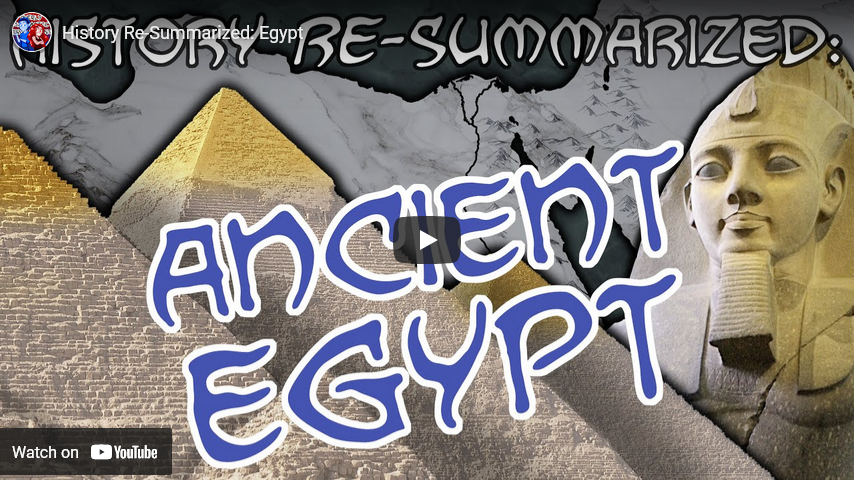
I for one was shocked to learn the Egyptians actually buried their kings in a giant Millennium Puzzle.

We’ve covered Egypt on this channel in previous videos, but this History Re-Summarized is the Definitive Edition, redone from the ground up to present the best possible account — starting at the beginning for a full chronology of Ancient Egypt, from the very first Pharaohs to the Muslim Conquest.

(Observant Egyptologists and D&D players might note the Pyramids are actually D-*Fives*, but technically they’re D-*Nines* since each face is actually two right triangles at a slight angle to each other and not a single flat isosceles triangle, so shhh, we can pretend it’s a D4.)

Sources & Further Reading: The Oxford History of Ancient Egypt & Ancient Egypt: A Very Short Introduction by Ian Shaw, World History Encyclopedia entries on “Ancient Egypt”, “Old Kingdom of Egypt”, “First Intermediate Period of Egypt”, “Middle Kingdom of Egypt”, “Second Intermediate Period of Egypt”, “New Kingdom of Egypt” https://www.worldhistory.org/egypt/, The Great Courses’ lecture series “History of Ancient Egypt” by Bob Brier. Additionally, I have an undergraduate degree in classical studies (re: Persia, Ptolemies and Rome). Extra special thanks to our OSP Discord server moderator & Egyptology connoisseur Billy, for his assistance and guidance for this video!

Our content is intended for teenage audiences and up.

PATREON: https://www.Patreon.com/OSP

PODCAST: https://overlysarcasticpodcast.transi…

DISCORD: https://discord.gg/osp

MERCH LINKS: http://rdbl.co/osp

OUR WEBSITE: https://www.OverlySarcasticProductions.com
Find us on Twitter https://www.Twitter.com/OSPYouTube
Find us on Reddit https://www.Reddit.com/r/OSP/

June 10, 2022

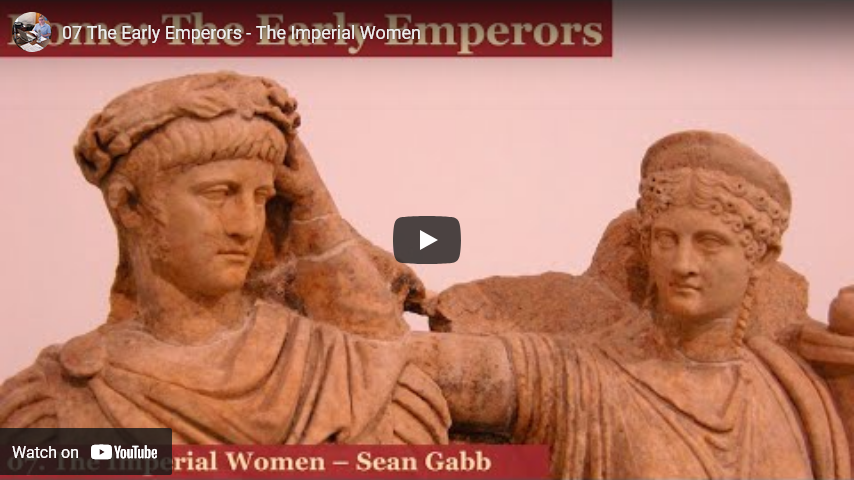
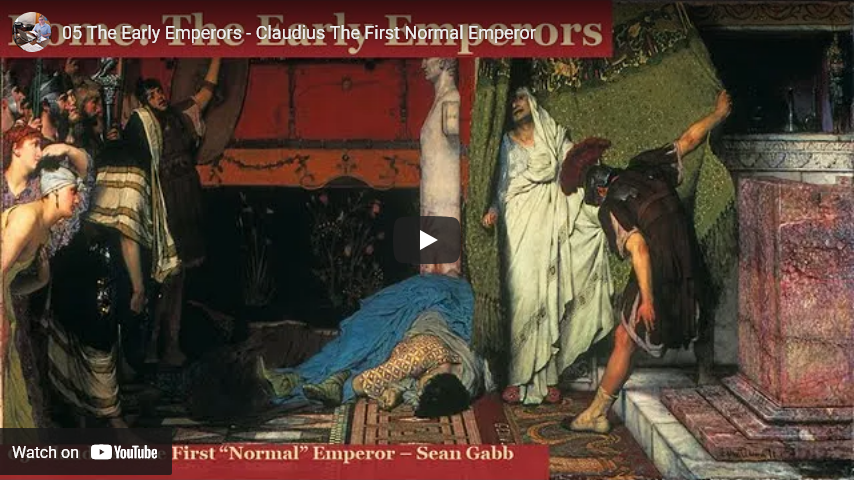
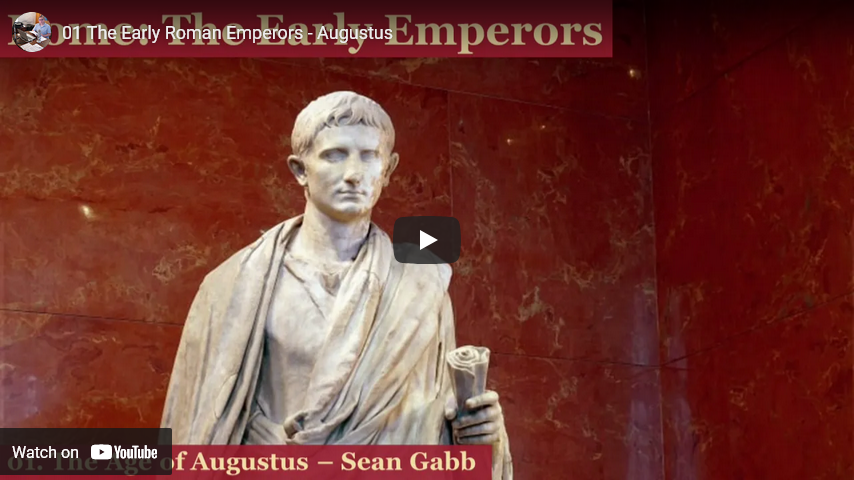
The Early Roman Emperors – Part 1: Augustus

Filed under: Europe, History — Tags: , , , , , , , , — Nicholas @ 04:00

seangabb
Published 26 Sep 2021

The Roman Empire was the last and the greatest of the ancient empires. It is the origin from which springs the history of Western Europe and those nations that descend from the Western Roman Empire. It is the political entity within which the Christian faith was born, and the growth of the Church within the Empire, and its eventual establishment as the sole faith of the Empire, have left an indelible impression on all modern denominations. Its history, together with that of the ancient Greeks and the Jews, is our history. To understand how the Empire emerged from a great though finally dysfunctional republic, and how it was consolidated by its early rulers, is partly how we understand ourselves.

Here is a series of lectures given by Sean Gabb in late 2021, in which he discusses and tries to explain the achievement of the early Emperors. For reasons of politeness and data protection, all student contributions have been removed.

More by Sean Gabb on the Ancient World: https://www.classicstuition.co.uk/

Learn Latin or Greek or both with him: https://www.udemy.com/user/sean-gabb/

His historical novels (under the pen name “Richard Blake”): https://www.amazon.co.uk/Richard-Blak…

June 9, 2022

A brutal microcosm of the English Civil War

Filed under: Books, Britain, History, Military — Tags: , , , , , — Nicholas @ 03:00

At The Critic, Jonathan Healey reviews The Siege of Loyalty House by Jessie Childs:

Late in the summer of 1641, with Charles I deep in dispute with his Parliament, alarming reports reached Westminster of Catholics amassing arms at Basing House in Hampshire. At this point in time, few expected civil war, but plenty feared an imminent Catholic plot. Recent reform to the Church had introduced lavish ceremonies which looked, to many eyes, like the trappings of Rome, and Charles himself was married to a Catholic.

More to the point, England’s Catholics had done it before. Every year, people marked the anniversary of the Gunpowder Treason, which was already stuck in the national consciousness as the quintessential Popish rebellion: an armed coup plotted by dissident aristocrats gathering weapons on their great rural estates and planning subterfuge at the highest levels.

Yet civil war came, and when it did it would be nothing like the “Popish Plots” of Protestant imagining. It would be fought over constitutional as much as religious divides. And, rather than a rebellion, it would be an armed struggle between two competing fiscal-military organisations — effectively between two competing states.

The English countryside became militarised. Now, it was not just a landscape. It was territory. The great houses were no longer places for covert plotting; now they were centres of command and control. And few were more important than Basing House.

Hampshire today is a pleasant place: gentle and verdant with rolling chalk hills, shaded woodlands, and quiet valleys. But in the 1640s it became contested and dangerous: a dark, malevolent land of violence and death. People looked upon one another with suspicion, and riders were ambushed and killed as they travelled at night. Parish churches were stormed, towns starved and bombarded. Armies of musketeers, pikemen, and cavalry traversed the folding lanes of the county looking to bring bloodshed and plunder.

[…]

A crucial theme is encapsulated in the book’s denouement. The deputy sent to pacify Hampshire for the New Model was Oliver Cromwell. He had been in the thick of the fighting from the start, and before then was an earnest — if obscure and scruffily-attired — Member of Parliament. But Cromwell really rose to prominence in 1644 and 1645, on the back of his military abilities. He represented a new approach to the war: the pursuit of total victory even at the cost of sharp bloodshed.

It was Cromwell’s direct — even brutal — efficiency that brought the siege of Basing House to its end. The walls fell and many of the garrison were killed. Slaughtered, too, were a number of Catholic priests in a moment of violence that was representative of the way the war was heading. Cold-blooded murder of female camp followers had been perpetrated by royalists in Cornwall and by parliamentarians after Naseby. King Charles had allowed a bloody storm of Leicester which had cost many civilian lives, and Cromwell would go on to oversee the horrors of Drogheda and Wexford in Ireland. The chivalry of Waller and Hopton would come to seem a long way in the past.

June 2, 2022

For Queen and Country (2010)

Filed under: Asia, Britain, Military — Tags: , , , , — Nicholas @ 04:00

emptyangel
Published 14 Jun 2011

“Documentary following the Grenadier Guards as they prepare to lead the 2010 Trooping the Colour. But these men have had precious little time to prepare; as fighting soldiers, they have just spent six months on the front line in Afghanistan’s Helmand Province. This is the story of how one and a half thousand men and women join together to create one of the greatest military ceremonies on earth. It is a ceremony with just one standard: Excellence.”

May 17, 2022

History of Rome in 15 Buildings 09. The Arch of Constantine

toldinstone
Published 27 Sep 2018

The many statues and reliefs from older monuments integrated into the Arch of Constantine – the focus of this ninth episode of our History of Rome – advertise the continuity of traditional Roman values into the fourth century. The Arch’s inscription, however, alludes to the religious revolution set in motion by the first Christian emperor.

If you enjoyed this video, you might be interested in my book Naked Statues, Fat Gladiators, and War Elephants: Frequently Asked Questions about the Ancient Greeks and Romans. You can find a preview of the book here:

https://toldinstone.com/naked-statues…

If you’re so inclined, you can follow me elsewhere on the web:

https://www.reddit.com/r/AskHistorian…
https://www.instagram.com/toldinstone/

To see the story and photo essay associated with this video, go to:
https://toldinstone.com/the-arch-of-c…

May 15, 2022

The young man who might have been King Henry IX of England

Filed under: Britain, History, Science — Tags: , , , — Nicholas @ 03:00

In the latest Age of Invention newsletter, Anton Howes considers what might have been had the eldest son of King James I and VI lived to take the thrones of England and Scotland:

Portrait of Prince Henry Frederick (1594-1612), Prince of Wales by Isaac Oliver
National Trust, Dunster Castle; http://www.artuk.org/artworks/prince-henry-frederick-15941612-prince-of-wales-99804 via Wikimedia Commons.

Henry Frederick, Prince of Wales, was the eldest son and heir of James I of England. He would presumably have become Henry IX had he managed to outlive his father. But he died in 1612 aged just 18. The kingdom instead ended up with his younger brother Charles I and civil war. I’m not sure how far Prince Henry was influenced, but it seems that many of the major innovators of the period were purposefully cultivating him as a kind of inventor-scientist king.

It reminds me of a very similar and successful scheme, which I noticed when researching my first book on the history of the Society for the Encouragement of Arts, Manufactures and Commerce. This was the scheme to cultivate George III — famed for his madness and losing the Thirteen Colonies, but also for his collection of scientific instruments and interest in agricultural innovation. Those interests were no accident: his upbringing had included lessons in botany from the inventor Stephen Hales, in art and architecture from William Chambers, and in mathematics from George Lewis Scott. These were not just experts, but active innovator-organisers. Hales was a key founder of the Society of Arts; Chambers helped organise the artists who split off from it to form the Royal Academy of Arts; and Scott was involved in updating Ephraim Chambers’s Cyclopaedia, or Universal Dictionary of Arts and Sciences — an early encyclopaedia focused on technical knowledge. And their efforts bore fruit. Unlike his predecessor and grandfather George II — whose interests mainly fell under the headings of Handel, Hanover, hunting, and heavy women — George III became an active patron of science, invention, and the arts.

Given how successfully the inventors cultivated George III, it makes me wonder how things might have looked had Prince Henry lived to be king. His younger brother Charles I had an education heavily geared towards languages, theology, and overcoming various health issues through sports. But Henry — naturally athletic and charismatic — had an upbringing tightly controlled by Sir Thomas Chaloner, who had a major financial stake in innovation.

Chaloner housed and supported his alchemist cousin (also, confusingly, called Thomas Chaloner). This cousin had published an early treatise on the medical applications of saltpetre, or nitre (what we now call potassium nitrate), and had tried to produce alum on the isle of Lambay, off the coast of Ireland. Alum was a valuable substance used to fix cloth dyes, which had hitherto been monopolised by the Pope, who owned Europe’s only alum mine. Opening a competing, English-controlled, Protestant supply of alum was not just about starting a new industry. It was a matter of Europe-wide religious and strategic urgency.

[…]

Henry’s circle also included the Dutch polymath Cornelis Drebbel, who would become famous all over Europe for travelling in a submarine under the Thames, for his improvements to microscopes, and for inventing a perpetual motion machine (which isn’t as silly as it sounds — it was effectively a kind of barometer, exploiting changes in temperature and air pressure to move).

And that’s just the tip of the iceberg. The more I look into the circle of inventors around Prince Henry, the more familiar names crop up. There even seems to be some connection to Simon Sturtevant, one of the original patentees of a method to make iron by using coal instead of wood — Chaloner was seemingly responsible for evaluating Sturtevant’s inventiveness, to see if he merited a patent. I found it very striking that when Sturtevant’s iron-making business was about to get going, Prince Henry was to have a share.

Given such innovative company, we can only imagine what kind of a king Prince Henry might have been. If George III grew up to be “Farmer George”, might a Henry IX have become associated with navigation or hydraulic engines? We’ll never know. But even during his brief lifetime, there was plenty of patronage to be had for inventors at the court of their would-be Inventor-King.

May 10, 2022

History of Rome in 15 Buildings 08. The Baths of Caracalla

Filed under: Architecture, Europe, History — Tags: , , , , — Nicholas @ 02:00

toldinstone
Published 27 Sep 2018

Every day, ten thousand bathers and over a million gallons of water were funneled through the Baths of Caracalla, the subject of this eighth episode in our History of Rome. The astonishing scale of the Baths indicates the power of two Roman obsessions: imperial propaganda and public bathing.

If you enjoyed this video, you might be interested in my book Naked Statues, Fat Gladiators, and War Elephants: Frequently Asked Questions about the Ancient Greeks and Romans. You can find a preview of the book here:

https://toldinstone.com/naked-statues…

If you’re so inclined, you can follow me elsewhere on the web:

https://www.reddit.com/r/AskHistorian…
https://www.instagram.com/toldinstone/

To see the story and photo essay associated with this video, go to:
https://toldinstone.com/the-baths-of-…

Thanks for watching!

May 3, 2022

History of Rome in 15 Buildings 07. The Column of Marcus Aurelius

Filed under: Architecture, Europe, History — Tags: , , , , , , — Nicholas @ 02:00

toldinstone
Published 27 Sep 2018

Roman troops file in neat lines over raging rivers and trackless mountains. They crush barbarian forces in battle after battle, leaving fields of corpses in their wake. Villages burn, captives weep – and the lonely figure of the philosopher-emperor leads his legions to victory. So the spiraling reliefs of the Column of Marcus Aurelius, subject of the seventh episode in our History of Rome, represent the brutal conflict that turned back the first wave of the barbarian invasions.

If you enjoyed this video, you might be interested in my book Naked Statues, Fat Gladiators, and War Elephants: Frequently Asked Questions about the Ancient Greeks and Romans. You can find a preview of the book here:

https://toldinstone.com/naked-statues…

If you’re so inclined, you can follow me elsewhere on the web:

https://www.reddit.com/r/AskHistorian…
https://www.instagram.com/toldinstone/

To see the story and photo essay associated with this video, go to:
https://toldinstone.com/the-column-of…

Thanks for watching!

April 22, 2022

Lucy Worsely on The Jacobites & the Scottish Enlightenment

Whitehall Moll History Clips
Published 22 Jul 2018

A segment on the Jacobites and the Scottish Enlightenment that blossomed in the face of Hanoverian oppression.

April 19, 2022

Alexander’s Successors (the Diadochi): Series Introduction and Historical Context

Thersites the Historian
Published 24 Nov 2018

This video introduces my series on Alexander’s Successors by talking about what the series will be like and by going through the historical context that the viewer might need to understand the age of the Successors.

Patreon link: https://www.patreon.com/thersites

PayPal link: paypal.me/thersites

Twitter link: https://twitter.com/ThersitesAthens

Minds.com link: https://www.minds.com/ThersitestheHis…

Steemit/dtube link: https://steemit.com/@thersites/feed

Backup Channel: https://www.youtube.com/channel/UCUrD…

History of Rome in 15 Buildings 05. The Colosseum

toldinstone
Published 27 Sep 2018

Six lions fighting eight tigers! A troupe of performing elephants! Executions, accompanied by a full orchestra! Twelve gladiatorial combats, guaranteed to the death! So might a day of games at the Colosseum, the subject of our fifth episode, be advertised. No monument better encapsulates Roman imperialism – or its costs.

If you enjoyed this video, you might be interested in my forthcoming book Naked Statues, Fat Gladiators, and War Elephants: Frequently Asked Questions about the Ancient Greeks and Romans. You can find a preview of the book here:

https://toldinstone.com/naked-statues…

If you’re so inclined, you can follow me elsewhere on the web:

https://www.reddit.com/r/AskHistorian…
https://www.instagram.com/toldinstone/

To see the story and photo essay associated with this video, go to:
https://toldinstone.com/the-colosseum/

Thanks for watching!

April 18, 2022

Republic to Empire: The Augustan Settlement

Filed under: Europe, History, Italy, Military — Tags: , , , , , , — Nicholas @ 04:00

seangabb
Published 23 Mar 2021

Here is the tenth lecture, which covers the Augustan Settlement and the ending of the Roman Republic. Discussion includes: the Constitutional Settlements, graphical representations of the old and new Roman Constitutions; opinions in Rome and the provinces of the new order; the legitimisation propaganda; the general success of the reign of Augustus.
(more…)

April 13, 2022

A new look at the Commonwealth and the Protectorate of Oliver Cromwell

Filed under: Books, Britain, History — Tags: , , , , , — Nicholas @ 03:00

In The Critic, Miranda Malins reviews a new history of the period between the execution of Charles I and the Stuart restoration of Charles II, The Restless Republic: Britain Without a Crown by Anna Keay:

This evasion is not for the historian Anna Keay. Faced with these collective shortcomings (“This book was born of ignorance,” she explains in opening), she explores this most dynamic of decades, looking it squarely in the face. With her, we roam around the period, the broad chronological narrative softened through a selection of nine interwoven biographies ranging from the irrepressible newspaperman Marchamont Nedham, to the indomitable royalist Countess of Derby, from the brilliant scientist William Petty to the dreaming Digger Gerrard Winstanley.

This structure achieves a broad perspective and rare realism, giving the reader the sense of dipping and diving through the restless waves of the republic and taking them to all corners of the new Britain forged in the fire of three Civil Wars. As expected, we travel from the trial and execution of Charles I to the Restoration of his son, but Keay’s achievement is to make the shape-shifting years of the kingless Commonwealth and Protectorate that lie between more thrilling than either royal bookend, demonstrating how far from inevitable the return of the Stuarts was. There is no “high road to Restoration” here, but rather a snaking maze of paths striking off in new directions and looping back: an uncharted landscape for Keay’s characters to navigate where every choice counted.

The result is a panoramic and pulsating drama every bit as restless as the republic it captures so well. Indeed the “Restless” adjective of the title perfectly conjures the progressive spirit of Britain without a crown: unstable and dangerous, yes, but as a result, experimental and unafraid. As Keay puts it: “The 1650s was a time of extraordinarily ambitious political, social, economic and intellectual innovation, and it was not a foregone conclusion that the British republic would fail.”

This portrait will be, for many, a revelation. Far from the dour, militaristic regimes of popular imagination, life under the Commonwealth and Oliver Cromwell’s Protectorate emerges as innovative and exciting: the effect of the hitherto unimaginable act of abolishing the monarchy and House of Lords after years of transformative conflict being to unleash an energetic spirit of ambitious experimentation and industry.

We feel this bold energy in the meetings of the Oxford Experimental Philosophy Club (which would become the Royal Society in 1660) and its young member William Petty managing to survey the whole of Ireland in record time despite having no cartographical experience; in failed cloth trader Gerrard Winstanley’s determination to dig the new Jerusalem that had come to him on an autumn ramble; in Marchamont Nedham escaping Newgate prison and picking his way through several dangerous changes of side, pen in hand, always managing to land cat-like on his feet through sheer commercial nous and audacity.

April 7, 2022

Republic to Empire: The Triumph of Caesar

Filed under: Europe, History, Italy, Military — Tags: , , , , , , , , — Nicholas @ 06:00

seangabb
Published 5 Mar 2021

In 120 BC, Rome was a republic with touches of democracy. A century later, it was a divine right military dictatorship. Between January and March 2021, Sean Gabb explored this transformation with his students. Here is one of his lectures. All student contributions have been removed.
(more…)

April 4, 2022

The Congress of Vienna (Part 2) (1814 to 1815)

Historia Civilis
Published 2 Apr 2022

Patreon | http://historiacivilis.com/patreon
Donate | http://historiacivilis.com/donate
Merch | historiacivilis.com/merch
Mailing List | http://historiacivilis.com/mailinglist
Twitter | http://historiacivilis.com/twitter
Website | http://historiacivilis.com

Sources:
Eric Hobsbawm, The Age of Revolution, 1789-1848
Adam Zamoyski, Rites of Peace: The Fall of Napoleon and the Congress of Vienna
Richard J. Evans, The Pursuit of Power: Europe 1815-1914
Wolfram Siemann, Metternich: Strategist and Visionary
A. Wess Mitchell, The Grand Strategy of the Habsburg Empire
Robert K. Massie, Dreadnought: Britain, Germany, and the Coming of the Great War
Adam Hochschild, Bury the Chains: Prophets and Rebels in the Fight to Free an Empire’s Slaves
Harry Dickinson, Public Opinion and the Abolition of the Slave Trade | https://bit.ly/2XRMLJC
The History of Parliament: The 5th Parliament of the United Kingdom | https://www.historyofparliamentonline…

Music:
“Past,” by Nctrnm
“While She Sleeps (Morning Edit),” by The Lights Galaxia
“Mell’s Parade,” by Broke For Free
“Day Bird,” by Broke For Free
“Thomas Neutrality,” by Enrique Molano
“Infados,” by Kevin MacLeod
“The House Glows (With Almost No Help),” by Chris Zabriskie
“Hallon,” by Christian Bjoerklund

« Newer PostsOlder Posts »

Powered by WordPress