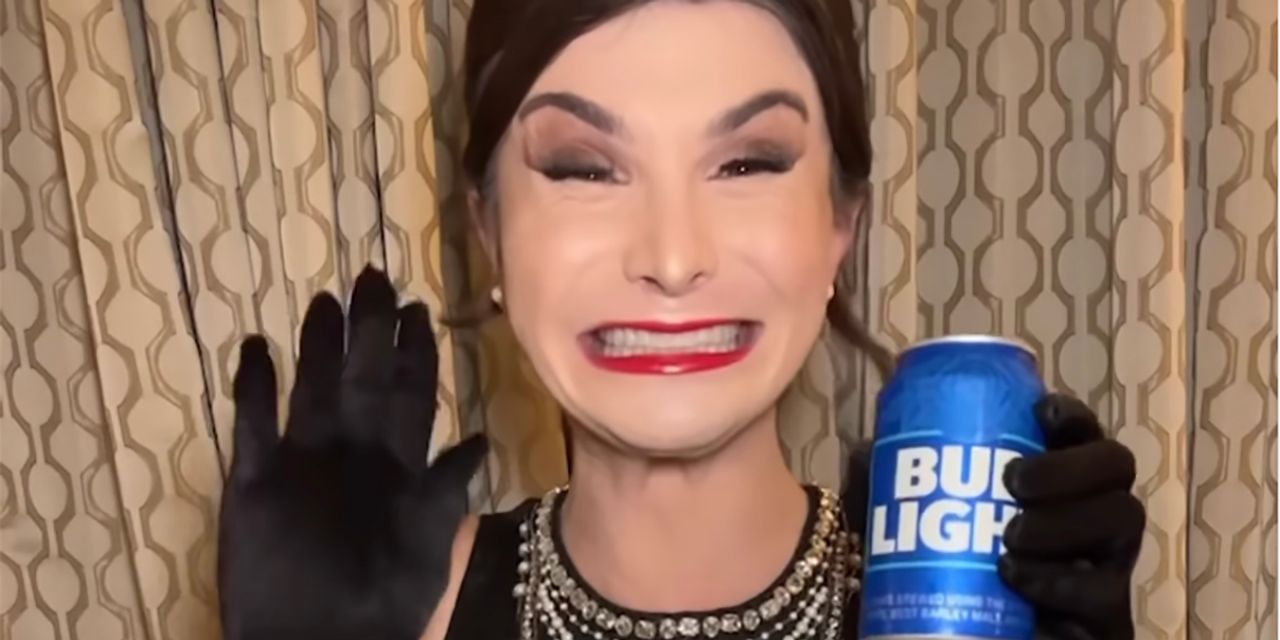
The effacement of women’s bodies is changing from a cultural signal to a battlefield maneuver. The acceleration of the presence of men as dominant participants in women’s sports, the growing intensity of casually monstrous blue zone attacks on families and parenting, the emergence of drag queens — men playacting as women, burlesque cartoons about sexual identity — as The Most Important Symbol Ever (and something children should definitely see) …
… and now this:
That’s footage from a Let Women Speak event in Auckland, New Zealand, where women arguing that “women” are “adult human females” were physically attacked by a mob of “transwomen” — by men — and their allies. It’s very progressive when men dressed as women silence women and hurt them. More here, also linked above.
In the opening paragraph of this post, you may have thought that one of the things I mentioned was different than the other things — that the blue state assault on families and parenting isn’t specifically gendered, and is equally an assault on the role of mothers and fathers. And it is. But.
It seems to me that the very very strange thing breaking out all over the world — or all over the Anglosphere, because I don’t see Nigeria and Peru and Singapore going all-in on transgendered everything — is loaded with subtext about a febrile loathing for fertility. In policy, we’re incentivizing childlessness, and disincentivizing childbearing. Birthrates are declining sharply, and were declining even before the mRNA injections, while blue state governments work on laws that tell would-be parents their children can vanish from their custody on political pretexts. Who has the future children while the state says that hey, nice family you have there, be a shame if something were to happen to it?
I suspect the reason so much hate and rage is being directed at women is that their bodies can produce babies, which means that the hate and rage is being directed at the future. Peachy Keenan, who’s all over this stuff in multiple forums, wrote recently about Hicklibs on Parade, describing “how deeply the postmodern, anti-human gender ideology has penetrated into what we used to call ‘middle America'”:
In Plano, Texas last fall, an “all-ages” drag brunch attracted some unwanted attention from people who thought they lived in a conservative state. At the brunch — which was held at Ebb & Flow, an eatery in an upscale strip mall — a buffoonish man in a dress wearing cat ears sings, “My p*ssy good, p*ssy sweet, p*ssy good enough to eat”, while flashing his underwear.
In the video from the event, a four-year old girl stares in shock as the “drag” performer twerks and grinds for the ladies in attendance.
The people in the crowd watching this man systematically strip away a little girl’s innocence look like nice friendly Texans; plump grandmas and families and the types you’d run into at the local Costco. They are not hipsters; they are not edgy. They look normal!
This is what makes all of this so striking. These slightly downmarket Texan and Midwestern prairie home companion women have, historically, been the only thing holding this rickety old country together.
March 27, 2023
The war against fertility
March 26, 2023
March 5, 2023
February 19, 2023
February 18, 2023
February 15, 2023
J.K. Rowling’s critics reach the “Burn the witch!” phase
In The Free Press, Megan Phelps-Roper introduces a new audio series featuring extensive interaction with J.K. Rowling herself:

J.K. Rowling’s Harry Potter books were insanely popular among Millennials until she had the temerity to say things the Trans* activists hated. Now, they try to sell customized copies of her books that omit her name completely.
J.K. Rowling is arguably the most successful author in the history of publishing, with the possible exception of God. And “Harry Potter” was a kind of bible for my generation. Since its publication beginning in the late ’90s, the series has taught tens of millions of children about virtues like loyalty, courage, and love — about the inclusion of outsiders and the celebration of difference. The books illustrated the idea of moral complexity, how a person who may at first appear sinister can turn out to be a hero after all.
The author herself became part of the legend, too. A broke, abused, and depressed single mother — writing in longhand at cafes across Edinburgh while her baby girl slept in a stroller beside her — she had spun a tale that begat a global phenomenon. If “Harry Potter” was a bible, then Rowling became a kind of saint.
When she gave the Harvard commencement address in 2008, she was introduced as a social, moral, and political inspiration. Her speech that day was partly about imagination: “the power that enables us to empathize with humans whose experiences we have never shared”.
“We do not need magic to transform our world,” Rowling told the rapt audience. “We carry all the power we need inside ourselves already.”
The uproarious applause that greeted her in 2008 is hard to imagine today. It’s hard to imagine Harvard — let alone any prestigious American university — welcoming Rowling. Indeed, I’m not sure she’d be allowed to give a reading at many local libraries.
That’s because to many, Rowling has since become a kind of Voldemort — the villain of villains in her own stories.
It all blew up in the summer of 2020.
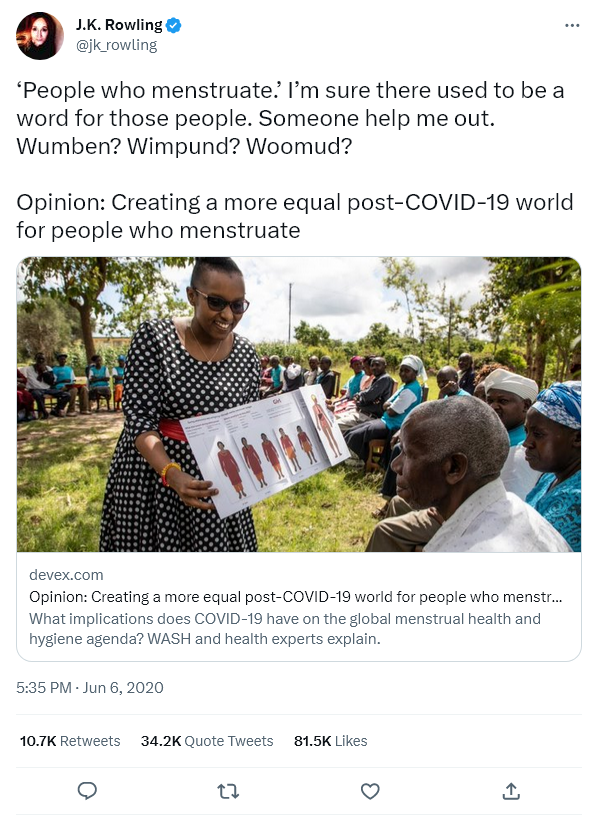
“‘People who menstruate'”, Rowling wrote on Twitter, quoting a headline. “I’m sure there used to be a word for those people. Someone help me out. Wumben? Wimpund? Woomud?”
She continued: “If sex isn’t real, there’s no same-sex attraction. If sex isn’t real, the lived reality of women globally is erased. I know and love trans people, but erasing the concept of sex removes the ability of many to meaningfully discuss their lives. It isn’t hate to speak the truth.”
It’s hard to capture the breadth of the firestorm that followed.
February 10, 2023
“What’s happening to children is morally and medically appalling”
In The Free Press, Jamie Reed explains why she gave up her job as as a case manager at The Washington University Transgender Center at St. Louis Children’s Hospital and is now speaking out against the early and aggressive therapeutic treatment of gender-confused children and teens:
Soon after my arrival at the Transgender Center, I was struck by the lack of formal protocols for treatment. The center’s physician co-directors were essentially the sole authority.
At first, the patient population was tipped toward what used to be the “traditional” instance of a child with gender dysphoria: a boy, often quite young, who wanted to present as — who wanted to be — a girl.
Until 2015 or so, a very small number of these boys comprised the population of pediatric gender dysphoria cases. Then, across the Western world, there began to be a dramatic increase in a new population: Teenage girls, many with no previous history of gender distress, suddenly declared they were transgender and demanded immediate treatment with testosterone.
I certainly saw this at the center. One of my jobs was to do intake for new patients and their families. When I started there were probably 10 such calls a month. When I left there were 50, and about 70 percent of the new patients were girls. Sometimes clusters of girls arrived from the same high school.
This concerned me, but didn’t feel I was in the position to sound some kind of alarm back then. There was a team of about eight of us, and only one other person brought up the kinds of questions I had. Anyone who raised doubts ran the risk of being called a transphobe.
The girls who came to us had many comorbidities: depression, anxiety, ADHD, eating disorders, obesity. Many were diagnosed with autism, or had autism-like symptoms. A report last year on a British pediatric transgender center found that about one-third of the patients referred there were on the autism spectrum.
Frequently, our patients declared they had disorders that no one believed they had. We had patients who said they had Tourette syndrome (but they didn’t); that they had tic disorders (but they didn’t); that they had multiple personalities (but they didn’t).
The doctors privately recognized these false self-diagnoses as a manifestation of social contagion. They even acknowledged that suicide has an element of social contagion. But when I said the clusters of girls streaming into our service looked as if their gender issues might be a manifestation of social contagion, the doctors said gender identity reflected something innate.
To begin transitioning, the girls needed a letter of support from a therapist — usually one we recommended — who they had to see only once or twice for the green light. To make it more efficient for the therapists, we offered them a template for how to write a letter in support of transition. The next stop was a single visit to the endocrinologist for a testosterone prescription.
That’s all it took.
When a female takes testosterone, the profound and permanent effects of the hormone can be seen in a matter of months. Voices drop, beards sprout, body fat is redistributed. Sexual interest explodes, aggression increases, and mood can be unpredictable. Our patients were told about some side effects, including sterility. But after working at the center, I came to believe that teenagers are simply not capable of fully grasping what it means to make the decision to become infertile while still a minor.
January 29, 2023
“That is what Westerners like about Dubai: the indentured servitude. And the weather.”
Tanya Gold at The Free Press:

“Royal Atlantis Resort hotel under construction, Palm Jumeirah, Dubai” by Jpbowen is licensed under CC BY-SA 4.0 .
I went to Dubai once. It is where tyranny meets hyper-capitalism, and it is as awful as it sounds.
I was helping a journalist friend research an article. I spent my days admiring an undersea bedroom in a lagoon and a ski slope inside a mall. At night I would meet trafficked maids, or a woman imprisoned for adultery. I asked an ancient British tourist why he came here for his holidays. He said, “The staff will hold your dick if you ask them.” That is what Westerners like about Dubai: the indentured servitude. And the weather.
Last week, at the grand opening of Atlantis The Royal, Dubai’s newest luxury hotel, Beyoncé gave her first live performance in five years. This gig featured a 48-person all-female orchestra — how feminist — a Lebanese dance troupe, and her daughter. She was reportedly paid $24 million for the occasion.
Her latest album, Renaissance, is, among other things, an homage to black queer culture. She performed no songs from it; how could she in a country where homosexuality is punishable by death? So she sang her back catalog for the equivalent of ten Bugatti Chirons. Oil-rich tyrannies have generous marketing budgets; they’re selling tyranny itself.
What Beyoncé does or doesn’t do for money wouldn’t matter but for the trend of celebrity activism, which insinuates that morality travels with a star like her wardrobe. Beyoncé acolytes say that just by arriving in Dubai she made the city gayer, a kind of subtle protest. Perhaps so subtle that even Dubai’s ruler Sheikh Mohammed bin Rashid — accused of abducting two of his daughters for noncompliance with his wishes, one from England, and another from a ship as she tried to flee Dubai — wouldn’t notice. Did his enforcers reconsider their stance on gayness as they sang along to “Drunk in Love”? Or are they laughing themselves stupid at the PR coup of persuading an until-now gay ally to perform at the opening of a hotel in a country that hates gays?
Dubai, along with Saudi Arabia, wants to reinvent itself as a tourist destination for when the oil runs out. There is nothing understated there — the Burj Khalifa, which is the tallest building in the world; the Palm Jumeirah, a man-made archipelago in the shape of a palm tree. Everything is vast and highly colored, a distraction. It has to be: To enjoy yourself in Dubai, you must close your eyes to suffering. Almost 90 percent of Dubai’s residents are migrant workers, and many of them live in conditions amounting to indentured slavery.
January 17, 2023
How ideological programming in British schools make men like Andrew Tate inevitable
To be honest, I don’t think I’d ever heard of Andrew Tate before his legal troubles in Romania hit the headlines, and I’m not well-versed on his achievements (such as they might be). Janice Fiamengo also admits that Tate wasn’t on her radar before then, but she’s done some work to try to put him into perspective:
What has Tate got to do with UK education, except perhaps as a telling symbol of its unintended consequences? Why not just model and enforce ideals such as courtesy, self-restraint, and hard work, while upholding high academic standards? The article demonstrates how deeply committed schools have become to ideological programming. Some schools have drawn up “entire lessons focused on Tate” (!!!) while others deal more generally with “misogyny and gender stereotypes”. Whatever the particulars, the general message is unvarying: “We’ve all got to work collaboratively and collectively to support young men to reframe masculinity—away from this toxic ideology that’s presented by the likes of Tate.”
No one who’s been following the feminist narrative over the past decade or two will be surprised by the dogmatic reference to “toxic ideology,” now standard in any discussion of “reframing” boyhood. There is just one problem for the concerned teachers: Tate is five steps ahead of them, having already made clear to his millions of followers why injunctions about “reframing masculinity” are just code for the continual marginalization that most boys naturally want nothing to do with. The moment Tate and his allies expressed their scorn for the project, it lost its power overs the millions of boys forced to sit in feminist classrooms across the UK. Tate confirmed what boys intuitively knew: having their masculinity “reframed” will prevent them from pursuing masculine dreams, from being proud of themselves as male, admired by their male peers, and able to attract the interest of pretty girls. Teachers can keep on telling boys that peer approval through masculine moxy isn’t important, but that won’t make it true.
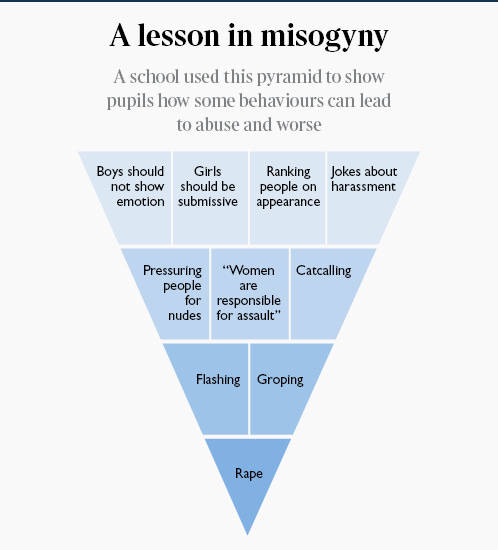
The point is not whether Tate’s (“I’ve got 33 cars“) program is an unalloyedly good one; the point is that it is manifestly better than the recipe for self-loathing and irrelevance being offered by the schools. The school’s program is the same that has been tried for years without any enthusiastic uptake because it offers nothing affirmatively male for young men to be and do (see especially White Ribbon UK, which has been trying for years to turn boys into handmaidens of feminism). All the normal things that centuries of boys in every major civilization on earth have cared about—competitiveness, status, toughness, mastery, knowledge, self-reliance, stoicism, high-jinks, displays of ability, and male bonding—are now frowned upon and must be replaced by feminine traits like empathy, egalitarianism, conformity, verbal display, and tone-policing. It doesn’t take a gender studies specialist to see that the life being offered these boys is one of deference, self-suppression, and self-contempt. No boy should want that.
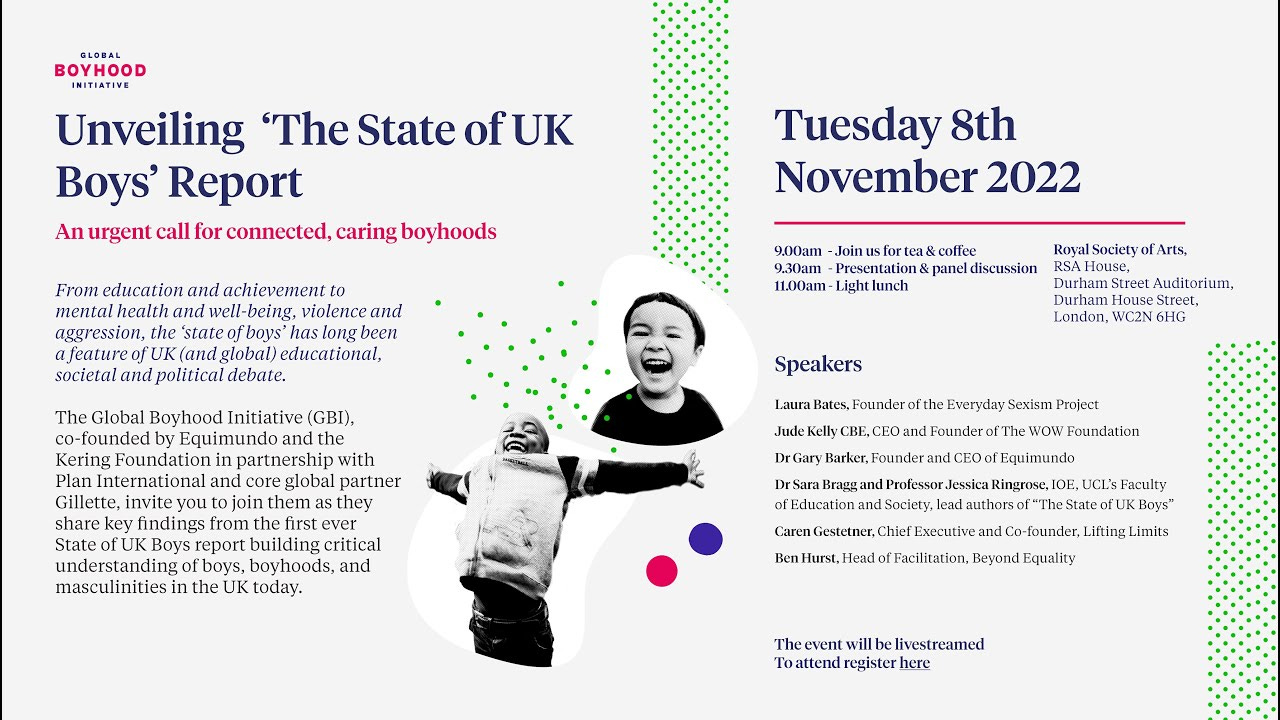
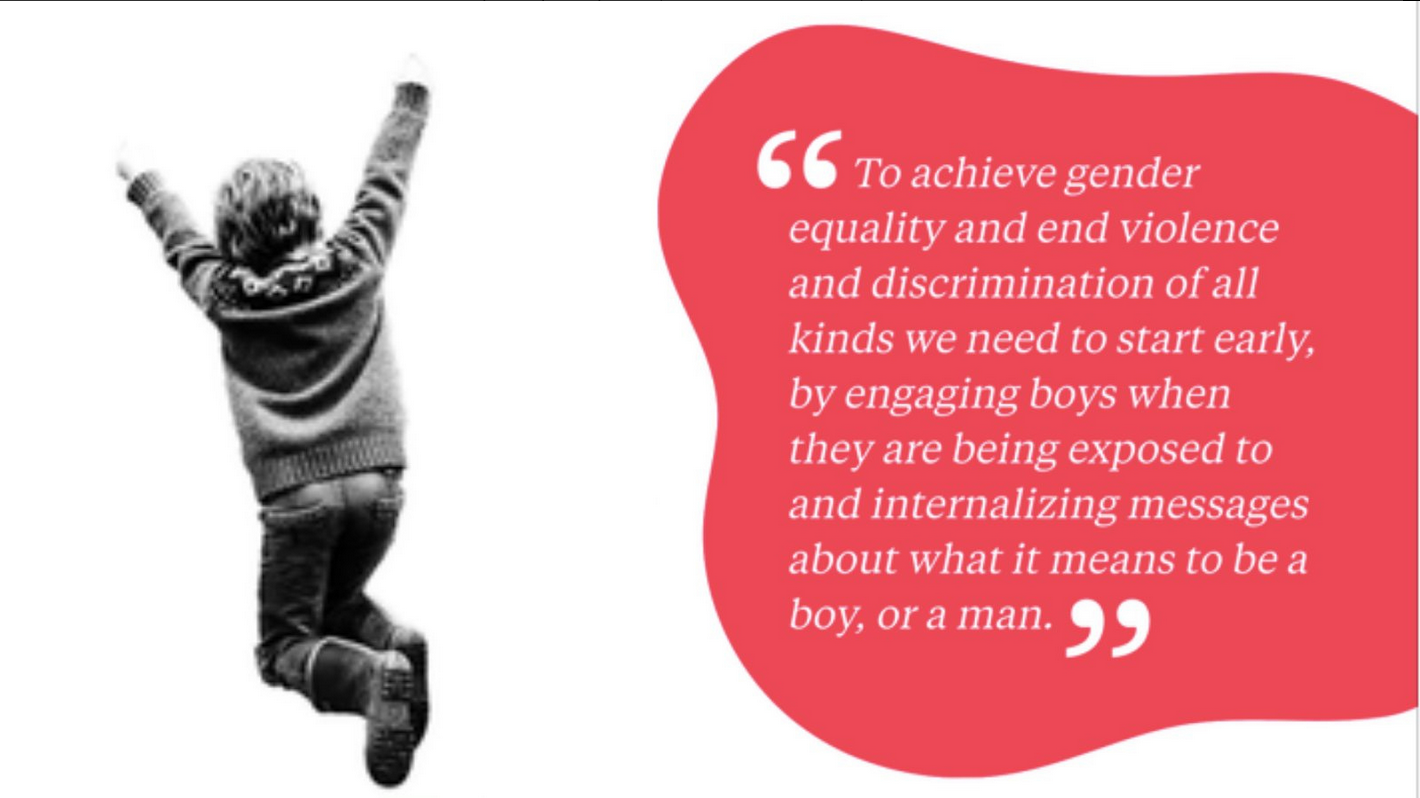
In case you doubt my characterization, take a look at the Global Boyhood Initiative’s report on The State of UK Boys: Understanding and Transforming Gender in the Lives of UK Boys, published in 2022. The report was written for “teachers, youth workers, early-years practitioners and other professionals” to achieve “gender equity and social justice”.
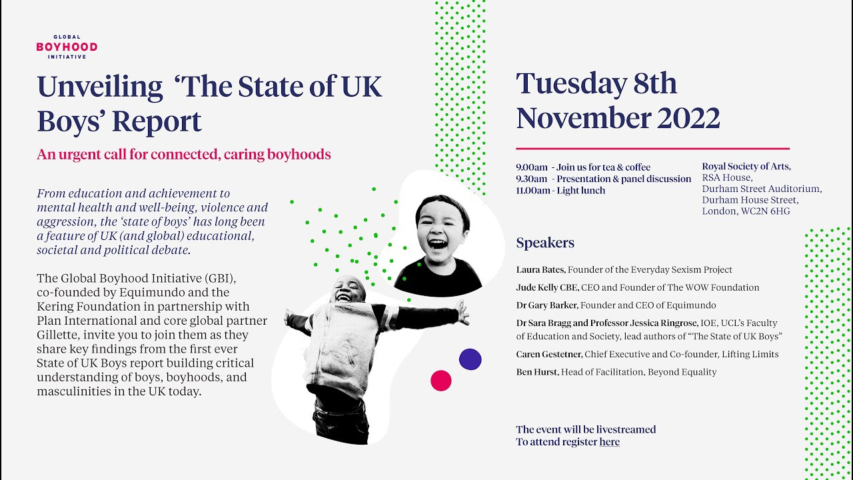
Incidentally, the report includes a section attacking an alleged “overemphasis” on research showing boys and men as victims of intimate partner violence by women. While the report enthusiastically promotes the end of “gender” through transgenderism and social constructivism, it emphatically does not support the end of gendered norms about which sex is violent. On this front, the report laments that “even young boys” now believe that male persons can be victimized by female persons, citing the case of Johnny Depp’s abuse by Amber Heard. Nothing could more clearly signal the report authors’ chagrined awareness of the difficulty of controlling boys’ thoughts in the internet age.
The rest of the report explores pathways to weaken masculinity. On a number of occasions, it takes aim at “simplistic notions that boys require male ‘role models'” because such notions “frame women as inadequate to parent and teach boys”. Taking for granted that “gender is not tied to sex organs, hormones, or biological traits” (one wonders, then, why trans persons elect to take hormones and to change their sex organs), the emphasis throughout the report is on “realigning” masculinity to highlight gender fluidity, transgenderism, and inclusion of girls. The document has absolutely nothing good to say about masculinity, which it describes, variously, as “a seductive form of power”, “hegemonic”, and “oppressive”. It even uses the derogatory term “boysplaining” to stigmatize boys’ alleged way of talking.
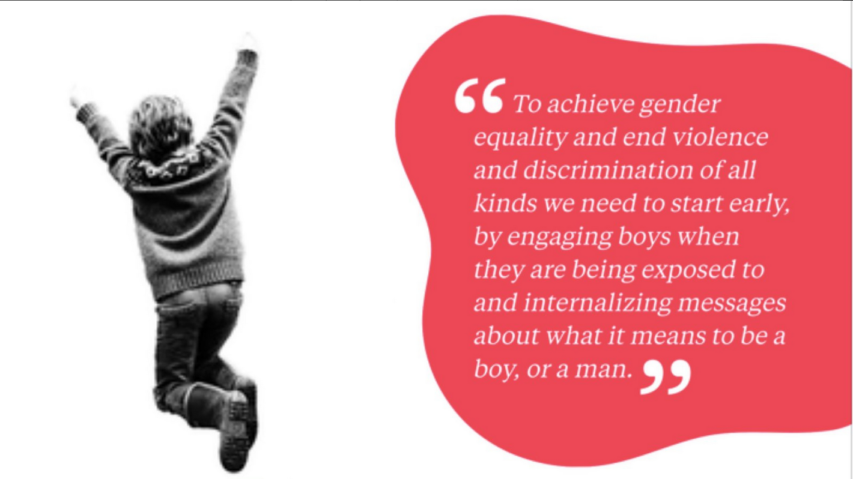
Even such seemingly benign behaviors as “laughter, banter, and entertaining one another” are said to be “laddish” and linked to the exclusion of women and homosexuals. Taking pleasure in being good at sport is also given a negative valence by being associated with bullying.
As in all such feminist propaganda, the report seeks the evacuation of all positive content from masculinity. “Realigned” boys are to anchor their sense of self mainly in not being what boys have always been. They are to shun the allegedly “hegemonic” characteristics of “physical, sexual, and mental prowess; being action-oriented; ‘knowing’; having autonomy […]; and being emotionally tough.” It is surely no coincidence that modern boys and young men have fallen well behind their female peers in educational attainment, economic status, and performance on the job market. “Prowess” is out, knowing is out, being active is out, toughness is out. No wonder so many boys feel lost, disaffected, and resentful, and no wonder some see Andrew Tate as a hero.

January 13, 2023
“Forced teaming”
In Quillette, Jonathan Kay provides us with our new term of the week:

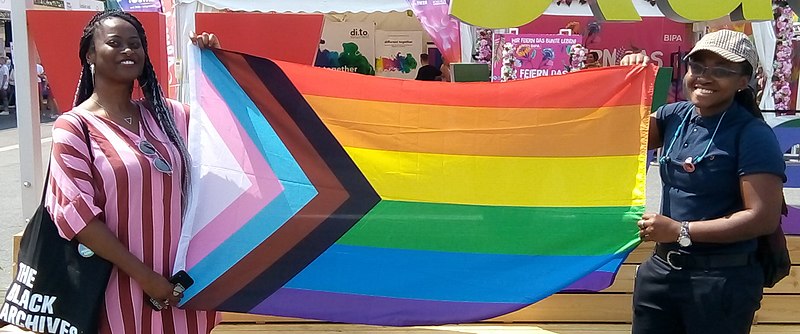
Two people at EuroPride 2019 in Vienna holding an LGBTQ+ pride rainbow flag featuring a design by Daniel Quasar; this variation of the rainbow flag was initially promoted as “Progress” a PRIDE Flag Reboot.
Photo by Bojan Cvetanović via Wikimedia Commons.
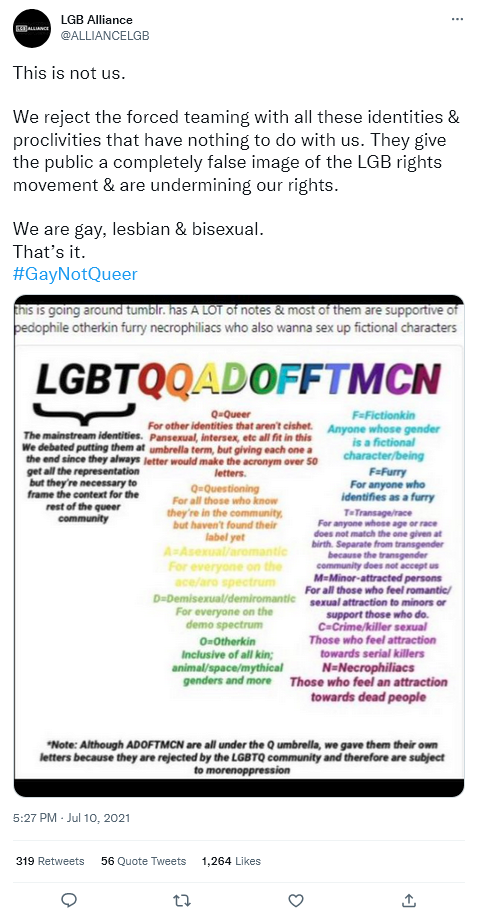
I learned a new term this week: “Forced teaming“. It describes what happens when a group of people — say, gay men and lesbian women — are forbidden from breaking ranks with some larger constituency, such as (in this case) the LGBT movement.
The example I’m discussing here is one that Quillette writers have been exploring for several years now. As author Allan Stratton noted last year, the central ideological fixation of many transgender-rights activists is the negation of biological sex as a meaningful marker of human identity. The true source of sexual attraction, they will insist, isn’t the reality of sexed male and female bodies; but rather an abstract gender spirit lodged within our souls, which somehow broadcasts itself in a way that prospective romantic partners are able to sense and interpret. As Stratton notes, this mythology isn’t just flagrantly wrong. It’s also homophobic to such extent that it denies the sexually defined nature of gay identity. Moreover, this homophobic element can’t be excised from gender ideology without fatally undercutting the (typically unspoken) mission of many biologically male trans activists, since giving up this claim “would be to admit that a lesbian isn’t going to be attracted to a male body, no matter how many times she is assured that the body in question belongs to someone who identifies as a woman.”
On Wednesday, Montreal-based Substacker Eliza Mondegreen provided an eyewitness report that helps illustrate what the “forced teaming” of ideologically non-compliant LGB men and women now looks like. The Centre for Human Rights and Legal Pluralism (CHRLP) at McGill University had planned to host a January 9th talk about the tension between sex and gender identity, to be delivered by Robert Wintemute, a professor of Human Rights Law at King’s College London. According to the event page, he was to discuss “whether or not the law should be changed to make it easier for a transgender individual to change their legal sex from their birth sex, and about exceptional situations, such as women-only spaces and sports, in which the individual’s birth sex should take priority over their gender identity, regardless of their legal sex.”
Though Wintemute seems the furthest thing from a bigot (or even a conservative), he is loathed by many trans activists due to what they see as an act of unforgivable apostasy. In 2006, Wintemute co-authored something called the “Yogyakarta Principles“, an international manifesto demanding that unfettered self-identification be recognized as the one and only means of distinguishing men from women. But he later recanted, declaring that “a key factor in my change of opinion has been listening to women”. Needless to say, many of Wintemute’s former activist friends then began treating him like Lord Voldemort. And Montreal’s Gazette newspaper, echoing such denunciations, darkly warned readers that the visiting human-rights professor had “ties to LGB Alliance, an advocacy group described by various LGBTQ2+ organizations and activists as a transphobic hate group”. (In truth, the LGB Alliance is simply a British charity that, as its name suggests, signal-boosts lesbian, gay, and bisexual individuals who believe that the interests of L, G, and B are now sometimes at cross-purposes with T.)
British feminists, who by now are well used to progressive mobs shutting down speaking events in the name of trans solidarity, may guess the rough contours of what happened next. A self-described “transfeminist sapphic activist” named Celeste Trianon compared Wintemute to a “cannibal”, and announced a protest, suggesting that followers should “bring out the pitchforks”.
January 6, 2023
The Church of England’s latest attempt to become “relevant”
In Spiked, Gareth Roberts discusses the announcement of Reverend Bingo Allison of themself’s “non-binary” status as the first openly genderqueer individual ordained as a priest in the established church:
Many have pinned the beginning of the “Great Awokening” – the transition of the venomous cocktail of extremely niche Tumblr culture and naff identity politics into the mainstream – to 2013. As we move into this 10th anniversary year of raving teenage internet nonsense being taken seriously in the real world by grown adults, perhaps we need a spiritual guide to lead us in our celebrations?
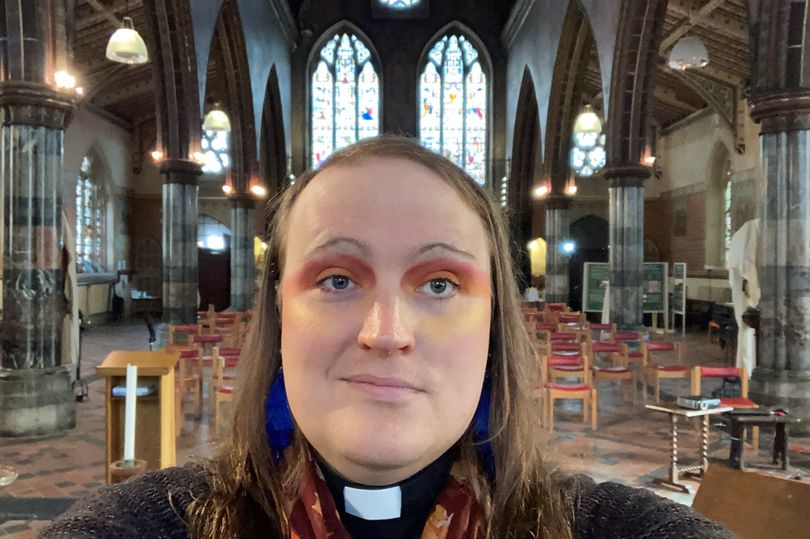
Step forward the Rev Bingo Allison, vicar of a church in a Liverpool suburb, and apparently both “nonbinary” and “genderqueer”. (We do not learn from Bingo’s New Year’s Day interview in the Liverpool Echo if Bingo is actually his – sorry, Them’s – real name-o.)
As ever, working out what the terms nonbinary and genderqueer actually mean is like knitting butter. In the case of the Rev Bingo, it seems from what he says and from the pictorial evidence in the Echo that this has something to do with wearing very, very badly applied cosmetics and regaling anybody silly enough to listen with cut-and-paste boilerplate, like “the history of biblical interpretation is littered with the opinions of rich, white, straight, cisgender, able-bodied, neurotypical men” – basically, ChatGPT with eyeshadow applied à la Black+Decker.
I’ve recently been wondering why so many men with a lady soul are so bad at the application of make-up – both the Rev Bingo and cyclist Emily Bridges seem to have particular difficulty with eyeliner. Applying cosmetics well is not that difficult. In my brief teenage flirtation with the crossover point between New Romantic and Goth, I mastered the art while travelling into London on the very bumpy stretch of the Metropolitan Line between Moor Park and Harrow-on-the-Hill. (It was fatal to even attempt androgyny while still in Hertfordshire, particularly if the end result just made you look like a very camp Herman Munster.) I’m beginning to realise that the wonky slap is an essential part of the non-illusion, of the passive-aggressive, male status display that is at work. It is saying: “I’m not even going to try and you still have to kneel to me.”
“Jesus loves sparkly eyeshadow”, Bingo told his Insta followers recently. I have news for the Rev. Us lads can wear sparkly eyeshadow too with no effect on our bodies or souls. It does not change your sex. It just makes you a man wearing sparkly eyeshadow, like the Sweet doing “Block Buster” on Top of the Pops – although in Bingo’s case there is, owing to a very binary dose of male-pattern baldness, a more marked resemblance to Brian Eno in his Roxy Music days, with a hint of Max Wall in there, too.
December 18, 2022
November 29, 2022
October 24, 2022
The rise of “Queer Theory”
In City Journal, Christopher F. Rufo provides the background that has lead to the widespread phenomenon of “Drag Queen Story Hour”:
Start with queer theory, the academic discipline born in 1984 with the publication of Gayle S. Rubin’s essay “Thinking Sex: Notes for a Radical Theory of the Politics of Sexuality”. Beginning in the late 1970s, Rubin, a lesbian writer and activist, had immersed herself in the subcultures of leather, bondage, orgies, fisting, and sado-masochism in San Francisco, migrating through an ephemeral network of BDSM (bondage, domination, sadomasochism) clubs, literary societies, and New Age spiritualist gatherings. In “Thinking Sex”, Rubin sought to reconcile her experiences in the sexual underworld with the broader forces of American society. Following the work of the French theorist Michel Foucault, Rubin sought to expose the power dynamics that shaped and repressed human sexual experience.
“Modern Western societies appraise sex acts according to a hierarchical system of sexual value,” Rubin wrote. “Marital, reproductive heterosexuals are alone at the top erotic pyramid. Clamouring below are unmarried monogamous heterosexuals in couples, followed by most other heterosexuals. … Stable, long-term lesbian and gay male couples are verging on respectability, but bar dykes and promiscuous gay men are hovering just above the groups at the very bottom of the pyramid. The most despised sexual castes currently include transsexuals, transvestites, fetishists, sadomasochists, sex workers such as prostitutes and porn models, and the lowliest of all, those whose eroticism transgresses generational boundaries.”
Rubin’s project — and, by extension, that of queer theory — was to interrogate, deconstruct, and subvert this sexual hierarchy and usher in a world beyond limits, much like the one she had experienced in San Francisco. The key mechanism for achieving this turn was the thesis of social construction. “The new scholarship on sexual behaviour has given sex a history and created a constructivist alternative to” the view that sex is a natural and pre-political phenomenon, Rubin wrote. “Underlying this body of work is an assumption that sexuality is constituted in society and history, not biologically ordained. This does not mean the biological capacities are not prerequisites for human sexuality. It does mean that human sexuality is not comprehensible in purely biological terms.” In other words, traditional conceptions of sex, regarding it as a natural behavior that reflects an unchanging order, are pure mythology, designed to rationalize and justify systems of oppression. For Rubin and later queer theorists, sex and gender were infinitely malleable. There was nothing permanent about human sexuality, which was, after all, “political”. Through a revolution of values, they believed, the sexual hierarchy could be torn down and rebuilt in their image.
There was some reason to believe that Rubin might be right. The sexual revolution had been conquering territory for two decades: the birth-control pill, the liberalization of laws surrounding marriage and abortion, the intellectual movements of feminism and sex liberation, the culture that had emerged around Playboy magazine. By 1984, as Rubin acknowledged, stable homosexual couples had achieved a certain amount of respectability in society. But Rubin, the queer theorists, and the fetishists of the BDSM subculture wanted more. They believed that they were on the cusp of fundamentally transforming sexual norms. “There [are] historical periods in which sexuality is more sharply contested and more overtly politicized,” Rubin wrote. “In such periods, the domain of erotic life is, in effect, renegotiated.” And, following the practice of any good negotiator, they laid out their theory of the case and their maximum demands. As Rubin explained: “A radical theory of sex must identify, describe, explain, and denounce erotic injustice and sexual oppression. Such a theory needs refined conceptual tools which can grasp the subject and hold it in view. It must build rich descriptions of sexuality as it exists in society and history. It requires a convincing critical language that can convey the barbarity of sexual persecution.” Once the ground is softened and the conventions are demystified, the sexual revolutionaries could do the work of rehabilitating the figures at the bottom of the hierarchy — “transsexuals, transvestites, fetishists, sadomasochists, sex workers”.
Where does this process end? At its logical conclusion: the abolition of restrictions on the behavior at the bottom end of the moral spectrum — pedophilia. Though she uses euphemisms such as “boylovers” and “men who love underaged youth”, Rubin makes her case clearly and emphatically. In long passages throughout “Thinking Sex”, Rubin denounces fears of child sex abuse as “erotic hysteria”, rails against anti–child pornography laws, and argues for legalizing and normalizing the behavior of “those whose eroticism transgresses generational boundaries”. These men are not deviants, but victims, in Rubin’s telling. “Like communists and homosexuals in the 1950s, boylovers are so stigmatized that it is difficult to find defenders for their civil liberties, let alone for their erotic orientation,” she explains. “Consequently, the police have feasted on them. Local police, the FBI, and watchdog postal inspectors have joined to build a huge apparatus whose sole aim is to wipe out the community of men who love underaged youth. In twenty years or so, when some of the smoke has cleared, it will be much easier to show that these men have been the victims of a savage and undeserved witch hunt.” Rubin wrote fondly of those primitive hunter-gatherer tribes in New Guinea in which “boy-love” was practiced freely.
Such positions are hardly idiosyncratic within the discipline of queer theory. The father figure of the ideology, Foucault, whom Rubin relies upon for her philosophical grounding, was a notorious sadomasochist who once joined scores of other prominent intellectuals to sign a petition to legalize adult–child sexual relationships in France. Like Rubin, Foucault haunted the underground sex scene in the Western capitals and reveled in transgressive sexuality. “It could be that the child, with his own sexuality, may have desired that adult, he may even have consented, he may even have made the first moves,” Foucault once told an interviewer on the question of sex between adults and minors. “And to assume that a child is incapable of explaining what happened and was incapable of giving his consent are two abuses that are intolerable, quite unacceptable.”
Rubin’s American compatriots made the same argument even more explicitly. Longtime Rubin collaborator Pat Califia, who would later become a transgender man, claimed that American society had turned pedophiles into “the new communists, the new niggers, the new witches”. For Califia, age-of-consent laws, religious sexual mores, and families who police the sexuality of their children represented a thousand-pound bulwark against sexual freedom. “You can’t liberate children and adolescents without disrupting the entire hierarchy of adult power and coercion and challenging the hegemony of antisex fundamentalist religious values,” she lamented. All of it — the family, the law, the religion, the culture — was a vector of oppression, and all of it had to go.