Quotulatiousness

January 29, 2023

“That is what Westerners like about Dubai: the indentured servitude. And the weather.”

Filed under: Economics, Media, Middle East — Tags: , , , , — Nicholas @ 05:00

Tanya Gold at The Free Press:

“Royal Atlantis Resort hotel under construction, Palm Jumeirah, Dubai” by Jpbowen is licensed under CC BY-SA 4.0 .

I went to Dubai once. It is where tyranny meets hyper-capitalism, and it is as awful as it sounds.

I was helping a journalist friend research an article. I spent my days admiring an undersea bedroom in a lagoon and a ski slope inside a mall. At night I would meet trafficked maids, or a woman imprisoned for adultery. I asked an ancient British tourist why he came here for his holidays. He said, “The staff will hold your dick if you ask them.” That is what Westerners like about Dubai: the indentured servitude. And the weather.

Last week, at the grand opening of Atlantis The Royal, Dubai’s newest luxury hotel, Beyoncé gave her first live performance in five years. This gig featured a 48-person all-female orchestra — how feminist — a Lebanese dance troupe, and her daughter. She was reportedly paid $24 million for the occasion.

Her latest album, Renaissance, is, among other things, an homage to black queer culture. She performed no songs from it; how could she in a country where homosexuality is punishable by death? So she sang her back catalog for the equivalent of ten Bugatti Chirons. Oil-rich tyrannies have generous marketing budgets; they’re selling tyranny itself.

What Beyoncé does or doesn’t do for money wouldn’t matter but for the trend of celebrity activism, which insinuates that morality travels with a star like her wardrobe. Beyoncé acolytes say that just by arriving in Dubai she made the city gayer, a kind of subtle protest. Perhaps so subtle that even Dubai’s ruler Sheikh Mohammed bin Rashid — accused of abducting two of his daughters for noncompliance with his wishes, one from England, and another from a ship as she tried to flee Dubai — wouldn’t notice. Did his enforcers reconsider their stance on gayness as they sang along to “Drunk in Love”? Or are they laughing themselves stupid at the PR coup of persuading an until-now gay ally to perform at the opening of a hotel in a country that hates gays?

Dubai, along with Saudi Arabia, wants to reinvent itself as a tourist destination for when the oil runs out. There is nothing understated there — the Burj Khalifa, which is the tallest building in the world; the Palm Jumeirah, a man-made archipelago in the shape of a palm tree. Everything is vast and highly colored, a distraction. It has to be: To enjoy yourself in Dubai, you must close your eyes to suffering. Almost 90 percent of Dubai’s residents are migrant workers, and many of them live in conditions amounting to indentured slavery.

January 17, 2023

How ideological programming in British schools make men like Andrew Tate inevitable

Filed under: Britain, Education, Europe — Tags: , , , , — Nicholas @ 03:00

To be honest, I don’t think I’d ever heard of Andrew Tate before his legal troubles in Romania hit the headlines, and I’m not well-versed on his achievements (such as they might be). Janice Fiamengo also admits that Tate wasn’t on her radar before then, but she’s done some work to try to put him into perspective:

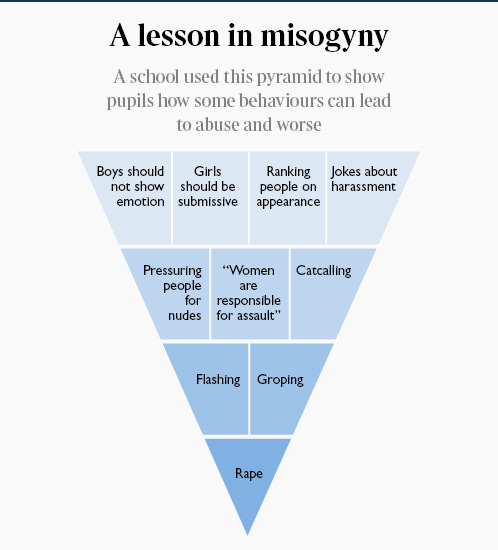
What has Tate got to do with UK education, except perhaps as a telling symbol of its unintended consequences? Why not just model and enforce ideals such as courtesy, self-restraint, and hard work, while upholding high academic standards? The article demonstrates how deeply committed schools have become to ideological programming. Some schools have drawn up “entire lessons focused on Tate” (!!!) while others deal more generally with “misogyny and gender stereotypes”. Whatever the particulars, the general message is unvarying: “We’ve all got to work collaboratively and collectively to support young men to reframe masculinity—away from this toxic ideology that’s presented by the likes of Tate.”

No one who’s been following the feminist narrative over the past decade or two will be surprised by the dogmatic reference to “toxic ideology,” now standard in any discussion of “reframing” boyhood. There is just one problem for the concerned teachers: Tate is five steps ahead of them, having already made clear to his millions of followers why injunctions about “reframing masculinity” are just code for the continual marginalization that most boys naturally want nothing to do with. The moment Tate and his allies expressed their scorn for the project, it lost its power overs the millions of boys forced to sit in feminist classrooms across the UK. Tate confirmed what boys intuitively knew: having their masculinity “reframed” will prevent them from pursuing masculine dreams, from being proud of themselves as male, admired by their male peers, and able to attract the interest of pretty girls. Teachers can keep on telling boys that peer approval through masculine moxy isn’t important, but that won’t make it true.

The point is not whether Tate’s (“I’ve got 33 cars“) program is an unalloyedly good one; the point is that it is manifestly better than the recipe for self-loathing and irrelevance being offered by the schools. The school’s program is the same that has been tried for years without any enthusiastic uptake because it offers nothing affirmatively male for young men to be and do (see especially White Ribbon UK, which has been trying for years to turn boys into handmaidens of feminism). All the normal things that centuries of boys in every major civilization on earth have cared about—competitiveness, status, toughness, mastery, knowledge, self-reliance, stoicism, high-jinks, displays of ability, and male bonding—are now frowned upon and must be replaced by feminine traits like empathy, egalitarianism, conformity, verbal display, and tone-policing. It doesn’t take a gender studies specialist to see that the life being offered these boys is one of deference, self-suppression, and self-contempt. No boy should want that.

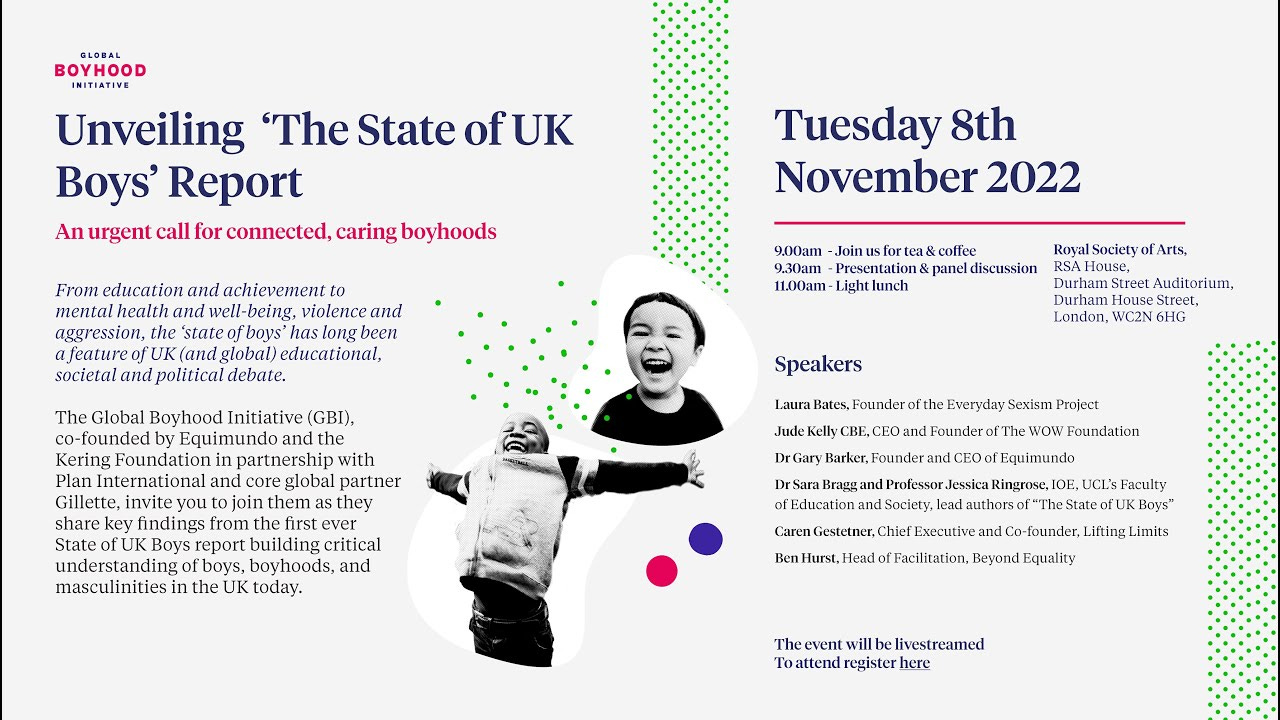
In case you doubt my characterization, take a look at the Global Boyhood Initiative’s report on The State of UK Boys: Understanding and Transforming Gender in the Lives of UK Boys, published in 2022. The report was written for “teachers, youth workers, early-years practitioners and other professionals” to achieve “gender equity and social justice”.

Incidentally, the report includes a section attacking an alleged “overemphasis” on research showing boys and men as victims of intimate partner violence by women. While the report enthusiastically promotes the end of “gender” through transgenderism and social constructivism, it emphatically does not support the end of gendered norms about which sex is violent. On this front, the report laments that “even young boys” now believe that male persons can be victimized by female persons, citing the case of Johnny Depp’s abuse by Amber Heard. Nothing could more clearly signal the report authors’ chagrined awareness of the difficulty of controlling boys’ thoughts in the internet age.

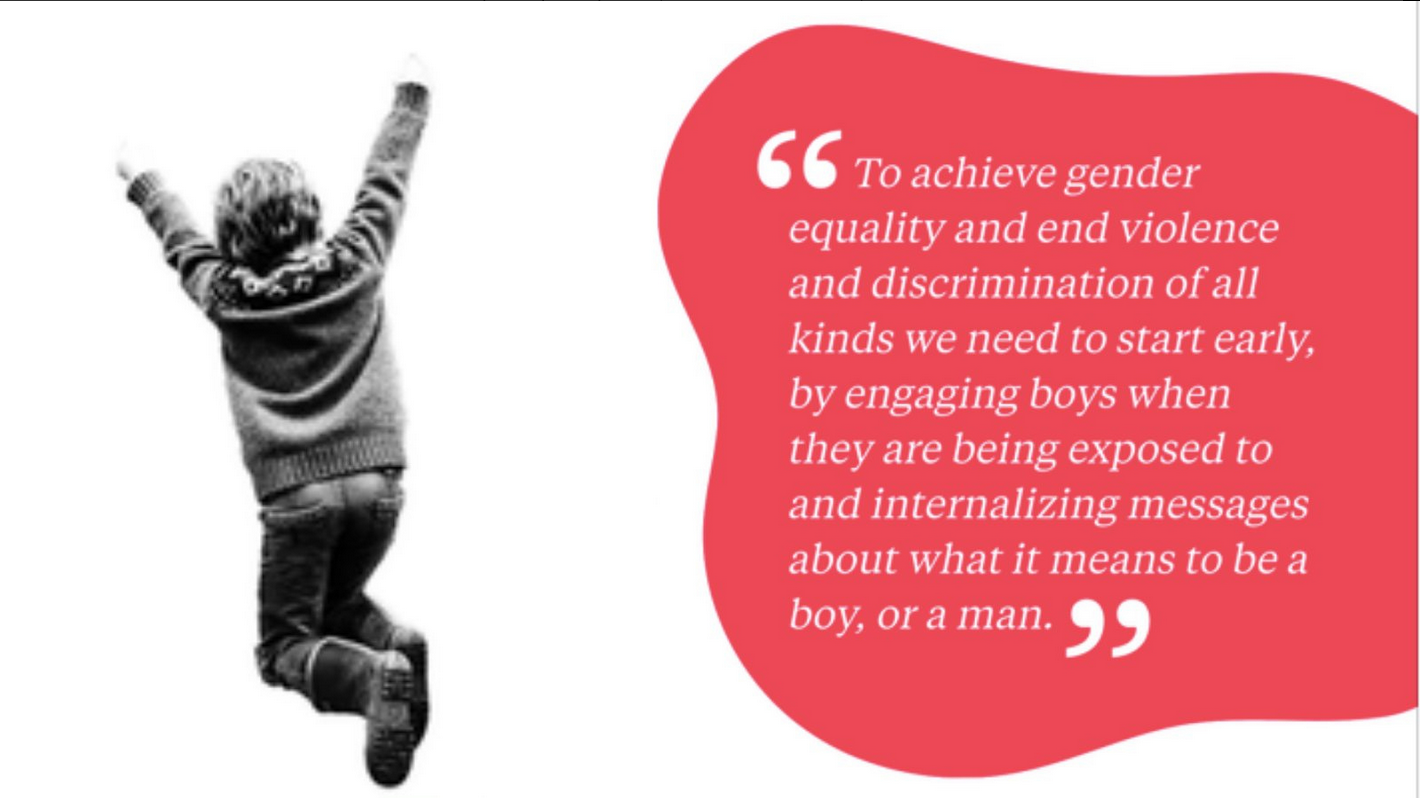
The rest of the report explores pathways to weaken masculinity. On a number of occasions, it takes aim at “simplistic notions that boys require male ‘role models'” because such notions “frame women as inadequate to parent and teach boys”. Taking for granted that “gender is not tied to sex organs, hormones, or biological traits” (one wonders, then, why trans persons elect to take hormones and to change their sex organs), the emphasis throughout the report is on “realigning” masculinity to highlight gender fluidity, transgenderism, and inclusion of girls. The document has absolutely nothing good to say about masculinity, which it describes, variously, as “a seductive form of power”, “hegemonic”, and “oppressive”. It even uses the derogatory term “boysplaining” to stigmatize boys’ alleged way of talking.

Even such seemingly benign behaviors as “laughter, banter, and entertaining one another” are said to be “laddish” and linked to the exclusion of women and homosexuals. Taking pleasure in being good at sport is also given a negative valence by being associated with bullying.

As in all such feminist propaganda, the report seeks the evacuation of all positive content from masculinity. “Realigned” boys are to anchor their sense of self mainly in not being what boys have always been. They are to shun the allegedly “hegemonic” characteristics of “physical, sexual, and mental prowess; being action-oriented; ‘knowing’; having autonomy […]; and being emotionally tough.” It is surely no coincidence that modern boys and young men have fallen well behind their female peers in educational attainment, economic status, and performance on the job market. “Prowess” is out, knowing is out, being active is out, toughness is out. No wonder so many boys feel lost, disaffected, and resentful, and no wonder some see Andrew Tate as a hero.

January 13, 2023

“Forced teaming”

Filed under: Cancon, Education, Health, Politics — Tags: , , , , , , — Nicholas @ 05:00

In Quillette, Jonathan Kay provides us with our new term of the week:

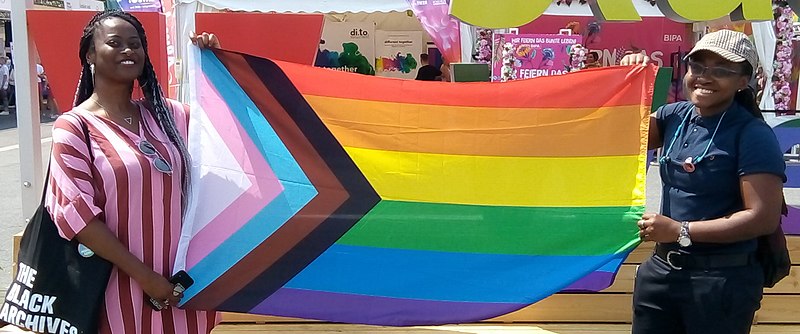
Two people at EuroPride 2019 in Vienna holding an LGBTQ+ pride rainbow flag featuring a design by Daniel Quasar; this variation of the rainbow flag was initially promoted as “Progress” a PRIDE Flag Reboot.
Photo by Bojan Cvetanović via Wikimedia Commons.

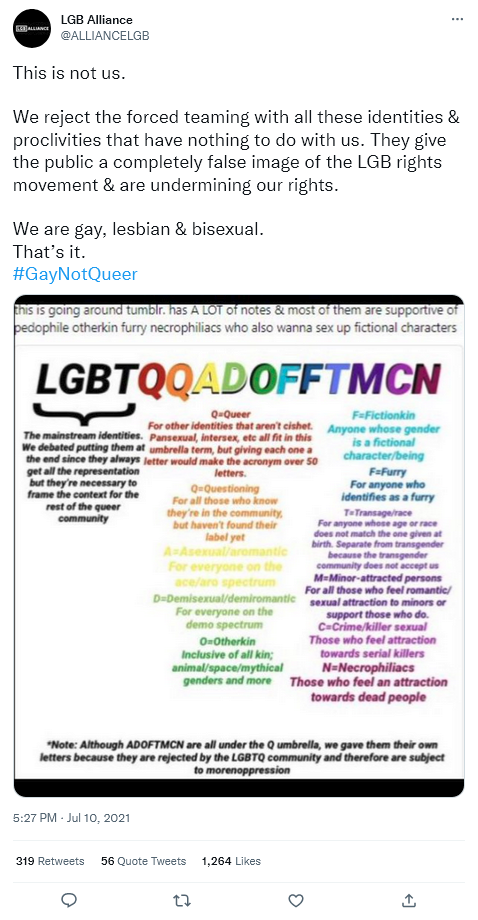
I learned a new term this week: “Forced teaming“. It describes what happens when a group of people — say, gay men and lesbian women — are forbidden from breaking ranks with some larger constituency, such as (in this case) the LGBT movement.

The example I’m discussing here is one that Quillette writers have been exploring for several years now. As author Allan Stratton noted last year, the central ideological fixation of many transgender-rights activists is the negation of biological sex as a meaningful marker of human identity. The true source of sexual attraction, they will insist, isn’t the reality of sexed male and female bodies; but rather an abstract gender spirit lodged within our souls, which somehow broadcasts itself in a way that prospective romantic partners are able to sense and interpret. As Stratton notes, this mythology isn’t just flagrantly wrong. It’s also homophobic to such extent that it denies the sexually defined nature of gay identity. Moreover, this homophobic element can’t be excised from gender ideology without fatally undercutting the (typically unspoken) mission of many biologically male trans activists, since giving up this claim “would be to admit that a lesbian isn’t going to be attracted to a male body, no matter how many times she is assured that the body in question belongs to someone who identifies as a woman.”

On Wednesday, Montreal-based Substacker Eliza Mondegreen provided an eyewitness report that helps illustrate what the “forced teaming” of ideologically non-compliant LGB men and women now looks like. The Centre for Human Rights and Legal Pluralism (CHRLP) at McGill University had planned to host a January 9th talk about the tension between sex and gender identity, to be delivered by Robert Wintemute, a professor of Human Rights Law at King’s College London. According to the event page, he was to discuss “whether or not the law should be changed to make it easier for a transgender individual to change their legal sex from their birth sex, and about exceptional situations, such as women-only spaces and sports, in which the individual’s birth sex should take priority over their gender identity, regardless of their legal sex.”

Though Wintemute seems the furthest thing from a bigot (or even a conservative), he is loathed by many trans activists due to what they see as an act of unforgivable apostasy. In 2006, Wintemute co-authored something called the “Yogyakarta Principles“, an international manifesto demanding that unfettered self-identification be recognized as the one and only means of distinguishing men from women. But he later recanted, declaring that “a key factor in my change of opinion has been listening to women”. Needless to say, many of Wintemute’s former activist friends then began treating him like Lord Voldemort. And Montreal’s Gazette newspaper, echoing such denunciations, darkly warned readers that the visiting human-rights professor had “ties to LGB Alliance, an advocacy group described by various LGBTQ2+ organizations and activists as a transphobic hate group”. (In truth, the LGB Alliance is simply a British charity that, as its name suggests, signal-boosts lesbian, gay, and bisexual individuals who believe that the interests of L, G, and B are now sometimes at cross-purposes with T.)

British feminists, who by now are well used to progressive mobs shutting down speaking events in the name of trans solidarity, may guess the rough contours of what happened next. A self-described “transfeminist sapphic activist” named Celeste Trianon compared Wintemute to a “cannibal”, and announced a protest, suggesting that followers should “bring out the pitchforks”.

January 6, 2023

The Church of England’s latest attempt to become “relevant”

Filed under: Britain, Religion — Tags: , — Nicholas @ 03:00

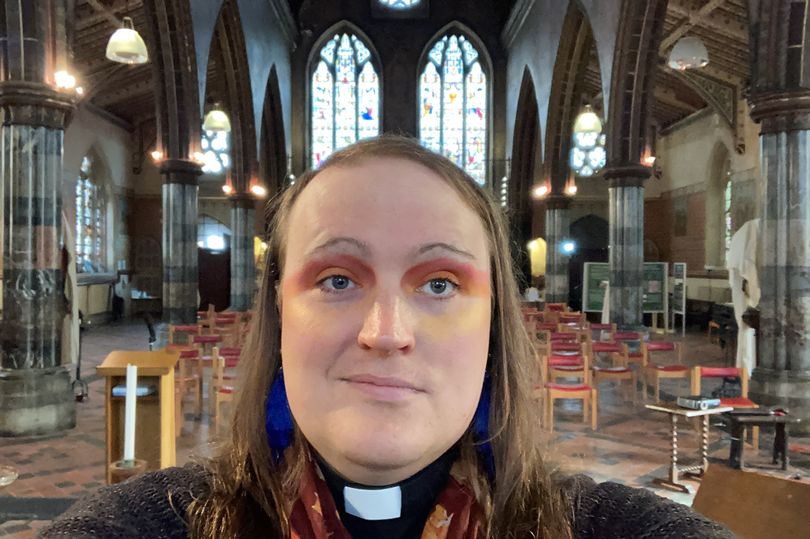
In Spiked, Gareth Roberts discusses the announcement of Reverend Bingo Allison of themself’s “non-binary” status as the first openly genderqueer individual ordained as a priest in the established church:

Rev. Bingo Allison selfie supplied to the Liverpool Echo.

Many have pinned the beginning of the “Great Awokening” – the transition of the venomous cocktail of extremely niche Tumblr culture and naff identity politics into the mainstream – to 2013. As we move into this 10th anniversary year of raving teenage internet nonsense being taken seriously in the real world by grown adults, perhaps we need a spiritual guide to lead us in our celebrations?

Step forward the Rev Bingo Allison, vicar of a church in a Liverpool suburb, and apparently both “nonbinary” and “genderqueer”. (We do not learn from Bingo’s New Year’s Day interview in the Liverpool Echo if Bingo is actually his – sorry, Them’s – real name-o.)

As ever, working out what the terms nonbinary and genderqueer actually mean is like knitting butter. In the case of the Rev Bingo, it seems from what he says and from the pictorial evidence in the Echo that this has something to do with wearing very, very badly applied cosmetics and regaling anybody silly enough to listen with cut-and-paste boilerplate, like “the history of biblical interpretation is littered with the opinions of rich, white, straight, cisgender, able-bodied, neurotypical men” – basically, ChatGPT with eyeshadow applied à la Black+Decker.

I’ve recently been wondering why so many men with a lady soul are so bad at the application of make-up – both the Rev Bingo and cyclist Emily Bridges seem to have particular difficulty with eyeliner. Applying cosmetics well is not that difficult. In my brief teenage flirtation with the crossover point between New Romantic and Goth, I mastered the art while travelling into London on the very bumpy stretch of the Metropolitan Line between Moor Park and Harrow-on-the-Hill. (It was fatal to even attempt androgyny while still in Hertfordshire, particularly if the end result just made you look like a very camp Herman Munster.) I’m beginning to realise that the wonky slap is an essential part of the non-illusion, of the passive-aggressive, male status display that is at work. It is saying: “I’m not even going to try and you still have to kneel to me.”

“Jesus loves sparkly eyeshadow”, Bingo told his Insta followers recently. I have news for the Rev. Us lads can wear sparkly eyeshadow too with no effect on our bodies or souls. It does not change your sex. It just makes you a man wearing sparkly eyeshadow, like the Sweet doing “Block Buster” on Top of the Pops – although in Bingo’s case there is, owing to a very binary dose of male-pattern baldness, a more marked resemblance to Brian Eno in his Roxy Music days, with a hint of Max Wall in there, too.

December 18, 2022

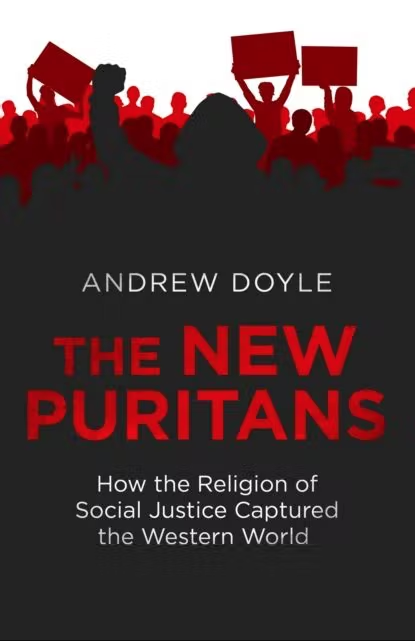
Christopher Snowden reviews Andrew Doyle’s The New Puritans

Filed under: Books, Britain, Education, Media, Politics — Tags: , , , , , — Nicholas @ 03:00

In The Critic, Christopher Snowden praises Doyle’s recent book:

How wrong I was. As Andrew Doyle shows in The New Puritans, it took only a few years for Critical Social Justice to infect the corporate world, government agencies and the media. Most worryingly for a system of thought that favours “lived experience” over objective truth, it became pervasive in higher and lower education.

Doyle had been warning about this for years and kept the receipts. He has a long list of examples of institutional idiocy and persecution to show that there is more to concerns about the “woke brigade” than a right-wing panic over a handful of crazies.

So divorced from reality is Critical Social Justice, that unintentional humour often arises: the CEO of Stonewall accusing lesbians who refuse to date trans women of “sexual racism”; activists becoming uncomfortable with the phrase “trigger warning” because it invokes guns; an American professor of education asserting that “on many levels, mathematics itself operates as whiteness” (how many levels?).

[…]

Those of us who will never be intimately acquainted with the Frankfurt School owe a debt to Doyle for calmly dissecting the anti-liberal worldview. Doyle himself is a left-wing homosexual who is often portrayed as a Nazi on social media for defending free speech and mocking the “entitled demands and infantile tantrums” of the woke mob.

Borrowing a phrase from Isaiah Berlin, he argues that we are living through a “Counter-Enlightenment” led by “conformists with pretensions of radicalism”. The woke ideology is not a natural extension of left-liberalism, he says, nor of political correctness. It is something far more sinister, regressive and authoritarian. In its Year Zero approach to knowledge and history, it is almost nihilistic.

Academically rigorous but never pretentious, The New Puritans is virtually unimprovable as an analysis of this chilling social phenomenon. It begins and ends with the Salem witch trials of 1692–93, when two vindictive children sent 20 people to their deaths on the basis of nothing more than “spectral evidence” (AKA “lived experience”). The mania ended as quickly as it began when the adults in the room simply stopped believing them.

Doyle believes the current madness will end the same way if we can return to critical thinking and put a stop to ad hominem attacks. Good luck with that. Most of the people he is writing about would sooner burn this book than read it.

November 29, 2022

QotD: People have always lied about sex, but GenZ’ers lie even more than you’d expect

Filed under: Education, Media, Quotations, USA — Tags: , , , , , — Nicholas @ 01:00

I’ve been out of academia for a few years, but this bespoke sexuality nonsense was already exploding by the time I got out. I saw two big shifts in the studentry during my academic career. The first was the catastrophic drop in academic readiness, thanks mostly to No Child Left Behind (et al. Lots of trends contributed, especially Participation Trophy culture, but NCLB is a good synecdoche). The second was the end of all-out college kid hedonism.

By the end of my last tour of duty, most college kids were dour puritans. I know, I know, but hear me out. This is the thing people keep forgetting about the Internet: People lie. I know we all know that consciously, but we seem hardwired to believe confessions. In the same way that we might not consciously watch TV — might go some distance out of our way to avoid it — but find ourselves staring mindlessly at the blinking screen when we’re in a bar or a waiting room or something. It seems to be hardwired. So when these folks start writing about all the bizarre sexual shit they’re into, we just … believe them. Sight unseen.

But y’all, in the kingdom of the blind, the one-eyed man is king. I want to state, unequivocally and for the record, that my entire knowledge of undergrads’ sex lives is secondhand. I have zero personal experience in this area. But it’s a close secondhand. For one thing, there’s not much to do in College Town that doesn’t involve undergrads, so I ended up drinking at a lot of the same bars, and in vino veritas. Second, kids these days have no filter. None whatsoever. Finally, social media — my last tour was at a SPLAC, where they strongly encouraged the faculty to be “friends” with the student body on their campus social media apps.

And yeah, they SAY a lot of things … but I highly, highly doubt they actually DO much of anything at all.

For one thing, those “student” bars were lucky I and a few other semi-normal profs were still in our “drink away the pain” phase, because otherwise they would’ve gone out of business. Friday and Saturday nights during football season were still pretty lively, but the rest of the week the “downtown” bars had all the crackling energy of singles’ night down at the mortuary.

Kids just don’t socialize much IRL, and when they do, they don’t hook up. In my not-inconsiderable experience, college drinking these days is like college anything — a grim, pinch-faced, assembly-line business. They intend to get blackout hammered, and they get after it like Heroes of Socialist Labor. Pausing for a quickie in the bathroom would mean skipping a turn in the drinking game — and they all play drinking games; it’s bizarre — so no thanks.

And y’all, those are the outgoing ones. The ones who still have some slight urge to see and be seen out in physical space. The rest of ’em never leave their rooms except at gunpoint, and when you force them to, their eyes never leave their phones.

That’s why I’d bet many crisp stacks of Crispus Attucks that all the “kink” in their social media profiles — even their personal ads — are just for show. They’re not listing all that stuff in order to find someone to have sex with. They’re using it as an excuse not to have sex with anybody, because “having sex with” entails personal interaction and they’re terrified of that. If they ever perfect those VR sex helmets like they had in Demolition Man, watch out, but as of now the whole idea is to seem weird and daring and liberated and kinky, but with no possibility of a follow-up. Oh, you’re into aardvarks and dental tools too? Um … yay? Oh, wait, you dress up as O. a. erikssoni, and I’m only into O. a. leptodon. Sorry!

Severian, “Saturday Miscellania”, Founding Questions, 2022-08-13.

October 24, 2022

The rise of “Queer Theory”

Filed under: Books, Health, History, Media, USA — Tags: , , , , , , , — Nicholas @ 05:00

In City Journal, Christopher F. Rufo provides the background that has lead to the widespread phenomenon of “Drag Queen Story Hour”:

Start with queer theory, the academic discipline born in 1984 with the publication of Gayle S. Rubin’s essay “Thinking Sex: Notes for a Radical Theory of the Politics of Sexuality”. Beginning in the late 1970s, Rubin, a lesbian writer and activist, had immersed herself in the subcultures of leather, bondage, orgies, fisting, and sado-masochism in San Francisco, migrating through an ephemeral network of BDSM (bondage, domination, sadomasochism) clubs, literary societies, and New Age spiritualist gatherings. In “Thinking Sex”, Rubin sought to reconcile her experiences in the sexual underworld with the broader forces of American society. Following the work of the French theorist Michel Foucault, Rubin sought to expose the power dynamics that shaped and repressed human sexual experience.

“Modern Western societies appraise sex acts according to a hierarchical system of sexual value,” Rubin wrote. “Marital, reproductive heterosexuals are alone at the top erotic pyramid. Clamouring below are unmarried monogamous heterosexuals in couples, followed by most other heterosexuals. … Stable, long-term lesbian and gay male couples are verging on respectability, but bar dykes and promiscuous gay men are hovering just above the groups at the very bottom of the pyramid. The most despised sexual castes currently include transsexuals, transvestites, fetishists, sadomasochists, sex workers such as prostitutes and porn models, and the lowliest of all, those whose eroticism transgresses generational boundaries.”

Rubin’s project — and, by extension, that of queer theory — was to interrogate, deconstruct, and subvert this sexual hierarchy and usher in a world beyond limits, much like the one she had experienced in San Francisco. The key mechanism for achieving this turn was the thesis of social construction. “The new scholarship on sexual behaviour has given sex a history and created a constructivist alternative to” the view that sex is a natural and pre-political phenomenon, Rubin wrote. “Underlying this body of work is an assumption that sexuality is constituted in society and history, not biologically ordained. This does not mean the biological capacities are not prerequisites for human sexuality. It does mean that human sexuality is not comprehensible in purely biological terms.” In other words, traditional conceptions of sex, regarding it as a natural behavior that reflects an unchanging order, are pure mythology, designed to rationalize and justify systems of oppression. For Rubin and later queer theorists, sex and gender were infinitely malleable. There was nothing permanent about human sexuality, which was, after all, “political”. Through a revolution of values, they believed, the sexual hierarchy could be torn down and rebuilt in their image.

There was some reason to believe that Rubin might be right. The sexual revolution had been conquering territory for two decades: the birth-control pill, the liberalization of laws surrounding marriage and abortion, the intellectual movements of feminism and sex liberation, the culture that had emerged around Playboy magazine. By 1984, as Rubin acknowledged, stable homosexual couples had achieved a certain amount of respectability in society. But Rubin, the queer theorists, and the fetishists of the BDSM subculture wanted more. They believed that they were on the cusp of fundamentally transforming sexual norms. “There [are] historical periods in which sexuality is more sharply contested and more overtly politicized,” Rubin wrote. “In such periods, the domain of erotic life is, in effect, renegotiated.” And, following the practice of any good negotiator, they laid out their theory of the case and their maximum demands. As Rubin explained: “A radical theory of sex must identify, describe, explain, and denounce erotic injustice and sexual oppression. Such a theory needs refined conceptual tools which can grasp the subject and hold it in view. It must build rich descriptions of sexuality as it exists in society and history. It requires a convincing critical language that can convey the barbarity of sexual persecution.” Once the ground is softened and the conventions are demystified, the sexual revolutionaries could do the work of rehabilitating the figures at the bottom of the hierarchy — “transsexuals, transvestites, fetishists, sadomasochists, sex workers”.

Where does this process end? At its logical conclusion: the abolition of restrictions on the behavior at the bottom end of the moral spectrum — pedophilia. Though she uses euphemisms such as “boylovers” and “men who love underaged youth”, Rubin makes her case clearly and emphatically. In long passages throughout “Thinking Sex”, Rubin denounces fears of child sex abuse as “erotic hysteria”, rails against anti–child pornography laws, and argues for legalizing and normalizing the behavior of “those whose eroticism transgresses generational boundaries”. These men are not deviants, but victims, in Rubin’s telling. “Like communists and homosexuals in the 1950s, boylovers are so stigmatized that it is difficult to find defenders for their civil liberties, let alone for their erotic orientation,” she explains. “Consequently, the police have feasted on them. Local police, the FBI, and watchdog postal inspectors have joined to build a huge apparatus whose sole aim is to wipe out the community of men who love underaged youth. In twenty years or so, when some of the smoke has cleared, it will be much easier to show that these men have been the victims of a savage and undeserved witch hunt.” Rubin wrote fondly of those primitive hunter-gatherer tribes in New Guinea in which “boy-love” was practiced freely.

Such positions are hardly idiosyncratic within the discipline of queer theory. The father figure of the ideology, Foucault, whom Rubin relies upon for her philosophical grounding, was a notorious sadomasochist who once joined scores of other prominent intellectuals to sign a petition to legalize adult–child sexual relationships in France. Like Rubin, Foucault haunted the underground sex scene in the Western capitals and reveled in transgressive sexuality. “It could be that the child, with his own sexuality, may have desired that adult, he may even have consented, he may even have made the first moves,” Foucault once told an interviewer on the question of sex between adults and minors. “And to assume that a child is incapable of explaining what happened and was incapable of giving his consent are two abuses that are intolerable, quite unacceptable.”

Rubin’s American compatriots made the same argument even more explicitly. Longtime Rubin collaborator Pat Califia, who would later become a transgender man, claimed that American society had turned pedophiles into “the new communists, the new niggers, the new witches”. For Califia, age-of-consent laws, religious sexual mores, and families who police the sexuality of their children represented a thousand-pound bulwark against sexual freedom. “You can’t liberate children and adolescents without disrupting the entire hierarchy of adult power and coercion and challenging the hegemony of antisex fundamentalist religious values,” she lamented. All of it — the family, the law, the religion, the culture — was a vector of oppression, and all of it had to go.


October 19, 2022

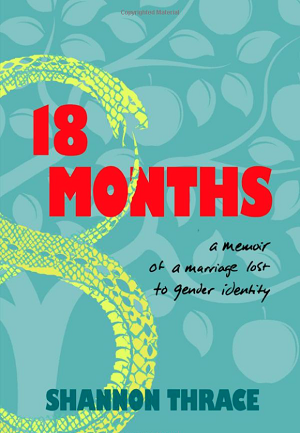
Jonathan Kay reviews 18 Months by Shannon Thrace

Filed under: Books, Health, Media, Politics, USA — Tags: , , , , , , , — Nicholas @ 05:00

At Quillette, a review of a new book on the breakdown of a once-happy marriage when one partner decides that mere transvestism isn’t enough any more and becomes transgendered:

The trans community is diverse, especially when it comes to attitudes toward sex. As writer Angus Fox noted in a seven-part Quillette series, When Sons Become Daughters, some biologically male trans-identified teenagers live a sexless existence; and are drawn to puberty blockers and androgynous aesthetics precisely because they seem to offer safe harbour from male sexual development. In the case of middle-aged men who abruptly adopt a trans identity later in life, on the other hand, it can be the opposite: the presentation is often hyper-sexualized.
(more…)

October 14, 2022

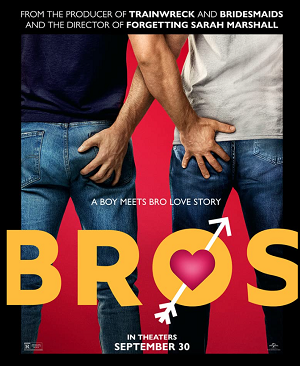
The commercial failure of Bros

Filed under: Media, USA — Tags: , , , , — Nicholas @ 03:00

With the movie failing to find much of an audience, the director and lead actor blame homophobia, because that’s far easier than accepting that rom-com movies are quaint, out-of-date, and stale in the modern hookup culture:

In the case of movies, one might respond to Stoller and Eichner by saying that entertainers are supposed to provide products that the viewing public wishes to see. It might surprise the team behind the didactic Bros that many of us watch movies to be entertained, not to be preached at, seeing them as brief, trivial moments of escape from the drudge of daily life, not an opportunity to (as the Victorians would have said) “improve” ourselves. But even though it has proved an abject commercial failure, the movie is nonetheless instructive in how our culture is changing. And both its production values and its failure are likely signs not of the LGBTQ movement’s influence stalling, but of its remarkable success.

[…]

Romance depends upon sex being costly. It was the difficulty of obtaining sex, the need for that delicate, complicated, and unpredictable interpersonal dance between two people, that was the very essence of what it was to be romantic. In a world where sex is not simply casual but remarkably cheap, the notion of romance is dead. Romance requires a particular kind of culture in order to make sense. A world of hookups, one-night stands, and all-pervasive pornography is not one that gives people the cultural grammar and syntax to understand it. That the movie apparently contains scenes of sex and nudity is hardly exceptional today. But that’s the point: A world where sex and nudity are displayed on the screen is not a world where romance has any place. Just as explicit rap lyrics reflect a world antithetical to that in which Frank Sinatra sang “Fly me to the moon”, so the endless tedium of explicit sex on celluloid is not that of Audrey Hepburn and Fred Astaire in Funny Face. Romance depends upon social codes of restraint and modesty, and upon the idea that sex is not something casual but something special, even sacred.

The same point can be made with reference to what we might call romantic tragedy. Take Tolstoy’s Anna Karenina. The story simply could not be set in modern America because Anna, married to the tedious Karenin but falling in love with the dashing Vronsky, would simply file for divorce and move out of Karenin’s house and into that of her lover. The tragic romance is rooted in the impossibility of Anna’s situation, given the way sex is seen through the powerful moral lens of nineteenth-century Russian society. The genre of romantic tragedy depends upon a specific moral framework. So does the genre of romantic comedy. But the sexual revolution has obliterated that moral framework.

To return to Bros, it is frankly as ridiculous to make a rom-com in the twenty-first century as it is to hire a cast and crew on the basis of modern categories of identity rather than professional competence. And, while the Bros team might regard its box office failure as discouraging, it might just as easily be evidence of the triumph of the LGBTQ movement in wider society as it is of a residual resistance to the same. Please don’t blame homophobia for your commercial failure. Romance is dead. And you helped to kill it.

October 11, 2022

Looking for a full definition of “Two-Spirit” is a fruitless task

Filed under: Cancon, History, Politics, USA — Tags: , , , , — Nicholas @ 03:00

In Quillette, Jonathan Kay tries to find a satisfactory definition of the term “Two-Spirit” but despite his best efforts comes up empty:

On August 28th, Justin Trudeau’s government announced “Canada’s first federal 2SLGBTQI+ action plan: Building Our Future With Pride“, which was described as “a whole-of-government approach to achieve a future where everyone in Canada is truly free to be who they are and love who they love”. One aim of the $100-million plan, the government explained, is to convince Canadians to adopt the term “2SLGBTQI+” in place of “LGBT” — on the basis that 2SLGBTQI+ “is more inclusive and places the experiences of Indigenous 2SLGBTQI+ communities at the foreground as the first 2SLGBTQI+ peoples in North America”.

The two characters given pride of place, “2S”, signify “Two-Spirit”, a term that’s been a form of self-identification among Indigenous North Americans since the 1990s. But the descriptor doesn’t appear to be in wide everyday use outside Canada. And so non-Canadian readers will sometimes ask me to explain its meaning — at which point, I have to admit that I can’t. And I’m hardly alone: While most Canadians know that the “Two-Spirit” category is connected to Indigenous identity in some way, there’s an unspoken rule against requesting more specific information.

Last week, the Elementary Teachers’ Federation of Ontario (ETFO), the province’s elementary-school teachers union, published what the authors present as a primer on Two-Spirit identity, a document written in close consultation with 2S-identified Indigenous people. Since the report’s target audience consists of workaday teachers who educate young students, I imagined that Niizh Manidoowag: Two-Spirit might finally provide me with a straightforward explanation of what the 2S identifier actually means.

Unfortunately, it doesn’t. In fact, one of the main themes of the 32-page document is that the task of defining the Two-Spirit concept is (quite literally) beyond the powers of Western language and epistemology. And in any case, the category is almost completely open-ended: The act of proclaiming oneself Two-Spirited could be a statement about one’s gender, or sexual orientation, or both, or neither. Or 2S can be a statement about one’s politics, spirituality, or simply one’s desire to present as “anti-colonial”.

According to the ETFO report, there are only two non-negotiable elements of a Two-Spirited individual—both of which are spelled out multiple times in the document, and in bold letters. Neither rule is concerned with sex or gender, but rather with race and political orientation: To be Two-Spirited requires (1) that you are Indigenous; and (2) that you are engaged in a “decolonizing act of resistance”:

    There is no one way to prescribe usage of the term [Two-Spirit] … There is no one way to define the term Two-Spirit. Two-Spirit people and their roles predate colonial impositions, expectations, and assumptions of sex, gender, and sexual orientation. Where colonial worldviews often frame concepts as linear, compartmentalized, categorical, and hierarchical, Indigenous worldviews tend to be understood as non-linear, reciprocal, (w)holistic, relational, and independent of Eurocentric perspectives and framings. As such, identifying as two-spirit is a decolonizing act of resistance in and of itself.

The term Two-Spirit was first popularized in 1990, at an inter-tribal Native American/First Nations gay and lesbian summit in Winnipeg, and is derived from the Ojibwa words Niizh Manidoowag. By one account, delegates were looking for a term that would “distance Native/First Nations people from non-Natives, as well as from the words ‘berdache‘ [a European term suggesting deviancy] and ‘gay'”. But lore has it that the true originator is a Fisher River First Nation woman named Myra Laramee, who experienced a vision of the world as seen “through the lens of having both feminine and masculine spirit”.

On the surface, that sounds like what today might be called “non-binary”. But that analogy fails on a fundamental level. The idea of gender identity relates to the (perceived) nature of oneself. Two-Spirit people, on the other hand, are described in the ETFO report as possessing a savant-like power (or “lens”) that channels truths about the nature of the external world.

The Two Spirit concept is also entirely distinct from run-of-the-mill gender dysphoria. In everyday progressive gender parlance, it is typically insisted that trans women are just like other women. Two-Spirited people, by contrast, are presented as an entirely unique specimen whose arrival within traditional Indigenous societies was “celebrated” — “highly valued” “gifts” who “possess the best of both gendered identities”.

October 3, 2022

“Still, what about the boys?”

Filed under: Health, Media, Politics — Tags: , , , , , , , , — Nicholas @ 05:00

Janice Fiamengo on the far-from-impartial emphasis of concern on young people being pushed toward radical “solutions” to gender dysphoria:

Last year, conservative educational institution Prager U published “Why Girls Become Boys“, a short video by journalist Abigail Shrier, the author of Irreversible Damage: The Transgender Craze Seducing Our Daughters, published in 2020. Shrier’s focus is evident from the titles: girls. Previously, Shrier had been profiled in an interview with Candace Owens when she was still working on the book. Though the interview is now three years old, its canvassing of teen transitioning — in a discussion that moves from concern about girls being “seduced” into trans, to anger at society’s failure to protect girls from boys who transition — provides a fairly accurate representation, I believe, of conservative positioning on this subject. Girls who transition are seen as victims; while boys who transition are seen (if they are seen at all) as predators.

This double emphasis is clear in the interview. Shrier and Owens describe the collusion of media influencers, the public school system, woke punditry, and medical authorities to encourage girls (but not boys, it seems) to consider their gender identity “fluid”. Feelings of discomfort are too readily interpreted as signs of a trans identity. Girls can be made to believe themselves trans very quickly, sometimes simply from viewing one or more internet videos; and schools are not required to tell parents if their daughter begins identifying as male. From age fifteen, girls can find gender clinics willing to prescribe testosterone without their parents’ consent; a girl can have her breasts amputated as early as age sixteen. The lifetime of dependency on hormones (their consequences unknown), the risky surgeries, and the tragic missed opportunities — of motherhood in particular, but even of having breasts — were emphasized by both pundits.

It’s almost impossible to imagine these two women discussing the tragedy of losing a penis, of being denied the opportunity to become a father, of being denied the joy of male sexuality.

From this point, the conversation moved seamlessly into discussing the victimhood of girls forced to share their private spaces — and of course their sporting competitions — with biological males (often called “men” as in “Men are invading girls’ sports”). These males are not discussed as vulnerable innocents duped into taking body-altering hormones or undergoing dangerous surgeries. No imaginative effort was spent on why these boys want to live as trans female. The underlying assumption seemed to be that boys’ transition, far from being an attempt to relieve real distress, is an act of appropriation of female experience. The boys were depicted as aggressors who invade girls’ locker-rooms and deny girls opportunities (or, even worse, masquerade as trans in order to prey on girls sexually). Are there boys made uncomfortable in their change rooms or other private spaces by the presence of biological girls? The question seems never to have occurred to Shrier and Owens.

Shrier and Owens agree in decrying feminism for failing to protect girls and for failing (allegedly) to affirm femininity and girlhood. “Girls aren’t being told how wonderful it is to be a girl!” Their own feminist — or at least female-centered — assumptions are clearly evident in their conviction that the trans phenomenon is about multiple harms to females, harms which must always take precedence over the legitimate needs and experiences of males. And in fact, contrary to what Shrier and Owens seem to believe, there are many feminists who vehemently denounce biological male incursions into female bodies and spaces; many of them, such as Meghan Murphy, Julie Bindel, and Sheila Jeffreys, to name only a few, advocate from an avowedly anti-male perspective.

Shrier might respond that the overwhelming majority of adolescents who believe themselves to be trans are female (as she states in her Prager U video). This may be true (a recent Psychology Today article puts the number at greater than 80% female) but does not mitigate my objection. Teen suicide is about 80% male (more on this later), but it is hard to imagine concerned pundits ignoring the troubles of girls. Many discussions of teen suicide, in fact, make much of the fact that girls attempt suicide more often than boys, downplaying the fact that boys carry out their suicides in such distinctively high numbers. Don’t get me wrong: I have no objection to a focus on girls’ difficulties in adolescence — except when it improperly ignores and even maligns boys.

It wasn’t all that long ago that the vast majority of young people seeking “gender-affirming” therapy were males hoping to become trans-females. In the last few years, that proportion has flipped completely.

September 27, 2022

Is Kayla Lemieux the leading edge of LGBT tolerance or a “dude gaming the system”?

Filed under: Cancon, Education, Health, Politics — Tags: , , , , — Nicholas @ 05:00

Back on September 16, I posted a link to the then-breaking story of the teacher in Halton whose prosthetic breasts had poked into news headlines everywhere: “This is either the teacher of the year (come on, you know that’s inevitable because reasons) or someone doing an epic physical and psychological parody of our culture right now.” It’s nearly two weeks later, and we’re still not really clear on which of those two possibilities is closest to the truth. At PJ Media, Athena Thorne is making a case for the epic prank case:

There is the most titillating rumor being bandied about the interwebs right now. And while it may or may not be true, it’s certainly food for thought. It concerns “Kayla Lemieux”, the infamous trans-woman shop teacher at Oakville Trafalgar High School (OTHS) in Ontario, Canada.

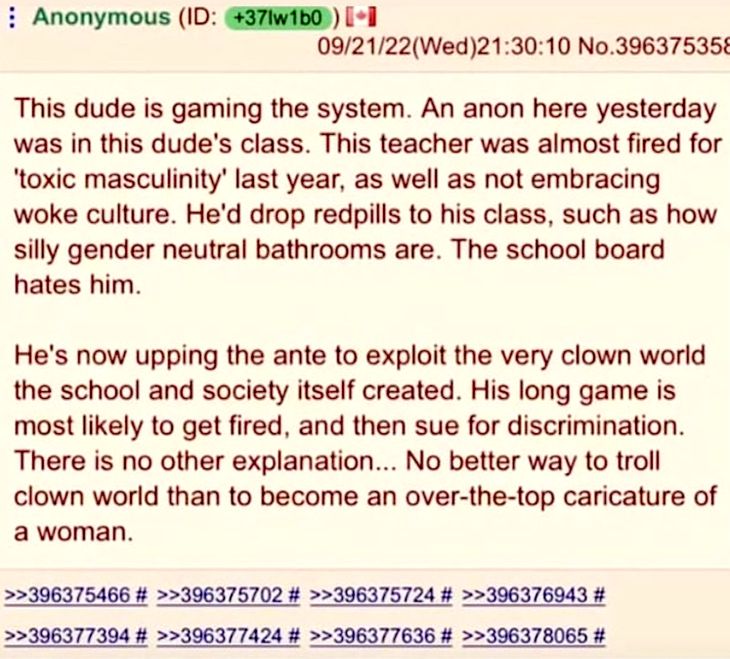
An anonymous poster on an online forum recently made a claim about Lemieux’s shop class back when “Kayla” was still Mr. Kerry Luc Lemieux. The post reads:

    This dude is gaming the system. An anon here yesterday was in this dude’s class. This teacher was almost fired for ‘toxic masculinity’ last year, as well as not embracing woke culture. He’d drop redpills to his class, such as how silly gender neutral bathrooms are. The school board hates him.

    He’s now upping the ante to exploit the very clown world the school and society itself created. His long game is most likely to get fired, and then sue for discrimination. There is no other explanation… No better way to troll clown world than to become an over-the-top caricature of a woman.

File this allegation under “Huge if True” (lol). Imagine for a moment that the anonymous person is telling the truth. If that is the case, then this teacher is the greatest hero the sane world has fronted yet.

If Lemieux is indeed pranking the school board, then he is a genius. When images of the trans-busty high school shop teacher began spreading like wildfire online, the outrage was swift and formidable. OTHS and the Halton District School Board (HDSB) went on the defensive — and it quickly became evident that they had painted themselves into a corner with their mindless commitment to “inclusion”.

“We are aware of discussion on social media and in the media regarding Oakville Trafalgar High School. We would like to take this opportunity to reiterate to our community that we are committed to establishing and maintaining a safe, caring, inclusive, equitable and welcoming learning and working environment for all students and staff”, said OTHS in an email sent to parents and obtained by feminist news site Reduxx.

September 13, 2022

The Boise Pride Festival’s “Drag Kids on Stage”

Filed under: Business, Media, Politics, USA — Tags: , , , , — Nicholas @ 03:00

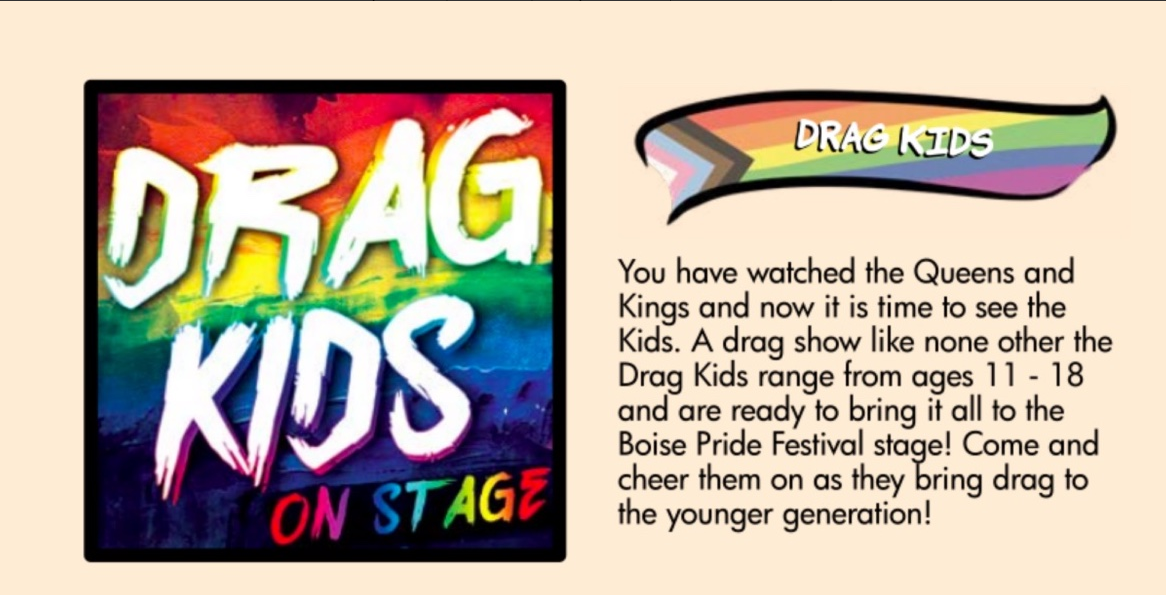
I’m not sure I could accurately place Boise on a map, but the city’s relative obscurity doesn’t mean it can’t have a really progressive LGBT scene, including a special “Drag Kids” event planned for their Pride Festival:

Remember that California has just passed a new law, SB 1100, to protect local legislative bodies against “bullying” from people who do hateful things like disagreeing with them, and that the recent failure of another (spectacularly offensive) bill in the state legislature was the product of “harassment”, by which the author of the bill meant that the peasantry forcefully and persistently criticized it. And you should definitely read this two–part essay from Bat Cattitude on the technocratic presumption that disagreement with technocrats can only be dangerous extremism.

With that background in mind, consider a modest victory in the most dismal battlefield of the culture war, and then watch the response to it.

This one happens in Boise, a purple town in a red state. This year’s Boise Pride Festival was all set to feature an event called Drag Kids:

“Now it is time to see the kids”, sexy eleven year-olds shaking that dirty little moneymaker on the stage. So hot. So empowering!

[…]

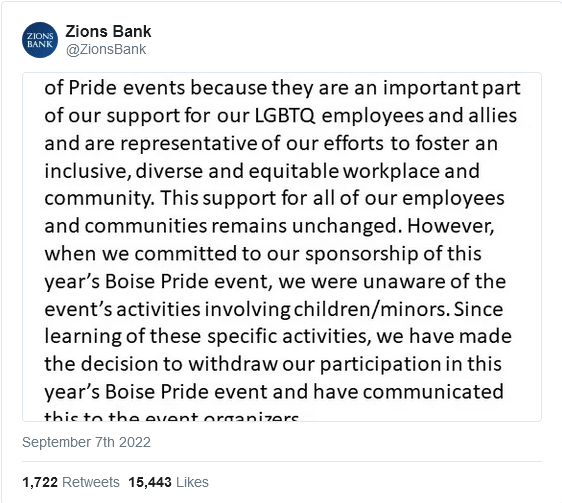
Now, the Big Pivot: Boise Pride pays its bills by soliciting the support of corporate sponsors, so a bunch of corporations suddenly found themselves sponsoring the sexuality-incorporating performances of some hot little eleven year-olds. They quickly began to jump clear of the thing:

Because bigotry still prevails in Amerikkka, see, corporations aren’t brave enough to stand up and support the sexy eleven year-olds in their extremely hot sexiness. Atavists! Prudes!

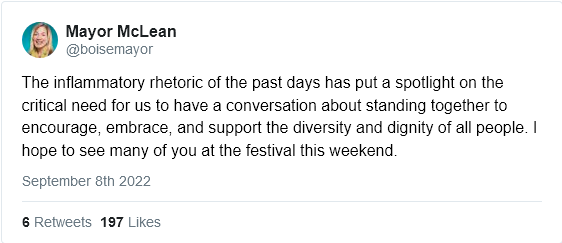
Now, here come the politicians. The mayor of Boise, Lauren McLean, is Very Disappointed In You All™:

Slogan slogan slogan, slogan slogan, slogan slogan slogan. A spotlight on the critical need for a conversation about standing together!

If you challenged Mayor NPC to publicly identify specific pieces of inflammatory rhetoric that were important and central to the controversy, she couldn’t; she just knows that the “inflammatory rhetoric” box has to be checked, because Mean Republicans objected to something involving an LGBT event, specifics not important. Nor could she explain how sexy children represent the dignity of all people, or respond coherently to a discussion about sexual commodification and the erasure of childhood. She has a list of slogans. She deploys them.

September 9, 2022

“Far from fighting against the establishment, the woke are the establishment”

Filed under: Books, Britain, Media, Politics — Tags: , , , , , — Nicholas @ 05:00

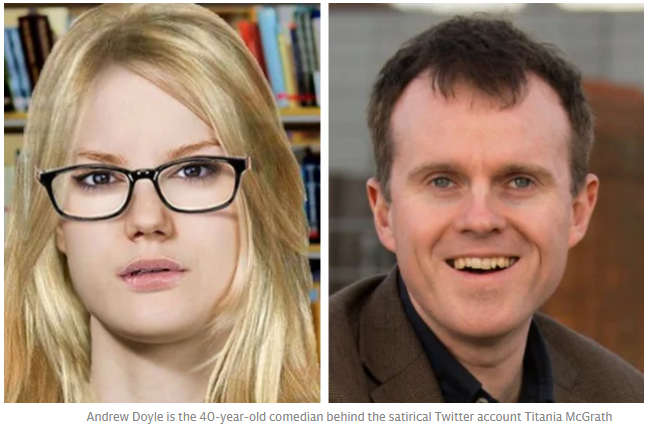
In Spiked, Andrew Doyle discusses the reactions to his announcement that he was writing a book about the ongoing culture wars:

“Titania McGrath” and Andrew Doyle

My new book is about intolerance. I am fascinated by those who prefer only to associate with people who share their own identical worldview, and who interpret the slightest point of political disagreement as evidence of evil. The new religion of group identity and “social justice” has driven once rational people into a state of frenzied bigotry. I want to understand why.

So, back in May, when I announced I was working on a book called The New Puritans, I wasn’t all that surprised to see so many self-proclaimed advocates of “social justice” rush to demonstrate the very phenomenon that I was attempting to explore. Some suggested that they would acquire copies only to burn them. One said that he intended to kick it under the bookshop shelf “so that it could rot in darkness”. Another simply declared that I was “pure scum”. Were any of these people aware that they were proving my point?

Byline Times even claimed that I was waging “a perpetual battle against social justice – fighting against a contrived present world of aggressive ‘woke snowflakes’ in order to return to an imagined past”. This was news to me, given that my book is a defence of progressive and liberal values, and it explicitly criticises those who resort to the “snowflake” slur. I particularly enjoyed the suggestion that my book was an example of someone imagining enemies into existence in order to fight them. It takes some chutzpah to make such a claim of a book you haven’t actually read.

It would seem that the title alone – The New Puritans: How the Religion of Social Justice Captured the Western World – was enough to stir the ire of these culture warriors. In a sense, this is unsurprising. One of the key aspects of this ideological movement is that its adherents treat all challenges as a form of heresy that must be quashed. For all that they like to smear their detractors as “bigots”, they forget that the main definition of the word – “a person who is utterly intolerant of any differing creed, belief or opinion” – applies most accurately to themselves.

Why is it, for instance, that JK Rowling can be so routinely monstered as “hateful” and “transphobic” despite having never said anything hateful or transphobic? Only this week, the Harry Potter author found herself in an exasperating Twitter exchange with someone claiming she had been “outwardly hateful of an entire community”. Rowling quite rightly asked for evidence, to which her detractor replied: “I don’t know where you said it, but I bet you do.” For those taking part in the witch-hunt, the total lack of evidence is simply an inconvenience to be brushed aside.

This is why my book draws comparisons between the hysteria of the “woke” movement and the witch hunts of Salem in the late 17th century. In a burst of collective madness that lasted a little over a year (from February 1692 to May 1693), 20 people were executed for witchcraft on the basis of the testimony of local girls. All of the prosecutions were secured on the basis of “spectral evidence” – what today we might call “lived experience”. The girls simply declared that they had seen these innocent people sign the devil’s book, or that they had been “sending out their spirits” to torment people. This was their “truth”, and so it had to be believed.

September 7, 2022

QotD: Gender Dysphoria

Filed under: Health, Politics, Quotations, USA — Tags: , , , , — Nicholas @ 01:00

My lifelong gender dysphoria has certainly been a primary inspiration for my entire career as a researcher and writer. I have never for a moment felt female — but neither have I ever felt male either. I regard my ambiguous position between the sexes as a privilege that has given me special access to and insight into a broad range of human thought and response. If a third gender option (“Other”) were ever added to government documents, I would be happy to check it. However, I have never believed, and do not now, that society has any obligation to bend over backwards to accommodate my particular singularity of identity. I am very concerned about current gender theory rhetoric that convinces young people that if they feel uneasy about or alienated from their assignment to one sex, then they must take concrete steps, from hormone therapy to alarmingly irreversible surgery, to become the other sex. I find this an oddly simplistic and indeed reactionary response to what should be regarded as a golden opportunity for flexibility and fluidity. Furthermore, it is scientifically impossible to change sex. Except for very rare cases of intersex, which are developmental anomalies, every cell of the human body remains coded with one’s birth sex for life.

Beyond that, I believe that my art-based theory of “sexual personae” is far more expansive and truthful about human psychology than is current campus ideology: who we are or want to be exceeds mere gender, because every experimental persona that we devise contains elements of gesture, dress, and attitude rich with historical and cultural associations. (For Halloween in childhood, for example, I defiantly dressed as Robin Hood, a Roman soldier, a matador, Napoleon, and Hamlet.) Because of my own personal odyssey, I am horrified by the escalating prescription of puberty-blockers to children with gender dysphoria like my own: I consider this practice to be a criminal violation of human rights. Have the adults gone mad? Children are now being callously used for fashionable medical experiments with unknown long-term results.

In regard to the vexed issue of toilets and locker rooms, if private unisex facilities can be conveniently provided through simple relabeling, it would be humane to do so, but I fail to see why any school district, restaurant, or business should be legally obligated to go to excess expense (which ultimately penalizes the public) to serve such a minuscule proportion of the population, however loud their voices. And speaking of voices: as a libertarian, I oppose all intrusion by government into the realm of language, which belongs to the people and which evolves organically over time. Thus the term “Ms.” eventually became standard English, but another 1970s feminist hybrid, “womyn”, did not: the populace as a whole made that decision, as it always does with argot or slang filtering up from ethnic or avant-garde subgroups. The same principle applies to preferred transgender pronouns: they are a courtesy that we may choose to defer to, but in a modern democracy, no authority has the right to compel their usage.

Camille Paglia, “Prominent Democratic Feminist Camille Paglia Says Hillary Clinton ‘Exploits Feminism’”, Washington Free Beacon, 2017-05-15.

« Newer Posts — Older Posts »

Powered by WordPress