Quotulatiousness

June 17, 2020

“We don’t need no stinkin’ badges!”

Theodore Dalrymple on the use of badges within the NHS to virtue signal and compel compliance in the unwilling:

Not actually the official symbol of Britain’s National Health Services … probably.

In Britain’s highly-centralized, almost Soviet-style healthcare system, the National Health Service, staff are being encouraged all over the country to wear little rainbow-coloured metal badges to show that they are homosexual, bisexual, and transsexual-friendly, and do not discriminate against them. The wearing of these badges is voluntary, but about 3,000 of the staff of Guy’s and St Thomas’ Hospitals, for example, now wear them. The self-congratulatory website of those ancient hospitals — St. Thomas’ is over 800 years old and Guy’s was founded in 1721, now combined into one administrative unit — says:

    The badges are just one way to show that Guy’s and St Thomas’ is an open, non-judgmental and inclusive place for people that identify as LGBT+ [which] stands for lesbian, gay, bisexual and transgender). The + simply means we are inclusive of all identities, regardless of how people identify themselves.

This language, which combines the unctuous with the bureaucratic, is typical of the way British hospital administrators express themselves nowadays. And if, as Buffon said, the style is the man himself, we may justly fear for a semi-totalitarian future.

By implication, the badges bully the staff, for if any of them refuse to wear one, their refusal is likely to be taken to mean that their minds are closed, judgmental (in the sense of being censorious, for even the attempt to avoid making judgments is itself based on a judgment), and exclusionary. It is to imply that they would deliberately treat any patients in the above mentioned categories differently and worse from all other patients. Wear the badge or declare yourself to be a bigot.

This is an insult to all those people who worked before the advent of the badges (or who now refuse to wear them) who strove and continue to strive always to treat patients to the best of their ability, irrespective of the many categories into which any individual patient falls. In my experience, the great majority of doctors have always tried to do this.

Let me give an example. Working as I did as a doctor in prison, I met many men who had done terrible things. I treated them, as a matter of course, to the best of my ability. I remember, for example, a man who had strangled three children and then impaled them on railings. Though I did not think he was a good man, and in that sense passed a judgment on him within the privacy of my mind, I treated him for his bronchitis exactly as I would have treated anyone else with bronchitis. I did not find this difficult in the least and do not claim any special merit for having done so, for it is only what all my colleagues in the profession did — as a matter not only of course, but of principle.

A couple of years ago, I read the diary of one of Marshal Pétain’s doctors during the latter’s imprisonment after World War II. The doctor had been a member of the Resistance and had no reason to love Pétain, to say the least: Pétain’s supporters would have had not a second thought about killing him if he had fallen into their power. Yet, as the diary makes clear, the doctor treated Pétain, who by then was demented, with the greatest humanity. Moreover, the doctor refused to publish his diary, despite the financial advantage of doing so, because he thought that publishing it would be to break patient confidentiality. It was only after his death, and more than half a century after Pétain’s, that the diary was published. The doctor’s adherence to his medical ethics was impressive, and he needed no badge to proclaim his virtue.

June 12, 2020

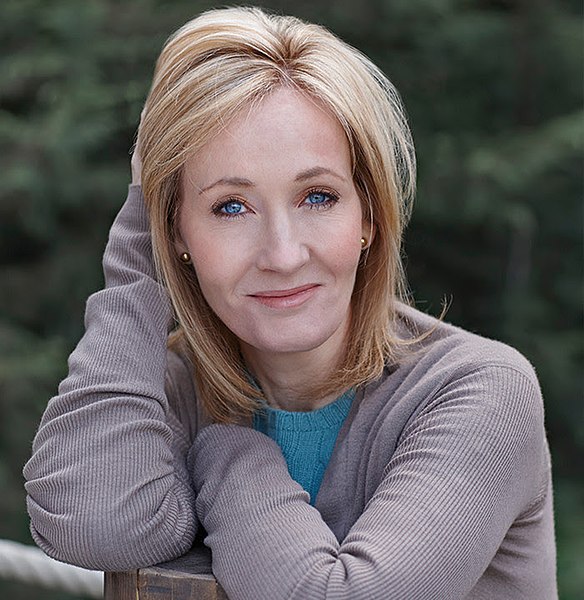
J.K. Rowling on her most recent “cancellation”

I know a lot of Harry Potter fans are upset with their formerly favourite author for her stance on transgenderism … or what they’ve heard about her stance … or what their friends have said about her stance … so J.K. Rowling has posted an essay on her own site explaining what happened and how she has been coping with being “cancelled” so many times:

… as a much-banned author, I’m interested in freedom of speech and have publicly defended it, even unto Donald Trump.

The fourth is where things start to get truly personal. I’m concerned about the huge explosion in young women wishing to transition and also about the increasing numbers who seem to be detransitioning (returning to their original sex), because they regret taking steps that have, in some cases, altered their bodies irrevocably, and taken away their fertility. Some say they decided to transition after realising they were same-sex attracted, and that transitioning was partly driven by homophobia, either in society or in their families.

Most people probably aren’t aware – I certainly wasn’t, until I started researching this issue properly – that ten years ago, the majority of people wanting to transition to the opposite sex were male. That ratio has now reversed. The UK has experienced a 4400% increase in girls being referred for transitioning treatment. Autistic girls are hugely overrepresented in their numbers.

The same phenomenon has been seen in the US. In 2018, American physician and researcher Lisa Littman set out to explore it. In an interview, she said:

“Parents online were describing a very unusual pattern of transgender-identification where multiple friends and even entire friend groups became transgender-identified at the same time. I would have been remiss had I not considered social contagion and peer influences as potential factors.”

Littman mentioned Tumblr, Reddit, Instagram and YouTube as contributing factors to Rapid Onset Gender Dysphoria, where she believes that in the realm of transgender identification “youth have created particularly insular echo chambers.”

Her paper caused a furore. She was accused of bias and of spreading misinformation about transgender people, subjected to a tsunami of abuse and a concerted campaign to discredit both her and her work. The journal took the paper offline and re-reviewed it before republishing it. However, her career took a similar hit to that suffered by Maya Forstater. Lisa Littman had dared challenge one of the central tenets of trans activism, which is that a person’s gender identity is innate, like sexual orientation. Nobody, the activists insisted, could ever be persuaded into being trans.

The argument of many current trans activists is that if you don’t let a gender dysphoric teenager transition, they will kill themselves. In an article explaining why he resigned from the Tavistock (an NHS gender clinic in England) psychiatrist Marcus Evans stated that claims that children will kill themselves if not permitted to transition do not “align substantially with any robust data or studies in this area. Nor do they align with the cases I have encountered over decades as a psychotherapist.”

The writings of young trans men reveal a group of notably sensitive and clever people. The more of their accounts of gender dysphoria I’ve read, with their insightful descriptions of anxiety, dissociation, eating disorders, self-harm and self-hatred, the more I’ve wondered whether, if I’d been born 30 years later, I too might have tried to transition. The allure of escaping womanhood would have been huge. I struggled with severe OCD as a teenager. If I’d found community and sympathy online that I couldn’t find in my immediate environment, I believe I could have been persuaded to turn myself into the son my father had openly said he’d have preferred.

When I read about the theory of gender identity, I remember how mentally sexless I felt in youth. I remember Colette’s description of herself as a “mental hermaphrodite” and Simone de Beauvoir’s words: “It is perfectly natural for the future woman to feel indignant at the limitations posed upon her by her sex. The real question is not why she should reject them: the problem is rather to understand why she accepts them.”

As I didn’t have a realistic possibility of becoming a man back in the 1980s, it had to be books and music that got me through both my mental health issues and the sexualised scrutiny and judgement that sets so many girls to war against their bodies in their teens. Fortunately for me, I found my own sense of otherness, and my ambivalence about being a woman, reflected in the work of female writers and musicians who reassured me that, in spite of everything a sexist world tries to throw at the female-bodied, it’s fine not to feel pink, frilly and compliant inside your own head; it’s OK to feel confused, dark, both sexual and non-sexual, unsure of what or who you are.

I want to be very clear here: I know transition will be a solution for some gender dysphoric people, although I’m also aware through extensive research that studies have consistently shown that between 60-90% of gender dysphoric teens will grow out of their dysphoria. Again and again I’ve been told to “just meet some trans people.” I have: in addition to a few younger people, who were all adorable, I happen to know a self-described transsexual woman who’s older than I am and wonderful. Although she’s open about her past as a gay man, I’ve always found it hard to think of her as anything other than a woman, and I believe (and certainly hope) she’s completely happy to have transitioned. Being older, though, she went through a long and rigorous process of evaluation, psychotherapy and staged transformation. The current explosion of trans activism is urging a removal of almost all the robust systems through which candidates for sex reassignment were once required to pass. A man who intends to have no surgery and take no hormones may now secure himself a Gender Recognition Certificate and be a woman in the sight of the law. Many people aren’t aware of this.

June 11, 2020

QotD: Equal rights

Filed under: Government, Law, Liberty, Quotations — Tags: , , , , , — Nicholas @ 01:00

We must separate the moral dimensions of a subject from the empirical questions surrounding it. For example, on the radioactive issue of sex (or gender) differences in cognitive abilities, there is the empirical question of whether or how men and women diverge in certain tasks, and then there is the moral question of how men and women should be treated. Empirically, there is much evidence that in some tasks women excel over men, and in other tasks, men excel over women. For example, women are more dexterous while men are better at throwing; women are superior in visual memory whereas men are better at mentally rotating shapes; women are better at mathematical calculation while men are better at mathematical problem-solving; in terms of overall general intelligence (g), however, there is no gender difference. Morally, however, none of this matters. We should support women’s rights regardless of any physical or cognitive differences between the sexes. To yoke one’s moral evaluation to empirical questions like this is a big mistake; worse is to assume that this is what people always do and therefore we must suppress any empirical evidence that there are differences, as this will only tilt people’s moral judgments toward empirical outcomes.

This reminds me of the debate in the late 1980s through mid-1990s about whether homosexuality was nature or nurture, something you were born to be or a lifestyle choice. Conservatives and Christians argued for the “choice” position and this led to efforts to “convert” gays to straight (or “pray the gay away”) because something that is learned can be unlearned. This led the gay community and supporters thereof to argue for the “born this way” position. The cumulative evidence from multiple lines of inquiry led to the nature position more than that of nurture, but this was another example of confusing the empirical question of the origin of homosexuality with the moral question of the rights of gays and lesbians (today the LGBTQ community). It should go without saying — but unfortunately in these times it must be said again and again — it doesn’t matter what the origins of homosexuality turn out to be, gays and lesbians and everyone else in the LGBTQ community are entitled to the same rights and privileges as everyone else protected by the constitution of their nation (and those nations that have yet to extend legal rights to gays and lesbians need to change their constitutions).

Michael Shermer, interviewed by Claire Lehmann, “The Skeptical Optimist: Interview with Michael Shermer”, Quillette, 2018-02-24.

June 10, 2020

“Gender critical” feminism

Barbara Kay finds herself in agreement with an academic who, having come from a Marxist and radical feminist background, she would not normally have much in common:

Kathleen Lowrey, associate professor of anthropology at the University of Alberta, ascribes much of her intellectual formation to Marxism and radical feminism. Not, I think my regular readers would agree, someone with whom I would normally have a great deal in common. And yet, in this strange cultural moment, Prof. Lowrey and I find ourselves amicably united in the service of a mutually revered ideal. I write this column with ardent sympathy for her in her present predicament.

Academics’ time is generally split 40/40/20 amongst, respectively, research, teaching and “service” to their community — meaning committees, mainly. Until late March, Lowrey served as associate chair for undergraduate programs on behalf of the department of anthropology. Following anonymous complaints about her views from one or more students to the university’s office of safe disclosure and human rights, as well as to the dean of students, Lowrey was asked to resign. She was not given a precise reason, only told that because she holds “gender critical” opinions, she was making the learning environment “unsafe” for the anonymous complainants who felt that her views caused them “harm.” (It’s not clear — Lowrey believes it is doubtful — that the complainants were even taking her courses.)

“Gender critical” refers to what was shortly ago normative feminism doctrine in considering biological sex of primordial importance in fighting for women’s rights. Where the traditional rights of biological women collide with asserted rights of trans women — sport, intimate spaces, rape crisis centres, prisons — gender-critical feminists join with conservatives like me in insisting that biological women’s rights must prevail: for the sake of their safety, privacy and right to a level playing field.

Until what seems like a few minutes ago, there was nothing controversial about this opinion. But now there is. The only “correct” opinion to hold is that gender expression trumps biology in any rights-based claims. And in academic circles, Lowrey’s views, which she is at no pains to hide on campus and off, are a form of apostasy that cries out for punishment.

April 5, 2020

QotD: The fear of “becoming” your job

Filed under: Education, Politics, Quotations, USA — Tags: , , , , , — Nicholas @ 01:00

In fact, “losing ourselves in the part” used to be our big worry. Maybe I am just a customer service rep …? The office, the commute, my neckties all laid out for me at the start of each week … is that really all there is to life? What happens when the long nights start taking their toll — as they must — and I have to give up the bar band? What happens when the kids grow up?

You could see this worry everywhere in our culture, our art. Watch Fast Times at Ridgemont High. Judge Reinhold’s character is wrestling with this type of question, and he’s in high school, fer chrissakes. See what I mean about that movie being made on Mars? Remember that; it’ll be on the final.

There’s a certain type of person, though, who just couldn’t grok those worries, because the very notion of social roles was incomprehensible. We didn’t know about the autism spectrum back then, but that’s what that type of person effectively is: A high-functioning autistic. For the autistic, what’s now is forever. Bob’s nametag says “customer service representative.” Therefore, Bob is a customer service representative, and only a customer service representative, now and forever. Bob the family man, Bob the stamp collector, Bob the bar-band strummer … all those fry the autistic’s circuits. It says “customer service representative,” damn it! The train is fine.

Two sides of the same coin. Normal people were worried that they were becoming their jobs. The autistics couldn’t grasp that anyone could be anything else.

The autistics all went into the ivory tower, which gave us identity politics. “Identity politics” only makes sense to the autistic — that is, to people who can’t process change. Normal people have such a hard time with it because we can’t see the logical connection between, say, being gay and being pro-abortion. I mean, if you’re gay it’s a moot point, right? Nor is there any logical connection between being gay and favoring redistributive economics, or worrying about global warming, or whatever. Maybe you do believe in redistributive economics and are worried about global warming, but those are just individual opinions, right? I’m not obliged to vote Republican because I dig blondes. It’s a non sequitur.

Not to the autistic, it isn’t. They’re told that this — pro-abortion, being “green,” the whole Liberal schmear — just is gayness, and they go with it, because that’s the only way the world makes sense to them. Just how “gay” came to mean all that is above my pay grade, but we all know it’s true. More importantly, we all know they believe it, with all their hearts and souls.

That’s the situation in which we find ourselves, my young friends, here in the Current Year. Most of us would like to be team players, but we have no role models. Because the autistics control the culture, we’ve internalized their worries. If I’m a member of the team, we instinctively feel, then somehow I am the team, and only the team, now and forever. It’s a stark choice: Either I give up my individuality completely to advance the team’s goals, or I take my ball and go home.

But it’s a false choice, kameraden, one that could only be beaten into us by very long, very expensive training — i.e. the American “education” system, K-thru-PhD.

Severian, “Advice to Young Dissidents”, Rotten Chestnuts, 2020-04-01.

March 25, 2020

Bonus QotD: Cognitive dissonance and the very, very woke

Like everyone, I’m tired of the Wuhan Flu freakout. But I owe a debt to future historians to leave them a primary source, so I’m going to do this last brief post on it, then move on. Unless something major happens, this is my final word on the subject […]

We’ve written a lot here on the West’s “crisis of legitimacy.” Well … this is it. Let’s break down some of the big factors in play:

The first, biggest, and in some ways only factor that matters, legitimacy-wise, is cognitive dissonance. We spent a lot of time here back in the days arguing about whether or not it’s a real thing […] I finally took the position that it’s real, but only for stuff that rises to level of actual cognition … which you just don’t see too much of anymore. Indeed, the whole point of Postmodern Leftism, when you come right down to it, is not having to think. Identity politics gives you The One Right Answer for most every situation; it’s just a matter of filling in the Social Justice Mad Lib. Any apparent conflict between One Right Answers is dealt with by ad hominem.

An example will probably help: Trannies vs. Feminists. Feminists, of course, are all in on The One Right Answer that “gender is just a social construction.” But Trannies actually believe this — if you feel you’re really a woman, then you are, your twelve-inch wang be damned. How, then, can impeccably #woke lesbians refuse to have sex with the aforesaid twelve-inch wang, since gender is just a social construction and Thundercock identifies as a lesbian? Easy: ad hominem. Oh, gender’s just a social construction all right … it’s just that any be-penised individual who “constructs” himself as a lesbian is lying for personal gain (#wokeness, as everyone knows, gives one the ability to read minds).

This isn’t a problem for the Left as a whole, much less for our entire society, because of the tiny numbers involved. Despite showing up pretty much everywhere in popular culture, gays are a small fraction of the population. Trannies are a fraction of a fraction, and since militant lesbianism is almost entirely political anyway (lesbian bed death is very real), about the only place this could possibly be a live issue is on the loonier college campuses.

Severian, “The Real Crisis”, Rotten Chestnuts, 2020-03-17.

March 21, 2020

QotD: The reason people don’t get a say in how the rulers carry on

Filed under: Government, Media, Politics, Quotations, USA — Tags: , , , , , — Nicholas @ 01:00

… as we dissidents have been pointing out for decades now, practically no government action since the late 1950s has had The People’s approval. Had The People been consulted at any point between 1960 and now, America would still be a White Christian nation. Lots more White boys would still be alive, having never been sent to some irrelevant, unpronounceable place to die. Lots more Black folks would be alive, too, since abortion disproportionately affects Blacks and abortion was always a fringe lunacy — even a half-century of nonstop propaganda has barely pushed it into majority support. Gays would still be in the closet, since even after a propaganda barrage that makes the abortion thing look like a mere suggestion public tolerance of homosexuality polls even lower. The borders, of course, would be closed — they don’t allow those polls to be taken anymore, because “immigration restriction” polled at something like 75% just a few years ago and the lunacy of the political class in a “democracy” going hard against three-quarters of the entire population is too glaring even for this tv-and-iCrap-addled country to stomach.

The People keep giving the wrong answer, in other words, so The People will not be asked anything of importance. Same as it ever was.

The problem with democracy, though, isn’t that people are fools. People are fools, of course, but since that’s as universal as gravity, any human institution will be staffed entirely with fools. But … just as the general characteristic “great leader” doesn’t necessarily translate into any specific competence, so the general truth “people are fools” doesn’t mean everyone is a fool about everything. Since we all know at least one other human being, we all know a blithering idiot who’s remarkably shrewd about one little slice of life. Junkies, for example, are idiots — taking hard drugs is a remarkably stupid idea, as every addict I’ve ever met readily confessed. And yet, when it comes to getting their drug of choice these morons are endlessly inventive. Billy Bob up the holler has six teeth and a fourth grade education, but he can MacGyver up methamphetamine out of household products like a Chemistry PhD.

The problem with democracy is twofold. The first — that it’s the best technique ever devised for organizing self-righteousness — deserves a book in itself. The second, though, is covered by a single word: ultracrepidarianism. It means “the habit of giving opinions and advice on matters outside of one’s knowledge.” Peter Strzok, for example, was probably a perfectly competent FBI agent, when it came to doing the things the FBI actually hired him to do. But he decided that he was also some kind of political science expert, as well as a human love machine, and here we are. See also: our “elected” “representatives” What else would you call sending someone like Alexandria Ocasio-Cortez, whose areas of expertise are “mixing drinks” and “having big tits,” to Congress, where she’s expected to make decisions of war and peace? Ultracrepidarianism is a feature, not a bug, of democratic systems, which is why even the very best “representatives” fuck up everything they touch.

Combine required ultracrepidarianism with real shrewdness and you get Stephen A. Douglas.

Take those, add in religious fervor, and you get the suicide cult that is the Democratic Party.

And here we are.

Severian, “Impeachment Thoughts”, Rotten Chestnuts, 2019-12-19.

February 22, 2020

Andrew Sullivan on the “inconvenient pioneers”

Filed under: Government, Media, Politics, USA — Tags: , , , , — Nicholas @ 05:00

Along with a mandatory worry piece on Trump and some positive news on the British economy under Boris Johnson, Andrew Sullivan noted the dog that didn’t bark about either Republican or Democratic pioneers:

Mayor Pete Buttigieg speaking with supporters at a town hall at the State Historical Museum in Des Moines, Iowa, 12 January 2020.
Photo by Gage Skidmore via Wikimedia Commons.

Every now and again, I take a moment to take stock of how deep gay integration has gotten in my adult lifetime. This past week, our politics featured two relatively young men, on both sides of the political divide, whose sexual orientation is both clear and irrelevant. Pete Buttigieg has been at the top of the field in Iowa and New Hampshire, one of seven remaining candidates, and in the circular flamethrower squad of Wednesday’s debate, he once again held his own. More than that: He was relentless in his attacks on Amy Klobuchar and more than a little blunt about Bernie Sanders’s plans to take private health insurance away from everyone (something that doesn’t even happen in socialized health care in Britain). There was not the slightest whiff of defensiveness about him.

His moderate politics (on most subjects) is filtered through a seemingly brutal, calculating Rhodes Scholar–style ambition. And why can’t gays as well as straights harbor that? It’s fantastic also that he is a man of Christian faith — like countless other gays and lesbians in America. Who would have imagined that the pioneering gay figure of 2020 would be a married Christian who got a standing ovation in a Fox News town hall? But that’s old news now.

It’s also fantastic that, for the most part, his sexual orientation is ignored. Yes, the queer left hates him — but they hate a lot of gay success in public life if it doesn’t exactly fit their ideological niche. And Rush Limbaugh indeed took a slightly homophobic dig the other day. But I doubt Trump would openly use Pete’s orientation as a way to demean him. And that’s not just because Trump is not personally homophobic but because he knows it would look ugly, and be counterproductive. That’s how far we’ve come.

Richard Grenell has not subjected himself to getting elected anywhere, but, like Buttigieg, he’s a classic careerist D.C. meritocrat (and why the fuck not?). From the heartland, he got a degree from Harvard’s Kennedy School and then attached himself to Republican pols — notably George Pataki and George W. Bush, who made him communications director for the U.S. seat at the U.N., a post he held for seven years. Launching his own communications shop, Grenell subsequently worked Fox News gigs even as he was a signatory to an amicus brief in defense of the right of gay couples to marry. By all accounts he has been a disaster as ambassador to Germany, trolling the E.U. and German elites, although I doubt Trump sees his regular Twitter provocations as a liability.

But check out a simple video of Grenell being sworn in for the Germany job. Mike Pence, of all people, officiates as Grenell’s longtime partner, Matt Lashey, holds the family Bible. This week his appointment as acting director of National Intelligence was widely panned — and is not expected to last long. But he nonetheless became the first-ever openly gay member of the Cabinet in U.S. history. You missed that? All the better. But for some of us, it’s a quiet landmark tarred only by the fact that most gay groups won’t even acknowledge it. The Human Rights Campaign’s Twitter feed has made no mention at all — even as they are rightly touting the first lesbian mother in Congress. Why is the first openly gay Cabinet member a nonevent? Because he’s a conservative. And to the activist left and too many of the Establishment liberals in the gay movement, that means he’s not really gay.

My politics tilt more toward Buttigieg than Grenell — but a moment like this should not be filtered entirely through ideology. History matters too. When I was a very lonely openly gay figure in Washington in the 1980s and 1990s, the idea that I would live to see an openly gay and successful presidential candidate and an openly gay Cabinet member at the same time would have been preposterous. And now it’s virtually normal. I’ll take that.

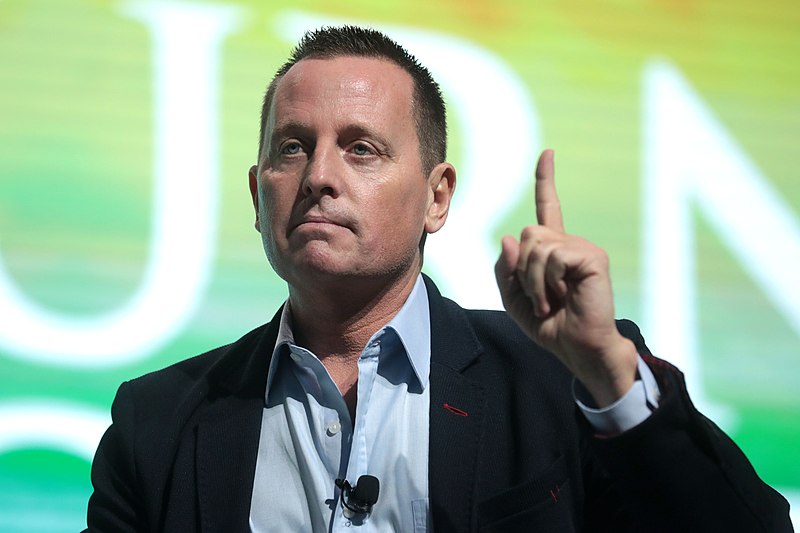
U.S. Ambassador to Germany Richard Grenell speaking with attendees at the 2019 Student Action Summit hosted by Turning Point USA in West Palm Beach, Florida on 20 December 2019.
Photo by Gage Skidmore via Wikimedia Commons.

Update: Inconvenient typo in the headline fixed.

February 15, 2020

The Best Couples in History — Valentine’s Day Special

Overly Sarcastic Productions
Published 14 Feb 2020

Happy Valentine’s Day! Celebrate the history of Love with a rundown of these outstanding couples — for better and for worse.

Our content is intended for teenage audiences and up.

This video was edited by Sophia Ricciardi, AKA “Indigo”.

PATREON: https://www.Patreon.com/OSP

DISCORD: https://discord.gg/h3AqJPe
MERCH LINKS: https://www.redbubble.com/people/OSPY…

OUR WEBSITE: https://www.OverlySarcasticProductions.com
Find us on Twitter https://www.Twitter.com/OSPYouTube
Find us on Reddit https://www.Reddit.com/r/OSP/

January 20, 2020

A Drag Queen speaks out against Drag Queen Story Hour for kids

Filed under: Books, Education, Health, Politics, USA — Tags: , , , — Nicholas @ 03:00

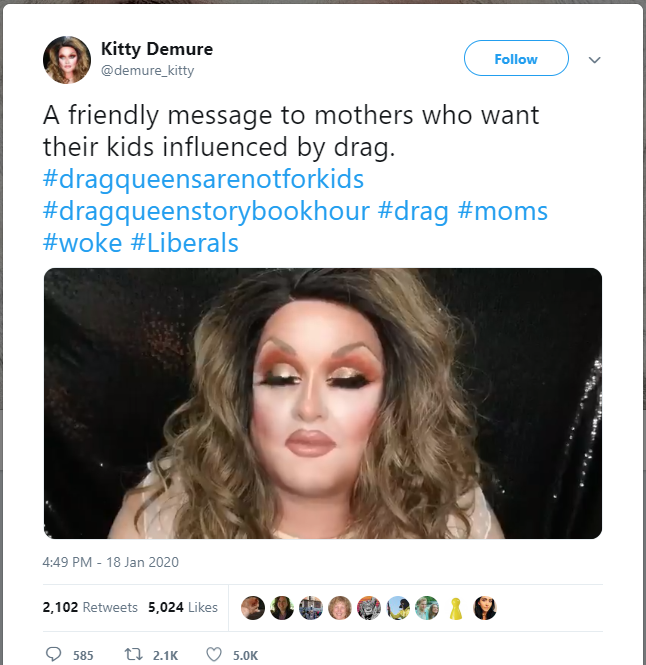
Libby Emmons reports on a rare bird indeed — a Drag Queen who doesn’t think it’s appropriate to have other Drag Queens visit schools and libraries to read to pre-teen kids:

Drag Queen Kitty Demure has taken to Twitter to speak out against the sexualization of children by woke people co-opting drag culture and rebranding it as an educational tool.

“I have absolutely no idea why you would want [drag queens] to influence your child. Would you want a stripper or porn star to influence your child?”

Demure notes that just as you wouldn’t take your kids out to see porn stars or strippers read stories while in full dress and makeup, you shouldn’t take them to see drag. There’s an effort to introduce kids earlier and earlier to adult sexuality. The idea is that this will help kids be more open-minded and understanding about the difference. What it really does is normalize deviant adult behaviour in children’s minds and override their own instincts. Giving children access to sexual content makes them think this kind of thing is for them, it opens doors that should stay closed until a child is of age.

Demure says here what all of us know: drag culture is adult entertainment. The look is sexualized. The names are sexualized. In fact, the entire concept of drag is a send-up of beauty queen culture. Beauty queen culture is sexualized as well, and while that is sometimes subsumed beneath the surface, it’s obviously fully part of it. That’s what drag plays on. Drag can be lots of fun, but it’s grown-up fun, not for kids.

January 11, 2020

QotD: “Don’t ask, don’t tell”

Filed under: Government, History, Military, Politics, Quotations, USA — Tags: , , , , , , — Nicholas @ 01:00

As all right-thinking people know, Don’t Ask, Don’t Tell was a right-wing atrocity against gays, hatched in the pernicious seventy-two degree corners of the doubleplusungood and evilwickedbadnaughty Pentagon, fought against nearly to the death by progressives …

That’s not remotely what happened. Rather, the Uniform Code of Military Justice, as enacted by Congress, has long deemed Sodomy, which covered more than just homosexual conduct, as a criminal offense potentially carrying severe penalties. Moreover, the procedure for entering into service demanded that prospective recruits deny or admit to homosexual leanings, in writing, which admissions would usually bar the man or woman from service. Of course, back when the shame of being publicly homosexual was very great, people who wanted to join the armed forces simply lied about it and then, as a general rule, hid it while in service.

Liberal Democratic President Bill Clinton, acting in his capacity as Commander in Chief of the armed forces, simply ordered that prospective recruits were not to be asked if they were gay or had homosexual leanings, and were not to volunteer the information. That, young Millennial, is where DADT came from; it came from a liberal, liberally motivated, and pandering to his liberal base.

Did you know that? No? Well, then; ask yourself, WHY didn’t you know?

What the loss of history does to you, dear Millennial, is that it robs you of the ability to reason your way to cause and effect. Never mind the crappy to the point of idiotic decisions and programs this might lead you to support, consider what it does to you as a person. What, after all, is the effect of shielding people from contrary opinions by designating and maintaining, under color of law or regulation, “safe spaces” for this or that minority? Does it make them stronger? Better able to deal with a harsh world? Does it change that objective world to something less harsh? No and no and no; it does none of that. Do you gain grit in a safe space? Ha. Do you learn endurance in a safe space? Oh, please.

Tom Kratman, “It’s Up to You, Millennials. Deflect or Be Doomed”, Milo, 2017-12-06.

December 21, 2019

J.K. Rowling falls afoul of the woke zeitgeist on Twitter

Filed under: Books, Britain, Politics — Tags: , , , , , , — Nicholas @ 05:00

The author of the immensely popular Harry Potter books suddenly finds herself on the wrong side of a Twitter firing squad:

The persecution of women who question transgenderism has got to stop.

Standing up for women’s rights is a risky business these days. Just ask JK Rowling. She has had merry hell rained down upon her over the past 24 hours. She has been called a stupid cunt, a bitch, trash, an old woman and so fucking ugly by an army of tweeting sexists. Her crime? She defended the right of a woman to express her opinion about sex and gender without losing her job.

The witch-hunting of JK Rowling, the ceaseless online abuse of her over the past day and night, exposes how unhinged, hateful and outright misogynistic the transgender movement has become. Rowling’s sin was to tweet in defence of Maya Forstater, the charity worker who was sacked for her belief that there are two sexes and that sex is immutable. That is, a man cannot become a woman, and vice versa. This week, an employment tribunal outrageously upheld Ms Forstater’s sacking and in the process it decreed what it is acceptable for people in the workplace to think and say. The judge said the kind of views held by Forstater are “not worthy of respect in a democratic society”. This essentially gives a green light to the harassment, isolation and expulsion from the workplace of anyone who questions the transgender ideology.

Not surprisingly, this chilling diktat, this judge-led effort to outline what opinions we are allowed to hold, alarmed people who care about freedom of conscience and freedom of speech and who think that women should not be punished for holding particular opinions. There is a foul, pre-modern vibe to the idea that women should keep their filthy opinions to themselves and if they don’t they should be expelled from polite society. Trans-sceptical feminists in academia and the cultural sphere responded to the censorious persecution of Ms Forstater by tweeting their backing of her – #IStandWithMaya – and calling for freedom of speech for women who think biological sex is an actual thing. Rowling joined in. The bile she has since received perfectly illustrates the problem at hand – that it has become tantamount to a speechcrime to say there are two sexes.

[…]

There is a powerfully Orwellian streak in the punishment of people for expressing obvious truths. That you can now be sacked and demonised for saying men are men and women are women confirms that the trans tyranny is out of control. This is why Rowling’s intervention was so important. The only way this woke censorship and persecution of disobedient women will be countered is if more individuals and institutions stand up to it. Everyone must now say what has, surreally, become unsayable: that sex is real, that sex is immutable, and that if you are born male, you will die male, regardless of what you do to yourself.

December 18, 2019

Mark Steyn on what passes as “conservatism” these days

Filed under: Britain, Cancon, Media, Politics — Tags: , , , , — Nicholas @ 05:00

It’s certainly Conservative-In-Name-Only:

In 2000, when the Vermont Supreme Court mandated same-sex “civil unions”, American conservatives were outraged. By 2010, when the left had moved on to gay marriage, conservatives were supportive of civil unions but insisted marriage was an ancient institution between a man and a woman. Now, the left having won that one and moved on to transgenderism, conservatives profess to be a bit queasy about transitioning grade-schoolers.

So you can take it to the bank that by 2030 rock-ribbed Republicans will be on board with penises in the girls’ changing rooms, but determined to hold the line against whatever the left’s next cause du jour is: human cloning, the state appropriation of parenthood, voting rights for animals.

There really isn’t much point to conservatism that’s just leftism ten years late, is there? It’s like that ITV+1 satellite service they have in Britain that offers you the ITV schedule but an hour later, in case you were caught in traffic heading home. If you’re considering on which side to bestow your tribal loyalty, the left is right quicker; the right is left behind — but only for a few years until they throw in the towel. If you’re all headed to the same destination, why not ride first class on the TGV instead of the creaking, jerking stopping service? Justin Trudeau’s vapid modishness was perfectly distilled by his campaign catchphrase of four years ago: “Because it’s 2015.” But that beats waiting till 2025 to say “Because it’s 2015”.

While we’re on the subject of the northern Tories: Because the late unlamented Andrew Scheer finessed his views on same-sex nuptials as lethargically as did Barack Obama, he was flayed by the Canadian media as some fire-and-brimstone social conservative of televangical inflexibility. I wish. As I wrote the other day, he’s as unmoored from principle as Boris Johnson, but without the countervailing strengths of being able to stick it to the other guy and to pass himself off as a human being. He was particularly contemptible in the hours before my appearance at the House of Commons Justice Committee, as I may discuss in detail one of these days. Yet the never-learn Conservatives are minded to replace an entirely hollow man with someone just like him, only more so.

It is surely telling that the only issues on which the right has made any progress at all in moving the ball in its direction — Brexit in the UK; illegal immigration and a belated honesty about the rise of China in the US — had to be injected into public discourse by two outsiders, Nigel Farage and Donald Trump. And indeed in the teeth of opposition by the establishment’s catch-up conservatives.

Catch-up conservatism gives the game away: The right has lost the knack of persuasion, and increasingly doesn’t even bother to try.

November 26, 2019

“Women’s sports are dying, and very quickly”

Filed under: Australia, History, Sports — Tags: , , , — Nicholas @ 03:00

Mark Steyn outlines the rise and sudden fall of women’s sports:

Rachel McKinnon on the podium after winning the Union Cycliste Internationale Masters Track Cycling World Championship, October 2018.

When the Olympic Games was revived in 1896, it was assumed by all that, as in the ancient games of Greece, the competitors would be men. The inclusion of women, said Baron de Coubertin, founder of the modern Olympiad, would be “impractical, uninteresting, unaesthetic and incorrect”.

By “uninteresting”, he meant that the innate differences between the male and female bodies ensured that women’s participation would require one to feign interest in races that were slower and jumps that were shorter. In a competitive celebration of excellence, what’s the point? So the first female Olympians were women who could hold their own with men and compete in the chaps’ events — such as Hélène de Pourtalès, who won a gold medal at the 1900 Paris Olympics as part of the Swiss sailing crew. A week later Mesdames Guerra and Moulin competed, unsuccessfully, in the hacks and hunter rounds of the equestrian events. In the croquet competition, seven men and three women participated, with the men taking all the medals.

And then came the tennis, for which they introduced a ladies’ singles event, at which Miss Charlotte Cooper (a five-times Wimbledon champ) prevailed.

These were the two models for female sportsmen, if you’ll forgive the expression: Compete in mixed events and spend most of your life losing to blokes, or compete only against other women where the lesser achievements are, as M le Baron saw it, “uninteresting”. In the case of certain activities, male sports felt obliged to spin off more genteel and (in Coubertin terms) even less interesting female variants — softball and netball, rather than baseball and basketball.

In the second half of the twentieth century, the latter model — female-only sports — prevailed, as part of what was understood by the general trend of “women’s rights”, loosely defined, and indeed more explicitly so by things like America’s Title Nine legislation.

In the second decade of the twenty-first century, the Charlotte Cooper model is collapsing, very fast. Women are back to losing to rivals who, whatever their lipstick, skirts or breast implants, are biologically male with all the inherent advantages. Miss Hannah Mouncey, for example, is six-foot-two and 220 pounds, which is rather heavier than me and an inch taller. The average Australian woman is five-foot-four-and-a-quarter and just under 157 pounds. If you have to catch a ball, standing six inches above anybody else on court comes in helpful:

Did Miss Mouncey procure her advantages over her sisters through a rigorous workout regime? No. She gained them by being born male. She played for Oz’s national men’s handball team until 2016, when she revealed she was transitioning and thus would henceforth play for the women’s team. She also announced she was taking up Aussie football, again for the ladies.

November 7, 2019

Blanchard’s transsexualism typology

Filed under: Health, Science — Tags: , , , — Nicholas @ 05:00

At Quillette, Louise Perry interviews Dr. Ray Blanchard about transsexualism, and his controversial-in-the-LGBT-community typology of transsexualism:

Ray Blanchard, PhD.
Image from his Twitter profile.

Ray Blanchard is an adjunct Professor of Psychiatry at the University of Toronto who specialises in the study of human sexuality, with a particular focus on sexual orientation, paraphilias, and gender identity disorders. In the 1980s and 1990s he developed a theory around the causes of gender dysphoria in natal males that became known as “Blanchard’s transsexualism typology“. This typology — which continues to attract a great deal of controversy — categorizes trans women (that is, natal males who identify as women) into two discrete groups.

The first group is composed of “androphilic” (sometimes termed “homosexual”) trans women, who are exclusively sexually attracted to men and are markedly feminine in behaviour and appearance from a young age. They typically begin the process of medical transition before the age of 30.

The second group are motivated to transition as a result of what Blanchard termed “autogynephilia”: a sexual orientation defined by sexual arousal at the thought or image of oneself as a woman. Autogynephiles are typically sexually attracted to women, although they may also identify as asexual or bisexual. They are more likely to transition later in life and to have been conventionally masculine in presentation up until that point.

Although Blanchard’s typology is supported by a wide range of sexologists and other researchers, it is strongly rejected by most trans activists who dispute the existence of autogynephilia. The medical historian Alice Dreger, whose 2015 book Galileo’s Middle Finger included an account of the autogynephilia controversy, summarises the conflict:

    There’s a critical difference between autogynephilia and most other sexual orientations: Most other orientations aren’t erotically disrupted simply by being labeled. When you call a typical gay man homosexual, you’re not disturbing his sexual hopes and desires. By contrast, autogynephilia is perhaps best understood as a love that would really rather we didn’t speak its name. The ultimate eroticism of autogynephilia lies in the idea of really becoming or being a woman, not in being a natal male who desires to be a woman.

I interviewed Blanchard over email and Skype. The text has been lightly edited for clarity.

« Newer Posts — Older Posts »

Powered by WordPress