
For instance, when an Islamic terrorist murders people, there’s an instant rush to fret over and condemn any sort of “anti-Muslim backlash.” Never mind that such backlashes have been vastly rarer than we’re usually told, the principle is correct: It is wrong to blame innocent Muslims for the things other Muslims did.
Or just think about how much ink has been spilled arguing that it is unfair and unjust to assume that one black youth is a criminal or a threat just because he resembles in some way a negative stereotype. I’m not mocking this argument; I am agreeing with it.
As I’ve been saying until I’m blue in the face on my book tour, one of the greatest things about this country is the ideal — always in tension with the lesser devils of our natures — that says we should take people as we find them. My objection to identity politics is that it reduces millions of people to a single attribute or grievance. It assumes that, simply by accident of birth, some people are more noble or more evil than others.
If you think that all you need to know about an African-American person to size up his character or humanity is his skin color, then you’re a racist. […]
You can run similar thought experiments about virtually any group. If all you need to know about Oscar Wilde is that he was a gay dude, just like Richard Simmons or Milo what’s-his-name, you’re a bigot. If Meyer Lansky and Albert Einstein are merely two Jews to you, you’re an anti-Semite. If Margaret Thatcher, Joan of Arc, and Lizzie Borden are just three chicks, you’re a sexist.
And again, historically, this is mostly a left-wing or liberal (both in the classical and modern senses of the word) insight. But for some bizarre reason, for many people, this idea evaporates like water off a hot skillet when you replace any of these categories with “white” or, very often, “male.”
Suddenly fancy words and phrases fly like sawdust from a wood chipper: “structures of oppression!” “decontextualized!” “ahistoricized!” etc. It’s all so clever and complicated. The same people who take to the streets at the slightest suggestion that Muslims can be judged by the evil deeds of other Muslims will lecture and harangue you for hours, mob you on Twitter, or condescendingly dismiss you for not understanding that all white people have it coming.
I am not denying the history of white racism in America. I’m more than eager to acknowledge it. But what these people are basically saying is that you can say bigoted things about all white people based on things other white people have done. And spare me the argument that some 70-hour-a-week truck driver in Appalachia has it coming because he’s a grand beneficiary of white supremacy.
Jonah Goldberg, “The G-File”, National Review, 2018-08-03.
November 17, 2020
QotD: Prejudice
November 14, 2020
“… we all know that Wrong Opinions Are No Longer Allowed On The Internet”
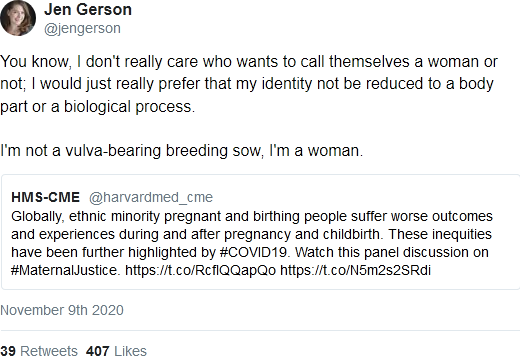
Jen Gerson has some Wrong Opinions that she shared On The Internet, so Dr. Bradley Mitchelmore, BSc. (Pharm), ACPR, PharmD, RPh has has taken it upon himself to try to get her cancelled:
Firstly, to explain how this little gem fell into my lap, some context is required. While I was avoiding the interminably dull task of invoicing our fine writers of The Line the other day, I threw out a position that some might find controversial.
That is, I find the trend towards identifying women by terms like “birthing people,” “menstruators,” “front-hole possessors” and “uterus bearers,” to be both reductive and offensive. I have no objection to finding more inclusive language for circumstances in which we want to acknowledge trans and non-binary people (ie; a phrase like “pregnant people” seems clunky, but inoffensive to me); but to date, all of this new language reduces the class of “women” to either a biological function or a bodily part.
Pregnancy is a particularly sensitive topic for a lot of women because, for most of us, the process is terrifying. To go through childbirth is the most profound loss of bodily autonomy imaginable and many women I know struggle with the after effects of feeling as if we’ve been treated like interchangeable breeding sows by some doctors and nurses. If a doctor started calling me a “birther” or a “uterus-bearer” while stretching my cervix apart knuckles-deep with two fingers, my response would not be welcoming.
I also don’t think it’s a coincidence that linguistic shifts that re-frame an entire biological sex class as “breeders” only ever seems to target one sex. Very few well-intentioned and committed activists are waging war online over the definition of “men.”
A lot of this is misogyny gilded in progressive language. And very few women want to stand up to the misogyny on the “pro-woman” team, nor suffer the consequences of pissing that team off. So most stay silent until they see a tweet like the one above, at which point they flood my DMs with private statements of support and relief. I’m happy to serve as a psychological outlet in that regard, but I’ll show you in a moment why they’re so afraid to say what they think.
Anyway, this is all just my opinion. I’m not married to it. If the trend comes around to allowing us to call all “male-bodied” people “dicks,” I might reconsider the position entirely. But we all know that Wrong Opinions Are No Longer Allowed On The Internet and therefore a doctor jumped in with one of the most delightfully fatuous replies I’ve ever received.
November 8, 2020
“… participants in men’s sport, on average, out-perform participants in women’s sports, current science is unable to isolate why this is the case”
Barbara Kay is not in favour of clearly misogynistic sports policies:
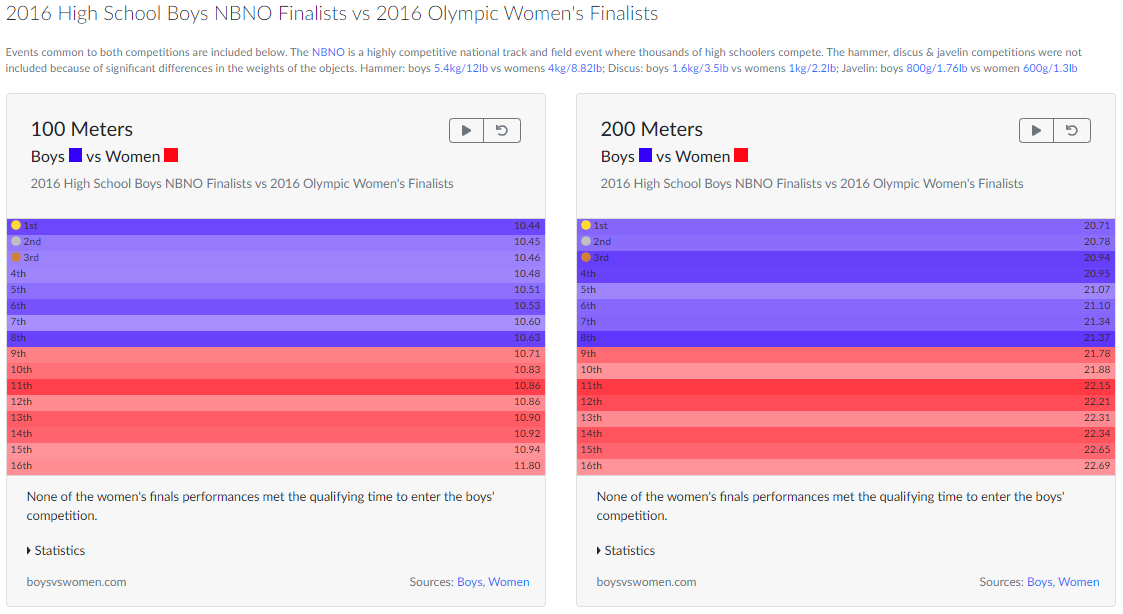
2016 high school boys compared to 2016 Olympic Women’s Finalists.
Source: http://boysvswomen.com/#/
No hormone treatment is required, says the EWG, because being male or female is not dependent on biology but on one’s feelings: “(It) is recognized that transfemales are not males who become females. Rather these are people who have always been psychologically female.” Furthermore, these individuals must be allowed to participate in “the gender with which they feel most comfortable and safe, which may not be the same in each sport or consistent in subsequent seasons.” Your eyes do not deceive you. First they justified trans women competing with women because they had “always” felt they were female. Then they say the “always” female trans athlete might “be” male for certain sports or at different times.
It gets worse.
They say that although “participants in men’s sport, on average, out-perform participants in women’s sports, current science is unable to isolate why this is the case.” This is nonsense on two counts. First, there is no “on average” about it. Virtually all high-performance male athletes out-perform all high-performance female athletes. And second, even in 2014, abundant scientific data “to isolate why this is the case” was readily, even effortlessly (#Google!) available.
Data or no data, a statement in the document itself makes clear that the ideological fix was in from the get-go: “The Expert Working Group held strongly to the principle that the inclusion of all athletes, based on the fundamental human right of gender self-determination overrides any consideration of potential competitive advantage.”
Needless to say, but it must be said anyway: Male athletes have nothing whatsoever to fear in competing with trans male athletes. This is a problem for female athletes only, which seems not to trouble the CCES at all. I’m not a feminist, but I know a misogynistic sport policy when I see it. Quis custodiet ipsos custodes?
November 2, 2020
In the University of Michigan’s Sexual Health Certificate Program, “mainstream sexual health issues that affect wide swaths of the population, such as marriage, reproduction, and family life, were treated as niche topics”
In Quillette, Tim Courtois explains what the University of Michigan’s Sexual Health Certificate Program is actually intended to teach:

When I signed up for the University of Michigan’s unique, year-long “Sexual Health Certificate Program” (SHCP), however, I truly did believe the experience would be both professionally and intellectually rewarding. I care about sexuality. I know that it is a fundamental component of the human search for joy and meaning. As a Michigan-based psychotherapist and licensed professional counselor, I wanted to deepen my understanding of sexuality, and become better equipped to provide care for the many clients who come to me with issues related to sexual health. The American Association of Sexuality Educators, Counselors, and Therapists sounded like the perfect fit for me, and the idea of becoming an AASECT-certified sex therapist appealed to me. I applied and was accepted for the 2019-2020 cohort. When I showed up, my class included participants from around the world — including Iceland, Egypt, Lebanon, and China — just as you’d expect at the kind of high-value, authoritative program that we all believed we’d signed up for.
The doubts started to creep in early, though — on day one, to be exact. Our first classroom module was titled “Sexual Attitude Reassessment.” I amused myself with the thought that this sounded like an unsettling euphemism for a brainwashing session. Sadly, that’s what it was.It quickly became clear that the issue of sexuality — the ostensible subject — often would serve merely as a pretext for more general harangues about society, and the urgent need to remake it according to AASECT’s ideological blueprint. In a keynote lecture entitled “Why Fetishism Matters,” the speaker argued that the world we inhabit is socially constructed, and told us (with what now seems like admirable candor), “I’m not neutral. I’m here to recruit you to a particular point of view about how kink should be valued.” The same speaker said that he’d been accused of teaching students that any form of sexual behavior is acceptable as long as there is consent from all parties. “Yes, that’s exactly right,” he said. Clearly, our attitude “reassessment” was well underway.
From the get-go, the scientific content was mostly superficial, and was often undercut by claims that the very idea of truth is a harmful (and even oppressive) construct. The teaching was not so much impartial and informative as it was evangelistic. Yet it was also self-contradictory: Declarations that there are no real “correct” moral values were uttered (without irony) alongside absolutist proclamations about the correct way to understand sex — and morality.As I learned, “Sexual Attitude Reassessment” (SAR) is an established term in the field, one that is often used to describe curriculum content that serves to educate sexual-health professionals about the wide range of sexual experiences that they may encounter among clients. The object is to ensure they won’t be shocked when such encounters occur, and to invite them to reassess their judgments and assumptions about various expressions of sexuality. These are valid and important goals. Unfortunately, the SAR in the SHCP descended into an exercise in overstimulation and desensitization — specifically, two full days of pornographic videos and interviews. At times, it felt like the famous brainwashing scene from A Clockwork Orange. There was a series of videos of people masturbating (one of which involved a strange interaction with a cat), a woman with “objectiphilia” who had a sexual attraction to her church pipe organ, various sadomasochistic acts, and a presentation on polyamory designed to make it clear that the polyamorous lifestyle is healthy, wholesome, and problem-free.
The focus on BDSM was a particular fixation throughout the program. In the SAR, we were shown videos of a woman meticulously applying genital clamps to the scrotum of a willing man, and a dominatrix teaching a class how to properly beat people while demonstrating on an eager participant. We also watched an interview with a sex-dungeon “dom” (the male equivalent of a dominatrix) who described one of his experiences: His client had instructed him, as the dom recounted it, “I want you to bind me and then beat me until I scream. And no matter how much I scream or beg you to stop, I want you to keep beating me.” The dom did as he was told, continuing the beatings through the customer’s begging and pleading, until the client went totally limp and silent, seeming to dissociate. At this point, the dom unbound the man, who then began to weep uncontrollably in the dom’s arms.
BDSM is a real and active sexual subculture, and I don’t object to its inclusion in the course materials. But I was shocked to see how much further the professors in the program took things, insisting that BDSM behaviors — up to and including the sexual “Fight Club” style of behavior described above — must be uncritically viewed as wholesome and beautiful. Students learned to sing from the same psalm book, with one memorably exclaiming “I’m so inspired by the wisdom and beauty in the BDSM community!” and insisting that the behavioral codes observed among BDSM participants can help us create a similar climate of safety and respect “in all our relationships.”
The program was focused on an agenda of “centering” the experience of minorities — in this case, sexual minorities. This meant that huge portions of time in class after class were spent focusing on BDSM, LGBTQIA+ issues, and polyamory, not to mention the obligatory discussions of oppression and privilege that were shoehorned into every discussion. Meanwhile, mainstream sexual health issues that affect wide swaths of the population, such as marriage, reproduction, and family life, were treated as niche topics. Further, while many Americans view sexuality through the prism of faith, religion hardly came up at all. And when it did, it was typically so that religious values could be denigrated. Even the few religious people in the program got the message: Whenever any made passing reference to their own observant religiosity, it was usually in a spirit of shame or penance.
In a few brief web searches to find a public domain or Creative Commons image to use for this post, I realized that web search engines offer “safe” options for a reason…
October 4, 2020
The End of Gender by Dr. Debra Soh
In The Critic, Louise Perry reviews Debra Soh’s recent book The End of Gender:
Contrary to what is commonly believed, sex is defined not by chromosomes or our genitals or hormonal profiles, but by gametes, which are mature reproductive cells. There are only two types of gametes: small ones called sperm that are produced by males, and large ones called eggs that are produced by females. There are no intermediate types of gametes between egg and sperm cells. Sex is therefore binary. It is not a spectrum.
The chapters in the first two thirds of the book are mostly concerned with the transgender movement. Soh works through trans activist claims with admirable thoroughness — no, not all people with gender dysphoria will benefit from transitioning; yes, natal males do have a physical advantage over natal females in sports; no, not all trans people are motivated to transition for the same reasons.
This last point is particularly explosive in political terms, but there is no doubt that Soh is on firm ground scientifically. Researchers have long been aware of the existence of two distinct categories of trans women — that is, natal males who identify as women. One group — sometimes called “homosexual transsexuals” — usually transition at a young age, have sexual relationships exclusively with men, and tend to be stereotypically feminine from childhood.
Another group — known as “autogynephiles” — have a very different profile: transitioning later, usually having sexual relationships exclusively with women, and often living as conventionally masculine men until they begin the transition process. And this second group are motivated to transition as a result of autogynephilia (sexual arousal at the idea of being a woman), a fact that trans activists are reluctant to acknowledge, preferring, as Soh puts it, “to neutralise the sexual aspect of their wishes to transition”. But she attempts an optimistic argument for tolerance:
In our sex-negative culture, trans women’s concerns are dismissed as a sexual fetish if anything about transitioning relates to sexual desire … I advocate for compassion and not being judgmental.
Soh, who writes for Playboy and other outlets, describes herself as sex-positive and supports destigmatising all discussion of sexual desire. Although I sometimes grew bored with the regular detours in which Soh writes about how much she loves going clubbing with her gay friends, or describes the confiding relationships she has formed with the parents of trans-identifying children, I understand the purpose of these sections: reassurance. This is a book written by a liberal for liberals, which prescribes a medicinal dose of yet more liberalism — more tolerance, more scientific inquiry, and more intellectual diversity. And liberal readers will no doubt be comforted that Soh’s live-and-let-live framing allows them to play the role of open-minded progressive, rather than (as trans activists would have it) bigoted reactionary.
September 30, 2020
“The culture war is the ‘New Normal'”
Andrew Doyle discusses the debate over the culture war in Spiked:
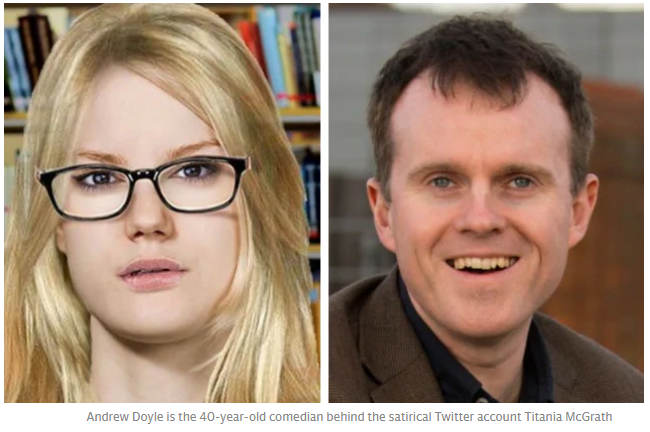
The phrase that probably best characterises the events of 2020 is the “New Normal”. Although it’s typically used to describe our changed circumstances under lockdown, it could just as easily be applied to the way in which we have all grown accustomed to the worst excesses of the social-justice revolution.
News stories that only five years ago would have been dismissed as asinine aberrations now recur with a quotidian certainty. Recent notable examples include: Princeton University confessing to “systemic racism”, leading to an investigation by the Department of Education on the grounds that racism is a violation of civil-rights law; the Royal Academy of Dramatic Arts making a similar admission, thereby emboldening some of its students to produce a 100-page document full of demands so entitled that it would make Veruca Salt blush; and an academic and novelist stating that debate is “an imperialist capitalist white supremacist cis-heteropatriarchal technique that transforms a potential exchange of knowledge into a tool of exclusion and oppression”. Yes, the culture war is the “New Normal”.
Yet with all the evidence before our eyes, certain commentators persist with their view that the culture war is a right-wing myth advanced by those who are resistant to change. “There’s no actual ‘culture war’, is there?”, writes LBC’s James O’Brien: “It’s just a new way of describing disagreements between people who hate racism and discrimination and people who love it.” Then there is the Guardian‘s Owen Jones, who maintains that “a lot of what’s called ‘the culture war’ is just younger people trying to assert their different social and moral values over older generations who run most of the media”. Nesrine Malik has argued that the culture war has been manufactured by the right, although it will not have escaped most people’s attention that the majority of salvos come from the left side of the battlefield.
It’s this kind of gaslighting – to borrow the language of social-justice activists – that we have already seen from writers who insist that “cancel culture” doesn’t exist, in spite of abundant and incontrovertible evidence that it does.
This is because, as Helen Pluckrose and James Lindsay have so clearly outlined in their seminal book Cynical Theories, the ideology of social justice has its origins in postmodernism, a school of thought which favours “lived experience” and multiple “ways of knowing” over objective truth. It doesn’t matter, for instance, that JK Rowling has never said or written anything transphobic — her new novel must be denounced for advancing an anti-trans agenda, even though it contains no actual references to trans people. These activists have apparently taken their cues from Humpty Dumpty in Lewis Carroll’s Through the Looking Glass (1871). “When I use a word”, he says to Alice, “it means just what I choose it to mean – neither more nor less”.
September 17, 2020
Book burning’s back on the menu, boys!
Brendan O’Neill on the latest fad for the ultrawoke celebrities — book burning.
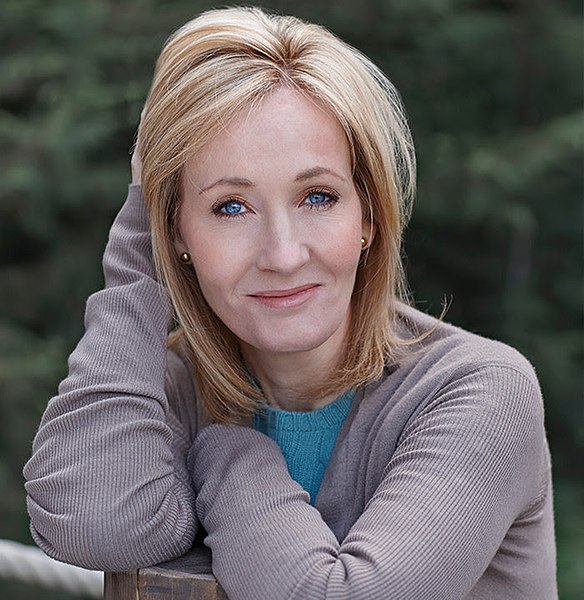
J.K. Rowling
So it turns out that Jedward, with their quiffed Aryan hair and strangely intense mannerisms, don’t only look like a couple of members of Hitler Youth who’ve been on a shopping spree at TK Maxx. They sound like it too. Yesterday, ever keen to jump on a bandwagon, even if it’s a bandwagon of misogynistic hate, the Shining twins of Irish pop suggested to their Twitter followers that they should burn JK Rowling’s next novel when it is published. “Does anyone need firewood this winter!”, they tweeted. “JK’s new book is perfect to burn next to a Romantic fire. Aww get all cozy and comfy can’t wait.”
Let’s leave to one side the industrial levels of gall it must require for two blokes who don’t know the difference between an exclamation mark and a question mark to have a pop at the most successful British author of all time. The more striking thing about Jedward’s tweet is that it suggests book-burning is back. Their tween-fascist cry for the burning of Rowling’s forthcoming novel was retweeted and liked thousands of times, by armies of so-called trans allies who now look upon Rowling as a real-life Voldemort: a despicable, evil figure whose works should be tossed on to raging bonfires as the woke mob yelps with delight.
The hatred for JK Rowling is out of control. It goes far beyond the everyday attempted cancellations and screeching Twittermob assaults on anyone who dares to deviate from the correct-think of the PC elites. The hatred for Rowling is far more raw, far more intense, far more irrational.
Her intellectual sin, her speechcrime, is of course that she believes in biological sex. She thinks there are differences between men and women. She thinks biological males should bugger off out of women’s changing rooms, sporting tournaments, prisons, rape-crisis centres, and so on. Many of us agree with her. And for this, she is frequently bombarded with rape threats and death threats. “Suck my cock!”, sexist pigs tweet at her. They invite her to die in a fire. They send her explicit pornography. This week #RIPJKRowling trended on Twitter. These people are insane. When your “activism” involves tirelessly insulting and sexually harassing a woman for having a thought that is different to your own, you need to have a serious word with yourself.
The deranged Rowling hate intensified this week after it was reported that her next Strike novel – the detective series she writes under the name Robert Galbraith – will involve a backstory about a man who dresses as a woman and then goes around murdering women. “Transphobia!”, the woke Twitterati predictably yelled. Not for the first time the sexist fury with Rowling for having the temerity to be a woman who thinks for herself was in large part inflamed by Pink News, the online gay magazine that has done more than most to depict women who are sceptical of certain aspects of transgenderism as “TERFs” – that is, witches, bitches, uppity broads who really ought to do what the editors at Pink News tell them to.
August 22, 2020
Debra Soh’s new book is “a cancel-culture grenade”
Jen Gerson knows that any positive mention of Debra Soh’s The End of Gender: Debunking Myths About Sex and Identity has a strong resemblance to square-dancing in a minefield. Cancellations may fall like raindrops on the career of anyone so unenlightened as to even acknowledge the existence of such a work:
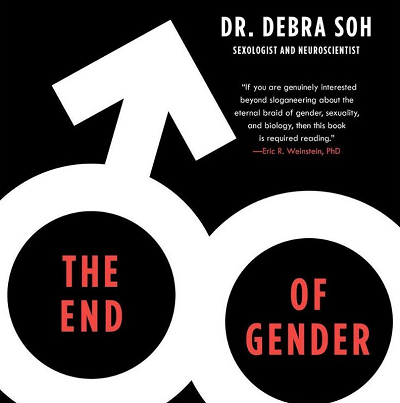
For that, at its heart, is what Soh’s book is: a lucid discussion of the best science we have to date on the nature of gender and sex, written for a lay audience. What gives the title its sizzle is not the content, but rather the cultural climate in which it is being published.
It maps the depth, scope and scale of current Culture War trenches in this particular theatre of battle. The End of Gender stomps on tripwires like the gender binary, whether transgender women are women, autogynephilia, Rapid Onset Gender Dysphoria, bathroom bans, and more.
It’s a cancel-culture grenade.
That’s not because these subjects ought to be contentious. Soh’s approach and tone are largely neutral. Rather, the controversy the book will inevitably incite is a reflection of a culture that has been warped into a state of existential terror by the very notion that these ideas can be responsibly discussed.
Soh begins by defining her terms.
So much of the debate around the most difficult topics of sex and gender stem from the simple fact that we are misusing the basic language. For example, sex and gender are not interchangeable concepts, even though they are often treated as such.
Sex is a term of biology. One’s sex, Soh argues, is determined by his or her gametes. With the exception of rare intersex disorders, 99 per cent of the population has a clearly defined biological sex that slots into one of two dimorphic categories: male or female.
Gender is more complicated. It’s now popular to state that there are more than two genders, but Soh disputes this. She argues that gender — or the set of characteristics that signal one’s sex to society — is also dimorphic. For 99 per cent of the population, gender correlates with sex. Further, even when expressions of gender are at odds with one’s biological sex, this, too, is mediated by biology. Whether one presents as gender typical or gender atypical is the result of prenatal testosterone exposure.
Soh notes that claiming to be gender non-binary, or gender fluid — or any one of a thousand variations that transcend the limiting concepts of male and female — is increasingly trendy, especially among teenagers and young adults. It seems to be the latest form of identity experimentation.
There are two reasons for this trend.
The first is that seeing the world through an intersectional framework encourages progressives to reverse the traditional hierarchies of race, sex and power. Therefore, claiming a marginalized identity — like genderqueer non-binary unicorn — accrues status within progressive peer circles.
The second is that the culture has undergone a massive awakening to transgender rights over the past decade. This has contributed expressive categories and vocabularies for people who otherwise might have struggled to find the language to explore their most authentic selves. As the cues, like cosmetics and dress, that we used to signal our gender are socially constructed, gender expression is limited only by our creativity.
July 26, 2020
J.K. Rowling receives an apology
In his first Weekly Dish newsletter, Andrew Sullivan reports on the retraction and apology by The Day to J.K. Rowling:
J.K. Rowling’s Harry Potter books have been pivotal for many Millennials in encouraging them to move away from traditional religious beliefs.
We’re used to public apologies by now, but this one is a little different. It comes from a magazine for schoolchildren in England, called The Day. It reads:
We accept that our article implied that … JK Rowling … had attacked and harmed trans people. The article was critical of JK Rowling personally and suggested that our readers should boycott her work and shame her into changing her behaviour … We did not intend to suggest that JK Rowling was transphobic or that she should be boycotted. We accept that our comparisons of JK Rowling to people such as Picasso, who celebrated sexual violence, and Wagner, who was praised by the Nazis for his antisemitic and racist views, were clumsy, offensive and wrong … We unreservedly apologise to JK Rowling for the offence caused, and are happy to retract these false allegations and to set the record straight.
The Day had been referring to JK Rowling’s open letter on trans issues, which you can read in its entirety here and judge for yourself.
I have to say it’s good to see this apology in print. It remains simply amazing to me that the author of the Harry Potter books, a bone fide liberal, a passionate feminist and a strong supporter of gay equality can be casually described, as Vox’s Zack Beauchamp did yesterday, as “one of the most visible anti-trans figures in our culture.” It is, in fact, bonkers. Rowling has absolutely no issue with the existence, dignity and equality of transgender people. Her now infamous letter is elegant, calm, reasonable and open-hearted. Among other things, Rowling wrote: “I believe the majority of trans-identified people not only pose zero threat to others, but are vulnerable for all the reasons I’ve outlined. Trans people need and deserve protection.”
She became interested in the question after a consultant, Maya Forsteter, lost a contract in the UK for believing and saying that sex is a biological reality. When Forsteter took her case to an employment tribunal, the judge ruled against her, arguing that such a view was a form of bigotry, in so far as it seemed to deny the gender of trans people (which, of course, it doesn’t). Rowling was perturbed by this. And I can see why: in order either to defend or oppose transgender rights, you need to be able to discuss what being transgender means. That will necessarily require an understanding of the human mind and body, the architectonic role of biology in the creation of two sexes, and the nature of the small minority whose genital and biological sex differs from the sex of their brain.
This is not an easy question. It requires some thinking through. And in a liberal democracy, we should be able to debate the subject freely and openly. I’ve done my best to do that in this column, and have come to many of the conclusions Rowling has. She does not question the existence of trans people, or the imperative to respect their dignity and equality as fully-formed human beings. She believes they should be protected from discrimination in every field, and given the same opportunities as anyone else. She would address any trans person as the gender they present, as would I. Of course. That those of us who hold these views are now deemed bigots is, quite simply, preposterous.
[…]
It pains me to see where this debate has gone. There’s so much common ground. And I do not doubt that taking into account the lived experiences of trans people is important. But if we cannot state an objective fact without being deemed a bigot, and if we cannot debate a subject because debating itself is a form of hate, we have all but abandoned any pretense of liberal democracy. And if a woman as sophisticated and eloquent and humane as JK Rowling is now deemed a foul bigot for having a different opinion, then the word bigotry has ceased to have any meaning at all.
June 17, 2020
“We don’t need no stinkin’ badges!”
Theodore Dalrymple on the use of badges within the NHS to virtue signal and compel compliance in the unwilling:

Not actually the official symbol of Britain’s National Health Services … probably.
In Britain’s highly-centralized, almost Soviet-style healthcare system, the National Health Service, staff are being encouraged all over the country to wear little rainbow-coloured metal badges to show that they are homosexual, bisexual, and transsexual-friendly, and do not discriminate against them. The wearing of these badges is voluntary, but about 3,000 of the staff of Guy’s and St Thomas’ Hospitals, for example, now wear them. The self-congratulatory website of those ancient hospitals — St. Thomas’ is over 800 years old and Guy’s was founded in 1721, now combined into one administrative unit — says:
The badges are just one way to show that Guy’s and St Thomas’ is an open, non-judgmental and inclusive place for people that identify as LGBT+ [which] stands for lesbian, gay, bisexual and transgender). The + simply means we are inclusive of all identities, regardless of how people identify themselves.
This language, which combines the unctuous with the bureaucratic, is typical of the way British hospital administrators express themselves nowadays. And if, as Buffon said, the style is the man himself, we may justly fear for a semi-totalitarian future.
By implication, the badges bully the staff, for if any of them refuse to wear one, their refusal is likely to be taken to mean that their minds are closed, judgmental (in the sense of being censorious, for even the attempt to avoid making judgments is itself based on a judgment), and exclusionary. It is to imply that they would deliberately treat any patients in the above mentioned categories differently and worse from all other patients. Wear the badge or declare yourself to be a bigot.
This is an insult to all those people who worked before the advent of the badges (or who now refuse to wear them) who strove and continue to strive always to treat patients to the best of their ability, irrespective of the many categories into which any individual patient falls. In my experience, the great majority of doctors have always tried to do this.
Let me give an example. Working as I did as a doctor in prison, I met many men who had done terrible things. I treated them, as a matter of course, to the best of my ability. I remember, for example, a man who had strangled three children and then impaled them on railings. Though I did not think he was a good man, and in that sense passed a judgment on him within the privacy of my mind, I treated him for his bronchitis exactly as I would have treated anyone else with bronchitis. I did not find this difficult in the least and do not claim any special merit for having done so, for it is only what all my colleagues in the profession did — as a matter not only of course, but of principle.
A couple of years ago, I read the diary of one of Marshal Pétain’s doctors during the latter’s imprisonment after World War II. The doctor had been a member of the Resistance and had no reason to love Pétain, to say the least: Pétain’s supporters would have had not a second thought about killing him if he had fallen into their power. Yet, as the diary makes clear, the doctor treated Pétain, who by then was demented, with the greatest humanity. Moreover, the doctor refused to publish his diary, despite the financial advantage of doing so, because he thought that publishing it would be to break patient confidentiality. It was only after his death, and more than half a century after Pétain’s, that the diary was published. The doctor’s adherence to his medical ethics was impressive, and he needed no badge to proclaim his virtue.
June 12, 2020
J.K. Rowling on her most recent “cancellation”
I know a lot of Harry Potter fans are upset with their formerly favourite author for her stance on transgenderism … or what they’ve heard about her stance … or what their friends have said about her stance … so J.K. Rowling has posted an essay on her own site explaining what happened and how she has been coping with being “cancelled” so many times:
… as a much-banned author, I’m interested in freedom of speech and have publicly defended it, even unto Donald Trump.
The fourth is where things start to get truly personal. I’m concerned about the huge explosion in young women wishing to transition and also about the increasing numbers who seem to be detransitioning (returning to their original sex), because they regret taking steps that have, in some cases, altered their bodies irrevocably, and taken away their fertility. Some say they decided to transition after realising they were same-sex attracted, and that transitioning was partly driven by homophobia, either in society or in their families.
Most people probably aren’t aware – I certainly wasn’t, until I started researching this issue properly – that ten years ago, the majority of people wanting to transition to the opposite sex were male. That ratio has now reversed. The UK has experienced a 4400% increase in girls being referred for transitioning treatment. Autistic girls are hugely overrepresented in their numbers.
The same phenomenon has been seen in the US. In 2018, American physician and researcher Lisa Littman set out to explore it. In an interview, she said:
“Parents online were describing a very unusual pattern of transgender-identification where multiple friends and even entire friend groups became transgender-identified at the same time. I would have been remiss had I not considered social contagion and peer influences as potential factors.”
Littman mentioned Tumblr, Reddit, Instagram and YouTube as contributing factors to Rapid Onset Gender Dysphoria, where she believes that in the realm of transgender identification “youth have created particularly insular echo chambers.”
Her paper caused a furore. She was accused of bias and of spreading misinformation about transgender people, subjected to a tsunami of abuse and a concerted campaign to discredit both her and her work. The journal took the paper offline and re-reviewed it before republishing it. However, her career took a similar hit to that suffered by Maya Forstater. Lisa Littman had dared challenge one of the central tenets of trans activism, which is that a person’s gender identity is innate, like sexual orientation. Nobody, the activists insisted, could ever be persuaded into being trans.
The argument of many current trans activists is that if you don’t let a gender dysphoric teenager transition, they will kill themselves. In an article explaining why he resigned from the Tavistock (an NHS gender clinic in England) psychiatrist Marcus Evans stated that claims that children will kill themselves if not permitted to transition do not “align substantially with any robust data or studies in this area. Nor do they align with the cases I have encountered over decades as a psychotherapist.”
The writings of young trans men reveal a group of notably sensitive and clever people. The more of their accounts of gender dysphoria I’ve read, with their insightful descriptions of anxiety, dissociation, eating disorders, self-harm and self-hatred, the more I’ve wondered whether, if I’d been born 30 years later, I too might have tried to transition. The allure of escaping womanhood would have been huge. I struggled with severe OCD as a teenager. If I’d found community and sympathy online that I couldn’t find in my immediate environment, I believe I could have been persuaded to turn myself into the son my father had openly said he’d have preferred.
When I read about the theory of gender identity, I remember how mentally sexless I felt in youth. I remember Colette’s description of herself as a “mental hermaphrodite” and Simone de Beauvoir’s words: “It is perfectly natural for the future woman to feel indignant at the limitations posed upon her by her sex. The real question is not why she should reject them: the problem is rather to understand why she accepts them.”
As I didn’t have a realistic possibility of becoming a man back in the 1980s, it had to be books and music that got me through both my mental health issues and the sexualised scrutiny and judgement that sets so many girls to war against their bodies in their teens. Fortunately for me, I found my own sense of otherness, and my ambivalence about being a woman, reflected in the work of female writers and musicians who reassured me that, in spite of everything a sexist world tries to throw at the female-bodied, it’s fine not to feel pink, frilly and compliant inside your own head; it’s OK to feel confused, dark, both sexual and non-sexual, unsure of what or who you are.
I want to be very clear here: I know transition will be a solution for some gender dysphoric people, although I’m also aware through extensive research that studies have consistently shown that between 60-90% of gender dysphoric teens will grow out of their dysphoria. Again and again I’ve been told to “just meet some trans people.” I have: in addition to a few younger people, who were all adorable, I happen to know a self-described transsexual woman who’s older than I am and wonderful. Although she’s open about her past as a gay man, I’ve always found it hard to think of her as anything other than a woman, and I believe (and certainly hope) she’s completely happy to have transitioned. Being older, though, she went through a long and rigorous process of evaluation, psychotherapy and staged transformation. The current explosion of trans activism is urging a removal of almost all the robust systems through which candidates for sex reassignment were once required to pass. A man who intends to have no surgery and take no hormones may now secure himself a Gender Recognition Certificate and be a woman in the sight of the law. Many people aren’t aware of this.
June 11, 2020
QotD: Equal rights
This reminds me of the debate in the late 1980s through mid-1990s about whether homosexuality was nature or nurture, something you were born to be or a lifestyle choice. Conservatives and Christians argued for the “choice” position and this led to efforts to “convert” gays to straight (or “pray the gay away”) because something that is learned can be unlearned. This led the gay community and supporters thereof to argue for the “born this way” position. The cumulative evidence from multiple lines of inquiry led to the nature position more than that of nurture, but this was another example of confusing the empirical question of the origin of homosexuality with the moral question of the rights of gays and lesbians (today the LGBTQ community). It should go without saying — but unfortunately in these times it must be said again and again — it doesn’t matter what the origins of homosexuality turn out to be, gays and lesbians and everyone else in the LGBTQ community are entitled to the same rights and privileges as everyone else protected by the constitution of their nation (and those nations that have yet to extend legal rights to gays and lesbians need to change their constitutions).
Michael Shermer, interviewed by Claire Lehmann, “The Skeptical Optimist: Interview with Michael Shermer”, Quillette, 2018-02-24.
June 10, 2020
“Gender critical” feminism
Barbara Kay finds herself in agreement with an academic who, having come from a Marxist and radical feminist background, she would not normally have much in common:

Kathleen Lowrey, associate professor of anthropology at the University of Alberta, ascribes much of her intellectual formation to Marxism and radical feminism. Not, I think my regular readers would agree, someone with whom I would normally have a great deal in common. And yet, in this strange cultural moment, Prof. Lowrey and I find ourselves amicably united in the service of a mutually revered ideal. I write this column with ardent sympathy for her in her present predicament.
Academics’ time is generally split 40/40/20 amongst, respectively, research, teaching and “service” to their community — meaning committees, mainly. Until late March, Lowrey served as associate chair for undergraduate programs on behalf of the department of anthropology. Following anonymous complaints about her views from one or more students to the university’s office of safe disclosure and human rights, as well as to the dean of students, Lowrey was asked to resign. She was not given a precise reason, only told that because she holds “gender critical” opinions, she was making the learning environment “unsafe” for the anonymous complainants who felt that her views caused them “harm.” (It’s not clear — Lowrey believes it is doubtful — that the complainants were even taking her courses.)
“Gender critical” refers to what was shortly ago normative feminism doctrine in considering biological sex of primordial importance in fighting for women’s rights. Where the traditional rights of biological women collide with asserted rights of trans women — sport, intimate spaces, rape crisis centres, prisons — gender-critical feminists join with conservatives like me in insisting that biological women’s rights must prevail: for the sake of their safety, privacy and right to a level playing field.
Until what seems like a few minutes ago, there was nothing controversial about this opinion. But now there is. The only “correct” opinion to hold is that gender expression trumps biology in any rights-based claims. And in academic circles, Lowrey’s views, which she is at no pains to hide on campus and off, are a form of apostasy that cries out for punishment.
April 5, 2020
QotD: The fear of “becoming” your job
You could see this worry everywhere in our culture, our art. Watch Fast Times at Ridgemont High. Judge Reinhold’s character is wrestling with this type of question, and he’s in high school, fer chrissakes. See what I mean about that movie being made on Mars? Remember that; it’ll be on the final.
There’s a certain type of person, though, who just couldn’t grok those worries, because the very notion of social roles was incomprehensible. We didn’t know about the autism spectrum back then, but that’s what that type of person effectively is: A high-functioning autistic. For the autistic, what’s now is forever. Bob’s nametag says “customer service representative.” Therefore, Bob is a customer service representative, and only a customer service representative, now and forever. Bob the family man, Bob the stamp collector, Bob the bar-band strummer … all those fry the autistic’s circuits. It says “customer service representative,” damn it! The train is fine.
Two sides of the same coin. Normal people were worried that they were becoming their jobs. The autistics couldn’t grasp that anyone could be anything else.
The autistics all went into the ivory tower, which gave us identity politics. “Identity politics” only makes sense to the autistic — that is, to people who can’t process change. Normal people have such a hard time with it because we can’t see the logical connection between, say, being gay and being pro-abortion. I mean, if you’re gay it’s a moot point, right? Nor is there any logical connection between being gay and favoring redistributive economics, or worrying about global warming, or whatever. Maybe you do believe in redistributive economics and are worried about global warming, but those are just individual opinions, right? I’m not obliged to vote Republican because I dig blondes. It’s a non sequitur.
Not to the autistic, it isn’t. They’re told that this — pro-abortion, being “green,” the whole Liberal schmear — just is gayness, and they go with it, because that’s the only way the world makes sense to them. Just how “gay” came to mean all that is above my pay grade, but we all know it’s true. More importantly, we all know they believe it, with all their hearts and souls.
That’s the situation in which we find ourselves, my young friends, here in the Current Year. Most of us would like to be team players, but we have no role models. Because the autistics control the culture, we’ve internalized their worries. If I’m a member of the team, we instinctively feel, then somehow I am the team, and only the team, now and forever. It’s a stark choice: Either I give up my individuality completely to advance the team’s goals, or I take my ball and go home.
But it’s a false choice, kameraden, one that could only be beaten into us by very long, very expensive training — i.e. the American “education” system, K-thru-PhD.
Severian, “Advice to Young Dissidents”, Rotten Chestnuts, 2020-04-01.
March 25, 2020
Bonus QotD: Cognitive dissonance and the very, very woke
We’ve written a lot here on the West’s “crisis of legitimacy.” Well … this is it. Let’s break down some of the big factors in play:
The first, biggest, and in some ways only factor that matters, legitimacy-wise, is cognitive dissonance. We spent a lot of time here back in the days arguing about whether or not it’s a real thing […] I finally took the position that it’s real, but only for stuff that rises to level of actual cognition … which you just don’t see too much of anymore. Indeed, the whole point of Postmodern Leftism, when you come right down to it, is not having to think. Identity politics gives you The One Right Answer for most every situation; it’s just a matter of filling in the Social Justice Mad Lib. Any apparent conflict between One Right Answers is dealt with by ad hominem.
An example will probably help: Trannies vs. Feminists. Feminists, of course, are all in on The One Right Answer that “gender is just a social construction.” But Trannies actually believe this — if you feel you’re really a woman, then you are, your twelve-inch wang be damned. How, then, can impeccably #woke lesbians refuse to have sex with the aforesaid twelve-inch wang, since gender is just a social construction and Thundercock identifies as a lesbian? Easy: ad hominem. Oh, gender’s just a social construction all right … it’s just that any be-penised individual who “constructs” himself as a lesbian is lying for personal gain (#wokeness, as everyone knows, gives one the ability to read minds).
This isn’t a problem for the Left as a whole, much less for our entire society, because of the tiny numbers involved. Despite showing up pretty much everywhere in popular culture, gays are a small fraction of the population. Trannies are a fraction of a fraction, and since militant lesbianism is almost entirely political anyway (lesbian bed death is very real), about the only place this could possibly be a live issue is on the loonier college campuses.
Severian, “The Real Crisis”, Rotten Chestnuts, 2020-03-17.


