
Mark Felton Productions
Published on 9 Feb 2019WW2-era German Panzers last saw combat during the Six Day War in 1967, when Syria used them against Israel on the Golan Heights. Discover how Syria was able to acquire so many WW2 German vehicles and how they fared in combat against IDF Shermans and Centurions.
Credits: Bukvoed, Mark Felton Productions, YouTube Creative Commons, Google Commons, Panzers in the Golan Heights – wwiiafterwwii
March 19, 2019
Last German Panzer Battle – Six Day War 1967
Comments Off on Last German Panzer Battle – Six Day War 1967
March 7, 2019
Line Of Fire The Six Day War
sixoctober war
Published on 4 Jul 2013After the 1956 Suez Crisis, Egypt agreed to the stationing of a United Nations Emergency Force (UNEF) in the Sinai to ensure all parties would comply with the 1949 Armistice Agreements. In the following years there were numerous minor border clashes between Israel and its Arab neighbors, particularly Syria. In early November, 1966, Syria signed a mutual defense agreement with Egypt. Soon thereafter, in response to Palestine Liberation Organization (PLO) guerilla activity, including a mine attack that left three dead, the Israeli Defense Force (IDF) attacked the city of as-Samu in the Jordanian-occupied West Bank. Jordanian units that engaged the Israelis were quickly beaten back. King Hussein of Jordan criticized Egyptian President Gamal Abdel Nasser for failing to come to Jordan’s aid, and “hiding behind UNEF skirts”.
In May 1967, Nasser received false reports from the Soviet Union that Israel was massing on the Syrian border. Nasser began massing his troops in the Sinai Peninsula on Israel’s border (May 16), expelled the UNEF force from Gaza and Sinai (May 19), and took up UNEF positions at Sharm el-Sheikh, overlooking the Straits of Tiran. UN Secretary-General U Thant proposed that the UNEF force be redeployed on the Israeli side of the border, but this was rejected by Israel despite U.S. pressure. Israel reiterated declarations made in 1957 that any closure of the Straits would be considered an act of war, or a justification for war. Nasser declared the Straits closed to Israeli shipping on May. 22-23. On 27 May he stated “Our basic objective will be the destruction of Israel. The Arab people want to fight.” On May 30, Jordan and Egypt signed a defense pact. The following day, at Jordan’s invitation, the Iraqi army began deploying troops and armored units in Jordan. They were later reinforced by an Egyptian contingent. On June 1, Israel formed a National Unity Government by widening its cabinet, and on June 4 the decision was made to go to war. The next morning, Israel launched Operation Focus, a large-scale surprise
Comments Off on Line Of Fire The Six Day War
January 23, 2019
A new beginning for the Middle East: The Cyrus Cylinder and Ancient Persia
The British Museum
Published on 18 Jul 2014The Cyrus Cylinder is one of the most famous objects to have survived from the ancient world. It was inscribed in Babylonian cuneiform on the orders of Persian King Cyrus the Great (559-530 BC) after he captured Babylon in 539 BC.
The cylinder is often referred to as the first bill of human rights as it appears to encourage freedom of worship throughout the Persian Empire and to allow deported people to return to their homelands. It was found in Babylon in modern Iraq in 1879 during a British Museum excavation.
Comments Off on A new beginning for the Middle East: The Cyrus Cylinder and Ancient Persia
January 5, 2019
QotD: Nasser’s anti-American success, funded by the USA
If you’re familiar with the history of the region, you already know that Nasser aligned Egypt with the Soviet Union anyway and whipped up the Arab world into an anti-American frenzy. Ike’s gamble failed. Nasser’s heart was with Moscow all along. He cleverly used Eisenhower as a tool for his own ambitions and planned to stab the United States in the front from the very beginning.
One of Nasser’s deceptions should be familiar to anyone who has followed the painful ins and outs of botched Arab-Israeli peacemaking. Over and over again, Nasser used a strategy Doran calls “dangle and delay.” He repeatedly dangled the tantalizing idea of peace between Egypt and Israel in front of Eisenhower’s eyes, only to delay moving forward for one bogus reason after another. He never planned to make peace with Israel or even to engage in serious talks.
Nasser did, however, participate in theatrical arms negotiations with Washington that he knew would never go anywhere.
Eisenhower wanted to equip the Egyptian army. Nasser wasn’t stupid, though. He knew that Ike would attach strings to the deal. Egypt’s soldiers would need to be trained by Americans, and they’d be reliant on Americans for spare and replacement parts. Nasser really wanted to be armed by and tied to the Soviet Union, but had to pretend otherwise lest Eisenhower side with Britain, France, and Israel. So Nasser slowly sabotaged talks with the United States in such a way that made Washington seem unreasonable. That way, when he turned to the Soviet Union for weapons, he could half-plausibly say he had no choice.
Nasser did such a good job pretending to be pro-American that he convinced the United States to give him a world-class broadcasting network that allowed him to speak to the entire Arab world over the radio. Washington expected him to use his radio addresses to rally the Arab world behind America against the Russians. Instead, he used it to blast the United States with virulently anti-American propaganda and to undermine the West’s Arab allies. “Nasser,” Doran writes, “was the first revolutionary leader in the postwar Middle East to exploit the technology in order to call over the heads of the monarchs to the man on the street. Suddenly the Hashemite monarchy [in Iraq and Jordan] found itself sitting atop volcanoes.”
Nasser strode the Arab world like a colossus after his American-made victory in the Suez Crisis, and he became more brazenly anti-American as he gathered strength. Conning Ike was no longer possible, but Nasser didn’t need the United States anymore anyway.
Michael J. Totten, “We Are Still Living With Eisenhower’s Biggest Mistake”, The Tower Magazine, 2017-02.
Comments Off on QotD: Nasser’s anti-American success, funded by the USA
December 13, 2018
The Israeli Galil
Forgotten Weapons
Published on 23 Nov 2018https://www.forgottenweapons.com/the-…
http://www.patreon.com/ForgottenWeapons
The Galil was the result of a program to replace the FAL in Israeli service after its somewhat disappointing performance in the Six-Day War of 1967. Israel found that while the FAL had shown reliability problems in the desert, AK rifles ran just fine despite often being badly neglected. In an initial series of tests, captured AK rifles came out superior to M16 and Stoner 63 rifles. This led to a more extensive series of tests and developmental work in which Yisrael Balashnikov developed a number of prototype rifles based on AK actions modified to 5.56mm using Stoner barrels and magazines. This second trial would ultimately compare the M16, Stoner 63, HK33, AR18, Beretta and Steyr rifles, and domestic developments by both Balashnikov and Uziel Gal. The Balashnikov rifles would prove the ultimate winner of the competition.
Balashnikov – whose name being so similar to Kalashnikov through pure coincidence, and who was originally born Mishmar Hayarden in Russia – would change his name to the more Hebrew sounding Yisrael Galili, and the new rifle pattern would be named the Galil after him. While the prototypes had been built on captured Soviet-bloc AKs, the production version would be based on the Finnish Rk-62 Valmet receiver. The Galil featured a great many improvements and additions to the AKM, including much better rear-mounted aperture sights, night sights, integral bipod (on some models), folding stock, ambidextrous safety and bolt handle, folding carry handle, and of course, a bottle opener. The Galil was formally adopted in 1972, but never did completely equip the Israeli Army, as surplus M16 rifles form the US were available for little or no cost. It was phased out by about 2000 and replaced by the Tavor series.
Prior to 1989, semiauto Galil could be imported into the US for commercial sale, and between 7000 and 9000 were brought in by a succession of importers (Magnum Research, Action Arms, and Springfield Armory). A 7.62mm NATO version of the Galil was introduced in 1983, which was not used by the Israeli military but did see adoption by Colombia as well as limited commercial sale in the US. The standard 5.56mm Galil were purchased by an array of foreign militaries including Guatemala, Nicaragua, Estonia, Portugal, and South Africa (where it served as the basis for the domestic production R4 series).
Contact:
Forgotten Weapons
PO Box 87647
Tucson, AZ 85754
Comments Off on The Israeli Galil
November 28, 2018
AirBnB virtue signals its … anti-semitic street cred?
In the National Post, Barbara Kay discusses the odd business choices of AirBnB in cutting off rentals to only certain locations that just happen to be in Israel:
Planning a group holiday in Kashmir? Airbnb is there to serve you. Likewise in Tibet, northern Cyprus and Georgia’s separatist republic of Abkhazia, all occupied or disputed territories. Airbnb’s political neutrality in these hot spots therefore quite rightly casts suspicion, to put it mildly, on its recent decision to delist some 200 Jewish homes in West Bank communities.
Airbnb stated, “We know that people will disagree with this decision and appreciate their perspective. This is a controversial issue.” No kidding. An Israeli class-action lawsuit has been filed against Airbnb, seeking US$4,000 in damages for every affected host.
Indignation has been running high outside of Israel as well, in statements both spontaneous — disgusted blog, Twitter and Facebook posts — and considered. The Beverly Hills city council, for example, passed a unanimous condemnatory resolution, calling Airbnb out for anti-Semitism and stating, in part: “The City of Beverly Hills hereby calls upon Airbnb to correct this act of disrespect to the land of Israel and restore its original services immediately.”
Setting aside the anti-Semitic optics, is it legal for Airbnb to do this?
The U.S. Constitution, as well as various state laws and acts of Congress, prohibits both American individuals and corporations from participating in boycotts against other nations. A corporate boycott against a foreign government does not fall under the “free speech” rubric,” but is considered a “tool of statecraft” reserved for the federal government in such situations as war. The office of Rob Portman of Ohio (R), an author of the Israel Anti-Boycott Act in the Senate, told The Jerusalem Post last Tuesday that it wants to hear from Airbnb. The Illinois state legislature — which passed the nation’s first local anti-BDS law in 2015 — will reportedly meet in mid-December, when it anticipates debating whether Airbnb violated its statute.
Establishing illegality pivots on whether the move is deemed as “politically” inspired. It certainly seems to be. As noted by Kohelet Forum legal expert Eugene Kontorovich in a recent Wall Street Journal oped, “An American Jew with a rental property in the West Bank is barred from listing it for rent on the website. But an American Arab is welcome to list his home a few hundred metres away, even though the Palestinian law forbidding real-estate deals with Jews carries a maximum penalty of death. That openly racist policy doesn’t trigger Airbnb’s delisting policy.”
Comments Off on AirBnB virtue signals its … anti-semitic street cred?
October 25, 2018
QotD: The unique situation of Israel
In 1948, one internationally recognized sovereign state (Israel) was invaded by the armies of various neighboring sovereign states (Jordan, Egypt, Syria, Iraq, Lebanon). At the end of that war, much of the former British Mandate of Palestine was in Israeli hands, but the West Bank wound up with Jordan and the Gaza Strip with Egypt. Over the next two decades, nobody referred to Egypt’s or Jordan’s exercise of its sovereignty in those lands under loaded terms such as “settlement”.
In 1967, the Arabs tried again to wipe out Israel, and again failed. And this time their defeat was even more total: Egypt lost the Gaza Strip (and the Sinai) and Jordan lost the West Bank. That was half-a-century ago. One of the most basic laws of war is: to the victor the spoils. If you launch a war and you lose, then the guy who took your territory is the one who determines its future. Instead, the “international community” decided to intervene in the matter in a way it has in no other supposed boundary dispute.
Thus began the “Palestiniazation” of the problem. Uniquely in such matters, the victorious sovereign state is forbidden from returning the spoils of war to the defeated sovereign states – Jordan and Egypt. Instead, it can only treat with the designated representatives of “Palestine”, who … have no interest in nation-building, or capacity for it, only in Jew-killing.
To repeat: the “international community”‘s treatment of this issue is like no other boundary dispute of the last 200 years. Maybe that’s because this situation is unique to one small patch of land in the Middle East. Or maybe it’s because the “international community” really really doesn’t like Jews.
I say that Israel (independent since 1948), Jordan (1946) and Egypt (1922) are all sovereign states entitled to act in their own interests, and live with the consequences – especially after two or three generations.
Mark Steyn, “License to Dye”, Steyn Online, 2016-12-30.
Comments Off on QotD: The unique situation of Israel
October 3, 2018
The Uzi Submachine Gun: Excellent or Overrated?
Forgotten Weapons
Published on 5 Mar 2018The Israeli Uzi has become a truly iconic submachine gun through both its military use and its Hollywood stunts – but how effective is it really?
I found this fully automatic Uzi Model A to be actually rather better than I had expected. Despite the uncomfortable sharp metal stock, the rate of fire and large sights make this a relatively easy gun to shoot. Not one of the absolute best, but certainly above average.
http://www.patreon.com/ForgottenWeapons
If you enjoy Forgotten Weapons, check out its sister channel, InRangeTV! http://www.youtube.com/InRangeTVShow
Comments Off on The Uzi Submachine Gun: Excellent or Overrated?
October 1, 2018
Britain’s Labour Party under Jeremy Corbyn has become a “force for antisemitism”
Hugh Fitzgerald on the British Labour Party’s slide into open anti-semitic actions under Jeremy Corbyn:

Jeremy Corbyn, Leader of the Labour Party speaking at a Rally in Hayfield, Peak District, UK on 25th July 2018 in support of Ruth George MP.
Photo by Sophie Brown via Wikimedia Commons.
In Great Britain, Jeremy Corbyn and his willing collaborators in the Labour Party continue their ferocious attacks on anyone in the party who still supports Israel. In the first week of September, a vote of no-confidence against Joan Ryan, the head of Labour Friends of Israel, passed 94-92 among local party members. Frank Field, another long-serving MP and prominent supporter of Israel, resigned as whip to protest the Labour Party becoming a “force for antisemitism” and for allowing a “culture of nastiness, bullying and intimidation” to develop; he was informed that as result he was no longer a member of the Party.
As is well known, Jeremy Corbyn intensely dislikes Israel. He refers to members of Hamas and Hezbollah, on the other hand, as “friends.” They feel the same about him. In a Twitter post, Hamas wrote: “We salute Jeremy Corbyn’s supportive positions to the Palestinians.”
When first accused of having honored dead terrorists at a graveside ceremony in Tunisia in October 2014, Corbyn denied that he had been anywhere near the graves of any terrorists, and he certainly had “no memory” of any wreath laying. Then some photographs surfaced. One of them shows Corbyn holding — with others — a large wreath. And the grave they are standing over turns out to have been that of one of those who planned the murder of the Israeli athletes at the Munich Olympics in 1972.
Another photo of Jeremy Corbyn shows him posing in the same graveyard next to a convicted terrorist, Fatima Bernawi, who was given a life sentence for trying to blow up a Israeli cinema in 1967. While the attempted terror attack did not come off, Bernawi boasted that it was successful because it “generated fear.” Bernawi was later freed in a prisoner swap, and was thus able to attend the same terrorist-honoring graveside ceremony as Jeremy Corbyn.
Asked to explain what he was doing next to a convicted terrorist, Mr Corbyn’s spokesman said: “Jeremy has a long and principled record of solidarity with the Palestinian people and engaging with actors in the conflict to support peace and justice in the Middle East.”
Comments Off on Britain’s Labour Party under Jeremy Corbyn has become a “force for antisemitism”
July 18, 2018
An Israeli milestone is reached
Barbara Kay in the National Post:
The announcement was not unexpected.
On the contrary, for those who follow the subject, it was long anticipated. But the words themselves, spoken by Israel’s Immigration Minister, Sofa Landver, still carried emotional force: “Israeli Jews now constitute the largest Jewish community in the world.”
Until now, the U.S., with its many millions of Jews, has been the most Jewish country in the world. For context, in 1948, when Israel achieved official nationhood, only 600,000 of the world’s 11.5 million Jews lived there (5.2 per cent of world Jewry). By 1967, Israel’s Jewish population was 2.4 million (almost 20 per cent), and in 2012, 5.9 million (43 per cent).
The exact numbers are disputed according to methodology and definition of Jewishness. Landver puts the Israeli number at 6.6 million, the U.S. figure at 5.7 million, while Pew has the U.S. number at 7.7 million Jews identifying as Jewish at some level, which includes 2.4 million people with “Jewish background,” but no affiliation or practice.
However one calculates who is or is not Jewish for census purposes, everyone agrees the trend is to a diminishing Jewish presence in America (secularization, intermarriage, low birthrate) and an escalating Jewish presence in Israel. So whether it’s this week or next year, the population dies are cast, and will, according to Hebrew University’s Sergio DellaPergolo, an expert on Jewish demographics, reflect a demographic reality not experienced by the Jewish people since 586 BCE.
In the age-old question: is this good or bad for the Jews?
It’s good in the sense that, since Israel is the Jewish homeland with Jews the only extant indigenous people who consider it sacred space, this is a return to an original norm. Twenty years ago, it was estimated that 98 per cent of Jews no longer reside in the place in which at least one grandparent was born. Perhaps it is a few percentage points fewer today. Still, such numbers speak to a rather lachrymose history of dispersion and insecurity, in which the dream of Zion restored has been both a comfort in adversity and motivation for endurance.
Once the dream came true (at a cost of two-thirds of European Jews’ deaths, numbers still not made up), it makes sense that Jews should gather in the one place where they know they will be unconditionally welcome. A steady stream of European Jews — notably from France, where the state has proved unequal to the task of quelling or reliably containing Muslim anti-Semitism — will continue to swell the ranks of highly cultured and well-educated Jews who can fairly seamlessly and productively integrate into Israeli society.
Comments Off on An Israeli milestone is reached
May 24, 2018
The Hamas pay scale for freelance protest attendees
Barbara Kay in the National Post:
Illuminating the validity of Col. Kemp’s statement, the Monday edition of the Wall Street Journal published an op ed by Israeli Brig. Ronen Manelis, spokesman for the IDF, titled “The Truth about Hamas and Israel.” In it Manelis reveals the depths of Hamas cynicism. Hamas provided free transportation to the security fence for all Gazans, including women and children. They were paid $14 a head or $100 per family to attend. The injured received $500. That’s pretty abominable. So’s this: Hamas gave everyone with a video camera VIP access to “the show,” and free wifi too to make sure no injury went unrecorded (both real and fake: one video shows an “injured” victim borne away on a stretcher hopping off completely unscathed when presumably out of camera range.)
According to Manelis, the “protest” theme was a complete fabrication: “The IDF had precise intelligence that the violent riots were masking a plan of mass infiltration into Israel in order to carry out a massacre against Israeli civilians.” Hamas operatives were dressed as civilians. On Facebook Hamas had posted maps for operatives indicating the fastest route from the border to nearby Israeli homes, schools and daycare centres. That’s abominable.
Manelis states that IDF soldiers “acted with courage and restraint, following strict rules of engagement to ensure minimum civilian injury and loss of life while still protecting the border.” The optics did not favour Israel, naturally, because the truth can’t make much headway when an enemy is prepared to put its own women and children in harm’s way, calculatedly using their bodies for propaganda purposes.
The IDF policy was indeed to warn first and shoot as a defensive action. Their first priority was, quite rightly, self-defence and defence of Israeli civilians. And as Manelis writes, “The soldiers of the IDF won this week by keeping Israeli families safe and by stopping Hamas from accomplishing its stated goals.”
But yeah, Hamas is winning the propaganda war, and the proof is that even a seasoned and objective journalist like Terry Glavin is so frustrated with the human cost of this reckless, feckless and essentially futile act of jihad, that he’s essentially asking Israel to find a way to stop it, as if there were some magical, casualty-free solution the IDF could employ, if only it chose to, in defending a border against a rabid mass of suicide-prone enemies.
Israel is constantly subjected to double standards — by the UN, by biased journalists, by anti-Semites on social media.
Comments Off on The Hamas pay scale for freelance protest attendees
May 22, 2018
“[Hamas] knows there is a market for stories of Palestinian pain, and it is happy to flood that market”
In Spiked, Brendan O’Neill explains why Hamas is so willing to literally sacrifice Palestinian lives for media coverage:
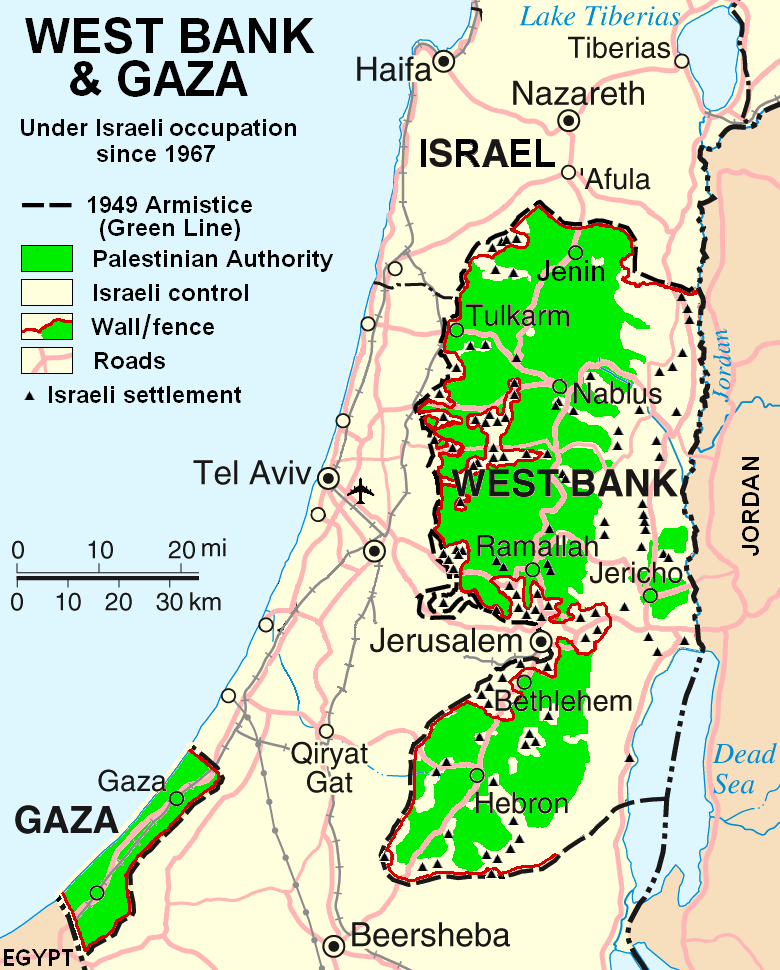
A 2007 map of the West Bank and Gaza, showing Israeli settlements
Via Wikimedia Commons
It is becoming increasingly clear that Hamas pushes Gaza’s people into harm’s way because it knows their suffering will strike a chord across the West. Because it knows images of their hardship will be shared widely, wept over, and held up as proof of the allegedly uniquely barbarous nature of the Jewish State. Hamas knows there is a hunger among the West’s so-called progressives for evidence of Palestinian pain, and by extension of Israeli evil, and it is more than willing to feed this hunger.
The clashes at the Gaza border, in which more than 60 Palestinians were killed and hundreds injured, cannot be viewed in isolation from Western liberals’ peculiar and disproportionate obsession with Israel. It now seems undeniable that this was no instinctive, grassroots protest, but rather one that was carefully orchestrated by Hamas. As a New York Times reporter described it, after midday prayers clerics and leaders of Hamas ‘urged thousands of worshippers to join the protests’. And Hamas’s urging was littered with false claims. It told people ‘the fence had already been breached’ and Palestinians were ‘flooding into Israel’. This was a lie. A Washington Post reporter details how Hamas’s leaders told people to keep attacking the border fence because ‘Israeli soldiers [are] fleeing their positions’. In truth, as Hamas knew only too well, the IDF was reinforcing its positions.
Israel had made clear, including in an airdrop of leaflets, that anyone who sought to dismantle the fence in Gaza, the de facto border between this part of Palestine and Israel, risked coming to harm. And still Hamas encouraged the protesters to strike at the fence. Still it sought to swell the angry ranks by pleading with people to go from their mosques to the border. Why would it do this? Why would the governing party of a territory knowingly put that territory’s citizens into serious danger?
This is the rub. This is the central question. And the answer is a disturbing one: Hamas does this because it knows it will benefit politically and morally if Palestinians suffer. It knows there is a market for stories of Palestinian pain, and it is happy to flood that market.
Writing in the New York Times last week, Matti Friedman, a former AP desk editor in Jerusalem, touched upon this trade in Palestinian horror. He said that during his years reporting from the Middle East he even developed a certain respect for Hamas’s ‘keen ability to tell a story’. Hamas’s great insight was to recognise that the vast majority of the Western media wanted ‘a simple story about villains and victims’, says Friedman. Most Western reporters and commentators weren’t interested in nuance and certainly not in any reading of events that might seek to understand the Israeli position. No, they wanted stories of ‘dead human beings’, made dead by ‘unwarranted Israeli slaughter’, says Friedman.
Comments Off on “[Hamas] knows there is a market for stories of Palestinian pain, and it is happy to flood that market”
May 19, 2018
“Don’t cry for Gaza. Gaza is a failed state and a failed society, marinated in hatred rather than aspiration”
Barbara Kay on the impossible situation Israeli troops find themselves in, with the media acting as cheerleaders and active propagandists for the Palestinian terrorists:
Optics play a huge role in any asymmetric war Israel is involved in. The media tend to favour the “underdog,” and seize on every incident that casts Israel in an inhumane light. In one story about the death of a baby, allegedly at IDF hands, an image in the news showed a group of Palestinian women comforting a mother holding her shrouded infant. The message conveyed was that of a heartless machine that kills indiscriminately. A closer look at the story reveals that it was a combination of tear gas and a pre-existing heart condition that killed the baby, with no direct intention on the part of the IDF. Rather than reflexive condemnation of Israel, the takeaway from the story should be: who brings an infant to a battle site? Children are purposefully being used as human shields. This is a tactic routinely deployed by Hamas, but rarely called out for the despicable war crime it is.
Israel’s critics point to the mounting death toll of Gazans with indignation, failing to distinguish between actual civilians and Hamas terror foot soldiers. But even Hamas has stated that the overwhelming majority of fatalities were their own fighters. Israel is killing mostly bad actors, and even then, relatively few in number. No army in the world can do better than “mostly.” No other army in the world would act as prudently as the IDF. The IDF uses rubber bullets when it can, but they only work at short range. They are using tear gas when they can, but that’s no good when it’s windy. They have senior commanders stationed at every confrontation point. Every single hit is reportedly documented and investigated in Excel spreadsheets. The collateral damage of actual non-combatants is around 20 deaths or fewer. It doesn’t get more humane than that in war.
Some critics ask why they don’t just “arrest” the invaders. That’s not feasible. If soldiers came near the crowds, they would be swarmed and a bloodbath could ensue. They use live ammunition as a last resort, but use it they must, for they cannot allow hundreds or thousands of Gazans to infiltrate their territory and imperil adjoining Israeli communities.
Comments Off on “Don’t cry for Gaza. Gaza is a failed state and a failed society, marinated in hatred rather than aspiration”
April 21, 2018
That time Mossad ran a resort to rescue Sudanese refugees
Join Israel’s secret spy agency! Learn all the tricks of espionage! Run an exotic beachside resort! Wait, what?
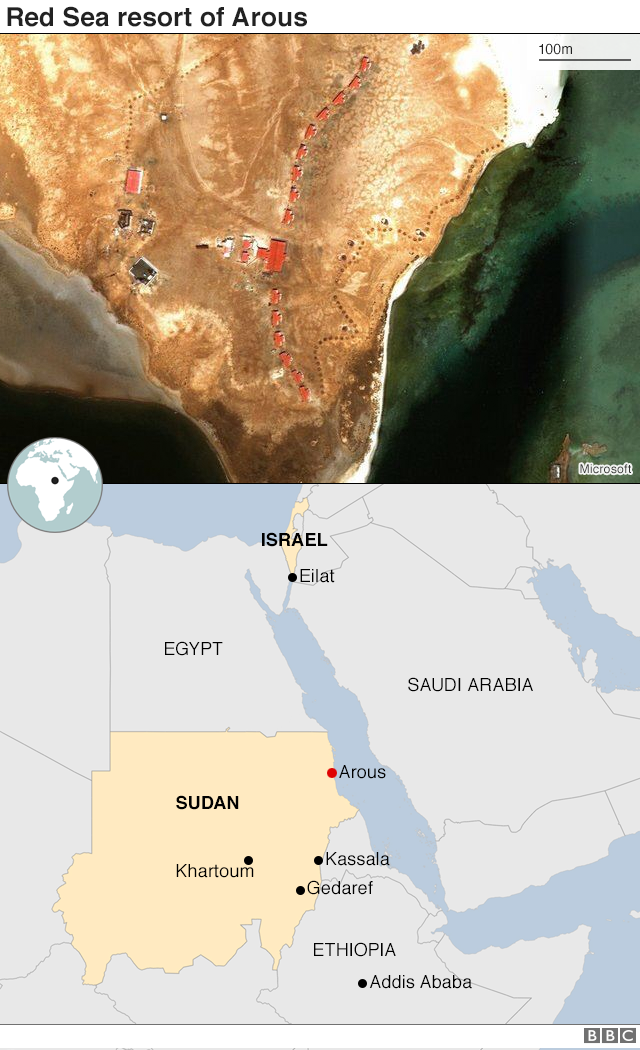
“Arous on the Red Sea, a wonderful world apart,” the glossy brochure says, pronouncing it “the diving and desert recreation centre of Sudan”
Illustrated with pictures of putty-coloured chalets on a sun-drenched beach, a smiling couple in scuba gear, and varieties of exotic fish, the advertisement boasts of “some of the best, clearest water in the world”. As night falls – “after the landscape colours have paled” – there are, it says, “breathtaking views of the heavens, aflame with millions of stars”.
Arous Village, on the fringe of spectacular coral reefs and the odd shipwreck, appears to be a diving enthusiast’s dream.
[…]
The only thing was, unbeknown to the guests or the authorities, the Red Sea diving resort was entirely fake.
It was a front, set up and run for more than four years in the early 1980s by operatives from the Mossad, Israel’s intelligence agency.
They used it as a cover for an extraordinary humanitarian mission – to rescue thousands of beleaguered Ethiopian Jews stranded in refugee camps in Sudan and evacuate them to Israel. Sudan was an enemy Arab country, and it had to be done without anyone finding out, either there or at home.
“It was a state secret, nobody talked about it,” says Gad Shimron, one of the agents who served at the village. “Even my family didn’t know.”
“For us it was a godsend. If we could get hold of this place and do it up, we could say we’re running a diving village, which would give us a reason for being in Sudan and furthermore for roaming around near the beach.”
What happened next is the subject of a soon-to be released Hollywood film called Red Sea Diving Resort. Filmed in Namibia and South Africa, it tells the story of the operation and the village. Though while it is based on true events, some of the scenes are fictitious.
[…]
While seeing to their guests by day, every so often at night a squad would leave under cover of darkness and head to a rendezvous point 10km (six miles) south of Gedaref.
“We’d tell the staff we’re going to Khartoum for a few days, or to meet some Swedish nurses from the hospital in Kassala,” says Gad.
They would pick up groups of Ethiopian Jews, smuggled out of the camps by so-called Committee Men – a handful of Beta Israelis recruited for the job.
“The Ethiopian Jews were given no notice, as we could not risk word getting out,” says Gad. “They did not even know we were Israelis. We told them we were mercenaries.”
From there, a convoy of lorries carrying dozens of bewildered refugees drove a two-day – 800km – journey, evading detection at numerous checkpoints along the way by a combination of guile, bribery and occasionally ramming their way through.
At breaks, they would try to pacify the frightened passengers.
“When we let them sit in the driver’s cabin and touch the wheel, they were in seventh heaven,” Gad says, in his book Mossad Exodus. “It was amazing to see how happy they were at sharing a piece of chewing gum among 20 children. They looked at us as though we were creatures from outer space.”
When they got to the beach, north of the holiday village, Israeli navy special forces would come ashore on Zodiac dinghies, collect the refugees and transport them a further hour and a half to a waiting naval vessel, the INS Bat Galim.
The ship then took them to Israel.
Comments Off on That time Mossad ran a resort to rescue Sudanese refugees
April 18, 2018
Israel at 70
In the National Post, Barbara Kay explains why the world should (but largely will not) celebrate the 70th anniversary of the foundation of the state of Israel on Thursday:
Making the case for Israel’s territorial and political rights involves a deep knowledge of Jewish and Arab history, understanding of the complexities around the reconstruction of the modern Middle East from the ashes of the Ottoman empire, and a plod through a litany of declarations, mandates, commissions, conferences and international legal documents that most Israel defenders aren’t even aware of, let alone able to deploy in debate with rhetorical economy.
Moreover, since the 1967 war, which changed so much on the ground, even the Israeli government hasn’t pressed itself to defend Israel’s historic rights in any systematic way (apart from crises, as in 2016, when the Palestinians drafted a resolution for UNESCO, whose language deliberately detached Jewish ties from Judaism’s holiest sites). With the 1993 Oslo peace process, the issue of legal rights fell further off the communications radar.
When it became clear over the next tumultuous decade that terrorism could not destroy Israel, Israel’s enemies ramped up the campaign to undermine her legitimacy as a member state within the international community. Once the Palestinian strategy of revisionist history replaced organized physical violence — including outright lies as in the UNESCO fiasco — it became clear that a fact-based counteroffensive was needed.
For in the end, it will be international law and accords, not blood libels and emotional mantras, that will settle the matter of Israel’s literal legitimacy. Israel was created, like many other countries, after a successful war in which no other country came to its aid. Gaza, Judea and Samaria were conquered by Jordan and Egypt illegally, as they had no claim to them, while Israel did. The Palestinian territories are not in fact “occupied” in law; rather they are “disputed.” The word “settlements” imply Jews are foreigners in their own homeland, which they are not. Jews have built 140 communities in Judea and Samaria since 1967, which excites condemnation. The Arabs have built 260 communities in Judea and Samaria since 1967, which excites … silence.
Comments Off on Israel at 70


