Quotulatiousness

February 2, 2020

Israeli M1919 Brownings and the US Semiauto Market

Forgotten Weapons
Published 28 Mar 2018

Sold for $4,888.

In the world of converted semiautomatic “machine guns,” the Browning 1919 is a happy example of one of the most iconic and historically important US machine guns and also one of the cheapest semiautomatic belt fed guns available. This stems from two factors, primarily. One is that the Browning 1919, being developed from the water-cooled M1917 Browning, is a closed bolt system. Open bolt semiautomatic designs are not allowed by ATF, and so most semiauto machine gun conversions require substantial alteration to convert from open bolt to closed bolt — which the M1919 does not need. Second, the IDF used the Browning M1919 for many years and in large numbers, and surplussed many of them in the late 1990s. These guns came into the United States as parts kits in large numbers. This meant a glut of cheap guns, easily built as semi autos, and in an easily shootable caliber — 7.62mm NATO (as converted by Israel from their original .30-06 chambering).

Today, we are looking at an example of a semiautomatic converted M1919, and specifically at the various changes made by Israel to both improve the design and convert it successfully to the NATO cartridge.

http://www.patreon.com/ForgottenWeapons

Cool Forgotten Weapons merch! http://shop.bbtv.com/collections/forg…

If you enjoy Forgotten Weapons, check out its sister channel, InRangeTV! http://www.youtube.com/InRangeTVShow

January 23, 2020

Vespasian: The Path To Power | Timeline

Filed under: Britain, Europe, History, Military — Tags: , , , , , — Nicholas @ 06:00

Timeline – World History Documentaries
Published 9 Jun 2017

Check out our new website for more incredible history documentaries: HD and ad-free. http://bit.ly/2O6zUsK

Looks at the life of the Roman emperor Vespasian, from childhood to his death in 79 AD. Provides insight into the sophisticated workings of the Roman Empire.

Content licensed from Digital Rights Group (DRG).

January 10, 2020

QotD: Deciding what is “newsworthy”

Filed under: History, India, Media, Middle East, Quotations — Tags: , , , , — Nicholas @ 01:00

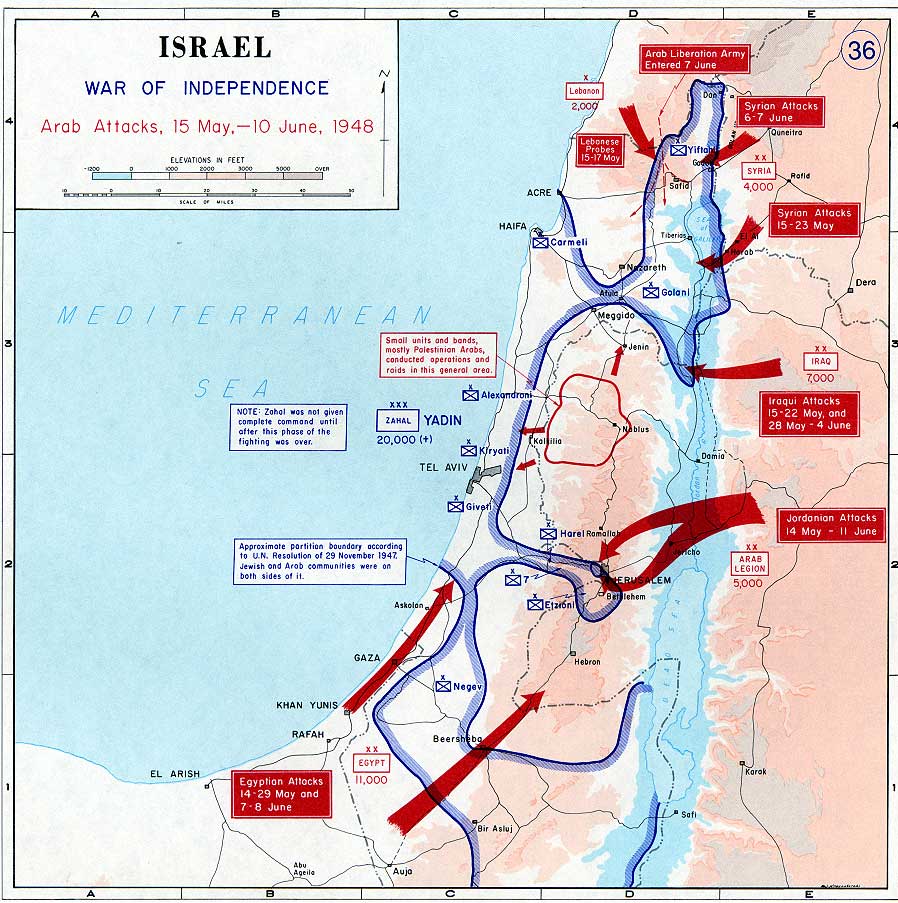
[…] the ripples of battle in their formal sense are guided by the presence of historians, and that means originally Westerners, and more recently in large part Europeans and Americans. And such distortions do not always play out in bias toward Westerners, especially in the present age. In April 2002 the Israeli Defence Forces entered the West Bank community of Jenin to hunt out suspected suicide-murderers, whose co-members had blown up hundreds of Israeli civilians over the prior year. Although fewer than sixty Palestinians were killed in Jenin — the great majority of them combatants — the world media seized upon the street fighting, dubbing it “Jeningrad” as if they were somehow the moral equivalent of one million Germans and Russians lost at Stalingrad. Yet just days after the Israeli withdrawal from Jenin, Pakistan squared off against India. The stakes were surely far higher: One-fifth of the world’s population was involved. Both sides were nuclear powers and issued threats to use their arsenals. In the prior year alone nearly four times more Indians and Pakistanis were killed than Palestinians and Israelis. By any calculation of numbers, the specter of the dead, the geopolitical consequences, or the long-term environmental health of the planet, the world should know all the major cities in Kashmir rather than a few street names in Jenin. And if the world sought to chronicle destruction and death in an Islamic city, then by any fair measure it should have turned its attention to Grozny, where an entire society of Muslim Chechnyans was quite literally obliterated by the Russian army.

The idiosyncracies of historical remembrance of battle do not hinge alone on the presence of a Socrates or Teddy Roosevelt in the ranks. Sometimes there are wild cards of culture and politics as well. In this case and at this time, the fact that Israelis fit the stereotype of affluent and proud Westerners abroad while the Palestinians were constructed as impoverished and oppressed colonial subjects brought to the equation the sympathies of influential Americans and Europeans in the media, universities, and government — the prominent and sometimes worrisome elites who determined to send their reporters, scholars, and diplomats to Jenin rather than to Islamabad or Grozny.

Victor Davis Hanson, Ripples of Battle, 2004.

October 10, 2019

Suez Crisis Part 2 of 2

Filed under: Britain, France, History, Middle East, Military, USA — Tags: , , , , , — Nicholas @ 02:00

Epic History TV
Published on 28 Dec 2017

In 1956, an international crisis over control of the Suez Canal put Britain and France into direct conflict with President Nasser of Egypt, a proud Arab nationalist determined to stand up to foreign powers meddling in Egyptian affairs.

Part 2 explores how Britain, France and Israel cooked up a secret plan to invade Egypt, overthrow Nasser and reassert their standing as global powers. But when the international community, and in particular the United States, condemned their actions, the aggressors were forced into a humiliating climbdown. The repercussions for the Middle East and global history were long-lasting and profound.

Archive film from AP Archive http://www.aparchive.com/

Music from Filmstro https://www.filmstro.com/
Get 20% off an annual license! Use our exclusive coupon code: EPICHISTORYTV_ANN

Help me make more videos by supporting Epic History TV on Patreon https://www.patreon.com/EpicHistoryTV

Further Reading on Suez Crisis (click affiliate links to buy on Amazon & support the channel):
Blood and Sand, Alex von Tunzelmann (Simon & Schuster, 2016) http://geni.us/QyoWs
Suez: Britain’s End of Empire in the Middle East, Keith Kyle (I.B.Tauris, 2011) http://geni.us/aqn6AH
The Suez Crisis 1956, Derek Varble (Osprey, 2003) http://geni.us/ANxBQEE
“Suez 1956”, Timothy Benson in History Today (Nov 2006)
“Suez: The Canal Before the Crisis”, Steve Morewood in History Today (Nov 2006)
“Nasser, Suez and Arab Nationalism”, Michael Scott-Baumann in History Today (Mar 2010)
“The First Suez Crisis”, Christopher Danziger in History Today (Sep 1982)
The Suez Crisis, by Laurie Milner, BBC website http://www.bbc.co.uk/history/british/…
“Andrew Bacevich reviews ‘Eisenhower 1956′”, London Review of Books (Vol.33 No.12)
“Avi Shlaim reviews ‘Israel’s Border Wars, 1949-56′”, London Review of Books (Vol.16 No.16)

#EpicHistoryTV #SuezCrisis #ColdWarHistory

October 9, 2019

Suez Crisis Part 1 of 2

Filed under: Britain, France, History, Middle East, Military, USA — Tags: , , , — Nicholas @ 02:00

Epic History TV
Published on 22 Dec 2017

In 1956, an international crisis over control of the Suez Canal put Britain and France into direct conflict with President Nasser of Egypt, a proud Arab nationalist determined to stand up to foreign powers meddling in Egyptian affairs.

To understand the deep roots of the crisis we go right back to the creation of the canal in 1869, and the long history of British intervention in Egypt — all with the usual Epic History TV maps as well as loads of brilliant and rarely-seen archive film from the period.

Archive film from AP Archive http://www.aparchive.com/

Music from Filmstro https://www.filmstro.com/
Get 20% off an annual license! Use our exclusive coupon code: EPICHISTORYTV_ANN

Help me make more videos by supporting Epic History TV on Patreon https://www.patreon.com/EpicHistoryTV

Further Reading on Suez Crisis (click affiliate links to buy on Amazon & support the channel):
Blood and Sand, Alex von Tunzelmann (Simon & Schuster, 2016) http://geni.us/QyoWs
Suez: Britain’s End of Empire in the Middle East, Keith Kyle (I.B.Tauris, 2011) http://geni.us/aqn6AH
The Suez Crisis 1956, Derek Varble (Osprey, 2003) http://geni.us/ANxBQEE
“Suez 1956”, Timothy Benson in History Today (Nov 2006)
“Suez: The Canal Before the Crisis”, Steve Morewood in History Today (Nov 2006)
“Nasser, Suez and Arab Nationalism”, Michael Scott-Baumann in History Today (Mar 2010)
“The First Suez Crisis”, Christopher Danziger in History Today (Sep 1982)
The Suez Crisis, by Laurie Milner, BBC website http://www.bbc.co.uk/history/british/…
“Andrew Bacevich reviews ‘Eisenhower 1956′”, London Review of Books (Vol.33 No.12)
“Avi Shlaim reviews ‘Israel’s Border Wars, 1949-56′”, London Review of Books (Vol.16 No.16)

#EpicHistoryTV #SuezCrisis #ColdWarHistory

September 24, 2019

Samson and Delilah – Old Testament Mythology – Extra Mythology – #2

Filed under: History, Middle East, Religion — Tags: , , — Nicholas @ 04:00

Extra Credits
Published on 23 Sep 2019

After killing 1000 men, Samson runs into more trouble with the Philistines. Samson is a Judge, but he may not be the best judge of romantic partners… When Delilah betrays Samson for silver, all hope seems lost. But Samson has one last favor to ask.

September 11, 2019

Samson and Delilah – Old Testament Mythology – Extra Mythology – #1

Filed under: History, Middle East, Religion — Tags: , , — Nicholas @ 04:00

Extra Credits
Published on 9 Sep 2019

Join the Patreon community! http://bit.ly/EMPatreon

It was a time of trial for the tribes of Israel. They were no nation, but a loose confederation bound together by their divine covenants — which they had just broken. Amid this political and social chaos, a child was born, instructed by God to keep the Nazirite oath — stay away from alcohol, don’t eat unclean food, and don’t shave — and he would become a man of incredible strength.

Samson was on a mission from God to never drink alcohol, to not eat honey found in a lion’s carcass, and to not cut his hair ever. FORESHADOWING!

June 23, 2019

Shooting the Negev LMG

Filed under: Middle East, Military, Technology, Weapons — Tags: , , , — Nicholas @ 04:00

Forgotten Weapons
Published on 22 Jun 2019

My first book is available for pre-order; check it out!
https://www.headstamppublishing.com/f…

http://www.patreon.com/ForgottenWeapons

Cool Forgotten Weapons merch! http://shop.bbtv.com/collections/forg…

After yesterday’s look at the history and mechanical details of the Israeli Negev LMG, today we are taking it out the the range.

It certainly is a very pleasant experience to shoot! The recoil is very light, although not as light as in a true constant-recoil system like the new Knight’s LAMG. As you can see in the high speed footage, the bolt carrier clearly does impact the back of the receiver with each shot. Still, it has a simple gas adjustment, a very easy barrel-changing system, excellent sights, and runs well on both magazines and belts.

Many thanks to Movie Armaments Group in Toronto for the opportunity to showcase their Negev for you! Check them out on Instagram to see many of the guns in their extensive collection:

https://instagram.com/moviearmamentsg…

http://www.moviearms.com

Contact:
Forgotten Weapons
PO Box 87647
Tucson, AZ 85754

June 22, 2019

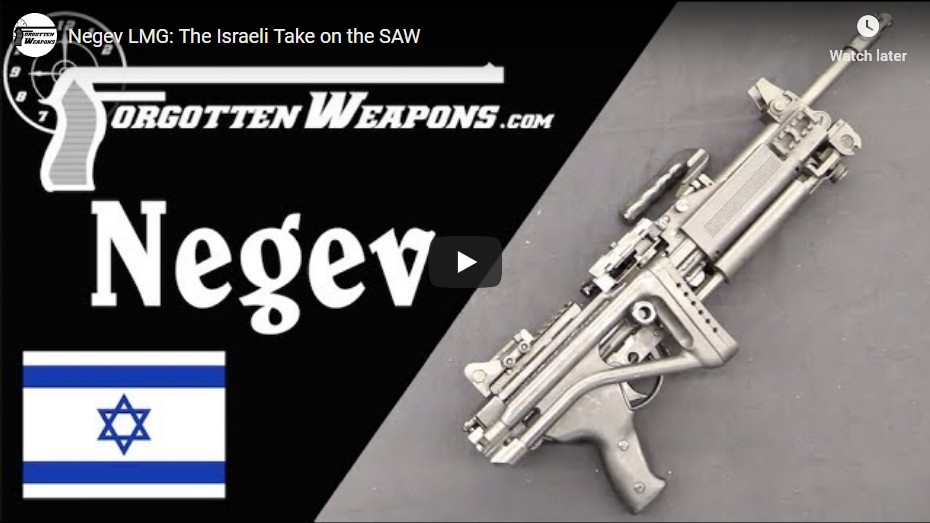
Negev LMG: The Israeli Take on the SAW

Filed under: Middle East, Military, Technology, Weapons — Tags: , , , — Nicholas @ 04:00

Forgotten Weapons
Published on 21 Jun 2019

My first book is available for pre-order; check it out!
https://www.headstamppublishing.com/f…

http://www.patreon.com/ForgottenWeapons

Cool Forgotten Weapons merch! http://shop.bbtv.com/collections/forg…

When the Israeli Defense Forces tested the FN Minimi, they found it to be lacking in a few areas, and decided that they could develop a better SAW domestically. Developed in the 1980s, the result was the Negev. Like the Minimi, the Negev is a 5.56mm light machine gun that can feed from either belts or box magazines (Galil mags or AR mags with an adapter), has quick-change barrels, and fires from an open bolt. The Negev has several features the Minimi does not, though, including a semiauto fire control position, optics mounting on the receiver (instead of the top cover), a standard folding stock, and some mechanical improvements internally.

So, let’s dig into this Negev and see how it ticks!

Many thanks to Movie Armaments Group in Toronto for the opportunity to showcase their Negev for you! Check them out on Instagram to see many of the guns in their extensive collection:

https://instagram.com/moviearmamentsg…

http://www.moviearms.com

Contact:
Forgotten Weapons
PO Box 87647
Tucson, AZ 85754

June 18, 2019

QotD: The birth of Jesus and the open concept house

Filed under: Architecture, Economics, History, Middle East, Quotations, Religion — Tags: , , , — Nicholas @ 01:00

Jesus was not born in a stable. That’s not to say the birth wasn’t attended by farm animals — the Gospel of Luke tells us twice the baby’s first bed was a feeding trough — but rather that the animals lived in the house.

Peasant homes in first century Bethlehem were designed with what we would today call an “open concept.” They typically had one large room with the nicer living space in an open loft or on the roof, while the main floor area was where the family’s animals would be brought for safekeeping at night. The guestroom that was unavailable to Jesus, Mary, and Joseph was that loft or roof space, and the big room where they stayed instead served as the kitchen, living room, dining room, and farmyard all at once. The defining feature of Jesus’ birthplace was not isolation, as we often tend to think, but an utter lack of privacy: Mary delivered in a crowded farmhouse with few, if any, interior walls.

And that was perfectly normal, if not exactly desirable, for our modern fixation on the open floor plan is a historical anomaly. It flies in the face of literally millennia of consensus that more rooms is better, and it is a dreadful mistake. The last 70 years of open concept construction and remodeling has left us with dysfunctional houses, homes that are less conducive to hospitality, less energy efficient, and more given to mess.

Bonnie Kristian, “Open concept homes are for peasants”, The Week, 2019-05-12.

May 10, 2019

“Counterstrike” – The Six-Day War – Sabaton History 014

Filed under: History, Media, Military — Tags: , , , , , , — Nicholas @ 04:00

Sabaton History
Published on 9 May 2019

When Egyptian president Nasser closes an important sea route for their neighbouring state of Israel in May 1967, Israel argues that a military attack on Egypt is justified. During the following six days in June 1967, Israel embarks on a war against Egypt, Syria and Jordan. The Sabaton song “Counterstrike” (on the Primo Victoria album) describes this short but influential and controversial conflict.

Support Sabaton History on Patreon: https://www.patreon.com/sabatonhistory

Check out the trailer for Sabaton’s new album The Great War right here: https://www.youtube.com/watch?v=HCZP1…

Watch more videos on the Sabaton YouTube channel: https://www.youtube.com/user/Sabaton?…
Listen to Sabaton on Spotify: http://smarturl.it/SabatonSpotify
Official Sabaton Merchandise Shop: http://bit.ly/SabatonOfficialShop

Hosted by: Indy Neidell
Written by: Markus Linke and Indy Neidell
Directed by: Astrid Deinhard and Wieke Kapteijns
Produced by: Pär Sundström, Astrid Deinhard and Spartacus Olsson
Creative Producer: Joram Appel
Executive Producers: Pär Sundström, Joakim Broden, Tomas Sunmo, Indy Neidell, Astrid Deinhard, and Spartacus Olsson
Maps by: Eastory
Edited by: Iryna Dulka
Sound Editing by: Marek Kaminski

Eastory YouTube Channel: https://www.youtube.com/channel/UCEly…
Archive by: Reuters/Screenocean https://www.screenocean.com
Music by Sabaton.

Sources:
National Photo Collection of Israel
D326-011
Israel Defence Forces Archives, Ministry of Defence Archives
Goverment Press Office of Israel (Also for Thumbnail)

An OnLion Entertainment GmbH and Raging Beaver Publishing AB co-Production.

© Raging Beaver Publishing AB, 2019 – all rights reserved.

From the comments:

Sabaton History
This might be the most controversial topic we have tackled to this date. We are aware of the many controversies and debate surrounding the Six-Day War, including debates surrounding the justification of the Israeli “preemptive strike”, the role that foreign/western nations played in the conflict and warcrimes that might have been committed by both sides. We decided to stay away from these debates in this video, and stick to the historical narrative. While we highly value (academic) debate and discussion, we don’t allow for racism, xenophobia, anti-semitism and partisan revisionism. Also, please try to stay away from modern partisan politics as far as possible.

Thanks for reading!
Cheers!

May 7, 2019

The Suez Crisis reconsidered

Filed under: Books, Britain, France, History, Military, USA — Tags: , , , , , — Nicholas @ 05:00

Jordan Chandler Hirsch reviews a new book on what is now a somewhat forgotten international crisis that shook the Atlantic alliance, Philip Zelikow’s Suez Deconstructed:

Zelikow encourages readers to assess Suez by examining three kinds of judgments made by the statesmen during the crisis: value judgments (“What do we care about?”), reality judgments (“What is really going on?”), and action judgments (“What can we do about it?”). Asking these questions, Zelikow argues, is the best means of evaluating the protagonists. Through this structure, Suez Deconstructed hopes to provide “a personal sense, even a checklist, of matters to consider” when confronting questions of statecraft.

The book begins this task by describing the world of 1956. The Cold War’s impermeable borders had not yet solidified, and the superpowers sought the favor of the so-called Third World. Among non-aligned nations, Cold War ideology mattered less than anti-colonialism. In the Middle East, its champion was Egyptian President Gamal Abdel Nasser, who wielded influence by exploiting several festering regional disputes. He rhetorically — and, the French suspected, materially — supported the Algerian revolt against French rule. He competed with Iraq, Egypt’s pro-British and anti-communist rival. He threatened to destroy the State of Israel. And through Egypt ran the Suez Canal, which Europe depended on for oil.

Egypt’s conflict with Israel precipitated the Suez crisis. In September 1955, Nasser struck a stunning and mammoth arms deal with the Soviet Union. The infusion of weaponry threatened Israel’s strategic superiority, undermined Iraq, and vaulted the Soviet Union into the Middle East. From that point forward, Zelikow argues, the question for all the countries in the crisis (aside from Egypt, of course) became “What to do next about Nasser?”

Israel responded with dread, while, Britain, France, and the United States alternated between confrontation and conciliation. Eventually, the United States abandoned Nasser, but he doubled down by nationalizing the Suez Canal. This was too much for France. Hoping to unseat Nasser to halt Egyptian aid to Algeria, it concocted a plan with Israel and, eventually, Britain for Israel to invade Egypt and for British and French troops to seize the Canal Zone on the pretense of separating Israeli and Egyptian forces. The attack began just before the upcoming U.S. presidential election and alongside a revolution in Hungary that triggered a Soviet invasion. The book highlights the Eisenhower administration’s anger at the tripartite plot. Despite having turned on Nasser, Eisenhower seethed at not having been told about the assault, bitterly opposed it, and threatened to ruin the British and French economies by withholding oil shipments.

Throughout, Suez Deconstructed disorients. As the story crisscrosses from terror raids into Israel to covert summits in French villas, from Turtle Bay to the Suez Canal, names and places, thoughts and actions blur. Venerable policymakers scramble to comprehend the latest maneuvers as they struggle with the weight of history: Was Suez another Munich? Could Britain and France still project power abroad? Would a young Israel survive?

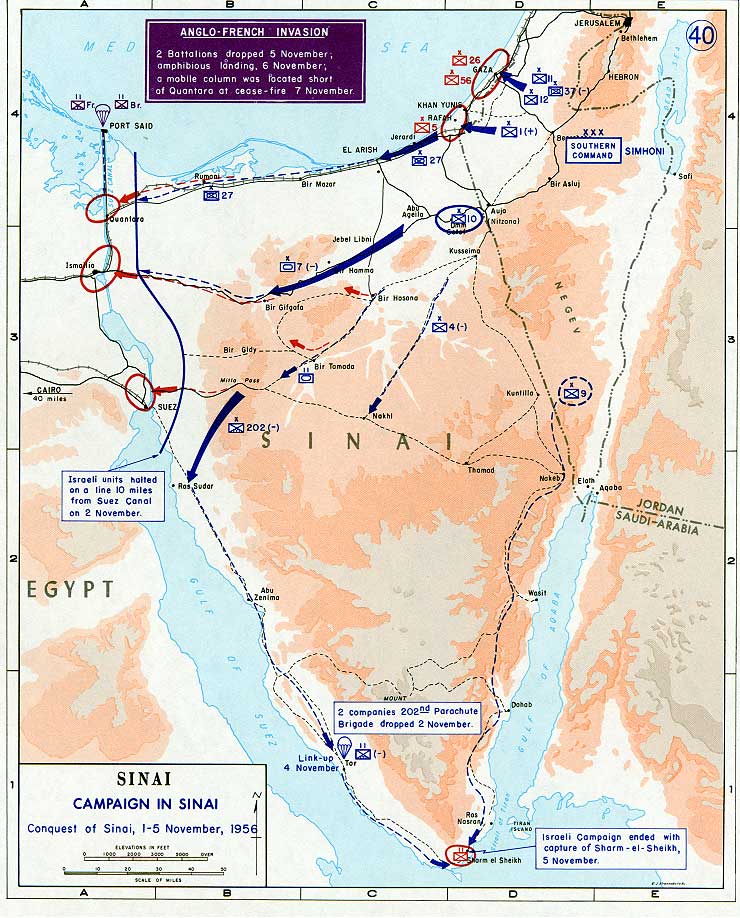
If you’re not familiar with the Suez Crisis and want more than just the Wikipedia article for background, here’s the coverage of the military side of things from the British perspective (Operation Musketeer) from Naval History Homepage.

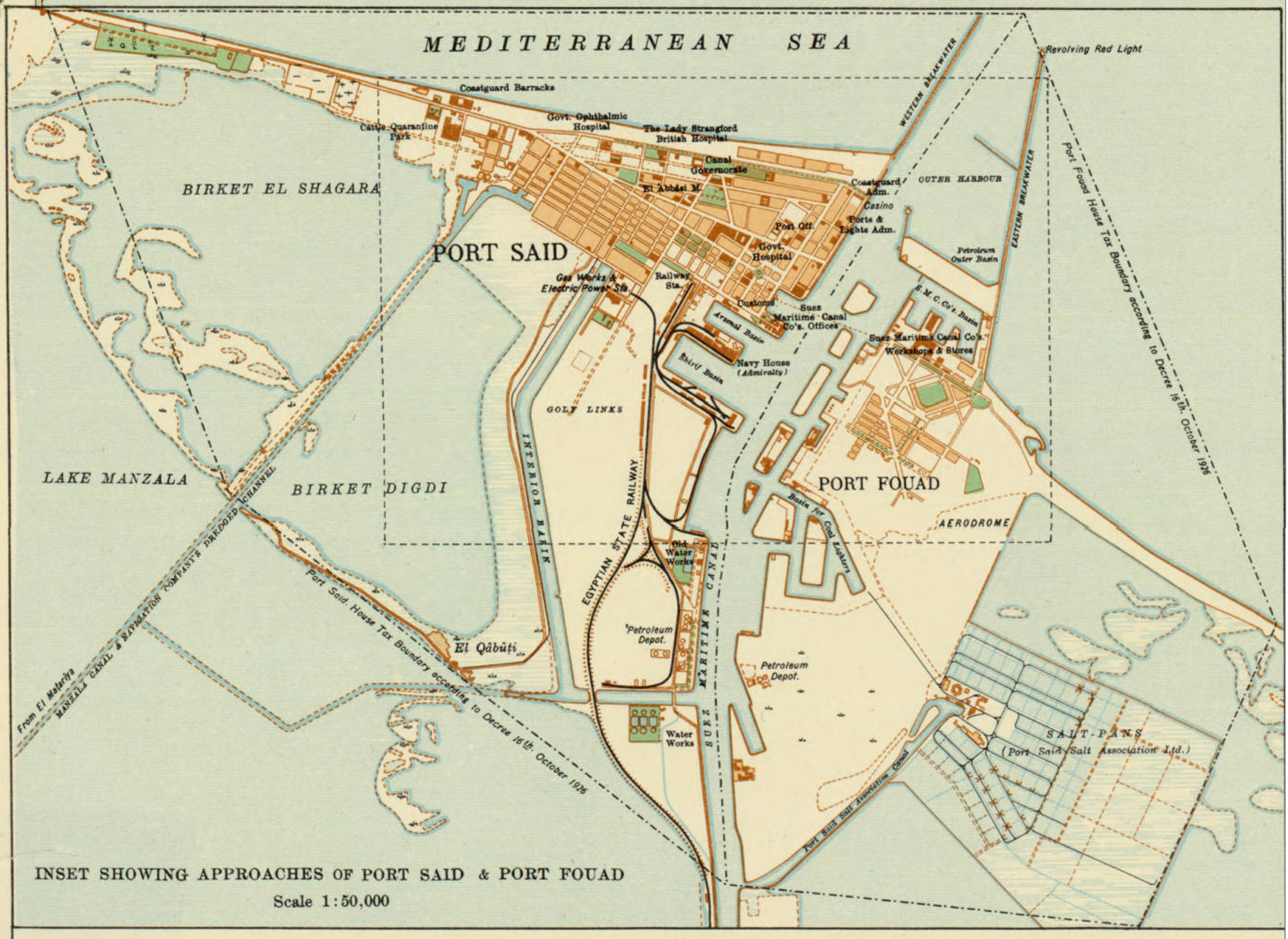
A detailed map of Port Said in 1936 (American Geographical Society Library). Changes by 1956 are not known.
Map via Naval History Homepage.

April 27, 2019

Israeli Light-Barrel FAL (from DS Arms)

Filed under: History, Middle East, Military, Technology, Weapons — Tags: , , , , — Nicholas @ 02:00

Forgotten Weapons
Published on 23 Mar 2019

http://www.patreon.com/ForgottenWeapons

Cool Forgotten Weapons merch! http://shop.bbtv.com/collections/forg…

Israel was one of the very First Nations to adopt the FN FAL rifle – after Canada but before many actual other NATO nations. Israel made its first purchases of the rifles in 1955, and delayed them almost immediately in the 1956 Suez Crisis. The first rifles were wholly made by FN in Belgium, but over time IMI in Israel would produce almost all parts except receivers (they had a good working relationship with FN, which had licensed production of the Uzi submachine gun from IMI). These first rifles are good examples of many early FN design elements, which are not seen on later major NATO contracts, as the design details evolved over time. Israel would use the FAL through the Yom Kippur War in 1973 before transitioning to the 5.56mm Galil rifles.

In addition to the light-barrel infantry rifle, Israel also adopted a heavy barreled version of the FAL as a light machine gun or automatic rifle. These were fitted with stout bipods, but used the same 20-round magazines as the standard rifles.

A very small number of Israel semiauto FAL rifles were imported in the late 1980s, and they are very scarce in the United States today – or they were, until DS Arms acquired a supply of Israeli light-barrel parts kits and began assembling them into complete rifles to sell. They are particularly nice builds as the DSA markings and serial number are on the inside of the magazine well, allowing the external surface to be engraved with a very nice recreation of the original Israeli receiver markings with their distinctive Hebrew text and IDF insignia.

Stay tuned for an upcoming 2-Gun Action Challenge Match on InRangeTV using this rifle!

Contact:
Forgotten Weapons
PO Box 87647
Tucson, AZ 85754

March 19, 2019

Last German Panzer Battle – Six Day War 1967

Filed under: Germany, History, Middle East, Military — Tags: , , , , — Nicholas @ 02:00

Mark Felton Productions
Published on 9 Feb 2019

WW2-era German Panzers last saw combat during the Six Day War in 1967, when Syria used them against Israel on the Golan Heights. Discover how Syria was able to acquire so many WW2 German vehicles and how they fared in combat against IDF Shermans and Centurions.

Credits: Bukvoed, Mark Felton Productions, YouTube Creative Commons, Google Commons, Panzers in the Golan Heights – wwiiafterwwii

March 7, 2019

Line Of Fire The Six Day War

Filed under: History, Middle East, Military — Tags: , , , , , , , — Nicholas @ 06:00

sixoctober war
Published on 4 Jul 2013

After the 1956 Suez Crisis, Egypt agreed to the stationing of a United Nations Emergency Force (UNEF) in the Sinai to ensure all parties would comply with the 1949 Armistice Agreements. In the following years there were numerous minor border clashes between Israel and its Arab neighbors, particularly Syria. In early November, 1966, Syria signed a mutual defense agreement with Egypt. Soon thereafter, in response to Palestine Liberation Organization (PLO) guerilla activity, including a mine attack that left three dead, the Israeli Defense Force (IDF) attacked the city of as-Samu in the Jordanian-occupied West Bank. Jordanian units that engaged the Israelis were quickly beaten back. King Hussein of Jordan criticized Egyptian President Gamal Abdel Nasser for failing to come to Jordan’s aid, and “hiding behind UNEF skirts”.

In May 1967, Nasser received false reports from the Soviet Union that Israel was massing on the Syrian border. Nasser began massing his troops in the Sinai Peninsula on Israel’s border (May 16), expelled the UNEF force from Gaza and Sinai (May 19), and took up UNEF positions at Sharm el-Sheikh, overlooking the Straits of Tiran. UN Secretary-General U Thant proposed that the UNEF force be redeployed on the Israeli side of the border, but this was rejected by Israel despite U.S. pressure. Israel reiterated declarations made in 1957 that any closure of the Straits would be considered an act of war, or a justification for war. Nasser declared the Straits closed to Israeli shipping on May. 22-23. On 27 May he stated “Our basic objective will be the destruction of Israel. The Arab people want to fight.” On May 30, Jordan and Egypt signed a defense pact. The following day, at Jordan’s invitation, the Iraqi army began deploying troops and armored units in Jordan. They were later reinforced by an Egyptian contingent. On June 1, Israel formed a National Unity Government by widening its cabinet, and on June 4 the decision was made to go to war. The next morning, Israel launched Operation Focus, a large-scale surprise

« Newer PostsOlder Posts »

Powered by WordPress