
… the basic formula for what would become gunpowder (saltpeter, charcoal, and sulfur in a roughly 75%, 15%, 10% mixture) was clearly in use in China by 1040 when we have our first attested formula, though saltpeter had been being refined and used as an incendiary since at least 808. The first guns appear to be extrapolations from Chinese incendiary “fire lances” (just add rocks!) and the first Chinese cannon appear in 1128. Guns arrive in Europe around 1300; our first representation of a cannon is from 1326, while we hear about them used in sieges beginning in the 1330s; the Mongol conquest and the sudden unification of the Eurasian Steppe probably provided the route for gunpowder and guns to move from China to Europe. Notably, guns seem to have arrived as a complete technology: chemistry, ignition system, tube and projectile.
There was still a long “shaking out” period for the new technology: figuring out how to get enough saltpeter for gunpowder (now that’s a story we’ll come back to some day), how to build a large enough and strong enough metal barrel, and how to actually use the weapons (in sieges? against infantry? big guns? little guns?) and so on. By 1453, the Ottomans have a capable siege-train of gunpowder artillery. Mehmed II (r. 1444-1481) pummeled the walls of Constantinople with some 5,000 shots using some 55,000 pounds of gunpowder; at last Theodosius’ engineers had met their match.
And then, in 1494, Charles VIII invaded Italy – in a dispute over the throne of Naples – with the first proper mobile siege train in Christendom (not in Europe, mind you, because Mehmed had beat our boy Chuck here by a solid four decades). A lot of changes had been happening to make these guns more effective: longer barrels allowed for more power and accuracy, wheeled carriages made them more mobile, trunnions made elevation control easier and some limited degree of caliber standardization reduced windage and simplified supply (though standardization at this point remains quite limited).
The various Italian states, exactly none of whom were excited to see Charles attempting to claim the Kingdom of Naples, could have figured that the many castles and fortified cities of northern Italy were likely to slow Charles down, giving them plenty of time to finish up their own holidays before this obnoxious French tourist showed up. On the 19th of October, 1494, Charles showed up to besiege the fortress at Mordano – a fortress which might well have been expected to hold him up for weeks or even months; on October 20th, 1494, Charles sacked Mordano and massacred the inhabitants, after having blasted a breach with his guns. Florence promptly surrendered and Charles marched to Naples, taking it in 1495 (it surrendered too). Francesco Guicciardini phrased it thusly (trans. via Lee, Waging War, 228),
They [Charles’ artillery] were planted against the Walls of a Town with such speed, the Space between the Shots was so little, and the Balls flew so quick, and were impelled with such Force, that as much Execution was done in a few Hours, as formerly, in Italy, in the like Number of Days.
The impacts of the sudden apparent obsolescence of European castles were considerable. The period from 1450 to 1550 sees a remarkable degree of state-consolidation in Europe (broadly construed) castles, and the power they gave the local nobility to resist the crown, had been one of the drivers of European fragmentation, though we should be careful not to overstate the gunpowder impact here: there are other reasons for a burst of state consolidation at this juncture. Of course that creates a run-away effect of its own, as states that consolidate have the resources to employ larger and more effective siege trains.
Now this strong reaction doesn’t happen everywhere or really anywhere outside of Europe. Part of that has to do with the way that castles were built. Because castles were designed to resist escalade, the walls needed to be built as high as possible, since that was the best way to resist attacks by ladders or towers. But of course, given a fixed amount of building resources, building high also means building thin (and European masonry techniques enabled tall-and-thin construction with walls essentially being constructed with a thick layer of fill material sandwiched between courses of stone). But “tall and thin”, while good against ladders, was a huge liability against cannon.
By contrast, city walls in China were often constructed using a rammed earth core. In essence, earth was piled up in courses and packed very tightly, and then sheathed in stone. This was a labor-intensive building style (but large cities and lots of state capacity meant that labor was available), and it meant the walls had to be made thick in order to be made tall since even rammed earth can only be piled up at an angle substantially less than vertical. But against cannon, the result was walls which were already massively thick, impossible to topple over and the earth-fill, unlike European stone-fill, could absorb some of the energy of the impact without cracking or shattering. Even if the stone shell was broken, the earth wouldn’t tumble out (because it was rammed), but would instead self-seal small gaps. And no attacker could hope that a few lucky hits to the base of a wall built like this would cause it to topple over, given how wide it is at the base. Consequently, European castle walls were vulnerable to cannon in a way that contemporary walls in many other places, such as China, were not. Again, path dependence in fortification matters, because of that antagonistic co-evolution.
In the event, in Italy, Charles’ Italian Vacation started to go badly almost immediately after Naples was taken. A united front against him, the League of Venice, formed in 1495 and fought Charles to a bloody draw at Fornovo in July, 1495. In the long-term, French involvement would draw in the Habsburgs, whose involvement would prevent the French from making permanent gains in a series of wars in Italy lasting well into the 1550s.
But more relevant for our topic was the tremendous shock of that first campaign and the sudden failure of defenses which had long been considered strong. The reader can, I’d argue, detect the continued light tremors of that shock as late as Machiavelli’s The Prince (1532, but perhaps written in some form by 1513). Meanwhile, Italian fortress designers were already at work retrofitting old castles and fortifications (and building new ones) to more effectively resist artillery. Their secret weapon? Geometry.
Bret Devereaux, “Collections: Fortification, Part IV: French Guns and Italian Lines”, A Collection of Unmitigated Pedantry, 2021-12-17.
December 6, 2023
QotD: What Charles VIII brought back from his Naples vacation
November 28, 2023
QotD: The tactical problem of attacking WW1 trenches
[…]
So, the first problem: artillery. Neither side starts the war in trenches. Rather the war starts with large armies, consisting mostly of infantry with rifles, backed up by smaller amounts of cavalry for scouting duties (who typically fight dismounted because this is 1914, not 1814) and substantial amounts of artillery, mostly smaller caliber direct-fire1 guns, maneuvering in the open, trying to do fancy things like flanking and enveloping attacks to win by movement rather than by brute attrition (though it is worth noting that this war of maneuver is also the period of the highest casualties on a per-day basis). The tremendous lethality of those weapons – both rifles that are accurate for hundreds of yards, machine guns that can deny entire areas of the battlefield to infantry and the artillery, which is utterly murderous against any infantry it can see and by far the most lethal part of the equation – all of that demands trenches. Trenches shield the infantry from all of that firepower. So you end up with parallel trenches, typically a few hundred yards apart as the armies settle in to defenses and maneuver breaks down (because the armies are large enough to occupy the entire front from the Alps to the Sea).
The new problem this creates, from the perspective of the defender, is how to defend these trenches. If enemies actually get close to them, they are very vulnerable because the soldier at the top of the trench has a huge advantage against enemies in the trench: he can fire down more easily, can throw grenades down very easily and also has an enormous mechanical advantage if the fight comes to bayonets and trench-knives, which it might. If you end up fighting at the lip of your trench against massed enemy infantry, you have almost certainly already lost. The defensive solution here, of course, are those machine guns which can deploy enough fire to prohibit enemies moving over no man’s land: put a bunch of those in strong-points in your trench line and you can prevent enemy infantry from reaching you.
Now the attacker has the problem: how to prevent the machine guns from making approach impossible. The popular conception here is that WWI generals didn’t “figure out” machine guns for a long time; that’s not quite true. By the end of 1914, most everyone seems to have recognized that attacking into machine guns without some way of shutting them down was futile. But generals who had done their studies already had the ready solution: the way to beat infantry defenses was with artillery and had been for centuries. Light, smaller, direct-fire guns wouldn’t work2 but heavy, indirect-fire howitzers could! Now landing a shell directly in a trench was hard and trenches were already being zig-zagged to prevent shell fragments flying down the whole line anyway, so actually annihilating the defenses wasn’t quite in the cards (though heavy shells designed to penetrate the ground with large high-explosive payloads could heave a hundred meters of trench along with all of their inhabitants up into the air at a stretch with predictably fatal results). But anyone fool enough to be standing out during a barrage would be killed, so your artillery could force enemy gunners to hide in deep dugouts designed to resist artillery. Machine gunners hiding in deep dugouts can’t fire their machine guns at your approaching infantry.
And now we have the “race to the parapet”. The attacker opens with a barrage, which has two purposes: silence enemy artillery (which could utterly ruin the attack if it isn’t knocked out) and second to disable the machine guns: knock out some directly, force the crews of the rest to flee underground. But attacking infantry can’t occupy a position its own artillery is shelling, so there is some gap between when the shells stop and when the attack arrives. In that gap, the defender is going to rush to set up their machine guns while the attacker rushes to get to the lip of the trench:first one to get into position is going to inflict a terrible slaughter on the other.
Now the defender begins to look for ways to slant the race to his advantage. One option is better dugouts and indeed there is fairly rapid development in sophistication here, with artillery-resistant shelters dug many meters underground, often reinforced with lots of concrete. Artillery which could have torn apart the long-prepared expensive fortresses of a few decades earlier struggle to actually kill all of the infantry in such positions (though they can bury them alive and men hiding in a dugout are, of course, not at the parapet ready to fire). The other option was to slow the enemy advance and here came barbed wire. One misconception to clear up here: the barbed wire here is not like you would see on a fence (like an animal pen, or as an anti-climb device at the top of a chain link fence), it is not a single wire or a set of parallel wires. Rather it is set out in giant coils, like massive hay-bales of barbed wire, or else strung in large numbers of interwoven strands held up with wooden or metal posts. And there isn’t merely one line of it, but multiple lines deep. If the attacker goes in with no preparation, the result will be sadly predictable even without machine guns: troops will get stuck at the wire (or worse yet, on the wire) and then get shot to pieces. But even if troops have wire-cutters, cutting the wire and clearing passages through it will still slow them down … and this is a race.
Bret Devereaux, “Collections: No Man’s Land, Part I: The Trench Stalemate”, A Collection of Unmitigated Pedantry, 2021-09-17.
1. Direct fire here means the guns fire on a low trajectory; you are more or less pointing them where you want the shell to go and shooting straight at it, as you might with a traditional firearm.
2. The problem with direct-fire artillery here is that you cannot effectively hide it in a trench (because it’s direct fire) and you can’t keep it well concealed, so in the event of an attack, the enemy is likely to begin by using their artillery to disable your artillery. The limitations of direct-fire guns hit the French particularly hard once the trench stalemate set in, because it reduced the usefulness of their very effective 75mm field gun (the famed “French 75” after which the modern cocktail is named [Forgotten Weapons did a video covering both]). That didn’t make direct-fire guns useless, but it put a lot more importance on much heavier indirect-fire artillery.
November 26, 2023
General Patton’s Metz Obsession – WW2 – Week 274 – November 25, 1944
World War Two
Published 25 Nov 2023Metz finally falls to Patton’s 3rd Army, but boy, it’s taken some time. To the south, the Allies also take Belfort and Strasbourg, and to the north Operation Queen continues trying to reach the Roer River. The Soviets complete their conquest of the islands in the Gulf of Riga and continue advancing in Hungary to the south, but it’s the Axis Powers — the Japanese — who are advancing in China, taking Dushan and Nanning.
01:15 Operation Queen Continues
04:49 9th Army attacks toward the Roer
05:54 Pattons 3rd Army takes Metz
09:22 Allies take Belfort, Mulhouse, and Strasbourg
13:56 8th Army Attacks in Italy
15:42 Soviet advances and German indecision
18:05 Japanese take Dushan and Nanning
19:21 The fight for Peleliu ends
21:43 Notes from all over
22:23 Conclusion
(more…)
November 20, 2023
A Tour of the Excavations at Vindolanda
Scenic Routes to the Past
Published 4 Aug 2023This spring, Dr. Andrew Birley gave me a tour of the ongoing excavations at Vindolanda, a Roman fort near Hadrian’s Wall.
Chapters:
0:00 Welcome to Vindolanda
4:41 The wooden underworld
7:13 Layers of history
9:03 Becoming part of the story
October 28, 2023
Israel’s Zugzwang
Not being a huge chess nerd, I’d never encountered the term “zugzwang” before, but as Niall Ferguson and Jay Mens explain here, it’s an appropriate way to characterize the situation Israel finds itself in at the moment:
Zugzwang is one of the ultimate challenges for a chess player. In zugzwang, a player is in a situation where any move can only weaken one’s position and carries the risk of checkmate — but not moving isn’t an option. Beyond the intrinsic horror of Hamas’s October 7 massacre, it is now obvious that the attack was designed to provoke Israel into reacting. The extent of the zugzwang is increasingly clear, and Israel has few good options. Nor does the United States.
No one should have been surprised by the attacks on Israel by Hamas and Palestinian Islamic Jihad (PIJ). Over the last year, there have been more than a dozen public meetings between Iranian officials and the leaders of Hamas, Hezbollah, and PIJ. Enormous quantities of men and matériel have moved from Iraq into Syria, with other matériel arriving by land and air to Lebanon. Hezbollah and the Iranian Revolutionary Guards Corps (IRGC), the common thread of the region’s so-called “Axis of Resistance”, have worked to build and consolidate enormous bunkers and fortifications across Syria along with Hezbollah. Some anticipated another Lebanon War, others expected another Gaza War, and others expected a Third Intifada. The only thing few — if any — expected was a design to drag Israel into all these battles and several more at once.
The Imperative to Act
In the aftermath of October 7, Israel must strike back. Propelled by nationwide rage, a new government of national unity in Jerusalem has vowed to destroy Hamas. If that is the true goal, a ground operation in Gaza is necessary. Such an operation began in Israel on Friday night. The very nature of urban warfare means that it will have an enormous human cost and an uncertain duration. And this is not just urban warfare: there are two Gazas — the aboveground and the underground network of tunnels where Hamas’s men and weapons are stored.
And time is not on Israel’s side. International support is already waning, and nowhere more than in the Arab world. Egypt and Jordan, Israel’s most important security partners in the region, have already accused Israel of planning the ethnic cleansing of Gaza. Worse still, the operation will tie down a significant portion of Israel’s manpower and assets. Israel will, as a result, be especially vulnerable to the risk of overextension.
Gaza isn’t the only problem. There is also the West Bank, where unrest is already growing and where the Palestinian Authority is at risk of collapse. Then, to the north, Hezbollah has its vast arsenal of rockets, drones, men, and missiles in Lebanon, while on the Syrian border tens of thousands of Iraqi militants have amassed with the goal of “liberating” the Golan. Thousands more Iranian-made drones and ballistic missiles are spread out across dozens of bases in Iraq, Syria, and Yemen. For that reason, Israel now relies on American support. Jerusalem is likely waiting for the last of American reinforcements — including another carrier strike group — to arrive in the region prior to launching its attack. But is there an alternative?
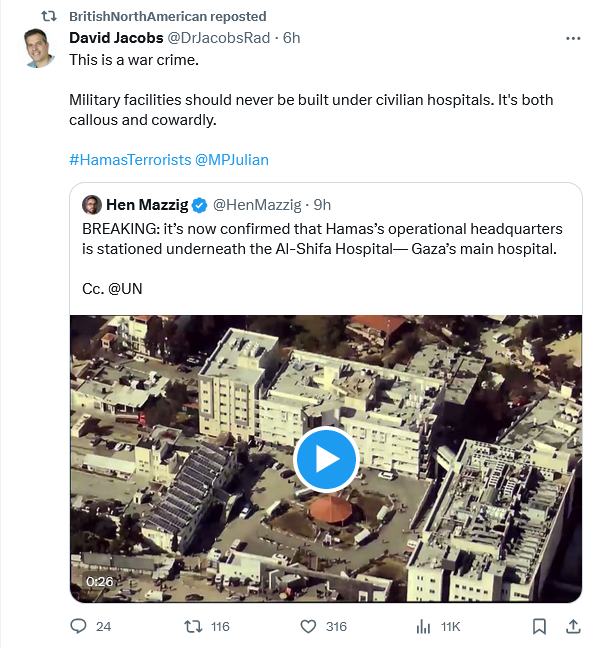
Of course, it’s widely believed that Hamas deliberately positions its facilities to make Israeli attacks less likely due to the elevated risk of unacceptable levels of collateral damage … like this:
October 15, 2023
History Summarized: The Castles of Wales
Overly Sarcastic Productions
Published 23 Jun 2023Every castle tells a story, but when one small country has over 600 castles, the collective story they tell is something like “holy heck ouch, ow, oh god, why are there so many arrows, ouch, good lord ow” – And that’s Wales for you.
(more…)
October 2, 2023
The fall and rise of siege warfare
Sieges are probably about a year or so younger than the first fortified village — as soon as someone came up with the bright idea of throwing a wall around it for protection, some equally bright spark likely started coming up with ways to get inside that wall. In The Critic, Peter Caddick-Adams considers the eclipse and return of siege warfare in Europe in reviewing Iain MacGregor’s The Lighthouse of Stalingrad and Prit Buttar’s To Besiege a City: Leningrad 1941-42:
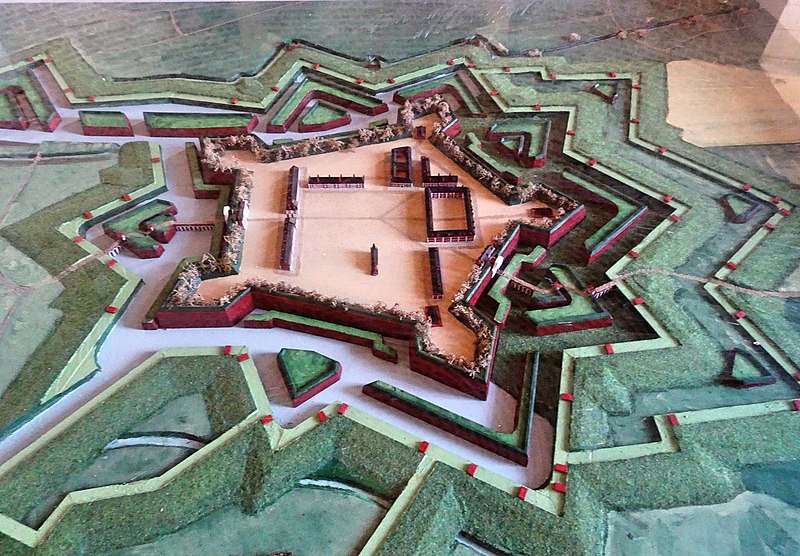
A model of the Vauban fortress at Arras in northern France. Arras is one of the Fortifications of Vauban, a UNESCO World Heritage Site.
Image via Wikimedia Commons.
The history of war is never far removed from battles for cities. Many of us, of whatever creed, were brought up on the story of the walls of Jericho tumbling after the Israelites marched around the stronghold once a day for six days, seven times on the seventh day, and then blew their trumpets. Though no archaeological evidence at Tell es-Sultan, in modern Palestine, corroborates the arresting visual image related in Joshua, Chapter 6, diggers have uncovered a range of defensive stone and brick walls dating back to 8,000 BC. It indicates that even 10,000 years ago, the ancients indulged in the odd siege when the mood took them. The biblical story also introduces us to the concept of intimidation, today fashionably called “psychological warfare”.
The much younger fortress of Troy provides insights into another city-focussed era of battles. Beneath today’s Hisarlik in northern Turkey are nine archaeological layers. Troy VIII was the alluring city of Classical and Hellenistic times, as portrayed in the Iliad, Homer’s Odyssey and Virgil’s Aeneid. The Romans took the lessons of Homeric Troy seriously and clad all their major settlements with defensive walls, as any exploration of Canterbury, Chester or York will confirm. These acted as magnets for opponents, as in Boudicca’s revolt of AD 60–61. Cities such as Colchester, London and St Albans were sacked, as much for what they represented as for their physical presence.
When the Normans arrived in their longships, they imported the concept of stone castles to control the newly conquered English. Their walled cities would be ungraded and contested scores of times over the succeeding six centuries. Henry V’s siege of Harfleur (modern Le Havre) in 1415, the beginning of the Agincourt campaign famously depicted in Shakespeare’s play, underlined the drawback of traditional sieges. They took longer and were usually far costlier than expected. Several thousand men camped in a small area with no knowledge of hygiene inevitably resulted in a high mortality rate amongst the attackers before a shot was fired.
Harfleur was also the first time an English army made use of gunpowder artillery in a siege, a technology that had trickled its way across the world from China. Powder and fuse heralded events 38 years later, when an Ottoman army shook the Christian world to its core by breaching the massive walls of Constantinople (Istanbul) after a 53-day bombardment using cannons. On Tuesday, 29 May 1453, stone finally gave way to bronze and iron, finishing the last remnant of the Roman Empire. Europe was never quite the same again. Fortress architecture started to employ breadth, using earthen ramparts and ditches, rather than height.
Strategy for urban warfare intensified during the lifetime of the French fortress engineer Vauban (1633–1707), who used landscaped terrain as well as geometrically designed defensive walls to deter would-be besiegers. When viewed from above, his fortification designs resemble starfish. So successful were his tactics that sieges, always costly and time-consuming, lessened in importance. His contemporary Marlborough recognised that on any cost-benefit analysis, Vauban had rendered sieges militarily unprofitable, restoring manoeuvre to campaigns.
Subsequent wars fought in the Napoleonic era, the Crimea, between the American North and South, and by Prussia generally reflected this return to mobility. There was the odd attritional discrepancy with the 1854–55 siege of Sevastopol, that of Petersburg in 1864–65 and Paris in 1870–71. Cities were still fought for, but usually contests were removed away from the walls, where forces could conduct wide sweeping manoeuvres, such as Leipzig in 1813 or Ypres in the Great War. As weapons grew more accurate and their munitions heavier, fortifications broadened and sank into the ground, culminating in the trenches of 1914–18. In this era, dominance of terrain became the hallmark, and it was virtually siege-free.
It was remarkable that urban warfare returned on an industrial scale during the Second World War, a time usually associated with blitzkrieg and rapid tank thrusts. This happened at Leningrad, Sevastopol and Stalingrad in the East; at Ortona and Cassino in Italy, Caen; Carentan and St Lo in Normandy; in Aachen and later assaults on Aschaffenburg and Cologne, Magdeburg, Leipzig and Berlin in 1945. Subsequent NATO doctrine for the defence of central Europe focussed on the threat of more attrition. Plans were devised to defend quite small localities, putting grit in the Soviet steamroller and making the cost of attacking Western towns and cities prohibitive.
Update: Broken URL corrected.
Why France Lost Vietnam: The Battle of Dien Bien Phu
Real Time History
Published 29 Sept 2023After the French success in the Battle of Na San, the battle of Dien Bien Phu is supposed to defeat the Viet Minh once and for all. But instead the weeks-long siege becomes a symbol of the French defeat in Vietnam.
(more…)
September 3, 2023
The Saalburg: A Roman Fort on the German Frontier
Scenic Routes to the Past
Published 23 May 2023A brief tour of the principal buildings in the Saalburg, Germany’s most completely reconstructed Roman fort.
(more…)
August 19, 2023
One Day in August – Dieppe Anniversary Battlefield Event (Operation Jubilee)
WW2TV
Published 19 Aug 2021One Day in August — Dieppe Anniversary Battlefield Event (Operation Jubilee) With David O’Keefe, Part 3 — Anniversary Battlefield Event.
David O’Keefe joins us for a third and final show about Operation Jubilee to explain how the plan unravelled and how the nearly 1,000 British, Canadian and American commandos died. We will use aerial footage, HD footage taken in Dieppe last week and maps, photos, and graphics.
In Part 1 David O’Keefe talked about the real reason for the raid on Dieppe in August 1942. In Part 2 David talked about the plan for Operation Jubilee. The intentions of the raid and how it was supposed to unfold.
(more…)
Dieppe Raid – 19 August, 1942
The History Chap
Published 15 Aug 2021The Dieppe Raid (codename Operation Jubilee) was a disastrous amphibious landing by the allies in France during World War 2. Nearly 4,000 allied soldiers (mainly Canadians) were killed, wounded or captured during the Battle of Dieppe.
1942 was turning out to be a bad year for the allies. The Nazis were sweeping forwards in Russia, the Japanese were sweeping though South East Asia. The British commonwealth troops were being pushed back by the Germans & Italians in North Africa and the Americans were still reeling from the attack on Pearl Harbour.
The British wanted to show that they were still willing to take the offensive in the war and were were being urged by Stalin to take some pressure off the Soviet Union. A plan was hatched to conduct a “smash & grab” raid on the port of Dieppe in northern France. The aim was to seize Dieppe and hold it for a limited time before evacuation, during which time the allied troops would collect intelligence and destroy German military infrastructure.
The Canadian government were keen to have their own troops play a role in the war and so the majority of the raiding force was made up of their troops. Initially planned for early July, Operation Jubilee was delayed for over a month due to bad weather and the need for a high tide at dawn. Eventually the Dieppe Raid took place just before 0400 on the 19th August 1942. 5,000 Canadians, 1,000 British and 50 US Rangers were to land at five different points along a 16km (10 mile front) either side of the port of Dieppe itself.
The result was a complete disaster. No major objectives were achieved, poor intelligence had not identified the strength of the German defences and the Germans were on high alert for a possible attack after the firefight at sea and the fact that there was high tide. Within less than 6 hours of the landing starting the order had been given to evacuate and by 1400 hours what remained of the allied force had been successfully removed.
The Dieppe Raid lasted 10 hours. They left behind 4,000 killed, wounded or prisoners of war — over 80% of whom were Canadians. The Royal Navy lost a destroyer and 33 landing craft whilst the RAF lost 106 planes.
The raid had sent a signal to the Germans that the Atlantic shoreline was not secure. That eventually they would have to fight the war on two fronts. It also raised morale within the population of occupied France. They were not alone. The best that can be said for the raid was that it taught the allies valuable lessons which were successfully implemented in the D-Day landings in Normandy in 1944. Maybe the sacrifice of the young men at Dieppe saved many more young men on D-Day.
(more…)
July 1, 2023
QotD: The ever-increasing size and number of artillery pieces in WW1 trench battles
So by the Second Battle of Artois (May, 1915), the barrage was four days long and included 293 heavy guns and 1,075 lighter pieces. At Verdun (February, 1916) the Germans brought in 1,201 guns, mostly heavy indirect fire artillery (of which the Germans had more than the French) with a shifting barrage that expected to fire 2 million shells in the first six days and 4 million during the first 18 days. At the Somme (1916) the British barrage lasted from the 24th of June to the attack on July 1 (so a seven-day barrage); a shorter barrage was proposed but could not be managed because the British didn’t have enough guns to throw enough shells in the shorter time frame. A longer barrage was also out: the British didn’t have the shells for it. By Passchendaele (1917) the British were deploying some 3,000 artillery pieces; one for every 15 yards of frontage they were attacking.
These efforts didn’t merely get to be more, but also more complex. It was recognized that if the infantry could start their advance while the shells were still falling, that would give them an advantage in the race to the parapet. The solution was the “creeping” barrage which slowly lifted, moving further towards the enemy’s rear. These could be run by carefully planned time-table (but disaster might strike if the infantry moved too slow or the barrage lifted too early) or, if you could guarantee observation by aircraft, be lifted based on your own movements (in as much as your aircraft pilots, with their MK1 eyeballs, could tell what was happening below them). […]
I find that most casual students of military history assume that these barrages generally failed. I suspect this has a lot to do with how certain attacks with ineffective barrages (e.g. the Somme generally, the ANZAC Corps’ attack at Passchendaele) have ended up as emblematic of the entire war (and in some cases, nationality-defining events) in the English-language discussion. And absolutely, sometimes the barrages just failed and attacks were stopped cold with terrible losses. But rather more frequently, the barrages worked: they inflicted tremendous casualties on defenders and allowed the attackers to win the race to the parapet which in turn meant the remaining defenders were likely to be swiftly grenaded or bayoneted. This is part of why WWI commanders continued to believe that they were “on the verge of a breakthrough”, that each attack had come so close, because initially there were often promising gains. They were wrong, of course, about being that close, but opening attacks regularly overran the initial enemy positions. Even the worst debacles of the war, like at the Somme, generally did so.
And at this point, you may be wondering if you’d been lied to, because you were always told this was a war where advances where measured in feet and meters instead of miles or kilometers and how can that be if initial attacks generally did, in fact, overrun the forward enemy positions? I’ll push this even further – typically, in the initial phases of these battles (the first few days) the casualty rates between attacker and defender were close to even, or favored the attacker. This is of course connected to the fact that the leading cause of battle deaths in the war was not rifle fire, machine guns, grenades, bayonets but in fact artillery fire and the attacker was the one blasting fixed positions with literal tons of artillery fire. So what is going on?
Because both sides quickly figured out that their forward positions were badly exposed to artillery barrages and began designing defenses in depth, with rear positions well out of the reach of all but the largest enemy artillery. For instance, most of the so-called “Hindenburg Line” (the Germans called it the Siegfriedstellung or “Siegfried Position”) was set in multiple lines […] The plan consisted of a thin initially defense which was assumed to fall in the event of an attack, but still featured channels made by heavy barbed wire and machine guns designed to inflict maximum casualties on an advancing force (and be dangerous enough to require the artillery barrage and planned assault). Then behind that was more open ground and then a second line of trenches, this time much more solid, with communications trenches cutting vertically and the battle positions horizontally, enabling reserves to be brought up through those trenches without being exposed to fire. Finally the reserves themselves were in a third line of trenches even further back, well outside of the enemy’s barrage (or indeed the range of all but their heaviest guns). Of course while your artillery is in the back, out of range of the enemy artillery, the enemy infantry is attacking into your artillery range. This keeps your artillery from being disabled into the initial barrage (you hope) so that it can be brought into action for the counter-attack.
And now the enemy of the attacker is friction (as we’ve discussed before with defense in depth). If everything possible goes right, you open with the barrage, your infantry sweeps forward, the creeping barrage lifts and you win the race to the parapet. The forward enemy defenders are either blasted apart by the barrage or butchered in their holes by your gas, grenades and bayonets. Great! Now you need to then attack again out of those enemy positions to get to the next line, but your forces are disorganized and disoriented, your troops are tired and your supplies, reinforcements and artillery (including many heavy guns that weigh many tons and shoot shells that also weigh 100+lbs a pop) have to get to you through the terrain the barrage created […]
So rapidly the power of your initial attack runs out. And then the counter-attacks, as inevitable as the rising sun, start. Your opponents can shell you from nice, prepared positions, while your artillery now has to move forward to support you. Their troops can ride railways to staging posts close to the front lines, advance through well-maintained communications trenches directly to you, while your troops have to advance over open group, under artillery fire, in order to support you. The brutal calculus begins to take its toll, you lose ground and the casualty ratios swings in favor of the “defender” (who to be clear, is now attacking positions he once held). Eventually your footholds are lost and both sides end up more or less where they started, minus a few hundreds or thousands of dead. This – not the popular image – this is the stalemate: the attacker frequently wins tactically, but operational conditions make it impossible to make victory stick.
The brutal irony of this “defensive” stalemate is that at any given moment in a battle that might last months and swing from offensive to defensive and back again that casualties typically favored the side which was attacking at any given moment. More ironic yet, the problem here is that the artillery itself is digging the hole you cannot climb out of, because it is the barrage that tears up the landscape, obliterating roads, making movement and communication nearly impossible for the attacker (but not for the defender). But without the barrage, there’s no way to suppress enemy artillery and machine guns to make it possible to cross no man’s land. Even with tanks, an attack without supporting artillery is suicide; enemy artillery will calmly knock out your tanks (which are quite slow; this is in 1918, not 1939).
The problem, for the attacker and the defender isn’t machine guns, it is artillery: the artillery that makes assaults possible in the first place makes actual victory – breaking through the enemy and restoring maneuver – impossible.
Bret Devereaux, “Collections: No Man’s Land, Part I: The Trench Stalemate”, A Collection of Unmitigated Pedantry, 2021-09-17.
June 10, 2023
George MacDonald Fraser – Quartered Safe Out Here
We Have Ways of Making You Talk
Published 16 Jan 2023Merry Christmas from “We Have Ways of Making You Talk”. Over the next 12 days Al and James are reading extracts from some of their favourite books about the Second World War. Today Al is reading from Quartered Safe Out Here, by George MacDonald Fraser.
(more…)
June 6, 2023
Juno Beach: The Fighting Canadians on D-Day | History Traveler Episode 194
The History Underground
Published 6 Feb 2022When one thinks about where the most violent fighting took place on D-Day, you wouldn’t be wrong in citing Omaha Beach where the highest number of casualties were inflicted. But as a percentage of the landing force, the Canadians on Juno Beach suffered more than any other Allied nation. In this episode, we’re joined by Paul Woodadge of @WW2TV to explore a few of the areas along Juno Beach where men to the 3rd Canadian Infantry Division landed on June 6th.
(more…)
May 31, 2023
QotD: The second system of war
In such war, the goal was to deliver the siege. But delivery of the siege meant a large army which might now be confronted in the field (for it was unlikely to move by stealth, being that it has to be large enough to take the town). And so to prohibit the siege from being delivered, defenders might march out and meet the attackers in the field for that pitched battle. In certain periods, siegecraft or army size had so outpaced fortress design that everyone rather understood that after the outcome of the pitched battle, the siege would be a forgone conclusion – it is that unusual state of affairs which gives us the “decisive battle” where a war might potentially be ended in a stoke (though they rarely were).
We may term this the second system of war. It is the system that most modern industrial and post-industrial cultures are focused on. Our cultural products are filled with such pitched battles, placed in every sort of era of our past or speculative future. It is how we imagine war. Except that it isn’t the sort of war we wage, is it?
Because in the early 1900s, the industrial revolution resulted in armies possessing both amounts of resources and levels of industrial firepower which precluded open pitched battles. All of those staples of our cultural fiction of battles, developed from the second system – surveying the enemy army drawn up in battle array, the tense wait, then the furious charge, coming to grips with the enemy in masses close up – none of that could survive modern machine guns and artillery.
Bret Devereaux, “Collections: The Universal Warrior, Part IIa: The Many Faces of Battle”, A Collection of Unmitigated Pedantry, 2021-02-05.


