
World War Two
Published 5 May 2024I don’t want to give too much away about this extra regular episode here in the description, but it’s true- German and American soldiers fought side by side in the waning days of the European part of WW2, and not just once! And the second time is an all-time great tale of adventure.
(more…)
May 6, 2024
Germans and Americans fighting side by side! – WW2 – Week 297B – May 5, 1945
Comments Off on Germans and Americans fighting side by side! – WW2 – Week 297B – May 5, 1945
April 29, 2024
“The disaster at Imphal was perhaps the worst of its kind yet chronicled in the annals of war”
Dr. Robert Lyman makes the case for the Japanese defeat at the battles of Imphal and Kohima being one of the four great turning points in the Second World War:
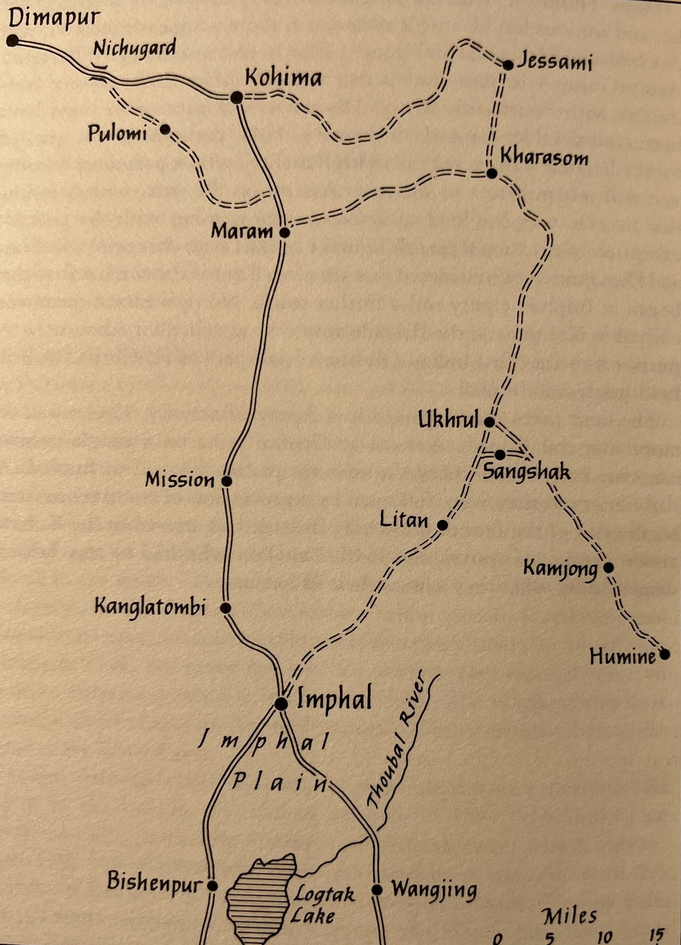
It is clear to me that the great twin battle of Imphal & Kohima, which raged from March through to late July 1944, was one of four great turning-point battles in the Second World War, when the tide of war changed irreversibly and dramatically against those who initially held the upper hand.
The first great turning point was arguably at Midway in June 1942 when the US Navy successfully challenged Japanese dominance in the Pacific. The second was at Stalingrad between August 1942 and January 1943 when the seemingly unstoppable German juggernaut in the Soviet Union was finally halted in the winter bloodbath of that city, where only 94,000 of the original 300,000 German, Rumanian and Hungarian troops survived. The third was at El Alamein in October 1942 when the British Commonwealth triumphed against Rommel’s Afrika Korps in North Africa and began the process that led to the German surrender in Tunisia in May 1943. The fourth was this battle, that at Kohima and Imphal between March and July 1944 when the Japanese “March on Delhi” was brought to nothing at a huge cost in human life, and the start of their retreat from Asia began. Adjectives such as “climactic” and “titanic”, struggle to give proper impact to the reality and extent of the terrible war that raged across the jungle-clad hills during these fearsome months.
That the Japanese were contemplating an offensive against India in early 1944 was a surprise to Allied planners, who had given no thought to its possibility. By this time Japan had reached the apogee of its power, having extended the violent reach of its Empire across much of Asia since it launched its first surprise attacks in late 1941. Its initial surge in 1942 into what was briefly to be Japan’s “Greater East Asia Co-Prosperity Sphere” was as dramatic as it was rapid and two years further on several millions of peoples across Asia laboured under its heavy yoke. But by early 1944 the tide had turned decisively in the Pacific, the American island-hopping advance reaching steadily but surely towards Japan itself, its humiliated enemies fighting back with desperation, and with every ounce of energy they could muster. They were beginning to prevail in the fight although the struggle on the landmass of Asia was a strategic sideshow in the context of a global conflict: at this time the British and American High Commands were totally occupied with Europe and the Pacific. The British and Americans were preparing for D Day. The Soviets were advancing in Ukraine. There was a stalemate in Italy at Monte Cassino. The Americans were preparing to land in the Philippines. Germany and Japan were both in retreat, but not defeated. In this global context India and Burma appeared strategically peripheral, even inconsequential. Yet in this month, at a time when on every other front the Japanese were on the strategic defensive, Japan launched a vast, audacious offensive deep into India in an attack designed to destroy for ever Britain’s ability to challenge Japan’s hegemony in Burma.
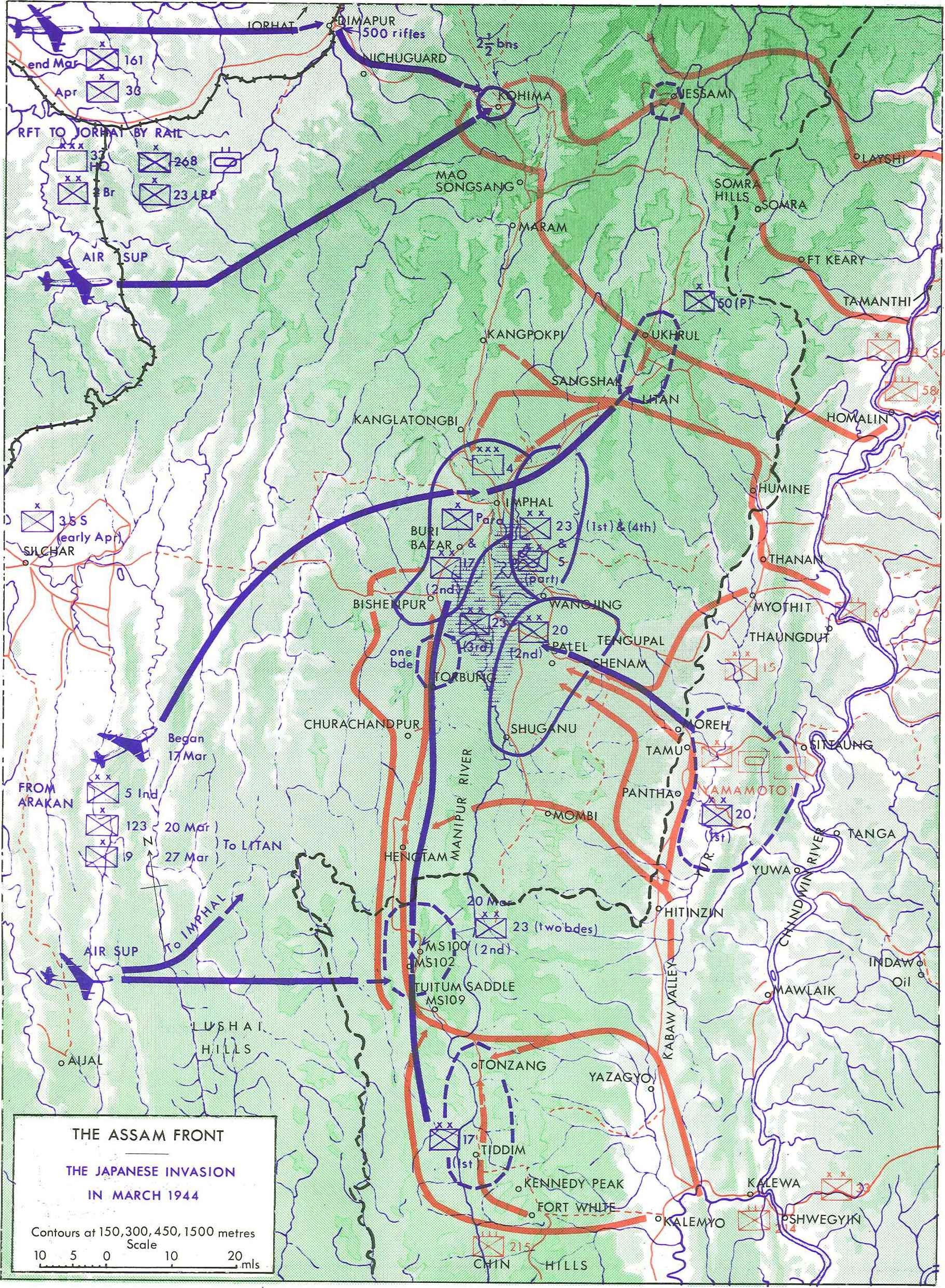
The Japanese commander was General Mutaguchi Renya, a gutsy go-getter who had played a significant role in the collapse of Singapore in February 1942. His evaluation of the British position in northeast India revealed that the three key strategic targets in Assam and Manipur were Imphal; the mountain town of Kohima, and the huge supply base further back on the edge of the Brahmaputra Valley at Dimapur. If Kohima were captured, Imphal would be cut off from the rest of India by land. From the outset Mutaguchi believed that with a good wind Dimapur, in addition to Kohima, could and should be secured. He reasoned that capturing this massive depot would be a devastating, possibly terminal blow to the British ability to defend Imphal, supply the Americans in Northern Burma under Vinegar Joe Stilwell, support the Hump airlift into China and mount an offensive into Burma. It would also enable him to feed his own, conquering army, which would advance across the mountains from the Chindwin on the tightest imaginable supply chain. With Dimapur captured, the Japanese-led Indian National Army under the Bengali nationalist Subhas Chandra Bose could pour into Bengal, initiating the long-awaited anti-British uprising.
(Click to enlarge)
The essence of the battle for India in 1944 can be quickly told. Mutaguchi’s 15th Army advanced in four separate columns into Manipur. The Japanese made determined, even desperate, efforts to seize their objectives: in the north Kohima, with a scratch British and Indian garrison of 1,200 trained fighting soldiers – about two thirds of them Indian – was attacked by an entire division of about 15,000 men in early April. Surrounded and slowly forced back onto a single hill they were supplied by air until relief came on 20 April, although the battle to dislodge the Japanese from Kohima continued bloodily, in appalling weather and battlefield conditions – the annual monsoon was in full spate – through to early June. Further south the Japanese plan entailed attacking Imphal from north, east and south. The plan of the commander of the 14th Army, Lieutenant General Bill Slim, was to withdraw his forces into the hills and there to allow the Japanese to expend themselves fruitlessly against well-supplied and aggressive British bastions, equipped with tanks, artillery and supported by air. The battle for Imphal in Manipur and for Kohima to the north-west in the neighbouring Naga Hills settled down to a bloody hand-to-hand struggle as the Japanese tried to gain the foothold necessary for their survival. They travelled lightly, and reserves soon exhausted themselves and further supplies were almost non-existent. Just as the air situation was becoming critical for Slim through poor weather and shortages of aircraft the relieving division from Kohima – the British 2nd Infantry Division that had last seen action at Dunkirk – began fighting its way towards Imphal, and the four beleaguered divisions began to push out from the Imphal pocket. By 22 June the 2nd Division and the 5th Indian Division met north of Imphal and the road to the plain was open. Four weeks later the Japanese withdrawal to Burma began.
Of all the invading armies of history, it is hard to think of one that was repulsed more decisively, or more ignominiously, than the Japanese 15th Army launched against India in March 1944. Its defeat was not the fault of the Japanese soldiers, who fought courageously, tenaciously and fiercely, but of their commanders, who sacrificed the lives of their troops on the altar of their own hubris. The battle had provided the largest, most prolonged and most intense engagement with a Japanese army yet seen in the war. “It is the most important defeat the Japs have ever suffered in their military career” wrote Mountbatten exultantly to his wife on 22nd June 1944, “because the numbers involved are so much greater than any Pacific Island operation.” The extent of the disaster that befell the 15th Army is captured by a comment by Kase Toshikazu, a member of the wartime Japanese Foreign Office, who lamented: “Most of this force perished in battle or later of starvation. The disaster at Imphal was perhaps the worst of its kind yet chronicled in the annals of war.” The latter might better have included the caveat “Japanese” to avoid charges of exaggeration, but his comment captures something of the enormity of the human disaster that overwhelmed the 15th Army. It might more fairly be described as the greatest Japanese military disaster of all time. The Indian, Gurkha, African and British troops of this remarkably homogeneous organisation had also decisively removed any remaining notions of Japanese superiority on the battlefield.
The importance of this victory was overshadowed at the time, and downplayed for decades afterwards, by the massive victories in 1945 which brought World War II to an end in Europe and the Pacific. But this lack of publicity and of awareness does not remove the fact that, objectively speaking, the battles in India in 1944, epitomized in the fulcrum battle at Kohima, were an epic comparable with Thermopylae, Gallipoli, Stalingrad, and other better known confrontational battles where the arrogant invader became, in time, the ignominious loser.
Comments Off on “The disaster at Imphal was perhaps the worst of its kind yet chronicled in the annals of war”
April 22, 2024
QotD: Before England could rely on the “wooden walls” of the Royal Navy
… given this general lack of geographical knowledge, try to imagine embarking on a voyage of discovery. To an extent, you might rely on the skill and experience of your mariners. For England in the mid-sixteenth century, however, these would not have been all that useful. It’s strange to think of England as not having been a nation of seafarers, but this was very much the case. Its merchants in 1550 might hop across the channel to Calais or Antwerp, or else hug the coastline down to Bordeaux or Spain. A handful had ventured further, to the eastern Mediterranean, but that was about it. Few, if any, had experience of sailing the open ocean. Even trade across the North Sea or to the Baltic was largely unknown – it was dominated by the German merchants of the Hanseatic League. Nor would England have had much to draw upon in the way of more military, naval experience. The seas for England were a traditional highway for invaders, not a defensive moat. After all, it had a land border with Scotland to the north, as well as a land border with France to the south, around the major trading port of Calais. Rather than relying on the “wooden walls” of its ships, as it would in the decades to come, the two bulwarks in 1550 were the major land forts at Calais and Berwick-upon-Tweed.
Anton Howes, “The House of Trade”, Age of Invention, 2019-11-13.
Comments Off on QotD: Before England could rely on the “wooden walls” of the Royal Navy
April 19, 2024
The Führerbunker – Hitler’s Grave
World War Two
Published 18 Apr 2024The man who once conquered Europe, Adolf Hitler, now cowers underground in the Führerbunker as bombs and artillery rain down on the ruins of the Reich. Today Sparty gives you a tour of the damp and claustrophobic concrete maze that will soon become the dictator’s coffin.
(more…)
Comments Off on The Führerbunker – Hitler’s Grave
April 18, 2024
What to do if Romans Sack your City
toldinstone
Published Jan 12, 2024Chapters:
0:00 Introduction
0:34 Progress of a siege
1:55 Looting and violence
3:42 Recorded atrocities
4:45 Captives
5:27 BetterHelp
6:36 Surviving a Roman sack
7:13 Where to hide
8:27 What to do if you’re captured
9:20 Advice for women
10:09 The fate of captives
(more…)
Comments Off on What to do if Romans Sack your City
March 27, 2024
The Volkssturm – a Million men to save the Reich?
World War Two
Published 26 Mar 2024The Volkssturm is the last-ditch people’s army of the Third Reich. Sure, on paper, there are millions of old men and boys ready to defend Germany. But how will they be armed? Are they truly willing to die for Hitler? Will they make any difference at all?
(more…)
Comments Off on The Volkssturm – a Million men to save the Reich?
March 23, 2024
The Roman Army’s Biggest Building Projects
toldinstone
Published Dec 15, 2023The greatest achievements of the Roman military engineers.
Chapters:
0:00 Introduction
0:38 Marching camps
1:36 Bridges
2:40 Siegeworks
3:26 PIA VPN
4:32 Permanent forts
5:49 Roads
6:24 Frontier defenses
7:41 Canals
8:21 Civilian projects
8:54 The aqueduct of Saldae
(more…)
Comments Off on The Roman Army’s Biggest Building Projects
March 2, 2024
QotD: Early siege warfare
In many ways the choice of where to begin following that process of evolution is arbitrary. We could in theory start anywhere from the very distant past or only very recently, but in this case I think it makes sense to begin with the early Near Eastern iron age because of the nature of our evidence. While it is clear that siege warfare must have been an important part of not only bronze age warfare but even pre-bronze age warfare, sources for the details of its practice in that era are sparse (in part because, as we’ll see, siege warfare was a sort of job done by lower status soldiers who often didn’t figure much into artwork focused on royal self-representation and legitimacy-building).
But as we move into the iron age, the dominant power that emerges in the Near East is the (Neo-)Assyrian Empire, the rulers of which make a point of foregrounding their siegecraft as part of a broader program of discouraging revolt by stressing the fearsome abilities of the Assyrian army (which in turn had much of its strength in its professional infantry). Consequently, we have some very useful artistic depictions of the Assyrian army doing siege work and at the same time some incomplete but still very useful information about the structure of the army itself. Moreover, it is just as the Assyrian Empire’s day is coming to a close (collapse in 609) that the surviving source base begins to grow markedly more robust (particularly, but not exclusively, in Greece), giving us dense descriptions of siege work (and even some manuals concerning it) in the following centuries, which we can in turn bring to the Assyrian evidence to better understand it. So this is a good place to start because it is the earliest point where we are really on firm ground in terms of understanding siegecraft in some detail. This does mean we are starting in medias res, with sophisticated states already using complex armies to assault fairly complex, sophisticated fortifications, which is worth keeping in mind.
That said, it should be noted that this is hardly beginning at the beginning. The earliest fortifications in most regions of the world were wooden and probably very simple (often just a palisade with perhaps an elevated watch-post), but by the late 8th century, well-defended sites (like walled cities) already sported sophisticated systems of stone walls and towers for defense. That caveat is in turn necessary because siegecraft didn’t evolve the same way everywhere: precisely because this is a system of antagonistic co-evolution it means that in places where either offensive or defensive methods (or technologies) took a different turn, one can end up with very different results down the line (something we’ll see especially with gunpowder).
Bret Devereaux, “Collections: Fortification, Part I: The Besieger’s Playbook”, A Collection of Unmitigated Pedantry, 2021-10-29.
Comments Off on QotD: Early siege warfare
March 1, 2024
Was JUNO BEACH The Deadliest On D Day? | Canadian Army | Normandy WW2
The History Explorer
Published Oct 27, 2023During the invasion of Fortress Europe the casualty figures sustained on Omaha beach were terrifying; approximately 2,500 US casualties were sustained of which around 800 were killed, depending on which source you use. The ratio was said to be 1 in 19 soldiers would become a casualty.
But it was at Juno beach where the fighting Canadians landed that the casualties were 1 in 18. The fighting on Juno beach resembled modern urban warfare – silencing fortified residential houses, clearing rooms and bunker busting. So was this the more deadly beach? This is the story, of Juno beach and the brave sons of Canada.
On June 6th, 1944, the 3rd Canadian Infantry Division and the 2nd Armoured Brigade were tasked with establishing a bridgehead on the beach codenamed “Juno”. This was an eight-kilometre long stretch of beach between Sword beach to the East and Gold beach to the West.
Come with me as we walk the beaches and take a look at what made this beach so well defended.
(more…)
Comments Off on Was JUNO BEACH The Deadliest On D Day? | Canadian Army | Normandy WW2
February 28, 2024
Why Germany Lost the First World War
The Great War
Published Nov 10, 2023Germany’s defeat in the First World War has been blamed on all kinds of factors or has even been denied outright as part of the “stab in the back” myth. But why did Germany actually lose?
(more…)
Comments Off on Why Germany Lost the First World War
February 10, 2024
“Ukraine is running out of soldiers to man the front”
In the second part of his review of the situation in the Russo-Ukrainian War, Niccolo Soldo discusses why the plight of Ukraine’s military is getting worse, not better:
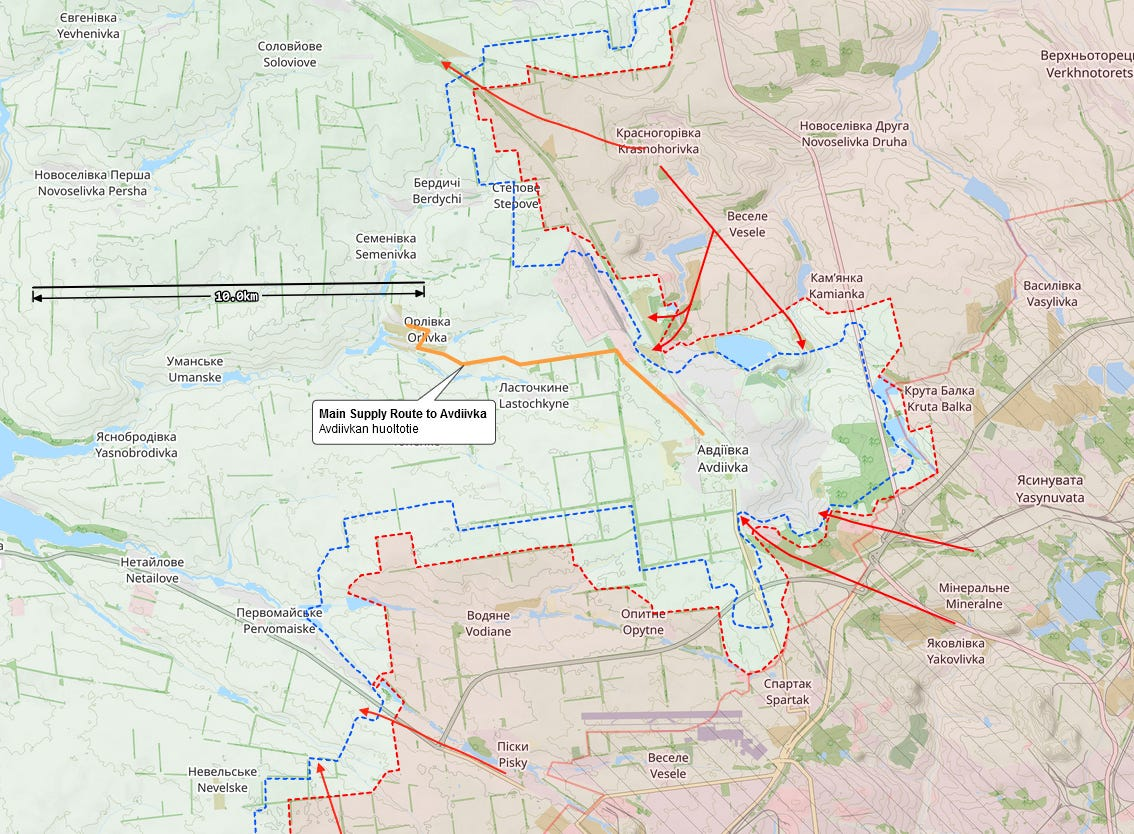
Since the previous entry was published, several key developments continue to make the outlook for Ukraine even gloomier than it already was then. The Ukrainian-held city of Avdiivka is now falling to Russian forces. This city is right next to Donetsk, the largest city in the Donbass. It is from Avdiivka that the Ukrainian Armed Forces (UAF) have been shelling that city for almost a decade now. It is considered by many to be the location with the strongest fortifications along the entire front line. Its capture by the Russians would be a significant victory, not just because of the size of the battle, but especially because it would spare the city of Donetsk from any future artillery barrages from the Ukrainian side.
Since the last entry, the ongoing fight between President Zelensky and his top general, Valeri Zaluzhny, has broken out into the open. Zelensky has indicated that he will be replacing Zaluzhny (and others) in order to “shake up” Ukraine’s war effort, a move that the general refuses to accept. The two Z’s do not see eye-to-eye, with observers informing us that Zaluzhny has called for the UAF to pull out of Avdiivka in order to buy time and not lose more men and arms in defending a city that they would lose in due time. [NR: Zelensky announced that Oleksandr Syrsky has replaced Zaluzhny on February 9th.]
Making matters even worse for the Ukrainians, the US Senate failed to agree to send more money to Kiev to help them in their fight against the Russians. Ukrainian officials told the Guardian that the failure in the US Senate “… will have real consequences in terms of lives on the battlefield and Kyiv’s ability to hold off Russian forces on the frontline”. US Aid For Ukraine President Yuriy Boyechko sounded an even gloomier note:
Everyone was hoping that US won’t let us down, and now we find ourselves at a very difficult place. People are losing hope little by little. We don’t have time for this because we see what’s going on at the front. The more time we give for the Russians to build up their stockpiles, even if the aid is going to show up it might be too little too late.
Newly-elected Polish Premier Donald Tusk criticized Senate Republicans by invoking the memory of Ronald Reagan:
And not to be outdone, Politico is blaming who else but Donald Trump.
The EU did finally manage to convince Hungary to agree to a new 50 Billion EUR package for Ukraine, but European leaders all agree that it is “nowhere near enough”, and requires the USA to chip in just as much as a minimum to sustain the war effort. This package is to be spread out until 2027, but Ukraine faces a funding shortfall of 40 Billion USD this year alone! From the linked article:
“Everyone realizes that €50 billion is not enough,” said Johan Van Overtveldt, a Belgian conservative who chairs the European Parliament’s Budget Committee. “Europe realizes that it needs to step up its efforts.” And by that, he means finding money from elsewhere.
World Bank estimates put Ukraine’s long-term needs for reconstruction at $411 billion.
Money is one thing (and a very, very important thing at that), but all the money in the world doesn’t address the elephant in the room: Ukraine is running out of soldiers to man the front.

Comments Off on “Ukraine is running out of soldiers to man the front”
February 1, 2024
The Kohima Epitaph: Britain’s Forgotten Battle That Changed WW2
The History Chap
Published 9 Nov 2023What is the Kohima Epitaph and what has it got to do with Britain’s forgotten battle that changed the Second World War? Well, those of you living in the UK and who attend Remembrance Sunday services will probably know the words even if you don’t know the story behind them:
“When you go home, tell them of us and say,
For your tomorrow, We gave our today.”The memorial which bears those powerful words, stands in a cemetery containing the graves over over 1,400 British servicemen and memorials to over 900 Indian troops who died alongside them. They died in one of the bloodiest, toughest, grimmest battles of the Second World War. A battle sometimes called the “Stalingrad of the East.”
Outnumbered 6:1 and half of whom were from non-combat units, the multi-national British garrison stood their ground in bloody hand-to-hand fighting, refusing to retreat or surrender for two weeks until relieved. And even then the battle continued for another vicious month. That stand stopped the Japanese invasion of India in its tracks and turned the tide of the war in South East Asia. Both for its ferocity and its turning point in the war, it has been called: “Britain’s greatest battle”.
The Japanese lost 53,000 men from their army of 85,000.
The British (14th Army) lost 4,000 men killed and wounded.This forgotten victory was made possible by General William (Bill) Slim commanding the 14th Army. Rather like the battle and the 14th Army, General Slim has not received the recognition that he is due. And yet, it is almost completely forgotten. Rather like the army that fought against the Japanese in Burma.
So, as we near Remembrance Sunday, I think it is time to reveal the story of the Battle of Kohima in 1944.
(more…)
Comments Off on The Kohima Epitaph: Britain’s Forgotten Battle That Changed WW2
December 30, 2023
Building the Walls of Constantinople
toldinstone
Published 15 Sept 2023This video, shot on location in Istanbul, explores the walls of Byzantine Constantinople — and describes how they finally fell to the Ottoman Turks in 1453.
(more…)
Comments Off on Building the Walls of Constantinople
December 21, 2023
The Battle of Ortona
Army University Press
Published 20 Dec 2023Between 20 and 28 December 1943, the idyllic Adriatic resort town of Ortona, Italy was the scene of some of the most intense urban combat in the Mediterranean Theater. Soldiers of the First Canadian Infantry Division fought German Falschirmjager for control of the city, the eastern anchor of the Gustav Line. The Army University Films Team is proud to present, The Battle of Ortona, as told by Major Jayson Geroux of the Canadian Armed Forces.
Comments Off on The Battle of Ortona
December 14, 2023
QotD: The rise of castles in early Medieval Europe
Now, we can engage here in a bit of a relatable thought experiment: how extensively do your fortify your house (or apartment)? I’ll bet the answer is actually not “none” – chances are your front door locks and your windows are designed to be difficult to open from the outside. But how extensive those protections are vary by a number of factors: homes in high crime areas might be made more resistant (multiple deadbolts, solid exterior doors rather than fancy glass-pane doors, possibly even barred windows at ground level). Lots of neighbors can lower the level of threat for a break-in, as can raw obscurity (as in a house well out into the country). Houses with lots of very valuable things in them might invest in fancy security systems, or at least thief deterring signs announcing fancy security systems. And of course the owner’s ability to actually afford more security is a factor. In short, home defenses respond to local conditions aiming not for absolute security, but for a balance of security and cost: in safe places, home owners “consume” that security by investing less heavily in it, while homeowners who feel less safety invest more in achieving that balance, in as much as their resources allow. And so the amount of security for a house is not a universal standard but a complicated function of the local danger, the resources available and the individual home owner’s risk tolerance. Crucially, almost no one aims for absolute home security.
And I go through this thought process because in their own way the same concerns dictate how castles – or indeed, any fortification – is constructed, albeit of course a fortified house that aims to hold off small armies rather than thieves is going to have quite a bit more in the way of defenses than your average house. No fortification is ever designed to be absolutely impenetrable (or perhaps most correctly put, no wise fortress designer ever aims at absolute impenetrability; surely some foolish ones have tried). This is a fundamental mistake in assessing fortifications that gets made very often: concluding that because no fortification can be built to withstand every assault, that fortification itself is useless; but withstanding every assault is not the goal. The goal is not to absolutely prohibit every attack but merely to raise the cost of an attack above either a potential enemy’s willingness to invest (so they don’t bother) or above their ability to afford (so the attack is attempted and fails) and because all of this is very expensive the aim is often a sort of minimum acceptable margin of security against an “expected threat” (which might, mind you, still be a lot of security, especially if the “expected threat” is very high). This is true of the castle itself, if for no other reason than that resources are scarce and there are always other concerns competing for them, but also for every component of its defenses: individual towers, gates and walls are not designed to be impenetrable, merely difficult enough.
This is particularly true in castle design because the individuals building these castles often faced fairly sharp limitations in the resources at their disposal. Castles as a style of fortification emerge in a context of political fragmentation, in particular the collapse of the Carolingian Empire, which left even the notional large kingdoms (like the kingdom of France) internally fragmented. Castles were largely being built not by kings but by counts and dukes who held substantial landholdings but nothing like the resources of Charlemagne or Louis the Pious, much less the Romans or Assyrians. Moreover, the long economic and demographic upswing of the Middle Ages was only just beginning to gain momentum; the great cities of the Roman world had shrunk away and the total level of economic production declined, so the sum resources available to these rulers were lower. Finally, the loss of the late Roman bureaucracy (replaced by these fragmented realms running on an economic system best termed “manorialism”) meant that the political authorities (the nobility) often couldn’t even get a hold of a very large portion of the available economic production they did have. Consequently, castle construction is all about producing what security you can with as little labor, money and resources as possible (this is always true of any fortification, mind you, merely that in this period the resource constraints are much tighter).
Bret Devereaux, “Collections: Fortification, Part III: Castling”, A Collection of Unmitigated Pedantry, 2021-12-10.


