
Unions only help if the underlying economic situation is that the employer is able to charge a great deal more for the amount of product generated per worker-hour than the worker is getting — there is headroom for the worker’s wage to expand into while the manufacturer still makes a net profit. (If the manufacturer doesn’t make a net profit the business collapses and nobody gets paid.)
During the age that manufacturing nostalgisists remember nostalgically, this was true. For most of that period (roughly 1870-1970), the capital goods required to manufacture in a way price-competitive with the U.S. were so expensive that almost nobody outside the U.S. could afford them, and in the few places that could they were mainly preoccupied with supplying their domestic markets rather than the U.S. World War II prolonged this period by hammering those “few places” rather badly.
In that environment, U.S. firms could profit-take hugely, benefited by being scarce suppliers not just to the U.S. but (later on) to the whole world. And unions could pry loose enough of that margin to make manufacturing jobs comfortably middle-class.
All that ended in the early 1970s. A good marker for the change is the ability of the Japanese to make cheap cars for export and sell them for the U.S.
In the new world, the profit margins on manufactured goods narrowed dramatically. The manufacturing firms could no longer effectively ignore overseas competition in the U.S. domestic market. U.S. consumers no longer had to to pay the large price premiums required to sustain domestic manufacturing wages at pre-1970 levels, and they jumped right on that option.
In this environment, unions don’t help because they have almost no negotiating room. If they bid up workers’ wages, the jobs will evaporate or move overseas – not because corporations are being “greedy” but because they can no longer charge the prices that would allow such high wages to be sustained. Too much foreign labor and capital is ready to pounce on the first hint of price-taking.
Eric S. Raymond, “Why labor unions have lost their moxie”, Armed and Dangerous, 2014-11-29.
December 19, 2014
QotD: The twin rise and fall of unions and manufacturing
November 23, 2014
ESR on how to learn hacking
Eric S. Raymond has been asked to write this document for years, and he’s finally given in to the demand:
What Is Hacking?
The “hacking” we’ll be talking about in this document is exploratory programming in an open-source environment. If you think “hacking” has anything to do with computer crime or security breaking and came here to learn that, you can go away now. There’s nothing for you here.
Hacking is a style of programming, and following the recommendations in this document can be an effective way to acquire general-purpose programming skills. This path is not guaranteed to work for everybody; it appears to work best for those who start with an above-average talent for programming and a fair degree of mental flexibility. People who successfully learn this style tend to become generalists with skills that are not strongly tied to a particular application domain or language.
Note that one can be doing hacking without being a hacker. “Hacking”, broadly speaking, is a description of a method and style; “hacker” implies that you hack, and are also attached to a particular culture or historical tradition that uses this method. Properly, “hacker” is an honorific bestowed by other hackers.
Hacking doesn’t have enough formal apparatus to be a full-fledged methodology in the way the term is used in software engineering, but it does have some characteristics that tend to set it apart from other styles of programming.
- Hacking is done on open source. Today, hacking skills are the individual micro-level of what is called “open source development” at the social macrolevel. A programmer working in the hacking style expects and readily uses peer review of source code by others to supplement and amplify his or her individual ability.
- Hacking is lightweight and exploratory. Rigid procedures and elaborate a-priori specifications have no place in hacking; instead, the tendency is try-it-and-find-out with a rapid release tempo.
- Hacking places a high value on modularity and reuse. In the hacking style, you try hard never to write a piece of code that can only be used once. You bias towards making general tools or libraries that can be specialized into what you want by freezing some arguments/variables or supplying a context.
- Hacking favors scrap-and-rebuild over patch-and-extend. An essential part of hacking is ruthlessly throwing away code that has become overcomplicated or crufty, no matter how much time you have invested in it.
The hacking style has been closely associated with the technical tradition of the Unix operating system.
Recently it has become evident that hacking blends well with the “agile programming” style. Agile techniques such as pair programming and feature stories adapt readily to hacking and vice-versa. In part this is because the early thought leaders of agile were influenced by the open source community. But there has since been traffic in the other direction as well, with open-source projects increasingly adopting techniques such as test-driven development.
October 1, 2014
QotD: Primitive belief systems and “sorcerism”
Many primitive societies believe that maleficent spirits cause all sorts of human misfortune that in the modern West we have learned to attribute to natural causes — cattle dying, crops failing, disease, drought, that sort of thing. A few societies have developed a more peculiar form of supernaturalism, in which evil spirits recede into the background and all misfortune is caused by the action of maleficent human sorcerers who must be found and rooted out to end the harm.
A society like that may be a grim, paranoid place with everyone constantly on the hunt for sorcerers — but a sorcerer can be punished or killed more easily than a spirit or a blind force of nature. Therein lies the perverse appeal of this sort of belief system, what I’ll call “sorcerism” — you may not be able to stop your cattle from dying, but at least you can find the bastard who did it and hurt him until you feel better. Maybe you can even prevent the next cattle-death. You are not powerless.
English needs, I think, a word for “beliefs which are motivated by the terror of being powerless against large threats”. I think I tripped over this in an odd place today, and it makes me wonder if our society may be talking itself into a belief system not essentially different from sorcerism.
Eric S. Raymond, “Heavy weather and bad juju”, Armed and Dangerous, 2011-02-03.
September 9, 2014
QotD: The Iron Law of Redistributionism
[P]olicies intended to “help” the poor are invariably hijacked by a rentier class that fattens on the rising diversion of income. Result: help never arrives, much wealth is destroyed, growth is strangled, and the poor get poorer.
Eric S. Raymond, Google+, 2014-09-06.
August 16, 2014
ESR on demilitarizing the police
Eric S. Raymond is with most other libertarians about the problems with having your police become more like an occupying army:
I join my voice to those of Rand Paul and other prominent libertarians who are reacting to the violence in Ferguson, Mo. by calling for the demilitarization of the U.S.’s police. Beyond question, the local civil police in the U.S. are too heavily armed and in many places have developed an adversarial attitude towards the civilians they serve, one that makes police overreactions and civil violence almost inevitable.
But I publish this blog in part because I think it is my duty to speak taboo and unspeakable truths. And there’s another injustice being done here: the specific assumption, common among civil libertarians, that police overreactions are being driven by institutional racism. I believe this is dangerously untrue and actually impedes effective thinking about how to prevent future outrages.
There are some unwelcome statistics which at least partly explain why young black men are more likely to be stopped by the police:
… the percentage of black males 15-24 in the general population is about 1%. If you add “mixed”, which is reasonable in order to correspond to a policeman’s category of “nonwhite”, it goes to about 2%.
That 2% is responsible for almost all of 52% of U.S. homicides. Or, to put it differently, by these figures a young black or “mixed” male is roughly 26 times more likely to be a homicidal threat than a random person outside that category – older or younger blacks, whites, hispanics, females, whatever. If the young male is unambiguously black that figure goes up, about doubling.
26 times more likely. That’s a lot. It means that even given very forgiving assumptions about differential rates of conviction and other factors we probably still have a difference in propensity to homicide (and other violent crimes for which its rates are an index, including rape, armed robbery, and hot burglary) of around 20:1. That’s being very generous, assuming that cumulative errors have thrown my calculations are off by up to a factor of 6 in the direction unfavorable to my argument.
[…]
Yeah, by all means let’s demilitarize the police. But let’s also stop screaming “racism” when, by the numbers, the bad shit that goes down with black male youths reflects a cop’s rational fear of that particular demographic – and not racism against blacks in general. Often the cops in these incidents are themselves black, a fact that media accounts tend to suppress.
What we can actually do about the implied problem is a larger question. (Decriminalizing drugs would be a good start.) But it’s one we can’t even begin to address rationally without seeing past the accusation of racism.
August 7, 2014
QotD: Hobbit architecture
Before you read the rest of this post, go look at these pictures of a Hobbit Pub and a Hobbit House. And recall the lovely Bag End sets from Peter Jackson’s LOTR movies.
I have a very powerful reaction to these buildings that, I believe, has nothing to do with having been a Tolkien fan for most of my life. In fact, some of the most Tolkien-specific details – the round doors, the dragon motifs in the pub – could be removed without attenuating that reaction a bit.
To me, they feel right. They feel like home. And I’m not entirely sure why, because I’ve never lived in such antique architecture. But I think it may have something to do with Christopher Alexander’s “Timeless Way of Building”.
Alexander’s ideas are not easy to summarize. He believes that there is a timeless set of generative ur-patterns which are continuously rediscovered in the world’s most beautiful buildings – patterns which derive from an interplay among mathematical harmonies, the psychological/social needs of human beings, and the properties of the materials we build in.
Alexander celebrates folk architecture adapted to local needs and materials. He loves organic forms and buildings that merge naturally with their surroundings. He respects architectural tradition, finding harmony and beauty even in its accidents.
When I look at these buildings, and the Tolkien sketches from which they derive, that’s what I see. The timelessness, the organic quality, the rootedness in place. When I look inside them, I see a kind of humane warmth that is all too rare in any building I actually visit. […]
I think it might be that Tolkien, an eccentric genius nostalgic for the English countryside of his pre-World-War-I youth, abstracted and distilled out of its vernacular architecture exactly those elements which are timeless in Christopher Alexander’s sense. There is a pattern language, a harmony, here. These buildings make sense as wholes. They are restful and welcoming.
They’re also rugged. You can tell by looking at the Hobbit House, or that inn in New Zealand, that you’d have to work pretty hard to do more than superficial damage to either. They’ll age well; scratches and scars will become patina. And a century from now or two, long after this year’s version of “modern” looks absurdly dated, they’ll still look like they belong exactly where they are.
Eric S. Raymond, “Tolkien and the Timeless Way of Building”, Armed and Dangerous, 2014-08-02.
August 5, 2014
ESR on “requesting orders from the International Lord of Hate as to which minority group we are to crush beneath our racist, fascist, cismale, heteronormative jackboots this week”
ESR discusses the ongoing civil war in the SF community that most non-fans — and even many actual fans — may not be consciously aware of:
On the one hand, you have a faction that is broadly left-wing in its politics and believes it has a mission to purge SF of authors who are reactionary, racist, sexist et weary cetera. This faction now includes the editors at every major SF publishing imprint except Baen and all of the magazines except Analog and controls the Science Fiction Writers of America (as demonstrated by their recent political purging of Theodore Beale, aka Vox Day). This group is generally frightened of and hostile to indie publishing. Notable figures include Patrick & Theresa Nielsen Hayden and John Scalzi. I’ll call this faction the Rabbits, after Scalzi’s “Gamma Rabbit” T-shirt and Vox Day’s extended metaphor about rabbits and rabbit warrens.
On the other hand, you have a faction that is broadly conservative or libertarian in its politics. Its members deny, mostly truthfully, being the bad things the Rabbits accuse them of. It counteraccuses the Rabbits of being Gramscian-damaged cod-Marxists who are throwing away SF’s future by churning out politically-correct message fiction that, judging by Amazon rankings and other sales measures, fans don’t actually want to read. This group tends to either fort up around Baen Books or be gung-ho for indie- and self-publishing. Notable figures include Larry Correia, Sarah Hoyt, Tom Kratman, John C. Wright, and Vox Day. I’ll call this group the Evil League of Evil, because Correia suggested it and other leading figures have adopted the label with snarky glee.
A few other contrasts between the Rabbits and the Evil League are noticeable. One is that the Evil League’s broadsides are often very funny and it seems almost incapable of taking either itself or the Rabbits’ accusations seriously – I mean, Correia actually tags himself the “International Lord of Hate” in deliberate parody of what the Rabbits say about him. On the other hand, the Rabbits seem almost incapable of not taking themselves far too seriously. There’s a whiny, intense, adolescent, over-fixated quality about their propaganda that almost begs for mockery. Exhibit A is Alex Dally McFarlane’s call for an end to the default of binary gender in SF.
There’s another contrast that gets near what I think is the pre-political cause of this war. The Rabbits have the best stylists, while the Evil League has the best storytellers. Pick up a Rabbit property like Rich Horton’s The Year’s Best Science Fiction and Fantasy 2014 and you’ll read large numbers of exquisitely crafted little numbers about nothing much. The likes of Correia, on the other hand, churn out primitive prose, simplistic plotting, at best serviceable characterization – and vastly more ability to engage the average reader. (I would bet money, based on Amazon rankings, that Correia outsells every author in that collection combined.)
All this might sound like I’m inclined to sign up with the Evil League of Evil. The temptation is certainly present; it’s where the more outspoken libertarians in SF tend to have landed. Much more to the point, my sense of humor is such that I find it nearly impossible to resist the idea of posting something public requesting orders from the International Lord of Hate as to which minority group we are to crush beneath our racist, fascist, cismale, heteronormative jackboots this week. The screams of outrage from Rabbits dimwitted enough to take this sort of thing seriously would entertain me for months.
April 3, 2014
ESR reviews Jeremy Rifkin’s latest book
The publisher sent a copy of The Zero Marginal Cost Society along with a note that Rifkin himself wanted ESR to receive a copy (because Rifkin thinks ESR is a good representative of some of the concepts in the book). ESR isn’t impressed:
In this book, Rifkin is fascinated by the phenomenon of goods for which the marginal cost of production is zero, or so close to zero that it can be ignored. All of the present-day examples of these he points at are information goods — software, music, visual art, novels. He joins this to the overarching obsession of all his books, which are variations on a theme of “Let us write an epitaph for capitalism”.
In doing so, Rifkin effectively ignores what capitalists do and what capitalism actually is. “Capital” is wealth paying for setup costs. Even for pure information goods those costs can be quite high. Music is a good example; it has zero marginal cost to reproduce, but the first copy is expensive. Musicians must own expensive instruments, be paid to perform, and require other capital goods such as recording studios. If those setup costs are not reliably priced into the final good, production of music will not remain economically viable.
[…]
Rifkin cites me in his book, but it is evident that he almost completely misunderstood my arguments in two different way, both of which bear on the premises of his book.
First, software has a marginal cost of production that is effectively zero, but that’s true of all software rather than just open source. What makes open source economically viable is the strength of secondary markets in support and related services. Most other kinds of information goods don’t have these. Thus, the economics favoring open source in software are not universal even in pure information goods.
Second, even in software — with those strong secondary markets — open-source development relies on the capital goods of software production being cheap. When computers were expensive, the economics of mass industrialization and its centralized management structures ruled them. Rifkin acknowledges that this is true of a wide variety of goods, but never actually grapples with the question of how to pull capital costs of those other goods down to the point where they no longer dominate marginal costs.
There are two other, much larger, holes below the waterline of Rifkin’s thesis. One is that atoms are heavy. The other is that human attention doesn’t get cheaper as you buy more of it. In fact, the opposite tends to be true — which is exactly why capitalists can make a lot of money by substituting capital goods for labor.
These are very stubborn cost drivers. They’re the reason Rifkin’s breathless hopes for 3-D printing will not be fulfilled. Because 3-D printers require feedstock, the marginal cost of producing goods with them has a floor well above zero. That ABS plastic, or whatever, has to be produced. Then it has to be moved to where the printer is. Then somebody has to operate the printer. Then the finished good has to be moved to the point of use. None of these operations has a cost that is driven to zero, or near zero at scale. 3-D printing can increase efficiency by outcompeting some kinds of mass production, but it can’t make production costs go away.
March 2, 2014
QotD: The voices are coming from inside your head
The thesis of the article was simple: though the content of schizophrenic delusions changes wildly in different cultural contexts, there’s an underlying motivation for them that never varies and produces a fundamental sameness.
The simple, constant thing is that delusional schizophrenics lose the capability to identify all the thoughts in their head as belonging to themselves. In an effort to make sense of their experience, they invent elaborate theories which attribute their disconnected thoughts to external agencies. Gods, demons, orbital mind-control lasers — the content of such delusions varies wildly, but the function is always the same — to restore a sense of causal order to the schizophrenic’s universe, to impose a narrative on the eruptions that he or she can no longer recognize as “self”.
It’s a startling shift in perspective to realize that the construction of schizophrenic delusions arises from the same drive that yields scientific theory-building. Both are Heideggerian rearrangements of the cognitive toolkit, strategies driven by the necessity of coping with the experienced world. The schizophrenic’s tragedy is that the most important fact about his or her experiential world (how much of it is self looking at self) is inaccessible.
Eric S. Raymond, “Sometimes I hear voices”, Armed and Dangerous, 2013-10-06
February 20, 2014
ESR examines the “Dark Enlightenment”
Remember that “Dark Enlightenment” we’re all supposed to be terrified about? ESR is looking at the phenomenon (it’s not really a movement, or at least, it isn’t a single movement):
The Dark Enlightenment is, as I have previously noted, a large and messy phenomenon. It appears to me in part to be a granfalloon invented by Nick Land and certain others to make their own piece of it (the neoreactionaries) look larger and more influential than it actually is. The most detailed critiques of the DE so far (notably Scott Alexander’s Reactionary Philosophy in an Enormous, Planet-Sized Nutshell and Anti-Reactionary FAQ nod in the direction of other cliques on the map I reproduced but focus pretty strongly on the neoreactionaries.
This is the map ESR is referring to:
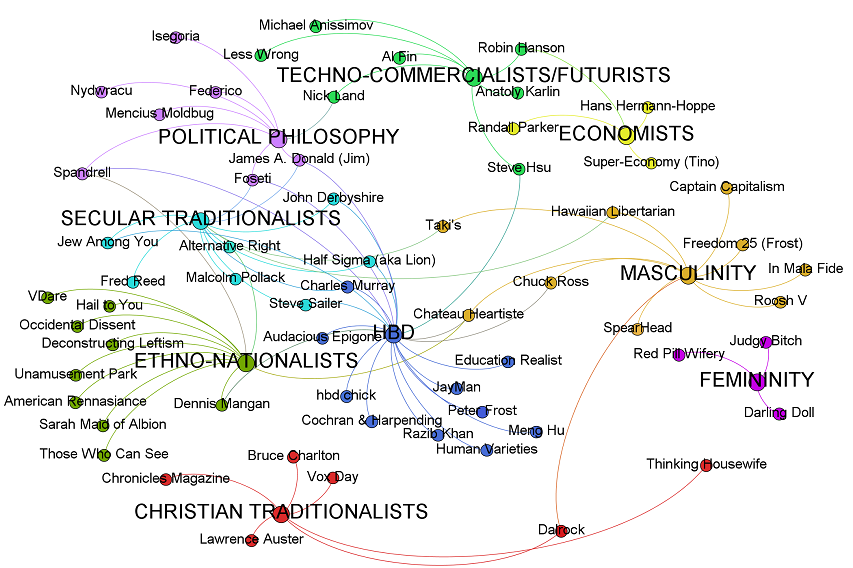
Scharlach’s affinity diagram of the Dark Enlightenment movement, grouped according to their major themes
Nevertheless, after we peel away clear outliers like the Techno-Commercial Futurists and the Christian Traditionalists, there remains a “core” Dark Enlightenment which shares a discernibly common set of complaints and concerns. In this post I’m going to enumerate these rather than dive deep into any of them. Development of and commentary on individual premises will be deferred to later blog posts.
(I will note the possibility that I may in summarizing the DE premises be inadvertently doing what Scott Alexander marvelously labels “steelmanning” – that is, reverse-strawmanning by representing them as more logical and coherent than they actually are. Readers should be cautious and check primary sources if in doubt.)
Complaint the first: We are all being lied to – massively, constantly, systematically – by an establishment that many DE writers call “the Cathedral”. Its power is maintained by inculcation in the masses of what a Marxist (but nobody in the DE, ever, except ironically) would call “false consciousness”. The Cathedral’s lies go far deeper than what most people think of as normal tactical political falsehoods or even conspiracy theories, down to the level of some of the core premises of post-Enlightenment civilization and widely cherished beliefs about the sustainability of racial equality, sexual equality, and democracy.
[…]
Complaint the second: “All men are created equal” is a pernicious lie. Human beings are created unequal, both as individuals and as breeding populations. Innate individual and group differences matter a lot. Denying this is one of the Cathedral’s largest and most damaging lies. The bad policies that proceed from it are corrosive of civilization and the cause of vast and needless misery.
[…]
Complaint the Third: Democracy is a failure. It has produced a race to the bottom in which politicians grow ever more venal, narrow interest groups ever more grasping, the function of government increasingly degenerates into subsidizing parasites at the expense of producers, and in general politics exhibits all the symptoms of what I have elsewhere called an accelerating Olsonian collapse (after Mancur Olson’s analysis in The Logic Of Collective Action).
February 2, 2014
ESR goes down the rabbit hole
After reading a post called An Incomplete Guide to Feminist infighting, ESR did a bit more spelunking down the feminist rabbit hole and came back with a bit of a travelogue for those trapped down there:
The most conspicuous thing is that these women ooze “privilege” from every pore. All of them, not just the white upper-middle-class academics but the putatively “oppressed” blacks and transsexuals and what have you. It’s the privilege of living in a society so wealthy and so indulgent that they can go years – even decades – without facing a reality check.
And yet, these women think they are oppressed, by patriarchy and neoliberalism, heteronormativity, cisnormativity, and there’s a continuous arms race to come up with new oppression modalities du jour and how many intersectional categories each player can claim.
While these children of privilege are filling out their victimological bingo cards…elsewhere, women are treated like chattels. Raped under color of law. Genitally mutilated. But none of this enters the charmed circle of modern American feminism. So much safer to rage at the Amerikkan phallocracy that provides them with cushy jobs writing about their outrage for audiences almost as insulated from reality as they are. Not to mention all those obliging men who will grow their food, fix their plumbing, mow their lawns, and know their place.
[…]
And to return to an older theme – I think this sort of bitter involution is what eventually and inevitably happens when you marinate in left-wing duckspeak for long enough. (Clue: if you find yourself using the word “neoliberal” as non-ironically as these women do, you’re there. For utter lack of meaning outside of a dense thicket of self-referential cod-Marxist presuppositions disconnected from reality, this one has few rivals.)
Accordingly, George Orwell would have no trouble at all identifying the language of the feminist twitter wars as a form of Newspeak, designed not to convey thought but suppress it. Indeed, part of the content of the wars is that some of these women dimly sort of get this – see the whole argument over “callout culture”. But none of them can wake up enough to see that the problem is not just individual behaviors. Because to do that they’d have to face how irretrievably rotten and oppressive their entire discourse has become, and their worldview would collapse.
Ah well. This too shall pass. The university system and establishment journalism are both in the process of collapsing under their own weight. With them will go most of the ecological niches that support these precious, precious creatures in their luxury. Massive reality check a’coming. No doubt the twitter wars will continue, but in historical terms they won’t last long.
May 2, 2013
ESR on the true meaning of moral panics
Eric S. Raymond on the difference between the claimed meaning and the actual, underlying reason for various moral panic incidents:
In my experience, moral panics are almost never about what they claim to be about. I am just (barely) old enough to remember the tail end of the period (around 1965) when conservative panic about drugs and rock music was actually rooted in a not very-thinly-veiled fear of the corrupting influence of non-whites on pure American children. In retrospect it’s easy to understand as a reaction against the gradual breakdown of both legally enforced and de-facto racial segregation in the U.S.
But moral panics are by no means a monopoly of cultural conservatives. These days the most virulent and bogus examples are as likely to arrive from the self-described “left” as the “right”. When they do, they’re just as likely to be about something other than the ostensible subject.
In Lies, Damn Lies, and Rape Statistics a college newspaper does a little digging through U.S. crime statistics and finds that the trendy “anti-rape” movement is exaggerating the rape risk of college women by two full orders of magnitude — as it concludes, “the ‘one in four’ chant should be abandoned and replaced with the more appropriate, albeit less catchy, 1 in 400.”
What can explain such gross distortion? I’ve looked into this issue myself and discovered a lot of flim-flam. Still, even the the best-case figures I arrived at apparently overestimated the actual risk on campuses by a factor of 50. (Barbarian zones — like, say, inner-city Detroit — might be a different story.)
If the rape panic runs parallel to the the now nearly forgotten drugs-and-rock panics of the 1950s and 1960s (and many others like them, before and after) we should expect it to actually be be rooted in an attempt to assert control of or cultural dominance over some threatening Other. And there is indeed evidence that points in that direction.
April 10, 2013
ESR asks “What if it really was like that?”
An interesting jaunt along the byways of human perception and social organization:
I think the book that taught me to ask “What if it really was like that?” systematically might have been Julian Jaynes’s The Origin of Consciousness in the Breakdown of the Bicameral Mind. Jaynes observed that Bronze Age literary sources take for granted the routine presence of god-voices in peoples’ heads. Instead of dismissing this as fantasy, he developed a theory that until around 1000BC it really was like that — humans had a bicameral consciousness in which one chamber or operating subsystem, programmed by culture, manifested to the other as the voice of God or some dominant authority figure (“my ka is the ka of the king”). Jaynes’s ideas were long dismissed as brilliant but speculative and untestable; however, some of his predictions are now being borne out by neuroimaging techniques not available when he was writing.
A recent comment on this blog pointed out that many cultures — including our own until around the time of the Industrial Revolution — constructed many of their customs around the belief that women are nigh-uncontrollably lustful creatures whose sexuality has to be restrained by strict social controls and even the amputation of the clitoris (still routine in large parts of the Islamic world). Of course today our reflex is to dismiss this as pure fantasy with no other function than keeping half the human species in perpetual subjection. But some years ago I found myself asking “What if it really was like that?”
Let’s be explicit about the underlying assumptions here and their consequences. It used to be believed (and still is over much of the planet) that a woman in her fertile period left alone with any remotely presentable man not a close relative would probably (as my commenter put it) be banging him like a barn door in five minutes. Thus, as one consequence, the extremely high value traditionally placed on physical evidence of virginity at time of marriage.
Could it really have been like that? Could it still be like that in the Islamic world and elsewhere today? One reason I think this question demands some attention is that the costs of the customs required to restrain female sexuality under this model are quite high on many levels. At minimum you have to prevent sex mixing, which is not merely unpleasant for both men and women but requires everybody to invest lots of effort in the system of control (wives and daughters cannot travel or in extreme cases even go outside without male escort, homes have to be built with zenanahs). At the extreme you find yourself mutilating the genitalia of your own daughters as they scream under the knife.
August 19, 2012
ESR on the limits of “lawfare” for Apple
To put it mildly, ESR isn’t a fan of Apple’s lawfare approach to competition:
It’s beginning to look like Apple’s legal offensive against Android might backfire on it big-time. Comes the news that Judge Koh has declined to suppress evidence that Apple may have copied crucial elements of the iPad design from prototypes developed by Knight-Ridder and the University of Missouri in the mid-1990s.
Those of us aware enough of computing history to be aware of early work by XEROX PARC and others have always been aware that Apple’s claims of originality were highly dubious. Apple’s history is one of adroit marketing and a facility for stealing adapting ideas from others, wrapping them in admittedly excellent industrial design, and then pretending that all of it originated de novo from the Cupertino campus.
The pretense has always galled a little, especially when Apple’s marketing created a myth that, footling technical details aside, the whole package somehow sprang like Athena from Steve Jobs’s forehead. But it didn’t become intolerable until Apple began using lawfare to suppress its competition.
The trouble with this is that there’s actually a lot of prior art out there. I myself saw and handled a Sharp tablet anticipating important iPhone/iPad design tropes two years before the uPhone launch, back in 2005; the Danger hiptop (aka T-Mobile Sidekick) anticipated the iPhone’s leveraging of what we’d now call “cloud services” in 2002-2003; and of course there’s the the Sony design study from 2006, described by one of Apple’s own designers as an important influence.
If only Apple were honest about what it owed others…but that cannot be, because the company’s strategy has come to depend on using junk patents in attempts to lock competitors out of its markets.
July 30, 2012
QotD: Playing “The Last Post” over the notion of Apple’s innovation
This isn’t speculation — an Apple employee copied Sony’s design, circulated it to his bosses, and testified to these facts in court.
From now on, when anyone heaps phrase on Apple’s design excellence and superlative innovation, just point and laugh. Some of us have been saying for years that what Apple is really good at is ripping off other peoples’ ideas and stealing the credit for them with slick marketing. This, right here, is the proof.
Eric S. Raymond, “The Smartphone Wars: The iPhone Design Was Inspired by Sony”, Armed and Dangerous, 2012-07-29


