Historia Civilis
Published 15 Dec 2017Patreon | http://historiacivilis.com/patreon
Donate | http://historiacivilis.com/donate
Merch | http://historiacivilis.com/merch
Mailing List | http://historiacivilis.com/mailinglist
Twitter | http://historiacivilis.com/twitter
Website | http://historiacivilis.comSources:
The Athenian Constitution by Aristotle: http://amzn.to/2C1mHLv
Politics by Aristotle: http://amzn.to/2AB6KPV
Parallel Lives: The Life of Solon by Plutarch: http://amzn.to/2AT5Viv
The Constitution of the Athenians by Pseudo-Xenophon: http://amzn.to/2z9rE6l
The Rise of Athens by Anthony Everitt: http://amzn.to/2C2ryMu
The Athenian Democracy in the Age of Demosthenes by Mogens Herman Hansen: http://amzn.to/2AEAtYj
Persian Fire by Tom Holland: http://amzn.to/2AjLB8WMusic:
“Direct to Video,” by Chris Zabriskie
“It’s Always Too Late to Start Over,” by Chris Zabriskie
“Mario Bava Sleeps In a Little Later Than He Expected To,” by Chris Zabriskie
“Hallon,” by Christian BjoerklundWe are a participant in the Amazon Services LLC Associates Program, an affiliate advertising program designed to provide a means for us to earn fees by linking to Amazon.com and affiliated sites.
October 26, 2021
The Constitution of Athens
October 20, 2021
Alberta and Quebec, the dark twins of Confederation
In The Line, Jen Gerson explains why the Alberta government is consciously taking some of its strategies for dealing with the feds and other provinces from the generations-long success that has been Quebec’s planbook:
Quebec — as the single largest recipient of equalization cash — is often a target of anger in these parts, but I’d encourage any readers from thereabouts not to read too much into this fact. Both Alberta and Quebec suffer from a culture of political grievance that feed off one another. Alberta resents the fiscal balances, often casting Quebec as an ungrateful recipient of the very oil wealth that the latter regards with contempt. And I can only imagine how Quebec must read this; as a signal of its own isolation from Anglo culture more broadly. On both sides, I see politicians who have made a generational art of milking these respective grievances.
So sometimes it’s worthwhile to point this out.
Alberta doesn’t hate Quebec.
The provinces exist on flip sides of the very same coin; they are each others’ dark twins, and Alberta seeks mostly to emulate its French sibling.
Kenney made this point entirely explicitly in the days leading up to the referendum.
“We’re using this to get leverage to basically take a page out of Quebec’s playbook in having successfully dominated the political attention of the federation for the last 40 or 50 years.”
What playbook was he referencing, here?
The answer is obvious; the separation referenda of 1980 and 1995. In fact, the whole logic of Alberta’s referenda last night was predicated on a novel reading of the Quebec Secession Reference, in which a clear majority on a clear question must force the federal government to the negotiating table in good faith. The fact that this reference spoke to a secession question — and not a longstanding quibble over an item within the constitution — is a material difference from a legal point of view, but not a psychological one.
The hope is that this referenda will give us somethin akin to the “leverage” Quebec has enjoyed vs. Ottawa since its failed separation referenda; and the disproportionate financial and cultural incentives that followed in the following decades. Essentially, Alberta is asking for the leverage of a true separatist movement without suffering the risk of actually separating. We are play-acting a little Potemkin secession referendum, here. If it falls to me to point out the show is a little childish and even a touch pathetic, well, so be it.
October 16, 2021
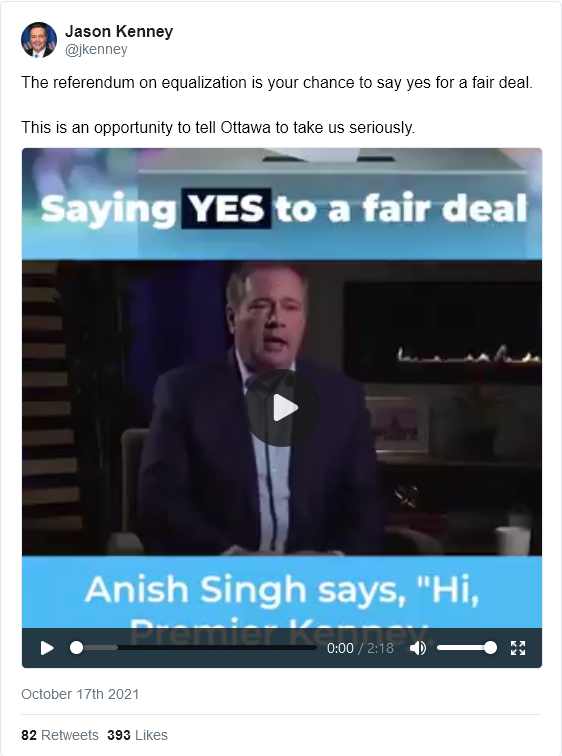
Alberta’s Equalization referendum is “political theatre, and it’s poorly timed political theatre at that”
The province of Alberta is unhappy with the current federal-provincial equalization arrangement. This is not new … it’s been the case off-and-on for most of my life, but this year the province is undertaking a formal referendum on the issue, as Jen Gerson explains in The Line:
Let’s start with all the usual but necessary rigmarole about the Alberta referendum on equalization: a “yes” vote won’t peel equalization from the constitution; even a resounding victory may not actually force the federal government to sit with the province of Alberta to discuss the matter. I mean, it might: this was Ted Morton’s idea, and his argument. That Alberta can force Ottawa and the provinces to engage in some kind of open-hearted exchange by piggybacking on the Quebec Secession Reference is not totally impossible, I guess.
As this Fraser Institute bulletin by Rainer Knopff points out, that reference is specific to questions of, well, secession and probably can’t be re-applied willy nilly to any old provincial grievance. However, Knopff goes on to note that the referendum is necessary to create a provincial legislative resolution on the matter, which would allegedly trigger some kind of duty to negotiate — although certainly no duty to come to an agreement that Alberta would find acceptable.
Most credible individuals begin to handwave furiously when asked to nail the technical legal details about how we’re going to make Ottawa cede a damn thing. Even Morton had to point out that the referendum’s greatest power lies in granting Alberta “moral force” on the question.
In other words, it’s political theatre, and it’s poorly timed political theatre at that.
Equalization is a perennial complaint in Alberta, and not one totally without merit. Although the province doesn’t cut Ottawa some kind of novelty-sized equalization cheque at tax time, we are a comparatively wealthy province, which means the province traditionally sends more money to the federal government through its income and business tax remittances than it receives in rebates and services. There is a sense of injustice, here, which notes that equalization-receiving provinces offer services like cheap daycare, and are now racking up rainy day funds as Alberta falls ever deeper into debt. Meanwhile, we can’t seem to get a pipeline built to transport the very product that provides so much of this national bounty and wealth because other provinces oppose them.
October 10, 2021
First the Bloc Québécois, then “Wexit”, now Bloc Montréal?
Barbara Kay makes the case for Montreal to re-evaluate its position within Quebec as the Quebec government pushes toward even more legal efforts to reduce the English-speaking community to a second- or even third-class citizenship:
Oct. 7 brought an end to consultations on Quebec’s Bill 96, which amends the 1977 Charter of the French Language (Bill 101) and — unilaterally, never before attempted by a province — the Constitution Act of 1867. A few anglophone institutions were invited to the hearings, but their inclusion was pro forma. Bill 96 will pass through use of the notwithstanding clause.
The bill affirms Quebec is a nation, with French as its “common” as well as its only official language, adding several new “fundamental language rights” for French. It effectively creates both a Canadian and Quebec Charter-free zone in a wide range of interactions between individuals and the state. Even before passage, use of the P-word (“province”) has become politically charged, and quietly redacted from public usage by Bill 96 dissidents.
The impact of Bill 96 on anglophones could be momentous. One amendment, which restricts access to English health and social services to those with education-eligibility certificates, could negatively affect upwards of 500,000 anglophone Quebecers. It speaks volumes that the Minister of the French Language will take responsibility for outcomes delivery in that sector away from the Minister of Health and Social Services. Bill 96 will also negatively affect young francophones by capping their numbers at English cegeps [Collège d’enseignement général et professionnel or “General and Vocational College”].
The previous expansions of French language rights in Quebec — and corresponding contractions of English language rights in the province — drove waves of emigration to other provinces, helping Toronto surpass Montreal as Canada’s largest city and economic powerhouse. In the middle of a pandemic, it’s much harder for those who are feeling oppressed to leave Quebec, but there may be another possibility:
Montreal as a city-state, or at least a special autonomous region — a status the Cree nation of northern Quebec has enjoyed for decades — was first raised as a serious idea eight years ago. In 2013 the Parti Québécois proposed language Bill 14, as draconian as Bill 96, which died when premier Pauline Marois’s minority government couldn’t enlist enough collegial support for its passage. Nevertheless, the attempt galvanized alarm sufficient to inspire a transiently influential city-state movement.
A 2014 Ipsos poll on the subject commissioned by that group elicited these key takeaways from Montrealers: Montreal is a distinct society within Quebec (90 per cent); to stop its decline, Montreal needs to take drastic steps to improve its performance (91 per cent); and Montreal deserves special status within Quebec because it is a world-class, cosmopolitan city (74 per cent). Those numbers would likely be as high or higher today.
[…]
We need a Bloc Montréal to represent Montreal/Greater Montreal’s “distinct society” at the Quebec National Assembly in Quebec City. The pivotal moment of the 1995 referendum campaign was the revelation — one that had never before occurred to the separatists — that “if Canada is divisible, then Quebec is divisible”. That was a sobering and clarifying moment. And Montreal has a greater need for augmented representation in Quebec City than Quebec has in Ottawa. After all, Quebec profits handsomely from its affiliation with Canada, while the opposite is true of Montreal and Quebec City.
September 25, 2021
QotD: The 2nd Amendment is obsolete because … the government has nukes?
Last week a congressman embarrassed himself on Twitter. He got into a debate about gun control, suggested a mandatory buyback — which is basically confiscation with a happy face sticker on it — and when someone told him that they would resist, he said resistance was futile because the government has nukes.
And everybody was like, wait, what?
Of course the congressman is now saying that using nuclear weapons on American gun owners was an exaggeration, he just wanted to rhetorically demonstrate that the all-powerful government could crush us peasants like bugs, they hold our pathetic lives in their iron hand, and he’d never ever advocate for the use of nuclear weapons on American soil (that would be bad for the environment!), and instead he merely wants to send a SWAT team to your house to shoot you in the face if you don’t comply.
See? That’s way better.
Larry Correia, “The 2nd Amendment Is Obsolete, Says Congressman Who Wants To Nuke Omaha”, Monster Hunter Nation, 2018-11-19.
September 12, 2021
QotD: The US Supreme Court’s Dred Scott decision of 1857
Scott was a slave who claimed to be free because his owners had taken him to U.S. states where slavery was outlawed; in ruling on the case, Chief Justice Roger Taney, writing for a 7-2 majority, found that Blacks were “beings of an inferior order” who, under the constitution, “had no rights which the white man was bound to respect.”
The Scott decision is now considered an important contributing cause of the U.S. Civil War, which began four years later. It proved, beyond anyone’s doubt, President Abraham Lincoln’s maxim that a sovereign nation could not survive half-slave and half-free. Northern states might be capable of abolishing slavery locally, but this “abolition” would never apply to imported slaves from elsewhere considered as property. One cannot fully understand U.S. history, never mind the progress of its law, without studying and appreciating Taney’s cruel language.
And, indeed, for the world at large, Dred Scott is an unsurpassed reminder of the distinction between law and justice, and of the limitations of a highly reverenced written constitution. Taney not only accepted the (irrefutable) argument that the constitution explicitly countenanced slavery: he wrote fawningly of the Founding Fathers as great men, “high in their sense of honour,” who could never have upheld absolute equality before the law on one hand while hypocritically denying it to Blacks in practice. The Declaration of Independence’s claim that “all men are created equal,” the ex-slaveowner Taney wrote, was never understood by anyone to include inferior races.
Abolitionists of the time saw the innate hypocrisy: the contemporary newspaper editor William Lloyd Garrison risked his life by calling the constitution “a league with hell.” But [University of Buffalo law professor Matthew] Steilen thinks it is better not to expose Black students to the details of that debate. Reading Taney’s “gratuitously insulting and demeaning” words and arguments, he tweeted, is likely to, and there is no other way to put this, injure their feelings. To inquire too deeply into the detail of slavery, and of the law that shielded it, would require Black students to “relive the humiliation” of Dred Scott.
Colby Cosh, “Another Day in a Feelings-First World”, NP Platformed, 2021-06-09.
July 20, 2021
An unlikely survivor in India, His Highness the Prince of Arcot
Ned Donovan explains why there is still a Prince of Arcot, despite the Indian government having abolished all the titles and privileges of the nearly 600 “Maharajas, Maharanas, Rajas, Nawabs, Khans and so on” of the Princely states that were incorporated into modern India after Partition in 1947:
A significant amount of effort was taken during the process of independence to integrate these princely states into the newly independent countries. Almost all of the rulers acceded quickly and peacefully in return for recognition of their symbolic status and titles by the new republics who also promised perpetual large annual payments to sweeten the deal. A handful of princely states were stubborn and were integrated by force, with issues as a result to this day, such as Jammu and Kashmir.
As a result, for the first few decades of independent India, there existed a class of royals recognised within the republic, with privileges and financial support not that different to what they received during the period of British rule. But in 1971 this came tumbling down.
The then-Prime Minister Indira Gandhi amended the Indian Constitution to abolish all privileges and titles, along with any financial subsidies. She believed the whole system to be at odds with the secular socialist republic she was attempting to perfect. The move also had financial benefits: the large princely subsidies stopped being a drain on the Indian treasury while much of the royals’ gold and property were seized by the Government in the process. In 1972, Pakistan followed suit and similarly abolished its remaining princes’ titles.
But the title “Prince of Arcot” somehow escaped to carry on to the modern day … thanks to an unusual historical situation and the presentation of letters patent from Queen Victoria:
In 1855, the 13th Nawab of Arcot died without children. The British, influenced by the East India Company, declared the kingdom had lapsed as a result and annexed it entirely. As a token compensation, Queen Victoria in 1870 gave the last Nawab’s uncle a pension and the title of “His Highness the Prince of Arcot” for him and his descendants in perpetuity. This was granted in a type of royal charter, known as letters patent.
As there was no land still to rule, the Princes of Arcot existed in a strange realm of being kings without a kingdom but with significant influence and prestige. The title continued to pass down through the original holder’s family and they built a large palace, Amir Mahal, in Madras that became a centre of culture instead of one of government.
H/T to Colby Cosh for the link.
June 16, 2021
“One nation, indivisible”?
As a child in England and then in Canada, I was used to the relatively low-key acknowledgements of the Crown and the nation which may be why I was quite befuddled watching American TV portrayal of the in-your-face patriotic displays of the United States, especially the Pledge of Allegiance required of schoolchildren. It seemed oddly statist and even collectivist (although I didn’t know those terms at the time) for a country that constantly seemed to be patting itself on the back as the “home of the free”. I later learned that the Pledge hadn’t even been invented until nearly a century after the nation had been established (and the current version was devised and popularized by a noted utopian socialist, then adopted by Congress in 1942). Tom Mullen explores how the Pledge came about and considers the idea that it is time to drop it:

“American Flag” by JeepersMedia is licensed under CC BY 2.0
An Atlanta, Georgia, charter school announced last week its intention to discontinue the practice of having students stand and recite the Pledge of Allegiance during its schoolwide morning meetings at the beginning of each school day, opting to allow students to recite the pledge in their classrooms instead. Predictably, conservatives were immediately triggered by this “anti-American” decision, prompting the school to reverse its decision shortly after.
The uproar over periodic resistance to reciting the pledge typically originates with Constitution-waving, Tea Party conservatives. Ironically, the pledge itself is not only un-American but antithetical to the most important principle underpinning the Constitution as originally ratified.
[…]
Then, there’s “indivisible”. One would think a federation born by its constituent states seceding from the nation to which they formerly belonged would make the point obvious enough. But the Declaration makes it explicit:
That whenever any Form of Government becomes destructive of these ends, it is the Right of the People to alter or to abolish it, and to institute new Government, laying its foundation on such principles and organizing its powers in such form, as to them shall seem most likely to effect their Safety and Happiness.
It would be impossible to exercise that right — that duty, as the Declaration later calls it — if the republic were indivisible. The strictest constructionists of the time didn’t consider the nation indivisible. Thomas Jefferson didn’t threaten to send troops to New England when some of its states considered seceding upon his election. Quite the opposite. And in an 1804 letter to Joseph Priestly, he deemed a potential split in the union between “Atlantic and Mississippi confederacies” not only possible but “not very important to the happiness of either part.”
The people advocating “one nation, indivisible” in those days were big government Federalists like Hamilton, whose proposals to remake the United States into precisely that were flatly rejected in 1787.
Proponents of absolute, national rule like to quip this question was “settled” by the American Civil War. That’s like saying Polish independence was “settled” by Germany and the Soviet Union in 1939.
In fact, it is precisely the trend towards “one nation” that has caused American politics to become so rancorous, to the point of boiling over into violence, over the course of the last several decades. This continent is inhabited by a multitude of very different cultures, which can coexist peacefully if left to govern themselves. But as the “federal” government increasingly seeks to impose a one-size-fits-all legal framework over people who never agreed to give it that power, the resistance is going to get more and more strident. If there is any chance to achieve peace among America’s warring factions, a return to a more truly federal system is likely the only way.
Getting rid of the un-American pledge to the imaginary nation would be a good, symbolic start.
May 19, 2021
The ginger Windsor loose cannon on “bonkers” free speech protection in the United States
James Delingpole on the latest unfortunate burble from one of the much lesser members of the House of Windsor:

Prince Harry and Meghan Markle visit Titanic Belfast in March 2018.
Photo from the Northern Ireland Office via Wikimedia Commons.
Prince Harry’s epic stupidity is probably inherited from his presumed father, the Prince of Wales. Prince Charles, too, only got two A levels — a B in History and a C in French — yet somehow strings were pulled to land him a place at Cambridge University (normally it would have required something like three A grades at A Level, plus a decent performance in the entrance exam), where he scraped a lowly 2:2 in History.
There is, of course, nothing wrong with being epically, fabulously, unbelievably stupid. Many upper-class men successfully make their brainlessness part of their comical charm. Where stupidity becomes unattractive and culpable, though, is when it’s deployed to comment on issues far, far above its pay grade, and when it’s afforded undeserved prestige.
No one as thick as Harry, it’s surely a given, ought ever be allowed on to a public platform to pronounce on issues as vital as the protection of free speech. Yet this is exactly what happened when Harry was given space to expound his half-baked views on a podcast. Sure, Harry had the good grace to admit that he hadn’t a clue what he was talking about:
I don’t want to start going down the First Amendment route because that’s a huge subject and one which I don’t understand because I’ve only been here a short time.
Unfortunately, that didn’t stop him declaring that he thought the First Amendment was “bonkers”.
His explanation as to why he thought so was a bit incoherent, but it seemed to involve his belief that it could be used for something bad called “ideology” and could be used as an excuse to “spread hate”. He added: “Laws were created to protect people.” What I’m guessing Harry was struggling to do was to try to wheel out the woke cliche that while free speech is fine, “hate speech” isn’t fine and should not enjoy constitutional protection. This threadbare argument can be demolished in a second by anyone with more than two A Levels. Essentially if “free speech” laws don’t protect “hate speech” then they are not really free speech protection laws at all.
Like Prince Harry, I wouldn’t consider myself to be an expert on U.S. history. But I do dimly recall that round about the second half of the 18th century America’s colonists successfully freed themselves from rule by one of Prince Harry’s ancestors. The U.S. Constitution — and that pesky First Amendment — was one of the consequences.
April 21, 2021
QotD: Freedom of speech in Canada
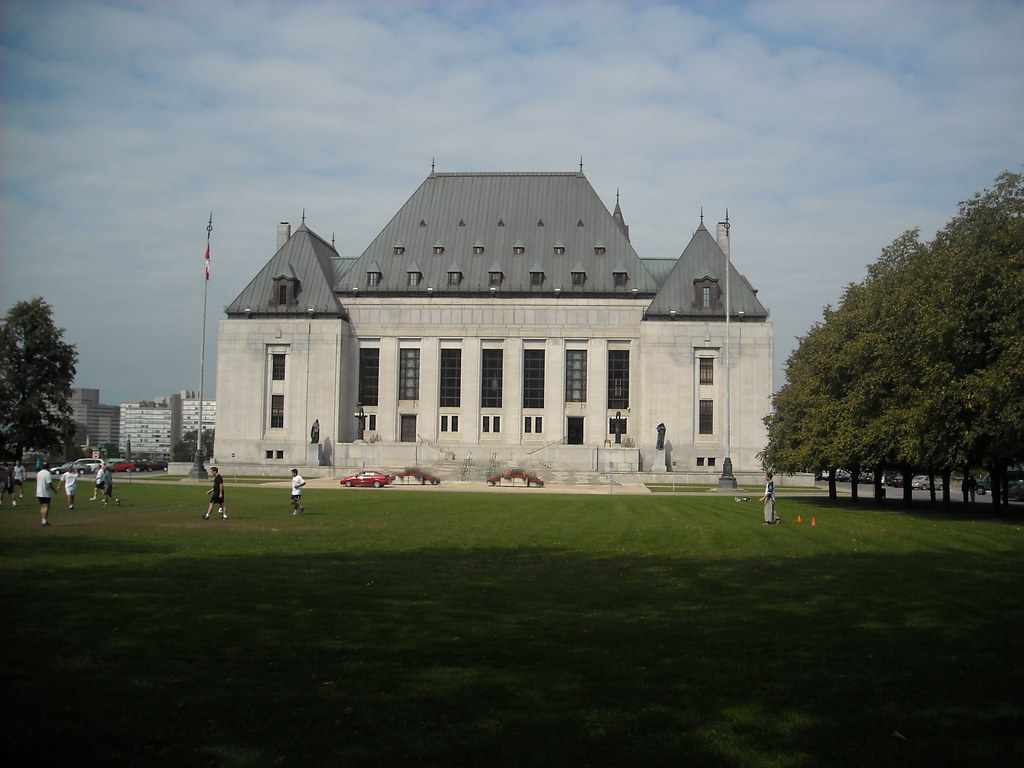
We have nothing like the First Amendment; our Supreme Court is a Leftist institution par excellence and has even decreed in effect that truth is no defense in cases where “protected groups” are insulted or offended. Paragraph 140 of a 2013 Judgment finds “that not all truthful statements must be free from restriction. Truthful statements can be interlaced with harmful ones or otherwise presented in a manner that would meet the definition of hate speech.” Section 15 (2) of the Constitution Act of 1982 abridges the rights that section 15(1) guarantees Canadian citizens.
Further, our Human Rights Tribunals are Soviet-style shadow courts that discard due process in adjudicating cases of supposed discrimination or “hate speech.” As Canadian Human Rights Commissioner Dean Steacy said: “Freedom of speech is an American concept, so I don’t give it any value.” Openness to everything except freedom of speech, chartered principle and practical reason is the hallmark of our justice system, as it is of the nation. As Carl Sagan quipped in The Demon-Haunted World: “It pays to keep an open mind, but not so open your brains fall out.”
David Solway, “The Canadian Mind: A Culture So Open, Its ‘Brains Fall Out'”, PJ Media, 2018-10-10.
April 12, 2021
The Constitution of the Spartans
Historia Civilis
Published 11 Sep 2017Patreon | http://historiacivilis.com/patreon
Donate | http://historiacivilis.com/donate
Merch | http://historiacivilis.com/merch
Mailing List | http://historiacivilis.com/mailinglist
Twitter | http://historiacivilis.com/twitter
Website | http://historiacivilis.comSources:
The Constitution of the Spartans, by Xenophon: http://amzn.to/2j7JXTB
The Moralia, by Plutarch: http://amzn.to/2gNMYHU
Parallel Lives: The Life of Lycurgus, by Plutarch: http://amzn.to/2xS29nI
Politics, by Aristotle: http://amzn.to/2wMq5ss
Rhetoric, by Aristotle: http://amzn.to/2xS3niO
Laws, by Plato: http://amzn.to/2wLpsiN
On the Republic, by Cicero: http://amzn.to/2j7Flgg
The Histories, by Herodotus: http://amzn.to/2xdH4a7
The Spartan Regime, by Paul A. Rahe: http://amzn.to/2vPmRqS
Property and Wealth in Classical Sparta, by Stephen Hodkinson: http://amzn.to/2xdV7MS
The Rise of Athens, by Anthony Everitt: http://amzn.to/2j69uMS
Persian Fire, by Tom Holland: http://amzn.to/2vPyCxEWe are a participant in the Amazon Services LLC Associates Program, an affiliate advertising program designed to provide a means for us to earn fees by linking to Amazon.com and affiliated sites.
Music:
“Air Hockey Saloon,” by Chris Zabriskie
“Candlepower,” by Chris Zabriskie
“CGI Snake,” by Chris Zabriskie
“Heliograph,” by Chris Zabriskie
“Hallon,” by Christian Bjoerklund
From the comments:
Temporary Fakename
3 years ago
You know, i thought the Roman political system was pretty odd and arcane. But the Spartans have a dual monarchy that has absolute power, except when it doesn’t, an elected Senate that is chosen partially randomly that can pass whatever the hell they want with a public assembly and punish kings, except when an all-male aristocracy decided no, a female aristocracy that is overwhelmingly rich but can’t vote, and a population so terrified of its own slaves that it ritually committed atrocities against them. Compared to that Roman politics look simple and elegant.
I found the presentation quite interesting and informative, but I felt that some discussion of the differences between the terrible plight of the Helots and the not-quite-free status of the Perioikoi was merited. I also felt that the final segment on the eventual decline of Sparta missed a major factor — Spartan military defeats in the Battle of Leuctra in 371 BC and the Battle of Mantinea in 362 BC — but reading down in the comments, I saw someone else had already brought this up:
xelena
2 years ago (edited)
This is a good video, but is missing a super important point at the end: The cause for the decline of Spartan power was its defeat by Epaminondas of Thebes and his freeing of Messenia (the land of the Helots). He also founded Messene in Messenia and Megalopolis in Arcadia for the Helots, which became a powerful check to Sparta. Spartan power never recovered from this death blow to its slave economy and continued to wither away into the nothingness you describe.Epaminondas is mostly forgotten today, but he was one of the greatest men of antiquity. It was him and Pelopidas who put to bed the myth of Spartan invincibility and freed an entire people who had been enslaved for centuries. So in a way, the crippling blow did come from other Greeks, and the Helots did participate in it.
April 10, 2021
The monarchy is a weird anachronism from our history … but it’s better than any likely replacement
I’m a very soft monarchist myself, largely for the same reasons that The Line articulates here:

Queen Elizabeth II signs Canada’s constitutional proclamation in Ottawa on April 17, 1982 as Prime Minister Pierre Trudeau looks on.
THE CANADIAN PRESS/Stf-Ron Poling
A little more seriously, though your Line editors wouldn’t describe themselves as ardent monarchists, we do believe that we shouldn’t invest much time and energy into trying to fix what ain’t broke. Canada’s system of government doesn’t always deliver optimal outcomes — we mean, look around, folks — but it is stable, reliable and proven. Given our track record at big new policies, those are three things we have absolutely zero confidence any successor system to the monarchy would be, even in the fantastically unlikely chance we could design and implement one.
Is it weird putting a ton of our reserve powers and our very sovereignty inside the living essence of an old woman on an island across the ocean? Yes. Does it work? Also yes. Would we botch any effort to replace said old lady with literally any other system? A resolute yes. The monarchy is weird, and it’s not how we’d design Canada if we were starting Canada from scratch today, but it works, folks, and these days, there’s not much else we can say that about. Further, it’s hard not to like Her Majesty. Our thoughts are with her today. Whatever your qualms with royalty or the royals may be, surely you can spare a thought to a woman who lost her husband … oh, who are we kidding? Lots of people can’t or won’t.
March 20, 2021
QotD: Flipping the table on gun ownership regulation
Heh. State representative Fred Maslack of Vermont has proposed a bill under which non-gun-owners would have to register and pay a fee. Entertainingly enough, there is actual justification for this in a careful reading of the Vermont state constitution.
The Hon. Rep. Maslack is joking. I think. And I’m against requiring people who don’t want to bear arms to do so. But gad, how tempting – because underlying his argument is a truth that the drafters of the Vermont and U.S. constitutions understood. People who refuse to take arms in defense of themselves and their neighbors are inflicting a cost on their communities far more certainly than healthy people who refuse to buy medical insurance (and yes, I do think that proposed mandate is an intended target of Maslack’s jab). That externality is measured in higher crime rates, higher law-enforcement and prison budgets, and all the (dis)opportunity costs associated with increased crime. And that’s before you get to the political consequences …
I’ve never made a secret of my evaluation that refusal to bear arms is a form of moral cowardice masquerading as virtue. Real adults know how precious human life is, when they are ethically required to risk it on behalf of others, and when killing is both necessary and justified. Real adults know that there is no magic about wearing a police or military uniform; those decisions are just as hard, and just as necessary, when we deny we’re making them by delegating them to others. Real adults do not shirk the responsibility that this knowledge implies. And the wistful thought Rep Maslack’s proposal leaves me with is … maybe if moral cowardice cost money and humiliation, there would be less of it.
Eric S. Raymond, “Maybe if moral cowardice cost money, it would be less common?”, Armed and Dangerous, 2009-11-05.
February 11, 2021
“… the entire Canadian constitution boiled down to the government saying, essentially, ‘trust us'”
Andrew Potter on the interesting and almost certainly unCanadian notion that the Prime Minister actually accept responsibility for things that happen on his watch:

Former Prime Minister Jean Chrétien speaking at the “No to the war in Iraq: 10 years later” colloquium, 15 March 2013.
Detail of a photo by Gopmtl1 via Wikimedia Commons.
The late UBC law professor Wesley Pue once remarked that the entire Canadian constitution boiled down to the government saying, essentially, “trust us.” He was speaking in the wake of the release of the Hughes Report into the APEC affair.
A refresher: In 1997 it was Canada’s turn to host the annual APEC summit, a free trade and cooperation gabfest for countries in the Pacific Rim. Prime Minister Jean Chrétien decided to hold the meeting on the campus of UBC. Given that it is probably one of the most gorgeous pieces of real estate in the country, Chrétien probably thought he was being a good host. But some UBC students objected to the presence of Indonesian dictator Suharto at their school, and so they marched, held up signs, blocked campus roads and exits, chanted slogans, the usual student protest stuff.
Chrétien was clearly embarrassed, and orders went out from the PMO to clear the roads. The Mounties started telling students their campus was now a “Charter-free zone,” arresting a bunch of them. In a notorious incident captured by CBC cameras, RCMP Staff Sgt. Hugh Stewart walked amongst the students hosing them down with pepper spray. (Asked about the incident at a press conference, Chrétien made a joke.)
The only proper investigation into the affair was led by commissioner Ted Hughes, who issued his report in the summer of 2001. Hughes found that the RCMP had behaved by turns incompetently and unprofessionally and that they had systematically violated the Charter rights of the students. Further, Hughes found that they had done so under direction from the PMO — in particular at the behest of its director of operations, Jean Carle. While Chrétien himself escaped direct censure (Hughes could find no evidence that Carle had acted on Chrétien’s explicit orders), Pue pointed out that the fundamental principle of responsible government requires that the prime minister accept responsibility for what happened. Yet Chrétien did not. He neither accepted personal responsibility, nor did he throw Carle under the bus. Instead, what happened was typically Canadian: the matter simply went away.
The APEC affair serves as a useful reminder of a fundamental truth about our system of government. As Pue noted, there are virtually no effective parliamentary or legal checks on a prime minister’s authority, and as a result it is pretty much impossible to hold our executive branch to account. We need to just trust them.
[…]
It’s worth rehearsing all of this because we are going through a rather extended “just trust us” phase in Ottawa. After shuttering parliament last spring, ostensibly to focus their energies on fighting the COVID-19 pandemic, Justin Trudeau’s Liberals spent the summer dreaming of “building back better” while fighting a ferocious rearguard action to keep MPs from finding out the truth about payments to Trudeau’s family by a charity. Trudeau has since spent the better part of the last six months governing by press conference from the front steps of his cottage, but even as the extreme levels of federal spending continue, and even as scandals and reports of gross mismanagement pile up, the Liberals have been brazenly testing the waters for a spring election.
January 10, 2021
Has the United States reached the same tipping point Canada reached in 1982?
David Warren considers the 1982 tipping point in Canada to have been the implementation of Pierre Trudeau’s Constitution:

Queen Elizabeth II signs Canada’s constitutional proclamation in Ottawa on April 17, 1982 as Prime Minister Pierre Trudeau looks on.
There are two principal political parties in modern America (in which I include up here). In the Natted States, the population is divided roughly equally between those of “progressive” and “regressive” habits of mind; in the Canadas, the former have come to dominate.
The tipping point was reached much earlier up here, and the new “metapower” (Foucault’s term) was seized, politically, from within the Liberal Party. The strategy was to disenfranchise the “conservative” half of the electorate, by undermining all national institutions, and hosing down Canada’s previous identity. I’d count, say, 1982, as the point of no return. That identity was replaced, definitively, under a revised Trudeau constitution, with a new “multicultural” identity, in which citizens were themselves redefined, from free persons whose rights were inalienable, to interchangeable clients of an omnipotent State, which could dispense rights whenever it was in the mood — and withdraw them whenever the mood changed; however frequently.
This is the Democrat strategy in the larger, and still less amenable, country next door. As Andrew Breitbart and Antonio Gramsci might agree, this is an essentially cultural process. Politics are visible at the tip of the iceberg, but “progress” requires a more thorough “cleansing,” of old cultural norms. The cancer metastasized more from Hollywood, than from Washington DC. The takeover of the Democratic Party as the vanguard “agent of change” was only part of the institutional takeover of America. As important was the takeover of the mass media, and even corporate boardrooms. Those who weren’t “progressive” would now be “cancelled”: must cease to be.
All cultural change has a religious dimension. The Democrat representatives of the “powers and principalities” mentioned by Saint Paul, are characteristically godless, themselves. But they depend on a massive, core constituency of low-information, low-intelligence, easily manipulated urban voters.
Those who can still see the stars at night tend to remain in the ancient, God-fearing default. In the cities, where the masses may not grasp that milk comes from cows, let alone that someone must milk them, the belief that the economy is based on government cheques is more common. That is the god of the populous cities, and for most city-dwellers, not voting for their “godless god” of progress, seems a kind of heresy.
The idea that such heretics should be deprived of their freedom, starting with freedom of speech, does not appeal to the “rural” voter, including people like me — a “country hick” type who paradoxically lives in the city. The idea that laws and constitutions should be flexible, to accommodate the latest schemes of a progressive technocratic élite, doesn’t flourish among us country bumpkins. But to the efficiency experts in the city, what is our problem?