The Cynical Historian
Published 10 Oct 2020Thanks to Private Internet Access for sponsoring this video. Click here to get 77% off and 3-months free: http://www.privateinternetaccess.com/…
We’ve been seeing a lot of coverage about the post office here in the United States. A lot of folks talk about the history of it, but generally in a piecemeal fashion. The fact most of this commentary lacks is that the post office has always been a political tool, from its beginnings even before the US Constitution. Interestingly enough, what it has been used for over the years has changed substantially, but it is always a harbinger of the up and coming dominant ideology. The post office is a cornerstone of our democracy. The postal system in the United States is uniquely important.
Check out Mr. Beat’s video: https://www.youtube.com/watch?v=favVdKa6cRQ
————————————————————
Connected videos:
3:30 – 1776 | Based on a True Story: https://youtu.be/xY4Te8Qm07A
9:15 – What caused the Mexican-American thing? https://youtu.be/HTmSN4Exci0
9:15 – What Caused the Texas Revolution? https://youtu.be/lDWH-DC74Pk
9:25 – California Gold Rush: https://youtu.be/W1dmyx6LBKA
9:30 – History of California: https://www.youtube.com/playlist?list…
11:30 – The Sectional Crisis: https://youtu.be/Ff2AKILyi0o
14:05 – History of Voting by Mail: https://www.youtube.com/watch?v=favVd…
18:25 – Trains and Oil in California: https://youtu.be/0Ef0Ir-hbFc
18:30 – The History of Early Flight: https://youtu.be/sPgxuD0uYYE
20:35 – US Veterans History: https://youtu.be/ANUqaNykuRs
————————————————————
references:
The United States Postal Service: An American History (Washington, DC: United States Postal Service, 2020). https://about.usps.com/publications/p… [PDF]USPS’s website has a trove of information on their history: https://about.usps.com/who-we-are/pos…
The national postal museum is run by the Smithsonian and includes numerous research articles available to anyone on their website: https://postalmuseum.si.edu/research-…https://www.nationalgeographic.com/hi…
————————————————————
Support the channel through PATREON:
https://www.patreon.com/CynicalHistorian
or by purchasing MERCH: teespring.com/stores/the-cynical-hist…
LET’S CONNECT:
Discord: https://discord.gg/Ukthk4U
Twitter: https://twitter.com/Cynical_History
Subreddit: https://www.reddit.com/r/CynicalHistory/————————————————————
Wiki: The United States Postal Service (USPS; also known as the Post Office, U.S. Mail, or Postal Service) is an independent agency of the executive branch of the United States federal government responsible for providing postal service in the United States, including its insular areas and associated states. It is one of the few government agencies explicitly authorized by the United States Constitution.
The USPS traces its roots to 1775 during the Second Continental Congress, when Benjamin Franklin was appointed the first postmaster general. The Post Office Department was created in 1792 with the passage of the Postal Service Act. It was elevated to a cabinet-level department in 1872, and was transformed by the Postal Reorganization Act of 1970 into the United States Postal Service as an independent agency. Since the early 1980s, many direct tax subsidies to the USPS (with the exception of subsidies for costs associated with disabled and overseas voters) have been reduced or eliminated.
————————————————————
Hashtags: #history #USPS #USMail
January 6, 2021
The Use and Abuse of the US Postal System (feat. Mr. Beat)
November 12, 2020
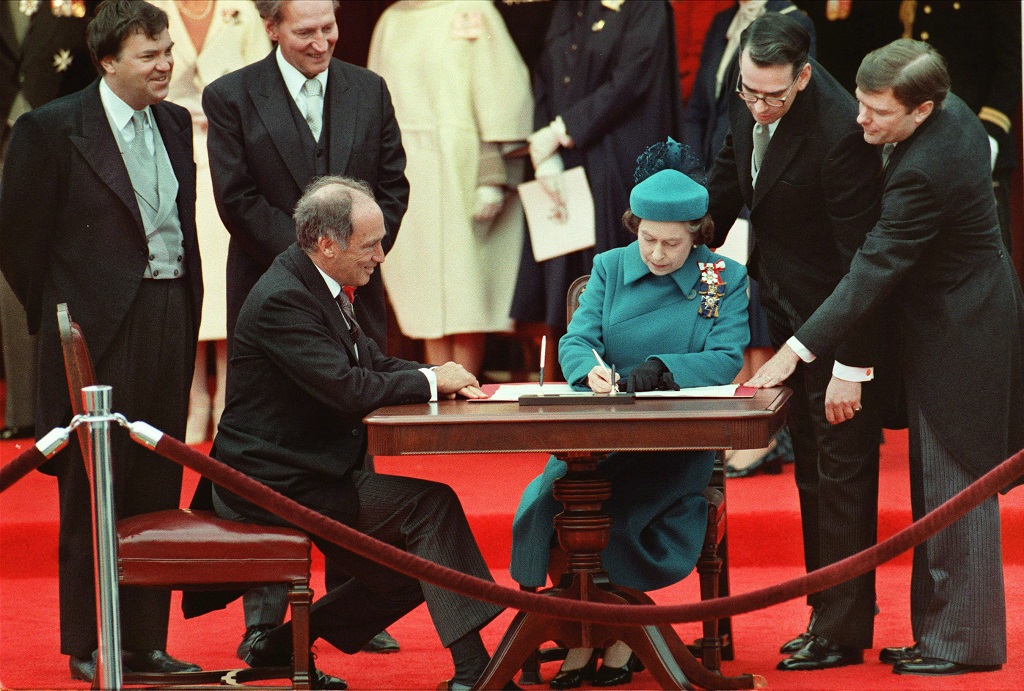
The history of Canada explained in 10 minutes
Epimetheus
Published 19 Jan 2019The history of Canada explained in 10 minutes
Support new videos on this channel on Patreon! 🙂
https://www.patreon.com/Epimetheus1776Canadian history from the discovery of the Vikings to the French and English colonization until modern times.
Tags:
Canadian history documentary, Canadian history crash course, Canada history, history of Canada documentary, history Canada summarized, Canada, history, Canadian history, Canadian American history, animated history of Canada, canadian history in a nutshell, canadian history for kids, educational, Canada Indians, Canada great Britain, English Canada, Quebec, French Canada, French English Canada,
November 10, 2020
The amazing mental gymnastics that lead to the US Supreme Court’s unanimous decision in Wickard v. Filburn in 1942
Antony Davies and James R. Harrigan explain how a farmer growing wheat on his own land to feed his own cattle somehow transmogrified into an interstate commerce activity that could be regulated by the federal government:

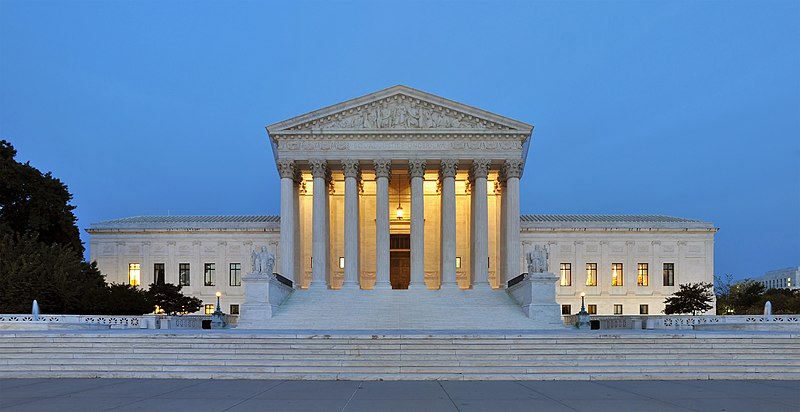
Panorama of the west facade of United States Supreme Court Building at dusk in Washington, D.C., 10 October, 2011.
Photo by Joe Ravi via Wikimedia Commons.
… who ended up being tasked with deciding what Article One, Section Eight actually meant? Herein lies the wrinkle that enables all manner of constitutional mischief in the United States. The institution that ended up deciding what the federal government is empowered to do is itself a branch of the federal government. And it should come as no surprise that when push comes to shove, the Supreme Court routinely finds in favor of empowering the federal government.
This sort of mischief flowered fully in the decade following ratification of the 21st Amendment. In 1942, the Supreme Court decided a case, Wickard v. Filburn, in which farmer Roscoe Filburn ran afoul of a federal law that limited how much wheat he was allowed to grow.
A careful reader might, and should, ask where the federal government’s right to legislate the wheat market is to be found — because the word “wheat” is nowhere to be found in the Constitution. Be that as it may, the federal government’s aim was clear enough. It was to keep the price of wheat high enough for farmers to remain profitable. The Agricultural Adjustment Act of 1938 put an upper limit on how much wheat farmers were allowed to grow, which would serve to keep prices high by limiting supply.
Roscoe Filburn had grown 12 more acres of wheat than the law allowed. But not only did he not sell the excess wheat outside of his home state, but he also didn’t sell it at all. He used the wheat from those 12 acres to feed his cattle. Filburn was very clearly not engaging in commerce, let alone interstate commerce, yet the Supreme Court found (unanimously) that because Congress had the authority to regulate interstate commerce, Congress also had the authority to prohibit Filburn from growing those 12 acres of wheat for his own use. The Supreme Court’s “reasoning”?
Had Filburn not fed his cattle that excess wheat, he would have been forced to purchase wheat on the open market. And even if he purchased wheat that was grown within his home state, doing so would have made less wheat available within his home state for other wheat buyers. Consequently, some wheat buyers within his home state would then have had to buy wheat from outside the state. Therefore, Filburn’s non-commercial activity was, according to the Supreme Court, interstate commerce.
The mental gymnastics that went into this ruling made just about any activity interstate commerce by definition. Since Wickard, any time Congress has wanted to exercise power not authorized by the Constitution, lawmakers have simply had to make an argument that links whatever they want to accomplish to interstate commerce. Why? Because they know they can get away with it.
October 15, 2020
This is what happens when politicians delegate too much of their powers to the courts
At the Foundation for Economic Education, Lawrence W. Reed recounts the stunning injustice of Soviet “justice”, in the person of Nikolai Krylenko:

Panorama of the west facade of United States Supreme Court Building at dusk in Washington, D.C., 10 October, 2011.
Photo by Joe Ravi via Wikimedia Commons.
As I watched the first day of hearings on Judge Barrett’s nomination, I was reminded of a largely forgotten Soviet legal theoretician from decades ago. His name was Nikolai Krylenko. Judge Barrett is being given the Krylenko treatment by Democrat senators like Cory Booker and Kamala Harris, meaning this: The only thing that matters is whether she will vote their party line in future cases.
Under the communist dictatorship of Lenin and then Stalin, Krylenko (1885-1938) rose through the Soviet Union’s legal system to become People’s Commissar for Justice and a Prosecutor General. He was a leading practitioner of the theory of “socialist legality,” which held that an accused person’s innocence or guilt depended on that person’s politics (real or imagined). It sounds nuts and indeed, it was. It was the stuff of Orwell’s nightmare, and one of the reasons the Soviet Union thankfully perished of its own poison.
In The Gulag Archipelago, the famous Soviet dissident and Nobel laureate Aleksandr Solzhenitsyn recounted an episode involving Krylenko. Shortly after Lenin’s Bolsheviks assumed power in 1917, an admiral named Shchastny was sentenced by one of the regime’s judges “to be shot within 24 hours.” When some in the courtroom expressed shock, it was Krylenko who responded thusly: “What are you worrying about? Executions have been abolished. But Shchastny is not being executed; he is being shot.”
To Krylenko, the only morality was what served the Party and the State, which of course in the Soviet Union were one and the same. If your politics were not correct, you would be “corrected,” one way or the other. In Richard Pipes’ authoritative book, The Russian Revolution, Krylenko is quoted as exclaiming, “We must execute not only the guilty. Execution of the innocent will impress the masses even more.”
At the Senate hearings for the Barrett nomination, it was apparent the first day that the Judge was being Krylenkoed. Hostile senators pronounced their verdicts before she had uttered a word, and those verdicts had nothing to do with Barrett’s stellar qualifications or keen legal mind. Legal analyst and George Washington University Law School professor Jonathan Turley commented,
What they were suggesting is that they will be voting against her because of what they expected her vote would be in a pending case, and that is a conditional confirmation … Here, the senators seem to be saying, “I’m not even going to listen; I’m going to vote against you because I don’t think you’re going to vote the right way …”
Judge Barrett clearly articulated her judicial philosophy, borne out by the way she has ruled at the US Court of Appeals for the Seventh Circuit: She believes the role of a judge or justice is to follow the Constitution and the law as written, not make stuff up in the service of a political agenda. How ironic that this is a point of fiery contention. Senators who swore an oath to uphold the Constitution and the law hate the guts of a judge who does just that!
October 7, 2020
QotD: The gullible generation
World War II, which I have described (in The Probability Broach) as a struggle between competing brands of fascism, was much the same thing. For the beleaguered people of Europe, it meant being forced to choose between Adolf Hitler and Josef Stalin. Would you rather be shot or gassed?
For Americans, it meant looking for protection by a political regime so grossly and criminally corrupt that future historians will shake their heads, wondering how an entire people could be such suckers. “The Greatest Generation”, that miserable collectivist mouthpiece Tom Brokaw has called them. Looking back over what my father told me of his life, how his family suffered in the government-caused Great Depression, how he and his comrades risked unspeakable danger in the war, and how he became a prisoner in Germany — all to aggrandize the virtual godhood of Franklin Delano Roosevelt — I call them “The Gullible Generation”.
On the other hand, people loved the Roosevelt Administration so much that they passed a Constitutional amendment to make sure that no sonofabitch could ever be elected to more than two Presidential terms again.
World War II gave government complete, dictatorial control of American society, control of industry, control of communications, control of the economy, control that Roosevelt had desperately lusted after before the war, but failed to achieve. If anyone objected, or insisted on his rights under the Constitution, all the other side had to say was, “Don’t you know there’s a war on?”
The government enjoyed that level of control. Once the war was won, and people looked forward to a period of peace, the government plunged us into the Korean War, Vietnam, and an increasing number of undeclared and stupid conflicts in order to retain its power. “Don’t you know there’s a war on?” never worked quite as well as it had to shut dissenters up, but it’s clear that this scam will go on and on and on until something drastic is done to stop it.
L. Neil Smith, “The Deep State”, Libertarian Enterprise, 2019-04-14.
October 2, 2020
The “Catch-22” in RBG’s majority opinion in City of Sherrill V. Oneida Indian Nation of N.Y.
In The Line, Meaghie Champion outlines the awkward position the Oneida First Nation found itself in after their case made it to the US Supreme Court:

Panorama of the west facade of United States Supreme Court Building at dusk in Washington, D.C., 10 October, 2011.
Photo by Joe Ravi via Wikimedia Commons.
In 2005, in the case of the City of Sherrill V. Oneida Indian Nation of N.Y., the U.S. Supreme Court ruled against the Oneidas, after the nation had attempted to assert sovereignty in traditional land they had to re-purchase after it had been illegally acquired.
Writing the majority position was the late liberal figurehead now being lionized in U.S. media — Ruth Bader Ginsburg.
Granted, she fought for women’s rights and accomplished a lot. She was a law school professor and a judge. She was one of the leaders of the American Civil Liberties Union. She was the second woman to ever serve on the United States Supreme Court. She was influential in a lot of cases on the Supreme Court, including a labour law case that inspired a law to be passed, and an environmental case that set new standards for who could be heard in court on environmental issues. Since her recent death, the news coverage has been singing her praises like hagiography.
But study history and you will find lots of villains, and no saints. Many First Nations people in North America look on Ginsburg’s reification with a much more skeptical eye.
Meanwhile, the sovereignty of many Indigenous nations in B.C. has never been extinguished. Many First Nations here are being corralled into signing treaties that give up lands, rights and sovereignty. They may look to the Oneida as a cautionary tale. When it comes to sovereignty, you must use it or lose it. Don’t look to courts to give it back later. Not even when you have a social justice saint for a judge.
Ginsburg ruled that Indian land in central New York acquired in violation of U.S. federal law, a treaty, and the U.S. Constitution, could not be reintegrated into the ancestral lands of the Oneida Indian Nation — that the Oneidas would be required to pay property taxes to the local government of the City of Sherill. That is, unless the Oneidas sacrificed that land and allowed the federal government to administer it as a trust.
Justice Ginsburg wrote that 200 years had passed since the initial illegal acquisition, the land had passed hands between jurisdictions multiple times over the period, and that the Oneida had just waited too long. (Even though the U.S. Supreme Court acknowledged in 2005 that there was no specific time limit on this kind of case.) She claimed in her opinion that it would just be “unfair” to the non-natives in this case. If the Oneida had sued in court sooner, then it would have been different.
In the long and fraught web of relationships between First Nations and the United States government, it’s hard to pick a time before the late 20th century or early 21st where a First Nations case might be given full and fair hearing by any federal court, which shows Ginsburg’s opinion to be … lacking in historical sensitivity.
October 1, 2020
Supreme Court Shenanigans!
September 30, 2020
August 26, 2020
QotD: The U.S. Supreme Court
During almost every Supreme Court nomination battle, I try to make the same point: These fights wouldn’t be nearly so ugly if we didn’t invest so much power in the Supreme Court it shouldn’t have in the first place.
Until the Robert Bork nomination in 1987, Supreme Court fights were remarkably staid affairs. But by the late ’80s, the court had become a bulwark for all sorts of policies and laws that should rightly be in the portfolio of the legislative or executive branch, or, better, left to the various states. As a result, on any number of issues — most conspicuously abortion policy — the court became more important than the presidency or Congress. No wonder fights over Supreme Court appointments started to look more and more like political campaigns than debates over the finer points of judicial philosophy.
Jonah Goldberg, “Concentrated Power Inevitably Leads to Political Backlash”, Townhall.com, 2018-05-11.
August 24, 2020
How to rectify a serious error the Founding Fathers made in the US Constitution
In the latest Libertarian Enterprise, L. Neil Smith suggests that despite his respect for the founding fathers, they made a couple of serious mistakes in drafting the Constitution and it needs fixing quickly:
Founders’ Mistake Number Two: lies in the enumeration of the powers of Congress, to wit:
“They [congress] shall in all Cases, except Treason, Felony and Breach of the Peace, be privileged from Arrest during their Attendance at the Session of their respective Houses and in going to and returning from the same; and for any Speech or Debate in either House, they shall not be questioned in any other Place.”
With those fifty-four words, the Founding Fathers gave birth to a permanent criminal class, as surely as the city councils of Seattle, Minneapolis. Philadelphia, New York, and Portland. Even “treason, felony, and breach of the peace” are for all practical purposes excepted, now, or three quarters of these miscreants would be languishing in prison. That heinous, stupid clause must be repealed or rewritten at once.
For many years, I have advocated reopening Alcatraz strictly for government criminals, although lately it occurs to me that Antarctica might be even better. Cash-poor Russia and the other two-for-a-nickel satrapies that lay claim to slivers of that frozen continent would give them up for thirty-seven cents and a good bus token. And I kind of like the ring of “McMurdo Sound Federal Penitentiary”.
But, as usual, I have, once again, digressed.
Another cure — with similar delightfully frostbitten consequences — might be to incorporate United States Code, Sections 241 and 242 directly into the Bill of Rights, probably as Amendment Zero. They establish the crimes of depriving folks of their rights “under color of law”, conspiring to deprive them of their rights under color of law, and prescribe extremely specific penalties.
To my knowledge, those laws are never properly applied, and that is a travesty and a tragedy. Make them an Amendment, and they might prove more effective. I would consider every American deprived of his or her rights to represent a separate punishable offense. How about three billion years in the freeze-dried slammer, Nancy, for your decades of malfeasance, misfeasance, nonfeasance, upfeasance, and downfeasance as a member in evil standing of the Viet Congress?
August 12, 2020
June 27, 2020
Maximilien Robespierre: The Reign of Terror
Biographics
Published 5 Jul 2018Maximilien Robespierre promised to usher a fairer, more representative form of government to the French people. What they got was a reign of terror that saw thousands facing the horror of the guillotine.
Visit our companion website for more: http://biographics.org
Credits:
Host – Simon Whistler
Author – Steve Theunissen
Producer – Jack Cole
Executive Producer – Shell HarrisBusiness inquiries to biographics.email@gmail.com
June 20, 2020
Opposition to home schooling is merely a side-issue for those who want government to control everything
Kerry McDonald recently took part in a debate with a Harvard academic who has called upon governments to ban homeschooling. She’s written up some of the things she took away from the discussion and from the many questions submitted before the event:
While this event was framed as a discussion about homeschooling, including whether and how to regulate the practice, it is clear that homeschooling is just a strawman. The real issue focuses on the role of government in people’s lives, and in particular in the lives of families and children. In her 80-page Arizona Law Review article that sparked this controversy, Professor Bartholet makes it clear that she is seeking a reinterpretation of the US Constitution, which she calls “outdated and inadequate,” to move from its existing focus on negative rights, or individuals being free from state intervention, to positive rights where the state takes a much more active role in citizens’ lives.
During Monday’s discussion, Professor Bartholet explained that “some parents can’t be trusted to not abuse and neglect their children,” and that is why “kids are going to be way better off if both parent and state are involved.” She said her argument focuses on “the state having the right to assert the rights of the child to both education and protection.” Finally, Professor Bartholet said that it’s important to “have the state have some say in protecting children and in trying to raise them so that the children have a decent chance at a future and also are likely to participate in some positive, meaningful ways in the larger society.”
It’s true that the state has a role in protecting children from harm, but does it really have a role in “trying to raise them”? And if the state does have a role in raising children to be competent adults, then the fact that two-thirds of US schoolchildren are not reading proficiently, and more than three-quarters are not proficient in civics, should cause us to be skeptical about the state’s ability to ensure competence.
I made the point on Monday that we already have an established government system to protect children from abuse and neglect. The mission of Child Protective Services (CPS) is to investigate suspected child abuse and punish perpetrators. CPS is plagued with problems and must be dramatically reformed, but the key is to improve the current government system meant to protect children rather than singling out homeschoolers for additional regulation and government oversight. This is particularly true when there is no compelling evidence that homeschooling parents are more likely to abuse their children than non-homeschooling parents, and some research to suggest that homeschooling parents are actually less likely to abuse their children.
Additionally, and perhaps most disturbingly, this argument for more state involvement in the lives of homeschoolers ignores the fact that children are routinely abused in government schools by government educators, as well as by school peers. If the government can’t even protect children enrolled in its own heavily regulated and surveilled schools, then how can it possibly argue for the right to regulate and monitor those families who opt out?
June 11, 2020
QotD: Equal rights
We must separate the moral dimensions of a subject from the empirical questions surrounding it. For example, on the radioactive issue of sex (or gender) differences in cognitive abilities, there is the empirical question of whether or how men and women diverge in certain tasks, and then there is the moral question of how men and women should be treated. Empirically, there is much evidence that in some tasks women excel over men, and in other tasks, men excel over women. For example, women are more dexterous while men are better at throwing; women are superior in visual memory whereas men are better at mentally rotating shapes; women are better at mathematical calculation while men are better at mathematical problem-solving; in terms of overall general intelligence (g), however, there is no gender difference. Morally, however, none of this matters. We should support women’s rights regardless of any physical or cognitive differences between the sexes. To yoke one’s moral evaluation to empirical questions like this is a big mistake; worse is to assume that this is what people always do and therefore we must suppress any empirical evidence that there are differences, as this will only tilt people’s moral judgments toward empirical outcomes.
This reminds me of the debate in the late 1980s through mid-1990s about whether homosexuality was nature or nurture, something you were born to be or a lifestyle choice. Conservatives and Christians argued for the “choice” position and this led to efforts to “convert” gays to straight (or “pray the gay away”) because something that is learned can be unlearned. This led the gay community and supporters thereof to argue for the “born this way” position. The cumulative evidence from multiple lines of inquiry led to the nature position more than that of nurture, but this was another example of confusing the empirical question of the origin of homosexuality with the moral question of the rights of gays and lesbians (today the LGBTQ community). It should go without saying — but unfortunately in these times it must be said again and again — it doesn’t matter what the origins of homosexuality turn out to be, gays and lesbians and everyone else in the LGBTQ community are entitled to the same rights and privileges as everyone else protected by the constitution of their nation (and those nations that have yet to extend legal rights to gays and lesbians need to change their constitutions).
Michael Shermer, interviewed by Claire Lehmann, “The Skeptical Optimist: Interview with Michael Shermer”, Quillette, 2018-02-24.
June 5, 2020
Australia’s 1975 constitutional crisis back in the news
Colby Cosh outlines the events of 1975, where the Governer-General of Australia, Sir John Kerr, used his reserve powers to dismiss the government of Gough Whitlam and call for a fresh federal election in which Whitlam’s party was soundly defeated. In taking this action, Sir John corresponded with Queen Elizabeth and after his retirement deposited those documents with the National Archives. The bulk of his papers were made available to researchers after the statutary 30 year delay, but the letters involving Her Majesty were withheld for 60 years. An Australian historian has now successfully challenged the National Archives in Federal Court:

National Archives of Australia in Parkes, Australian Capital Territory.
Photo by Bidgee via Wikimedia Commons.
The confrontation at Yarralumla, and the various narrative twists and turns leading up to it, are a major event in Australian constitutional history. Which brings us to Jenny Hocking, a left-leaning historian who is a top specialist on the 1975 crisis.
Hocking knew that Kerr, after his retirement, had deposited copies of his correspondence with the Queen in Australia’s National Archives. Hocking made good professional use of Kerr’s formal papers, made available to the public in 2005 under the 30-year rule that covers Australian state papers. But Kerr had, with the agreement of the Archives, made separate arrangements for his letters to and from the Queen — the so-called “(Buckingham) Palace letters”.
[…]
The National Archives, trying to stand by its bargain with Kerr as a donor, successfully argued that while papers generated or received by “the official establishment of the Governor-General” would clearly be ordinary public records under Australian law, the letters that Hocking wanted to see didn’t involve “the official establishment,” but merely Kerr himself as … well, just a guy. The Federal Court found that the Palace letters therefore had the legal status of one of Sir John’s grocery bills, or sex diaries, or anything else that he would be perfectly entitled to stick in a locked box for 50 years.
(Or to burn in private. Which was an option he had, but rejected, explaining explicitly that he wanted future historians to have access to the material. But not for them to have it so soon that it might surprise or embarrass the Queen during her own lifetime.)
What happened last week was that the case reached Australia’s top court and Hocking won a smashing victory. Kerr’s correspondence with the Queen is known to have contained discussions of the Australian constitutional situation, and in view of that, the High Court said, the Federal Court’s distinction between Commonwealth records and personal correspondence must be regarded as a bogus artifice. The concepts aren’t mutually exclusive.
The Archives also asserted that queen-viceroy letters attract a higher level of secrecy “by convention” in all the Queen’s realms, but they couldn’t produce evidence that such a convention exists. Hocking’s costs must be covered by the Archives, and as far as the letters go, the ball is in their court legally. They could still use a “national security” exemption to withhold some of the material, and the freedom with which this magic formula is used by archival gatekeepers is notorious. But it may soon be possible for Australians to read the final chapter of the cataclysmic Kerr-Whitlam story.