Quotulatiousness

June 1, 2020

QotD: The right to keep and bear arms

Filed under: Law, Liberty, Quotations, USA — Tags: , , , , — Nicholas @ 01:00

The bureaucrat who commands an army of over forty-nine thousand armed men and women (the largest police force in the world, slightly more than three Army divisions) in its century-old struggle against the Bill of Rights, has loftily decreed on 60 Minutes, the famous CBS newsish show, that it is “insanity” to “allow” national concealed carry reciprocity for law-abiding citizens. This according to an article that appeared this week on the Breitbart website, written by their distinguished Second Amendment specialist, A.W.R. Hawkins.

The bureaucrat in question is New York Police Department Commissioner James O’Neill, an individual who clearly believes that his thirty-five years spent plodding unspectacularly up the NYPD chain of command equips him better to tell you what your rights are, and what they are not, than the Founding Fathers of this country and the Framers of its unique social contract.

Well I’ve got news for you, Jimmy, there is no “allow”.

“Every man, woman, and responsible child has an unalienable individual, civil, Constitutional, and human right to obtain, own, and carry, openly or concealed, any weapon — rifle, shotgun, handgun, machine-gun, anything — any time, any place, without asking anyone’s permission.”* That’s the essential freight of the Second Amendment to the United States Constitution, the highest law of the land, which you and yours have been illegally suppressing since passage of the 1911 Sullivan Act, named for Tammany Hall’s Timothy Sullivan, perhaps the most corrupt, bigoted politician ever to occupy office in New York.

Since the ability to own and carry weapons unmolested by the State is a fundamental right, there can be no thought of any unit of that state “allowing” it or not “allowing” it. Any government employee who attempts to interfere with that right deserves a long stay in prison among those whose rights he’s violated. Note that I am not saying that peace and civil order are a bad thing, just that it has to be achieved within Constitutional parameters. The Founders put them there for a reason; they had seen the rule of law abused too often by arrogant and brutish British authorities.

* “The Atlanta Declaration”, L. Neil Smith, 1987

L Neil Smith, “There Is No ‘Allow’, Jimmy”, Libertarian Enterprise, 2018-02-18.

May 19, 2020

The Karenist coup

Filed under: Government, Health, Law, Liberty, USA — Tags: , , , , , , — Nicholas @ 03:00

L. Neil Smith on our current self-inflicted plight:

We find ourselves here, in this particular time and this particular place in the history of our republic, because of a 239-year-old oversight made by the Founding Fathers, in that the first ten amendments to the United States Constitution, commonly known as the Bill of Rights (the name itself is a mistake), contain no penalty clause for those — politicians, bureaucrats, policemen — who violate them. I’m not entirely sure it was accidental, but, as a result, they are violated daily, hourly, as a matter of course, and this Corona Virus farce — many others come to mind — is simply the most recent and most preposterous example.

(The name itself is an error because this document is not a mere list of privileges that the government generously lets the people exercise. Quite the opposite, it is a list of things that the government is absolutely forbidden to do It should have been called the “Bill of Limits”. And if the Founders, who had just fought and won a desperate, bloody war against the world’s most brutal and rapacious super-power, hadn’t meant them to be absolute, then why — for all you “living document” idiots out there — would they have even bothered to write them down?)

All over this bruised and battered country, a flock of mean, moronic, petty tyrants have issued illegal orders to those they clearly regard as the peasantry: stay home, avoid your fellow human beings, and above all, shut down the Machinery of Freedom which we know as capitalism. If it’s ever allowed to start up again, it must strictly be on terms that are essentially Marxist in character. No mere individual can ever again scratch his ass without written government approval and permission. In effect, the left has the revolution — as usual, achieved by somebody else — it has wanted for 180 years, since the days of Pierre-Joseph Proudhon.

What’s more, many otherwise decent and intelligent folks are out there begging for their rulers to let them be free again. I find that repulsive and unAmerican. And to those boobies (including Sean Hannity and Joy Behar) blubbering about patriots bring their weapons to demonstrations, listen up: the Founders meant the government to be intimidated by the people, you hapless buffoons.

My bottom line, here, is that, in the short run, we must free ourselves — now — from what we have to call Faucism. Scientific pleaders like the dictatorial doctor must be made painfully aware that when their pronouncements have clear political and economic consequences, their protests of innocence sound a bit too much like “I was just following orders”.

March 4, 2020

QotD: Tax cuts “for the rich”

Filed under: Americas, Economics, Politics, Quotations, USA — Tags: , , , , — Nicholas @ 01:00

I keep hearing about how tax cuts are “giveaways” for the rich. Never mind that some rich people will see their taxes go up. This is philosophically grotesque. The people saying it may be more civilized and restrained than the pro-government mobs in the streets of Caracas, but it’s still basically the same idea: “The People” or “the nation” own everything. The state is the expression of the peoples’ spirit or of the nation’s “will”, and therefore it effectively owns everything. Thus, taking less money from you is the same as giving you more money.

This is why populism and nationalism, taken to their natural conclusions, always lead to statism. The state is the only expression of the national or popular will that encompasses everybody. So, the more you talk about how the fundamental unit of society is a mythologized collective called “The People” or the nation, the more you are rhetorically empowering the state.

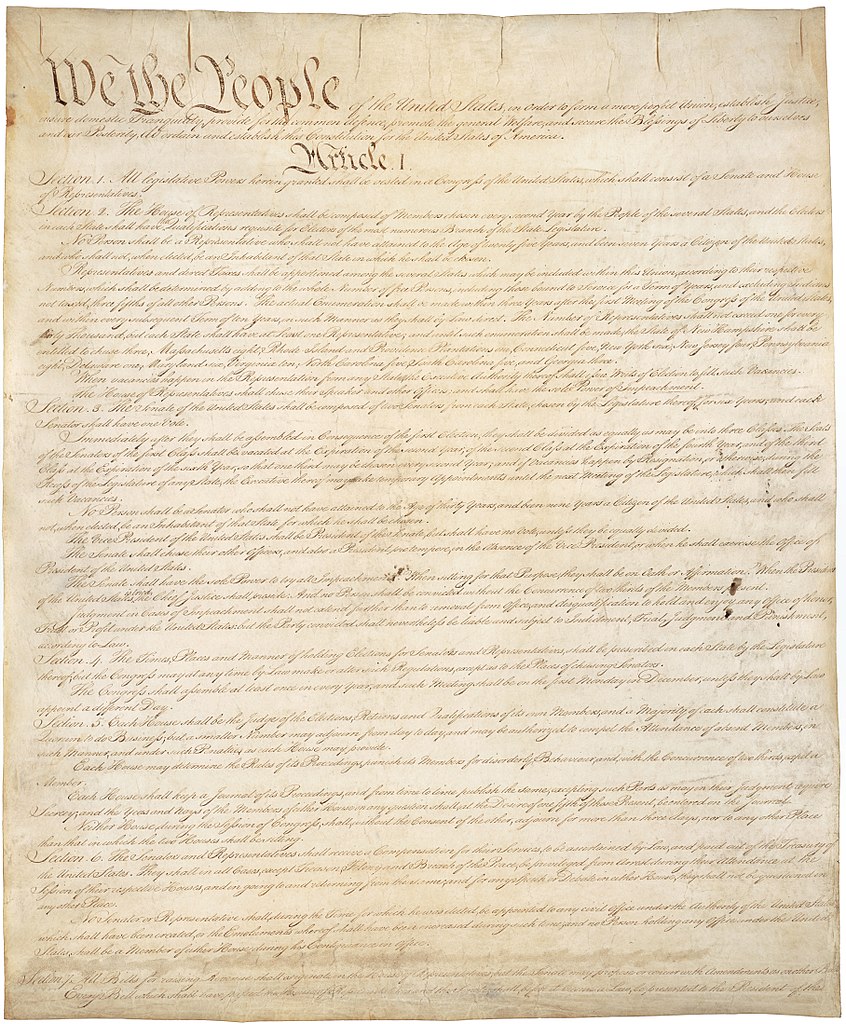
Sure, the Constitution begins with the words “We the People,” but that is not a populist sentiment — it’s a statement of precedence in terms of authority: The people come before the government (not the European notion of the state). The spirit of the Constitution is entirely about the fact that The People are not all one thing. It places the rights of a single person above those of the entire federal government! It assumes not only that the people will disagree among themselves, but that the country will be better off if there is such disagreement. No populist frets about the tyranny of the majority. American patriots do.

But if you recognize that humans create wealth with their brains and their industry and that it therefore belongs to them, you’ll be a little more humble about the state’s “right” to take as much as it wants to spend how it wants. Human ingenuity is the engine of wealth creation, and there is no other.

But that doesn’t mean government doesn’t play a role. Because, as I said, there will be no wealth creation if there is no rule of law. There will be no investment or ingenuity if there is no guarantee that you will be able to collect on that investment or reap the benefits of your innovation. Without such an environment, the biggest mob wins. And when the mob wins, children starve to death in what should be one of the richest countries in the world.

Jonah Goldberg, “America and the ‘Original Position'”, National Review, 2017-12-22.

January 21, 2020

The United States Goes Dry – Alcohol Prohibition I THE GREAT WAR

Filed under: Britain, Health, History, Law, Liberty, Russia, USA — Tags: , , , , , — Nicholas @ 04:00

The Great War
Published 20 Jan 2020

In January 1920, after one year of preparation, the 18th Amendment to the US Constitution went into effect. From now on alcohol prohibition was the law.

» SUPPORT THE CHANNEL
Patreon: https://www.patreon.com/thegreatwar
Merchandise: https://shop.spreadshirt.de/thegreatwar/

» SOURCES
Ehmer, K. and Hindermann, B. (2015). The School of Sophisticated Drinking. New York: Greystone Books.
Miron and Zwiebel, “Alcohol Consumption During Prohibition”. In the American Economic Review, Vol. 81, No. 2, pp. 242-247, (May 1991).
Darrow, Clarence, and John Haynes Holmes. Debate On Prohibition. Haldeman-Julius Co., 1924.
Iorizzo, Luciano J. Al Capone. Greenwood Press, 2003.
Nemtsov, Aleksandr. A Contemporary History of Alcohol in Russia. Stockholm, 2011.
Sullivan, Edward D. Rattling the Cup on Chicago Crime. New York: The Vangaurd Press, 1929.
United States Government, “Codification of Internal Revenue Laws, … Published Pursuant to Section 1203(c) Revenue Act of 1926”.
18th Amendment to the Constitution of the United States. https://www.loc.gov/rr/program/bib/ou…
United States Department of Agriculture. “Crop Production Historical Track Records, 2018”. https://www.nass.usda.gov/Publication…
Kamieński, Łukasz: “Drugs”, in: 1914-1918-online. International Encyclopedia of the First World War, ed. by Ute Daniel, Peter Gatrell, Oliver Janz, Heather Jones, Jennifer Keene, Alan Kramer, and Bill Nasson, issued by Freie Universität Berlin, Berlin 2019-03-07
Blocker, Jack S Jr. “Did prohibition really work? Alcohol prohibition as a public health innovation.” American Journal of Public Health vol. 96,2 (2006): 233-43.

» SOCIAL MEDIA
Instagram: https://instagram.com/the_great_war
Twitter: https://twitter.com/WW1_Series
Reddit: https://reddit.com/r/TheGreatWarChannel

»CREDITS
Presented by: Jesse Alexander
Written by: Mark Newton
Director: Toni Steller & Florian Wittig
Director of Photography: Toni Steller
Sound: Toni Steller
Editing: Toni Steller
Mixing, Mastering & Sound Design: http://above-zero.com
Maps: Daniel Kogosov (https://www.patreon.com/Zalezsky)
Research by: Jesse Alexander
Fact checking: Florian Wittig

Channel Design: Alexander Clark
Original Logo: David van Stephold

A Mediakraft Networks Original Channel

Contains licensed material by getty images
All rights reserved – Real Time History GmbH 2020

December 8, 2019

The “Church of Atheism” doesn’t get charitable status … this time

Filed under: Cancon, Law, Religion — Tags: , , , , , — Nicholas @ 03:00

Colby Cosh on the recent court decision on the Church of Atheism’s attempt to qualify as a church — and receive the tax benefits — under Revenue Canada’s rules:

“The Descent of the Modernists”, by E.J. Pace, first appearing in his book Christian Cartoons, published in 1922.
Public domain via Wikimedia Commons.

Last week the Federal Court of Appeal upheld Revenue Canada’s rejection of an application for charitable status made by a “Church of Atheism” tucked away in Ontario’s Lanark Highlands. The idea of making a gesture like this has probably occurred to every atheist who looks around at a world of tax-exempt churches and wonders why his kind is excluded from the gravy train. (Clergymen pay tax on their income, but they have access to a generous residential deduction, and any professional expenses covered by the church go untaxed.)

The fact is that the “Church’s” efforts were a bit amateurish and confused. But they may, like a doomed military reconnaissance, have revealed weaknesses in the anomalous exclusion of atheists from religious tax exemptions.

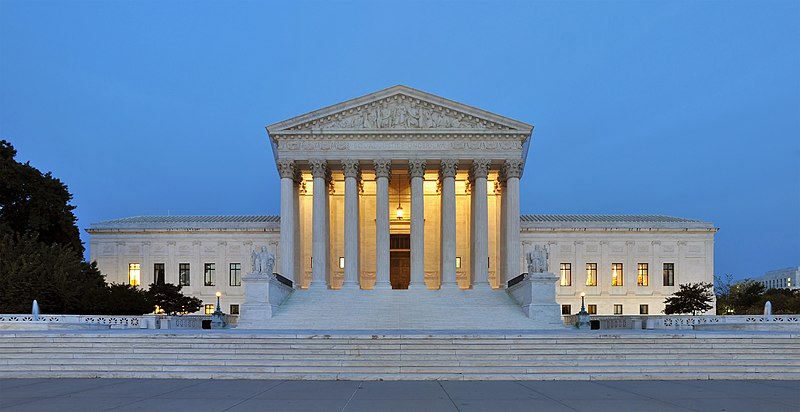
These weaknesses cannot be any big secret. You probably remember the Supreme Court’s Mouvement laïque québécois v. Saguenay decision of 2015 — that’s the case in which the Quebec Court of Appeal had ruled that a statue of Christ with an electrically illuminated Sacred Heart was “devoid of religious connotation.” The Supreme Court, perhaps suppressing a chuckle or two, proceeded to unanimously overturn the Quebec ruling and expound the concept that the Canadian state has a Charter-based “duty of religious neutrality” (except, of course, where the constitution explicitly specifies otherwise, as with Catholic schools). Government, the SCC insisted, “must neither favour nor hinder any particular belief, and the same holds true for non-belief.”

Given that this is our law, what can be the problem with a “Church of Atheism”? Good question! Justice Marianne Rivoalen, writing on behalf of a three-judge Federal Court panel, confirmed the general point that there is a state duty of religious neutrality; in fact, even Revenue Canada, acting as the respondent, conceded this.

But the court simply ruled, without any logical elucidation, that “the Minister (of Revenue)’s refusal to register the appellant as a charitable organization does not interfere in a manner that is more than trivial or insubstantial with the appellant’s members’ ability to practise their atheistic beliefs. The appellant can continue to carry out its purpose and its activities without charitable registration.”

October 27, 2019

Freedom of speech under threat (again)

Filed under: Law, Liberty, USA — Tags: , , , — Nicholas @ 03:00

In The Atlantic, Ken White strongly urges pro-free-speech advocates to avoid using some arguments that have been bandied around recently:

What speech should be protected by the First Amendment is open to debate. Americans can, and should, argue about what the law ought to be. That’s what free people do. But while we’re all entitled to our own opinions, we’re not entitled to our own facts, even in 2019. In fact, the First Amendment is broad, robust, aggressively and consistently protected by the Supreme Court, and not subject to the many exceptions and qualifications that commentators seek to graft upon it. The majority of contemptible, bigoted speech is protected.

If you’ve read op-eds about free speech in America, or listened to talking heads on the news, you’ve almost certainly encountered empty, misleading, or simply false tropes about the First Amendment. Those tired tropes are barriers to serious discussions about free speech. Any useful discussion of what the law should be must be informed by an accurate view of what the law is.

Supreme Court Justice Oliver Wendell Holmes, Jr.
Photo by Harris & Ewing via Wikimedia Commons.


[…]

“This speech isn’t protected, because you can’t shout ‘Fire!’ in a crowded theater.”

This line, though ubiquitous, is just another way to convey that “not all speech is protected by the First Amendment.” As an argument, it is just as useless.

But the phrase is not just empty. It’s also a historically ignorant way to convey the point. It dates back to a 1919 Supreme Court decision allowing the imprisonment of Charles Schenck for urging resistance to the draft in World War I. Justice Oliver Wendell Holmes Jr. wrote that the “most stringent protection of free speech would not protect a man in falsely shouting fire in a theatre and causing a panic.” This decision led to a series of cases broadly endorsing the government’s ability to suppress speech that questioned official policy. But for more than half a century Schenck has unequivocally and universally been acknowledged as bad law.

Holmes himself repented of the decision — though he continued to indulge his taste for pithy phrases with lines like “Three generations of imbeciles are enough” to justify forcible government sterilization of the handicapped.

So when you smugly drop “You can’t shout ‘Fire!’ in a crowded theater” in a First Amendment debate, you’re misquoting an empty rhetorical device uttered by a career totalitarian in a long-overturned case about jailing draft protesters. This is not persuasive or helpful.

September 27, 2019

England’s constitution before the shiny new Supreme Court was created

Filed under: Britain, History, Law, USA — Tags: , , , , , — Nicholas @ 05:00

Peter Hitchins provides a thumbnail sketch of the state of play before the Supreme Court was added to British constitutional arrangements:

Why did we never even have such a body until ten years ago? As we shall see, it would have been, and still is, a contradiction in terms. But in interesting times such as these, elephants fly, fishes walk, figs grow on thorns, and oxymorons inherit the earth.

The most powerful law court in the land was, by a curious paradox, not in the land at all, but based in tiny Luxembourg, across the Narrow Seas which have kept invaders from our door but are useless against bureaucratic takeovers by the European Union. There sits the European Court of Justice, which as long ago as 1990 established that it could tell British courts to overrule British Acts of Parliament when they conflict with E.U. law. It can carry on doing this until we eventually do leave the E.U., if we ever do.

These various messes came about because we are so old, and rely so much on convention and manners, that it is all too easy for unconventional and ill-mannered busybodies to come storming in with new ideas. England’s constitution was not planned and built, like America’s. Instead, it grew during a thousand years of freedom from invasion. Both are beautiful in their way. America’s fundamental law has the cold, orderly beauty of a classical temple. England’s has the warmer, more chaotic loveliness of an ancient forest. It seems to be wholly natural but, when examined closely, it shows many signs of careful cultivation and pruning. Our powers are not as separated as America’s, but slightly tangled. Still, it has worked well enough for us over time.

Any thinking person must admire both the American and the English constitutions as serious efforts in a world of chaos, despotism, and stupidity to apply human intelligence to the task of giving people ordered, peaceful, and free lives. They have a common origin in the miraculous Magna Carta, which Americans often revere more than modern Englishmen do. We in England have grown complacent about our liberty, and have become inclined to forget our great founding documents.

But the two constitutions are not the same, and in my view they are not compatible. For my whole life, until a few years ago, the very idea that England should have a Supreme Court was an absurdity. The Highest Court in England is the Crown in Parliament which, as I was once taught, had the power to do everything except turn a man into a woman. In these more gender-fluid times, that expression is not much used. But it contains the truth. Parliament can make any law and overturn any law, made by itself or by the courts.

That is why England (often to my regret) lacks a First Amendment and cannot have one unless we undergo a revolution. No law in England could possibly open with the words “Parliament shall make no law.” Our 1689 Bill of Rights, the model for the U.S. Bill of Rights a century later, tells the king what he cannot do and the courts what they cannot do. It grants me (as a Protestant) the right to have weapons for my defense. But while it draws its sword against arbitrary power, it puts a protective arm round Parliament.

September 20, 2019

QotD: Red Flag laws for politicians

Filed under: Humour, Law, Politics, Quotations, USA — Tags: , , — Nicholas @ 01:00

You know what I’d like to see?

Red Flag laws for Congress.

Any Congresscritter says or does, something unConstitutional, anyone should be able to file a Red Flag violation and have that politician’s powers to write bills, attend sessions of Congress, vote, draw a taxpayer-funded paycheque, live in a mansion in Washington DC, or anything else tied to the job of being a Congresscritter immediately suspended.

There would be a hearing within fourteen days before a judge in their home district, where the Representative or Senator would be given the opportunity to show where in the Constitution what they said, or the law they proposed, or the action they did, was explicitly authorised, and if they can show that, their rights to all the goodies of being an elected representative of the People would be restored.

If they can’t, then they can sit at home for a year and twiddle their thumbs. Not allowed into the Capitol, no drawing a paycheque, no voting, no proposing bills, nothing added to their pension funds, zip, zero, NADA to do with being an elected official.

And their party doesn’t get to fill that slot. Their party doesn’t get to vote on their behalf. Their party doesn’t get to help them with re-election.

No, that Congresscritter, and the seat they occupy, goes into the penalty box for a year.

After a year, if their term in office hasn’t expired, they can take up their duties again.

Unless, and until, they mention violating the Constitution again, and someone files another Red Flag complaint.

Lawdog, “Sauce for the goose…”, The Lawdog Files, 2019-08-06.

September 19, 2019

“[T]he Indian Act is a benign form of apartheid”

Filed under: Books, Cancon, History, Law, Liberty — Tags: , , — Nicholas @ 03:00

In the National Post, Barbara Kay discusses a recent book on the key legislation that regulates relations between the Canadian federal government and the various First Nations groups:

Few and far between are disinterested scholars of Canada’s Aboriginal history who have the tough hide and principled will to publicly depart from the approved Indigenous “nation-to-nation” narrative that keeps the guilt and money flowing, but perpetuates a dysfunctional status quo on many reserves. Most of the dissenters are university academics. But Best is simply an intelligent man with a passion for his subject, a deep impatience with political correctness, and unremitting determination to weather whatever storms afflict him as he shepherds his views to a public market.

I’ve written before in the National Post and elsewhere about Best’s lonely battles with our society’s forces of repression. There Is No Difference began its public life as a post on a dedicated online site in 2014, copied to his legal firm’s. Shortly afterward, complaints were filed against him with the Law Society of Upper Canada (now the Law Society of Ontario), asking that Best be “disbarred or suspended” and that he be forced to apologize for using his law practice “to disseminate racist materials.”

After two years of stressful limbo, the Law Society graciously allowed that the excerpts submitted by the (unnamed) complainant were “not enough to merit a finding of any form of professional misconduct on their face.” (The last three words telegraph the ardent wish that they had been; apart from a dissenting group of new benchers, the Law Society’s board has increasingly demonstrated worrying Thought Police tendencies.)

Best believes the Indian Act is a benign form of apartheid, and advocates for the integration model of equal citizenship for all, a model promoted, for example, by Pierre Elliott Trudeau (who called the system “apartheid”), and the late Aboriginal lawyer William Wuttunee, author of Ruffled Feathers, who was marginalized and discredited as an “apple,” red on the outside, white on the inside.

Best believes the federal government must be the ultimate master in its own house for Canada to function as a healthy nation. He is fiercely critical of the Supreme Court’s 2004 emphasis on the “honour of the Crown” concept in its Haida Nation vs. British Columbia ruling, with key words “to consult and where appropriate, accommodate the Aboriginal interest” virtually decreeing a devolution of Crown sovereignty to Aboriginals, and effectively turning Indigenous bands into a third order of government with the power arbitrarily to advance or restrict Canada’s economic fortunes.

It’s easy for Indigenous activists to bash a white historian, or even an Aboriginal dissident without special standing like Wuttunee. But it will be more difficult to dismiss the opinion of a former Supreme Court justice. Best just came in for an unexpected stroke of luck. Former Supreme Court justice Jack Major (1992-2005) has given the book his endorsement in a letter discussed in an article by the Frontier Centre for Public Policy (FCPP).

September 18, 2019

The Canadian Charter of Rights and Freedoms* (*not all sections apply in Quebec)

Filed under: Cancon, Law, Liberty, Politics, Religion — Tags: , , , , , — Nicholas @ 03:00

Andrew Coyne on the disgraceful habit of the federal government (and nine provincial governments) to look the other way when Quebec decides that some of the guarantees in the Charter don’t apply in La Belle Province:

For many observant persons, particularly Muslims, Sikhs and orthodox Jews, this amounts to a religious hiring bar: the wearing of the hijab, the turban and the kippa are key requirements of their faith, and as such core elements of their identity. To demand that they work uncovered is, in effect, to post a sign saying Muslims, Sikhs and Jews need not apply.

We should be clear on this. It’s not just a dress code, or an infringement of religious freedom, or religious discrimination, or those other abstract phrases you hear tossed about. We are talking about a law barring employment in much of the public sector — not just police and judges, but government lawyers and teachers — to certain religious minorities.

Existing workers may have been grandfathered, but only so long as they remain in their current jobs. Should they ever move, or seek a promotion, they will face the same restrictions. The signal to the province’s religious and, let’s say it, racial minorities, vulnerable as they will be feeling already after the mounting public vitriol to which they have been exposed in the name of the endless “reasonable accommodation” debate, is unmistakable: you are not wanted here. Not surprisingly, many are getting out — out of the public service, out of Quebec.

That this is actually happening, in 2019, in a province of Canada — members of religious minorities being driven from their jobs, and for no reason other than their religion — is sickening, and shameful. That shame is not reserved to Premier Francois Legault or his CAQ government, the people responsible for designing and implementing this disgraceful exercise in segregation, this manifestly cruel attempt to cleanse the province’s schools and courts of religious minorities. It is no less shaming to the rest of us, everywhere across Canada, so long as we permit it to continue.

That is, so far as we are capable of feeling it. But experience has taught us to look the other way when it comes to Quebec, to tell ourselves that it is none of our affair, that we must not raise a fuss when the province explicitly elevates the interests of its ethnic and linguistic majority over those of its minorities, or threatens the country’s life for long years at a time — the beloved “knife at the throat” strategy — to back its escalating fiscal and constitutional demands. We dare not. We cannot. For then Quebec would leave.

September 8, 2019

Boris may have a viable escape hatch after all

Filed under: Britain, Government, Law, Politics — Tags: , , , , — Nicholas @ 05:00

It could not only untangle the current mess in Parliament but have the almost equally attractive feature of sending his opponents into paroxysms of rage:

The consensus is that the Government is trapped in an iron vice that will now be tightened till it cracks. The truth, however, is that this vice is less of iron than of hot air.

The Civil Contingencies Act 2004 is a constitutional outrage. It allows a government to declare an emergency, and then to rule by decree. It should never have been made. But it was made; and it can now be used as an instrument of liberation.

The Act defines “emergency” as just about anything the authorities may dislike. One possible definition is “an event or situation which threatens serious damage to human welfare in a place in the United Kingdom.” (s.1(1)) This sounds a promising excuse. It seems to cover what the Opposition claims would be the effect of a No-Deal Brexit.

Triggering the Act requires no more than “a senior Minister of the Crown” – that is, Boris Johnson – to announce an Emergency. This done, he can make, alter or suspend almost any law he likes. (s.22) He can do this for a period of thirty days. (s.26) All he has to do is preface his decree with a statement that he “is satisfied that the regulations contain only provision which is appropriate for the purpose of preventing, controlling or mitigating an aspect or effect of the emergency in respect of which the regulations are made.” (s.20(5)(b)(ii))

He cannot change the Act itself, or the Human Rights Act. He cannot set up concentration camps for his opponents, or put them before a firing squad. But the Fixed Term Parliament Act is fair game. He could suspend that. Then he could dissolve Parliament in the traditional way.

He must, “as soon as is reasonably practicable,” lay his decrees before Parliament. (s.27(1)(a)) No doubt, the Parliament we have would punish him with an Act of Attainder. But this Parliament would no sooner reassemble after the prorogation than it would be dissolved. The Speaker would barely have time to open his mouth. Assuming the general election went as hoped, the next Parliament would not be inclined to dispute the circumstances of its birth.

All the opposition parties would go screaming mad. But, as said, we are not talking about concentration camps and firing squads. The only use of the Emergency would be to give a voice to the people. Who could legitimately deny that? As for sharp practice in general, the opposition parties have spent this year turning the Constitution upside down. Who could complain if the Government now joined in the fun?

August 20, 2019

Jonathan Kay listened to the whole SNC-Lavalin report so you don’t have to…

Update: Apparently the Thread Reader App only picked up the first couple of entries (it worked fine when I queued it up for publication yesterday). Here’s the text version:

I just listened to the entire ethics commissioner’s report on the SNC-Lavalin scandal while driving back from Maine. I loaded up the text in my VoiceAloud app, hit play, and the audio kept me going for 3 hours, all the way into central New York State, along the I-90….

As with any narrative, you begin to identify with certain characters. In my case, it was @Puglaas. I found it especially maddening the way everyone around her kept babbling about finding a “solution,” which was their settled euphemism for bullying her into helping SNC…

The level of condescension exhibited by everyone in and around the PMO toward @Puglaas was breathtaking. These Liberal dudes always kept pretending that they just wanted to make sure she had enough “information,” as if she were a law student, not the AG of a G7 nation …

At the same time, it was breathtaking the way SNC Lavalin was essentially able to turn the entire PMO, and major ministries, into its personal lobbying operation. Texts, emails, calls, in-person visits… it was like SNC-Lavalin had Trudeau’s PMO on retainer, like a law firm ….

I hadn’t realized SNC was able to mobilize, or attempted to mobilize, not one, not two, but THREE former SC of Canada justices on its behalf. This is the sort of blurring between corporate & govt operations that u expect in banana republics (or in the Irvings’ New Brunswick)…

The fact trudeau & those around him still pretend this is about “jobs” is…I don’t even know the word for it. The ethics comm essentially called it a lie. This was about partisan politics. How can JT say he “accepts” the report without coming to terms with this core finding?

When this scandal & election is done, we need an inquiry that gets to the bottom of the larger issue here: how a single quebec corp, one heavily impugned by its own action, was able to essential create legislation to help itself, got trudeau to ram it thru on a budget omnibus…

And then spent weeks pulling every lever in ottawa to try to override our constitutional system of govt so they could get off the hook for alleged crimes, culminating in the actual reconstitution of cabinet. SNC turned our govt into a joke. And trudeau still sez it’s about “jobs”

If yr attitude is that u dont want to educate yourself about this scandal, bcuz the only thing that matters is hating @AndrewScheer (an attitude some ppl have candidly expressed) pls reconsider. Even if u vote Liberal, the scandal exposed problems in our system that need fixing

Conservative governments have no doubt been equally solicitous to big well-connected firms. Leftists *especially*, the same ones dismissing this scandal bcuz it interferes with their elxn narrative, should be horrified that corporations are treating @Bill_Morneau & PMO as puppets

The fact that all of these Libs can bleat “jobz jobz jobz” with a straight face isnt just a symptom of the amoral cynicism of politics (tho it is that). It reflect the fact that we canadians expect that big corps will get coddled like this. We need to end it

If youre @AndrewScheer or @theJagmeetSingh, it’s fine to rake the Libs over the coals for lying to us. But all politicians lie. Tell us how you’d fix the system structurally to ensure that the PMO isn’t acting as a pro bono hanger-on to a major corporation

And if you’re a progressive activist of a certain age, go back & look at all the things @NaomiAKlein @Sheila_Copps Judie Rebick etc warned us about during the free trade battles…corporations dictating terms to elected govts. Well, guess what ? That’s what’s on display here…

In fact, one of the most tragicomic subplots here is the Libs running around in full panic bcuz SNC was about to have a board meeting the next day… Yes, that’s right: Trudeau’s PMO prioritized important legal decisions on the basis of some company’s board meeting.
Because Jobz.

What’s more, the full-court press on @Puglaas in the shadow of these meetings was itself based on another lie: Libs knew SNC HQ couldnt abandon quebec (till 2024) bcuz of representations made to Caisse in regard to purchase of a UK sub. Bullshit layered on bullshit
#BecauseJobz

I keep coming back to @Puglaas, & how she must have felt. How many cdns have been in a job where yr boss & his minions tried to pressure u to find an unethical “solution,” to help the boss keep his own job? then when u did what was right, u get turfed 4 not being a “team player”

This isnt just about Trudeau. One galling episode described is a meeting in which @Bill_Morneau pontificates to @Puglaas about how she doesnt have enuf “information” about econ effects of possible SNC crim conviction. @Puglaas asks Morneau if he’s done a study on it. Answer: no.

We talk a lot about toxic workplaces for women. hard not to see how the dudes who Trudeau assigned to push @Puglaas around on this file aren’t guilty of this. Their strategy was to make her feel ignorant bcuz she did the right thing. The PMO gaslit their own justice minister

There are several female Liberal MPs whom I have come to know and respect, such as @juliedabrusin @cafreeland @JulieDzerowicz. It is mortifying to watch them being forced to line up in defence of this.

As for SNC itself, I don’t really blame it for doing what it did. If u were running a company and knew you could dictate terms to a govt, why not? The lesson to other CEOs would be that if youre accused of a crime, just threaten to lay ppl off and move your HQ. Problem solved.

final note…u can see y the Libs are going hard with demagoguery about @AndrewScheer being white supremacist-adjacent. A traditional leftist claim was that Tories would sell out to corporate interests. That’s a hard claim for Libs to make now. bcuz the Libs have already done it

It’s been a day since I wrote this thread, & some commenters are saying the SNC scandal shows Trudeau & the Libs are unscrupulous people. But I dont think that’s it. I have met some of these protagonists, and have found them to be *more* public-minded than the average citizen…

As noted in a response to @staceylnewman, the problem is that politics changes ppl. There’s a chilling quote in the report, from a meeting, where a Lib says to @Puglaas (paraphrasing here) “It doesn’t matter how great our policies are. We need to get re-elected to implement them”

To me, that sums everything up: The means justifies the ends, bcuz the ends (the “good” side wins power, & the “bad” side loses) are taken to have existential importance. That’s the myth that leads all politicians astray. If JT just admitted this, I bet many would forgive him

August 10, 2019

Sulla’s dictatorships

Filed under: Europe, Government, History, Politics, USA — Tags: , , , , , — Nicholas @ 03:00

In New York magazine, Andrew Sullivan portrays the current state of the American Republic in light of the late history of the Roman Republic:

This 54 B.C. coin bears the portrait of the dictator Sulla. The moneyer was Q. Pompeius Rufus, the grandson of Sulla and his home would likely have had portraits of their famous ancestor. Thus, although posthumously struck, the portrait on these coins is probably an accurate representation.
Photo by CNG via Wikimedia Commons.

… zoom out a little more and one obvious and arguably apposite parallel exists: the Roman Republic, whose fate the Founding Fathers were extremely conscious of when they designed the U.S. Constitution. That tremendously successful republic began, like ours, by throwing off monarchy, and went on to last for the better part of 500 years. It practiced slavery as an integral and fast-growing part of its economy. It became embroiled in bitter and bloody civil wars, even as its territory kept expanding and its population took off. It won its own hot-and-cold war with its original nemesis, Carthage, bringing it into unexpected dominance over the entire Mediterranean as well as the whole Italian peninsula and Spain.

And the unprecedented wealth it acquired by essentially looting or taxing every city and territory it won and occupied soon created not just the first superpower but a superwealthy micro-elite — a one percent of its day — that used its money to control the political process and, over time, more to advance its own interests than the public good. As the republic grew and grew in size and population and wealth, these elites generated intense and increasing resentment and hatred from the lower orders, and two deeply hostile factions eventually emerged, largely on class lines, to be exploited by canny and charismatic opportunists. Well, you get the point.

After the overthrow of the monarchy, the new Republic went from strength to strength, struggling against and generally beating and absorbing other city states in the Italian peninsula, eventually rising to face the challenge of Carthage, the dominant power in the western Mediterranean. The eventual Roman victory over Carthage left Rome the superpower of its age, able to dominate and control even the remaining “great” powers of the eastern Mediterranean world. One of the costs of military dominance was an over-reliance on its citizen armies, which eventually changed the entire economy of the Republic, switching from largely small-holding farmers (who were subject to legionary service) to larger slave-worked farms that displaced the families of free citizens from their lands. The result was a constant inflow of impoverished rural citizens to the urban centres, especially Rome itself.

The newly enlarged urban poor found champions to push for reforms to aid them in their plight, the first of whom was Tiberius Gracchus (Extra Credits did a short video series on the Brothers Gracchi: Part I, Part II, Part III, Part IV, Part V, and an extra commentary video). The defeat and death of the Gracchi brothers by agents of the Patrician order led, as you might expect, to yet more polarization and further violent political struggle. This process was hastened by the conflict between Marius and his former protégé Sulla:

As the turn of the first century BCE approached and wars proliferated, with Roman control expanding west and east and south across the Mediterranean, the elites became ever wealthier and the cycle deepened. Precedents fell: A brilliant military leader, Marius, emerged from outside the elite as consul, and his war victories and populist appeal were potent enough for him to hold an unprecedented seven consulships in a row, earning him the title “the third founder of Rome.” Like the Gracchi, his personal brand grew even as republican norms of self-effacement and public service attenuated. In a telling portent of the celebrity politics ahead, for the first time, a Roman coin carried the portrait of a living politician and commander-in-chief: Marius and his son in a chariot.

A dashing military protégé (and rival) of Marius, Sulla, was the next logical step in weakening the system — a popular and highly successful commander whose personal hold on his soldiers appeared unbreakable. Tasked with bringing the lucrative East back under Rome’s control, he did so with gusto, prompting a somewhat nervous Senate to withdraw his command and give it to his aging (and jealous) mentor Marius. But Sulla, appalled by the snub, simply refused to follow his civilian orders, gathered his men, and called on them to march back to Rome to reverse the decision. His officers, shocked by the insubordination, deserted him. His troops didn’t, soon storming Rome, restoring Sulla’s highly profitable command, and forcing his enemies into exile. Sulla then presided over new elections of friendly consuls and went back into the field. But his absence from Rome — he needed to keep fighting to reward his men to keep them loyal — enabled a comeback of his enemies, including Marius, who retook the city in his absence and revoked Sulla’s revocations of command. Roman politics had suddenly become a deadly game of tit for tat.

When Sulla entered Rome a second time, he rounded up 6,000 of his enemies, slaughtered them en masse within earshot of the Senate itself, launched a reign of terror, and assumed the old emergency office of dictator, but with one critical difference: He removed the six-month expiration date — turning himself into an absolute ruler with no time limit. Stocking and massively expanding the Senate with his allies, he neutered the tribunes and reempowered the consuls. He was trying to use dictatorial power to reestablish the old order. And after three years, he retired, leaving what he thought was a republic restored.

Within a decade, though, the underlying patterns deepened, and nearly all of Sulla’s reforms collapsed. What lasted instead was his model of indefinite dictatorship, with the power to make or repeal any law. He had established a precedent that would soon swallow Rome whole.

August 9, 2019

What’s happening in Jammu and Kashmir?

Filed under: Government, History, India, Law, Religion — Tags: , , , , , — Nicholas @ 03:00

Pieter J. Friedrich reports on recent events concerning the unique constitutional status of Jammu and Kashmir within the Republic of India:

CIA map of the Kashmir Region in 2004.
Via Wikimedia Commons. Click image to see full-sized map.

Terror grips the most militarized zone in the world after India’s Central Government terminated Jammu and Kashmir’s 70-year-old “special status” as the first step towards stripping the disputed region of statehood entirely.

Internationally infamous as the world’s hottest potential nuclear flashpoint, J&K originally acceded to India in 1947 only on the condition that the newly-formed country be restricted from interfering in the domestic affairs of the mountainous northern region. The agreement was sealed between the last king of J&K, Maharaja Hari Singh Dogra, and the representative of the British crown, Governor-General Lord Mountbatten. In 1949, when passage of the constitution formed the Republic of India, the Maharaja’s conditions for accession were enshrined in Article 370.

The crux of the article – in combination with Article 35A of 1954 – was that, while J&K accepted India’s handling of issues like defense and foreign policy, the state otherwise reserved the right to autonomy in handling its domestic affairs. Kashmiris, thus, lived under their own distinct laws. Notably, citizens of other parts of India were prohibited from settling permanently or owning property in Kashmir. In the eyes of many Kashmiris, this prevented settler colonialism. On August 5, 2019, the President of India abolished this “special status” by decree.

Simultaneously, Home Minister Amit Shah – charged with India’s internal security – introduced a bill in the upper house of parliament to strip J&K of statehood, downgrade it to a “Union Territory,” and partition the region.

As Shah did this, the Central Government shut down Kashmir. It imposed a virtual curfew, banning movement of the public, shuttering educational institutions, and barring all public assemblies or meetings. It severed communications, cutting off phone and internet access. And it conducted arrests of mainstream Kashmiri political leaders – such as former chief ministers Mehbooba Mufti and Omar Abdullah – on unknown charges.

India’s ruling Bharatiya Janata Party, which was just re-elected in May, campaigned on promises to scrap J&K’s “special status.” The BJP’s manifesto alleged that it was “an obstacle in the development of the state,” while Shah insisted it stood in the way of of Kashmir becoming an “integral party of India permanently” and was necessary for “national security.” Indeed, the tumultuous region has suffered a significant influx in violence in recent years.

Since 2014, when Prime Minister Modi’s regime first came to power, terrorist incidents in J&K have nearly tripled and security forces deaths have nearly doubled. According to a July 2019 UN report, independent bodies documented 159 security forces deaths in 2018 – a figure comparable to US troop fatalities in Iraq in 2009. The latest round of escalating tensions traces back to at least 2010, when mass protests erupted over an “encounter killing” of three civilians by Indian Army troops. Protests again erupted in 2016. During suppression efforts, security forces killed hundreds of protesters.

The Central Government has responded by flooding J&K with more and more soldiers. The small region – slightly smaller than the United Kingdom – is already occupied by a bare minimum of 500,000 troops. Since late July 2019, India has deployed nearly another 50,000.

Delhi has additionally responded by repeatedly dissolving J&K’s elected state government, imposing direct rule three times since 2015. The last time was in June 2018, after India’s ruling BJP withdrew from a coalition with then J&K Chief Minister Mufti – apparently because she advocated “reconciliation” instead of a “muscular security policy” as the most effective solution to the Kashmir conflict. Elections have not been allowed since 2014.

The ongoing occupation as well as the long-term use of direct rule – imposed for approximately ten of the past 42 years – contribute to the perception of Kashmiris that they are nothing more than vassals within the Republic of India.

July 11, 2019

The genesis of the administrative state during the Great Depression

Filed under: Cancon, History, Law, USA — Tags: , , , , — Nicholas @ 03:00

Leonid Sirota provides some interesting background on the rise of the administrative state during the 1930s:

Top left: The Tennessee Valley Authority, part of the New Deal, being signed into law in 1933.
Top right: FDR (President Franklin Delano Roosevelt) was responsible for the New Deal.
Bottom: A public mural from one of the artists employed by the New Deal’s WPA program.
Wikimedia Commons.

To a degree that is, I think, unusual among other areas of the law, administrative law in the United States and, to a lesser extent, in Canada is riven by a conflict about its underlying institution. To be sure there, there are some constitutional lawyers who speak of getting rid of judicial review of legislation and so transferring the constitution to the realm of politics, rather than law, but that’s very much a minority view. Labour unions have their critics, but not so much among labour lawyers. But the administrative state is under attack from within the field of administrative law. It has, of course, its resolute defenders too, some of them going so far as to argue that the administrative state has somehow become a constitutional requirement.

In an interesting article on “The Depravity of the 1930s and the Modern Administrative State” [PDF] recently published in the Notre Dame Law Review, Steven G. Calabresi and Gary Lawson challenge the defenders of the administrative state by pointing out its intellectual origins in what they persuasively argue was

    a time, worldwide and in the United States, of truly awful ideas about government, about humanity, and about the fundamental unit of moral worth—ideas which, even in relatively benign forms, have institutional consequences that … should be fiercely resisted.

That time was the 1930s.

Professors Calabresi and Lawson point out that the creation of the administrative state was spearheaded by thinkers ― first the original “progressives” and then New Dealers ― who “fundamentally did not believe that all men are created equal and should democratically govern themselves through representative institutions”. At an extreme, this rejection of the belief in equality led them to embrace eugenics, whose popularity in the United States peaked in the 1930s. But the faith in expertise and “the modern descendants of Platonic philosopher kings, distinguished by their academic pedigrees rather than the metals in their souls” is a less radical manifestation of the same tendency.

The experts, real or supposed ― some of whom “might well be bona fide experts [while] [o]thers might be partisan hacks, incompetent, entirely lacking in judgment beyond their narrow sphere of learning, or some combination thereof” ― would not “serve as wise counselors to autonomous individuals and elected representatives [but] as guardians for servile wards”. According to the “advanced” thinkers of the 1930s, “[o]rdinary people simply could not handle the complexities of modern life, so they needed to be managed by their betters. All for the greater good, of course.” Individual agency was, in any case, discounted: “the basic unit of value was a collective: the nation, the race, or the tribe. Individuals were simply cells in an organic whole rather than ends in themselves.”

H/T to Colby Cosh for the link.

« Newer PostsOlder Posts »

Powered by WordPress