Alas, as my fictional namesake said somewhere, time has a habit of turning all our lies into truths. It turns out Karl Marx was right after all. Who, I ask you, is more cartoonishly evil, more like the caricature capitalist of paranoid Communist fantasies, than Jeff Bezos? Mark Zuckerberg? Tim Cook? Jack Dorsey? Sundar Pichai?
We’re actually living, comrades, in the class-warfare world Marx preached in the 1840s. Everything Marx said about the factory owners of the First Industrial Revolution, that seemed so luridly absurd that even other Socialists criticized him for it, is true of the tech fascists of the Biden-Harris Revolution. Solzhenitsyn cites Russian writers from the late nineteenth century noting that Marxian socialism would end up as nothing more than dialectically-constructed feudalism, and lo, here we are. America in 2021 looks almost exactly like the USSR looked upon Lenin’s death …
… that was 1924, gang, and in case you’ve forgotten, what happened next was a vicious intra-Party civil war, in which Stalin crushed his enemies. AOC makes a pretty unlikely Trotsky, but it’s no less ludicrous than the thought of Nancy Pelosi as Koba … but that’s just the thing, isn’t it? We’ve been noting here for years that the modern Left is dedicated to being the Hollow Men in all things. They’re Revolutionaries without a Revolution — they go on and on (and on and on and on) about fighting the power and sticking it to the Man, even though they, themselves, have been the Man since at least 1974. They’re moralizers without morality — you’ll be scolded for not being as perverse as humanly possible. And, of course, their politics is a cult of personality without the personality — not even Orwell or Kafka could’ve come up with the Party installing an obvious dementia patient as its figurehead, not even if you’d dropped LSD in their tea.
As always — and yes, even in the depths of Stalin’s terror — the real rulers are the nomenklatura, the apparatchiki. Not even Koba the Dread can be everywhere. Being Hollow Men, our Postmodern Leftist masters have decided to dispense with the whole Kremlin thing. Who needs the NKVD, the gulag, the dreaded Lubyanka? The Junior Volunteer Thought Police “fact checking” everything on social media will do it for free, and much more efficiently, at which point their fellow travelers in the banking system will simply cut the badthinkers off. The only reason the gulag persisted after Khrushchev’s “secret speech” was that the Soviets, those fools, wanted to exploit their natural resources themselves, to build things themselves; labor camps were thus integral to the Soviet economy. Our masters don’t care about that, and their masters, the Chinese, certainly don’t. Much more efficient, and psychologically effective, to let the unperson simply starve in the middle of the town square, pour encourager les autres.
But hey, at least we’ll have some fun figuring out who the new Trotsky is. Again, my money’s on AOC — she’s so stupid that she’s bound to do something irrecoverably dumb sooner or later, after which she gets the digital icepick. That’ll be a hoot. Enjoy what parts of the spectacle you can, comrades – if you’re a student of human folly, you’re going to love the next few decades, because Marx was right about that too, the bastard — second time as farce.
Severian, “Marx Was Right After All (on ongoing series”, Rotten Chestnuts, 2021-01-12.
September 5, 2023
August 26, 2023
The United Banana Republics of America and their efforts to “get” Trump
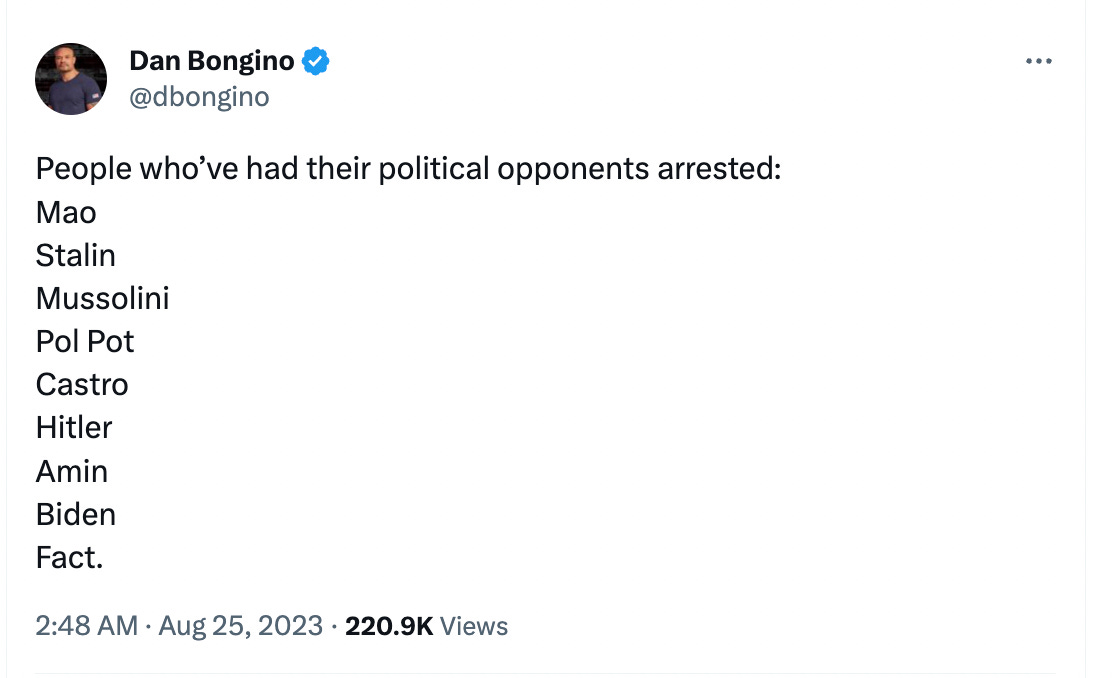
Chris Bray points out an interesting historical precedent for the US government’s determination to pin something on former President Donald Trump:
There’s a whole lot of this sentiment on social media this morning, and I agree with it entirely:
But also read this. It’s important, and it’ll take you three minutes. Click on that link and read. You’ll see the point with every paragraph.
There are American precedents for the shameful acts of disgusting political lawfare being directed against Donald Trump (and his lawyers and political staff), and the most obvious and extremely telling precedent is the behaviour of Federalists during the Adams administration. The Sedition Act of 1798 made criticism of the federal government a crime, on a comparable construction of the idea of “disinformation” that’s now used as a repressive tool: the law forbade “any false, scandalous, and malicious writing” about the government, subjective terms that in practice opened the prison doors to mere disagreement and ordinary political criticism. Federalists arrested and prosecuted newspaper editors and a congressman. Representative Matthew Lyon was imprisoned for criticizing the Adams administration.
But the effects of the Sedition Act are extremely important. Here’s a description from archives.gov — from a site run by the federal government:
The laws were directed against Democratic-Republicans, the party typically favoured by new citizens. The only journalists prosecuted under the Sedition Act were editors of Democratic-Republican newspapers.
Sedition Act trials, along with the Senate’s use of its contempt powers to suppress dissent, set off a firestorm of criticism against the Federalists and contributed to their defeat in the election of 1800, after which the acts were repealed or allowed to expire.
The criminalization of dissent by Federalists destroyed the Federalists. The party went into a hard decline; John Adams became the only Federalist president in our history (because Washington, sentimentally a federalist, declined to identify as a Federalist), though the party continued to be regionally important in New England until it finally destroyed itself at the Hartford Convention. The event that historians call the Revolution of 1800, the election of the Democratic-Republican Thomas Jefferson to the presidency, was in significant part a result of American disgust over the political repression of dissent1. See this point clearly:
Federalists jailed their political opposition, so America loathed the Federalists and turned against them.
1. See also the High Federalist response to the Fries Rebellion, which treated a careful act of resistance as a dangerous insurrection. If you’ve never read about this one, I strongly recommend this book.
August 22, 2023
With Bill C-18 about to come into effect, there is zero sense for the “tech giants” to start negotiating
Michael Geist explains why there are no incentives for Google and Meta to begin any kind of negotiations with the Canadian government over the ruthlessly self-destructive Online News Act:

The rhetoric around Bill C-18 has escalated in recent days in light of the awful wildfires in NWT and British Columbia. In my view, the issues associated with these tragic events have little to do with Meta blocking news links and the attempt to bring it into the conversation is a transparent attempt to score political points (the connectivity issues with some NWT communities completely taken offline for days is somehow never mentioned). The reality is that Meta was asked about just this scenario at committee and it made it clear that it would not block any non-news outlet links. That is precisely what has been happening and the government’s legislative choices should be the starting point for understanding why compliance with the law involves blocking a very broad range of news links that extend beyond even those sources that are defined as “eligible news outlets”.
The government and supporters of Bill C-18 talking points now emphasize two things in relation to Meta blocking news links: the law has yet to take effect and there is room to address their concerns in the regulation-making process. Both of these claims are incredibly deceptive, relying on the assumption that most won’t bother to read the actual legislation. If they did, they would see that (1) the law has received royal assent and can take effect anytime and (2) the regulation making process addresses only a small subset of Bill C-18 issues with most of the core issues finalized. In other words, the time to shape the law and address many of the key concerns was before the government repeatedly cut off debate in order to ensure it that received royal assent before the summer break.
Start with when the law takes effect. As noted above, the law has been passed and received royal assent. It is the law of the land and there is no scope for changes or amendments without a new bill that must be passed by Parliament. Section 93 establishes when the provisions come into force. The law initially envisioned a staged approach whereby certain sections would be proclaimed in effect by the government in stage one, followed by four additional stages, some of which were contingent on certain regulations coming into force. Yet at the last minute the government approved a Senate amendment that basically discarded the entire approach. Section 93(6) states:
(6) Despite subsections (1) to (5), any provision of this Act that does not come into force by order before the 180th day following the day on which this Act receives royal assent comes into force 180 days after the day on which this Act receives royal assent.
The entire law therefore takes effect no later than 180 days after royal assent, which is December 19, 2023. This change was included at the urging of the Canadian media sector (specifically Quebecor) which lobbied to have it take effect as soon as possible. Under this approach, the law can take effect at any time as the government need only issue the relevant Orders-in-Council. There is now little wiggle room. As of today’s post, the latest the law will take effect is in 120 days but it could happen well before that.
Once the law takes effect, the clock on negotiations and potential mediation and arbitration begins. The timelines are fixed in Section 19(1) of the law: 90 days to negotiate and 120 days for mediation. If there is no agreement and no request to the CRTC to extend the deadlines, the issue can go to final offer arbitration. To be clear, none of these timelines are subject to the regulation making process. They are fixed and they create obvious urgency for anyone facing compliance requirements.
The government threatened Meta and Google with mandated payment to Canadian news sources if their online services merely linked to articles or videos from those news sources. Meta and Google rationally decided that the tiny little Canadian market wasn’t worth the cost of paying CBC and other Canadian news outlets for the privilege of sending them readers and are in the process of obeying the letter of the new law and blocking such links on their respective platforms. They told the Canadian government that this is what they’d do if the law was passed in its current form, yet the government is pretending to be shocked and surprised that Meta and Google are going to obey the law.
After all, there’s no real risk that lives might be endangered because so many Canadians are used to getting their news by way of Facebook or Google, is there?
August 19, 2023
“Twitter used to work well, but now he receives negative comments, which means that it has stopped working”
Chris Bray on the claims that Twitter, er, I mean “X” is broken from people who are suddenly being exposed to unfriendly opinions that the old platform used to kindly keep out of their very comfortable bubbles:
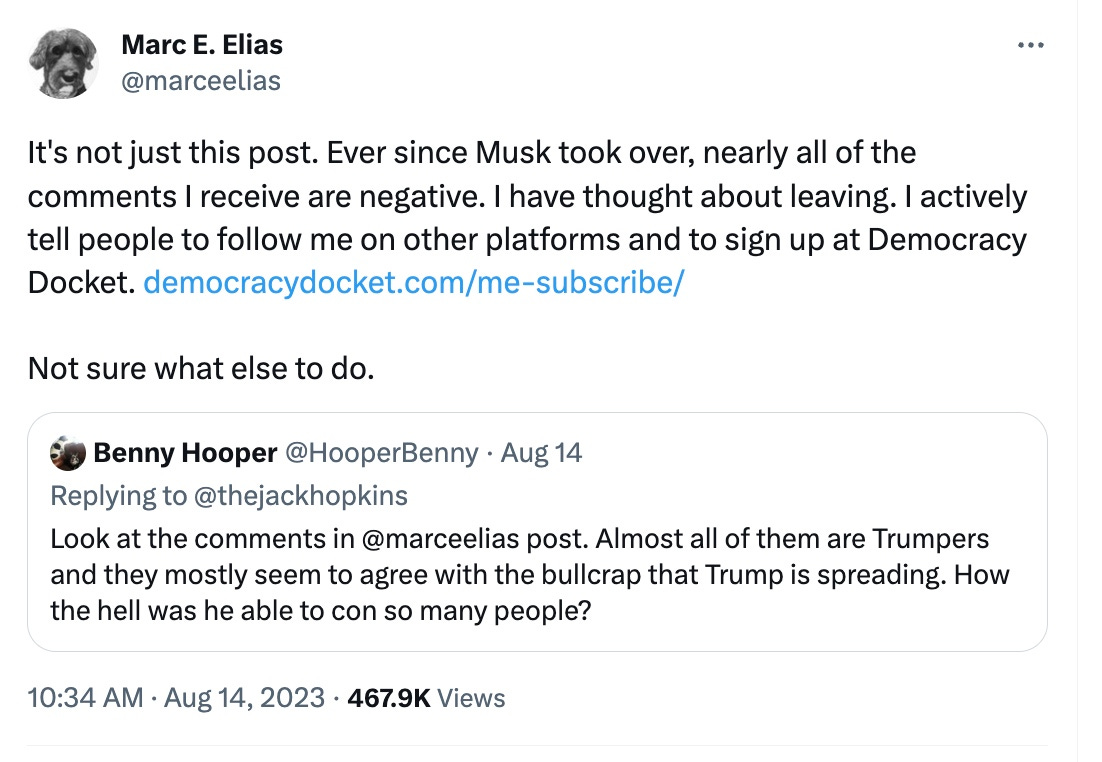
The Democratic Party’s go-to election lawyer, Marc Elias, is disturbed by the decline of Twitter:
Twitter used to work well, but now he receives negative comments, which means that it has stopped working. People can criticize him and express disagreement, so the platform is broken. If it worked, he would only be praised.
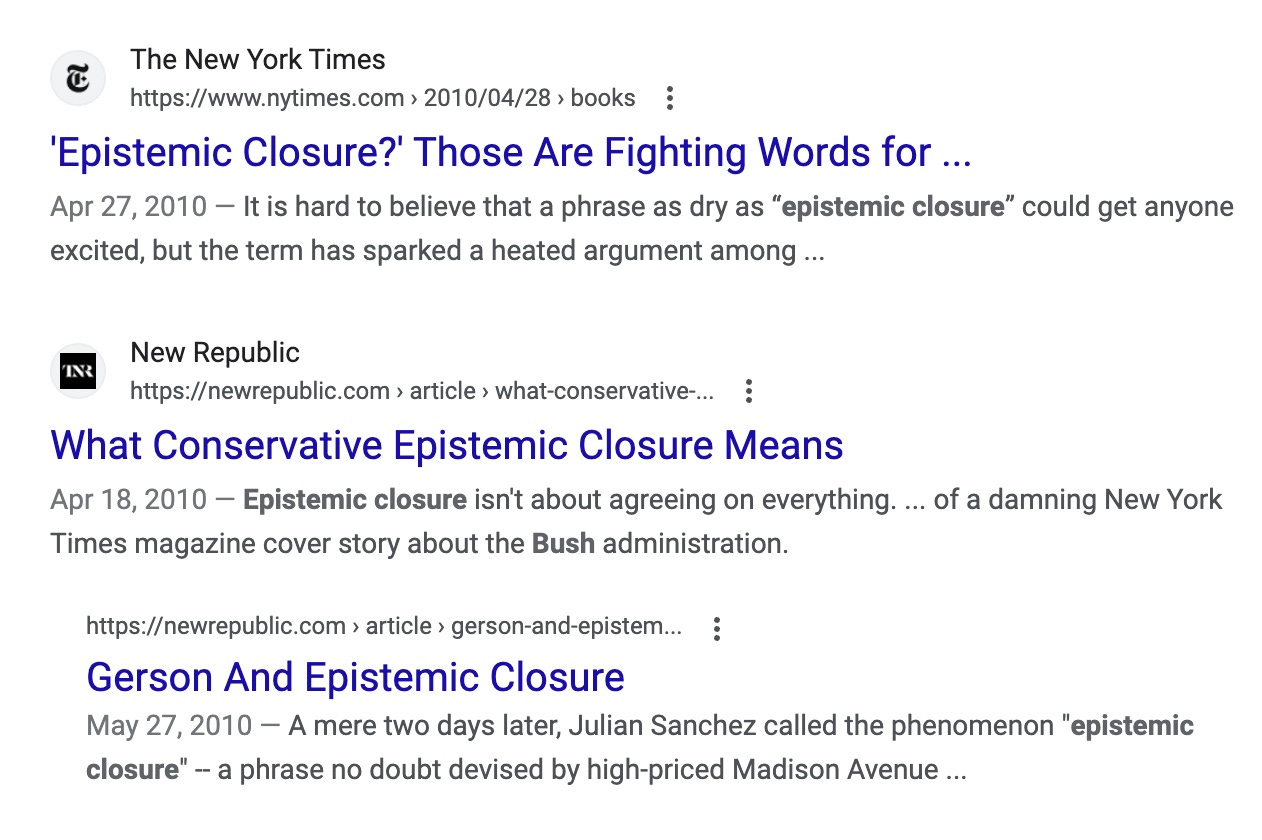
“Epistemic closure” had its pet rock moment in 2010, as the news media looked back on the George W. Bush years and the Iraq War and concluded that American neoconservatives had simply lost their ability to think.
[…]
It was supposed to mean this:
It’s rather about information, and what counts as evidence about the real world … if one only gets information from a narrow set of sources that feed back into each other but do not engage beyond themselves, that one will have a closed mind … regardless of what one does with that information.
And this:
Epistemic closure is a fancy term for the practice of defining – or redefining – reality in ways that support your pre-existing ideological preferences. Most of us think of it as “creating and living in a bubble”.
It was a fair enough point, as Bush watched sectarian brutality continue in post-Saddam Iraq and kept drawing the conclusion that everyone everywhere really yearns for democratic pluralism, honest elections, and a free press.
But that era’s epistemic closure is bush-league — sorry — compared to the sealed-in-a-jar-in-a-closed-box-in-a-deep-cave closure of the “mainstream” mind in 2023. If you’ve been on social media since roughly the night of November 8, 2016 and you’ve expressed disagreement with a politician, academic, or media figure, you’ve been a Russian bot, and Putin told you to say that. Criticism of institutions can’t simply arise from authentic grievances, or even from an authentically felt but misperceived grievance; rather, criticism is an op, a calculated string-pulling effort by manipulative forces. The far-right Putin-aligned Nazi grifters are tricking you into believing that you’re unhappy with the Biden administration. Your brain has been fooled by cognitive warfare, see?
August 18, 2023
When your friendly local bank turns into a branch of the Stasi
Theodore Dalrymple on the British bank — probably not the only one to do things like this — that compiled a “dossier” of information on one of their long-term clients with a view to de-banking him, his family, and associates. It might have worked if the client was a private citizen with no particular public profile, but the client was someone who absolutely is not that kind of man:
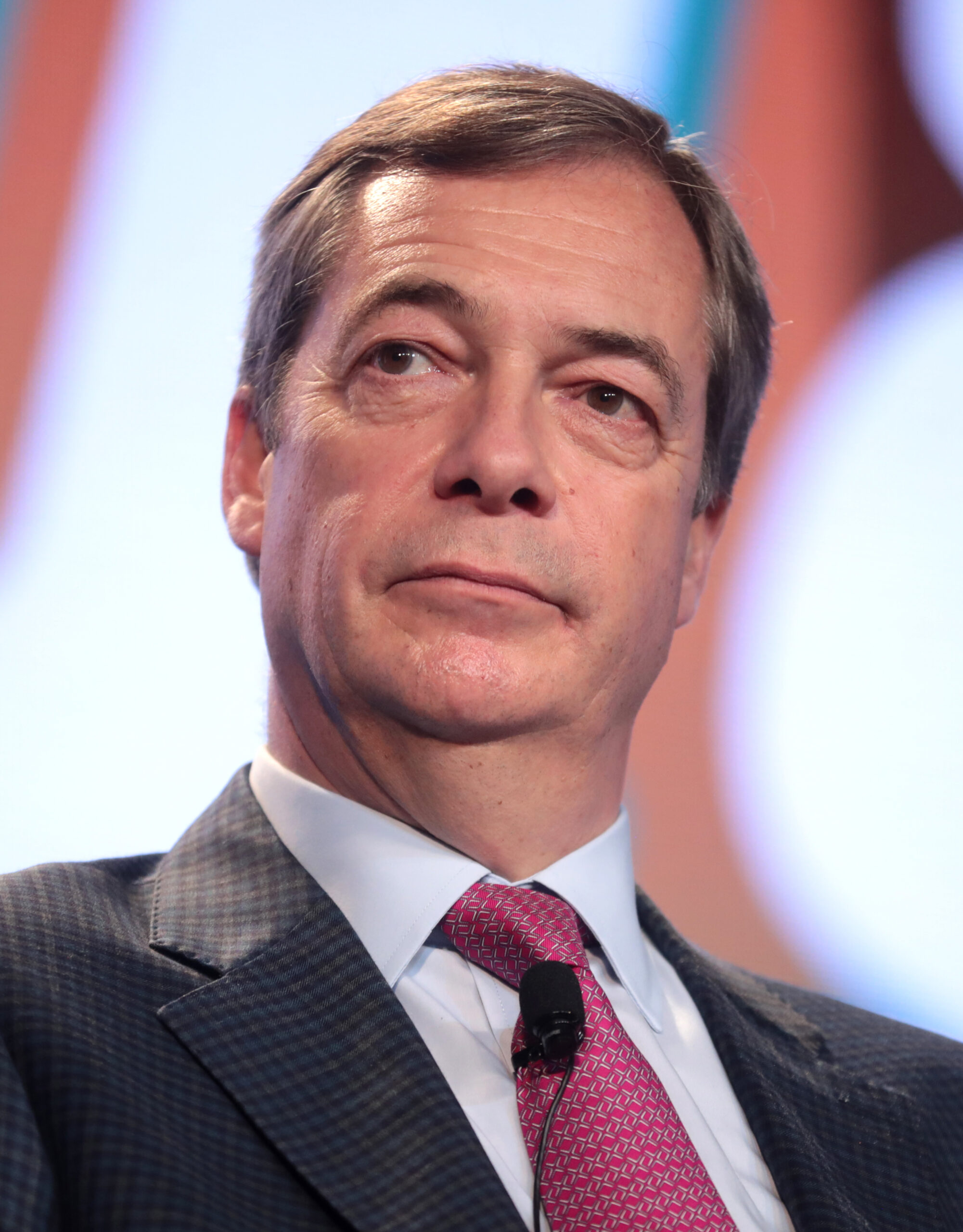
The following day, [National Westminster Bank CEO Alison] Rose resigned, admitting to “a serious error of judgment”. The value of the bank fell by more than $1 billion.
The weasel words of Ms. Rose and the bank board are worth examination. They deflected, and I suspect were intended to deflect, the main criticism directed at Ms. Rose and the bank: namely, that the bank had been involved in a scandalous and sinister surveillance of Mr. Farage’s political views and attempted to use them as a reason to deny him banking services, all in the name of their own political views, which they assumed to be beyond criticism or even discussion. The humble role of keeping his money, lending him money, or perhaps giving him financial advice, was not enough for them: they saw themselves as the guardians of correct political policy.
It was not that the words used to describe Mr. Farage were “inappropriate”, or even that they were libelous. It is that the bank saw fit to investigate and describe him at all, at least in the absence of any suspicion of fraud, money laundering, and so forth. “The error of judgment” to which Ms. Rose referred was not that she spoke to the BBC about his banking affairs (it is not easy to believe that she did so without malice, incidentally), but that she compiled a dossier on Farage in the first place — and then “error of judgment” is hardly a sufficient term on what was a blatant and even wicked attempt at instituting a form of totalitarianism.
This raises the question of whether one can be wicked without intending to be so, for it is quite clear that Ms. Rose had no real understanding, even after her resignation, of the sheer dangerousness and depravity of what the bank, under her direction, had done.
As for the board’s somewhat convoluted declaration that “after careful consideration, it concluded that it retains full confidence”, etc., it suggests that it was involved in an exercise of psychoanalytical self-examination rather than of an objective state of affairs: absurd, in the light of Ms. Rose’s resignation within twenty-four hours. The board, no more than Ms. Rose herself, understood what the essence of the problem was. For them, if there had been no publicity, there would have been no problem: so when Mr. Farage called for the dismissal of the board en masse, I sympathised with his view.
August 13, 2023
Don’t worry about losing all your news links, citizen! The Liberal government’s Ministry of Propaganda will tell you everything you need to know!
The federal government still seems shocked and a little bit hurt that the “tech giants” are carefully obeying the letter of their new Online News Act instead of pumping millions of dollars into government-favoured media outlets. How dare Alphabet and Meta obey the law we wrote? We wanted to soak them for bribes subsidies to give to legacy corporations who can be depended upon to cheerlead our agenda!
Blocking of news links on Facebook and Instagram in Canada has becomes increasingly widespread in recent days, leading to a growing number of public comments from media outlets and reporters expressing surprise or shock about the scope of the link blocking. Indeed, outlets with blocked links include university student newspapers, radio stations, and foreign news outlets. While there may have been some errors (Facebook has a page to seek review of any blocked link decision), the inclusion of a very wide range of Canadian and foreign news outlets is no accident. Rather, it reflects the government’s Bill C-18 approach, which effectively covers all news outlets worldwide whose links are accessed in Canada. The Canadian government could have adopted a more targeted approach – for example, limiting the scope to news links from those news outlets eligible to negotiate agreements with Internet platforms under the law – but it instead went for the broadest possible approach that includes foreign news outlets with little or no connection to Canada.
Understanding why Bill C-18 covers news links from outlets who are not “eligible news businesses” under the law requires unpacking several provisions. First, start with the definition of a “digital news intermediary”, which states:
digital news intermediary means an online communications platform, including a search engine or social media service, that is subject to the legislative authority of Parliament and that makes news content produced by news outlets available to persons in Canada. It does not include an online communications platform that is a messaging service the primary purpose of which is to allow persons to communicate with each other privately.
This definition is critical since the only companies that are subject to Bill C-18’s requirement to negotiate agreements with news outlets are (1) those that qualify as DNIs under this definition and (2) meet the requirements found in Section 6 on a significant bargaining power imbalance. The absence of significant bargaining power imbalance is why companies such as Twitter, Microsoft or Apple are not subject to the law. That leaves Google and Meta, provided that they qualify as DNIs. The key phrase in the qualification requirement is that the companies “make news content produced by news outlets available to persons in Canada”. If the companies do not make news content produced by news outlets available to persons in Canada they are not DNIs and are not subject to the law.
[…]
… the government’s choice was to try to bring Meta and Google into the scope of the law by virtue of any news links to any news outlet anywhere in the world, even if those outlets have nothing to do with Canada or with the Bill C-18 system. Given Meta’s stated goal of complying with Bill C-18 by removing links to news content that would render it a DNI, the government’s legislative choice of covering all news links from all news outlets therefore effectively requires it to block all of those news links.
It takes a lot to make Google, of all companies, a sympathetic victim … yet Canada’s awesomely awful Liberal government aced it. Bananada strikes again!
July 30, 2023
Letting a UN agency police “disinformation” online? What a great idea! With the best of intentions! What could possibly go wrong?
Savroula Pabst outlines the United Nations Development Program’s new online anti-disinformation tool, iVerify:
The United Nations Development Programme (UNDP) has quietly announced the rollout of an automated anti-disinformation tool, iVerify, this spring. The instrument, initially created to support election integrity, centers a multi-stakeholder approach spanning the public and private sectors to “provide national actors with a support package to enhance identification, monitoring and response capacity to threats to information integrity”.
The UNDP demonstrates how iVerify works in a short video, where anyone can send articles to iVerify’s team of local “highly-trained” fact-checkers to determine if “an article is true or not”. The tool also uses machine learning to prevent duplicate article checks, and monitors social media for “toxic” content which can then be sent to “verification” teams of fact-checkers to evaluate, making it a tool with both automated- and human-facilitated elements.
On its website, the UNDP makes a blunt case for iVerify as an instrument against “information pollution“, which they describe as an “overabundance” of harmful, useless or otherwise misleading information that blunts “citizens’ capacity to make informed decisions”. Identifying information pollution as an issue of urgency, the UNDP claims that “misinformation, disinformation, and hate speech threaten peace and security, disproportionately affecting those who are already vulnerable”.
But, behind this rhetoric of fact-checking expertise and protecting society’s most marginalized, iVerify, as a tool functionally claiming an ability to separate the true from the false, actually provides governments, adjacent institutions, and the global elite an opportunity for unprecedented dismissal, and perhaps thus subsequent censorship, of dissenting perspectives and inconvenient information and reporting, all behind the pedigree of a UN institution with international reach.
July 29, 2023
If you like the CRTC regulating the internet, you’ll love having them regulating video games!
Not satisfied with strenuously trying to break the internet for ordinary Canadians, the Trudeau government is now being lobbied to introduce regulation of video games, too:
Bill C-11 may have receded into the background of CRTC consultations and government policy directions, but Canadians concerned with user content, video game and algorithmic regulation would do well to pay attention. Lobby groups that fought for the inclusion of user content regulation in the bill have now turned their attention to the regulatory process and are seeking to undo government assurances that each of those issues – user content, algorithms and even video games – would fall outside of the scope of the regulatory implementation of the bill. In fact, if the groups get their way, Canadians would face unprecedented regulations with the CRTC empowered to create a host of new obligations that could even include requirements for Youtubers and TikTokers to register with the Commission. With a new Heritage Minister in place, the submissions raise serious concerns about whether the government will maintain its commitments regarding scoping out users, video games, and algorithms.
The most troubling publicly available document comes from a coalition that calls itself ACCORD, representing songwriters, composers, and music publishers. The group has posted its submission to the government’s consultation on the draft policy direction to the CRTC on Bill C-11. All submissions are not yet posted, but I should note that I also submitted a brief document, calling on the government to fully honour its commitment to exclude user content and algorithms from regulation and to establish limits on discoverability regulation.
The government’s draft direction had called for “minimizing” algorithmic regulation and the exclusion of user content and video game regulation. The music lobby is now calling on the government to rollback virtually all of its commitments on these issues. The draft direction states:
The Commission is directed not to impose regulatory requirements on
(a) online undertakings in respect of the programs of social media creators, including podcasts; and
(b) broadcasting undertakings in respect of the transmission of video games.
The lobby wants virtually all of this removed, deleting references to online undertakings and video games. Moreover, the directive speaks to Section 4.2, stating:
In exercising its powers under section 4.2 of the Act, the Commission is directed to set out clear, objective and readily ascertainable criteria, including criteria that ensure that the Act only applies in respect of programs that have been broadcast, in whole or in significant part, by a broadcasting undertaking that is required to be carried on under a licence or that is required to be registered with the Commission but does not provide a social media service.
Here too the lobby group wants most of the paragraph deleted. And while the government directed the CRTC to minimize algorithmic regulation for discoverability purposes, the groups wants those limitations removed as well. In short, the lobby groups validate the concerns expressed by thousands of Canadians that Bill C-11 opened the door to the regulation of user content, video games, and algorithms.
July 24, 2023
Revolutionary boredom
Chris Bray rises to passionately denounce [Comrade to be named later] as a traitor to the revolution who must be purged from the movement instantly!
Well-written histories of the Great Terror or the Cultural Revolution — or of the final years of the Roman republic, say for example — have the strange effect of becoming incredibly boring. The 94th bonfire of humanity, appearing on page 678, resembles the previous 93 bonfires. The grim machine of political purges makes brutal depravity tedious. Commissar X, Commissar Y, and Commissar Z run the Committee to Kill Wrongthinkers; then, and you always see this coming, Commissar X, Commissar Y, and Commissar Z are declared to be wrongthinkers, and are tossed on their own bonfire. The managerial tier is always consumed by its own instrument. Purge culture is the center of a politics of repression, the inevitable dynamic of a system that has degenerated to the stage of an unprincipled grasping for status and position. Someone was denounced yesterday; someone is being denounced today; someone will be denounced tomorrow.
The “Gang of Four” on trial in 1981.
In two instances, now — the frenzied shark attack on Matt Taibbi and Michael Shellenberger, and the obviously insane response to RFK Jr. this week — prominent House Democrats have mimicked a cultural style that should be extremely familiar to anyone who has read some history. Debbie Wasserman Schultz is so fascinatingly horrible a figure that she echoes, a bug-eyed ranting halfwitted sociopath with a hollow core like a long historical line of hollow bug-eyed sociopaths. These are the people who are drawn to destructive political stages. Repellent and ascendant, they call to others of the type. Destroyers flock.
I assume you’ve seen some footage from yesterday’s hearing, which was widely covered and widely discussed, so I’m not going to rehash that nasty piece of Theatre of Cruelty. If you missed it, just know that Robert F. Kennedy, Jr. is OBSOLETE OBSOLETE OBSOLETE.
But I want to point at the water underneath the waves we can see in national media, because the presumptions of the Central Commissariat go all the way down.
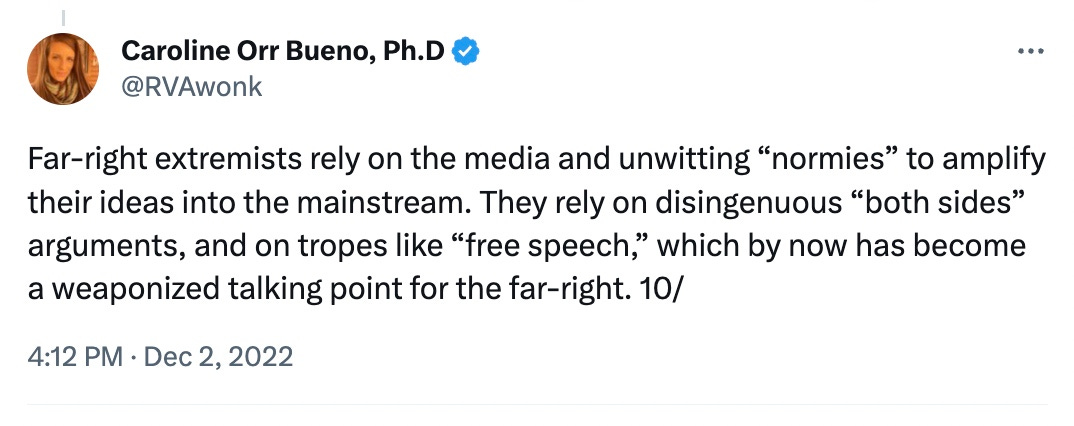
The week that led to the ritual denunciation of RFK Jr. started with a fascinatingly naked declaration in a Pasadena courthouse. Two California physicians, Mark McDonald and Jeff Barke, are suing the California Medical Board to block enforcement of AB 2098, the new law that threatens the medical license of any doctor in the state who expresses consensus-deviating crimethink about the darkly sacred Covid-19, a High Enemy of the Glorious Motherland. McDonald and Barke are relying on the First Amendment and its protection of the so-called “free speech” trope, a well-known tool of dangerous far-right extremists.
Courts have split on AB 2098, and so far some have declined the premise that this regulation of physicians’ speech is unconstitutional, so the case is now before the 9th Circuit on appeal. A three-judge panel heard oral argument in the case this week, in an architecturally pleasant forum that used to be a luxury hotel. And this is where Deputy Attorney General Kristin Liska said this to the court: “In order to effectively regulate the practice of medicine, the state needs to be able to reach the aspects of speech that are used to care for patients.”
If you take a professional license from the state, the regulatory power of the state reaches your speech acts; you can lose your license not only for harming patients or providing poor quality care, but for saying things that the state disagrees with. Your conversations belong to the government.


July 22, 2023
“… no-one has a ‘right’ to a bank account …”
Unlike in Canada, where the extra-legal debanking of an unknown number of what Justin Trudeau described as a “small fringe minority … holding unacceptable views” had all the bien-pensants in and out of the legacy media nodding along, British opinion is not so friendly toward the extra-legal debanking of Nigel Farage and his family and friends:
An acquaintance of mine on Facebook, a hardline capitalist (so he says) made a comment that no-one has a “right” to a bank account, as they don’t have “rights” (those inverted commas are doing a lot of work here) to healthcare, education, paid-for holidays, etc. He was, of course, writing about the Nigel Farage/Coutts saga that has seen the CEO of NatWest, Coutts’ parent firm (39% owned by the taxpayer) issue a sort-of apology to the former UKIP leader.
[…]
When a person is “debanked” today, they can have a problem opening an account anywhere else if the bank asks them why they left a bank in the past. As a result, we have almost a sort of “cartel” system operating.
In time, hopefully, competition will swing back, and some of the nonsense going on will disappear. In the meantime, while I agree with you that the idea of having a “right” to a bank account is as bogus as many of the other “rights” that people talk about today, the fact that banking is such an embedded form of life in a modern economy means this issue hits hard in a way that, say, isn’t the case if you are banned from a pizza restaurant or candy store for holding the “wrong” views. Of course, it may be that the Farage case might encourage a firm to go out of its way to court business from those who have been targeted. Let’s hope so. For example, a bank could, without incurring wrath from the “woke” or regulators, say something like “Banking is all we do. No politics. No agendas. Just finance.”
And as I have said before, the outrageous Nigel Farage case, and that of others, surely demonstrates that a central bank digital currency idea must be resisted. This would be the end of any financial autonomy at all.
As you’d expect, Brendan O’Neill isn’t a fan of this latest attempt to make certain political viewpoints effectively illegal:

So there you have it. Nigel Farage really was given the boot from the prestigious private bank Coutts because of his political views. Because he is very pro-Brexit, is fond of Donald Trump and has been critical of Black Lives Matter. Because, in the words of an extraordinary internal dossier compiled by Coutts, his views “do not align’ with the bank’s values”. For the past fortnight the chattering classes have been chortling over Farage’s claim that Coutts was persecuting him for his political beliefs. How dumb – worse, how complacent in the face of corporate tyranny – those people look now.
Last month, Farage went public about the closure of his Coutts account. I’ve been given the heave-ho for political reasons, he said. He also said that nine other banks have since rejected his custom. Now he has published a dossier that was distributed at a meeting of Coutts’ “reputational risk committee” on 17 November 2022. It is a truly chilling read. It runs to 36 pages. There is a strong case for “exiting” Farage from the bank, it says, because his publicly stated views are “at odds with our position as an inclusive organisation”. The Stasi once compiled dossiers on dissident activists and artists whose views ran counter to those of the GDR regime. Now Coutts seems to be doing similar on customers who dare to bristle against the regime of woke.
The dossier basically finds Farage guilty of wrongthink. It highlights his renegade views not only on Brexit and Trump but also on Net Zero and even on King Charles – he has had the audacity to criticise His Majesty. Like dissidents in East Germany, his friendships are held against him, too. His links with Trump and tennis champ Novak Djokovic make him suspect, apparently. The dossier quotes the Independent‘s description of Farage’s visit to Djokovic’s trophy room in Belgrade, during which he criticised Australia’s expulsion of Djokovic for failing to get vaccinated against Covid, as “the spineless, chaotic behaviour of a chancer”.
[…]
The Farage / Coutts story is important because it highlights what a huge threat woke capitalism poses to freedom and fairness. Let’s be clear about what has happened here: a man has been economically unpersoned for having the supposedly wrong views. He’s been blacklisted for being a little too dissenting on the big issues of the day. And it’s happening to others, too – including people who do not have access to the same media platforms as Farage and thus have little leeway to protest against their expulsion from economic life by unelected, unaccountable banks and businesses. We acquiesce to this capitalist policing of thought at our peril. It is surely time for the government to act and clip the wings of banks and companies that believe they have the right to penalise citizens for the contents of their conscience. It might be Farage today, it could be you tomorrow.
Theodore Dalrymple sees it as a sign of the rise of woke totalitarianism:
It isn’t a question of whether Mr. Farage is always right or sometimes horribly wrong; when the bank says that it “uncovered” something that he said, as if he had recorded saying it by secret microphones, it makes itself ridiculous. Not even his worst enemies, or perhaps his best friends, would accuse him of hiding his light under a bushel.
The question is whether it’s the role of a bank to examine its clients’ views and deny them service if those views don’t accord with those of the chief executive, as if the latter were indisputably true and from which it were heresy to dissent. Is a bank an inquisition?
The chief executive of the parent bank, Alison Rose, said soon after her appointment that “tackling climate change would be a central pillar” of her work, and on the occasion of the so-called Pride month last year said that “our focus on diversity, equity and inclusion is integral to our purpose of championing the potential of people, families, and businesses”. This year, the company headquarters were covered in the rainbow colors of the LGBT flag, with lettering the height of humans declaring the “Championing the power of Pride”. Under her leadership, staff may “identify” as women and men on alternate days, should they so wish.
Of course, when she said that “diversity” and “inclusion” was “integral to our purpose”, she was using these terms in a strictly technical sense to mean “everyone who thinks as I do and has a fair bit of money”. The diversity “integral” to the “purpose” of Coutts doesn’t include those persons with less than $1 million to deposit, who even in these days of currency depreciation remain a small minority. People bank with Coutts because it’s exclusive, not inclusive.
The chief executive, however, is safely within what we might call the Coutts Community, because she was paid about $5.2 million last year. The prospect of being barred from the bank will no doubt inhibit anyone who banks with her banks from suggesting in public that she’s paid too much.
July 10, 2023
“De-banking” is the financial world’s version of cancelling someone
At the Free Life blog, Alan Bickley considers the recently reported rash of prominent (and not-so-prominent) critics of the British government being refused service by their banks and further refused permission to open new accounts with any other chartered bank. Being “cancelled” by social media companies is bad, but being “de-banked” in a modern economy is worse than being declared a “non-person” by a totalitarian regime:

“The bank of England. London.”by Demetrio Neri_1959 is licensed under CC BY-NC-SA 2.0


In the past month, we have heard that various rich and well-connected people have had their bank accounts closed, seemingly because of their dissident political opinions. The same has happened to other people who are much poorer and without connections. Twenty years ago, the same happened to the British National Party. There is a simple libertarian response to this.
No one has the right to coerced association with anyone else. If someone comes to me and asks me to provide him with services, I have an absolute right to say yes or no. If I am uncharitable enough to dislike the colour of his face or what he does in bed, so much the worse. I may lose valuable business. But it is my time, and it is my choice. If anyone starts a whine about the horrors of discrimination, he should be ignored. We have an absolute right to discriminate against others for any reason whatever.
This being said, the position becomes less clear when state power of some kind is involved. Banks in this country require a licence from the State to operate. This protects them from open competition. It also gives them access to services and information from the State that are not given to other persons or businesses. If a bank finds itself in serious financial difficulties, it has at least a greater chance than other large businesses of being saved by the State – by a coordination of support by others or by direct financial help. The State has also made it illegal for many transactions to be made in cash. If I try to buy a car with £20,000 in cash, the car dealership is obliged to refuse my business, or to make so many enquiries that accepting my business is too much trouble. In effect, anyone who wants to spend more than a few thousand pounds in cash is obliged by various actual and shadow laws to use a bank account.
So we have privileged corporations and an effective legal obligation for people to do business with them. This entirely changes the libertarian indifference to commercial discrimination. The banks are a privileged oligopoly. The banks compete for custom among a public that is free to choose one bank rather than another, but that is compelled to choose some bank. For this reason, since the relevant laws will not be repealed, it is legitimate to demand another law to offset some of the effects of the others. Banks should be legally obliged to accept the business of any person or group of persons without question. Limitations on what services are provided must be justified on the grounds of previous financial misconduct as reasonably defined. For example, it should be permitted for a bank to refuse an overdraft to someone who is or has recently been bankrupt, or whose spending habits are obviously reckless. Perhaps it should be permitted for a bank to refuse to lend money for purposes it regards as scandalous as well as commercially unviable. Therefore, a representative of the White Persons’ Supremacy Foundation, or the Vladimir Putin Appreciation Society, should be able to walk into any bank and open an account – with no questions asked. If an account is refused, there should be a legal obligation on the bank to provide a full explanation of the refusal. If the refusal is not made on valid commercial grounds, there should be a right of appeal before a tribunal which does not award costs, and this tribunal should have the power to grant punitive damages against any bank found to be discriminating on any grounds but the validly commercial.
The refusal of banking services is only the beginning of a new and sophisticated totalitarianism. What the banks can do can also be done by supermarkets, by Internet service providers, by hotel chains, by airlines and railway companies, and by utility providers. There is indeed a good case for insisting on a law forbidding any organisation that has the privilege of limited liability from any but obviously commercial discrimination.
June 23, 2023
From Operation Barbarossa in 1941 to the disinformation and cover-up over the origins of the Wuhan Coronavirus
Chris Bray outlines the utterly amazing situation between the Soviet Union and Nazi Germany on the eve of Hitler launching Operation Barbarossa — where Stalin refused to believe that Hitler would attack Russia despite overwhelming evidence from many sources — to the parallel situation over Covid:
Several sources quite specifically reported to the Soviet government that the Germans would invade around dawn on June 22. Their reports can be found in the Soviet archives in a “folder of dubious and misleading reports”. Then, shortly before dawn on June 22, Germany invaded the Soviet Union. Military leaders on the border called in reports of the invasion, and the people they talked to in Moscow declined to believe them. Soviet border troops held their fire, seeing Germans while being ordered to understand that no true invasion could possibly be underway. Stalin knew better, and contradicting Josef Stalin was known to be a fatal mistake. Achieving an entirely avoidable surprise, the Germans destroyed much of the Soviet air force on the ground, parked wingtip-to-wingtip for the convenience of the invader’s bombers.
[…]
An invasion that could have been met with brutal severity from the first moment instead achieved considerable initial success against a supine nation because the Soviet leader, and the chain of subordinates beneath him who were forced to adopt his conception of facts and truth, assumed that things they didn’t wish to believe constituted disinformation. Millions of lives were wasted for that illusion. A society that categorizes inconvenient truths in this way is committing a form of suicide, hiding from hard facts that demand acknowledgment.
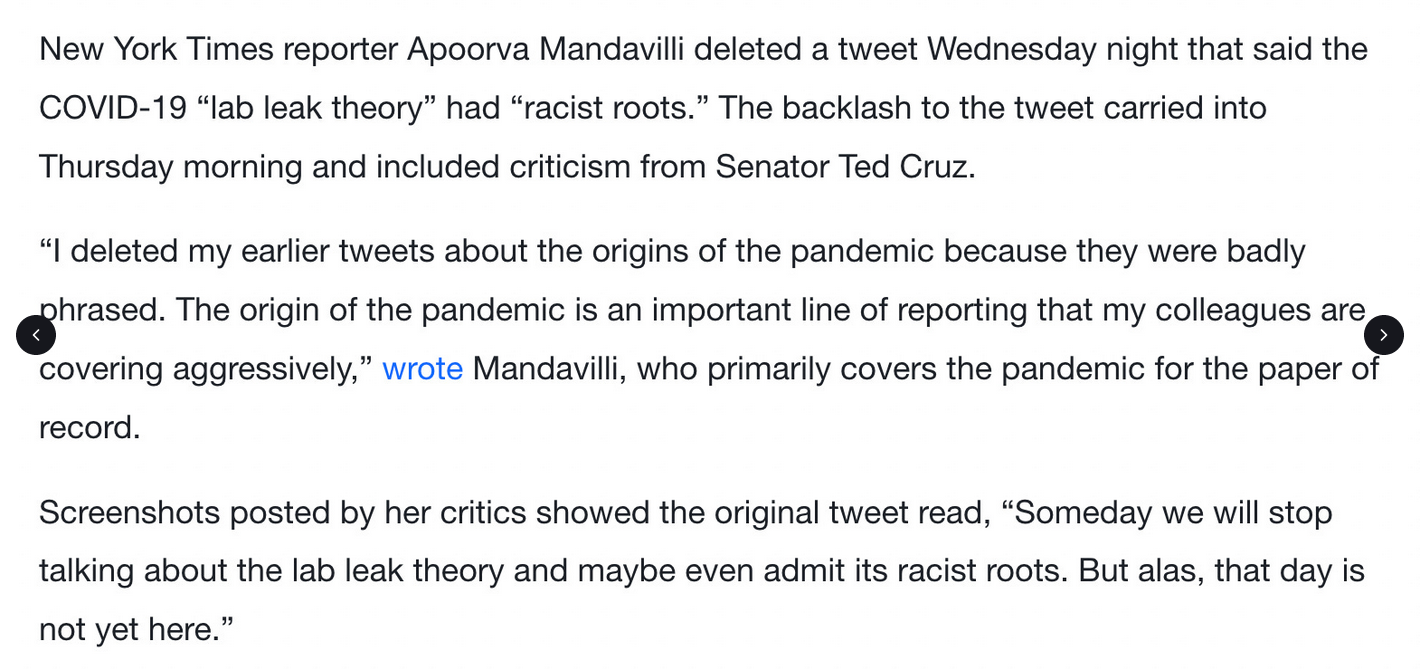
Now: In 2021, the lab leak theory was a disgusting lie with “racist roots”.
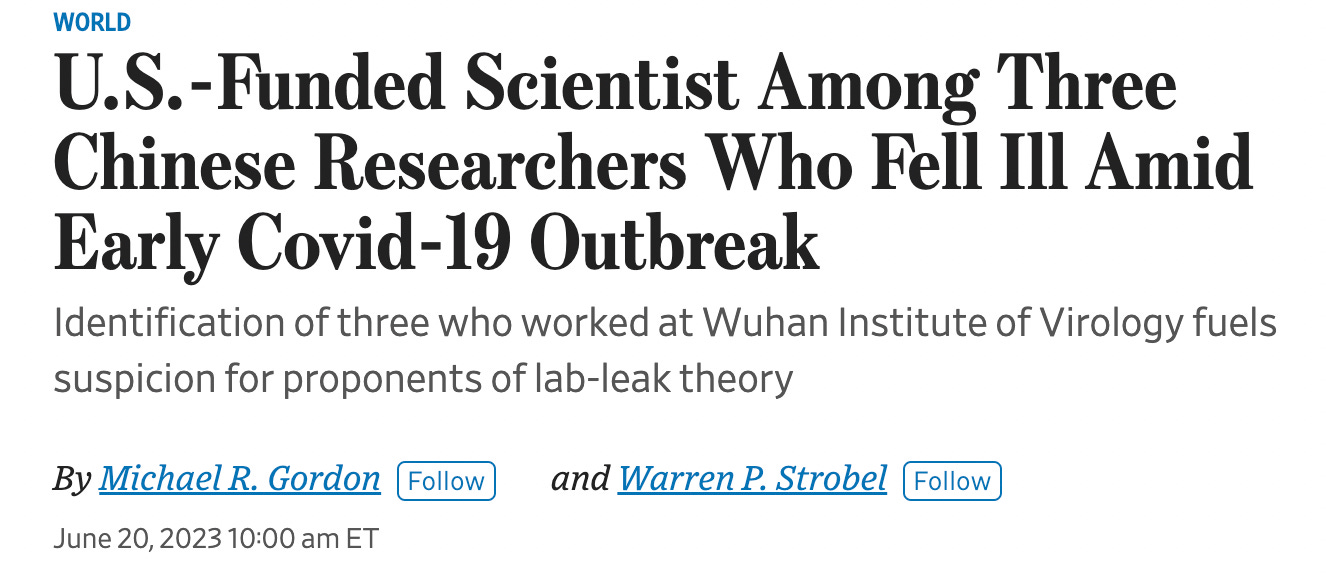
In June of 2023, the, uh, first people who got sick with Covid turn out to have been, uh, scientists at the lab in Wuhan. BUT THEY PROBABLY HAD SOME BAT SOUP AT THE WET MARKET, IS WHY, or something.
Stupid conspiracy theorists, you people are such MORONS, do you actually bel— okay, that one’s true too.
We’ve somehow developed an industry of professional information barriers, dimwitted parasitical human garbage whose sole function in life is to prevent understanding by pasting “disinformation” stickers on things that you’re not supposed to know.
June 18, 2023
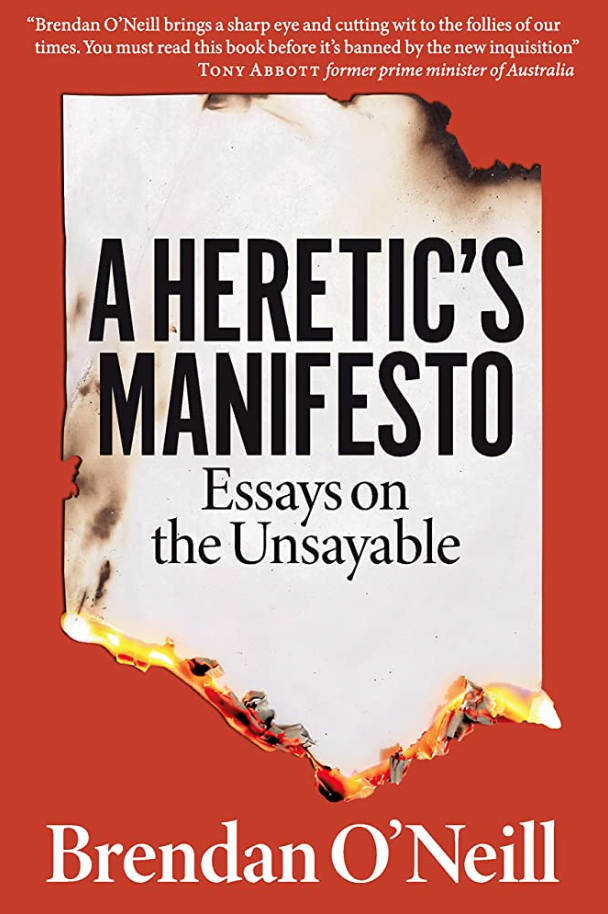
Brendan O’Neill’s new book, A Heretic’s Manifesto
This is an extract from A Heretic’s Manifesto thanks to Spiked:
Words hurt, they say. This is the ideological underpinning to so much censorship today – the idea that words wound, as a punch might wound. The imagery of violence is deployed in almost every call for censure in the 21st-century West. Speech has been reimagined as aggression, hence “microaggressions”. People speak of feeling “assaulted” by speech. “Words, like sticks and stones, can assault; they can injure; they can exclude” – that’s the thesis of Words That Wound, an influential tome published in 1993. Activists claim to feel “erased” by controversial or disagreeable utterances. Trans campaigners speak darkly of “trans erasure”, as if words from the other side of the divide, the speech of gender-critical feminists, might contain that most awesome and nullifying power of genocide.
Words make us feel “unsafe”, people say. Witness the rise and rise of Safe Spaces on university campuses, designed to ensure students’ psychic security against the terrible threat of their hearing an idea they disagree with. Safe Spaces recreate the state of childhood, complete with colouring books and ice cream, speaking to how determinedly some long to retreat from the adult world of hurtful chatter and brickbats.
The United Nations wrings its hands over “hate speech and real harm” (my emphasis). The “weaponisation of public discourse for political gain” can lead to “stigmatisation, discrimination and large-scale violence”, it says. Better keep a check on those hurtful words. One US university even maintains a list of “words that hurt“. It includes the phrase “You guys”. That scandalous utterance “erases the identities of people who are in the room” and “generalise[s] a group of people to be masculine”. Shut it down. Silence that act of violence.
Both the formal and informal punishment of words rests on the belief that they can wound. Laws in Europe claim to guard people from speech that is alarming, distressing, hurtful. The overlords of social media censor speech for “the wellbeing of our community“. Everywhere the cry goes up: words injure, they can cut like a knife, they can be used as “weapons to ambush, terrorise, wound, humiliate and degrade“. And just as the law protects us from such dreadful things when they are done to our bodies with fists and kicks, surely it should also protect us from them when they are done to our minds with words and ideas. Surely our psychic wellbeing should be accorded as much respect by the powers-that-be as our physical integrity is.
The temptation of many of us who believe in freedom of speech, in the liberty of all to utter their beliefs and ideas, is to damn this claim that “words hurt” as a libel against public discourse. As a slippery untruth that is cynically designed to depict words as all-powerful, as containing so much energy, so much heat, that they can lay waste to self-esteem and even make us fret over erasure, over being wiped out entirely by that sore comment or that disturbing idea. Actually, we often say, words are just words. They’re not sticks, they’re not stones, they’re words. They won’t kill you, they won’t hurt you, you’ll be fine. They say words are a force of nature like no other, we say: “Relax. It’s just speech.”
We need to stop doing this. We need to stop countering the new censors by accusing them of exaggerating the power and the potency of words. We need to stop responding to their painting of speech as a dangerous, disorientating force by defensively pleading that words don’t wound because they’re just words. We need to stop reacting to their branding of speech as a weapon, as a tool of ambush and degradation, by effectively draining speech of its power and saying: “It’s only speech.” As if speech were a small thing, almost an insignificant thing, more likely to contain calming qualities than upsetting ones, more likely to help us overcome conflict rather than stir it up, more likely to offer a balm to your soul than to stab at it as a knife might stab at your body.
For when we do this, we play down the power of words. And that includes the power of words to wound. Words do wound. It’s true. Words hurt people, they hurt institutions, they hurt belief systems. Words make churches tremble and ideologies quake. Words inflict pain on priests and princes and ideologues. Words upend the social order. Words rip away the comforting ideas people and communities might have wrapped themselves in for decades, centuries perhaps. Words ambush the complacent and degrade the powerful. Words cause discord, angst, even conflict. Isn’t every revolution in history the offspring of words? Of ideas? Words do destabilise, they do disorientate. People are right to sometimes feel afraid of words. Words are dangerous. When they say words wound, we should say: “I agree.”
June 1, 2023
Banning Roger Waters would be playing his game
In Spiked, Daniel Ben-Ami explains why we should reject the arguments about banning Roger Waters, formerly the frontman for Pink Floyd, and lately a pretty out-there antisemite:

Screencapture from a YouTube video.
Pressure is mounting to ban Roger Waters from performing in Britain. The former Pink Floyd frontman and veteran anti-Israel activist stands accused of anti-Semitism. But whatever one makes of Waters’s antics, his performances should not be cancelled.
Waters is set to perform his first UK show tonight in Birmingham, with further concerts scheduled for Glasgow, London and Manchester. These are part of his controversial “This Is Not a Drill” tour, which began its European leg a few months ago. The show contains a number of controversial elements, such as Waters dressing up in a Nazi-style uniform and brandishing a gun, while Anne Frank’s name is projected above the stage. In past tours, he has floated an inflatable pig with a Star of David on it above the stage.
The Waters row came to a head earlier this month, when local authorities in Frankfurt attempted to ban his concert. The ban was successfully challenged by Waters in court and the concert went ahead, despite protests. Waters is now being investigated by the German police for wearing a Nazi-style uniform on stage at his Berlin gig (the display of Nazi symbols is illegal in Germany, except for educational or artistic purposes). According to Waters, he donned the uniform not to endorse Nazism, but in order to make a “scathing critique” of it.
Jewish community organisations in the UK have condemned Waters, with some calling for him to be censored. The Board of Deputies of British Jews has argued that his concerts are probably better described as political rallies. The National Jewish Assembly has called on the UK government to condemn Waters. The Campaign Against Antisemitism, a volunteer-led charity, has not only launched a petition to stop venues hosting him – it has also written to cinema chains demanding they cancel film screenings of his concerts.
[…]
There are also more practical reasons to challenge these attempts to cancel Waters. The campaign against him, first in Germany and now in Britain, has allowed Waters to present himself as a free-speech martyr. To some, this will lend credence to his dubious claim that he is the victim of shadowy, covert forces determined to silence his advocacy for the oppressed.
Besides, banning displays of anti-Semitism does not make the problem go away. On the contrary, it only encourages anti-Semitism to take on more disguised forms. This often includes the demonisation of Israel or of Zionism, rather than Jews as such. Even those who do genuinely hate Jews will rarely admit to it openly. Instead, they typically use coded language, which is harder to challenge and confront.
By all means, protest outside Waters’s concerts and challenge his outrageous antics. But the attempts to ban his concerts are an affront to freedom. And they will do nothing to help the struggle against anti-Semitism. Roger Waters must have the right to perform.
May 30, 2023
Ban all the words!
Chris Bray reflects on the historical context of literature bans:
Before the Civil War, Southern states banned abolitionist literature. That ban meant that postmasters (illegally!) searched the mail, seized anti-slavery tracts, and burned them. And it meant that people caught with abolitionist pamphlets faced the likelihood of arrest. The District of Columbia considered a ban, then didn’t pass the thing, but Reuben Crandall was still arrested and tried for seditious libel in 1833 when he was caught with abolitionist literature. He was acquitted, then died of illness from a brutal pre-trial detention. Seizure, destruction, arrest: abolitionist literature was banned.
The Soviet writer Yevgeny Zamyatin wrote a 1924 novel, We, depicting a world in which an all-powerful government minutely controlled every aspect of life for an enervated population, finding as an endpoint for their ideological project a surgery that destroyed the centers of the brain that allowed ordinary people to have will and imagination. The Soviet government banned Zamyatin’s work: They seized and destroyed all known copies, told editors and publishers the author was no longer to allowed to publish, and sent Zamyatin into exile, where he died without ever seeing his own country again. Seizure, destruction, exile: Yevgeny Zamyatin’s work was banned.
During World War I, the federal government banned literature that discouraged military service, including tracts that criticized conscription. Subsequently, “socialists Charles Schenck and Elizabeth Baer distributed leaflets declaring that the draft violated the Thirteenth Amendment prohibition against involuntary servitude”. They were arrested, convicted, and imprisoned. The Supreme Court upheld the conviction. Anti-conscription literature was banned: It was seized and destroyed, and people caught distributing it were sent to prison.
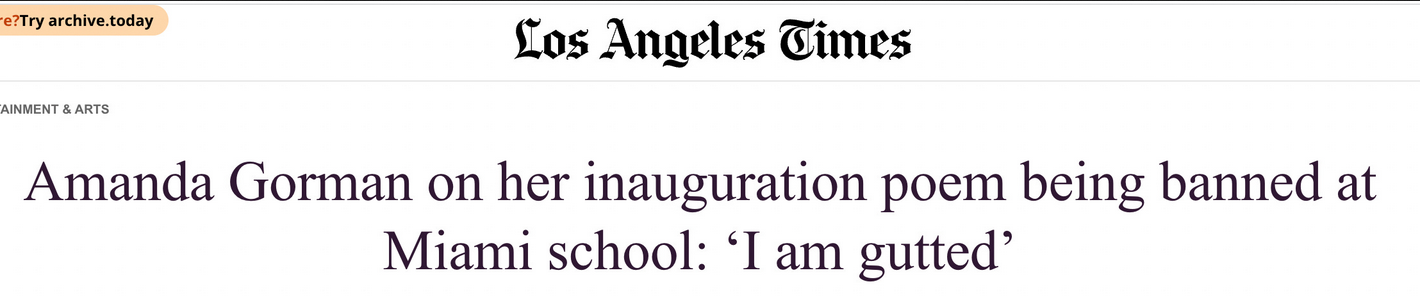
In 2023, the tedious midwit poet Amanda Gorman posted on Twitter that she was “gutted” — the standard emotion for tedious midwits — to discover that one of her poems had been “banned” by a school in Florida. The news media raced to proclaim that Florida schools are banning books, the leading edge of the Ron DeSantis fascist wave.
As others have already said, Gorman’s boring poem was moved from an elementary school library shelf to a middle school library shelf, without leaving the library