Quotulatiousness

August 14, 2019

Hong Kong’s struggle with the Chinese government

Filed under: China, Government, Law, Liberty — Tags: , , , , — Nicholas @ 03:00

Andrew Coyne on the desperate situation of the Hong Kong protests:

2019 Hong Kong anti-extradition law protest on 16 June, captured by Studio Incendo from Flickr.
Photo via Wikimedia Commons

A sickening pall of inevitability hangs over the protests in Hong Kong, now in their tenth week. Neither side can afford to back down – the protesters, because their way of life, indeed their very lives, are at stake; the Beijing-backed government, for the precedent it would set, and the hope it would inspire.

As the violence mounts — most of it, to date, on the part of the police, or in some cases the Triad gangs hired to beat and intimidate the protesters — so does the likelihood of mass bloodshed, a reprise of the Tienanmen massacre of 30 years ago. Some of the protesters may indeed hope to tempt Beijing into such an appalling overstep; however horrific the prospect, or improbable their chances, it is difficult to blame them.

For as the people of the world’s freest city fend off being swallowed by one of the world’s most repressive dictatorships, they do so largely alone. Fifty-six years ago, when West Berlin faced a similar threat from the Eastern Bloc, the democratic world rallied to its cause – because its cause, they knew, was their cause. President John F. Kennedy went to Berlin to give his great, moving “ich bin ein Berliner” speech, declaring before the world that “all free men, wherever they may live, are citizens of Berlin.” These were not just words — it was NATO policy to defend the city with arms, if necessary.

And today? The president of the United States refers to the protesters as “rioters,” the Beijing-approved term. Should President Xi Jinping decide to suppress the unrest in Hong Kong by force, he seems to be signalling, he would be willing to look the other way — perhaps for reasons of state (what are a few hundred or even thousand lives if it helps close a trade deal?), or perhaps just out of his habitual admiration for dictators. But the government of Canada — 300,000 of whose citizens, let us remember, live in the city — has been scarcely more robust in their defence; neither have most western governments.


1950s Willys Jeep Promotional Film – The Jeep Family Of 4 Wheel Drive Vehicles

Filed under: Business, History, Technology, USA — Tags: , , — Nicholas @ 02:00

PeriscopeFilm II
Published on 3 Sep 2015

Willys, the “World’s Largest Manufacturer of Utility Vehicles,” presents the Jeep Family of 4-Wheel Drive Vehicles and Special Equipment, a circa 1954 black-and-white film promoting Jeeps produced for civilian use. Following the success of Jeeps during World War II, the film opens with an explanation of how the vehicles soon their way to civilian use. Some of the vehicles seen in this film are used by construction companies, farmers, firefighters, and even at airports to tow aircraft and move cargo trailers and plow snow. At mark 02:49 the film introduces other types of Jeep equipment, such as a generator that turns the vehicle “into a mobile source of electric power to operate saws, communication equipment, motion picture equipment, flood and spotlights. And indeed any electrical equipment that must be moved around over bad terrain or in bad weather.” Scenes also capture telephone company repair crews, oil field crews, plus local and state road crews and construction companies. A Jeep is shown at a cemetery at mark 04:03 moving sand, shrubs, and burial equipment around the grounds in addition to lifting memorial markers. The viewer learns about variable engine speeds beginning at mark 05:55 with an up-close look at an engine and a discussion of its power, as well as various ways that power can be tapped for various operations. As it continues the film touts the Jeep rotary cutter (mark 07:45) as high brush is cut down, a hammer mill (mark 08:15), and a trencher (mark 08:30). There are forklift attachments, front and rear winches, as a front winch is shown pulling a dead tree from the ground (mark 10:10). The sales pitch rolls on at mark 11:42 showing some Jeep steel tops including the half-cab, master, and standard top — “each one designed for a special purpose but all three designed to stand up in rough hard service year after year.” Mark 12:00 begins an explanation of the vehicle’s 4-wheel drive capabilities, meaning that the vehicle “can go anywhere to do its job” including remote camping and hunting spots, while by mark 13:48 there’s a look at a Willys sedan delivery vehicle as grocery store employees are shown loading items into the back, and the Willys pick-up trick at mark 14:52. Other models are shown hauling grain and livestock, as well as an ambulance (mark 17:00).

Jeep is a brand of American automobiles that is a division of FCA US LLC (formerly Chrysler Group, LLC), a wholly owned subsidiary of Fiat Chrysler Automobiles. The original Jeep was the prototype Bantam BRC. Willys MB Jeeps went into production in 1941 specifically for the military, arguably making them the oldest four-wheel drive mass-production vehicles now known as SUVs. The Jeep became the primary light 4-wheel-drive vehicle of the United States Army and the Allies during World War II, as well as the postwar period. The term became common worldwide in the wake of the war. The first civilian models were produced in 1945. It inspired a number of other light utility vehicles, such as the Land Rover. Many Jeep variants serving similar military and civilian roles have since been designed in other nations. Willys-Overland and Ford, under the direction of Charles E. Sorensen (Vice-President of Ford during World War II), produced about 640,000 Jeeps towards the war effort, which accounted for approximately 18% of all the wheeled military vehicles built in the U.S. during the war.

From 1945 onwards, Willys took its four-wheel drive vehicle to the public with its CJ (Civilian Jeep) versions, making these the first mass-produced 4×4 civilian vehicles. In 1948, the U.S. Federal Trade Commission agreed with American Bantam that the idea of creating the Jeep was originated and developed by American Bantam in collaboration with some U.S. Army officers. The commission forbade Willys from claiming, directly or by implication, that it had created or designed the Jeep, and allowed it only to claim that it contributed to the development of the vehicle. However, American Bantam went bankrupt by 1950, and Willys was granted the “Jeep” trademark in 1950.

This film is part of the Periscope Film LLC archive, one of the largest historic military, transportation, and aviation stock footage collections in the USA. Entirely film backed, this material is available for licensing in 24p HD and 2k. For more information visit http://www.PeriscopeFilm.com

QotD: Proto-progressive thought

Filed under: Government, History, Liberty, Politics, Quotations — Tags: , — Nicholas @ 01:00

[Robert Southey] conceives that the business of the magistrate is not merely to see that the persons and property of the people are secure from attack, but that he ought to be a jack-of-all-trades, architect, engineer, schoolmaster, merchant, theologian, a Lady Bountiful in every parish, a Paul Pry in every house, spying, eavesdropping, relieving, admonishing, spending our money for us. His principle is, if we understand it rightly, that no man can do anything so well for himself as his rulers, be they who they may, can do it for him, and that a government approaches nearer and nearer to perfection in proportion as it interferes more and more with the habits and notions of individuals.

Thomas Babington Macaulay, “Southey’s Colloquies on Society”, 1830.

August 13, 2019

Titania McGrath reviews the very best show at the Edinburgh Fringe this year

Filed under: Britain, Humour, Politics — Tags: , , — Nicholas @ 05:00

It is, of course, her own show:

There are over 2,000 shows at this year’s Edinburgh Festival Fringe, but only one that is really worth seeing. Titania McGrath’s Mxnifesto is a tour de force of political oratory that is unlikely to be surpassed in my lifetime. I have seen every single performance, except for the nights I’ve had off (usually when my self-diagnosed PTSD has flared up), and its cultural significance is indisputable. I’d go so far as to suggest that the Edinburgh Fringe should cease after this current year, given that its purpose has now surely been fulfilled.

I was warned against writing this piece. Apparently, it is frowned upon to write a review for your own show. I consider this yet another attempt to silence women’s voices by the forces of heteronormative patriarchy. Why should I, as a proud independent woman, not proclaim my own worth? I will not bend the knee to swaggering males who seek to oppress me with their “opinions”. I will not seek permission before declaring my own genius. Mxnifesto is a fucking masterpiece and I am only awarding it five stars because to give it six it might seem arrogant.

As one walks into the auditorium at the Pleasance Above, a charming little theater space that emphasizes McGrath’s humility, there is a collective tremble of anticipation among the crowd. After all, McGrath has a reputation not only for her wisdom, but also for her righteous anger. Like Joan of Arc, she has successfully fought for justice against incredible odds. But unlike Joan of Arc, she didn’t make the stupid mistake of getting herself burned to death in the process.

From the program description:

Titania McGrath is a radical intersectionalist poet committed to feminism, social justice and armed peaceful protest. As a millennial icon on the forefront of online activism, Titania is uniquely placed to explain to you why you are wrong about everything and how to become truly woke. “The latest genius twist in Britain’s long tradition of satirical spoof” (Daily Express). “Outrageous and hilarious” (Irish Independent). “Brilliant” (Daniel Sloss). “Titania McGrath is a genius” (Spectator). “Hilarious… perfectly captures the joyless tone of the woke Stasi” (Times). “Lampooning the language of social justice is a cheap shot” (Observer).

Hands on with the Sutton Hoo sword I Curator’s Corner Season 5 Episode 1

Filed under: Britain, History, Weapons — Tags: , , , , — Nicholas @ 04:00

The British Museum
Published on 5 Aug 2019

Sue Brunning and her trusty foam sword (newly dubbed Flexcalibur by commentator Pipe2DevNull) are back for another sword story. This time Sue takes us up close and personal with one of the most famous swords ever discovered.

Sue has also written a blog about Sutton Hoo available here: https://bit.ly/2yQkfYV (there are lots of other great articles there too!)

#CuratorsCorner #SwordswithSue #SuttonHooSue

Vikings trade for P/K Kaare Vedvik, release LS Kevin McDermott

Filed under: Football — Tags: , , , — Nicholas @ 03:00

It had been an uncharacteristically quiet training camp for the Minnesota Vikings so far this year, with very little in the way of drama or even news. Until Sunday, when the team sent their 2020 5th-round draft pick to Baltimore to acquire punter/kicker Kaare Vedvik and then released their veteran long snapper Kevin McDermott.

I’ll be honest, I rarely glance at news for those 31 other, less-important NFL teams, so Vedvik was a total unknown to me, but apparently he’s already been annointed as the saviour for the Chicago Bears, according to his Wikipedia entry:

It’s not clear whether Vedvik will be competing for the role of kicker (against Dan Bailey) or punter (against Matt Wile) or even both. The moves make sense financially for the Vikings, as they’re one of the worst-off teams against the salary cap this season: they gain $119,742 in cap space for releasing Kevin McDermott (with $200,000 “dead” money). Rookie Austin Cutting will earn $513,644 for the season.

And while I’m looking at Vikings coverage, I’ll include Ted Glover’s Buy/Sell ratings from his belated Stock Market Report on the New Orleans game:

Buy: Sean Mannion has the inside track for the backup QB job. Mannion had a nice night, and didn’t play himself out of the backup job, like a lot of us felt Trevor Siemian did last year. His TD to Johnson was a bit underthrown, but he stood tall in the pocket and delivered the ball right as he was getting hit. He did make at least one throw that should or could have been picked, but overall it was a respectable night for Mannion.

Sell: Kyle Sloter has lost the backup QB battle. His first drive in the second half was impressive. He made two great throws to Conklin and Khari Blasingame for over 40 yards, and hit Blasingame for a two yard TD pass to cap the drive. Sloter just looks like a guy that could be the backup, and if nothing else, I’d like to at least see him get some work with the second team.

Buy: There was some encouraging play from the rookie class. I gotta say, there’s a lot to like from this draft class so far, at least in the somewhat limited action. Garrett Bradbury looked very much like the real deal in his only drive, and we’ve already talked about Mattison, Smith, Blasingame, and Johnson.

Sell: It was all unicorns and rainbows for the rookie class. Still, it was and up and down night for these guys. Smith had the untimely penalty, Mattison never really got it going on the ground, and other than the two catches Johnson had in the second quarter, he didn’t do anything else. Fourth round pick Dru Samia had a holding penalty called on him and graded out very poorly per PFF, but I don’t recall any horrible missed blocks or assignments, though.

Buy: Nate Meadors pick six. Heck of an effort by Meadors to pick the bobbled ball out of mid air and take it to the house. It was a tough adjustment on the bobble, and a really nice play.

Sell: Nate Meadors made the roster with that play. I still don’t know that was enough to get him ahead of a guy like Kris Boyd or Holton Hill and his doghouse on the back end of the roster, though. I mean let’s face it, if the Saints tight end holds on to the ball, it’s a seven or 8 yard gain, more than likely, and a very routine play.

Buy: Preseason games are inherently sloppy. Young players are trying to learn the game at the NFL level, veterans haven’t played in seven months, and with all the substitutions constantly going in and out it and at times, it almost looks like a hockey game when lines are shifting. Both teams were bumbling and stumbling, and the referees are throwing more flags as they are wanting to highlight what the league is emphasizing in terms of fouls this year.

Sell: The amount of penalties can be excused because it was preseason. Eric Wilson had a nice TFL erased, Ifeadi Odenigbo had a sack that was almost a strip sack nullified, the first team defense had a penalty on a third and goal that gave the Saints a fresh set of downs … and that was all in the first half. The Vikings had 13 penalties for 176 yards, which is unacceptable for any game, preseason or otherwise. That has GOT to be cleaned up, as no team in the NFL can overcome that many mistakes and win consistently.

How to Make Really Good Garlic Bread

Filed under: Food, Randomness — Tags: , — Nicholas @ 02:00

America’s Test Kitchen
Published on 3 Mar 2019

Keith shows Bridget how to make the absolute best garlic bread.

Get the recipe for Really Good Garlic Bread: http://cooks.io/2I9Anbx
Buy Our Winning Rasp-Style Grater: https://cooks.io/2VrLqlU

ABOUT US: Located in Boston’s Seaport District in the historic Innovation and Design Building, America’s Test Kitchen features 15,000 square feet of kitchen space including multiple photography and video studios. It is the home of Cook’s Illustrated magazine and Cook’s Country magazine and is the workday destination for more than 60 test cooks, editors, and cookware specialists. Our mission is to test recipes over and over again until we understand how and why they work and until we arrive at the best version.

If you like us, follow us:
http://americastestkitchen.com

QotD: Karl Popper on the paradox of tolerance

Filed under: Books, Liberty, Politics, Quotations — Tags: , , — Nicholas @ 01:00

It’s very unlikely that the violent communists using the paradox of tolerance as a defense have actually read what Karl Popper said in full. They will cite a general summary and ignore the full context of what was actually written.

In note 4 of volume 1, chapter 7, of Popper’s The Open Society and Its Enemies, he clarifies his position on how best to deal with intolerant philosophies:

    … I do not imply, for instance, that we should always suppress the utterance of intolerant philosophies; as long as we can counter them by rational argument and keep them in check by public opinion, suppression would certainly be unwise. But we should claim the right to suppress them if necessary even by force; for it may easily turn out that they are not prepared to meet us on the level of rational argument, but begin by denouncing all argument; they may forbid their followers to listen to rational argument, because it is deceptive, and teach them to answer arguments by the use of their fists or pistols. We should therefore claim, in the name of tolerance, the right not to tolerate the intolerant.

It is clear from Popper’s writing that it would be unwise to resort to violence against an intolerant group that is willing to discuss and debate their ideas. So long as the intolerant group is tolerant enough to agree to debate and discuss their intolerant ideas rather than resort to violence, it is better to handle them with words.

The problem is, some groups, like Antifa, respond to arguments with violence. And it is these sorts of groups that Popper claims must not be tolerated. If a group is so intolerant that they are unwilling to discuss ideas and instead rely entirely on violence, then they must be met with violence. In other words, Popper is simply saying that a nonviolent society must, at the very least, believe in a right to use violence as a form of self-defense.

Nathan Kreider, “Misconceptions of the Paradox of Tolerance”, Being Libertarian, 2019-05-31.

August 12, 2019

Hogs in History – Creator and Destroyer – Extra History

Filed under: Americas, Environment, Europe, Food, History — Tags: , , , — Nicholas @ 06:00

Extra Credits
Published on 10 Aug 2019

Download the World of Tanks game for free https://tanks.ly/2yj0usN and use the invite code EXTRATANKS1 to claim your $15 starter pack.

In 1494, among the colonization forces from Spain, eight pigs arrived in Cuba. With multiple uses in culinary and craft trades, as well as their general top-tier hardiness, pigs would naturally propagate themselves throughout the Caribbean, and then to Central, South, and North America — but they were also incredibly destructive.

Visit TierZoo to learn about how OP pigs are: https://www.youtube.com/watch?v=6xbQ2…

Join us on Patreon! http://bit.ly/EHPatreon

News consumption in Canada according to a new report from the Digital Democracy Project

Filed under: Cancon, Media, Politics — Tags: , , , , , — Nicholas @ 05:00

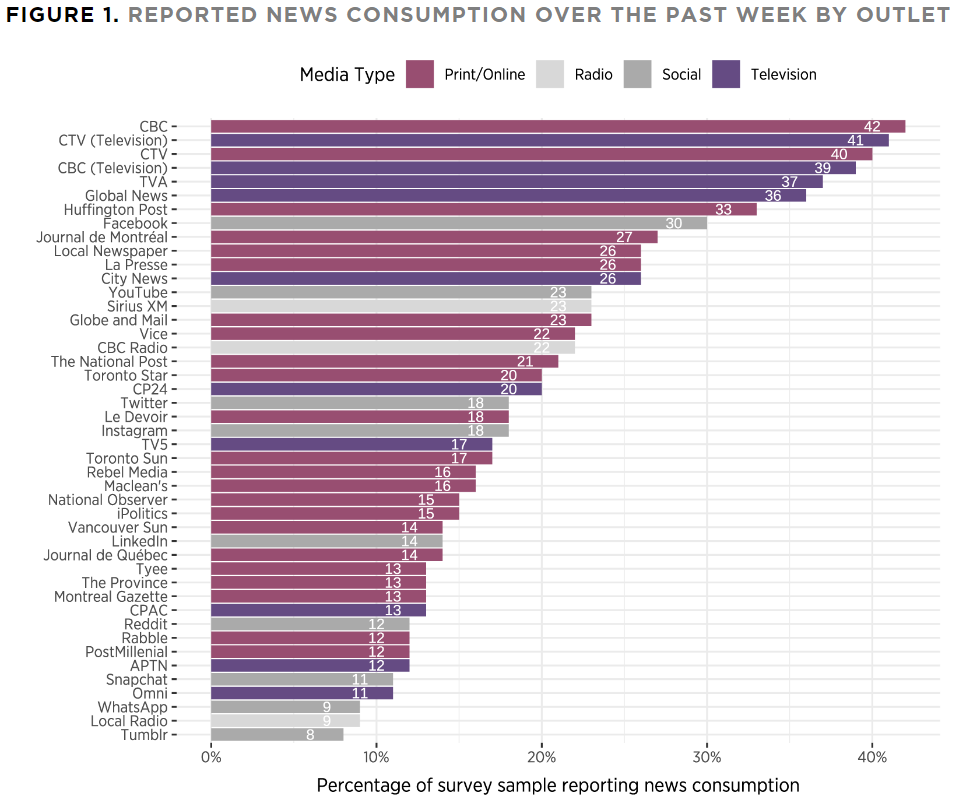
Ali Taghva summarizes some of the more interesting findings from a new study of how Canadians get their news in the internet age:

Earlier this month, the Digital Democracy Project (DDP), a joint initiative led by the Public Policy Forum and the Max Bell School of Public Policy at McGill University, published their first report in a series aimed at studying the Canadian media ecosystem in the lead up to the 2019 election.

The results are reaffirming for anyone who believes the nation’s media do not require ethically worrying government funds to continue operation.

In less than two years, The Post Millennial has become one of the largest media organizations in the country. According to DDP’s survey results, roughly 12% of respondents viewed our content in the last week.

The above chart indicates that our digital viewership equates roughly to one-fourth of the reach held by CBC.

While the CBC and others continue to spend hundreds of millions to compete, we continue to grow and remain cash-flow positive on a budget less than 1/100th the size of our mainstream competitors.

Another interesting graphic from the PDF research memo is this representation of the distribution of online link sharing by candidates of the major parties:

The following directed network graph shows the relative frequency of linked news sites among the six main parties. Each media outlet is represented by a circle, the size of which reflects the frequency at which candidates link to the site. A large circle thus indicates multiple parties frequently sharing content from that outlet. The width of the lines that the parties to the outlets is based on how often candidates from that party share content from that outlet.

The Battle For Hungary: October – December 1944

Filed under: Europe, Germany, History, Military, Russia, WW2 — Tags: , , — Nicholas @ 04:00

Historigraph
Published on 10 Aug 2019

Join me in War Thunder! Use my link for a FREE premium aircraft, tank or ship and a three day account boost as a BONUS: https://gjn.link/Historigraph/190810 Also available for free on PlayStation®4 and Xbox One.

If you enjoyed this video and want to see more made, consider supporting my efforts on Patreon: https://www.patreon.com/historigraph

To chat history, join my discord: https://discord.gg/vAFTK2D

I’m indebted to some viewers for helping me out with pronounciation of Hungarian words:

https://www.youtube.com/watch?v=FApWW…
https://www.youtube.com/watch?v=nCG_w…

If you are Hungarian, please be charitable as I will still not have the word sounds 100% correct, as I am not a native speaker. I’m not about to put on a bad hungarian accent!
#WarThunder #BattleForHungary #Historigraph

Sources:

The Siege of Budapest and the battles that led to it have had precious little written about them (in English!), so the bulk of this video (and the next) comes from one book:

Krisztián Ungváry, Battle for Budapest: 100 Days in World War 2

This is by far the most detailed account of the battle that I could find.

Australia’s government broadband fiasco might be a useful lesson for Senator Warren

Filed under: Australia, Business, Economics, Government, Politics, Technology, USA — Tags: , , — Nicholas @ 03:00

In the race for the Democratic party’s presidential nomination, Senator Elizabeth Warren recently proposed a government-provided broadband rollout across the United States to compete with or supplant the existing private ISPs. Arthur Chrenkoff suggests that looking at Australia’s experience with a very similar plan might encourage her to abandon her proposal after a brief airing on the campaign trail:

Senator Elizabeth Warren speaking at the Iowa Democrats Hall of Fame Celebration in Cedar Rapids, Iowa, on 9 June, 2019.
Photo by Lorie Shaull via Wikimedia Commons.

Maybe Senator Warren should have a pow-wow first with IT experts from Australia, who could enlighten her about our country’s 12-years-and-counting saga of the National Broadband Network, a Labor government initiative that the -then leader of the opposition, Tony Abbott, described as “a white elephant on a massive scale” but later adopted and continued while in government.

It started in 2007 as a policy for a government-rolled out broadband network, in most areas duplicating internet services already provided by private sector providers (mainly through the existing copper wire telephony network), which would be available as an option to all Australian households. In most cases it would be achieved through wired technology (fibre to the premises, later downgraded to a cheaper fibre to the node) with a satellite connection available to the most remote areas where cabling was impractical.

I remember thinking then that the project was an absurd waste of taxpayers’ money for a service of the type that telecommunication companies would be able and willing to provide in any case. At most, there was an argument that the government could step in and provide the infrastructure in some country areas where there was no commercial case for the private providers to proceed. Call me a clairvoyant but it was pretty clear to me that “broadband for all” would take a lot longer to roll out that planned, would cost significantly more than initially budgeted, and would very likely be technologically obsolete by the time it was finished.

At the Range with the Iconic MP5A3

Filed under: Germany, Technology, Weapons — Tags: , , — Nicholas @ 02:00

Forgotten Weapons
Published on 15 Jun 2019

http://www.patreon.com/ForgottenWeapons

Cool Forgotten Weapons merch! http://shop.bbtv.com/collections/forg…

The MP5 is widely considered the best submachine gun ever made, for its reliability, its handling, and its closed-bolt delayed-blowback action. It is so widely praised, in fact, that H&K’s efforts to replace it with less expensive polymer submachine guns have largely failed, as their customers simply insist on the MP5.

I have had only a brief bit of experience actually using the MP5 myself, and I wanted to take this opportunity while visiting H&K to fix that. So, does it live up to its reputation?

In a word, yes.

Many thanks to H&K USA for providing me access to this MP5A3, and to Trijicon for graciously providing use of their range!

Contact:
Forgotten Weapons
PO Box 87647
Tucson, AZ 85754

QotD: The “lost technological developments” of the Great Library

Filed under: Books, History, Quotations, Science, Technology — Tags: , , , , — Nicholas @ 01:00

… the largely unempirical and abstract nature of Greek natural philosophy and the fact that it was generally socially divorced from the practical arts of engineering and architecture meant that most Greek and Roman scientists did little to advance technology, and the idea that the Great Library would have been filled with men excitedly sketching flying machines or submarines is, once again, a fantasy. When all this is pointed out some New Atheists try to invoke counter-evidence. They often claim, for example, that Hero of Alexandria worked at the Great Library and that he invented the steam engine. Even a scientist who has not studied history past high school (i.e. most of them) will have dim memories of the history of the Industrial Revolution and would therefore know it had something to do with the invention of steam engines, so surely Hero brought the ancient world to the brink of industrial transformation. Well, actually, no.

Hero does seem to have been another exception to the rule when it comes to philosophers tinkering with gadgets and it’s possible (though far from certain) that he worked in the Mouseion. But the practical applications of his study of pneumatics and dynamics were more toys and curiosities than any great leaps forward in technology. He famously made an aeolipile, though he didn’t actually invent it, given that it had already been described by the Roman engineer and architect Vitruvius, but this can only be called a “steam engine” in the loosest sense of the term. Hero’s little device was not capable of doing anything more than spinning in place and Roman technology lacked the high tensile metallurgy, the mathematics or the precision tooling that would be required to make a true steam engine. The other technological wonder that is often invoked here is the Antikythera mechanism. Exactly how this intricate mechanical orrery based on a geocentric model is supposed to indicate some nascent Industrial or Scientific Revolution is never made clear, but not only did it have no connection to the Great Library, it was a kind of instrument known since the third century BC. If it is evidence that the Greco-Roman world was on the brink of a technological revolution and was only stymied by the rise of Christianity, one has to wonder what kept them from achieving this wondrous thing for the 600 years between its invention and the conversion of Constantine.

The New Atheist mythic conception of the “Great Library of Alexandria” bears very little resemblance to any historical actuality. It was a shrine with scholars attached to it, not a secular university. Its scholars were far more concerned with poetry, textual analysis, grammar, lexicography and rhetoric than anything we would see as “science”. The proto-science they did do was mainly of a highly abstract and often metaphysical nature rather than anything like modern science. And it was also generally divorced from technical innovation and what little practical application it was given did not much at all to advance technology. The idea that if the Great Library had not been burned down by wicked Christians we’d all be living in gleaming space cities on Europa or Callisto is, therefore, a silly fantasy. And not least because the Great Library … wasn’t burned down by wicked Christians.

Tim O’Neill, “The Great Myths 5: The Destruction Of The Great Library Of Alexandria”, History for Atheists, 2017-07-02.

August 11, 2019

Hail Mussolini, Haile Selassie’s Usurper – WW2 – 050 – August 10 1940

Filed under: Africa, Britain, Europe, Germany, History, Italy, Military, Russia, WW2 — Tags: , , , , — Nicholas @ 06:00

World War Two
Published on 10 Aug 2019

This week, the war spreads to Africa, when the Italians invade the British Colony of British Somaliland. While this might seem trivial, it might have tremendous consequences on the remainder of the war.

Join us on Patreon: https://www.patreon.com/TimeGhostHistory
Or join The TimeGhost Army directly at: https://timeghost.tv

Follow WW2 day by day on Instagram @World_war_two_realtime https://www.instagram.com/world_war_t…
Join our Discord Server: https://discord.gg/D6D2aYN.
Between 2 Wars: https://www.youtube.com/playlist?list…
Source list: http://bit.ly/WW2sources

Written and Hosted by: Indy Neidell
Produced and Directed by: Spartacus Olsson and Astrid Deinhard
Executive Producers: Bodo Rittenauer, Astrid Deinhard, Indy Neidell, Spartacus Olsson
Creative Producer: Joram Appel
Post-Production Director: Wieke Kapteijns
Research by: Indy Neidell
Edited by: Iryna Dulka
Map animations: Eastory

Colorisations by Norman Stewart and Julius Jääskeläinen https://www.facebook.com/JJcolorization/

Eastory’s channel: https://www.youtube.com/channel/UCEly…
Archive by Screenocean/Reuters https://www.screenocean.com.

Sources:
Freepngimg.com
IWM: CH 3484
Sound effect: littlerobotsoundfactory

A TimeGhost chronological documentary produced by OnLion Entertainment GmbH.

From the comments:

World War Two
2 days ago
Last week, we saw how one of our flagship episodes was taken down by YouTube. It turned out that this was a mistake by a YouTube worker who erroneously identified our content as hate speech. While we contacted YouTube immediately to protest, they themselves noticed the mistake before we reached the right people. They have since apologized to us and reinstated the episode. You can watch it here: https://youtu.be/DLN8NHXiMy0. We welcome YouTube’s diligence in fighting against extremist hateful content, especially in light of the current tragic events in the US, and we have accepted their apology. However, this does not change the fact that we still face demonetization of many of our videos, connected to lower recommendation of these videos. This is a problematic situation that we deplore – we continue to believe that the best way to fight ignorance and hatred is by education and that is at the heart of what we do here, unfortunately YouTube’s monetization policies continue to stand in the way of that mission.

When the episode went down we saw a surge of support from many of you and we are humbly grateful for our dedicated community. The effort you all have made to share our content and support us on Patreon and timeghost.tv is what makes this show possible, and it’s an honor to have you all here. It is your support, both financially and in spirit that keeps us getting up in the morning to face yet another day of the war. Thank You!

Cheers,
The TimeGhost team

« Newer PostsOlder Posts »

Powered by WordPress