Quotulatiousness

August 11, 2019

Vikings ruin Saints’ preseason home opener, 34-25

Filed under: Football — Tags: , , , , — Nicholas @ 05:00

It’s only the preseason, so there’s no real “need” to win, aside from the natural urge to beat your opponent that comes with any competitive activity, but it’s always nice to win at someone else’s home field. The Minnesota Vikings visited the New Orleans Saints on Friday night, coming away with a comfortable victory.

As is typical in the first preseason game, the presumptive starters only play for a limited time in order to both limit injury possibilities and to provide more snaps for players further down the depth chart. Chris Tomasson reported on the game for the St. Paul Pioneer Press:

Kirk Cousins was close to perfect to start the preseason last year. On Friday night, he was perfect.

At least according to the NFL’s passer rating.

In a 34-25 win over New Orleans at the Superdome, the Vikings quarterback completed 4 of 4 passes for 65 yards and a touchdown for a perfect passer rating of 158.3.

In last year’s preseason opener at Denver, Cousins completed 4 of 4 passes for 42 yards and a touchdown with a passer rating of 150.0.

And once again the Vikings won an exhibition opener. Head coach Mike Zimmer is now 6-0 in such games since taking over in 2014.

It initially looked Friday as if Cousins had hit Adam Thielen for a 35-yard touchdown pass after the receiver made a diving catch. However, a replay showed Thielen was down just shy of the goal line, and Cousins connected on the next play with rookie running back Alexander Mattison on a 1-yard touchdown pass for a 7-0 lead.

For the Saints, quarterback Teddy Bridgewater also impressive, and he played a lot longer. With starter Drew Brees held out, the former Vikings quarterback went the distance in the first half, and completed 14 of 19 passes for 134 yards and a touchdown.

Bridgewater, who played for the Vikings from 2013-17, suffered a severe knee injury in August 2016. He said on Wednesday he is fully recovered, and it certainly looked that way against his former teammates.

Cousins had expressed hope earlier in the week that the Vikings would score a touchdown on his only possession, and they delivered. Cousins also helped out with his legs, running for 10 yards on third-and-9 at the Minnesota 25 for the initial first down of the game.

At the Daily Norseman, Christopher Gates mentions some players who might have been buried in the depth chart before the game, but who materially changed their chances for making the final 53-man roster with their work on Friday night:

Bisi Johnson, WR – With the competition for the Vikings’ #3 wide receiver spot still pretty wide open, the seventh-round pick from Colorado State may have just jumped himself up to the top spot. He had two very nice catches on Friday night, including an 18-yard touchdown catch on a throw by Sean Mannion into very good coverage. He also got an opportunity as a kick returner in this one.

Nate Meadors, CB – I’m not sure what his odds of actually making the roster at this point are, but there’s no scenario where a pick-six is going to go down as a negative, so he pretty clearly helped himself. As we’ve said all offseason, with Mike Hughes’ status up in the air and Holton Hill’s status very well-known, there could be some room at the bottom of the cornerback depth chart in Minnesota, and Meadors is making his case.

Tyler Conklin, TE – Fellow tight end Cole Hikutini has been one of the hot names at Training Camp so far this year, but if the Vikings are going to keep four tight ends, it looked tonight like Conklin is comfortably in the lead for that spot at this point. He led the Vikings in receiving yardage on Friday, despite having just two catches. He averaged 28 yards/reception, and showed some nifty skills after the catch on a screen pass in the second quarter.

The Vikings’ young defensive linemen – With both the Vikings’ starting defensive tackles out of this one, some of the younger players up front got some chances to shine, and both Hercules Mata’afa and Jalyn Holmes did just that. Ifeadi Odenigbo also made the most of his opportunities on Friday night. There are going to be some very, very difficult decisions that have to be made among the defensive linemen on cutdown day, as has been the case the past few years.


Transferring the Tails | Dovetail Box Project #4 | Free Online Woodworking School

Filed under: Woodworking — Tags: , — Nicholas @ 04:00

Matt Estlea
Published on 9 Aug 2019

In this video, I show you how to transfer the tails onto the pin board for maximum accuracy. This is a tricky part of the process that is easy to screw up so I want to share some tips with you that may help you with this part of the build.
_________________________________________________________________

Support what I do by becoming a Patron! This will help fund new tools, equipment and cover my overheads. Meaning I can continue to bring you regular, high quality, free content. Thank you so much for your support! https://www.patreon.com/mattestlea

Don’t want to commit to a monthly direct debit but still want to help out? That’s fine!
You can make a one time donation here: https://www.paypal.me/MattEstlea
You can donate us biscuits here: https://amzn.to/2WOl1UR
_________________________________________________________________
BUY THE WOODWORKING BIBLE HERE:
– UK: https://goo.gl/X8ZzSF
– US: https://goo.gl/UDqWf3
– CA: https://goo.gl/31jBxj
_________________________________________________________________

See what tools I use here: https://kit.com/MattEstlea
My Website: http://www.mattestlea.com
_________________________________________________________________

My name is Matt Estlea, I’m a 23 year old Woodworker from Basingstoke in England and my aim is to make your woodworking less s***.

I come from 5 years tuition at Rycotewood Furniture Centre with a further 1 year working as an Artist in Residence at the Sylva Foundation. I now teach City and Guilds Furniture Making at Rycotewood as of September 2018.

I also had 5 years of experience working at Axminster Tools and Machinery where I helped customers with purchasing tools, demonstrated in stores and events, and gained extensive knowledge about a variety of tools and brands.

During the week, I film woodworking projects, tutorials, reviews and a viewer favourite ‘Tool Duel’ where I compare two competitive manufacturers tools against one another to find out which is best.

I like to have a laugh and my videos are quite fast paced BUT you will learn a lot, I assure you.

Lets go make a mess.

“Saying ‘Donald Trump is not my president’ is like saying that your stepfather isn’t your real dad and slamming your bedroom door”

Filed under: Britain, Cancon, Politics, USA — Tags: , , , , , — Nicholas @ 03:00

Colby Cosh looks at the oddly immature and childish meme of “Not my President”/”Not my Prime Minister” declarations that seem to be ubiquitous these days:

If you sent me back to grad school I would love to do some proper research into the history of the “Not My President”/”Not My Prime Minister”-type statements that are everywhere now. They do seem especially popular with liberals, although they are not exclusive to them. A strong memetic influence was obviously the multi-city “Not My Presidents Day” protests that followed Donald Trump’s inauguration. But the indignant, huffy insistence that Trump is “not my president” obviously had to gain traction in the first place.

The theme has been taken up internationally: if you Google “not my prime minister” most of the top hits are Boris Johnson-related (no doubt the “Theresa May: not my prime minister” T-shirts and buttons will sell in the online shops at a significant discount now), and the theme has become a formal slogan of street protest in the U.K. Adding “Trudeau” to the search string reveals a few comment threads. The Canadian politician who gets the most “Not my X” action is certainly Doug Ford. In Alberta, Rachel Notley and Jason Kenney have been getting roughly equal helpings of “Not my premier!”, presumably not from the same people. Who knows, maybe there’s someone out there who feels that his real premier is still Harry E. Strom.

In analyzing this emerging cliché, I suppose one could interpret it as a small act of libertarian or even anarchist rebellion. Is anybody really deserving of being “my” prime minister? Should we not all, in the glorious Utopia, be the prime ministers of ourselves? But the psychological force and intention of the statement that Joe Blow is not “my prime minister” or “my president” is not really anarchistic. The implication of the assertion is always that someone else might really deserve the title, or that there existed past statesmen nobody was ashamed to follow and identify completely with. Saying “Donald Trump is not my president” is like saying that your stepfather isn’t your real dad and slamming your bedroom door.

Meanwhile, of course, your stepfather is probably covering the mortgage and cleaning the eavestrough. “Not my X!” is a defection from democracy more than it is a challenge to the idea of the state. Donald Trump is definitely the lawful, constitutional president of the United States of America, and anyway possesses the powers thereof; those who say it ain’t so are making an incantation, trying to will a state of affairs into existence. If enough people say it, maybe it sorta automatically comes true. There is a lot of this kind of attempted magic going around these days.

How to make a Housing Dado Joint – The Three Joints – | Paul Sellers

Filed under: Tools, Woodworking — Tags: , , — Nicholas @ 02:00

Paul Sellers
Published on 18 Mar 2015

It takes a master woodworker to teach the basics. Watch Paul’s every move in this video. He shows every single detail of cutting this essential woodworking joint. This is one of the three joints that Paul talks about in his woodworking curriculum.

The housing dado is the essential shelving joint. It is the strongest way to suspend a wide horizontal board by passing it into a vertical piece such as a bookshelf. It has many other uses, such as the back of a drawer. Although there are many variations on a theme with this joint mastering the most simple form is the most difficult and important step.

To see a beginner friendly guide on how to cut a housing dado, visit our sister site: https://commonwoodworking.com/courses…

To find out more about Paul Sellers and the project he is involved with visit https://paulsellers.com

QotD: Deconstructing “Minoan Crete”

In many ways, “Minoan” Crete seemed like a Freudian paradise. Here the archaeologists unearthed colourful frescoes of naked-breasted women participating in the dangerous “bull-vaulting” game, whilst statuettes of bare-breasted goddesses, holding writhing snakes in each hand, emerged from various parts of the island. Evans spoke glowingly of a pacifist matriarchy that flourished before the coming of the warlike and patriarchal Greeks, and his vision was hugely influential in academic circles for at least half a century. It is a vision which has been humorously outlined by Rebecca Bradley on the dust-cover of her book, Goodbye, Mother: The Warriors of Crete: “Once upon a time, on an olive-strewn island in a wine-dark sea, beautiful people lived in peace under the rule of the Great Goddess and her matriarchal avatars. The like of their palaces was not seen again until the advent of shopping-mall architecture in the twentieth century; their artistry flowered like the saffron blossoms collected by their luscious bare-breasted maidens. This was Minoan Crete, stronghold of the Matriarchy and the Great Goddess, flower child of the ancient world — until those nasty patriarchal Mycenaeans and even nastier Dorians came along and crashed the party. Oh yes, and there’s something about a volcano on Santorini, and a few earthquakes as well, but the rot really set in when the men from the mainland took over.”

Perhaps the most prominent high priestess of the Great Goddess was Lithuanian archaeologist Marija Gimbutas (1921-1994). During the 1950s and 60s Gimbutas developed her so-called “Kurgan Thesis;” basically the idea that the archaeological marker of the arrival in Europe of Indo-European-speakers was to be found in the Bronze Age Kurgan mound burials of the Pontic Steppe, a vast region incorporating most of present-day Ukraine, southern Russia and northern Kazakhstan. Controversially, Gimbutas further claimed that these nomadic Indo-Europeans brought with them a warrior-culture dominated by male sky-gods, which supplanted earlier matriarchal and goddess-worshipping cultures. In this, she echoed ideas already expressed at great length by Robert Graves in his 1948 book The White Goddess. Over the next three decades Gimbutas developed her ideas further in a series of books, articles and lectures delivered at campuses throughout America and Europe, where she was immensely influential amongst the burgeoning women’s movement. Three major works, The Goddesses and Gods of Old Europe (1974), The Language of the Goddess (1989), and The Civilization of the Goddess (1991), presented an overview of her conclusions regarding what she saw as Europe’s primeval matriarchy.

The importance of Gimbutas in the development of the matriarchal myth, and also by extension in the development of modern radical feminism, cannot be overstated. Her archaeological experience and expertise, together with her wide knowledge of linguistics and anthropology, seemed to give academic credibility to the romantic and poetic ramblings of Arthur Evans and Robert Graves. Yet in retrospect it is hard to imagine why anyone with even a modicum of common sense could have been taken in.

There were warning signals everywhere. Right from the beginning, for example, many historians were critical of Evans’ interpretation of Minoan Crete, and a devastating blow was delivered in 1974 when German author Hans Georg Wunderlich published his Wohin der Stier Europa trug? (Where did the Bull carry Europa? published in English in 1975 as The Secret of Crete). Here Wunderlich, a trained geologist, examined the structure of the “palace” of Knossos in Crete in detail and came to the conclusion that the building could never have been a palace for the living. It was, instead, a charnel house, a massive necropolis which doubled as an arena for human sacrifice. For the happy-go-lucky “bull vaulting game”, said Wunderlich, was nothing of the sort: it was a ferocious form of human sacrifice which involved young men and women being gored and trampled to death by a sacred bull. This, said Wunderlich, was the origin of the legend of the Minotaur. Since Wunderlich’s time human sacrifice has been confirmed as an integral part of Cretan religious practice, whilst the supposed “pacifism” which Evans and others had imagined, was exposed as nonsensical.

Emmet Scott, “The Myth of the Primeval Matriarchy”, The Gates of Vienna, 2016-07-13.

August 10, 2019

Enter Yugoslavia Part 2 | BETWEEN 2 WARS I 1929 Part 3 of 3

Filed under: Europe, History — Tags: , , , , , , , — Nicholas @ 06:00

TimeGhost History
Published on 9 Aug 2019

As 1929 approaches, the Kingdom of Serbs, Croats and Slovenes spirals closer and closer to collapse. When the parliament descends into murderous chaos, it is up to King Alexander to decide what to do…

Join us on Patreon: https://www.patreon.com/TimeGhostHistory

Hosted by: Indy Neidell
Written by: Francis van Berkel and Spartacus Olsson
Directed by: Spartacus Olsson and Astrid Deinhard
Executive Producers: Bodo Rittenauer, Astrid Deinhard, Indy Neidell, Spartacus Olsson
Creative Producer: Joram Appel
Post-Production Director: Wieke Kapteijns
Research by: Francis van Berkel
Edited by: Daniel Weiss
Sound design: Make Kaminski

Archive by: Reuters/Screenocean http://www.screenocean.com

A TimeGhost chronological documentary produced by OnLion Entertainment GmbH.

From the comments:

TimeGhost History
1 hour ago
We don’t delete or ban any opinions which disagree with other opinions. We delete comments that contain historical fallacies and political propaganda by antidemocratic organisations, irrespective of political leaning. This means that we do not tolerate any lies or propaganda that forward the agenda of, for instance, Nazis, Fascists, Stalinists, Leninists, other ultra-Marxists or Anarchists. That is within our responsibility according to the laws in our territory which forbids the dissemination of false flag information, propaganda, and symbols connected to organizations that have been found to be unconstitutional and an immediate danger to a democratic, free society by the German courts, in accordance with §86 and §86a of the German Penal Code. The law specifically mentions NDSDAP in §86 and the KPD in §86a (NSDAP is the Nazi Party and KPD the Communist party). Moreover we do not tolerate hate speech, racism, xenophobia, and the denial of proven crimes against humanity. This is in perfect agreement with the opinion forwarded by The US Supreme Court on society’s responsibility to fight against that kind of speech and it is in agreement with numerous EU and EU member state laws against same said speech.

Trump as the American Commodus

Filed under: Government, History, Media, Politics, USA — Tags: , , , , — Nicholas @ 05:00

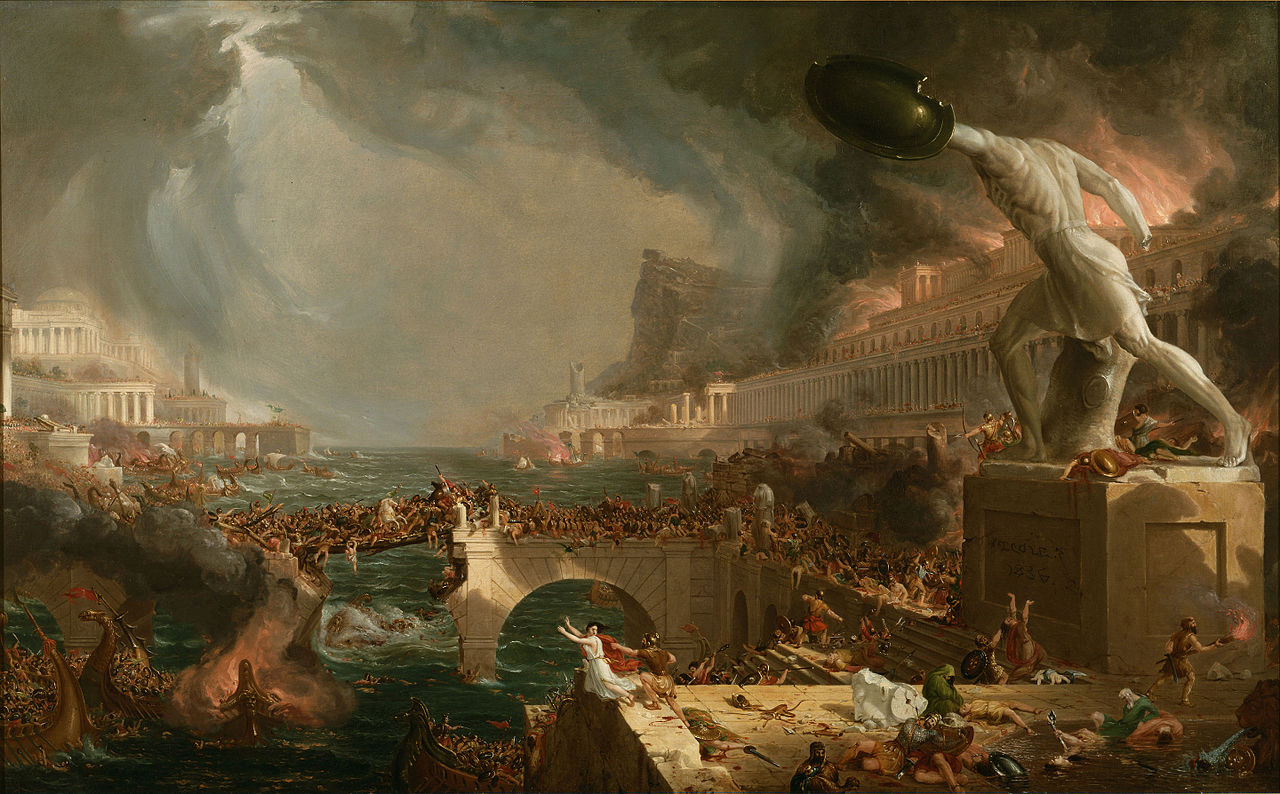
In the New York Review of Books, Tom Holland explains that America isn’t Rome, even if the current President does rather remind him of the Emperor Commodus:

The Course of Empire – Destruction by Thomas Cole, 1836.
From the New York Historical Society collection via Wikimedia Commons.

When Edward Gibbon embarked on his great history of the decline and fall of the Roman Empire, he began his narrative with the accession of Commodus. Marcus Aurelius, the father of the new emperor, was a man who, in the noblest traditions of the Roman people, had combined the attributes of a warrior, a statesman, and a philosopher; Commodus was none of these.

“The influence of a polite age, and the labour of an attentive education,” Gibbon wrote sternly, “had never been able to infuse into his rude and brutish mind, the least tincture of learning; and he was the first of the Roman emperors totally devoid of taste for the pleasures of the understanding.” Instead, Commodus delighted in trampling on the standards by which the Roman political class had traditionally comported themselves. Most shockingly of all — as everyone who has seen Gladiator will remember — he appeared in the arena. His reward for this spectacular breach of etiquette was the cheers of the plebs and the pursed-lipped horror of the senatorial elite. To fight before the gaze of the stinking masses was regarded by all decent upholders of Roman morality as the most scandalous thing that a citizen could possibly do — but Commodus reveled in it. So it was, as Gibbon put it, that he “attained the summit of vice and infamy.”

Today, when conservatives contemplate a leader who, far from being merely an enthusiast for World Wrestling Entertainment, has long been an active and flamboyant participant in it, they may experience a similar shudder. Donald Trump, the only president of the United States ever to have been inducted into the WWE Hall of Fame, boasted that he had won “the highest ratings, the highest pay-per-view in the history of wrestling of any kind.” The Battle of the Billionaires — a proxy wrestling match fought in 2007 between Trump and Vince McMahon, the owner of WWE — had culminated in a victorious Trump strapping McMahon to a barber’s chair and shaving him bald. A decade later, Trump made clear just how much of an influence the theatrical violence of WWE had had on his approach to politics when he tweeted a video of himself body-slamming and repeatedly punching McMahon.

It was in a similar spirit, perhaps, that Commodus might have posed after decapitating an ostrich. Trump, smacking home his point, made sure before he tweeted the video to specify who his real target was. Clumsily superimposed over McMahon’s face was the CNN logo. “FraudNewsCNN” ran the hashtag. “The speed with which we’re recapitulating the decline and fall of Rome is impressive,” the conservative intellectual and former editor of the Weekly Standard Bill Kristol tweeted in response. “What took Rome centuries we’re achieving in months.”

The conviction that Trump is single-handedly tipping the United States into a crisis worthy of the Roman Empire at its most decadent has been a staple of jeremiads ever since his election, but fretting whether it is the fate of the United States in the twenty-first century to ape Rome by subsiding into terminal decay did not begin with his presidency. A year before Trump’s election, the distinguished Harvard political scientist Joseph Nye was already glancing nervously over his shoulder at the vanished empire of the Caesars: “Rome rotted from within when people lost confidence in their culture and institutions, elites battled for control, corruption increased and the economy failed to grow adequately.” Doom-laden prophecies such as these, of decline and fall, are the somber counterpoint to the optimism of the American Dream.

H/T to Niall Ferguson for this and the preceding Roman-related link.

Miscellaneous Myths: Utgard-Loki

Filed under: Europe, History — Tags: , , — Nicholas @ 04:00

Overly Sarcastic Productions
Published on 9 Aug 2019

BRAND NEW MYTH-RELEVANT MERCH: https://www.redbubble.com/people/ospy…

In today’s Norse Mythology news: A goat has a very bad day, Loki loses an eating competition and Thor fails to wrestle an old lady, more at 11.

PATREON: https://www.Patreon.com/OSP

OUR WEBSITE: https://www.OverlySarcasticProductions.com
Find us on Twitter https://www.Twitter.com/OSPYouTube
Find us on Reddit https://www.Reddit.com/r/OSP/

Sulla’s dictatorships

Filed under: Europe, Government, History, Politics, USA — Tags: , , , , , — Nicholas @ 03:00

In New York magazine, Andrew Sullivan portrays the current state of the American Republic in light of the late history of the Roman Republic:

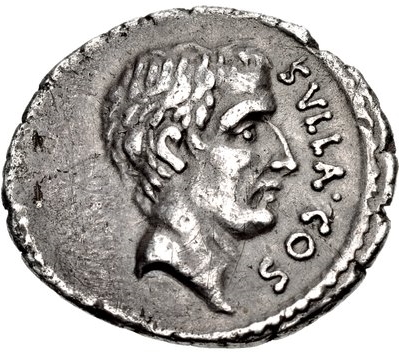
This 54 B.C. coin bears the portrait of the dictator Sulla. The moneyer was Q. Pompeius Rufus, the grandson of Sulla and his home would likely have had portraits of their famous ancestor. Thus, although posthumously struck, the portrait on these coins is probably an accurate representation.
Photo by CNG via Wikimedia Commons.

… zoom out a little more and one obvious and arguably apposite parallel exists: the Roman Republic, whose fate the Founding Fathers were extremely conscious of when they designed the U.S. Constitution. That tremendously successful republic began, like ours, by throwing off monarchy, and went on to last for the better part of 500 years. It practiced slavery as an integral and fast-growing part of its economy. It became embroiled in bitter and bloody civil wars, even as its territory kept expanding and its population took off. It won its own hot-and-cold war with its original nemesis, Carthage, bringing it into unexpected dominance over the entire Mediterranean as well as the whole Italian peninsula and Spain.

And the unprecedented wealth it acquired by essentially looting or taxing every city and territory it won and occupied soon created not just the first superpower but a superwealthy micro-elite — a one percent of its day — that used its money to control the political process and, over time, more to advance its own interests than the public good. As the republic grew and grew in size and population and wealth, these elites generated intense and increasing resentment and hatred from the lower orders, and two deeply hostile factions eventually emerged, largely on class lines, to be exploited by canny and charismatic opportunists. Well, you get the point.

After the overthrow of the monarchy, the new Republic went from strength to strength, struggling against and generally beating and absorbing other city states in the Italian peninsula, eventually rising to face the challenge of Carthage, the dominant power in the western Mediterranean. The eventual Roman victory over Carthage left Rome the superpower of its age, able to dominate and control even the remaining “great” powers of the eastern Mediterranean world. One of the costs of military dominance was an over-reliance on its citizen armies, which eventually changed the entire economy of the Republic, switching from largely small-holding farmers (who were subject to legionary service) to larger slave-worked farms that displaced the families of free citizens from their lands. The result was a constant inflow of impoverished rural citizens to the urban centres, especially Rome itself.

The newly enlarged urban poor found champions to push for reforms to aid them in their plight, the first of whom was Tiberius Gracchus (Extra Credits did a short video series on the Brothers Gracchi: Part I, Part II, Part III, Part IV, Part V, and an extra commentary video). The defeat and death of the Gracchi brothers by agents of the Patrician order led, as you might expect, to yet more polarization and further violent political struggle. This process was hastened by the conflict between Marius and his former protégé Sulla:

As the turn of the first century BCE approached and wars proliferated, with Roman control expanding west and east and south across the Mediterranean, the elites became ever wealthier and the cycle deepened. Precedents fell: A brilliant military leader, Marius, emerged from outside the elite as consul, and his war victories and populist appeal were potent enough for him to hold an unprecedented seven consulships in a row, earning him the title “the third founder of Rome.” Like the Gracchi, his personal brand grew even as republican norms of self-effacement and public service attenuated. In a telling portent of the celebrity politics ahead, for the first time, a Roman coin carried the portrait of a living politician and commander-in-chief: Marius and his son in a chariot.

A dashing military protégé (and rival) of Marius, Sulla, was the next logical step in weakening the system — a popular and highly successful commander whose personal hold on his soldiers appeared unbreakable. Tasked with bringing the lucrative East back under Rome’s control, he did so with gusto, prompting a somewhat nervous Senate to withdraw his command and give it to his aging (and jealous) mentor Marius. But Sulla, appalled by the snub, simply refused to follow his civilian orders, gathered his men, and called on them to march back to Rome to reverse the decision. His officers, shocked by the insubordination, deserted him. His troops didn’t, soon storming Rome, restoring Sulla’s highly profitable command, and forcing his enemies into exile. Sulla then presided over new elections of friendly consuls and went back into the field. But his absence from Rome — he needed to keep fighting to reward his men to keep them loyal — enabled a comeback of his enemies, including Marius, who retook the city in his absence and revoked Sulla’s revocations of command. Roman politics had suddenly become a deadly game of tit for tat.

When Sulla entered Rome a second time, he rounded up 6,000 of his enemies, slaughtered them en masse within earshot of the Senate itself, launched a reign of terror, and assumed the old emergency office of dictator, but with one critical difference: He removed the six-month expiration date — turning himself into an absolute ruler with no time limit. Stocking and massively expanding the Senate with his allies, he neutered the tribunes and reempowered the consuls. He was trying to use dictatorial power to reestablish the old order. And after three years, he retired, leaving what he thought was a republic restored.

Within a decade, though, the underlying patterns deepened, and nearly all of Sulla’s reforms collapsed. What lasted instead was his model of indefinite dictatorship, with the power to make or repeal any law. He had established a precedent that would soon swallow Rome whole.

Make the cheapest, fastest woodturning gouge EVER

Filed under: Tools, Woodworking — Tags: , , — Nicholas @ 02:00

Rex Krueger
Published on 21 May 2017

More videos and exclusive content: http://www.patreon.com/rexkrueger

Bowl-gouges cost a lot of money, but you can make a fantastic gouge out of some simple materials and a few hours time in the shop. Lots of turners have made the famous “Oland tool”, but this video presents an easy, cheap, and nearly idiot-proof method for making an Oland-style tool that can handle large turnings and hard, challenging woods.

If you like this video, you can see other projects and follow my progress on instagram: @rexkrueger

QotD: Progressives and spontaneous order

I suspect that the single biggest factor that distinguishes “Progressives” from libertarians and free-market conservatives is the simple fact that “Progressives” do not begin to grasp the reality of spontaneous order. “Progressives” seem unable to appreciate the reality that productive and complex economic and social orders not only can, but do, emerge unplanned from the countless local decisions of individuals each pursuing his or her own individual plans. Therefore, “Progressives” naturally adopt a creationist view of society and of the economy: without a conscious and visible (and well-intentioned) guiding hand, society and the economy cannot possibly work very well. Indeed, it seems that for many (most?) “Progressives,” the idea that a spontaneously ordered economy can work better than one directed consciously from above – or, indeed, that a spontaneously ordered economy can work at all – is so absurd that when “Progressives” encounter people who oppose “Progressive” schemes for regulating the economy, “Progressives” instantly and with great confidence conclude that their opponents are either stupid or, more often, evil cronies for the rich and the powerful.

Conduct an on-going experiment: whenever well-meaning “Progressives” (of which there are very many) propose this government intervention or oppose that policy of reducing government’s role in the economy, ask if these “Progressives'” stated reasons can be understood to be nothing more than a reflection of a failure to understand the power and range of spontaneous-ordering forces in private-property settings. The answer will almost always be “yes.” Very often, no further explanation for “Progressives'” policy stances is necessary.

“Progressives” simply don’t “get” spontaneous order in human society. They see a problem and leap to the only conclusion that for them is sensible – namely, that that problem’s only realistic “solution” is that it be directly addressed by government officials. Indeed, even “Progressives'” frequent misdiagnoses of the results of trade-offs as being “problems” (or “market failures”) reflect a failure to understand spontaneous-ordering processes. Many phenomena and patterns that “Progressives” assume to be problems – for example, increasing inequality of monetary incomes – are often the benign results of the countless and nuanced individual trade-offs made by individuals. For “Progressives,” though, these “outcomes” are often assumed to be the consequence of sinister designs.

Don Boudreaux, “Bonus Quotation of the Day…”, Café Hayek, 2017-06-24.

August 9, 2019

“Purple Heart” – US Military Decoration – Sabaton History 027 [Official]

Filed under: History, Media, Military, USA — Tags: , — Nicholas @ 06:00

Sabaton History
Published on 8 Aug 2019

The Purple Heart is arguably one of the most iconic military decorations in the American military. The Sabaton Song “Purple Heart” is about the origins and story behind the famous medal.

Support Sabaton History on Patreon: https://www.patreon.com/sabatonhistory

Listen to Primo Victoria (where Purple Heart is featured):

CD: http://bit.ly/PrimoVictoriaStore
Spotify: http://bit.ly/PrimoVictoriaSpotify
Apple Music: http://bit.ly/PrimoVictoriaAppleMusic
iTunes: http://bit.ly/PrimoVictoriaiTunes
Amazon: http://bit.ly/PrimoVictoriaAmzn
Google Play: http://bit.ly/PrimoVictoriaGooglePlay

Check out the trailer for Sabaton’s new album The Great War right here: https://www.youtube.com/watch?v=HCZP1…

Hosted by: Indy Neidell
Written by: Markus Linke and Indy Neidell
Directed by: Astrid Deinhard and Wieke Kapteijns
Produced by: Pär Sundström, Astrid Deinhard and Spartacus Olsson
Creative Producer: Joram Appel
Executive Producers: Pär Sundström, Joakim Broden, Tomas Sunmo, Indy Neidell, Astrid Deinhard, and Spartacus Olsson
Maps by: Eastory
Edited by: Iryna Dulka
Sound Editing by: Marek Kaminski

Eastory YouTube Channel: https://www.youtube.com/channel/UCEly…
Archive by: Reuters/Screenocean https://www.screenocean.com
Music by Sabaton.

Sources:
– Parks, Recreation and Historic Preservation
– U.S. Army Center of Military History
– identifymedals.com
– Medal of Honor, NHHC 1957-2-F, Naval History and Heritage Command, Washington, DC
– Civil War Campaign Medal – Naval History and Heritage Command, Washington, DC
– Photo of Elizabeth Will Courtesy of The Institute of Heraldry
– Reagan Library, National Archives Identifier: 5730544

An OnLion Entertainment GmbH and Raging Beaver Publishing AB co-Production.

© Raging Beaver Publishing AB, 2019 – all rights reserved.

Moulding Planes | Paul Sellers

Filed under: Tools, Woodworking — Tags: , , — Nicholas @ 04:00

Paul Sellers
Published on 8 Aug 2019

We might easily be disaffectionate to the forebears of woodworking, who so enriched our lives with the most wonderful woodworking ever created, using only their bare hands and tools they made to work with. For a short run of moulded stock, moulding planes can be immediate and quite inexpensive. Many “old-timers” kept them around to replicate old moulds and also to develop modern alternatives with their own proven technology. In this video Paul touches the very tip of the iceberg of what lies beneath the surface that we have just barely scraped.

Want to learn more about woodworking? See https://woodworkingmasterclasses.com or https://commonwoodworking.com for step-by-step videos, guides and tutorials. You can also follow Paul’s latest ventures on his woodworking blog at https://paulsellers.com/

What’s happening in Jammu and Kashmir?

Filed under: Government, History, India, Law, Religion — Tags: , , , , , — Nicholas @ 03:00

Pieter J. Friedrich reports on recent events concerning the unique constitutional status of Jammu and Kashmir within the Republic of India:

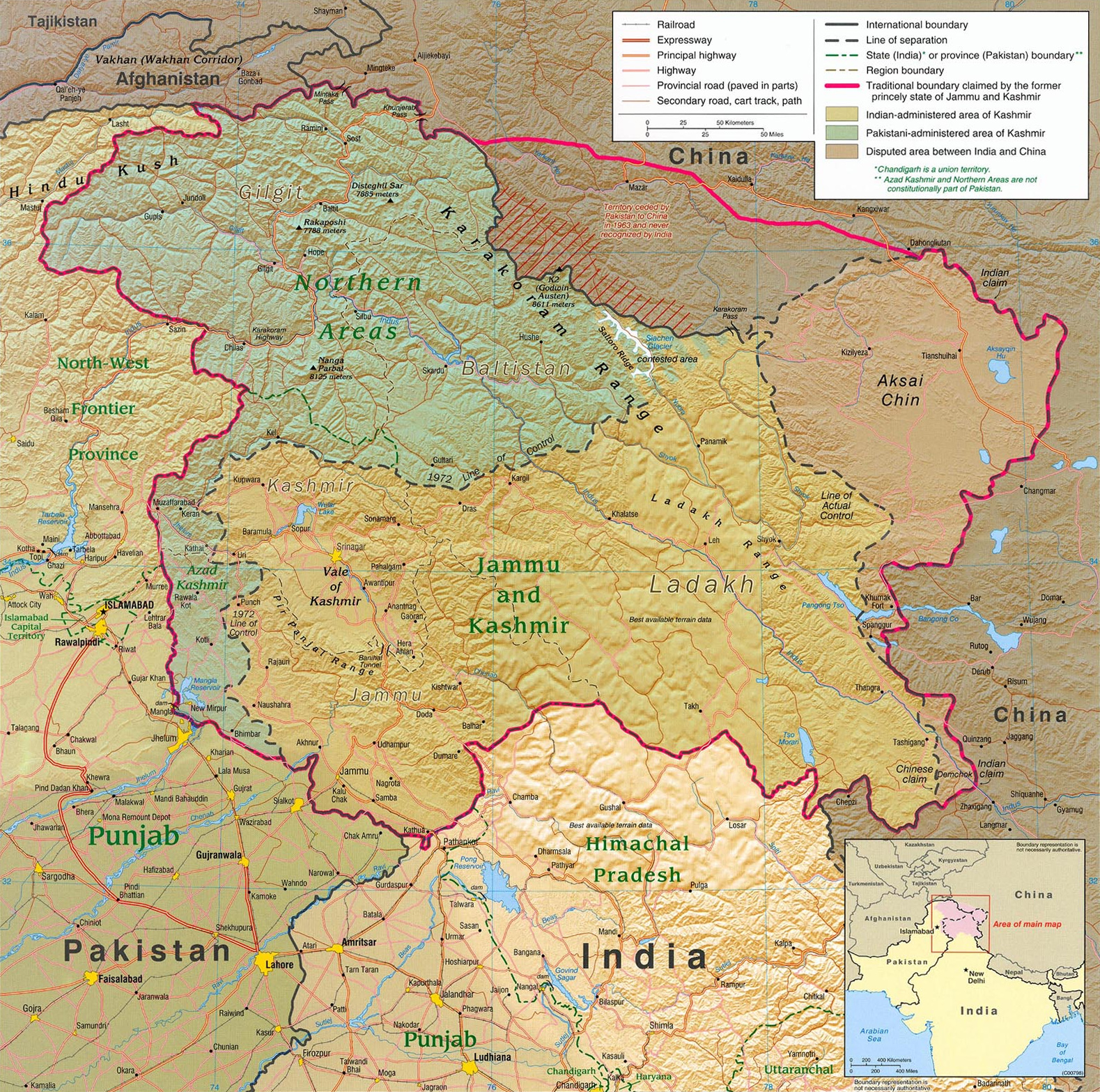
CIA map of the Kashmir Region in 2004.
Via Wikimedia Commons. Click image to see full-sized map.

Terror grips the most militarized zone in the world after India’s Central Government terminated Jammu and Kashmir’s 70-year-old “special status” as the first step towards stripping the disputed region of statehood entirely.

Internationally infamous as the world’s hottest potential nuclear flashpoint, J&K originally acceded to India in 1947 only on the condition that the newly-formed country be restricted from interfering in the domestic affairs of the mountainous northern region. The agreement was sealed between the last king of J&K, Maharaja Hari Singh Dogra, and the representative of the British crown, Governor-General Lord Mountbatten. In 1949, when passage of the constitution formed the Republic of India, the Maharaja’s conditions for accession were enshrined in Article 370.

The crux of the article – in combination with Article 35A of 1954 – was that, while J&K accepted India’s handling of issues like defense and foreign policy, the state otherwise reserved the right to autonomy in handling its domestic affairs. Kashmiris, thus, lived under their own distinct laws. Notably, citizens of other parts of India were prohibited from settling permanently or owning property in Kashmir. In the eyes of many Kashmiris, this prevented settler colonialism. On August 5, 2019, the President of India abolished this “special status” by decree.

Simultaneously, Home Minister Amit Shah – charged with India’s internal security – introduced a bill in the upper house of parliament to strip J&K of statehood, downgrade it to a “Union Territory,” and partition the region.

As Shah did this, the Central Government shut down Kashmir. It imposed a virtual curfew, banning movement of the public, shuttering educational institutions, and barring all public assemblies or meetings. It severed communications, cutting off phone and internet access. And it conducted arrests of mainstream Kashmiri political leaders – such as former chief ministers Mehbooba Mufti and Omar Abdullah – on unknown charges.

India’s ruling Bharatiya Janata Party, which was just re-elected in May, campaigned on promises to scrap J&K’s “special status.” The BJP’s manifesto alleged that it was “an obstacle in the development of the state,” while Shah insisted it stood in the way of of Kashmir becoming an “integral party of India permanently” and was necessary for “national security.” Indeed, the tumultuous region has suffered a significant influx in violence in recent years.

Since 2014, when Prime Minister Modi’s regime first came to power, terrorist incidents in J&K have nearly tripled and security forces deaths have nearly doubled. According to a July 2019 UN report, independent bodies documented 159 security forces deaths in 2018 – a figure comparable to US troop fatalities in Iraq in 2009. The latest round of escalating tensions traces back to at least 2010, when mass protests erupted over an “encounter killing” of three civilians by Indian Army troops. Protests again erupted in 2016. During suppression efforts, security forces killed hundreds of protesters.

The Central Government has responded by flooding J&K with more and more soldiers. The small region – slightly smaller than the United Kingdom – is already occupied by a bare minimum of 500,000 troops. Since late July 2019, India has deployed nearly another 50,000.

Delhi has additionally responded by repeatedly dissolving J&K’s elected state government, imposing direct rule three times since 2015. The last time was in June 2018, after India’s ruling BJP withdrew from a coalition with then J&K Chief Minister Mufti – apparently because she advocated “reconciliation” instead of a “muscular security policy” as the most effective solution to the Kashmir conflict. Elections have not been allowed since 2014.

The ongoing occupation as well as the long-term use of direct rule – imposed for approximately ten of the past 42 years – contribute to the perception of Kashmiris that they are nothing more than vassals within the Republic of India.

Lightweight Experimental Lanchester SMGs

Filed under: Britain, History, Military, Weapons, WW2 — Tags: , , — Nicholas @ 02:00

Forgotten Weapons
Published on 14 Jun 2019

http://www.patreon.com/ForgottenWeapons

Cool Forgotten Weapons merch! http://shop.bbtv.com/collections/forg…

George Lanchester was the engineer responsible for originally reverse engineering the German MP28 submachine gun for production by the British, under the designation Lanchester. Once he finished that design work, the gun was put into production by the Sterling Engineering Company, and Lanchester went to work for them as part of the manufacturing process. Once there, he began tinkering with improved designs to reduce the weight of the gun – one of its main drawbacks. He created these three prototypes, but went no further, as government officials ordered him to stop when they discovered this work in 1942. By that time the Sten was in production, and continued development of the Lanchester was seen as a waste of time and resources.

The guns remained in the Sterling company’s reference collection, and elements of the final stock design would resurface in a later prototype design in the 60s. Beyond that, these guns were a simple dead end of design.

Many thanks to the Royal Armouries for allowing me to film and disassemble these unique submachine guns! The NFC collection there – perhaps the best military small arms collection in Western Europe – is available by appointment to researchers:

https://royalarmouries.org/research/n…

You can browse the various Armouries collections online here:

https://royalarmouries.org/collection/

Contact:
Forgotten Weapons
PO Box 87647
Tucson, AZ 85754

« Newer PostsOlder Posts »

Powered by WordPress