Quotulatiousness

April 12, 2020

Minimum alcohol pricing – a policy so good you have to lie about it

Filed under: Britain, Economics, Government, Health, Wine — Tags: , , , , , — Nicholas @ 05:00

Scotland has had legal minimum prices for alcoholic beverages since mid-2018. If you read a random selection of mainstream media coverage, you’d know that it’s been a huge success, with vastly improved public health results at a price to consumers measured in mere pennies. As with all propaganda efforts, if you tell the lies often enough, people may believe you:

There has been all sorts of rubbish written about minimum pricing since it was introduced in Scotland in May 2018. Nicola Sturgeon has lied about in the Scottish Parliament. The BBC has gone to extraordinary lengths to spin the policy as a success. The public have been told that alcohol-related hospital admissions have gone down when they have gone up. We have seen the media fall for blatant cherry-picking. We have been told that rates of problem drinking have gone down when we don’t have any evidence either way.

One of the few solid facts — that there were more alcohol-related deaths recorded in Scotland in 2018 than in 2017 — has been sidelined. Instead, the media have focused on a disputed, and relatively small, decline in alcohol sales as if that were an end in itself. Any port in a storm (fortified wine sales have definitely benefited from minimum pricing).

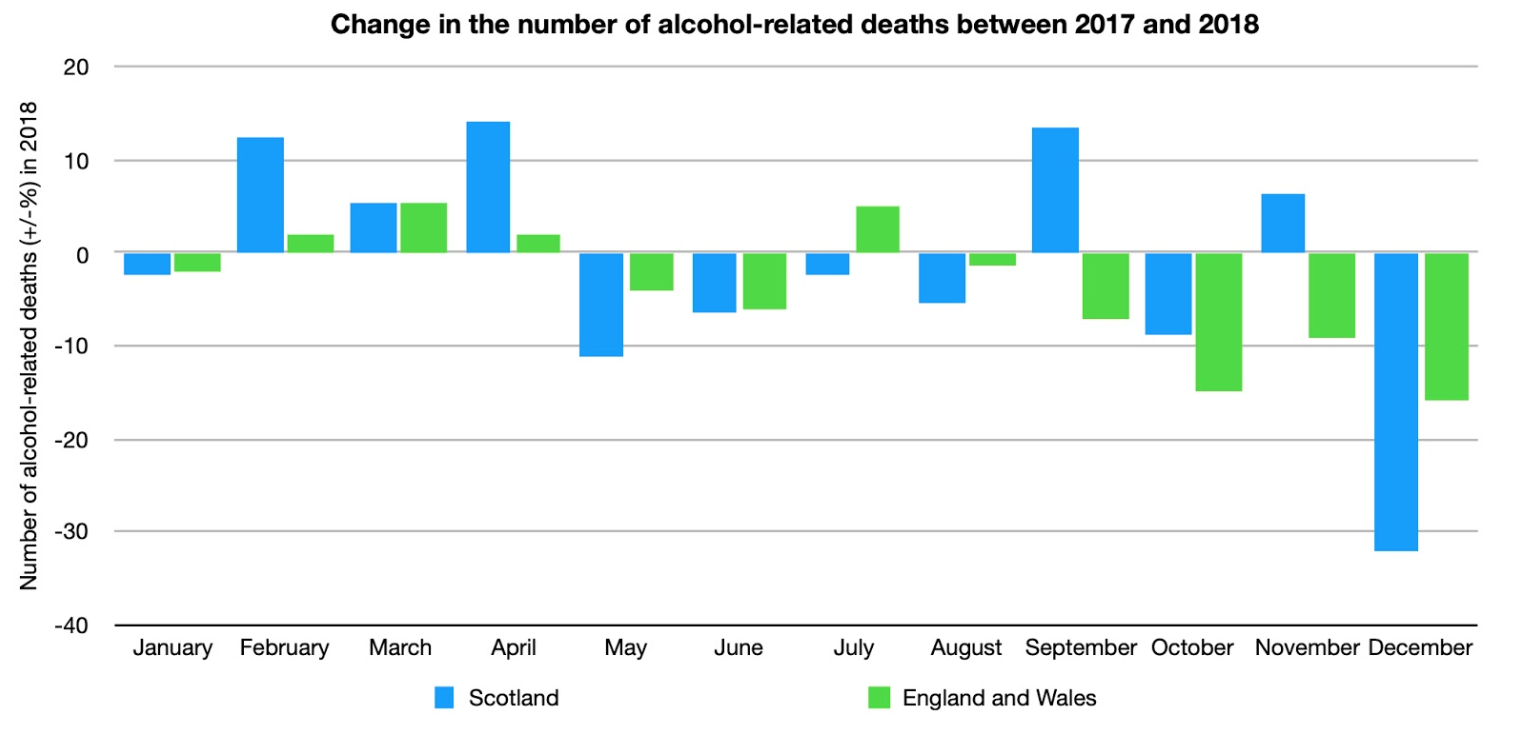
Figures from the calendar year of 2018 are of limited use because minimum pricing didn’t begin until May 1st. Today, for the first time, I can reveal the monthly mortality figures for Scotland, England and Wales. They show that there was no difference between the change in annual death rates from alcohol-related causes, regardless of whether the country had minimum pricing in place. Both England/Wales and Scotland saw a decline between May and December of seven per cent (compared to the previous year).

This graph is published in a new briefing paper I have written for the IEA. It summarises all the evidence gathered to date on deaths, hospitalisations and sales, plus exclusive new data.

Importantly, it contains estimates of the costs to consumers. Among the more outlandish claims made by the Sheffield modellers was the idea that moderate and low income consumers would be barely affected by minimum pricing. They predicted that a low income moderate drinker would only pay an extra 4p a year! This was never realistic, not least because it was based on the minimum price being set at 45p and they defined a moderate drinker as someone consuming the equivalent of just two pints of lager a week, but it worked from a PR perspective because it quelled politicians’ fears about the policy being regressive.
The Failed Start Of The League of Nations I THE GREAT WAR 1920

Filed under: Europe, History, Military, USA, WW1 — Tags: , , , , — Nicholas @ 04:00

The Great War
Published 10 Apr 2020

Sign up for Curiosity Stream and Nebula – and get 40% off annual plans right now: https://curiositystream.com/thegreatwar

The League of Nations was US President Woodrow Wilson’s tool for a new and peaceful world after the war of 1914-1918 — and the US should have been their most important member. But the United States never joined and today the League of Nations is often seen as a failure. Was it doomed from the start?

» SUPPORT THE CHANNEL
Patreon: https://www.patreon.com/thegreatwar
Merchandise: https://shop.spreadshirt.de/thegreatwar/

» SOURCES
“The Treaty of Peace with Germany (The Treaty of Versailles),” June 28, 1919, United States Statutes at Large, art. 1-440.

Walters, F.P. A History of the League of Nations. (Oxford, UK: Oxford University Press, 1952)

Link, Arthur et al., eds., The Papers of Woodrow Wilson, vol. 45 (1984)

Ray S. Baker and William E. Dodd, eds, The Public Papers of Woodrow Wilson: Authorized Edition, Vol. 1, (New York, 1924)

Matz, Nele, “Civilization and the Mandate System under the League of Nations as Origin of Trusteeship” in von Bogdandy, A and Wolfrum, R (eds.), Max Planck Yearbook of United Nations Law, Volume 9, 2005

Braumoeller, Bear F. “The Myth of American Isolationism”, Foreign Policy Analysis Vol. 6, No. 4 (OCTOBER 2010), pp. 349-371

“March 19, 1920: Senate Rejects Treaty of Versailles for Second and Final Time” New York Times, https://learning.blogs.nytimes.com/20… /march-19-1920-senate- rejects-treaty-of-versailles-for-second-and-final-time/

Egerton, George W, “The Lloyd George Government and the Creation of the League of Nations”, The American Historical Review, Vol. 79, No. 2 (Apr., 1974), pp. 419-444

Burkman, Thomas W. “Japan and the League of Nations: AN ASIAN POWER ENCOUNTERS THE ‘EUROPEAN CLUB'”, World Affairs, Vol. 158, No. 1, Woodrow Wilson and the League of Nations: Part Two (SUMMER 1995), pp. 45-57

Rappart, William E. “Small States in the League of Nations”, Political Science Quarterly Vol. 49, No. 4 (Dec., 1934), pp. 544-575

Cox, James Middleston, Journey Through My Years, (Simon & Schuster: New York, 1946)

“THE BRITISH EMPIRE, THE LEAGUE OF NATIONS, AND THE UNITED STATES”, Advocate of Peace through Justice, Vol. 82, No. 7 (JULY, 1920), pp. 229-231

Dorsey, Leeroy G, “Woodrow Wilson’s Fight for the League of Nations: A Reexamination”, Rhetoric and Public Affairs, Vol. 2, No. 1 (Spring 1999), pp. 107-135

“The Covenant of the League of Nations” AVALON PROJECT, Yale Law School, https://avalon.law.yale.edu/20th_cent…

“Woodrow Wilson’s 14 Points”, AVALON PROJECT, Yale Law School, https://avalon.law.yale.edu/20th_cent…

Riddell, George Allardice, The Riddell diaries, 1908-1923, (London ; Dover, N.H. : Athlone Press, 1986)

» SOCIAL MEDIA
Instagram: https://instagram.com/the_great_war
Twitter: https://twitter.com/WW1_Series
Reddit: https://reddit.com/r/TheGreatWarChannel

»CREDITS
Presented by: Jesse Alexander
Written by: Mark Newton, Jesse Alexander
Director: Toni Steller & Florian Wittig
Director of Photography: Toni Steller
Sound: Toni Steller
Editing: Toni Steller
Mixing, Mastering & Sound Design: http://above-zero.com
Maps: Daniel Kogosov (https://www.patreon.com/Zalezsky)
Research by: Jesse Alexander
Fact checking: Florian Wittig

Channel Design: Alexander Clark
Original Logo: David van Stephold

A Mediakraft Networks Original Channel

Contains licensed material by getty images
All rights reserved – Real Time History GmbH 2020

Self-interest in the clothing of idealism

Filed under: Economics, Media, Politics, USA — Tags: , , — Nicholas @ 03:00

Last week, Esteban wrote at the Continental Telegraph:

Much has been made over the past year of the fact that young people in America approve of Socialism in rather large numbers, and quite a lot more than their elders. Some explain that this is because they are more idealistic than the older crowd, who have become corrupted and “sold out” now that they have a mortgage and expensive lifestyle. Others argue that this supposed idealism is actually naivete.

It seems fair to point out that if you are 24 with negative net worth, a modest paying job and no reasonable expectation on the horizon to make serious cash, it isn’t idealistic to support redistribution, it’s self-interest. And you don’t change this fact by saying “Well, if I made that much money, I’d be happy to pay a lot in taxes”. If you ever get to that point we’ll see, until then this statement doesn’t fly.

Likewise, if you’re 55 with a couple of million dollars in your 401(k), a big home and an income well into six figures your view may be biased against “sharing the wealth” based on your wallet, not principles.

Tank Chats #67 Covenanter | The Tank Museum

Filed under: Britain, History, Military, Weapons, WW2 — Tags: , , , — Nicholas @ 02:00

The Tank Museum
Published 22 Feb 2019

Historian David Fletcher MBE talks through the Second World War British Cruiser tank, the Covenanter. Otherwise known as Tank Cruiser Mark V** A13.

Support the work of The Tank Museum on Patreon: ► https://www.patreon.com/tankmuseum

Visit The Tank Museum SHOP: ► https://tankmuseumshop.org/
Twitter: ► https://twitter.com/TankMuseum
Tiger Tank Blog: ► http://blog.tiger-tank.com/
Tank 100 First World War Centenary Blog: ► http://tank100.com/ #tankmuseum #tanks #tankchats

QotD: The Gini coefficient

Filed under: Economics, Government, Politics, Quotations, USA — Tags: , , , , — Nicholas @ 01:00

At least for now, most progressives acknowledge that markets and economic growth are necessary. But progressives in academia contend that growth has proved itself secondary to equality efforts — something to be exploited, rather than appreciated. Not just nationally, but worldwide, policymakers and the press regard the subordination of growth to equality to be a benign practice, as in the recent line in the Indian periodical Mint: a policy aimed at “reducing inequality need not hurt growth.”

The redistributionist impulse has brought to the fore metrics such as the Gini coefficient, named after the ur-redistributor, Corrado Gini, an Italian social scientist who developed an early statistical measure of income distribution a century ago. A society where a single plutocrat earns all the income ranks a pure “1” on the Gini scale; one in which all earnings are perfectly equally distributed, the old Scandinavian ideal, scores a “0” by the Gini test. The Gini Index has been renamed or updated numerous times, but the principle remains the same. Income distribution and redistribution seem so crucial to progressives that French economist Thomas Piketty built an international bestseller around it, the wildly lauded Capital.

Through Gini’s lens, we now rank past eras. Decades in which policy endeavored or managed to even out and equalize earnings — the 1930s under Franklin Roosevelt, the 1960s under Lyndon Johnson — score high. Decades where policymakers focused on growth before equality, such as the 1920s, fare poorly. Decades about which social-justice advocates aren’t sure what to say — the 1970s, say — simply drop from the discussion. In the same hierarchy, federal debt moves down as a concern because austerity to reduce debt could hinder redistribution. Lately, advocates of economically progressive history have made taking any position other than theirs a dangerous practice. Academic culture longs to topple the idols of markets, just as it longs to topple statutes of Robert E. Lee.

But progressives have their metrics wrong and their story backward. The geeky Gini metric fails to capture the American economic dynamic: in our country, innovative bursts lead to great wealth, which then moves to the rest of the population. Equality campaigns don’t lead automatically to prosperity; instead, prosperity leads to a higher standard of living and, eventually, in democracies, to greater equality. The late Simon Kuznets, who posited that societies that grow economically eventually become more equal, was right: growth cannot be assumed. Prioritizing equality over markets and growth hurts markets and growth and, most important, the low earners for whom social-justice advocates claim to fight. Government debt matters as well. Those who ring the equality theme so loudly deprive their own constituents, whose goals are usually much more concrete: educational opportunity, homes, better electronics, and, most of all, jobs. Translated into policy, the equality impulse takes our future hostage.

Amity Shlaes, “Growth, Not Equality”, City Journal, 2018-01-21.

April 11, 2020

Attaching The Back Panel | The Cabinet Project #11 | Free Online Woodworking School

Filed under: Tools, Woodworking — Tags: , — Nicholas @ 06:00

Matt Estlea
Published 9 Apr 2020

In this part of the project, I will show you how to attach the back panel of the cabinet to ensure no damage is caused to the edge of the plywood, and the internal faces of the cabinet.

See the full lesson here:
www.mattestlea.com/free-online-woodworking-school/how-to-attach-the-back-panel/

Plans for this project:
https://mattestlea.com/product/cabine…

Buy Pre-Planed Material Packs for this Project Here:
www.mattestlea.com/projectpacks

_________________________________________________________________

Support what I do by becoming a Patron! This will help fund new tools, equipment and cover my overheads. Meaning I can continue to bring you regular, high quality, free content. Thank you so much for your support! https://www.patreon.com/mattestlea

Don’t want to commit to a monthly direct debit but still want to help out? That’s fine!
You can make a one time donation here: www.mattestlea.com/donate
You can donate us biscuits here: www.mattestlea.com/wishlist
_________________________________________________________________
BUY THE WOODWORKING BIBLE HERE:
www.mattestlea.com/the-woodworkers-manual
_________________________________________________________________

SOCIAL MEDIA
Instagram: www.instagram.com/mattestlea
Twitter: www.twitter.com/mattestlea
Patreon: www.patreon.com/mattestlea
Pinterest: www.pinterest.com/mattestlea
LinkedIn: www.linkedin.com/in/matt-estlea-b6414b11a/
_________________________________________________________________
See what tools I use here: www.mattestlea.com/equipment
My Website: www.mattestlea.com
_________________________________________________________________

My name is Matt Estlea, I’m a 24 year old Woodworker from Basingstoke in England and my aim is to make your woodworking less s***.

I come from 5 years tuition at Rycotewood Furniture Centre with a further 1 year working as an Artist in Residence at the Sylva Foundation. I now teach City and Guilds Furniture Making at Rycotewood as of September 2018.

If you’re interested in studying at Rycotewood, view their courses here:
www.mattestlea.com/rycotewood

I also had 5 years of experience working at Axminster Tools and Machinery where I helped customers with purchasing tools, demonstrated in stores and events, and gained extensive knowledge about a variety of tools and brands. I discontinued this at the start of 2019 to focus solely on video creation and teaching.

During the week, I film woodworking projects, tutorials, reviews and a viewer favourite ‘Tool Duel’ where I compare two competitive manufacturers tools against one another to find out which is best. I also have a Free Online Woodworking School which you should definitely check out!

www.mattestlea.com/school

I like to have a laugh and my videos are quite fast paced BUT you will learn a lot, I assure you.

Lets go make a mess.

Pandemics Economically Worse than War – The First Pandemic – Pandemic History 01

Filed under: Europe, Health, History, Science — Tags: , , , , — Nicholas @ 04:00

TimeGhost History
Published 10 Apr 2020

There is much we can learn from past pandemics, like how Emperor Justinian ruined the Eastern Roman Empire’s economy and made the first plague pandemic even worse.

Join us on Patreon: https://www.patreon.com/TimeGhostHistory

Hosted by: Indy Neidell and Spartacus Olsson
Written by: Spartacus Olsson
Directed by: Astrid Deinhard
Executive Producers: Bodo Rittenauer, Astrid Deinhard, Indy Neidell, Spartacus Olsson
Creative Producer: Joram Appel
Post-Production Director: Wieke Kapteijns

Research by: Spartacus Olsson
Edited by: Spartacus Olsson

Archive by Reuters/Screenocean http://screenocean.com
A TimeGhost chronological documentary produced by OnLion Entertainment GmbH.

From the comments:

TimeGhost History
3 minutes ago
As announced, here is the first instalment of our impromptu series on the history of pandemics. Now, as you will see in the video this is not just a reaction to the current COVID-19 pandemic, but very much back to the roots for us. Indy studied the pandemics extensively back in university times, and to study history in general requires a somewhat morbid fascination with human disaster in general. So we have spent many, many years looking intently at the worst disasters that have befallen humanity — and there is nothing worse than disease, especially on a pandemic scale. Hopefully this is the time when we can share a bit of that amassed knowledge to add a little timely understanding of the greater effects of pandemics, beyond the immediate tragic medical ones, like how they have impacted society, the economy, and human life in general throughout history. While we cannot give you fixed schedule for this series (we have the regular programming to take care of) we will try to come out with the next one very soon.

A note on a statement I make in the video: when I say COVID-19 might be the first time we successfully fight back a pandemic, I am saying that fully aware of the eradication of small pox and the near eradication of polio, the flu vaccine successes and so on — but that is avoidance of recurring pandemics of a specific kind and we have made more progress there than actually handling pandemics of a new disease when they break out for the first time. On that note, take care, stay safe, and may you be healthy despite these trying times.

Spartacus

3.7cm PAK – Germany’s Basic WWII Antitank Gun

Filed under: Germany, History, Military, Weapons, WW2 — Tags: , , , , — Nicholas @ 02:00

Forgotten Weapons
Published 10 Dec 2019

http://www.patreon.com/ForgottenWeapons

Cool Forgotten Weapons merch! http://shop.bbtv.com/collections/forg…

Germany developed its first 37mm (or as German designations put it, 3.7cm) antitank gun in the last months of World War One; a very simple design built using barrels from obsolete Hotchkiss revolving cannons. In the mid 1920s, the concept was reinvigorated by Rheinmetall, which developed a much more modern 37mm gun using a much larger and higher-pressure case (37 x 249mm). In its initial pattern, the Tak as it was called (Tankabwerhkanone) has wooden spoke wheels and no suspension, intended for transport by horse. A small number were made for the German military (to avoid aggravating the conditions of the Treaty of Versailles), and the gun was sold commercially by Rheinmetall. The Soviet Union in particular was interested, and used the 3.7cm Tak as the basis for its later 45mm antitank gun.

Between 1934 and 1936, a number of changes were made to the design. The wooden wheels were replaced with steel wheels and pneumatic rubber tires, and spring suspension was added to allow the gun to be towed at higher speed by motor vehicles. The designation also changed at the time from Tank-abwehrKanone to Panzer-abwehrKanone, as the new term “panzer” entered German military parlance. Under Germany’s 1930s rearmament program, the Versailles limitations were ignored, and Pak production took off. By September of 1939, the German military has some 11,200 of the guns in service. They were solid dependable guns at the beginning of World War Two, but became obsolete by 1941 as tank armor began to rapidly increase. A new tungsten-core AP round was introduced in 1940, and a rifle-grenade-like hollow charge munition (the Stielgranate 41) added in 1941, but there was stopgaps at best. The last few 3.7mm Paks were built in early 1942, as both it and the 50mm Pak 38 were phased out in favor of the 75mm Pak 40 antitank gun.

There is an excellent article on the development and use of the 3.7cm Pak at Tank Archives: http://tankarchives.blogspot.com/2016…

I’d like to thank DriveTanks.com for giving me the opportunity to bring you their 3.7mm Pak! They have a very cool collection of armored vehicles, artillery, and machine guns available for rental in Texas; check them out: http://www.drivetanks.com

Contact:
Forgotten Weapons
6281 N. Oracle #36270
Tucson, AZ 85704

QotD: Zhou Enlai’s famous “too early to say” comment on the French Revolution

Filed under: China, France, History, Media, Quotations, USA — Tags: , , , , — Nicholas @ 01:00

When Chinese premier Zhou Enlai famously said it was “too early” to assess the implications of the French revolution, he was referring to turmoil in France in 1968 and not — as is commonly thought — to the more distant political upheaval of 1789.

So says a retired American diplomat, Charles W. (Chas) Freeman Jr., who was present when Zhou made the comment during President Richard Nixon’s visit to China in February 1972.

Freeman, who was Nixon’s interpreter during the historic, weeklong trip, made the disclosure last week during a panel discussion in Washington about On China, the latest book by former Secretary of State Henry Kissinger.

The discussion was moderated by Richard McGregor, a journalist and China expert who wrote about Freeman’s comments for the Financial Times of London.

In an interview yesterday, Freeman elaborated on his recollection about Zhou’s comment, the conventional interpretation of which is frequently offered as evidence of China’s sage, patient, and far-sighted ways. Foreign Policy magazine, for example, referred last month to that interpretation, saying the comment was “a cautionary warning of the perils of judgments made in real time.”

The Washington Post‘s recent review of Kissinger’s book likewise referred to the conventional understanding of Zhou’s remark.

Freeman described Zhou’s misconstrued comment as “one of those convenient misunderstandings that never gets corrected.”

He said Zhou’s remark probably was made over lunch or dinner, during a discussion about revolutions that had succeeded and failed. They included, Freeman said, the Prague Spring of 1968 and the Hungarian uprising of 1956, both of which the Soviet Union crushed.

He said it was clear from the context and content of Zhou’s comment that in saying it was “too early to say” the Chinese leader was speaking about the events in France in May 1968, not the years of upheaval that began in 1789.

Freeman acknowledged that the conventional interpretation makes for a better story but added that it was “absolutely clear” from the context of the discussion that Zhou was speaking about 1968.

W. Joseph Campbell, “‘Too early to say’: Zhou was speaking about 1968, not 1789”, Media Myth Alert, 2011-06-14.

April 10, 2020

“In Flanders Fields” – Sabaton History 062 [Official]

Filed under: Britain, Cancon, History, Media, Military, WW1 — Tags: , , — Nicholas @ 06:00

Sabaton History
Published 9 Apr 2020

“In Flanders fields the poppies blow, between the crosses, row on row.” These words, written by John McCrae in his famous war poem “In Flanders Fields”, immortalize death and dying in the Great War like only a few others. It is said, that shortly after the death of his dear friend, McCrae looked over the parapet and onto the battlefield once more. In all the mayhem, the smoke, the exploding shells and the dead bodies on the ground, he saw that the little red flowers, the poppies, still grew. After a strong wind, their pedals would fly across the field, and lay there strewn, like the blood that was shed by the soldiers that had to die there.

Support Sabaton History on Patreon: https://www.patreon.com/sabatonhistory

Listen to “In Flanders Fields” on the Album The Great War here:
CD: http://nblast.de/SabatonTheGreatWar
Spotify: https://sabat.one/TheGreatWarSpotify
Apple Music: https://sabat.one/TheGreatWarAppleMusic
iTunes: https://sabat.one/TheGreatWarItunes
Amazon: https://sabat.one/TheGreatWarAmazon
Google Play: https://sabat.one/TheGreatWarGooglePlay

Watch the Official Lyric Video of “In Flanders Fields” here:
https://www.youtube.com/watch?v=ZPgZn…

Check out the trailer for Sabaton’s new album The Great War right here: https://www.youtube.com/watch?v=HCZP1…

Listen to Sabaton on Spotify: http://smarturl.it/SabatonSpotify
Official Sabaton Merchandise Shop: http://bit.ly/SabatonOfficialShop

Hosted by: Indy Neidell
Written by: Markus Linke and Indy Neidell
Directed by: Astrid Deinhard and Wieke Kapteijns
Produced by: Pär Sundström, Astrid Deinhard and Spartacus Olsson
Creative Producer: Joram Appel
Executive Producers: Pär Sundström, Joakim Broden, Tomas Sunmo, Indy Neidell, Astrid Deinhard, and Spartacus Olsson
Post-Production Director: Wieke Kapteijns
Edited by: Karolina Dołęga
Sound Editing by: Marek Kaminski
Maps by: Eastory – https://www.youtube.com/c/eastory

Archive by: Reuters/Screenocean https://www.screenocean.com
Music by Sabaton.

An OnLion Entertainment GmbH and Raging Beaver Publishing AB co-Production.

© Raging Beaver Publishing AB, 2019 – all rights reserved.

Did the British Engineer the Yugoslavian Coup of March 1941? – WW2 Special Episode

Filed under: Britain, Europe, History, Military, WW2 — Tags: , , , , — Nicholas @ 05:00

World War Two
Published 9 Apr 2020

As Hitler pressured Yugoslavia to join the Axis Powers, Britain tried to gain a Balkan ally. Then Yugoslavia did join then Axis… and then there was an anti-Axis coup in Yugoslavia. But just how much were the British involved in that coup? Let’s find out.

Join us on Patreon: https://www.patreon.com/TimeGhostHistory
Or join The TimeGhost Army directly at: https://timeghost.tv

David Stafford, “SOE and British Involvement in the Belgrade Coup d’Etat of March 1941”. In: Slavic Review 36:3 (1977) 399-419, https://www.cambridge.org/core/servic….

Follow WW2 day by day on Instagram @World_war_two_realtime https://www.instagram.com/world_war_t…
Between 2 Wars: https://www.youtube.com/playlist?list…
Source list: http://bit.ly/WW2sources

Written and Hosted by: Indy Neidell
Produced and Directed by: Spartacus Olsson and Astrid Deinhard
Executive Producers: Bodo Rittenauer, Astrid Deinhard, Indy Neidell, Spartacus Olsson
Creative Producer: Joram Appel
Post-Production Director: Wieke Kapteijns
Research by: Indy Neidell
Edited by: Mikołaj Cackowski
Map animations: Eastory (https://www.youtube.com/c/eastory)

Colorizations by:
Dememorabilia – https://www.instagram.com/dememorabilia/
Adrien Fillon – https://www.instagram.com/adrien.colo…
Norman Stewart – https://oldtimesincolor.blogspot.com/
Julius Jääskeläinen – https://www.facebook.com/JJcolorization/
Daniel Weiss

Sources:
Istorijski arhiv u Pančevu
IWM HU 55505, D 4311, H 10922
FOTO:FORTEPAN / MZSL/Ofner Károly
Narodowe Archiwum Cyfrowe
Portrait of Ronald Ian Campbell, courtesy National Portrait Gallery
Portrait of Frank Nelson, courtesy National Portrait Gallery
Digital Library of Slovenia

Soundtracks from the Epidemic Sound:
Reynard Seidel – “Deflection”
John Hynynen – “Dark Beginning”
Johannes Bornlof – “Deviation In Time”
Philip Ayers – “Trapped in a Maze”
Johannes Bornlof – “The Inspector 4”

Archive by Screenocean/Reuters https://www.screenocean.com.

A TimeGhost chronological documentary produced by OnLion Entertainment GmbH.

M1 Carbine: A Whole New Class of Weapon

Filed under: History, Military, USA, Weapons, WW2 — Tags: , , , — Nicholas @ 04:00

Forgotten Weapons
Published 9 Apr 2020

http://www.patreon.com/ForgottenWeapons

https://www.floatplane.com/channel/Fo…

Cool Forgotten Weapons merch! http://shop.bbtv.com/collections/forg…

The United States developed the M1 carbine very quickly at the beginning of World War Two, once the German “blitzkrieg” made it clear that highly mobile enemy forces could threaten rear echelon troops in a modern war. The M1911 pistol was seen as a difficult weapon to use well, and a light carbine would offer much greater effectiveness with less training. It was estimated that 500,000 would be needed, and more than 6 million were eventually produced during the war. The M1 Carbine would equip drivers, artillery crews, mortar men, headquarters staff, paratroops, and many more.

The M1 Carbine was developed by Winchester, but they were not participants in the first round of trials, Instead, their design came about when Rene Studler (head of the Ordnance Department) saw Winchester’s “M2” rifle prototype, a lightweight .30-06 intended to compete with the M1 Garand. He urged them to scale it down for the light rifle trials then ongoing in 1941, and Winchester complied. The design used a Garand-like rotating bolt and a gas tappet system designed by David Marshall Williams for the .30-06 rifle. The new carbine was cobbled together in less than two weeks, and is a truly fantastic achievement.

Thanks to InterOrdnance / Royal Tiger Imports for providing this M1 Carbine for filming!

Contact:
Forgotten Weapons
6281 N. Oracle #36270
Tucson, AZ 85740

A French Air Force Rafale-B flight that could have ended even worse for all concerned

Filed under: France, Military — Tags: , , — Nicholas @ 03:00

I’m guessing from what is revealed in this report, the Armée de l’air will be far more reluctant to allow unqualified individuals to get into their fighter aircraft in future:

The Rafale-B that was damaged during the accidental passenger ejection in March 2019.
Image from Bureau enquêtes accidents pour la sécurité de l’aéronautique d’État, BEA-A.

An elderly and reluctant Frenchman was ejected from a French Air Force fighter during a retirement day jolly – and narrowly missed taking the pilot with him, an investigation report littered with unintentional howlers has revealed.

The unnamed 64-year-old was éjecté from the two-seat Rafale-B in March from a height of 2,500ft in March last year after grabbing his ejection seat handle to steady himself, France’s BEA-E aviation investigator concluded.

Although the BEA’s full report is in French [PDF], aviation news website Aerotime Hub translated and summarised its contents, revealing the full comedy of errors triggered by a group of enthusiastic colleagues hoping to give their workmate a send-off to remember.

[…] a mechanic gave them both a cursory check, strapped a Go-Pro to an approved bulkhead mounting point so the hapless passenger’s gurning would be preserved for all time, and nodded to the pilot to close the transparent cockpit canopies.

Things got worse when the pilot took off from northeastern France’s Saint-Dizier Robinson airbase. Rather than the gentle ascent at 10°-15° that airline passengers experience, the Frenchman at the Rafale’s controls carried out a typical fighter jet departure and “climbed at 47°, generating a load factor of around +4G. Then, as he levelled off, he subjected his passenger to a negative load factor of about -0.6G”.

Forces exerted by Britain’s most G-force-intensive roller coaster, Alton Towers’ Rita, max out at +4.7G – or four times the normal force of gravity.

Our pensioner, loose in his straps, not really wanting to be there and totally unused to being flung around like a rag doll, reached out to grab something and hang on for dear life. He picked the worst possible handhold: the trigger handle for the ejection seat. After the customary loud bang and whoosh he ceased to be part of the jet’s payload, with the force of the ejection tearing his unsecured helmet and mask from his face.

The Rafale-B’s command ejection system is meant to fire both seats if one of the crew pulls the handle. A very confused pilot, however, was still sitting in his newly canopy-free Rafale wondering what the hell had just happened. He returned to land, conscious all the time that the seat could fire at any moment without warning. Luckily, it didn’t go off.

Approximate reconstruction of the path of the Rafale-B leading up to and following the accidental ejection.
Image from Bureau enquêtes accidents pour la sécurité de l’aéronautique d’État, BEA-A.

Char 2C – The World’s Biggest Operational Tank

Filed under: France, History, Military, Weapons, WW1, WW2 — Tags: , , — Nicholas @ 02:00

Mark Felton Productions
Published 15 Nov 2019

Find out the unbelievable story of the biggest operational tanks in history – the French Char 2C, and their peculiar fate.

Help support my channel:
https://www.paypal.me/markfeltonprodu…
https://www.patreon.com/markfeltonpro…

Disclaimer: All opinions and comments expressed in the ‘Comments’ section do not reflect the opinions of Mark Felton Productions. All opinions and comments should contribute to the dialogue. Mark Felton Productions does not condone written attacks, insults, racism, sexism, extremism, violence or otherwise questionable comments or material in the ‘Comments’ section, and reserves the right to delete any comment violating this rule or to block any poster from the channel.

Credits: YouTube Creative Commons; WikiCommons; Google Commons; Mark Felton Productions
Music: “Pursuit” and “Dogma” licenced to iMovie by Apple, Inc.

H/T to @AnonymousFred514 for the link.

QotD: Ketman

I got into the higher ed biz fully intending to practice what Milosz calls “aesthetic ketman.” [“paying lip service to official ideology while secretly subverting it”] I loved my subject, but my subject was recondite enough, I figured, that I could keep the SJW bullshit to a bare minimum. I don’t remember what they called “intersectionality” back then, but whatever it was, I’d just make a few brief nods to it, then get on with my work in relative peace. Throw a few quotes from Foucault, Judith Butler, Gayatri Spivak, and the like in my dissertation intro, and that was that.

The problem, though, is that the sour pleasure of ketman is addictive, and like any addiction, you need to keep upping the dose to feel the same effect.

My first few years in grad school, anyone who cared to look could’ve easily spotted me as a secret shitlord. For one thing, I was the only guy in the whole damn town who actually looked happy. For one thing, professing is a 24/7 job — that’s “24 hours a week, 7 months a year,” and don’t let anyone tell you otherwise. All that free time is lovely, especially in a college town with 24-hour everything and scads of scantily clad undergraduate eye candy.

But more importantly, there’s the pleasure of ketman. So long as I make a few radical noises, I can get you sheep to believe anything I say. I used to tell people I studied transgendered potato farmers in the Kenyan uplands. I told this obnoxious girl from the Gender Studies department my dissertation was on resistance strategies of Eskimos in the Waffen-SS. I cited Alan Sokal’s hoax paper on the social construction of gravity in every seminar taught by a radical feminist, and no one ever called me on it. Anyone who thinks I’m kidding obviously hasn’t been on campus in the last 20 years or so. It was fucking hilarious

… for a time. And then it got sad, then nauseating, because I eventually realized I was no different from the fools who swallowed my bullshit. It doesn’t matter if you’re being exquisitely ironic when you tell a room full of freshmen that “gender is a social construction.” They can’t recognize irony anyway, and even if they could, parroting the phrase “gender is a social construction” is still required to pass the class. More importantly, what if they did recognize it? I’m up there thinking I’m a shitlord, speaking truth to power to anyone smart enough to figure it out, but all they see is another fat, middle-aged sellout parroting nonsense. If I were serious about my shitlordery, they think, then I’d quit. But I don’t quit, which must mean my so-called “principles” are worth … what? We’ve already established you’re a whore, madam; now we’re just haggling over the price.

Severian, “The Pleasures of Ketman”, Rotten Chestnuts, 2020-01-09.

« Newer PostsOlder Posts »

Powered by WordPress