Quotulatiousness

July 22, 2020

How the left lost its sense of humour

Filed under: History, Media, Politics, USA — Tags: , , , — Nicholas @ 03:00

Matt Taibbi outlines the way “the right” used to be the humourless scolds and omnipresent busybodies demanding the government trample the rights of people they didn’t like, then points out that the progressives have become exactly the people they used to poke fun at:

The old Republican right’s idea of “humor” was its usual diatribes against Bad People, only with puns thrown in (are you ready for “OxyClinton”?). As a result the Fox effort at countering the Daily Show, the 1/2 Hour News Hour — a string of agonizing “burns” on Bush-haters and Hillary — remains the worst-rated show in the history of television, according to Metacritic. The irony gap eventually spelled doom for that group of Republicans, as Trump drove a truck through it in 2016. However, it’s possible they just weren’t as committed to the concept as current counterparts.

Take the Smithsonian story. The museum became the latest institution to attempt to combat racism by pledging itself to “antiracism,” a quack sub-theology that in a self-clowning trick straight out of Catch-22 seeks to raise awareness about ignorant race stereotypes by reviving and amplifying them.

The National Museum of African American History and Culture created a graphic on “Aspects and Assumptions of White Culture” that declared the following white values: “the scientific method,” “rational, linear thinking,” “the nuclear family,” “children should have their own rooms,” “hard work is the key to success,” “be polite,” “written tradition,” and “self-reliance.” White food is “steak and potatoes; bland is best,” and in white justice, “intent counts.”

The astute observer will notice this graphic could equally have been written by white supremacist Richard Spencer or History of White People parodist Martin Mull. It seems impossible that no one at one of the country’s leading educational institutions noticed this messaging is ludicrously racist, not just to white people but to everyone (what is any person of color supposed to think when he or she reads that self-reliance, politeness, and “linear thinking” are white values?).

The exhibit was inspired by white corporate consultants with Education degrees like Judith Katz and White Fragility author Robin DiAngelo, who themselves echo the work of more consultants with Ed degrees like Glenn Singleton of Courageous Conversations. Per the New York Times, Courageous Conversations even teaches that “written communication over other forms” and “mechanical time” (i.e. clock time) are tools by which “whiteness undercuts Black kids.”

The notion that such bugbears as as time, data, and the written word are racist has caught fire across the United States in the last few weeks, igniting calls for an end to virtually every form of quantitative evaluation in hiring and admissions, including many that were designed specifically to combat racism. Few tears will be shed for the SAT and ACT exams, even though they were once infamous for causing Harvard to be overpopulated with high-scoring “undesirables” like Jews and Catholics, forcing the school to add letters of reference and personal essays to help restore the WASP balance.

The outcry against the tests as “longstanding forces of institutional racism” by the National Association of Basketball Coaches is particularly hilarious, given that the real problem most of those coaches are combating is the minimal fake academic entry requirement imposed by the NCAA to help maintain a crooked billion-dollar business scheme based on free (and largely Black) labor. The tests have been tweaked repeatedly over the years to be more minority-friendly and are one of the few tools that gave brilliant but underprivileged kids a way to blow past the sea of rich suburbanites who feel oppressed by them … But, fine, let’s stipulate, as Neon Bodeaux put it, that “them tests are culturally biased.” What to make of the campaign to end blind auditions for musical positions, which the New York Philharmonic began holding in the early seventies in response to complaints of discrimination?

Before blind auditions, women made up less than 6 percent of orchestras; today they’re half of the New York Philharmonic. But because the change did not achieve similar results with Black and Hispanic musicians, the blind audition must now be “altered to take into fuller account artists’ backgrounds and experiences.” This completes a decades-long circle where the left/liberal project went from working feverishly to expunge racial stereotypes in an effort to level the playing field, to denouncing itself for ever having done so.

This would be less absurd if the effort were not being led in an extraordinary number of cases by extravagantly-paid white consultants like DiAngelo and Howard Ross, a “social justice advocate” whose company billed the federal government $5 million since 2006 to teach basically the same course on “whiteness” to agencies like NASA, the Treasury, the FDIC, and others.

It’s unsurprising that in the mouths of such people, the definitions of “whiteness” sound suspiciously like lazy suburban white stereotypes about Black America, only in reverse. They read like a peer-reviewed version of Bill de Blasio’s infamous joke about “CP Time.”


Glorious Revolution | 3 Minute History

Filed under: Britain, France, History, Military, Religion — Tags: , , , , , — Nicholas @ 02:00

Jabzy
Published 21 Jul 2015

Sorry about the delay I’ve been without internet while I’ve moved apartment. And thanks for the 9,000 subs

Thanks to Xios, Alan Haskayne, Lachlan Lindenmayer, William Crabb, Derpvic, Seth Reeves and all my other Patrons. If you want to help out – https://www.patreon.com/Jabzy?ty=h

Please let me know if I’ve forgot to mention you, I’m a little disorganized without internet.

QotD: Urban decline

Filed under: Business, Economics, Government, Quotations — Tags: , , , — Nicholas @ 01:00

At the heart of big-city exoduses is a process that I call accumulative decay. When schools are rotten and unsafe, neighborhoods become run-down and unsafe, and city services decline, the first people to leave are those who care the most about good schools and neighborhood amenities and have the resources to move. As a result, cities lose their best and ablest people first. Those who leave the city for greener pastures tend to be replaced by people who don’t care so much about schools and neighborhood amenities or people who do care but don’t have the means to move anywhere else. Because the “best” people — those who put more into the city’s coffer than they take out in services — leave, politicians must raise taxes and/or permit city services to deteriorate. This sets up the conditions for the next round of people who can do better to leave. Businesses — which depend on these people, either as employees or as customers — also begin to leave. The typical political response to a declining tax base is to raise taxes even more and hence create incentives for more businesses and residents to leave. Of course, there’s also mayoral begging for federal and state bailouts. Once started, there is little to stop the city’s downward spiral.

Intelligent mayors could prevent, halt and perhaps reverse their city decline by paying more attention to efficiency than equity. That might be politically difficult. Regardless of any other goal, mayors must recognize that their first order of business is to retain what economists call net positive fiscal residue. That’s a fancy term for keeping those people in the city who put more into the city’s coffers, in the form of taxes, than they take out in services. To do that might require discrimination in the provision of city services — e.g., providing better street lighting, greater safety, nicer libraries, better schools and other amenities in more affluent neighborhoods.

As one example, many middle-class families leave cities because of poor school quality. Mayors and others who care about the viability of a city should support school vouchers. That way, parents who stay — and put a high premium on the education of their children — wouldn’t be faced with paying twice in order for their kids to get a good education, through property taxes and private school tuition. Some might protest that city service discrimination is unfair. I might agree, but it’s even more unfair for cities, once the magnets of opportunities for low-income people, to become economic wastelands.

Walter E. Williams, “A Mayor’s Most Important Job”, Townhall, 2018-04-18.

July 21, 2020

The Destruction of Convoy PQ17: Merchant Ships Left Defenceless

Filed under: Britain, Germany, History, Military, Russia, USA, WW2 — Tags: , , , , , — Nicholas @ 06:00

Historigraph
Published 18 Jul 2020

For unlimited access to the world’s top documentaries and non­fiction series go to http://go.thoughtleaders.io/166892020… and use the promo code ‘historigraph‘ to get 30 days free access.

Buy Historigraph Posters here! teespring.com/stores/historigraph
Support the channel on Patreon: https://www.patreon.com/historigraph

#ConvoyPQ17 #Historigraph #CuriosityStream

► Twitch: https://www.twitch.tv/addaway
► Twitter: https://twitter.com/historigraph
► Instagram: https://www.instagram.com/historigraph

Music:

“Rynos Theme” Kevin MacLeod (incompetech.com)
Licensed under Creative Commons: By Attribution 4.0 License
http://creativecommons.org/licenses/b…

The Descent by Kevin MacLeod
Link: https://incompetech.filmmusic.io/song…
License: http://creativecommons.org/licenses/b…

Crypto by Kevin MacLeod
Link: https://incompetech.filmmusic.io/song…
License: http://creativecommons.org/licenses/b…

Ship command in the People’s Liberation Army Navy

Filed under: China, History, Military, Politics — Tags: , , , , — Nicholas @ 05:00

China has been quickly adding capabilities and hulls to the PLAN, but a relatively recent change to how larger naval ship command is structured may be a throwback to Soviet Union practices:

China’s Type 001A aircraft carrier shortly after launch, 17 August 2017.
Photo via Wikimedia Commons

When dealing with Chinese navy or coast guard ships, foreign naval commanders have learned to take into account the dual command structure of Chinese crews. In effect, Chinese warships except for smaller (less than 2,000 tons) ones, have dual commanders and a naval command system that is more premeditated and slower to respond to unexpected conditions.

This comes as a surprise to many Western naval officers. Although the Chinese military has achieved many visible signs of modernizing, like new weapons, equipment, uniforms, tactics and officer training, it is still having problems in several key areas. When it comes to leadership there are problems with the political officers.

The Chinese long ago borrowed the concept of the political officer (“Zampolit“) from the Soviet Union. The political officer represents the Communist Party and has the authority to overrule any order a military commander gives. In reality, the political officer usually acts as a combined morale and special events officer. The political officers are primarily responsible for preventing anything happening in their unit that would embarrass the party. For naval zampolits that meant watching out for signs of mutiny or sailors planning to seek asylum in a foreign port.

Unlike the Russian naval zampolit, the Chinese counterpart, called a political commissar is considered the equal of the regular naval commander and his superior when it comes to a “special mission”, like deliberately harassing foreign warships or opening fire on anyone. The political commissar is the same rank as the ship captain and can overrule the ship commander at any time and in any situation. It was not always that way.

An important change took place in 2018 when naval political commissars were given equal authority with the captain as “mission commander” and is expected to replace the captain if the captain is disabled by injury or sickness. The normal second-in-command (the XO or executive officer) becomes the XO for the political commissar and the captain and third, not second, in command. The practical problem with this is that the captain and XO have spent their entire careers (fifteen or more years) learning how to run a ship and supervise the crew. In contrast, the political commissar learned enough tech stuff to be more annoying. The political commissar was a professional busybody, scold and snitch. The political commissar can end the career of the captain, XO or any other officer by simply making a series of uncomplimentary reports.

The 2018 change was part of a program that began in 2016 throughout the military as the CCP (Chinese Communist Party) sought to improve its control over the military. In the navy that meant the political commissar had the ultimate responsibility for achieving goals assigned to a ship. The captain is not the true commander of the ship in the Western sense. He is there to see that technical details are well taken care of and that would include taking change during very bad weather or some kind of technical (fire, explosion) problem aboard ship. The political commissar is expected to personally undertake particularly dangerous leadership missions, although only those he is qualified to deal with. That means political commissars have led boarding parties in dangerous situations but not entrusted with command during damage control situations.

The full impact of the 2016-18 “reforms” to improve CCP control of the military are still working themselves out in the navy. Western, especially American, captains are being warned that their Chinese counterparts will probably not react as quickly to an emergency or unexpected situation that that should be taken into account, or taken advantage of.

Spanish Republican Exiles – Nazi Colonialism & Hitler + Mussolini ≠ ❤️ – WW2 – OOTF 014

Filed under: Africa, France, Germany, History, Italy, Military, WW2 — Tags: , , , , — Nicholas @ 04:00

World War Two
Published 16 Jul 2020

What did Spanish Republicans do during the Second World War? How would the Axis have divided Africa? And did Hitler plan to keep Mussolini around after the war? Find out as Indy and the Chair of Infinite Knowledge answer three more intriguing questions in this episode of Out of the Foxholes!

Join us on Patreon: https://www.patreon.com/TimeGhostHistory
Or join The TimeGhost Army directly at: https://timeghost.tv

Submit your own question for Out of the Foxholes here: https://community.timeghost.tv/c/Out-…

Follow WW2 day by day on Instagram @World_war_two_realtime https://www.instagram.com/world_war_two_realtime
Between 2 Wars: https://www.youtube.com/playlist?list…
Source list: http://bit.ly/WW2sources

Hosted by: Indy Neidell
Written by: Rune Væver Hartvig
Director: Astrid Deinhard
Producers: Astrid Deinhard and Spartacus Olsson
Executive Producers: Astrid Deinhard, Indy Neidell, Spartacus Olsson, Bodo Rittenauer
Creative Producer: Joram Appel
Post-Production Director: Wieke Kapteijns
Research by: Rune Væver Hartvig
Edited by: Karolina Dołęga
Sound design: Marek Kamiński
Map animations: Karolina Dołęga

Visual Sources:
Bundesarchiv
US Holocaust Memorial Museums
Library of Congress Geography and Map Division
Nasjonalbiblioteket from Norway
Icons from The Noun Project by: Milinda Courey, Eucalyp, Luis Prado, Gan Khoon Lay, DonBLC, Pavel N and Rigo Peter

Music:
“Deviation In Time” – Johannes Bornlof
“Superior” – Silver Maple
“Underlying Truth” – Howard Harper-Barnes

Archive by Screenocean/Reuters https://www.screenocean.com.

A TimeGhost chronological documentary produced by OnLion Entertainment GmbH.

“Journalists” and photographers in the media

Filed under: History, Media, Politics — Tags: , , — Nicholas @ 03:00

David Warren considers the decline of boots-on-the-ground reporting and the rise of comfortable bourgeois “journalism”:

Andy Ngo after being assaulted during Antifa protests in Portland, Oregon on 29 June 2019.

When I was a “journalist” — God help me, but it was an increasingly long time ago — my understanding was that the job involved getting into the riot. Andy Ngo may be the only journalist left, unless we count “talking heads” and “scribblers.” Well-informed, at first hand, on events in such towns as Seattle and Portland — where the bourgeoisie now enjoy their “summer of love” — he has been beaten up a few times. For journalism was meant to be a dangerous sport, quite unlike ping-pong.

Alas, and already in Vietnam, I discovered that only the photographers looked directly on the face of battle. This is because they were getting paid for the pics — in cash, but sometimes in prizes. The people who wrote the (frequently misleading) captions were safe in a bar, back in Saigon, or more likely, in the editorial suites of New York. It interested me that the photographers were often rightwing crazies. Whereas, the scribblers were, generally, leftists to a man, or in those days, the very occasional woman. I liked to get my information from photographers, whenever possible, but the scribblers did not. In possession of a fully-formed “narrative” from New York, they had already written their stories.

Am I exaggerating? Less than usual. My caricature points to a flaw in the meejah — cowardice, ignorance, arrogance, and malice, stirred into a rather potent brew. Then we had “editors,” to do the distillation.

Enfield L85A1: Perhaps the Worst Modern Military Rifle

Filed under: Britain, History, Military, Weapons — Tags: , , , , , — Nicholas @ 02:00

Forgotten Weapons
Published 29 Dec 2016

http://www.patreon.com/ForgottenWeapons

Cool Forgotten Weapons merch! http://shop.bbtv.com/collections/forg…

If you enjoy Forgotten Weapons, check out its sister channel, InRangeTV! http://www.youtube.com/InRangeTVShow

The L85A1 (part of the SA80 small arms family) was adopted by the British military in 1985 as a new generation of small arms to replace the L1A1 FAL (one quick note, where “A1” indicates a revision in American designations, it is simply the first iteration in British ones — there was no “L85”). As a bullpup rifle, the L85A1 was intended to replace both the FAL and Sterling SMG, similar to the French replacing the MAS 49/56 and MAT 49 with the FAMAS.

Unfortunately, the L85A1 had massive problems of both reliability and durability. They were kept pretty much hidden until Desert Storm, when it became unavoidably clear that the weapon was seriously flawed. The UK government denied the problems for several years, until finally contracting with H&K (then owned by Royal Ordnance) to redesign and rebuild the rifles. The result, after changes to virtually every part of the rifle, was the L85A2 — a much better rifle that will be tainted with its predecessor’s reputation regardless.

Mechanically, the L85A1 and A2 are basically copies of the Armalite AR-180, with a multi-lug rotating bolt and a short stroke gas piston. It feeds from STANAG magazines, and it universally fitted with the heavy but rugged SUSAT optical sight.

Thanks to the Institute of Military Technology for allowing me to have access to this rifle (which is extremely rare in the US) and bring it to you! Check them out at:

http://www.instmiltech.com

QotD: Burritos

Filed under: Americas, Food, Health, Humour, Quotations — Tags: , — Nicholas @ 01:00

… places that will be serving up the “hand-wrapped garbage disposal delight” known as the “Burrito” (so named because it contains scraps of otherwise inedible food that was, in the past, fed only to Burros.) Touted by the poor and the brain-dead alike as a “tasty snack,” the Burrito violates the primary rule of dining, “Never eat anything bigger than your head,” while recycling stuff usually found in the dumpsters of good restaurants through the innards of a human host who should know better and — shortly — will.

This last item is probably why the Burrito (AKA “Tomorrow’s Turd Today”) remains popular with liberal medheads hooked on keeping human ethnic pets on their progressive political plantations. After all, if you can only afford to eat or to feed people once a day, the Burrito is your huckleberry. And if you can also reduce food scraps that would otherwise go straight to the landfill into human waste, you also have a food object that “walks lightly on the planet.”

Gerard VanderLeun, “GRINGO DE MAYO!: A Counter-Celebration for May 7”, American Digest, 2018-05-04.

July 20, 2020

History Hijinks: Plague

Filed under: China, Europe, Health, History, Humour — Tags: , , , , — Nicholas @ 06:00

Overly Sarcastic Productions
Published 17 Jul 2020

Escape the worries of our modern world by visiting the high middle ages and learning about something esoteric and irrelevant: Plague!

In this video, I attempt to actually teach you something about how the medieval world worked and how it responded to this existential threat, rather than dredging up 3rd grade plague facts for easy views. Oops, did I say that out loud?

SOURCES & Further Reading: The Black Death: The World’s Most Devastating Plague via The Great Courses by Dorsey Armstrong, “From Plague Doctor to PPE” by Bernadette Banner (https://youtu.be/ZniriC-jTHg), “Biological Warfare at the Siege of Caffa” from the CDC (https://wwwnc.cdc.gov/eid/article/8/9…)

This video was edited by Sophia Ricciardi AKA “Indigo”. https://www.sophiakricci.com/

Our content is intended for teenage audiences and up.

DISCORD: https://discord.gg/kguuvvq

PATREON: https://www.Patreon.com/OSP

MERCH LINKS: https://www.redbubble.com/people/OSPY…

OUR WEBSITE: https://www.OverlySarcasticProductions.com
Find us on Twitter https://www.Twitter.com/OSPYouTube
Find us on Reddit https://www.Reddit.com/r/OSP/

A lost nation that lasted for 300 years in (relative) peace and prosperity

Filed under: Asia, Economics, Europe, History — Tags: , , , — Nicholas @ 05:00

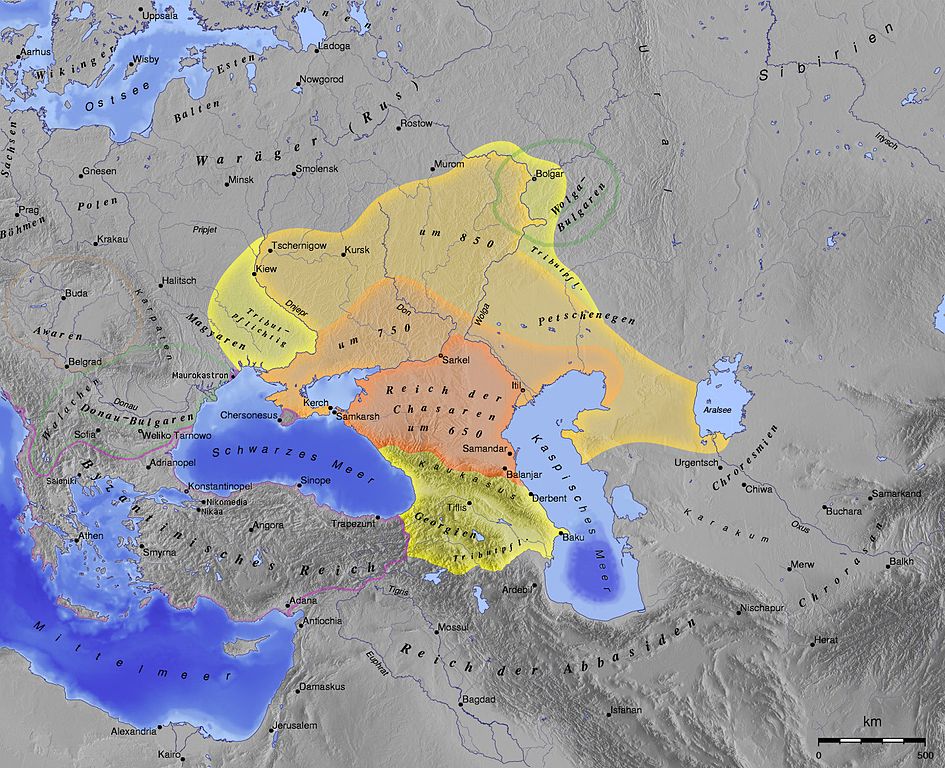
I’d heard of the Khazar Khaganate occasionally, but didn’t know much about it until I read a useful summary by Lawrence W. Reed:

Borders of the Khazar Khaganate between 650 and 850 A.D.
Wikimedia Commons.

The list of extinct countries includes the better known ones like the USSR (aptly dubbed “the Evil Empire” by Ronald Reagan) and Yugoslavia, as well as hundreds of largely forgotten others like Majapahit, Assyria, Babylonia, Burgundy, and the Ottoman Empire. Far more countries are long gone, in fact, than the 195 on the map today. As a history lover, I’ve never yet discovered a country whose inhabitants’ experience was devoid of interesting facts and lessons.

Take Khazaria, for example. It lasted over 300 years (650 to 965 AD) and covered more territory than the combined Scandinavian nations of our time. It spanned the eastern half of modern-day Ukraine, the steppes of the Volga-Don region of present Russia, the entire Crimean Peninsula, and the northern Caucasus. Its southern portion took in most of the shorelines of three seas: the Black, the Caspian and the Aral.

It’s my thesis that for a country to be “successful” for a considerable period — success being defined loosely here as economically prosperous, politically stable, and militarily defensible — it must possess substantial TTD. That’s not a pronounceable acronym, unfortunately, but it stands for trade, tolerance and decentralization.

Each of these three criteria for success is worth volumes of discussion but here’s the nub of it: When economic freedom and private property exist, trade flourishes. And trade is what peaceful humans do to satisfy wants and improve material well-being. Choke it off and living standards plummet. Tolerance is a sign that people appreciate the benefits derived from diversity in personal choices. An intolerant people deprive themselves of what others can offer and waste time and resources fighting instead of collaborating. Decentralization preserves the rich identities of local communities and stymies the concentration of authority with its inevitable corruption. Power dispersed is power tamed.

So a successful country is one that can boast a lot of TTD. It encourages exchange, celebrates diversity and avoids top-down, political command-and-control. Almost every “failed state” in history did just the opposite by stifling commerce; stoking racial, ethnic or nationalistic hatred; and/or installing a dictatorship.

Khazaria, to its great credit, practiced remarkable measures of trade and tolerance and enough decentralization to prevent its government from sabotaging either one. In the end, it met its demise not from internal decay but from foreign assault.

To Save the World Takes Only One Good Man | The Cuban Missile Crisis | Day 13

TimeGhost History
Published 19 Jul 2020

On Sunday, 28 October, 1962 the Cuban Missile Crisis comes to an end to end all things, and almost everything. Only one young man, Vasili Arkhipov will stand between humanity and nuclear armageddon.

Join us on Patreon: https://www.patreon.com/TimeGhostHistory

Hosted by: Indy Neidell
Written by: Spartacus Olsson
Director: Astrid Deinhard
Producers: Astrid Deinhard and Spartacus Olsson
Executive Producers: Astrid Deinhard, Indy Neidell, Spartacus Olsson, Bodo Rittenauer
Creative Producer: Joram Appel
Post-Production Director: Wieke Kapteijns
Research by: Spartacus Olsson
Edited by: Daniel Weiss
Sound design: Marek Kaminski

Colorizations:
– Carlos Ortega Pereira (BlauColorizations) – https://www.instagram.com/blaucoloriz…

Sources:
http://www.jproc.ca/crypto/hotline.html

Soundtracks from Epidemic Sound:
– “Cold Eyes” – Elliot Holmes
– “From the Depths” – Walt Adams
– “Moving to Disturbia” – Experia
– “When They Fell” – Wendel Scherer
– “Under the Dome” – Philip Ayers
– “Scope” – Got Happy
– “Symphony of the Cold-Blooded” – Christian Andersen
– “City Night Lights” – Elliot Holmes
– “Secret Cargo” – Craft Case
– “Too Young for This Shirt” – Elliot Holmes
– “Juvenile Delinquent” – Elliot Holmes
– “Drifting Emotions 3” – Gavin Luke

Archive by Screenocean/Reuters https://www.screenocean.com.

A TimeGhost chronological documentary produced by OnLion Entertainment GmbH.

From the comments:

TimeGhost History
59 minutes ago (edited)
When we recorded this the first time, we didn’t have the chance to release these day by day. It took us almost half a year from when we had the idea until the last episode came out. We still felt that it was a revelation to see it chronologically. For me as writer it was in any case a deep dive into a story that I thought I knew, but rediscovered by reassembling the source documents in the exact order things happened. I learnt new aspects and gained an incredibly more detailed understanding of both the events and the people involved. But today, on Sunday July 19, 2020 it is the fourteenth day that both Indy, Astrid and I watch the remade episodes completed as they are released every day, I haven’t even watched this last episode yet, and even though I know exactly what is going to happen, I’m excited. This is crazy, crazy stuff.

And now, the three of us are sitting in the garden in Bavaria preparing to shoot the next months shows. And when we look back and talk about it it we’re all so glad that we got the chance to make this even better. Astrid could go full out on the set, and do even more with Indy’s costume. We had fun adding drama with the light. Indy make the delivery even better by changing the tenses to the present and altering the script slightly so that it felt more immediate. But perhaps more than anything, we could get more, better archive, get our editors added touch, and rethink the music score so that it was more consistent and period appropriate.

We also want to take this moment to thank:
The TimeGhost Army – it is your membership that enabled us to improve to this level from 2017 until now – you are the souls of TimeGhost.
Wieke, who directed the post-production and put his personal flair into it – especially grateful for the choice of music.
Daniel and Karolina who did a fantastic job on the editing.
All of our colorizers that made the portraits come alive in technicolor splendor (OK, OK… RGB splendor, but same, same)
Marek who sound engineered and made it sound so much better than what I managed in the first round.
Joram who made sure that we had all the publishing in order so that it worked day by day.

And all of the rest of the TimeGhost team that as usual had their hands full with this and all the mad stuff we do.

For Astrid, Indy and myself,
I’m Spartacus.

The “epic failure” of the RCMP during the Nova Scotia killing spree

Filed under: Cancon, Law — Tags: , , , , , — Nicholas @ 03:00

In the Halifax Examiner, Paul Palango reconstructs the (known) series of events during the April pursuit of the killer at large in Nova Scotia:

The RCMP has claimed it did its best in trying to deal with the Nova Scotia mass killer on the weekend of April 18 and 19, but a reconstruction of events by the Halifax Examiner strongly suggests that the police force made no attempt to save lives by confronting the gunman or stopping his spree at any point.

“Public safety and preservation of life are the primary duties of any peace officer,” said a former high ranking RCMP executive officer who asked for anonymity out of fear of retaliation by current and former law enforcement officials who are vigilant about any criticism of policing by those in the field. “As far as I can tell, the RCMP did nothing in Nova Scotia to save a life. They weren’t ready. It is embarrassing to me. The entire thing was an epic failure.”

Based upon interviews with other current and former police officers, witnesses, and law enforcement, and on emergency services transcripts, it seems clear that there was a collapse of the policing function on that weekend.

At no point in the two-day rampage did the RCMP get in front of the killer, who the Examiner identifies as GW. It also seems apparent that some Mounties, many of whom were called in from distant locales, were stunningly unaware of the geography and landmarks in the general area as the RCMP tried to keep up with GW.

Sources within the RCMP say a major problem was that communications between various RCMP units was never co-ordinated. “Everyone was on their own channels,” the source said. “Nothing was synchronized. They could have gone to a single channel and brought in the municipal cops as well, but for some reason they didn’t. It was like no one was in charge.”

This incident is revealing:

Several RCMP and law enforcement sources say that a corporal from a nearby detachment who was the initial supervisor on the scene froze in place to the distress of other Mounties. The corporal later ran into nearby woods and turned off their flashlight and hid. That officer continues to be off work on stress leave.

Some veteran Mounties say that there were likely a number of factors which caused the first Mounties on the scene to hesitate.

“It could have been inexperience. Maybe there was no backup. And then there’s always that Canada Labour Code thing,” said one long time Mountie.

The “Canada Labour Code thing” is an interesting insight, although it doesn’t excuse the RCMP’s disorganization and lack of effective leadership over the two days.

An annotated RCMP map shows the killer’s route from 123 Ventura Drive in Debert to 2328 Hunter Road in Wentworth. Insets of still images taken from different videos show the killer’s replica police car at 5:43am in Debert and passing a driveway on Hunter Road in Wentworth at 6:29am.

As they say, “read the whole thing“, as the events unfold with what seems like an endless series of missed opportunities on the part of the RCMP to stop the killings.

H/T to Colby Cosh for the link.

How They Did It – Baby Names in Ancient Rome (Tria Nomina)

Filed under: Europe, History — Tags: , , — Nicholas @ 02:00

Invicta
Published 9 Apr 2016

The Romans took great pride in setting themselves apart from foreigners and even themselves. The tria nomina naming convention was one such way of achieving this and can tell us much about an individual.

Literary Sources:
Caesar: Life of a Colossus by Adrian Goldsworthy
Who’s Who in the Roman World by John Hazel

Game Engine:
Total War: Rome II

Music:
Cinematic Music – “Beneath the Sun”
Cinematic Music – “Fade Away”

QotD: Protectionists misunderstand the role of money

Filed under: Economics, Education, Quotations — Tags: , , , — Nicholas @ 01:00

A Protectionist is Someone Who … thinks that the ultimate purpose of producing goods and services is to use them to acquire as much money as possible. Unlike a free-trader who understands that the purpose of producing goods and services is to acquire for yourself and your family as many as possible real goods and services to raise as much as possible your standard of living – and who understands that exchanging for money what you directly produce is merely a means of lowering your cost of acquiring in exchange as many as possible goods and services produced by others – the protectionist thinks that the ultimate purpose of producing real goods and services is to use them to acquire as much money as possible.

The Econ 101 teacher typically draws on the white board a diagram of two countries trading with each other. Country A is shown exporting (say) steel to country B in exchange for dollars, and then using those dollars to buy lumber from country B. The Econ 101 teacher informs his or her class that, while these exchanges are mediated by dollars, what ultimately is going on in this diagram is that the people of country A produce steel and send some of that steel to the people of country B because the people of country A want lumber from country B. Likewise, the people of country B produce lumber and send some of it to the people of country A because the people of country B want steel from country A. “The money that you see, class,” explains the Econ 101 teacher, “merely facilitates the exchange of steel for lumber. What’s important here is the getting of steel and of lumber. Money is a tool used by the people of country A to transform some of the steel they produce into lumber that they want to consume. Likewise, money is a tool used by the people of country B to transform some of the lumber they produce into steel that they want to consume.”

The protectionist thinks of this hypothetical two-country exchange entirely differently from the way that the Econ 101 teacher thinks of it. For the protectionist, the people of country A produce steel as a means of getting money; that is the ultimate goal. And the people of country B produce lumber as a means of getting money; that – the getting of money – is the ultimate goal. While for the Econ 101 teacher the two-country diagram that he or she draws is meant to show how money facilitates the ultimate acquisition by the peoples of each country of real goods, for the protectionist the diagram seems to show that the production of real goods is a means of facilitating the ultimate acquisition by the peoples of each country of money.

Don Boudreaux, “A Protectionist is Someone Who…”, Café Hayek, 2018-04-10.

« Newer PostsOlder Posts »

Powered by WordPress