
World War Two
Published 20 Dec 2022Books, films, and comics are filled with Nazi scientists and explorers travelling the globe to get their hands on ancient artifacts or summoning daemons with black magic. But how much of it is grounded in reality? Well, some of it. In the neo-pagan religion invented by Reichsführer-SS Heinrich Himmler, the world can only be explained through the occult.
(more…)
December 21, 2022
The Nazi Quest for Thor’s Hammer – WW2 Documentary Special
Comments Off on The Nazi Quest for Thor’s Hammer – WW2 Documentary Special
Tom Holland’s Dominion
Ed West expands on the review he wrote when Holland’s book was first published in 2019:
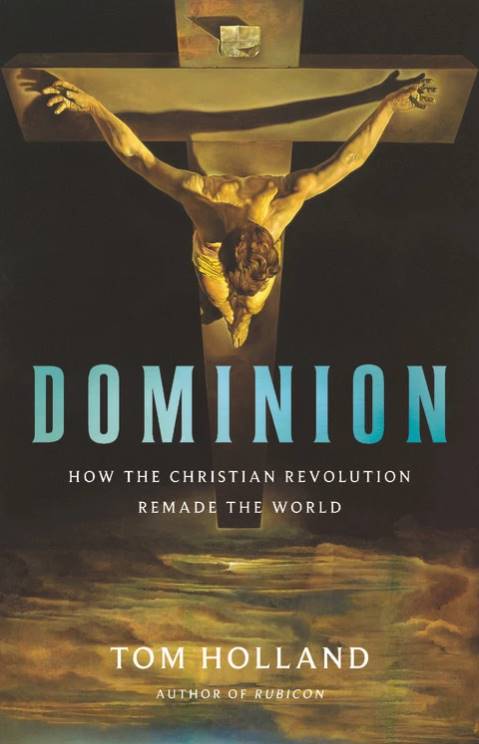
The Romans are the most “epic” figures in history, to use my young son’s favourite word, exerting a glamour and allure that no civilisation has successfully matched. This magnetism can also appear heightened by what followed, the illiterate bleakness of the early Middle Ages, and the fun-sucking religion that came with it. Many down the years have lamented the switch from the Rome of the Caesars to the Rome of the popes.
The young Tom Holland was one of them. Raised as an Anglican, the historian’s childhood fascination with dinosaurs evolved into one for the equally glamorous ancients. “Although I vaguely continued to believe in God,” he writes: “I found him infinitely less charismatic than the gods of the Greeks: Apollo, Athena, Dionysus. I liked the way that they did not lay down laws, or condemn other deities as demons; I liked their rock-star glamour. As a result, by the time I came to read Edward Gibbon and his great history of the decline and fall of the Roman Empire, I was more ready to accept his interpretation of the triumph of Christianity: that it had ushered in an ‘age of superstition and credulity’. My childhood instinct to see the biblical God as the po-faced enemy of liberty and fun was rationalised.”
This, indeed, is a widespread view. Since Gibbon wrote his great work in the late 18th century there has existed the popular idea that the Renaissance, with its return to classical values, and the Enlightenment, which saw the birth of reason over superstition, were a reaction to Christianity, which had in those thousand dark medieval years suppressed science and freedom.
Yet the truth and paradox, as Holland shows in this truly epic account of how Christianity came to shape the West, is that the western idea of secularism is itself a very Christian one. Liberalism was never a reaction to Christianity, it was a product, perhaps one might heresy; ditto Marxism, socialism and the various progressive creeds of the modern era, right up to the current Great Awokening with its focus on the sanctity of victimhood.
All our assumptions about progress, the rights of the individual, our horror of racism and sexual exploitation, even the acceptance of gay marriage, are the products of Christianity. They are not in themselves universal or “natural”, and to the Romans these ideas of human rights and dignity would have been incomprehensible, laughable even.
Holland made his name with thrilling popular histories set in the ancient world, yet the more he studied antiquity, the more alien it became to him. It wasn’t just that Spartans or Romans killed innocents in large numbers, but that they lacked even the suggestion that the weak might be worth pitying. “That my belief in God had faded over the course of my teenage years did not mean that I had ceased to be Christian,” he writes.
Cruelties such as the exposure of infants – especially female infants – were almost universally accepted in antiquity, except among one or two small German tribes and, at the other end of the empire, a monotheistic people in the eastern Mediterranean. Perhaps the obscenest horror, however, was the practice of crucifixion, a death so cruel that Roman writers barely touched on the subject. Indeed only “four detailed accounts of the process by which a man might be sentenced to the cross, and then suffer his punishment, have survived from antiquity. Remarkably, they all describe the same execution.”
This is the story of how on that one Friday in Judea the world was changed forever — with a moral revolution like nothing before or since.
Comments Off on Tom Holland’s Dominion
Is Regifting a Crime?
It’s a Southern Thing
Published 10 Dec 2019To regift or not to regift? The Southern People’s Court brings their unique brand of justice to this tough issue.
(more…)
Comments Off on Is Regifting a Crime?
QotD: The Spoon Theory
The blogger Christine Miserandino, who has lupus, coined the term spoonie in a 2003 post called “The Spoon Theory”. A spoon, Miserandino explained, equates to a certain amount of energy. The Healthy have unlimited spoons. The Sick — the spoonies — only have a few. They might use one spoon to shower, two to get groceries, and four to go to work. They have to be strategic about how they spend their spoons.
Since then, the theory has ballooned into an illness kingdom filled with micro-celebrities offering discounts on supplements and tinctures; podcasts on dating as a spoonie; spoonie clubs on college campuses; a weekly magazine; and online stores with spoonie merch. In the past few years, spoonie-ism has dovetailed with the #MeToo movement and the ascendance of identity politics. The result is a worldview that is highly skeptical of so-called male-dominated power structures, and that insists on trusting the lived experience of individuals — especially those from groups that have historically been disbelieved. So what do spoonies need from you? “To believe; Be understanding; Be patient; To educate yourself; Show compassion; Don’t question”.
Spoonie illnesses include, but are not limited to, serious diseases like multiple sclerosis and Crohn’s disease, but also harder-to-diagnose ones that manifest differently in different people: polycystic ovary syndrome (PCOS), Rheumatoid arthritis (RA), endometriosis, postural orthostatic tachycardia syndrome (POTS), Ehlers-Danlos syndrome, dysautonomia, Guillain-Barré Syndrome, gastroparesis, and fibromyalgia. Another spoonie illness is myalgic encephalomyelitis — or chronic fatigue syndrome — which has now been linked to long Covid.
These illnesses are often “invisible”: To most people, spoonies may appear healthy and able-bodied, especially when they’re young. Many of the conditions affect women more frequently, and most are chronic illnesses that can be managed, but not cured. A diagnosis often lasts for a lifetime, while symptoms come, go, morph, and multiply.
Spoonies find community in having complicated conditions that are often hard to identify and difficult to treat. That’s why a lot of spoonies include a zebra emoji in their social media bios, borrowed from the old doctor’s adage: “When you hear hoof beats, look for horses, not zebras.” In other words: assume your patient has a more common illness, rather than a rare one.
The spoonie mantra might be: I am the zebra.
Although the term is relatively new, the spoonies fit into a long history of women having amorphous, hard-to-diagnose conditions. Since ancient times, women who were diagnosed under the general category of “hysteria” were prescribed treatments such as sex, hanging upside down, and the placement of leeches on the abdomen. Then, in the 19th century, the new field of psychoanalysis concluded that women with hysteria were not suffering from physical disorders, but mental ones. Whether the women’s inexplicable pain was a function of their brains or of their bodies — or of each other (see mass hysteria), or of the devil (see Salem, 1692) — has always been a fraught subject.
And then the internet arrived and created a 21st century version of Freud’s Vienna, in which everyone was always on the couch, perpetually the patient.
Suzy Weiss, “Hurts So Good”, Common Sense, 2022-09-06.
Comments Off on QotD: The Spoon Theory
December 20, 2022
A true behind-the-scenes look at George Orwell’s Nineteen Eighty-Four
In Spiked, Alexander Adams reports on a new, limited edition of the surviving portion of George Orwell’s manuscript for the novel:
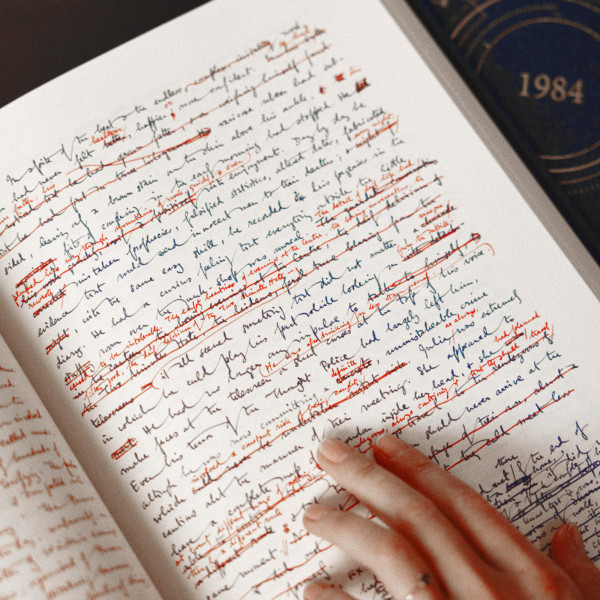
A photo from SP Books’ web page showing the reproduction of Orwell’s manuscript.
SP Books, https://www.spbooks.com/150-1984-9791095457114.html
Published by SP Books, this is Nineteen Eighty-Four as you’ve never seen it before. It reproduces, in colour facsimile, the 197 surviving pages of Orwell’s manuscript, held by the John Hay Library at Brown University, Rhode Island. We see Orwell’s work in fountain pen and ballpoint (complete with ink blots), as well as 14 typewritten sides. We are even given his doodles and pen tests. Readers will remember how Winston also marvels at the beauty of the paper and binding of a blank book he buys from a junk shop.
This edition contains what amounts to 44 per cent of the text of the published novel. It is in a jumbled state, with pages missing and drastic changes made. There are many crossings out and additions. The handwriting can be a little tricky to decipher – Orwell had a habit of using cursive joining lines between words and using abbreviations. Added to that, the script can be somewhat crabbed, especially where Orwell adds text between existing lines. With a little patience, though, the reader can adjust to Orwell’s writing, especially if familiar with the text, and glimpse this most familiar of novels anew.
This version includes an introduction by Orwell scholar DJ Taylor. He tells us that although Orwell usually wrote quickly, he took five years to complete Nineteen Eighty-Four. Taylor details the difficult conditions that explain the novel’s long gestation. The death of Orwell’s first wife in 1945, the effort of raising their young son alone and the toll of tuberculosis all slowed work and drained the author’s energy (tuberculosis would kill him in 1950, only months after the novel’s publication). There are indications that Orwell let the book go to publication even though he thought it was not properly finished.
Looking at this draft, we can see Orwell revising heavily as he wrote. Some revisions are minor, such as Trotsky-figure Goldstein’s description of the workings of the Party and his description of the geopolitics of Oceania, Eurasia and Eastasia. Other changes are more significant. Here, in the propaganda film described by Winston at the start of his diary, there is a graphic passage about the lynching of a pregnant black woman. Orwell seems to have cut these lines on grounds of decency. He also reduced the references to race overall, perhaps uncomfortable about the implications of speaking so generally about groups and types. Orwell’s background as a policeman in Burma no doubt made him sensitive to racial issues.
Comments Off on A true behind-the-scenes look at George Orwell’s Nineteen Eighty-Four
Coming of the Sea Peoples: Part 2 – The Old and New Chronology of the Bronze Age
seangabb
Published 2 May 2021The Late Bronze Age is a story of collapse. From New Kingdom Egypt to Hittite Anatolia, from the Assyrian Empire to Babylonia and Mycenaean Greece, the coming of the Sea Peoples is a terror that threatens the end of all things. Between April and July 2021, Sean Gabb explored this collapse with his students. Here is one of his lectures. All student contributions have been removed.
(more…)
Comments Off on Coming of the Sea Peoples: Part 2 – The Old and New Chronology of the Bronze Age
The forgotten Thomas Savery
In the latest Age of Invention newsletter, Anton Howes remembers the work of inventor Thomas Savery:

Screenshot from “Savery’s Miners Friend – 1698”, a YouTube video by Guy Janssen (https://www.youtube.com/watch?v=Dt5VvrEIj8w)
We know surprisingly little about Thomas Savery — the inventor of the first widely-used steam engine. Unfortunately, his achievements were almost immediately overshadowed by the engine of Thomas Newcomen, and so he’s often only mentioned as a sort of afterthought — a loose and rather odd-seeming pebble before the firmer stepping stones of Newcomen, Watt, Trevithick, and other steam engine pioneers in the standard and simple narratives of technological progress that people like to tell. I’ve often seen Savery’s name omitted entirely.
He is even neglected by the experts. The Newcomen Society, of which I am a new member, has an excellent journal — it is the best place to find scholarly detail about all steam pioneers, and about the history of engineering in general. Yet even it only mentions Savery in passing. In over a century, Savery has been named in the titles of just three of its articles, and the last was published in 1986.
I think Savery is extremely under-rated, and deserves to be studied more. Fortunately, we do know quite a bit about the engine he designed, which he intended primarily for raising the water out of mines. Steam was admitted into a chamber, and then sprayed with cold water to condense it. This caused mine water to be sucked up a pipe beneath it, by creating a partial vacuum within the chamber and thus exploiting the relative pressure of the atmosphere on the surface of the mine water. Then, hot steam was readmitted to the chamber, this time pushing the raised water further up through another pipe above. Two chambers, the one sucking while the other pushed, created a continuous flow. (Video here.) We have dozens of images and technical descriptions of Savery’s engine, as it continued to be used for decades, especially in continental Europe.
But we know essentially nothing about Savery’s background, training, inspiration, or profession, and most of the supposedly known biographical details we have for him are simply wrong. There is no evidence that he was a “military engineer” or a “trenchmaster”, for example — mere speculation that has been repeated so often as to take on the appearance of fact. Savery simply appears out of nowhere in the 1690s, with his inventions almost fully formed.
Yet in Savery’s own writings we can see a few tantalising hints of how he thought, including some flashes of brilliance. I kept coming across them by chance, when investigating various energy-related themes with Carbon Upcycling. Take the following aside, from Savery’s 1702 prospectus for his steam engine: “I have only this to urge, that water in its fall from any determinate height, has simply a force answerable and equal to the force that raises it”. Savery here seems to be hinting at some idea of the conservation of energy, and perhaps of a theoretical maximum efficiency — in a phrase that is remarkably similar to that used by the pioneers of water wheel theory half a century later, and to Sadi Carnot when he applied the same ideas to early thermodynamics.
Savery, frustratingly, doesn’t expand any further on the point, except to then casually mention the notions of both mechanical work and horsepower — over eighty years before James Watt. Savery noted that when an engine will raise as much water as two horses can in the same time, “then I say, such an engine will do the work or labour of ten or twelve horses” — ten horsepower, rather than two, because you’d need a much larger team of horses from which to rotate fresh ones while the others rested, to keep raising water as continuously as the force of a stream could turn a water-wheel, or his steam engine could pump. (Incidentally, Watt wasn’t even the second person to use horsepower — the same concept was also mentioned by John Theophilus Desaguliers in the 1720s and John Smeaton in the 1770s. Watt just managed to get all the credit later on. Perhaps watts should really be called saveries, even if he was less precise.)
Comments Off on The forgotten Thomas Savery
Eggnog: A Christmas History
Tasting History with Max Miller
Published 22 Dec 2020
(more…)
Comments Off on Eggnog: A Christmas History
QotD: Myrna Loy
She goes on to provide a short list: John Barrymore (“just because he felt like a little redhead now and then didn’t incline me to join the club …”), Clark Gable (she shoved him off her back porch one night after he made a pass “and, boy, did he punish me for that!”), Spencer Tracy (“he chased me for years, then sulked adorably when I married someone else …”) and Leslie Howard (despite both of them being married he “wanted to whisk me off to the South Seas, and, believe me, that was tempting …”).
“These days you’re made to feel dull and defensive if you weren’t the Whore of Babylon,” Loy writes. “Well, succumbing isn’t the only interesting aspect of a relationship.”
It’s no surprise that a woman who understands this much was such a natural in screwball comedies, where succumbing is usually held at bay until the last shot, the better to draw out the difficulties, obstacles and improbabilities set up like an obstacle course along the way.
Of the over 120 films she made, most of the first half of her career – largely bit parts, vamps and “exotics” – is forgotten, her reputation based on the fourteen she made with William Powell (six of which were Thin Man pictures), along with titles like The Best Years of Our Lives, The Bachelor and the Bobby Soxer, Mr. Blandings Builds His Dream House and Cheaper by the Dozen.
If she had a type onscreen – and Loy tried hard to avoid becoming a type – she would become Nora Charles, the paragon of wives: supportive but not obsequious, the equal of any spouse, ready with a wisecrack and a bit of fun, and always beautifully turned out. Quite a stretch, she’d admit, for a woman divorced four times, childless and openly dismissive of her domestic skills.
Rick McGinnis, “Do You Take This Woman? Myrna Loy and Third Finger, Left Hand“, Steyn Online, 2022-09-17.
Comments Off on QotD: Myrna Loy
December 19, 2022
“[T]he major promoter of the ‘Canada is broken’ thesis over the past few years has been … Justin Trudeau”
In the free-to-cheapskates exerpt from this week’s Dispatch from The Line, they set up the possible lines of attack for the next federal election:
What was more interesting to us this week were the comments made by Prime Minister Justin Trudeau to thousands of Liberals at a large in-person Christmas party. As one does at any good Christmas party, the PM took the chance to, uh, savage his rivals. To wit: “Canada is not broken … Mr. Poilievre might choose to undermine our democracy by amplifying conspiracy theories. He might decide to run away from journalists when they ask him tough questions. That’s how he brands himself. That’s his choice. But, when he says that Canada is broken, that’s where we draw the line.” (Full video of the speech is available via CTV News).
The PM was responding, of course, to a recent line of attack favoured by the Conservatives: that Canada is broken, and we need the Conservatives to fix it.
There are three comments we’ll make in response to this.
The first is strictly an analysis: Trudeau is staking out some interesting rhetorical ground. We aren’t sure this will be the ground on which the next campaign is fought over — God only knows what’ll happen between now and whenever we are next headed to the polls. But if this is the subject of our next “ballot question”, well, that’s just fascinating. “Sunny Ways” vs. “Everything Is Broken and It’s Your Fault.”
How fun! Both men would be able to make an honest pitch for their case. As we’ve written before, the Liberals seem exhausted and spent. They’ve accumulated baggage since their first smiley-faced win back in 2015, and the country has been thoroughly battered by events since then. That suggests that Poilievre, who is at his best when on the attack, could mop the floor with Trudeau.
That said, we don’t take that outcome as a given. First, Trudeau is a damned good politician, better than the Conservatives still give him credit for, and though we are starting to wonder if Trudeau is past the point of no return, we will never count him out. We also think that if the Conservatives make “Things are terrible” the centrepiece of their next campaign, may find that Canadians recoil. Canadian pride is a fragile, brittle thing, and while many of us may feel like things are bad, it’s not clear to us that Poilievre saying so won’t rub a lot of voters the wrong way.
But we honestly don’t know. That’s why it’s fascinating.
The second point is a bit of a reminder: It is worth noting that the major promoter of the “Canada is broken” thesis over the past few years has been … Justin Trudeau. We don’t think we — your Line editors, the media, Canadians in general — should let him take such casual re-occupation of the “Sunny Ways” position, since he’s spent the last five years absolutely dumping on Canada, its history (genocide), its symbols (the flag), and its institutions (the military, amongst others). No one has done more to proclaim Canada broken than Justin Trudeau. Is he now claiming that he’s fixed all the problems he’s spent the last half decade making political hay over?
We mean … the guy won’t even fix his house.
The third point is our own view: of course Canada is broken. And Trudeau has done nothing to fix it.
Now, we have to define our terms here. “Broken” isn’t “destroyed”. We don’t think we’re descending into some kind of post-apocalyptic wasteland. It remains undeniably true that Canada is, in global terms, a nice place to live. Safe. Lots of food. No one is firing missiles at us. Sweet! But, like, gosh, folks. Look around. If the PM really wants to assert that Canada isn’t broken, we’ll agree insofar as it’s not so broken that the average person fears starvation and violent death. Sure. But that average person also probably can’t get a passport, or a family doctor, or timely care in an emergency room, or a house in a big city where the jobs are clustering, or Tylenol for their kids.

Comments Off on “[T]he major promoter of the ‘Canada is broken’ thesis over the past few years has been … Justin Trudeau”
Napoleon’s Downfall: German Wars of Liberation 1813
Real Time History
Published 16 Dec 2022After Napoleon’s defeat in Russia in 1812, the situation on the European continent is rapidly shifting. Prussia and Austria are leaving their unhappy alliance with the French. Prussian general Yorck even pledges his support to the Russian Army which is on the move towards Berlin. At Lützen and Bautzen Napoleon still manages to beat the new coalition, but his losses from Russia put him on the backfoot.
(more…)
Comments Off on Napoleon’s Downfall: German Wars of Liberation 1813
“Both sides have their crazy folks … But usually, they’re on the semi-fringe”
Tom Knighton on the increasing difficulty of taking some people seriously:
There are some people who are completely unhinged. We all know this and have seen it ourselves throughout our lives. This is especially true if you spend much time in the political space.
Both sides have their crazy folks. They exist in the realm of conspiracy theories, rationalizations, and fearmongering with absolutely no basis in reality.
But usually, they’re on the semi-fringe.
Or, at least, they used to be.
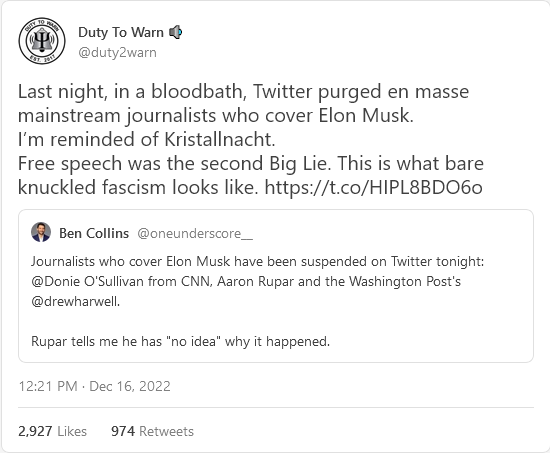
However, I came across this tweet from an account with over 400,000 followers and reportedly run by a group of mental health professionals, and if this isn’t the height of unhinged, I don’t know what is.
Now look, I know that the official reason these journalists were suspended was because of doxxing, but I don’t know just how valid that is. I didn’t see their tweets so I can’t say.
I do know that they caught a seven-day suspension, so they’ll all be back.
But for these jackwagons to claim it reminds them of Kristallnacht …
At least 91 Jews were murdered during Kristallnacht. Some experts say the actual death toll should be higher due to post-arrest maltreatment with at least one saying over 630 people died as a result of Kristallnacht.
I looked to see if this was a parody account, but it doesn’t look like it, which means these dipsticks are serious.
And that’s terrifying.
See, if they’re mental health professionals, then it means at least some in our mental health system are crazier than most trying to get help in the first place. This is beyond deranged.
And yet, it’s unlikely that those more than 400,000 followers are hate followers. They’re people who actually like what these people say and take it seriously. That’s downright terrifying.
Comments Off on “Both sides have their crazy folks … But usually, they’re on the semi-fringe”
Christmas Crack – You Suck at Cooking (episode 54)
You Suck At Cooking
Published 22 Dec 2016To make the Christmas crack:
1. Combine equal parts of butter and brown sugar (1 cup of each works) and heat in a sauce pan until it turns into sauce in the pan.
2. Line a baking sheet with foil then with graham crackers. Break them up to make them fit along the edges.
3. Once the butter and sugar become a thickish sauce, pour it all over.
4. Bake in in the oven for a couple minutes until it starts to bubble but not for too long.
5. Cover with chocolate chips … you can put that back in the oven for a minute or just wait a minute and start spreading them around as they melt until it’s a full layer. Use just over 1 cup.
6. Throw on whatever toppings you want; almonds, pepperoni, whatever.
7. Wait a few hours for it to harden or throw it in the fridge or the freezer.I personally like keeping it frozen and eating it that way. But I am not you and you may have different temperature preferences. It’s hard for me to tell at this point, but if you message me on snapchat perhaps we can discuss this more thoroughly. Or perhaps not. I’m sorta moody that way.
(more…)
Comments Off on Christmas Crack – You Suck at Cooking (episode 54)
QotD: When reality fails to follow the model, ditch reality
I get that, man. On some fundamental level. But that makes me a generally unhappy guy. So it is, so it has always been.
For whatever reason, the Leftist is able to externalize that. If there are no more worlds to conquer, well, that’s the world’s fault. I remember hanging out with some of the Political Science goofs at Flyover State. For whatever reason, they rank pretty high for Poli Sci — their department developed some measure of whatzit to better analyze the doodad, you know how it goes, the Karl Roves and James Carvilles of the world all use it.
Anyway, this was 2004, when George W. Bush won his reelection campaign against Kerry. Exactly zero of the Flyover State Poli Sci goofs predicted that. They were all certain that Kerry was cruising to victory. When I pointed out that this seems to be a BIG flaw in their precious model — the election wasn’t even particularly close — their response was instructive: It wasn’t the model’s fault. Rather, it’s that the American public chose to throw a temper tantrum.
That’s seriously what they went with. There’s the actual, observed behavior of 70 million people; and there’s your model; and when the one contradicts the other, the only possible explanation is: All those people are idiots.
(One of those grad students I was talking to ended up doing something “unofficial” yet fairly important for the Hillary Clinton campaign in 2016; if I’d known that, I could’ve called it for Trump at the very start of election and made a fortune on prop bets).
It’s probably genetic for them, too. Which is either hopeful or depressing, depending, but I think it answers the question: Why does society end up being ruled by Very Clever Boys? They just can’t do anything else. They can’t internalize; they have game the system. Have to. A society that wants to survive must find a system for them to game, somewhere far isolated from the real affairs of people.
Severian, “Me vs. The World”, Founding Questions, 2022-09-14.
Comments Off on QotD: When reality fails to follow the model, ditch reality
December 18, 2022
Euthanasia, Canadian-style
In the free-to-cheapskates portion of his Weekly Dish, Andrew Sullivan considers the alarming growth of euthanasia in Canada:

Front view of Toronto General Hospital in 2005.
Photo via Wikimedia Commons.
I mention all this as critical background for debating policies around euthanasia or “assisted dying” (a phrase that feels morbidly destined to become “death-care”.) Oregon pioneered the practice in the US with the Death with Dignity Act in 1997. At the heart of its requirements is a diagnosis of six months to live. Following Oregon’s framework, nine other states and DC now have laws for assisted suicide. Public support for euthanasia has remained strong — 72 percent in the latest Gallup.
But this balance could easily get destabilized in the demographic traffic-jam to come. In 2016, euthanasia came to Canada — but it’s gone much, much further than the US. The Medical Assistance in Dying (or MAID) program is now booming and raising all kinds of red flags: there were “10,000 deaths by euthanasia last year, an increase of about a third from the previous year”. (That’s five times the rate of Oregon, which actually saw a drop in deaths last year.) To help bump yourself off in Canada, under the initial guidelines, there had to be “unbearable physical or mental suffering that cannot be relieved under conditions that patients consider acceptable”, and death had to be “reasonably foreseeable” — not a strict timeline as in Oregon. The law was later amended to allow for assisted suicide even if you are not terminally ill.
More safeguards are now being stripped away:
Gone is the “reasonably foreseeable” death requirement, thus clearing the path of eligibility for disabled individuals who otherwise might have a lifetime to live. Gone, too, is the ten-day waiting requirement and the obligation to provide information on palliative-care options to all applicants. … [O]nly one [independent witness] is necessary now. Unlike in other countries where euthanasia is lawful, Canada does not even require an independent review of the applicant’s request for death to make sure coercion was not involved.
This is less a slippery slope than a full-on, well-polished ice-rink. Several disturbing cases have cropped up — of muddled individuals signing papers they really shouldn’t have with no close relatives consulted; others who simply could not afford the costs of survival with a challenging disease, or housing, and so chose death; people with severe illness being subtly encouraged to die in order to save money:
In one recording obtained by the AP, the hospital’s director of ethics told [patient Roger Foley] that for him to remain in the hospital, it would cost “north of $1,500 a day”. Foley replied that mentioning fees felt like coercion and asked what plan there was for his long-term care. “Roger, this is not my show”, the ethicist responded. “My piece of this was to talk to you, (to see) if you had an interest in assisted dying.”
It’s hard to imagine a greater power-dynamic than that of a hospital doctor and a patient with a degenerative brain disorder. For any doctor to initiate a discussion of costs and euthanasia in this context should, in my view, be a firing offense.
Then this: in March, a Canadian will be able to request assistance in dying solely for mental health reasons. And the law will also be available to minors under the age of 18. Where to begin? How do we know that the request for suicide isn’t a function of the mental illness? And when the number of assisted suicides jumps by a third in one year, as it just did in Canada, it’s obviously not a hypothetical matter.
Comments Off on Euthanasia, Canadian-style


