
Overly Sarcastic Productions
Published 23 Dec 2022Merry Sinterklaasfeest to all, and to all a good night.
Our content is intended for teenage audiences and up.
(more…)
December 24, 2022
History-Makers: Saint Nicholas to Santa Claus
Comments Off on History-Makers: Saint Nicholas to Santa Claus
Repost – Hey Kids! Did you get your paperwork in on time?
If you hurry, you can just get your Santa’s Visit Application in before the deadline tonight!

Comments Off on Repost – Hey Kids! Did you get your paperwork in on time?
Repost – The Monkees – “Riu Chiu”
Uploaded on 15 Dec 2015
The Monkees perform “Riu Chiu” from Episode 47, “The Monkees’ Christmas Show”.
H/T to the late Kathy Shaidle for the link.
Comments Off on Repost – The Monkees – “Riu Chiu”
QotD: Auberon Waugh on Christmas shopping
For Christmas shopping in London I go by force of habit to Harrods. The toy department is full of loud-voiced Englishwomen, but I do not see a fellow Englishman anywhere until I chance upon the Women’s Underwear Department. As I pass, I hear a Major of the Household Brigade ask for some knickers with pussy fur. Another man, almost certainly from the Treasury, asks in a hoarse whisper for some crotchless briefs.
Auberon Waugh, Diary, 1975-12-18.
Comments Off on QotD: Auberon Waugh on Christmas shopping
December 23, 2022
Never, ever be the first to stop clapping
Chris Bray on the echoes of Soviet-era mandatory celebrations expected of US elected politicians during a speech by Comrade Stalin to the Politburo state visit by the President of Ukraine:
I hesitate to say any of this, because it’s December 22 and none of us should be thinking about the grotesqueries of the political and media classes, but it’s been a busy week for them. I started writing here a little more than a year ago, and have argued since the beginning that our notional leadership classes have developed a set of ritual behaviors that are entirely severed from any form of reality you’ll ever see in your own daily life. (Dana Loesch: “You can’t run a country you’ve never been to.”)
And so here’s one of the least subtle court eunuchs with a message about ritual obedience:
I wish I could replicate the awkward burst of nervous laughter that came out of me at the moment that I saw this message. The policing of performative applause in a formal political setting is so obviously a theme of totalitarian societies that … well, that Chief Eunuch Michael Beschloss can be counted on to not notice what he’s just done. I didn’t get a harumph outta that guy, he said, from deep inside a cloud of obtuse self-regard.
“They insist on inflicting on us such bloated theater & they seem not to know how false it all appears.” The Ukrainian president made it all the way to the Capitol in his combat fatigues, doncha know, and was greeted with a rapturous standing ovation by members of Congress, seen here in this actual footage:
Are there any normal human beings who don’t taste bile when they see this performance? And, Thomas Massie and Rand Paul aside, are there any normal human beings left inside the Beltway?
“Squee! Squee! Squee!” they explained, shaking their pom poms in a dignified ritual of state.



Comments Off on Never, ever be the first to stop clapping
A Jungle Miracle – War Against Humanity 092
World War Two
Published 22 Dec 2022Two escapes, one from the Nazis in Kovno (Kaunas) Lithuania, from the prison at Fort IX, and one from Japanese terror on Panay in the Philippines this week, will help to document the crimes of the Axis powers.
(more…)
Comments Off on A Jungle Miracle – War Against Humanity 092
Remember when ending “Net Neutrality” was going to be the death of the internet?
Peter Jacobsen answers a reader question about the now almost forgotten doomsday scenario for the internet that was the ending of “Net Neutrality” in 2017:
To answer this question, we have to wind back the clock to 2017. Then-chair of the Federal Communications Commission (FCC) Ajit Pai successfully led an effort to repeal a set of 2015 regulations on Internet Service Provider (ISP) companies originally put into place by the Obama Administration.
The simplest summary of net neutrality regulations is that they required ISPs to enable access to content on the internet at equal speeds and for equal costs. For example, your ISP charging you to get faster speeds on YouTube or blocking High Definition access on Netflix would be examples of violations of net neutrality.
The idea of paying your ISP extra to have access to certain websites is a scary one, but it appears the worst fears associated with the end of net neutrality were overstated. To some extent proponents of net neutrality are the victim of their own apocalyptic marketing.
The Rumors of the Internet’s Death Were Greatly Exaggerated
If you spent any time on the internet during the death of net neutrality, it was hard to miss it. On July 12, 2017 websites across the internet coordinated their messages for the “battle for the net.”
Websites including Amazon, Netflix, YouTube, and Reddit called their users to fight for “a free and open internet”.
On Twitter, #SaveTheInternet thrived, seemingly implying the internet itself was facing an existential threat.
The repeal of #NetNeutrality officially goes into effect today, but the fight is far from over.
The people saying we can’t pass the resolution to #SaveTheInternet in the House are the same people who were saying we couldn’t do it in the Senate.
Ignore them. Just keep fighting.
— Ed Markey (@SenMarkey) June 11, 2018
After the decision by the FCC, CNN briefly declared it was “the end of the internet as we know it”.
Unfortunately for all kinds of doomsday prophets, extreme rhetoric always looks silly in hindsight when it fails to pan out.
Obviously we aren’t seeing ISPs charge users different amounts to use different websites in any systematic way. There’s no “pay your ISP to access Hulu” package yet. So already it’s clear some of the doom and gloom was over-hyped.
Fears of ISPs offering “fast lanes” to make users pay more for better service don’t seem to have materialized either. The only example of this sort of thing I could find was a Cox Communications trial of an “Elite Gamer” service. But this service was unlike the “fast lanes” hyped up by net neutrality proponents in that it never offered a less throttled experience and would have been permissible under the old net neutrality rules.
One of the biggest concerns about the repeal of these regulations was that it would lead ISPs to favor their own services. For example, AT&T owns Time Warner and HBO Max. In theory, AT&T could silently throttle speed to competing streaming platforms like YouTube and Netflix, thereby destroying competition.
Comments Off on Remember when ending “Net Neutrality” was going to be the death of the internet?
Hot Buttered Rum – Food Wishes
Food Wishes
Published 8 Dec 2020You can do a lot of great things with rum. Make rum balls, soak a chocolate cake, pour it into a glass of cola, and of course, entertain pirates, but maybe my favorite thing to do with rum, especially around the holidays, would be to butter it. Enjoy!
(more…)
Comments Off on Hot Buttered Rum – Food Wishes
QotD: Wokeness as a lifestyle
For Gen X, think of my personal candidate for “everything that’s wrong with the 90s, all in one place,” the 1994 movie Reality Bites. Don’t rent it unless you’re current on your blood pressure meds. It’s four of the 1990s’ most insufferable people (Winona Ryder, Ethan Hawke, Ben Stiller, Janeane Garofalo) quipping about being slackers. Well, except Stiller (also the director), who plays the grasping, uptight, sold-his-soul-to-The-Man yuppie foil to the other three. Stiller is the Gen Xer who chose to compete in the oversaturated career arena; he’s cartoonishly evil. The rest of them hang out in coffee houses, polishing their image. They’re lifestyle competitors.
For Millennials, and whatever we’re calling the upcoming generation (“The Lobotomized Snowflake Posse” is my suggestion, brevity be damned), well, just look at social media. Even lounging-around-Starbucks lifestyle competition is out of reach for people who went $100K in the hole for a Gender Studies degree. The only currency they’ve got is effort — hey, didn’t Karl Marx say something about that? — so Twitter becomes their full time job. Xzhe with the most followers wins.
Severian, “Why So #Woke?”, Rotten Chestnuts, 2020-01-07.
Comments Off on QotD: Wokeness as a lifestyle
December 22, 2022
It may have taken most of the year, but Canada finally figured out its Ukraine position
In The Line, Andrew Potter theorizes that the Canadian government finally “got it right” on Ukraine, but only after having exhausted all the other possibilities:

Operation Unifier shoulder patch for Canadian troops in Ukraine.
Detail from a photo in the Operation Unifier image gallery.
When Russia started massing troops on the border in Ukraine this time last year, Canada was one of the first Western countries to close its embassy in Kyiv, moving everyone to Lviv on February 12. Hours after Russia launched its illegal, insane, nihilistic, genocidal full invasion of Ukraine on February 24, all non-Ukrainian employees of our embassy scooted across the border into Poland.
For months after the invasion, that highly risk-averse attitude infected every aspect of Canada’s approach to helping Ukraine. Whether it was diplomacy (hesitant), military aid (slow and limited), financial support (inadequate) or straight-up moral fortitude (lacking), the Trudeau government made it clear that it would do the least amount necessary, while taking the most credit possible, in supporting Ukraine.
[…]
The weird thing about Canada’s foot-draggy-as-she-goes approach to helping Ukraine is how little sense it made politically, for both domestic and international audiences. Canada has one of the largest Ukrainian diaspora populations in the world. We were the first Western country to recognize Ukrainian independence in 1991. The deputy prime minister of Canada is half Ukrainian and has been a loud supporter of the country for years. Privately and publicly, our allies were pleading for us to do more.
Who knows what it was that finally shook some sense into the Trudeau government. Maybe it was Freeland, maybe it was a call from Uncle Joe Biden, maybe it was just a sense in the PMO that, having exhausted all other options, the only thing left to do was the right thing. Whatever it was, over the last three or four months, Canada is finally punching its weight on the global stage on the Ukraine file. In particular, we seem to have finally figured out that the best way to help is to provide the sorts of support that draws on our strengths.
So for example, while the handful of M777 howitzers we sent were certainly useful (and the ammunition we’re continuing to supply will be well spent) we’re never going to compete with the Americans or Brits when it comes to heavy arms supplies. That’s why, back in October, it was probably more helpful for us to send 400,000 pieces of winter gear and to provide a few million dollars worth of satellite communications to the Ukrainians through Telesat. And it was great to see Canada re-engage with its training commitments to the Ukrainian armed forces through the deployment of 40 combat engineers to train Ukrainian sappers in Poland, to complement our ongoing training of recruits in the U.K.
Comments Off on It may have taken most of the year, but Canada finally figured out its Ukraine position
The Minimum Timber Bench // Start woodworking for less!
Rex Krueger
Published 21 Dec 2022The Minimum Timber Bench plans are 34 pages of full-color, step-by-step instructions in standard and metric measurements. The plans include a full stock list and cut list. Every image is modeled in 3D and each step includes tips and tricks to make your build easier. This bench is designed for beginning woodworkers and power-tool woodworkers who want to get into hand tools. You can build it completely by hand or with a few common machine tools. Get your plans here: https://www.rexkrueger.com/store/mini…
The Minimum Timber Bench Course is eight chapters of detailed build instructions. Follow along as I do each step of the build using basic machine tools (and a few hand tools). I’ll take you from stock selection all the way through to flattening and using the bench. The course is 80 minutes long, fully searchable, and includes the complete plans for FREE! Learn more here: https://tinyurl.com/43yfhjwb
(more…)
Comments Off on The Minimum Timber Bench // Start woodworking for less!
Pseudo swear words “like fuckpuffin, spunktrumpet, shitgibbon, but, most of all, by the undisputed king of the new pseudo swear words, cockwomble“
John Sturgis would like you to swear properly without all these modern pseudo swear words that are all the rage:
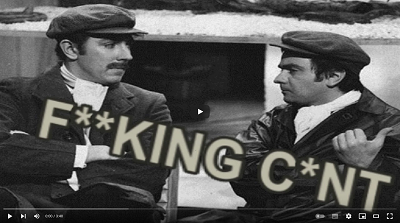
Peter Cook and Dudley Moore as “Derek and Clive” in 1976.
Full video at https://www.youtube.com/watch?v=RYGy-j_oH5Q
Warning: this article features a number of words and terms which some readers may find offensive.
As it happens, I have been offended frequently myself lately — by a growing trend for replacing traditional expressions of anger, aggression or exasperation with neologisms.
I am speaking of terms like fuckpuffin, spunktrumpet, shitgibbon, but, most of all, by the undisputed king of the new pseudo swear words, cockwomble.
Cockwomble’s origins are hard to pin down. There are earlier examples of compound swear words from overseas: the American dickwad, the (I think) Australian fuckwit. They weren’t a significant phenomenon here until around five years ago when cockwomble first began to circulate.
Since then its popularity has grown and grown. Just last week it was trending on Twitter, apparently in relation to Matt Hancock. In fairness, Hancock probably does embody the qualities suggested by the expression better than any other living person.
That exception doesn’t excuse its proliferation: cockwomble has now begun to be picked up overseas and celebrated as an example of our native humour. The British Council really ought to step in and disassociate the nation from this awful expression.
My problem with cockwomble isn’t so much that it’s vulgar, but that it’s not vulgar enough. The addition of the completely innocuous womble to what is already one of our tamer core swear words, serves to neuter it to the point where it’s almost entirely inoffensive, even twee. The fictional furry creatures from Wimbledon have absolutely no place in meaningful swearing. Swearing shouldn’t be nice; it should be the preserve of the slightly scary: the docker, the builder, the fishwife, the public rather than saloon bar. Swearing should be a little bit dark, dangerous, even underground. It should certainly not be underground, overground.
Comments Off on Pseudo swear words “like fuckpuffin, spunktrumpet, shitgibbon, but, most of all, by the undisputed king of the new pseudo swear words, cockwomble“
The Emulsified High-Fat Offal Tube | Yes, Minister: 1984 Christmas Special | BBC Comedy Greats
BBC Comedy Greats
Published 26 Jul 2021Bernard (Derek Fowlds) walks Jim Hacker (Paul Eddington) through the red-tape of signing his Christmas cards, but Jim Hacker is more concerned with worrying plans from Brussels to rename the British sausage.
(more…)
Comments Off on The Emulsified High-Fat Offal Tube | Yes, Minister: 1984 Christmas Special | BBC Comedy Greats
QotD: Sparta as the pre-eminent foe of tyranny
It also matters exactly how tyranny is understood here. For the ancient Greeks, tyranny was a technical term, meaning a specific kind of one-man rule – a lot like how we use the word dictatorship to mean monarchies that are not kingdoms (though in Greece this word didn’t have quite so strong a negative connotation). Sparta was pretty reliable in opposing one-man rule, but that doesn’t mean it supported “free” governments. For instance, after the Peloponnesian War, Sparta foisted a brutal oligarchy – what the Athenians came to call “The Thirty Tyrants” – on Athens; their rule was so bad and harsh that it only lasted eight months (another feat of awful Spartan statecraft). Such a government was tyrannical, but not a tyranny in the technical sense.
But the Spartan reputation for fighting against tyrannies – both in the minds of the Greeks and in the popular consciousness – is predicted on fighting one very specific monarchy: the Achaemenids of Persia. […] This is the thing for which Sparta is given the most credit in popular culture, but Sparta’s record in this regard is awful. Sparta (along with Athens) leads the Greek coalition in the second Persian war and – as discussed – much of the Spartan reputation was built out of that. But Sparta had largely been a no-show during the first Persian war, and in the subsequent decades, Sparta’s commitment to opposing Persia was opportunistic at best.
During the late stages of the Peloponnesian War, Sparta essentially allied with Persia, taking funding and ships first from the Persian satrap Tissaphernes and later from Cyrus the Younger (a Persian prince and satrap). Sparta, after all, lacked the economic foundation to finance their own navy and the Spartans had – belatedly – realized that they needed a navy to defeat Athens. And of course the Persians – and any Spartan paying attention – knew that the Athenian navy was the one thing keeping Persia out of Greek affairs. So Sparta accepted Persian money to build up the fleets necessary to bring down the Athenian navy, with the consequence that the Ionian Greeks once again became subjects to the Persian Empire.
Subsequent Spartan diplomatic incompetence would lead to the Corinthian War (395-387), which turned into a nasty stalemate – due in part to the limitations of Spartan siege and naval capabilities. Unable to end the conflict on their own, the Spartans turned to Persia – again – to help them out, and the Persians brokered a pro-Spartan peace by threatening the Corinthians with Persian intervention in favor of Sparta. The subequent treaty – the “King’s Peace” (since it was imposed by the Persian Great King, Artaxerxes II) was highly favorable to Persia. All of Ionian, Cyprus, Aeolia and Carnia fell under Persian control and the treaty barred the Greeks from forming defensive leagues – meaning that it prevented the formation of any Greek coalition large enough to resist Persian influence. The treaty essentially made Sparta into Persia’s local enforcer in Greece, a role it would hold until its defeat in 371.
If Sparta held the objective of excluding Persian influence or tyranny from Greece, it failed completely and abjectly. Sparta opened not only the windows but also the doors to Persian influence in Greece – between 410 and 370, Sparta probably did more than any Greek state had ever or would ever do to push Greece into the Persian sphere of influence. Sparta would also refuse to participate in Alexander’s invasion of Persia – a point Alexander mocked them for by dedicating the spoils of his victories “from all of the Greeks, except the Spartans” (Arr. Anab. 1.16.7); for their part, the Spartans instead tried to use it as an opportunity to seize Crete and petitioned the Persians for aid in their war against Alexander, before being crushed by Alexander’s local commander, Antipater, in what Alexander termed “a clash of mice”.
Bret Devereaux, “Collections: This. Isn’t. Sparta. Part VII: Spartan Ends”, A Collection of Unmitigated Pedantry, 2019-09-27.
Comments Off on QotD: Sparta as the pre-eminent foe of tyranny
December 21, 2022
The rise of David Bowie
In Quillette, David Cohen outlines the career of David Bowie:
With impeccable timing, the thin white stork had dropped David Robert Jones out of London’s skies nearly three-score-and-ten years earlier. The suburban Bromley Boomer fell to Earth on January 8th, 1947, and landed smack in the middle of the bulge years, a wonderfully fertile period for anyone looking to forge a career in recorded music. His first instrument was the saxophone, which he was blowing on by the age of 14. Within a few years, the transistor radio would be ubiquitous, young people would be awash with disposable cash to buy records, and the mass adoption of international air travel would open up new vistas for fans and artists alike. Could any moment have been better suited to a rock-star-in-waiting?
But he also came of age as the youngest child in a doomy household. Three of his maternal aunts suffered from acute mental health issues — one of whom was eventually lobotomized — and the family was riven with more dark secrets than the Tolstoy home. His schizophrenic step-brother, Terry, would spend much of his adult life in psychiatric care. His beloved father dropped dead when Bowie was just 22, while his mother — a children’s home publicist with whom he was emphatically not close — lived on. “Everyone says, ‘Oh yes, my family is quite mad,'” Bowie later recalled. “Mine really is.”
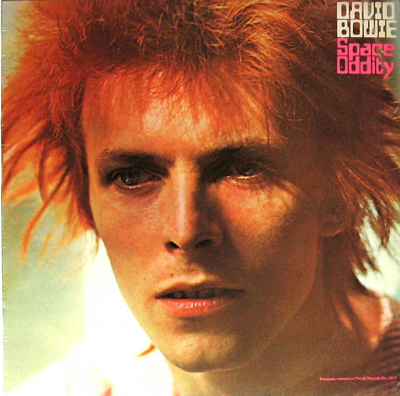
The greatest dream of the era in which Bowie grew up — the promise of putting Man on the Moon — became one of his first signature artistic nightmares. Space Oddity, the most famous track from his eponymous second album, conjured one such scenario, and provided him with his first real hit after the false start of his debut. The earlier album had its moments, but it left unresolved the question of whether the singer wanted to be a fey-voiced Anthony Newley or a strange young man called Dylan.
By the time he recorded his second album — and, especially, his third — Bowie had decided he would be a bit of both. The cover art for 1970’s The Man Who Sold the World presented him elegantly reclining on a chaise longue in a dress. He smoked copious amounts of hash and assembled a crack band for 10 days of whirling Moog synthesizers and hard rock guitars. The experience was so enjoyable and creatively rewarding that bassist Trevor Bolder, guitarist Mick Ronson, and drummer Mick Woodmansey stayed on. The tracks were laid down at a London residence called Haddon Hall, in Beckenham, and it is here that he would write and rehearse the material for his next three albums that would send his career stratospheric.
Commercially, the sex, drugs, and frock ‘n’ roll of The Man Who Sold the World didn’t find much of an audience. It was too heavy, perhaps, for the folk followers he had accrued with its acoustic predecessor. And too gay for rock fans certainly, the singer’s voracious heterosexuality notwithstanding. He followed it a year later with Hunky Dory, which is generally thought to be the record on which the Bowie alchemy first cohered into something truly new. It was also the curtain-raiser for what’s generally regarded as his classic period, and it provided him with his first American hit, “Changes”. More critically, it saw him discard the claustrophobic sound of The Man Who Sold the World for textured melodies, creamy arrangements, seat-of-the-pants lyrics, and further cameos from extraterrestrials.
On Hunky Dory, Bowie also turned in tribute tracks about Lou Reed, Andy Warhol, and Bob Dylan. Warhol hated the song Bowie had written about him. Reed would eventually smack Bowie about the head during an altercation at a London restaurant in April 1979. And when Bowie finally met Dylan, he later told Playboy, they “didn’t have a lot to talk about. We’re not great friends. Actually, I think he hates me.” Small wonder that he preferred the company of spacemen. The razzle-dazzle of “Oh! You Pretty Things” conjures hordes of them. As does “Life on Mars?” which features a chord progression nicked from Frank Sinatra’s “My Way”. The album closes with “The Bewlay Brothers”, in which the 24-year-old singer paid a tribute of sorts to his own step-brother, Terry.
But it was the release of The Rise and Fall of Ziggy Stardust and the Spiders from Mars in 1972 that made David Bowie a superstar. Picking the space songs out of that record is difficult because, by that point, almost everything Bowie was writing seemed to have an explicitly alien streak. During his appearance on Top of the Pops, he draped an arm across Ronson’s shoulders, and glowered out at a world that was about to repay the attention. In the wake of the album’s release, he returned to the United States a sensation (although the stormy flight en route only confirmed his fear of flying).
A generation on, Ziggy Stardust still routinely appears at or near the top of critics’ lists of the all-time greatest rock albums. It is strange to recall then, that in 1972, while it picked up its share of warm reviews, the album was by no means universally well received (the work of a “competent plagiarist”, sniffed Sounds). Some critics never got it. “I always thought all that Ziggy Stardust homo-from-Aldebaran business was a crock of shit,” wrote Lester Bangs in Creem four years later, “especially coming from a guy who wouldn’t even get in a goddam airplane.”
Comments Off on The rise of David Bowie


