
World War Two
Published 5 Aug 2023As the Red Army closes in on Warsaw, the Polish Home Army in the city rises up against the German forces. Up in the north the Red Army takes Kaunas. The Allies take Florence in Italy this week, well, half of it, and in France break out of Normandy and into Brittany. The Allies also finally take Myitkyina in Burma after many weeks of siege, and in the Marianas take Tinian and nearly finish taking Guam. And in Finland the President resigns, which could have serious implications for Finland remaining in the war.
(more…)
August 6, 2023
The Warsaw Uprising Begins! – WW2 – Week 258 – August 5, 1944
Comments Off on The Warsaw Uprising Begins! – WW2 – Week 258 – August 5, 1944
What’s in a (tech) name?
Ted Gioia isn’t a fan of all the recent rebrandings of social media platforms, and tries to explain “why web platforms keep changing their names like criminals in the Witness Protection Program”:

“Automotive Social Media Marketing” by socialautomotive is licensed under CC BY 2.0

When I first heard that Twitter was renaming itself as X, I thought it was a joke.
Not a funny joke, just a goofy one. Elon Musk has a taste for schoolboy humor — and on many occasions has posted something undignified for a laugh. I assumed X was another example of this.
Who could take that name seriously?
Just consider the significations of X:
- The crossbones you put in front of a skull on a bottle of poison;
- A mistake on a test, marked by the teacher in red;
- How you sign your name if you can’t read or write;
- Something you haven’t figured out in algebra;
- A movie that’s dirty, raunchy, or offensive in some manner;
- A mark on a map where stolen wealth has been buried by pirates or criminals;
- The street name for an illegal drug (MDMA) with various adverse long-term effects — including depression, anxiety, and impairments of cognition, memory, and learning;
- A symbol of betrayal (i.e., a double cross);
- In marketing language, an inferior product, as in “Brand X”;
- A radioactive ray so dangerous that it killed the people who invented and developed it.
Given these associations, nobody in their right mind would replace a familiar, proven brand name with X. Mr. Musk must be joking again. Or so I thought.
But I thought wrong.
If this were an isolated event, I would dismiss it as just one more quirk on the part of an eccentric CEO. But these horrible rebrands are now standard practice in Silicon Valley, especially among dominant Internet platforms.
Why did Google change its corporate name to Alphabet? Why did Facebook change its corporate name to Meta? These were two of the best known brand names in the history of capitalism. Why get rid of them?
And consider this bizarre coincidence. The very same month that Twitter became X, Instagram launched its own text posting option. But it refused to use the familiar Instagram name, instead calling this new feature Threads.
Threads is another word that has all sorts of negative connotations. It refers to something old and torn. It’s associated with poverty and an embarrassing appearance.
What gives?
Do you remember the carefree early days of the web? Brand names were innocent and playful — they sounded like something from a nursery rhyme: Yahoo, Google, Tumblr. Twitter was one of those cutesy names.
Its symbol was a chirping bird. So sweet. So innocent.
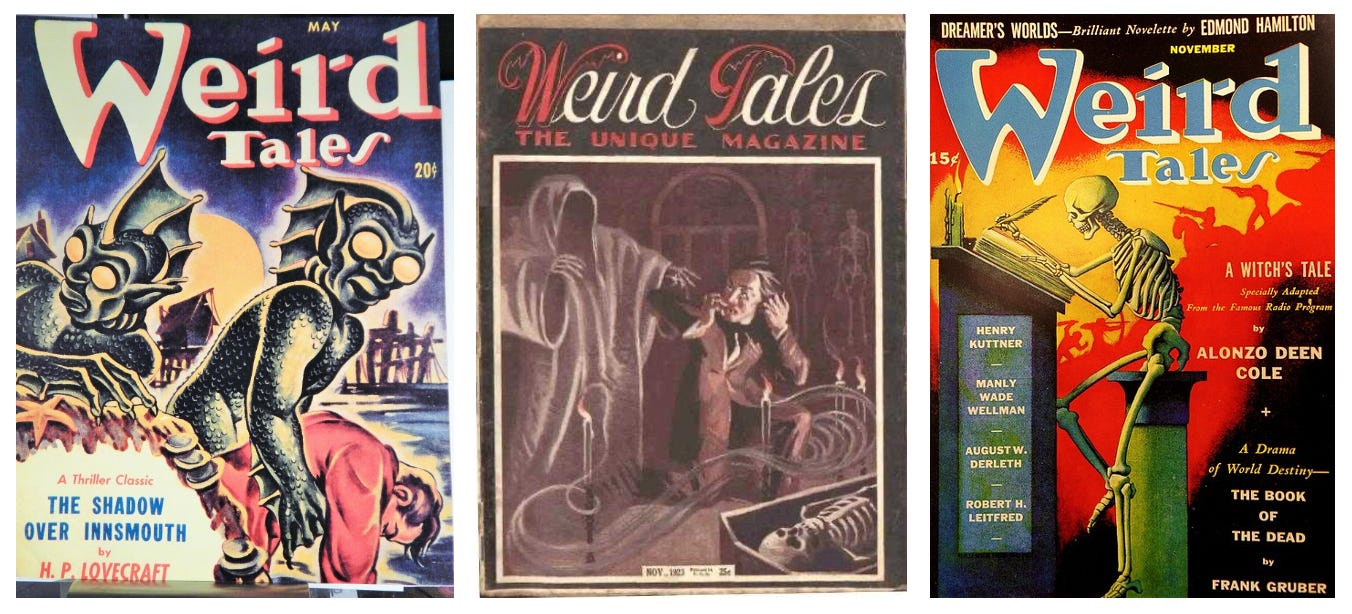
But nowadays, web platforms take on names straight out of an H.P. Lovecraft horror story — Threads, X, Ghost, Twitch, Discord, etc.
Today’s writing prompt: Use all of those words in the opening lines of a story. Then send it off to an editor at Weird Tales.
Current day techno bro vibe
Comments Off on What’s in a (tech) name?
Chaffee Reece Model 1882: A Good Idea on Paper …
Forgotten Weapons
Published 29 Aug 2017Patented in 1879 by Reuben Chaffee and General James Reece, the Chaffee-Reece rifle is an excellent example of how an idea that seems good on paper can easily become untenable in a fielded rifle. The main design premise of the rifle was to have a tubular magazine in the buttstock which held the cartridges out of contact with each other, as opposed to being pressed together by a magazine spring as in a conventional design. This would notionally prevent any possibility of recoil or other forces causing the bullet of our round to impact the primer of another and cause a detonation in the magazine.
In initial testing by the Army in 1882, the prototypes were appealing, and a field trial of 750 rifles was requested. Chaffee and Reece were unable to find a commercial manufacturer willing to take on the production (except Colt, which offered to make just 200, and at the cost of $150 etc), and they ultimately turned to the government-operated Springfield Arsenal to build the guns. A total of 753 rifles were made by Springfield in 1883 and 1884 (interestingly, not serial numbered) and delivered for testing.
That testing went quite badly. The magazine was a very complex system, using two sets of basically reciprocating racks to shuttle cartridges up the magazine as the bolt was cycled, without allowing them to contact each other. It proved very prone to jamming and breakage, and was both extremely difficult to keep clean and very susceptible to, as they would have called it at the time, “derangement”. It was handily beaten by the Winchester Hotchkiss 1885 pattern rifles (among others) in field trials, and that was the end of its potential for adoption. The rifles were eventually sold as surplus, and bought by the Bannerman company, where they remained in stock and available for purchase until at least 1907.
(more…)
Comments Off on Chaffee Reece Model 1882: A Good Idea on Paper …
QotD: Pierre Trudeau’s legacy
I have banged on and on and on, to the annoyance of some of my readers, about how Pierre Elliot Trudeau reshaped Canada, almost entirely, in my considered opinion, for the worse. I have singled out, frequently, his evident distaste for the Canadian military and his very real isolationism and reluctance to have armed forces, at all.
There is a lot of documentation about Pierre Trudeau and his views and attitudes, much of it laudatory, some of it critical. I make no secret of the fact that I assert that one Canadian prime minister (perhaps, in my opinion, Canada best-ever leader) the great Liberal Louis St. Laurent, gave Canada a coherent, principled, liberal, values-based grand strategy in the late 1940s and then, just 20 years later another Liberal, Pierre Trudeau, tore it all down, threw it all aside and imposed new, very illiberal, values on Canada ~ all because, I guess, he could not reconcile the facts that stared him in the face in the late 1940s with his own personal choice to have stood, firmly, on the wrong side of history in 1944 when he elected to continue to study (this time at Harvard) rather than to join in the fight to crush Hitler.
M. St. Laurent and M. Trudeau could not have been more different. Louis St. Laurent was an internationally respected lawyer, he was “a man of the world”, neither an anglophile, like Sir Wildred Laurier, nor an anglophobe like Trudeau, he was secure in being a Canadian. He came to politics reluctantly, as a duty, but he quickly became known to, respected by, and, indeed, often friends with Harry Truman, George Marshal, Dwight Eisenhower and Dean Acheson, with Anthony Eden, Ernest Bevin, Clement Atlee, Sir Winston Churchill and Harold Macmillan, and with Tage Erlander of Sweden, Jawaharlal Nehru and V.K. Krishna Menon in India, Sir Robert Menzies of Australia, Tunku Abdul Rahman in Malaysia and leaders, from the West, the East and the non-aligned states. Pierre Trudeau, on the other hand, was a small, very parochial man who did not, really, understand Canada, beyond French-speaking Québec. He became “famous” for opposing Maurice Duplessis ~ something, I have suggested, that would not be much beyond the intellectual capabilities of a somnolent house cat. He travelled the world but never seemed, to me, to have acquired the respect that was accorded to Louis St. Laurent or Mike Pearson … except, perhaps from Fidel Castro.
Ted Campbell, “Pierre Trudeau’s legacy”, Ted Campbell’s Point of View, 2019-08-02.
Comments Off on QotD: Pierre Trudeau’s legacy
August 5, 2023
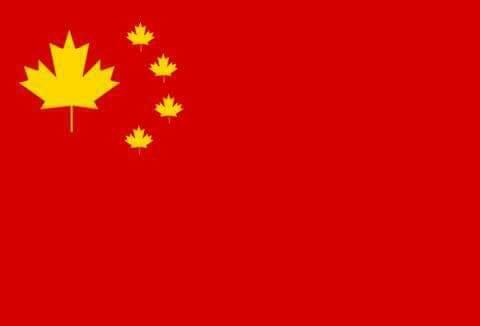
In the “New World Order”, China was expected to become more democratic. Instead, the west is rapidly becoming more like China
N.S. Lyons discusses the unhappy convergence of Communist China with the post-democratic western world, led by the United States:
Differences and tensions between the United States and China have never been greater. The whole world is dividing itself between the blocs of these two opposing superpowers. A new Cold War is dawning, complete with a global ideological “battle between democracy and autocracy“. Freedom is on the line. The future of global governance will be determined by the winner of this extended competition between two fundamentally opposed political and economic systems – unless a hot war settles the question early with a cataclysmic fight to the death, much as liberal democracy once fought off fascism.
This is the simple and easy narrative of our present moment. In some ways it is accurate: a geopolitical competition really is in the process of boiling over into open confrontation. But it’s also fundamentally shallow and misleading: when it comes to the most fundamental political questions, China and the United States are not diverging but converging to become more alike.
In fact, I can already predict and describe the winner set to prevail in this epochal competition between these two fiercely opposed national systems. In this soon-to-be triumphant system …
Despite a rhetorical commitment to egalitarianism and “democracy”, the elite class deeply distrusts and fears the people over whom it rules. These elites have concentrated themselves into a separate oligarchic political body focused on prioritizing and preserving their rule and their own overlapping set of shared interests. Wracked by anxiety, they strive constantly to maximize their control over the masses, rationalizing a need to forcefully maintain stability in the face of dangerous threats, foreign and domestic. Everything is treated as an emergency. “Safety” and “security” have become be the watchwords of the state, and of society generally.
This elite obsession with control is accelerated by a belief in “scientific management”, or the ability to understand, organize, and run all the complex systems of society like a machine, through scientific principles and technologies. The expert knowledge of how to do so is considered the unique and proprietary possession of the elite vanguard. Ideologically, this elite is deeply materialist, and openly hostile to organized religion, which inhibits and resists state control. They view human beings themselves as machines to be programmed, and, believing the common man to be an unpredictable creature too stupid, irrational, and violent to rule himself, they endeavor to steadily condition and replace him with a better model through engineering, whether social or biological. Complex systems of surveillance, propaganda, and coercion are implemented to help firmly nudge (or shove) the common man into line. Communities and cultural traditions that resist this project are dismantled. Harmfully contrary ideas are systematically censored, lest they lead to dangerous exposure. Governing power has been steadily elevated, centralized, and distributed to a technocratic bureaucracy unconstrained by any accountability to the public.
All of this is justified by a utopian ideological dialectic of historical progress and inevitability. Those more in tune with the tide of history (i.e. elite interests) are held to be morally and intellectually superior, as a class, to backwards reactionary elements. Only certain views are stamped “scientific” and “correct,” although these may change on a political whim. An economism that values only the easily quantifiable reigns as the only moral lodestar, and frictionless efficiency is held up as highest common good; the individual is encouraged to fulfill his assigned role as a docile consumer and cog in the regime’s machine, not that of a self-governing citizen. The state regularly acts to stimulate and manage consumer demand, and to strategically regulate and guide industrial production, and the corporate sector has largely fused itself with the state. Cronyism is rampant.
The relentless political messaging and ideological narrative has come to suffuse every sphere of life, and dissent is policed. Culture is largely stagnant. Uprooted, corralled, and hounded, the people are atomized, and social trust is very low. Reality itself often feels obscured and uncertain. Demoralized, some gratefully accept any security offered by the state as a blessing. At the same time, many citizens automatically assume everything the regime says is a lie. Officialdom in general is a Kafkaesque tragi-comedy of the absurd, something only to be stoically endured by normal people. Yet year by year the pressure to conform only continues to be ratcheted higher…
Which country does this describe? If you can’t quite tell, well, that’s the point. For many citizens of the West, the systems of governance under which we live increasingly feel uncomfortably similar to what appears offer in the People’s Republic of China.
Comments Off on In the “New World Order”, China was expected to become more democratic. Instead, the west is rapidly becoming more like China
Tempting Armageddon: Soviet vs. NATO Nuclear Strategy
Real Time History
Published 4 Aug 2023Since the inception of the nuclear bomb, military strategists have tried to figure out how to use them best. During the Cold War, this led to two very different doctrines but on both sides of the Iron Curtain the military wasn’t sure if you could actually win Nuclear War.
(more…)
Comments Off on Tempting Armageddon: Soviet vs. NATO Nuclear Strategy
The Anglo-Scottish “Debatable Lands”
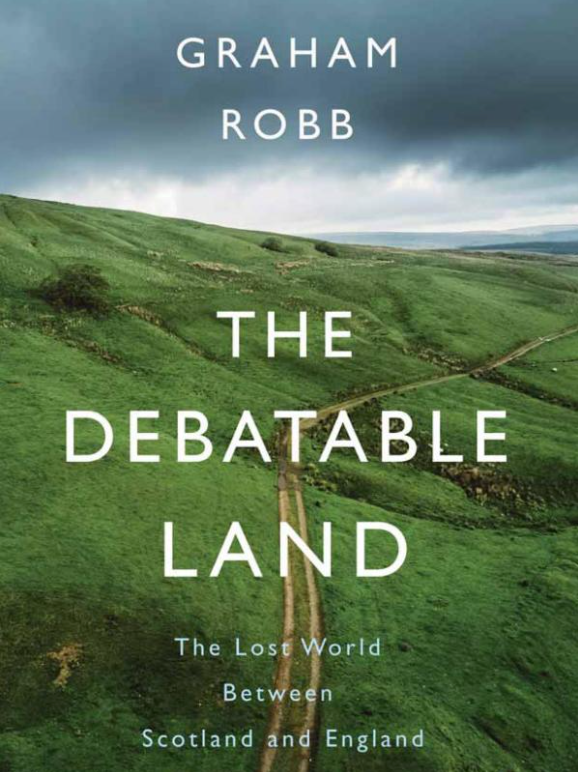
In the visible portion of this post on the history of the Debatable Lands, Ed West considers the differences between national heartlands and the borders:
Border regions tend to be different, something I thought about during the summer before Brexit when we underwent a mammoth trip across five of those six countries (we never got around to Luxembourg, for which apologies). The journey from Alsace to Baden-Württemberg, or Liguria to Provence, brings home how nationality is often a matter of gradations and unnatural boundaries imposed on the whims of bureaucrats in distant capitals – often more alien than supposed foreigners across the border.
But once you leave that tunnel, things are different; there is no ambiguity between Calais and Dover, only ocean. You’re either in England or France. The same is not true of England’s northern frontier, Britain’s great zone of ambiguity, and in particular the area between Carlisle and Langholm which has historically been known as the “Debatable Land” – the subject of Graham Robb’s book.
Robb, an Anglo-Scot who mostly writes about France, moved back to this part of Britain in the 2010s, and describes it with his characteristic style of history, personal narrative and social commentary.
The border people are a unique subset of the English nation, being the last to undergo the pacification of government. Until the Union of Crowns in 1603, the region’s unusual position outside the orbit of either London and Edinburgh helped create a culture that was clannish and marked by violent feuds and cattle rustling.
Among the notorious Borderer clans were the Scotts, Burns and Irvines north of the border, and Fenwicks, Millburns, Charltons and Musgraves on the English side, while some could be found on both, among them the Halls, Nixons and Grahams. Many of these clans were outlaws and some were lawmen; others were both or either, depending on circumstances.
This proto-Wild West produced many characters, and among the famous border reivers of legend were men such as Archie Fire-the-Braes, Buggerback, Davy the Lady, Jok Pott the Bastard, Wynkyng Will, Nebless [noseless] Clem, Fingerless Well and Dog Dyntle [penis] Elliot.
“Debatable Land” most likely comes from batten, common land where livestock could be pastured, and it was this pastoral economy which shaped their psychology: the importance of honour, and a reputation for violence and revenge, as a deterrent against predators.
Violence was so common on the border that there sprung a tradition whereby truces were arranged in return for “blackmail”, a tribute to border chiefs, from the Middle English male, tribute; only in the nineteenth century did this come to mean any sort of extortion.
Another of the Borderers’ contributions to our language is “bereaved”, which is how you felt after the reivers had raided your land (it usually meant to have lost property rather than a loved one). Other local terms were less successful in spreading, such as “scumfishing”, which meant “surrounding a pele tower with a smouldering heap of damp straw and smoking out its inhabitants”, as Robb put it.
Border folk relied heavily on the protection of their clan, and so “for a reiver, the greatest disgrace was not excommunication but ostracism: if a man failed to keep his word, one of his gloves or a picture of his face was stuck on the end of a spear or a sword and paraded around at public meetings. This ‘bauchling’ was considered a punishment worse than death.”
Both the kings of England and Scotland regarded them as a nuisance. In 1525, the Archbishop of Glasgow excommunicated the reivers en masse; Parliamentary decrees issued by authorities in England and Scotland between 1537 and 1551 stated that “all Englishmen and Scottishmen are and shall be free to rob, burn, spoil, slay, murder and destroy, all and every such person and persons, their bodies, property, goods and livestock … without any redress to be made for same”.
In the 1580s the border area remained “verie ticklie and dangerous”. One adviser even urged Elizabeth I to build another Roman wall because he believed the “Romaynes” had built theirs to defend themselves “from the dayly and daungereous incurtyons of the valyaunte barbarous Scottyshe nation”.
Comments Off on The Anglo-Scottish “Debatable Lands”
The rotten luck of the American Orient Express
Train of Thought
Published 5 May 2023In today’s video, we take a look at the American Orient Express, an attempt made by several businesses to replicate the charm and appeal of the real deal that just kept running into bad luck.
(more…)
Comments Off on The rotten luck of the American Orient Express
QotD: Europe
A common European identity therefore has to be forged deliberately and artificially; and one of the imperatives for attempting to do so is the need of Germans for an identity that is not German (the other, which dovetails neatly, is the French drive to recover world power). And since the Germans are very powerful in Europe, by weight of their economy, their need to escape from themselves by absorbing everyone into a new collective identity will sooner or later be perceived in the rest of Europe as the need to impose themselves — as a return to their bad old habits. New identities can indeed be forged, but usually in the crucible of war or at least of social upheaval: not, in the context, an inviting prospect.
Theodore Dalrymple, “The Specters Haunting Dresden”, City Journal, 2005-01
Comments Off on QotD: Europe
August 4, 2023
Tsar Vlad’s biography
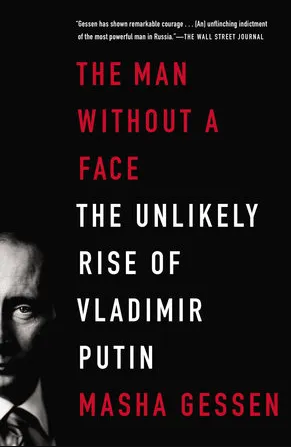
Scott Alexander reviews The Man Without A Face: The Unlikely Rise of Vladimir Putin by Masha Gessen:
Vladimir Putin appeared on Earth fully-formed at the age of nine.
At least this is the opinion of Natalia Gevorkyan, his first authorized biographer. There were plenty of witnesses and records to every post-nine-year-old stage of Putin’s life. Before that, nothing. Gevorkyan thinks he might have been adopted. Putin’s official mother, Maria Putina, was 42 and sickly when he was born. In 1999, a Georgian peasant woman, Vera Putina, claimed to be his real mother, who had given him up for adoption when he was ten. Journalists dutifully investigated and found that a “Vladimir Putin” had been registered at her village’s school, and that a local teacher remembered him as a bright pupil who loved Russian folk tales. What happened to him? Unclear; Artyom Borovik, the investigative journalist pursuing the story, died in a plane crash just before he could publish. Another investigative journalist, Antonio Russo, took up the story, but “his body was found on the edge of a country road … bruised and showed signs of torture, with techniques related to special military services”.
Still, I’m inclined to doubt the adoption theory. Vladimir Putin’s official father, a WWII veteran and factory worker, was also named Vladimir Putin. The adoption story requires that a child named Vladimir Putin was coincidentally adopted by a man also named Vladimir Putin. Far easier to believe that an old Georgian woman had a son who died or was adopted out. Then, when a man with the same name became President of Russia, she assuaged her broken heart by pretending it was the same guy. Records of Putin’s early life are surprisingly sparse. But there are a few photos (admittedly fakeable), and people who aren’t face-blind tell me that Putin looks very much like his official mother.
As for the investigative journalist deaths, it would be more surprising for a Russian investigative journalist of the early 2000s not to die horribly. Both were researching other things about Putin besides his childhood. and had made themselves plenty of enemies. Russo was in Chechnya at the time, another known risk factor for horrible death. I wouldn’t over-update on this.
Still, I found the adoption controversy interesting as a metaphor for everything about Putin. Vladimir Putin really did seem to appear on Earth – or at least in the corridors of power in Russia – fully formed. At each step in his career, he was promoted for no particular reason, or because he seemed so devoid of personality that nobody could imagine him causing trouble. This culminated in his 2000 appointment as Yeltsin’s successor when “The world’s largest landmass, a land of oil, gas, and nuclear arms, had a new leader, and its business and political elites had no idea who he was.”
My source for this quote is The Man Without A Face: The Unlikely Rise Of Vladimir Putin by Masha Gessen, a rare surviving Russian investigative journalist. As always in Dictator Book Club, we’ll go through the story first, then discuss if there are any implications for other countries trying to avoid dictatorship.
Comments Off on Tsar Vlad’s biography
Vivek Ramaswamy as “Trump 2.0”
Bari Weiss considers Vivek Ramaswamy as an improved version of Donald Trump, appealing to a similar audience but with less obvious baggage. Here are some excerpts from her recent interview with Ramaswamy:
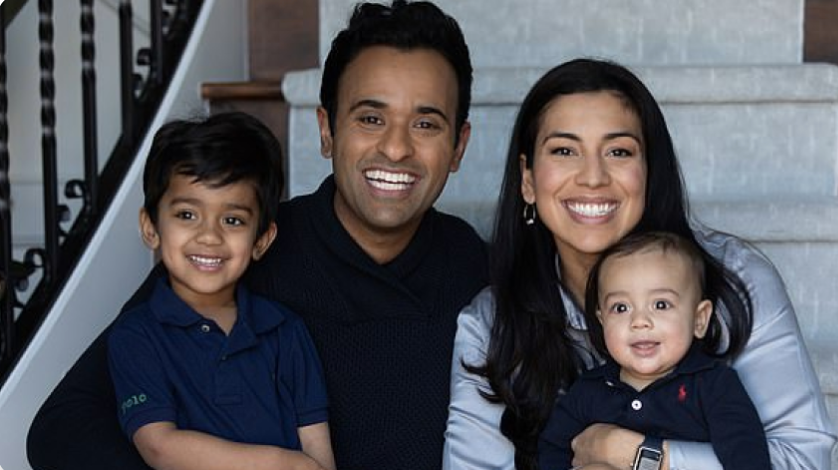
Vivek Ramaswamy and his family.
Detail of a photo from his campaign website, https://www.vivekramaswamy.com/
BW: Politics is all about storytelling, and the winning candidate — or the candidate that catches fire — is almost always the one with the best story. What is your story, and why is it the story that Americans are craving right now?
VR: Whether Americans are craving it or not, that’ll be for them to decide. But I’ll tell you what my story is. I’m the embodiment of the American dream. My parents came to this country over 40 years ago with almost no money. I’ve gone on to found multibillion-dollar companies that created value by doing valuable things for other people, developing five medicines that are FDA approved today. One of them is a life-saving therapy for kids, another one for prostate cancer. I did it while getting married, while bringing two sons into this world, while following my faith in God, while growing up with the ultimate privilege in this country. And I think the thing that’s extraordinary about that story is that it isn’t extraordinary. It is the story of this country. And I don’t think we’re in decline. I think we are still a nation in our ascent, in the early stages of our ascent actually, a nation whose best days are still ahead. I think it takes someone in my shoes to see our nation that way, too. That’s truly what pulled me into the race.
BW: There’s a lot of people running on a reformist platform. You’re running on a radical or a revolutionary one. You say America needs a second revolution. Many people hear revolution, and they think bloodshed and violence. What do you mean by that, and what does that revolution look like?
VR: To me, it does not mean bloodshed and violence, but it means a revival of the ideals that set this nation into motion in 1776. I do think we live in a 1776 moment. I think that the American bargain was built on the idea that we, the people, determine how we settle our political differences through free speech and open debate in the public square where every person’s voice and vote counts equally. That is self-governance. And I think that there is the Old World vision now rearing its head in multiple forms that says, no, we the people cannot be trusted. The citizens of a nation cannot be trusted to determine what’s actually good for them — so we, the intelligentsia, must make that determination centrally at large. I stand on the side of the American Revolution, the ideals that birthed this nation. I think we live in a moment where we have to confront those radical ideals. I think that the American ideals are very fundamentally radical ideals: self-governance, free speech, like absolute free speech, the idea that you get ahead through unbridled meritocracy, the unbridled pursuit of excellence, the steadfast commitment to the rule of law rather than the whims of men. These are radical ideals, because for most of human history, it was done the other way. I think it is the radicalism of the American Revolution and those ideals that are our last best chance for national unity, because that is what actually binds us together across our diverse attributes. And without embracing that radicalism, I think we’re nothing.
BW: You’re incredibly entertaining. You have a view on everything. You’re a phenomenal talker, which will take you far. And remarkably, as of the latest polls, you’re third behind Trump and DeSantis. But many commentators say that ultimately, you have no shot at the nomination. Why is that conventional wisdom wrong about you?
VR: Everyone seems to be shocked where I am right now. I’m not surprised. This is exactly where we expected to be. The reality is, I think people are hungry for the unfiltered truth. I would rather speak the truth about my own beliefs at every step and lose the election than to play some political Snakes and Ladders. And I believe that our voters across this country have a good sixth sense for being able to tell the difference for somebody who’s actually sharing their true beliefs versus somebody who’s giving them carefully constructed, poll-tested slogans. And that is the competitive advantage. My gut instinct is we’re going to win this election. We’re going to win it in a landslide of a margin similar to what Reagan delivered in 1980.
BW: So you’re going to be the Obama of this race, not the Andrew Yang?
VR: I’m going to be the Vivek Ramaswamy of this race, and that’s what I’m committed to being.
At 7% in the polls at the moment, Ramaswamy is a long-shot to win the Republican nomination, but you’ll know if his chances are improving when the media slow-walks the Bad Orange Man stories and starts criticizing Ramaswamy (or “Bad Curry Man” as some online wits have dubbed him).
Comments Off on Vivek Ramaswamy as “Trump 2.0”
What Does A Smoothing Plane Do? | Paul Sellers
Paul Sellers
Published 7 Apr 2023We live in an age when fewer and fewer people will ever use a hand plane and may never even see one in use. This super-short video shows how and why we woodworkers still use and rely on hand planes today. They are fast and effective and they reduce the need for sandpaper too because the wood comes out super-smooth and level.
(more…)
Comments Off on What Does A Smoothing Plane Do? | Paul Sellers
QotD: The “knowledge base” problem in teaching history
The point is this: Even if I were an expert in that particular field (I’m not; as with Sovietology, I’m a gentleman amateur), there are zillions of people who know more of the details than I do. It seems like half the Internet can reel off, from memory, the entire command structure of the 6th Volksgrenadier regiment. Teach a “Modern Europe” class, and you’re guaranteed to have at least one of them among the studentry. Knowledge, in that sense, is over-supplied.
It’s over-supplied in another way, too. There have been tremendous recent advances in the study of, say, the Roman Empire. Computer modeling of seed-distribution patterns and asdzlsjdfjkha … sorry, my head hit the keyboard, I can’t stay awake for this stuff, but I’m sure glad someone can, because it’s important. As I understand it, there have been revolutions even in older fields like numismatics and epigraphy — you can learn a lot from coins and inscriptions, and they’re changing our understanding of some fundamental stuff (see e.g. Roman coins in Japan).
But knowledge is also under-supplied, especially from the teachers’ side. Not just “knowledge of human nature”, above, though of course that’s a biggie. Here’s a far from exhaustive list of what I was NOT taught in graduate school:
- economics
- military strategy
- ecology
- agriculture
- logistics
- Western languages
- non-Western languages
and so on. Now, some of these you’re supposed to have supplied yourself (e.g. the languages, provided you don’t need them for your specialty, and at one time I could muddle through a few), but nobody checks. Obviously nobody checks when it comes to economics, because everyone in the Biz is a Marxist, and sentence one of page one of any basic economics textbook should read “Marxism is a comprehensive crock of horseshit”, but it works that way for all the others, too. Considering that “farming” and “fighting” are two of the Three F’s that comprise “what almost all humans did, all the time, for all of recorded history”, those are some pretty goddamn big oversights … you know, if actually knowing how humans do is the point.1
Severian, “How to Teach History”, Rotten Chestnuts, 2020-12-23.
1. the third F, for the record, is “fucking”, and like the languages, you’re supposed to have acquired a working knowledge of that on your own before you arrive. Alas, that obviously didn’t work out as planned. The 40 Year Old Virgin wasn’t supposed to be a documentary, but it’s pretty much cinéma vérité in your average graduate program. Trust me: The persyn with bespoke pronouns has them because xzhey have absolutely no idea what to do with their naughty bits. When I say that a night on the town with a sailor on shore leave would cure most of these … organisms … of the majority of their problems, I mean it. Getting eggheads blued, screwed, and tattooed wouldn’t save America, but it would be a damn good start.
August 3, 2023
Behind Japanese lines in Burma – SOE and Karen tribal guerillas in 1944/45
Bill Lyman outlines one of the significant factors assisting General Slim’s XIVth Army to recapture Burma from the Japanese during late 1944 and early 1945:
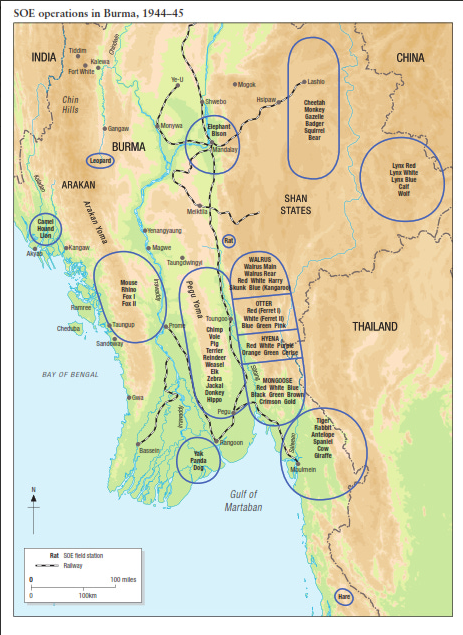
If Lieutenant General Sir Bill Slim (he had been knighted by General Archibald Wavell, the Viceroy, the previous October, at Imphal) had been asked in January 1945 to describe the situation in Burma at the onset of the next monsoon period in May, I do not believe that in his wildest imaginings he could have conceived that the whole of Burma would be about to fall into his hands. After all, his army wasn’t yet fully across the Chindwin. Nearly 800 miles of tough country with few roads lay before him, not least the entire Burma Area Army under a new commander, General Kimura. The Arakanese coastline needed to be captured too, to allow aircraft to use the vital airfields at Akyab as a stepping stone to Rangoon. Likewise, I’m not sure that he would have imagined that a primary reason for the success of his Army was the work of 12,000 native levies from the Karen Hills, under the leadership of SOE, whose guerrilla activities prevented the Japanese from reaching, reinforcing and defending the key town of Toungoo on the Sittang river. It was the loss of this town, more than any other, which handed Burma to Slim on a plate, and it was SOE and their native Karen guerrillas which made it all possible.
In January 1945 Slim was given operational responsibility for Force 136 (i.e. Special Operations Executive, or SOE). It had operated in front of 20 Indian Division along the Chindwin between 1943 and early 1944 and did sterling work reporting on Japanese activity facing 4 Corps. Persuaded that similar groups working among the Karens in Burma’s eastern hills – an area known as the Karenni States – could achieve significant support for a land offensive in Burma, Slim authorised an operation to the Karens. Its task was not merely to undertake intelligence missions watching the road and railways between Mandalay and Rangoon, but to determine whether they would fight. If the Karens were prepared to do so, SOE would be responsible for training and organising them as armed groups able to deliver battlefield intelligence directly in support of the advancing 14 Army. In fact, the resulting operation – Character – was so spectacularly successful that it far outweighed what had been achieved by Operation Thursday the previous year in terms of its impact on the course of military operations in pursuit of the strategy to defeat the Japanese in the whole of Burma. It has been strangely forgotten, or ignored, by most historians ever since, drowned out perhaps by the noise made by the drama and heroism of Thursday, the second Chindit expedition. Over the course of Slim’s advance in 1945 some 2,000 British, Indian and Burmese officers and soldiers, along with 1,430 tons of supplies, were dropped into Burma for the purposes of providing intelligence about the Japanese that would be useful for the fighting formations of 14 Army, as well as undertaking limited guerrilla operations. As Richard Duckett has observed, this found SOE operating not merely as intelligence gatherers in the traditional sense, but as Special Forces with a defined military mission as part of conventional operations linked directly to a military strategic outcome. For Operation Character specifically, about 110 British officers and NCOs and over 100 men of all Burmese ethnicities, dominated interestingly by Burmans mobilised as many as 12,000 Karens over an area of 7,000 square miles to the anti-Japanese cause. Some 3,000 weapons were dropped into the Karenni States. Operating in five distinct groups (“Walrus”, “Ferret”, “Otter”, “Mongoose” and “Hyena”) the Karen irregulars trained and led by Force 136, waited the moment when 14 Army instructed them to attack.
Between 30 March and 10 April 1945 14 Army drove hard for Rangoon after its victories at Mandalay and Meiktila, with Lt General Frank Messervy’s 4 Indian Corps in the van. Pyawbe saw the first battle of 14 Army’s drive to Rangoon, and it proved as decisive in 1945 as the Japanese attack on Prome had been in 1942. Otherwise strong Japanese defensive positions around the town with limited capability for counter attack meant that the Japanese were sitting targets for Allied tanks, artillery and airpower. Messervy’s plan was simple: to bypass the defended points that lay before Pyawbe, allowing them to be dealt with by subsequent attack from the air, and surround Pyawbe from all points of the compass by 17 Indian Division before squeezing it like a lemon with his tanks and artillery. With nowhere to go, and with no effective means to counter-attack, the Japanese were exterminated bunker by bunker by the Shermans of 255 Tank Brigade, now slick with the experience of battle gained at Meiktila. Infantry, armour and aircraft cleared General Honda’s primary blocking point before Toungoo with coordinated precision. This single battle, which killed over 1,000 Japanese, entirely removed Honda’s ability to prevent 4 Corps from exploiting the road to Toungoo. Messervy grasped the opportunity, leapfrogging 5 Indian Division (the vanguard of the advance comprising an armoured regiment and armoured reconnaissance group from 255 Tank Brigade) southwards, capturing Shwemyo on 16 April, Pyinmana on 19 April and Lewe on 21 April. Toungoo was the immediate target, attractive because it boasted three airfields, from where No 224 Group could provide air support to Operation Dracula, the planned amphibious attack against Rangoon. Messervy drove his armour on, reaching Toungoo, much to the surprise of the Japanese, the following day. After three days of fighting, supported by heavy attack from the air by B24 Liberators, the town and its airfields fell to Messervy. On the very day of its capture, 100 C47s and C46 Commando transports landed the air transportable elements of 17 Indian Division to join their armoured comrades. They now took the lead from 5 Indian Division, accompanied by 255 Tank Brigade, for whom rations in their supporting vehicles had had been substituted for petrol, pressing on via Pegu to Rangoon.
Comments Off on Behind Japanese lines in Burma – SOE and Karen tribal guerillas in 1944/45
“Tech giants” obey the law and block access to Canadian news sites to Canadian users
For some reason — despite a clamour of warnings from sensible observers — the Canadian government still seems shocked and surprised that the much-reviled “tech giants” have chosen to obey the new Online News Act and are actively blocking links to Canadian media outlets just as the law requires:

For months, supporters of Bill C-18, the Online News Act, assured the government that Meta and Google were bluffing when they warned that a bill based on mandated payments for links was unworkable and they would comply with it by removing links to news from their platforms. However, what has been readily apparent for months became reality yesterday: Meta is now actively blocking news links and sharing on its Facebook and Instagram platforms. The announcement does not reference Threads, but it would not surprise if news links are ultimately blocked on that platform as well. The company says that the blocking will take several weeks to fully roll out to all users, suggesting that it has learned from the over-blocking mistakes made in Australia and is proceeding more cautiously in Canada. By the end of the month, the world’s largest social media platform will become a news desert in Canada, with links to all news – both Canadian and foreign – blocked on the platform.
It is worth revisiting that it was only a couple of months ago that some industry leaders, lobbyists, and academics were assuring the Senate that the Meta threat was just a bluff. Kevin Desjardins of the Canadian Association of Broadcasters, referenced the Australian experience, and told the Senate committee studying the bill that “when legislated to do so, they will come to the table”. Sylvain Poisson of Hebdos Quebec confidently said “they made those threats in Australia and elsewhere and every time they back down”. Chris Pedigo of the U.S.-based Digital Context Next assured the committee “it’s important to understand what happens when these bills become law. In Australia, they moved quickly to secure deals. They have done similar work in Europe, and I expect it would happen quickly in Canada as well.” And Carleton professor Dwayne Winseck said “I am not worried. The threats they are making, they are doing this all around the world.”
Despite the assurances, the company was true to its word and blocking news links is now here. If this is a negotiation tactic, it’s a pretty strange one given that reports indicate the company is not talking to the government about potential changes to a law that has already received royal assent. Indeed, while the new Heritage Minister Pascale St-Onge urged the company to participate in the regulatory process, there is nothing in the regulations that could alter the fundamental principle in the bill of mandated payments for links. At best, the government could toss aside its commitment to stay out of negotiations by using the regulations to dictate to the supposedly independent CRTC how much needs to be spent in order to avoid Bill C-18’s final offer arbitration provisions. Government negotiating total payment value and eviscerating the CRTC’s independence does not inspire confidence and Meta reasonably wants no part of it, since the time to fix Bill C-18 was before it received royal assent, not after.
Bolded section mine: I didn’t realize that it wasn’t just Canadian media links that were being blocked … it’s all news sites in the world being hidden from Canadian users. That’s an escalation from what I’d originally understood. I don’t blame the “tech giants” at all, but it will be tough on older Canadians who’ve been depending on social media to keep them up-to-date on domestic and foreign news.
Comments Off on “Tech giants” obey the law and block access to Canadian news sites to Canadian users


