Most men get over the strippers-and-sports-cars overreaction pretty quickly, generally to be replaced by a new outlook on life. The guys who have come through the midlife crisis are generally a lot better people — more focused, more outgoing, far less materialistic — because they’ve taken up, however briefly, the perspective of Eternity. If you’re religious, you wonder if you’ll merit heaven. If you’re not, you wonder how you’ll be remembered. Either way, you start thinking about the kind of world you want to leave behind you, and what you’re going to do to achieve it with whatever time is left to you.
Which is why I’ve found the COVID overreaction so bizarre. Realizing your own mortality changes things. You can always tell, for instance, when it has happened to a younger person — when they come home, combat vets often act like middle-aged men going through a midlife crisis. Readjustment to civilian life is hard. Read the great war narratives, and it’s clear that none of them ever really “got over it”. Robert Graves and Ernst Junger, for instance, both lived to ripe old ages (90 and 103, respectively), and were titans in fields far removed from battle … and yet, the war WAS their lives, in some way we who haven’t been through it will never understand, and it comes through in every line they wrote.
If the Covidians were really freaking out about COVID, then, I’d expect one of two broad types of reaction: Either party-hearty midlife crisis mode, or a new determination to get on with whatever’s left of life. Obviously neither of those are true, and I just can’t grasp it — these might be your last few weeks on Earth, and that’s how you’re going to spend them? Sitting in your apartment like a sheep, wearing a mask and eating takeout, glued to a computer screen?
If you want a measure of just how feminized our society has become, there you go. Call this misogyny if you must, but it’s an easily observed fact of human nature — indeed, it has been observed, in every time, place, and culture of which we have knowledge — that post-menopausal women go a bit batty. Though a man might know for certain that he dies tomorrow, he can still keep plugging away today, because he’s programmed to find real meaning in his “work” — we are, after all, running our snazzy new mental software over kludgy old caveman hardware.
Women aren’t like that. They have one “job”, just one, and when they can’t do it anymore, they get weird. In much the same way high-end sports cars would cease to exist if middle aged men ceased to exist, so there are entire aspects of culture that don’t make sense in any other way except: These are channels for the energies of post-menopausal, and therefore surplus-to-requirements, women. You could go so far as to say that pretty much everything we call culture — traditions, history, customs — exist for that reason. Women go from being the bearers, to being the custodians, of the tribe’s future.
Severian, “Life’s Back Nine”, Rotten Chestnuts, 2021-05-11.
April 17, 2024
QotD: The mid-life crisis, male and female versions
April 16, 2024
Gabriele D’Annunzio’s Impresa – the 1919 occupation of Fiume
Ned Donovan on the turbulent history of the Adriatic port of Fiume (today the Croatian city of Rijeka) after the end of the First World War:
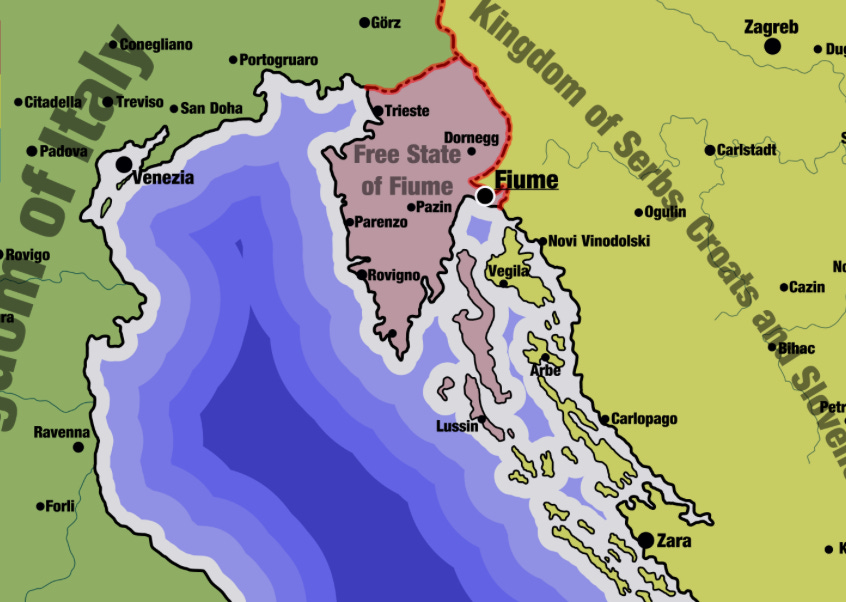
Fiume was a port on the Adriatic coast with several thousand residents, almost half of whom were ethnic Italians that had been under Austro-Hungarian rule for several hundred years after it once having been a Venetian trade port. By some quirk, Fiume was missed in the Treaty of London, probably because it had never been envisioned by the Allies that the Austro-Hungarian Empire would ever truly disintegrate and the rump of it that would remain required a sea port in some form. The city’s other residents were ethnically Serbian and Croatian, who knew the city as Rijeka (as you will find it named on a map today). All of this complexity meant that the fate of Fiume became a major topic of controversy during the Versailles Peace Conference. President Woodrow Wilson had become so unsure of what to do that he proposed the place become a free city and the headquarters of the nascent League of Nations, under the jurisdiction of no country.
By September 1919 there was still no conclusion as to the fate of Fiume. Events had overtaken the place and through the Treaty of St Germain, the Austro-Hungarian Empire had been dissolved after the abdication of the final Habsburg Emperor Charles I. Once again, Fiume had not been mentioned in the treaty and the country it had been set aside for no longer existed. The city’s fate was still at play.
Enter Gabriele D’Annunzio, an aristocrat from Abruzzo on the eastern coast of Italy. Born in 1863, he was a handsome and intelligent child and was nurtured by his family to be exceptional, with a predictable side effect of immense selfishness. As a teenager, he had begun to dabble in poetry and it was praised by authors unaware of his age. At university he began to be associated with Italian irredentism, a philosophy that yearned for all ethnic Italians to live in one country – by retaking places under foreign rule like Corsica, Malta, Dalmatia and even Nice.
[…]
The Italian government’s lack of interest [in Fiume] was unacceptable to D’Annunzio and he made clear he would take action to prevent it becoming part of Yugoslavia by default. With his fame and pedigree he was able to quickly assemble a small private force of ex-soldiers, who he quickly took to calling his “legionaries”. In September 1919 after the Treaty of St Germain was signed, his small legion of a few hundred marched from near Venice to Fiume in what they called the Impresa – the Enterprise. By the time he had reached Fiume, the “army” numbered in the thousands, the vanguard crying “Fiume or Death” with D’Annunzio at its head in a red Fiat.
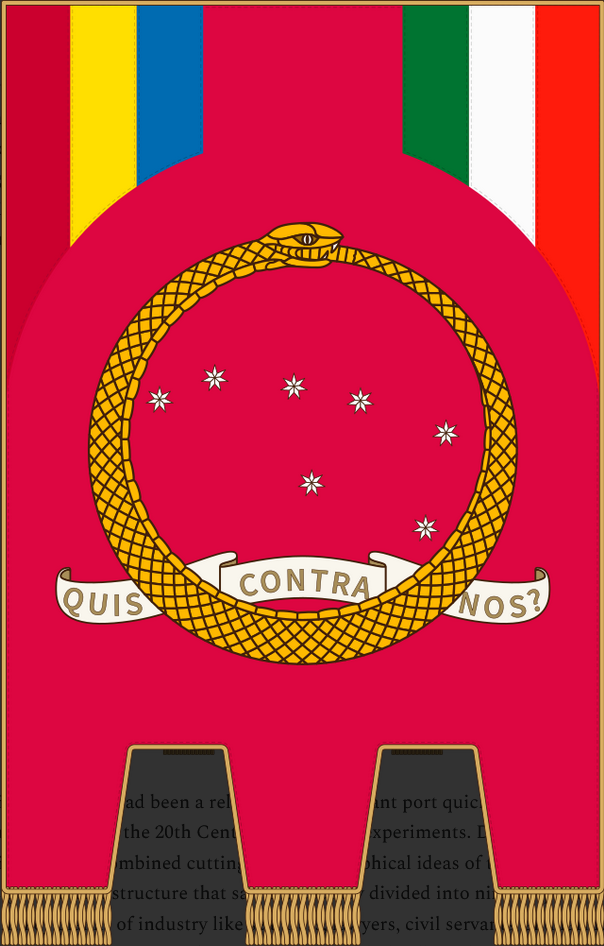
A flag designed by Gabriele D’Annunzio for the would-be independent state of Fiume, 1919.
The only thing that stood in his way was the garrison of the Entente, soldiers who had been given orders to prevent D’Annunzio’s invasion by any means necessary. But amongst the garrison’s leaders were many [Italian officers] sympathetic to D’Annunzio’s vision, some even artists themselves and before long most of the defenders had deserted to join the poet’s army. On the 12th September 1919, Gabriele D’Annunzio proclaimed that he had annexed Fiume to the Kingdom of Italy as the “Regency of Carnaro” – of which he was the Regent. The Italian government was thoroughly unimpressed and refused to recognise their newest purported land, demanding the plotters give up. Instead, D’Annunzio took matters into his own hands and set up a government and designed a flag (to the right).
The citizens of what had been a relatively unimportant port quickly found themselves in the midst of one of the 20th Century’s strangest experiments. D’Annunzio instituted a constitution that combined cutting-edge philosophical ideas of the time with a curious government structure that saw the country divided into nine corporations to represent key planks of industry like seafarers, lawyers, civil servants, and farmers. There was a 10th corporation that existed only symbolically and represented who D’Annunzio called the “Supermen” and was reserved largely for him and his fellow poets.
These corporations selected members for a state council, which was joined by “The Council of the Best” and made up of local councillors elected under universal suffrage. Together these institutions were instructed to carry out a radical agenda that sought an ideal society of industry and creativity. From all over the world, famous intellectuals and oddities migrated to Fiume. One of D’Annunzio’s closest advisers was the Italian pilot Guido Keller, who was named the new country’s first “Secretary of Action” – the first action he took was to institute nationwide yoga classes which he sometimes led in the nude and encouraged all to join. When not teaching yoga, Keller would often sleep in a tree in Fiume with his semi-tame pet eagle and at least one romantic partner.
If citizens weren’t interested in yoga, they could take up karate taught by the Japanese poet Harukichi Shimoi, who had translated Dante’s works into Japanese. Shimoi, who quickly became known to the government of Fiume as “Comrade Samurai” was a keen believer in Fiume’s vision and saw it as the closest the modern world had come to putting into practice the old Japanese art of Bushido.
The whole thing would have felt like a fever dream to an outsider. If a tourist was to visit the city, they would have found foreign spies from across the world checking into hotels and rubbing shoulders with members of the Irish republican movement while others did copious amounts of cocaine, another national pastime in Fiume. The most fashionable residents of Fiume carried little gold containers of the powder, and D’Annunzio himself was said to have a voracious habit for it. Sex was everywhere one turned and the city had seen a huge inward migration of prostitutes and pimps within days of D’Annunzio’s arrival. Almost every day was a festival, and it was an odd evening if the harbour of Fiume did not see dozens of fireworks burst above it, watched on by D’Annunzio’s uniformed paramilitaries.
D’Annunzio himself lived in a palace overlooking the city, Osbert Sitwell describes walking up a steep hill to a Renaissance-style square palazzo which inside was filled with plaster flowerpots the poet had installed and planted with palms and cacti. D’Annunzio would cloister himself in his rooms for 18 hours a day and without food. Immaculate guards hid amongst the shrubs to ensure he would not be disturbed. In D’Annunzio’s study, facing the sea, he sat with statutes of saints and with French windows onto the state balcony. When he wanted to interact with his people he would wait for a crowd to form over some issue, walk to the balcony and then ask what they wanted.
For you, is no autobahn
eugyppius on the German federal government’s latest brainstorm to achieve their mandated emissions targets:
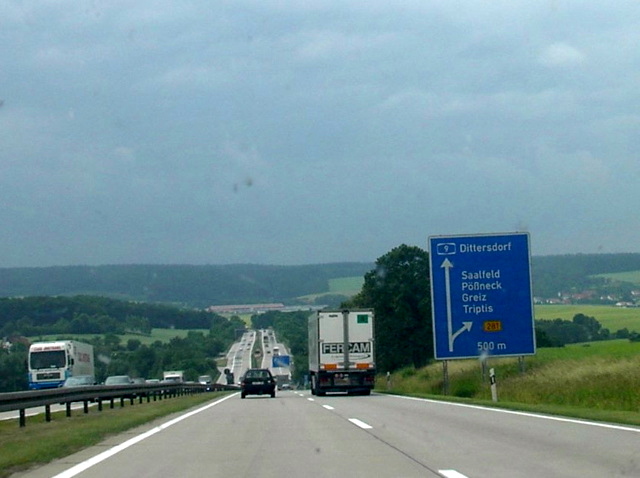
“Old Autobahn” by en:User:DF08 is licensed under CC BY-SA 3.0 

 .
.
… despite the headlines, they are not going to take away our cars. Amazingly, not even the Greens want to do that. For once the story is not about German authoritarianism, or woke insanity or anything like that. Rather, it’s about how nobody can really bring himself to care about the climate anymore – not even our forward-thinking, progressively minded, environmentally responsible political establishment.
For the backstory, we must go all the way back to the pre-Covid era, when aggressive climate legislation was popular even with centre-right CDU voters, and before the electorate had a taste of what Green policies like the draconian home heating ordinances really feel like on the ground.
Back in those halcyon days, when the child saint Greta Thunberg was cutting class to save the earth, Angela Merkel’s government passed the Climate Protection Act. The law mandates a 65% reduction in CO2 emissions compared to 1990 levels by 2030, an 88% reduction by 2040, and an utterly unrealisable carbon neutrality by 2045. In the near term, the Climate Protection Act also establishes maximum annual emissions levels for various economic sectors. Should a given sector exceed its maximum, the responsible Ministry must submit an ominous “action programme” to bring things back on target.
The Climate Protection Act is archetypal climate nonsense. Politicians like to take credit for Doing Something about the climate, but because Doing Something amounts to massive economic restrictions and drastic interventions in daily life, they would prefer not to Do that Something themselves. Far better is to pass legislation committing future governments to Do Something and let them deal with the mess. Then you can reap the short-term rewards of being tough on carbon emissions, without bearing direct responsibility for all the chaos that actually being tough on carbon emissions would unleash. Alas, time marches forwards at a steady pace. I am sure that 2030 sounded like an unimaginably distant date when it was floated at the Paris Accords in 2015, but now it is a mere six years away. That is becoming a big, big problem for the climatists.
You could say that Merkel’s Climate Protection Act bequeathed the hapless Scholz government a small collection of ticking time bombs, which they’ve developed a considerable interest in defusing. One way to do this, is to revise the Climate Protection Act and remove its strict sector-based emissions limits before anybody is forced to field a climate-saving “action programme”. In the meantime, they’ve been studiously ignoring the requirements, which is why our Minister of Economic Destruction Robert Habeck could be found complaining back in June that no cabinet ministers were complying with Climate Protection Act emissions limits.
QotD: Binding and non-binding rules
An omniscient being would be foolish to bind itself to rules.
When we adopt a rule, we wisely admit our ignorance. For a clever assistant professor or ambitious politician to then describe situations in which violating this or that rule will make the world a better place is to achieve absolutely nothing. Although such descriptions often appear to be ingenious discoveries of means for improving the human condition, such descriptions are nearly always nothing but trite demonstrations that if we knew what we do not and cannot know, then acting in disregard of the rule would bring about a state of affairs better than the state of affairs that would be brought about by following the rule.
Well duh.
As a rule, whenever you encounter someone peddling a scheme for improving the world by giving the state discretion to act in violation of well-established rules – for example, to make workers better off by blocking the operation of the price system with minimum wages, or to enrich residents of the domestic economy by substituting free trade with “strategic trade policies” or “optimal tariffs” – recognize that these scheme peddlers arrogantly assume that they or those who will carry out their schemes possess knowledge and information that human beings, as a rule, do not and cannot possibly ever possess.
Don Boudreaux, “Quotation of the Day…”, Café Hayek, 2019-08-20.
April 15, 2024
El Salvador’s approach to fighting serious crime draws gasps of horror from NGOs
In Niccolo Soldo‘s weekend collection of links, he devotes some attention to the amazing success of El Salvador’s current government in driving down the murder rate and why it’s causing much pearl-clutching and dives for the fainting couches among the transnational “elites” and their media handmaidens:
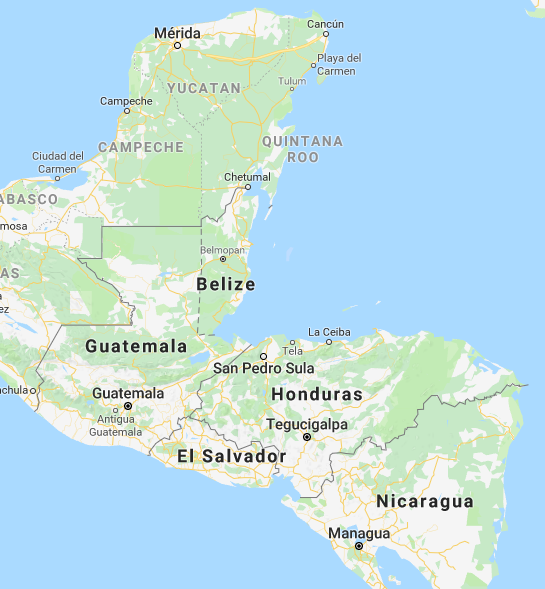
Honduras, Guatemala and El Salvador
Image via Google Maps.
We are bombarded daily with news of mass/random shootings, subway stabbings, and so on. Many of the perpetrators of these violent acts are repeat offenders who for some reason or another (politics) are allowed to roam the streets and attack innocent bystanders. The effect of these lax policies on law and order is the condition known as “anarcho-tyranny” i.e. where the state permits random acts of violence while offering/permitting no solution/resolution … until it has no option but to try and do so.
In NYC, the National Guard is now patrolling the subway. This is a band-aid solution for a problem that was largely fixed already via the policy known as “stop and frisk”. This policy was deemed “racist”, so it had to end. The price of ending this successful policy was a bit of the ol’ anarcho-tyranny. The conflict between rights and law and order continues unabated for the foreseeable future, at least in the USA.
El Salvador has taken a different approach. Since taking office, President Bukele has arrested some 77,000 gang members, locking them up in prisons throughout the country. In one fell swoop, its notoriously high homicide rate has collapsed. Bukele’s law and order policy has resolved El Salvador’s internal security issue … but at what cost? Western media and human rights NGOs insist that the cost has been El Salvador’s democracy:
Under President Nayib Bukele, El Salvador has experienced one of the most spectacular declines in violent crime in recent memory, anywhere in the world. Despite ranking among the most dangerous countries on the planet a mere decade ago, the Central American state today boasts a homicide rate of only 2.4 per 100,000 people — the lowest of any country in the Western Hemisphere other than Canada.
El Salvador owes much of its dramatic drop in crime to Bukele’s crackdown on street gangs and criminal organizations, including MS-13 and Barrio 18. Although homicide rates were trending downward before Bukele took office in 2019, violent crime declined sharply after March 2022, when his government declared a state of emergency following a spike in murders, allowing the government to suspend basic civil liberties and mobilize the armed forces to carry out mass arrests. This state of exception granted Bukele’s administration a blank check to fight gangs and detain suspects without consideration for transparency, due process, or human rights.
Bukele is wildly popular at home, and his policy is now gaining currency elsewhere in Latin America:
Bukele’s iron-fist measures and their apparent results have not only made him wildly popular in his country — earning him a landslide reelection in February 2024 — but also captured the imagination of politicians elsewhere grappling with rapidly deteriorating public safety. Members of the political elite in other states are now toying with the so-called Bukele model. In Ecuador, for instance, President Daniel Noboa has unabashedly followed in Bukele’s footsteps in response to prison riots and a major surge in homicides, declaring a state of emergency in January that gave the armed forces free rein to detain suspects and to take over control of the country’s prisons. The Bukele-style security measures appear to be succeeding there, as well: a little over a month into the crackdown, the government reported that the daily average of homicides had fallen from 28 to six. The fact that militarized public safety campaigns are proving effective outside El Salvador has only enhanced the model’s growing appeal across Latin America, which has long suffered the highest rate of violence of any region in the world.
Here’s the part where the author lodges his protest, and suggests alternative models:
But as appealing as a Bukele-style crackdown might seem, these punitive campaigns against organized crime come at a serious cost to democracy and human rights. These measures concentrate power in the hands of the executive, chipping away at other democratic institutions, such as Congress and the judiciary, that are critical bulwarks against governmental abuse. They also fail to solve the underlying problems, such as corruption and impunity, that generate such violence and instability in the first place.
There are alternatives to the Bukele model for reducing crime. In cities in Brazil, Colombia, and Mexico, politicians have managed to decrease homicides without eroding civil and human rights by making sustained investments in democratic policing, which emphasizes transparency, accountability, and civil liberties. These measures may not work as quickly, and they may not be as conspicuous. But they do not sacrifice democracy on the altar of public safety. Militarized states of emergency are no silver bullet: for any public safety measures to permanently succeed, they must not come at the expense of the democratic institutions that protect civilians from abuse at the hands of the government.
El Salvador has traded off some civil liberties for public safety, but to suggest examples from Brazil, Colombia, and especially Mexico as workable alternatives boggles the mind. This isn’t the first essay written about El Salvador that laments its “loss of democracy” … The Economist keeps pumping out this same argument over and over again. What these articles do tell us is that for many, democracy is indeed a god, and being a god, it is infallible. Not only can the openness of liberal democratic societies not be at fault for some of the crime that has plagued these countries, but Bukele’s heavy-handed approach is doomed to failure in the long run because it is not based on democratic principles. These democratic critics of Bukele are engaging faith-based reasoning, because their god cannot fail.
Is “Big Trans” in retreat?
In the latest Weekly Dish, Andrew Sullivan considers just how much things have changed in recent years, especially with the publication of the Cass Report on the true medical situation for children being prescribed puberty blocking or opposite sex hormones … and it really doesn’t match the rhetoric we’ve been hearing from activists over the last few years:

Tribalization does funny things to people. If you’d told me a decade ago that within a few years, Republicans would be against Ukraine defending itself from a Russian invasion, and Democrats would be pulling the Full Churchill to counter the Kremlin, I’d have gently asked what sativa strain you were smoking.
If you’d told me the Democrats would soon be the party most protective of the CIA and the FBI, and that Republicans would regard them as part of an evil “deep state,” ditto. And who would have thought that a president accused in 2017 of having “no real ideology [but] white supremacy” would today be doubling his support with black voters, and tripling it with black men? Who would have bet the Dems would go all-in on Big Pharma when it came to Covid vaccines? And who would have thought Republicans who long carried little copies of the Constitution in their suit pockets would lead a riot to prevent the peaceful transfer of power? You live and learn.
But would anyone have predicted that the Democrats and the left in general would soon favor a vast, completely unregulated, for-profit medical industry that would conduct a vast, new experimental treatment on children with drugs that were off-label and without any clinical trials to prove their effectiveness and safety? In the 2016 presidential race, both Dem contenders railed against Big Pharma, with Bernie going as far as calling the industry “a health hazard for the American people.” Back in 2009, you saw MSM stories like this:
The Food and Drug Administration said adults using prescription testosterone gel must be extra careful not to get any of it on children to avoid causing serious side effects. These include enlargement of the genital organs, aggressive behavior, early aging of the bones, premature growth of pubic hair, and increased sexual drive. Boys and girls are both at risk. The agency ordered its strongest warning on the products — a so-called black box.
Nowadays, it’s deemed a “genocide” if you don’t hand out these potent drugs to children almost on demand. Drugs used to castrate sex offenders and to treat adult prostate cancer have been re-purposed, off-label, to sexually reassign children before they even got through puberty. Big Pharma created lucrative “customers for life” by putting kids on irreversible drugs for a condition that could not be measured or identified by doctors and entirely self-diagnosed by … children.
And what if over 80 percent of the children subject to this experiment were of a marginalized group — gay kids? And the result of these procedures was to cure them of same-sex attraction by converting them to the opposite sex? I simply cannot imagine that any liberal or progressive would hand over gender-nonconforming children, let alone their own children, to the pharmaceutical and medical-industrial complex to be experimented on in this way.
And yet for years now, this has been the absolutely rigid left position on sex reassignments for children with gender dysphoria on the verge of puberty. And for years now, those of us who have expressed concern have been vilified, hounded, canceled and physically attacked for our advocacy. When we argued that children should get counseling and support but wait until they have matured before making irreversible, life-long medical choices they have no way of fully understanding, we were told we were bigots, transphobes and haters.
The reason we were told that children couldn’t wait and mature was that they would kill themselves if they didn’t. This is one of the most malicious lies ever told in pediatric medicine. While there is a higher chance of suicide among children with gender distress than those without, it is still extremely rare. And there is absolutely no solid evidence that treatment reduces suicide rates at all.
Don’t take this from me. The most authoritative and definitive study of the question has just been published in Britain, The Cass Report, by Hilary Cass, one of the most respected pediatricians in the country. It’s 388 pages long, crammed with references, five years in the making, based on serious research and interviews with countless doctors, parents, scientists and, most importantly, children and trans people directly affected. In the UK, its findings have been accepted by both major parties and even some of the groups who helped pioneer and enable this experiment. I urge you to read it — if only the preliminary summary.
It’s a decisive moment in this debate. After weighing all the credible evidence and data, the report concludes that puberty blockers are not reversible and not used to “take time” to consider sex reassignment, but rather irreversible precursors for a lifetime of medication. It says that gender incongruence among kids is perfectly normal and that kids should be left alone to explore their own identities; that early social transitioning is not neutral in affecting long-term outcomes; and that there is no evidence that sex reassignment for children increases or reduces suicides.
How on earth did all the American medical authorities come to support this? The report explains that as well: all the studies that purport to show positive results are plagued by profound limitations: no control group, no randomization, no double-blind studies, no subsequent follow-up with patients, or simply poor quality.
Simon & Schuster, founded 1924
In the latest SHuSH newsletter, Ken Whyte provides a thumbnail history of the American publishing house Simon & Schuster:
The firm was started by Richard Leo Simon, a Great War veteran and piano salesman, and his partner, Max Lincoln Schuster, an auto magazine editor. They had met when Simon failed to sell Schuster a piano. They scraped together $8,000 in savings and loans from friends, family, and a telephone operator, and launched their first title in 1924: The Cross Word Puzzle Book, a collection compiled by the editors of the New York World, which was reputed to have the best crossword of the day. Each copy of the book came with a pencil and an eraser.
Messrs. Simon and Schuster initially called themselves The Plaza Publishing Company (something S&S doesn’t mention on its history webpage). They didn’t want to be personally associated with a novelty publishing project.
The novelty project sold 40,000 copies in three months and just under half a million in its first year, earning the boys a profit of $100,000, which has to be the fastest start ever for a book publisher. The Cross Word Puzzle Book was a cash cow for decades to come — there were at least fifty-six more editions, the vast majority published as S&S books. Its proceeds funded many better quality publishing initiatives.
Will Durant’s The Story of Philosophy was published in 1926 to critical success and impressive sales. Hervey Allen’s Anthony Adverse won the Pulitzer in 1934, as did Thomas Wolfe’s You Can’t Go Home Again in 1940. Will and Ariel Durant’s eleven-volume The Story of Civilization, which started publishing in 1935 and would take forty years to complete, also won a Pulitzer and was another huge seller.
By the time S&S acquired the paperback rights to Margaret Mitchell’s Gone with the Wind in 1942 and Fitzgerald’s The Great Gatsby in 1945, it was already the leading publisher in America. To make sure everyone knew it, the boys moved into a stunning new headquarters at one of the most expensive addresses in the world, 1230 Avenue of the Americas, part of Rockefeller Center.
While it was winning its share of literary awards and publishing some great books, Simon & Schuster never forgot its roots in commercial projects. In mid-life it was famous as the how-to publisher: How to Read a Book, How to Improve your Memory, How to Raise a Dog, How to Think Straight, How to Play Winning Checkers, and the bestselling granddaddy of them all, Dale Carnegie’s How to Win Friends and Influence People, which has sold a staggering thirty million copies and still routinely shows up on bestseller lists.
Interestingly, the operational brains behind S&S was an unnamed partner, Leonard Shimkin, who joined the company as business manager at age seventeen. It was largely at Shimkin’s initiative that S&S launched Pocket Books in 1939, establishing the concept of inexpensive paperbacks, which broadened the reading public and opened the door to the expansion of genre fiction. He was also the one who walked Dale Carnegie into S&S.
The boys sold the company to Marshall Field, owner of the Chicago Sun, in 1944 but continued to work at it. They bought it back when Field died in 1956, this time with Shimkin taking an equity position. Simon retired in 1957 and Schuster not long after, eventually leaving Shimkin with sole ownership.
Meanwhile, the hits kept coming. Joseph Heller’s Catch-22 in 1961, Rachel Carson’s Silent Spring in 1962, Capote’s In Cold Blood in 1966, Alex Haley’s Roots in 1976, Larry McMurtry’s Lonesome Dove in 1985, Stephen Hawking’s A Brief History of Time in 1988, and so on.
In 1975, Shimkin sold S&S to Gulf + Western, the first in a depressing series of corporate foster homes, none of which has known anything about or cared anything for books. G+W became Paramount in 1989, which was acquired by Viacom in 1994, which split into two companies in 2005, with Simon & Schuster becoming part of CBS Corporation, which in 2019 was merged back with Viacom, which in 2022 changed its name to Paramount Global and, after failing to unload S&S to Penguin Random House that same year, landed it with KKR the next. More on why all the corporate shuffling is far from over here.
Simon & Schuster and its subsidiary, Scribner, are the last great American-owned monuments to the golden age of American book publishing, which runs from about 1920 through to … I don’t know, the 1970s? All the others — Random House, Knopf, HarperCollins, Little, Brown & Co. — are owned by foreign conglomerates (HC’s owner, News Corp, is technically American but its controlling family, the Murdochs, are culturally British when they’re not being Australian).

The MOST INCOMPETENT Railroad You’ve Ever Seen!
Southern Plains Railfan
Published Jan 6, 2024In today’s video, we recount the time Penn Central let nearly all of Maine’s potato harvest rot in Selkirk yard; ruining thousands of lives and nearly taking down other railroads in the process.
Merch Shop: http://okieprint.com/SPR/shop/home
QotD: Cereal cultivation also helped grow the centralized state
Intensive cereal cultivation is miserable work requiring constant toil with little guarantee of a good harvest. Why would anyone leave this wilderness Eden for a 100% wheat diet?
Not because they were tired of wandering around; Scott presents evidence that permanent settlements began as early as 6000 BC, long before Uruk, the first true city-state, began in 3300. Sometimes these towns subsisted off of particularly rich local wildlife; other times they practiced some transitional form of agriculture, which also antedated states by millennia. Settled peoples would eat whatever plants they liked, then scatter the seeds in particularly promising-looking soil close to camp – reaping the benefits of agriculture without the back-breaking work.
And not because they needed to store food. Hunter-gatherers could store food just fine, from salting animal meat to burying fish and letting it ferment to just having grain in siloes like everyone else. There is ample archaeological evidence of all of these techniques. Also, when you are surrounded by so much bounty, storing things takes on secondary importance.
And not because the new lifestyle made this happy life even happier. While hunter-gatherers enjoyed a stable and varied diet, agriculturalists subsisted almost entirely on grain; their bones display signs of significant nutritional deficiency. While hunter-gatherers were well-fed, agriculturalists were famished; their skeletons were several inches shorter than contemporaneous foragers. While hunter-gatherers worked ten to twenty hour weeks, agriculturalists lived lives of backbreaking labor. While hunter-gatherers who survived childhood usually lived to old age, agriculturalists suffered from disease, warfare, and conscription into dangerous forced labor.
Scott Alexander, “Book Review: Against The Grain“, Slate Star Codex, 2019-10-15.
April 14, 2024
Soviets Take Vienna and Königsberg – WW2 – Week 294 – April 13, 1945
World War Two
Published 13 Apr 2024The prizes of Vienna and Königsberg fall to the Soviets as they continue what seems an inexorable advance. In the West the Allies advance to the Elbe River, but there they are stopped by command. The big news in their national papers this week is the death of American President Franklin Roosevelt, which provokes rejoicing in Hitler’s bunker. The Allied fighting dash for Rangoon continues in Burma, as does the American advance on Okinawa, although Japanese resistance is stiffening and they are beginning counterattacks.
Chapters
00:32 Recap
01:05 Operation Grapeshot
01:57 Roosevelt Dies
06:01 Soviet Attack Plans for Berlin
12:45 Stalin’s Suspicions
14:31 The fall of Königsberg
17:02 The fall of Vienna
18:38 Japanese Resistance on Okinawa
20:34 The War in China
21:09 Burma and the Philippines
22:38 Summary
22:57 Conclusion
25:05 Memorial
(more…)
More evidence of Canada’s dwindling state capacity – not enough judges
Matt Gurney discussed this issue along with several others in this week’s Line podcast (highly recommended listening/watching, by the way):
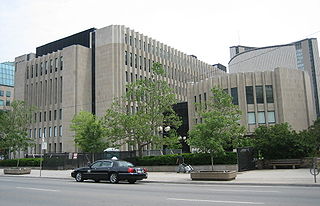
Superior Court of Justice building on University Avenue in Toronto (formerly the York County Court House).
An evolving line of defence we see from the federal Liberals is that they’re actually doing a great job. It’s those darned provincial premiers that are screwing things up.
We touched on this in our last dispatch. And you know what? There’s some truth to it. Some, I stress. A lot of issues that are much vexing Canadians today aren’t fully or even primarily in federal jurisdiction. Health care and housing are two obvious examples. Canada is a complicated place, and the Liberals no doubt prefer to not talk about things that they’ve done that have exacerbated challenges faced by other orders of government. But the basic point is fair: Justin Trudeau ain’t to blame for all that ails you. Or at least, the blame ought to be spread around some.
This national disgrace, though, lands squarely on him.
You might have read about the shortage of judges across the country. It’s a pretty niche issue, so you might have missed it. Even if you’ve heard about it, you may not have paid much attention to it. Most Canadians won’t have much contact with the criminal justice system over their lives, let alone make their careers in it. But the crux of the issue is this: appointing judges to provincial superior courts, where many of the most serious matters are heard, is in the federal jurisdiction. Solely. Ditto appointments to the courts of appeal: totally in the federal jurisdiction. And the feds have fallen way behind on filling vacancies and aren’t appointing judges fast enough to erase the backlog. Despite a spate of recent appointments, there are dozens of vacancies across the country. These are funded positions that ought to be filled and overseeing cases. But they aren’t, entirely because the feds haven’t made the necessary appointments. That’s the issue.
A lack of judges is creating bottlenecks in the justice system. Arrests are being made and charges are being laid and cases are being prepared and then … nothing happens. Because you can’t hold a trial if there isn’t a judge available to oversee it.
The Toronto Star‘s Jacques Gallant has established something of a bleak speciality in his recent reporting. He’s written a series of articles in recent months documenting serious criminal cases that are being thrown out of court, with the accused set free, because their trial has been delayed so much that it cannot be completed before the Supreme Court-ordered limit for a “reasonable” wait for a trial runs out. That’s 18 months for more minor issues, and 30 months for serious ones.
To be clear: the decision to throw out the cases is, in a legal sense, correct. Indeed, it’s mandatory. The Supreme Court determined what a hard limit should be, and a case that exceeds that is dead. Full stop. That’s the law of the land. The judges forced to preside over these dismissals are not to blame, and are increasingly venting their frustration in their rulings. They’re mortified, and they’re criticizing the government in unusually blunt terms, to put it mildly. You don’t often read court rulings that come off more like op-eds, but we live in weird times.
But it’s a good thing that they’re saying something. Because these vacancies are having appalling real-world consequences. Gallant wrote recently about a case that I felt would mark the low point in the entire embarrassment. A woman had accused a man of raping her. She did a brave thing and reported it. The police believed her and made an arrest. The Crown reviewed the evidence and believed her, and proceeded with a trial. A jury believed her, and after considering the evidence against the accused and hearing his defence, convicted him of the crime.
And then the judge tossed the case, setting aside the verdict and letting the accused go free, innocent in the eyes of the law. Because the clock had run out.
Elmer Keith’s Revolver Number 5
Forgotten Weapons
Published Feb 28, 2015Elmer Keith’s No.5 Single Action Army is arguably the most famous custom revolver ever made. Keith had it built in 1928 after developing a friendship with Harold Croft, another revolver enthusiast. Croft had shown Keith his own custom revolvers, which he had numbered 1 through 4. Croft had been trying to make an ideal pocket gun, and Keith used several of his ideas along with some of Keith’s own to put together a revolver for general-purpose field use. In recognition of Croft’s work, Keith called his gun Number 5. It featured an extended flat top with windage-adjustable sights, an improved mainspring, redesigned cylinder pin, custom hammer spur, and modified Bisley grip. It was chambered for the .44 Special/.44 Russian cartridges (the Russian being a slightly shorter version of the Special), and it was Keith’s favorite shooting piece until the .44 Magnum cartridge was introduced in the late 1950s. He described this gun in detail in a 1929 American Rifleman article entitled “The Last Word”.
http://www.forgottenweapons.com
Theme music by Dylan Benson – http://dbproductioncompany.webs.com
QotD: Imperium in the Roman Republic
That power was represented visually around the person of magistrates with imperium through the lictors (Latin: lictores), attendants who follows magistrates with imperium, mostly to add dignity to the office but who also could act as the magistrate’s “muscle” if necessary. The lictors carried the fasces, a set of sticks bundled together in a rod; often in modern depictions the bundle is thick and short but in ancient artwork it is long and thin, the ancient equivalent of a policeman’s less-lethal billy club. That, notionally non-lethal but still violent, configuration represented the imperium-bearing magistrate’s civil power within the pomerium (recall, this is the sacred boundary of the city). When passing beyond the pomerium, an axe was inserted into the bundle, turning the non-lethal crowd-control device into a lethal weapon, reflective of the greater power of the imperium-bearing magistrate to act with unilateral military violence outside of Rome (though to be clear the consul couldn’t just murder you because you were on your farm; this is symbolism). The consuls were each assigned 12 lictors, while praetors got six. Pro-magistrates [proconsuls and propraetors] had one fewer lictor than their magistrate versions to reflect that, while they wielded imperium, it was of an inferior sort to the actual magistrate of the year.
What is notable about the Roman concept of imperium is that it is a single, unitary thing: multiple magistrates can have imperium, you can have greater or lesser forms of imperium, but you cannot break apart the component elements of imperium.1 This is a real difference from the polis, where the standard structure was to take the three components of royal power (religious, judicial and military) and split them up between different magistrates or boards in order to avoid any one figure being too powerful. For the Romans, the royal authority over judicial and military matters were unavoidably linked because they were the same thing, imperium, and so could not be separated. That in turn leads to Polybius’ awe at the power wielded by Roman magistrates, particularly the consuls (Polyb. 6.12); a polis wouldn’t generally focus so much power into a single set of hands constitutionally (keeping in mind that tyrants are extra-constitutional figures).
So what does imperium empower a magistrate to do? All magistrates have potestas, the power to act on behalf of the community within their sphere of influence. Imperium is the subset of magisterial potestas which covers the provision of violence for the community and it comes in two forms: the power to raise and lead armies and the power to organize and oversee courts. Now we normally think of these powers as cut by that domi et militiae (“at home and on military service”) distinction we discussed earlier in the series: at home imperium is the power to organize courts (which are generally jury courts, though for some matters magistrates might make a summary judgement) and abroad the power to organize armies. But as we’ll see when we get to the role of magistrates and pro-magistrates in the provinces, the power of legal judgement conferred by imperium is, if anything, more intense outside of Rome. That said it is absolutely the case that imperium is restrained within the pomerium and far less restrained outside of it.
There were limits on the ability of a magistrate with imperium to deploy violence within the pomerium against citizens. The Lex Valeria, dating to the very beginning of the res publica stipulated that in the case of certain punishments (death or flogging), the victim had the right of provocatio to call upon the judgement of the Roman people, through either an assembly or a jury trial. That limit to the consul’s ability to use violence was reinforced by the leges Porciae (passed in the 190s and 180s), which protected civilian citizens from summary violence from magistrates, even when outside of Rome. That said, on campaign – that is, militae rather than domi – these laws did not exempt citizen soldiers from beating or even execution as a part of military discipline and indeed Roman military discipline struck Polybius – himself an experienced Greek military man – as harsh (Polyb. 6.35-39).
In practice then, the ability of a magistrate to utilize imperium within Rome was hemmed in by the laws, whereas when out in the provinces on campaign it was far less limited. A second power, coercitio or “coercion” – the power of a higher magistrate to use minor punishments or force to protect public order – is sometimes presented as a distinct power of the magistrates, but I tend to agree with Lintott (op. cit., 97-8) that this rather overrates the importance of the coercive powers of magistrates within the pomerium; in any case, the day-to-day maintenance of public order generally fell to minor magistrates.
While imperium was a “complete package” as it were, the Romans clearly understood certain figures as having an imperium that outranked others, thus dictators could order consuls, who could order praetors, the hierarchy neatly visualized by the number of lictors each had. This could create problems, of course, when Rome’s informal systems of hierarchy conflicted with this formal system, for instance at the Battle of Arausio, the proconsul Quintus Servilius Caepio refused to take orders from the consul, Gnaeus Mallius Maximus, because the latter was his social inferior (being a novus homo, a “new man” from a family that hadn’t yet been in the Senate and thus not a member of the nobiles), despite the fact that by law the imperium of a sitting consul outranked that of a pro-consul. The result of that bit of insubordination was a military catastrophe that got both commanders later charged and exiled.
Finally, a vocabulary note: it would be reasonable to assume that the Latin word for a person with imperium would be imperator2 because that’s the standard way Latin words form. And I will say, from the perspective of a person who has to decide at the beginning of each thing I write what circumlocution I am going to use to describe “magistrate or pro-magistrate with imperium“, it would be remarkably fortunate if imperator meant that, but it doesn’t. Instead, imperator in Latin ends up swallowed by its idiomatic meaning of “victorious general”, as it was normal in the republic for armies to proclaim their general as imperator after a major victory (which set the general up to request a triumph from the Senate). In the imperial period, this leads to the emperors monopolizing the term, as all of the armies of Rome operated under their imperium and thus all victory accolades belonged to the emperor. That in turn leads to imperator becoming part of the imperial title, from where it gives us our word “emperor”.
That said, the circumlocution I am going to use here, because this isn’t a formal genre and I can, is “imperium-haver”. I desperately wish I could use that in peer reviewed articles, but I fear no editor would let me (while Reviewer 2 will predictably object to “general”, “commander” or “governor” for all being modern coinages).3
Bret Devereaux, “Collections: How to Roman Republic 101, Part IIIb: Imperium”, A Collection of Unmitigated Pedantry, 2023-08-18.
1. I should note here that Drogula (in Commanders and Command (2015)) understands imperium a bit differently than this more traditional version I am presenting (in line with Lintott’s understanding). He contends that imperium was an entirely military power which was not necessary for judicial functions and was not only indivisible but also, at least early on, did not come in different degrees. In practice, I’m not sure the Romans were ever so precise with their concepts as Drogula wants them to be.
2. Pronunication note because this bothers me when I hear this word in popular media: it is not imPERator, but impeRAtor, because that “a” is long by nature, and thus keeps the stress.
3. And yes, really, I have had reviewers object to “general” or “commander” to mean “the magistrate or pro-magistrate with imperium in the province”. There is no pleasing Reviewer 2.
April 13, 2024
When there was an active counterculture
Ted Gioia on a recent oral history of the countercultural touchstone, The Village Voice:
At the start of her oral history of The Village Voice, author Tricia Romano provides a “cast of characters”. It goes on for 15 pages, and includes 216 people — each with some connection to the alternative newspaper.
Many people nowadays have never lived in a society with such a vibrant counterculture. In a time when official sources all seem part of a predictable Disney-fied monoculture, just reading this list of names and mini-bios can be a revelation.
Many of these individuals are now revered as historic figures who changed society. They had power and prestige. It’s easy to forget that most of them operated as outsiders.
That’s how they wanted it.
These renegades at The Village Voice knew that working outside the system — and typically against the system — was their superpower. They could criticize ruling institutions. They could speak harsh truths. They could go against the grain.
One thing is certain: They didn’t align their interests with globalist corporate CEOs, billionaire technocrats, the surveillance state, and establishment bureaucracies. They would have laughed at journalists who did that — believing, rightly, that honest media requires distance, or even an adversarial stance, vis-à-vis entrenched powers.
Because that’s what a counterculture does. That’s what it’s expected to do.
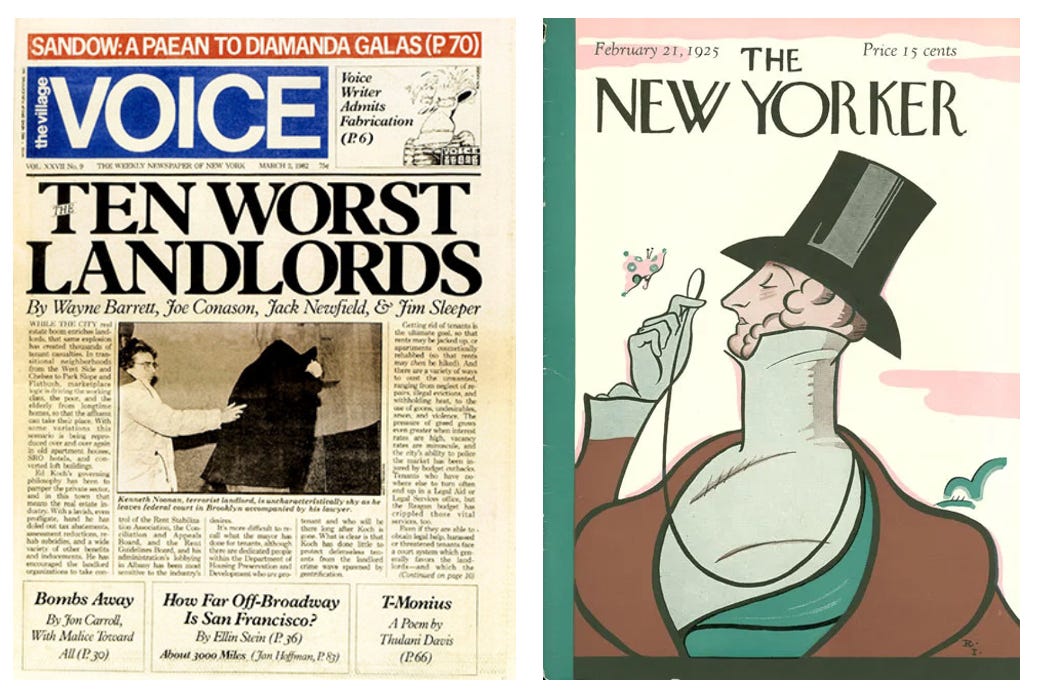
Romano captures the peculiar vibe in the title of her book The Freaks Came Out to Write. She makes clear that The Village Voice wasn’t The New York Times and it definitely wasn’t The New Yorker.
Nobody ever stepped into its madcap offices and said “Ah, the Gray Lady”. No reader ever picked up a copy and expected to see Eustace Tilley on the cover.
Can you tell the difference between culture and counterculture?
And The Voice was heard. Even establishment insiders knew they needed to listen to these “Freaks”. Sometimes they feared The Voice, sometimes they secretly agreed with it, but they always treated it as a force deserving respect.
Until recently that’s how it worked. The tension between insiders and outsiders was a source of creative energy in society. The upstarts provided alternative views and new ideas. They kept everybody accountable.
I’m pointing this out because this no longer happens. This is the world we’ve lost.