
Forgotten Weapons
Published Jan 12, 2024Today we return to Guadalcanal, to the site of the last actions of the campaign. For the Japanese, the defeat at Edson’s Ridge (aka Bloody Ridge) forced a disastrous and uncoordinated retreat into the jungle. With their supply lines destroyed, Japanese troops largely moved west on the island, away from American positions and in search of food. This would eventually bring them to Cape Esperance, where a rearguard force was landed, and some 10,652 Japanese soldiers were successfully evacuated on fast-moving destroyers over the course of several nights in early February, 1943.
On the American side, Army troops landed to relieve the Marines. In January and into early February they ran what was considered a mopping-up campaign west, including landings on the far west end of the island beyond Esperance. The intention was to encircle the remaining Japanese forces, under the assumption that the destroyer activity was landing fresh troops. Instead, when the American forces joined up at Cape Esperance it was an anticlimactic end to the fighting, as all they found were remnants of equipment that had been left on the beaches.
(more…)
April 20, 2024
Cape Esperance and the Japanese Evacuation of Guadalcanal
QotD: Cyber-addiction
Researchers at the University of London Institute of Psychiatry say the distractions of email and such extract a toll on intellectual performance as similar to that of marijuana. The study of 1,100 volunteers found that attention and concentration could be so frazzled by answering and managing calls and messages that IQ temporarily dropped by 10 points. The resulting loss of focus due to “Crackberry”, in fact, was judged to worse than that experienced by pot smokers.
This, of course, cannot really be a surprise. It is a great hallmark of modern life that over-indulgence in practically anything can be turned into pathology given enough time and clinical studies.
Jeff A. Taylor, Reason Express, 2005-04-26.
April 19, 2024
Humza Yousuf, the “Thug King of Scotland”
I don’t know what Scotland did to deserve Humza Yousuf as their first minister, but it must have been really bad:
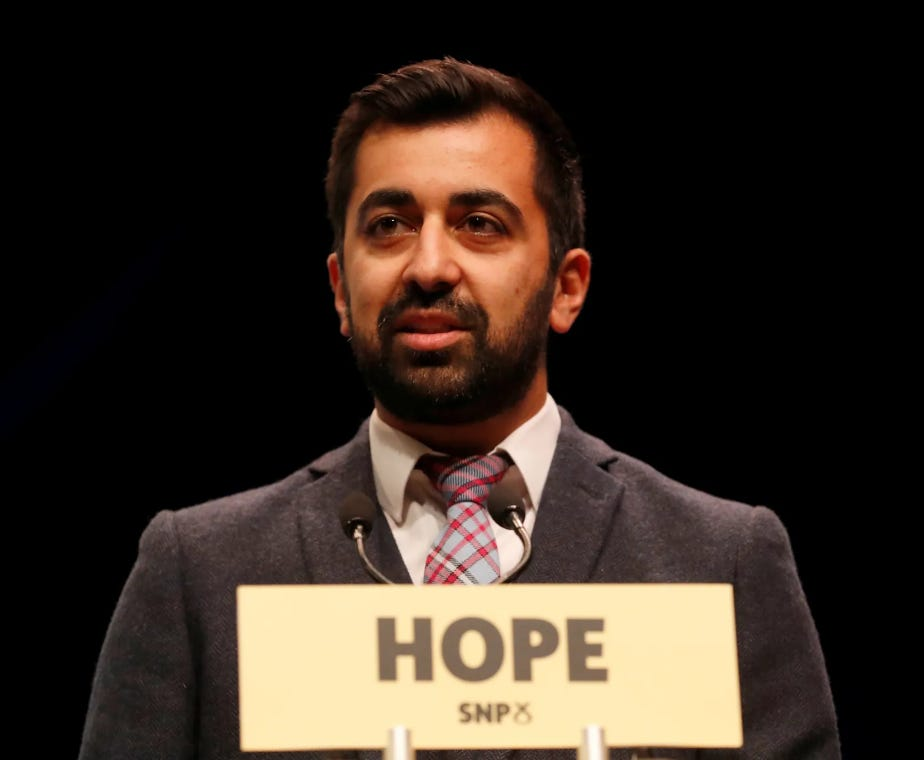
Not what you were hoping for.
Assuming he doesn’t get removed by a leadership coup before voters sink the leaking Tory battleship, Sunak will be gone by January of 2025 at the latest. That just leaves Humza Yousuf, characterized by Morgoth as The Thug King of Scotland: a post-ideological, apolitical opportunist interested purely in power for its own sake and quite happy to use the absurd public morality of the despised rubes that he rules over to keep the wretches in their place.
And boy, does he despise them.
Yousuf first came to the Internet’s attention in 2020, when he was filmed ranting in the Scottish parliament about how disgustingly racist it was that most of the high public offices in a country with an overwhelmingly White population were occupied by presumptively racist White cavebeasts:
The Lord President is white, the Lord Justice Clerk is white, every High Court judge is white, the Lord Advocate is white, the Solicitor General is white, the chief constable is white, every deputy chief constable is white, every assistant chief constable is white, the head of the Law Society is white, the head of the Faculty of Advocates is white and every prison governor is white.
That is not the case only in justice. The chief medical officer is white, the chief nursing officer is white, the chief veterinary officer is white, the chief social work adviser is whiteand almost every trade union in the country is headed by white people. In the Scottish Government, every director general is white. Every chair of every public body is white. That is not good enough.
If you haven’t watched the video, you should. You need to hear the contempt dripping off of his tongue, the way he spits out the awful word “White” like bitter venom.
In the immediate aftermath of this angry foreigner’s tirade, a sane country would have immediately marched their ill-mannered guest out of parliament, stripped him of office and citizenship, thrown him on a rusty fishing vessel, hauled him up north of the Orkneys, tossed him into the North Sea wearing nothing but a life preserver, and sent him on his way with a cheery wave and a reminder to mind the orcas.
Instead, they gave him the keys to the kingdom.
But while the infamous White Speech might not have prevented his elevation to the highest office in the land – indeed, given the derangement of our elites, if anything it smoothed his ascent – it has come back to haunt him. Thin-skinned and insecure as he is, Yousuf’s first priority on taking office was to ram through a new hate speech law with which to prevent the contemptible White worms from critiquing him or his noble tribe of vape-shop owners, cabbies, and grooming gang pimps. The law was ridiculously broad and invasive: one could be reported for the criminal offence of hate speech merely for making a remark in the privacy of one’s home, around the dinner table, with no one present but one’s kith and kin.
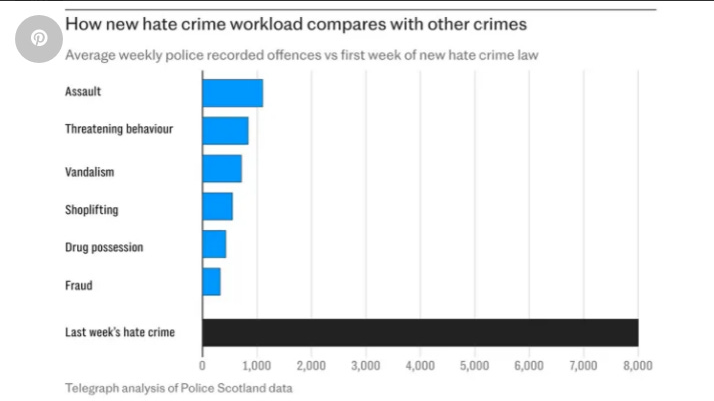
The day that the bill was finally forced through the Scottish parliament, and predictably enough for anyone who glanced at the law and had a passing understanding of the Scottish national character, the Scottish people responded by DDoSing the police with a deluge of hate crime reports, a very large number of which were reporting Yousuf’s rant as a hate crime … which, apparently, under the strict interpretation of the new law, it certainly was, with the only thing standing between Yousuf and indictment under his own half-baked law being that his ill-considered harangue took place prior to the law being passed. Which hasn’t stopped the Scots from taking the piss and continuing to report him.
It turns out that the Scots really do not like a ban on bantz, not one bit, and respond to demands that they cease the bantz by cranking up the bantz. Yousuf, being a humourless Pakistani who is confused and angered by this entirely foreseeable reaction, has risen to the occasion with all the grace, poise, and wit you would expect. In an attempt to stem the savage tide of mockery, Yousuf has tried claiming that reporting his hate speech is hate speech (lulz); has ordered Scottish police to read verbatim a prewritten transcript defending him each time his hate speech is thrown back at him (because that doesn’t look ridiculous); and faked a hate crime against himself by having his house sprayed with graffiti (did anyone fall for this?).
The next Scottish general election is two years away. Whether Humza survives the interim as First Minister, and if so whether he is able to guide the “Scottish” “National” Party to victory, remains to be seen. I don’t fancy his chances. He is a cunning and ruthless brute, to be sure. But he is also clumsy, clueless, and very stupid. Yousuf’s popularity has already plummeted. I’m sure he can find ways to plummet further. I believe in you, Yousuf. You can do it!
The Führerbunker – Hitler’s Grave
World War Two
Published 18 Apr 2024The man who once conquered Europe, Adolf Hitler, now cowers underground in the Führerbunker as bombs and artillery rain down on the ruins of the Reich. Today Sparty gives you a tour of the damp and claustrophobic concrete maze that will soon become the dictator’s coffin.
(more…)
Yet another unintended consequence of the Online Harms Act – easier deportation of non-citizens
In The Line, Kevin Wiener explains another of the hidden “gems” of the Trudeau government’s ill-considered and repressive Online Harms Act that at least will please a few anti-immigration activists:

According to the Trudeau government and its defenders, the Online Harms Act is nothing to worry about. This is supposed to be a bill that will protect equity-seeking groups like racial minorities — yet one little-discussed provision will make millions of permanent residents open to deportation for even the most minor criminal offences, as long as a prosecutor can show that the crime was hate-motivated.
The resulting power to turn any crime into a deportable offence will make non-citizens — many of whom are racial and religious minorities — even more vulnerable in the criminal justice system compared to citizens.
The main focus of the Online Harms Act is regulating online platforms, but it also makes major changes to the way the criminal justice system deals with hate-motivated crimes. Under current law, if a crime is motivated by hate based on a protected characteristic, that’s considered an aggravating factor at sentencing. That means the judge can impose a higher sentence than they normally would, although they can never exceed the maximum sentence for the underlying crime. For many minor crimes, that maximum sentence is two years less a day.
The Online Harms Act uses a totally different approach to hate crimes. Rather than just being a sentencing factor, the Act would create a brand-new hate crime offence. Committing any crime, if motivated by hatred, would make someone guilty of a second crime, with a maximum sentence of life imprisonment. To counter public concern, the Trudeau government has recently sent one of its senior advisors, Supriya Dwivedi, to argue that critics of this provision are “engaging in bad faith tactics”, going so far as to make the absolutely false statement that the bill won’t allow an increased sentence unless the underlying crime already had that sentence.
That is an accurate description of the current sentencing regime, but the text and clear purpose of the new bill is to let judges go further: a serious aggravated assault that might normally attract the maximum 14-year sentence can lead to life imprisonment if the attack was hate-motivated.
Further, Dwivedi’s defence of the bill ignores that maximum sentences play an important role in Canada’s immigration policy. If someone is neither a citizen nor a permanent resident, they can only be deported if they commit a more serious (called an “indictable”) offence, or two separate less serious (or “summary”) offences.
The new hate crime provision would be an indictable offence.
Breakfast in Jane Austen’s England
Tasting History with Max Miller
Published Jan 16, 2024What you could tell about someone from their breakfast in Jane Austen’s England, and a recipe for Bath buns as she might have eaten them for her first meal of the day.
Caraway buns topped with glaze, sugar, and caraway, served with butter. Perfect for a Jane Austen inspired breakfast with some hot chocolate
City/Region: England
Time Period: 1769It is a truth universally acknowledged that a person who has recently risen from bed must be in want of breakfast. In Jane Austen’s time, breakfast could be around 8:00 or 9:00 in the morning if you were a manual laborer or servant, or it could be as late as 3:00 or 4:00 in the afternoon if you were upper class.
Jane wrote a letter to her sister Cassandra saying that she wanted to join her on her trip to Bath, but didn’t want to inconvenience their hosts, so she would fill up on bath buns for breakfast. I can see why this would have been a sound strategy. The buns are denser than modern versions, but still soft and very good (they would certainly fill you up). The caraway is present but not overpowering, and they’re sweet but not as sweet as a dessert.
Caraway comfits were candy-coated caraway seeds (think M&Ms), but they don’t use caraway to make them anymore. I mimic them as best I can with caraway seeds and sugar.
To make Bath Cakes.
Rub half a pound of butter into a pound of flour, and one spoonful of good barm, warm some cream, and make it into a light paste, set it to the fire to rise, when you make them up, take four ounces of carraway comfits work part of them in, and strew the rest on the top, make them into a round cake, the size of a French roll, bake them on sheet tins, and send them in hot for breakfast.
— The Experienced English Houskeeper by Elizabeth Raffald, 1769
QotD: The “Greatest Generation”
P.J. O’Rourke, interviewed by Scott Walter, “The 60’s Return”, American Enterprise, May/June 1997.
April 18, 2024
Wagner’s Ring Cycle, summarized
I have to admit that aside from some amazing helicopter music, most of Wagner’s music isn’t my cup of tea drinking horn of mead. As a result, I didn’t know what the whole Ring Cycle was all about and mostly didn’t care. Coming to my rescue, Kulak provides a summary for my fellow non-Wagner fans:
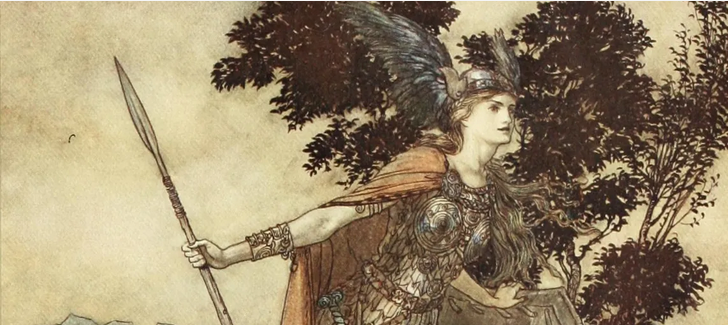
So researching my epic length piece on female warriors, pre-Christian sexual politics, and the unique development of North European culture I got really into Richard Wagner’s Ring Cycle after stumbling on Arthur Rackham’s gorgeous illustrations to the English translations of the text of the operas (Link 1, Link 2).
And one of the things that immediately jumped out to me, even beyond everything listed in the long piece, is how weird and unique the sexual politics of Pagan Germanic culture is.
Sure it’s Wagner, it’s not a primary source. It’s a 19th century romantic composer interpreting several different legends of pagan era Germany and Scandinavia, as record by Christian monks and scholars 100s of years after the fact. So academically not the most accurate thing to draw conclusions from, however if you subscribe to any blood memory, or spirit of a people, or eternal culture theory … it’s almost better.
This is the version of the tale that’s survived and been refined across first oral, then written traditions, then preserved by Christian monks, then revived by high Victorian romantics into one of the most celebrate and popular operas of all time. If there’s anything we could learn about the eternal character of North European women, sexuality, and sexual politics (and by extension modern sexual politics, we’re all North Europeans now) it is here.
And damned … what a datapoint.
What follows is a MeToo story on hyperborean crack.
The Female lead Brunhilde starts out as a Valkyrie who disobeys her master/father the god Wotan (Odin) in a matter of divine importance so as to save a mortal man. For her disobedience Wotan strips her of her divine nature and curses her to sleep on the earth as a mortal woman until such a time as the first man to find her wakes her, then she is to be his wife. However, taking pity Wotan lays out an magical wall of fire to guard her so no coward, only a great hero, would ever succeed. (end opera 1/3).
20-ish years later Siegfried, the son of the man Brunhilde saved, finds her (she hasn’t aged a day), and perfectly fearless he braves the fire to wake her, where-upon they fall in love (end opera 2/3)… then taking leave for more adventure Siegfried takes off promising to return and remember their. Where-upon he meets the King Gunther and his sister Gutrune, who seduces Siegfried and makes him forget Brunhilde. Making friends with Gunther, Siegfried conspires with him that he should have Brunhilde for a wife (given she’s the best woman he can think of for his friend), but there’s a problem … Gunther cannot brave the fire, he’s not fearless like Siegfried. So Siegfried, conspires to impersonate Gunther using his magic, brave the fire again, seduce Brunilde again, get her to consent to marry him in the Guise of Gunther, spend the night using his sword to divide himself from Brunhilde. Then in the morning swap back, Siegfried Married to Gutrune, Gunther to Brunhilde … The plan worked perfectly.
Then Brunhilde found out.
Learning what had been done she conspires with Siegfried’s enemies to have him killed, falsely accuses him of rape, and successfully maneuvers him into admitting to lying in an oath he wasn’t even aware was a lie … so that his fearless perfect life can end with a stab in the back.
So you may ask: Having avenged herself does she settle-down with her husband?
Hell no! You think you could fill the shoes of Siegfried you curr, you coward, you beta-cuck?! You will NEVER be Siegfried.
Instead she gives the mother of all angry speeches denounces Gertrude and everyone else of the court to their face, and then rides Siegfried’s horse onto his funeral pyre, determined it is better to die with Chad than live with Brad.
THE END.
Of the entire opera cycle. No more.
The Fat Lady has sung.
Your 4 day trip into the German mountains to experience 3 1/2 Operas over as many days and a combined 15 hours has concluded. Go Home.
Rhinemaidens, Minnesota Opera production of Das Rheingold
I’m Sorry bros, the hoes have always been like this.
Even in the mythical past of high Germanic mythology … the hoes were like this.

On The Line with General Wayne Eyre, commander of the Canadian Armed Forces
The Line
Published Apr 16, 2024General Wayne Eyre served for decades in the Canadian Army, including as its commander, before being promoted to Chief of the Defence Staff in 2021. During his time as Canada’s top soldier, he has overseen not only a series of challenges inside the Canadian military, but also a rapid deterioration in the geopolitical environment. The world is a more dangerous place, and Gen. Eyre has been unusually outspoken in noting that Canada needs to do more to be ready for what’s coming.
In this conversation with The Line‘s Matt Gurney, the general provides his take on the state of the world today, shares his thoughts on the recently announced Defence Policy Update, and talks about why he is encouraged by some of what he is already seeing change with Canada’s military readiness.
On The Line is The Line‘s newest podcast, featuring longer interviews by either Jen or Matt with someone who is currently in the news or able to speak to something topical (or, sometimes, simply fun and interesting). We are still getting it up to speed, but Line listeners and viewers can expect an episode weekly by next month, at the latest.
To never miss an episode of either On The Line or The Line Podcast, sign up today to follow us on YouTube, on the streaming app of your choice and, of course, at ReadtheLine.ca, home of The Line. Like and subscribe!
Please note: This interview was recorded on Friday, before the Iranian attack on Israel.
“… the scary part of town, the place where the true freaks and degenerates hang out, is general topology“
John Psmith does his level best to make mathematics interesting to layfolk like you’n’me:
In our end of year post I threatened to write more math reviews, and multiple people in the comments egged me on. So now, with Jane laid up in the final stages of pregnancy, I have seized control of the Substack for a very special lightning round of math textbooks I recently enjoyed. No, wait! Don’t close the tab! I promise that some of these will be fun for non-mathematicians as well.
- Counterexamples in Topology, by Lynn Arthur Steen and J. Arthur Seebach Jr.
The mathematicians I have known included some eccentric characters. In fact when one considers research mathematicians as a class, it’s usually the normal people who are the exception. But there are degrees of weirdness. One of the most delightful things about the world is how fractal it is, and this extends to human hierarchies. Take any unusual group of people — frequent-flyers, monastics, the ultra-wealthy, members of genealogical societies — and zoom in on them, and it turns out there are even stranger or more elite subgroups buried within. This is true of mathematicians too, each subfield has its reputation, some of them regarded with awe, others with disdain. But ask any mathematician, “Who are the real weirdos? Who are the ones who are truly cracked?” The answer will be unanimous: it’s the topologists.
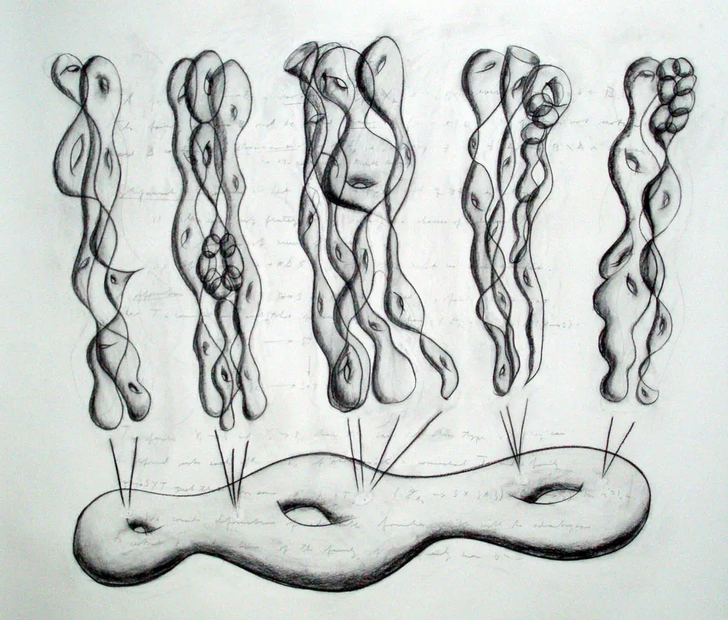
Topology is the study of spaces in the most abstract sense, so abstract that they may not even support a well-defined notion of distance (if your spaces are guaranteed to have distances, then you are now doing geometry rather than topology). Topology takes a coarser view of space: forget about curvature, distance, or really anything involving numbers at all. To a topologist, two points can be “near” each other or not, “connected” or not, and beyond that it doesn’t matter. This is the source of all the jokes about topologists mistaking donuts for coffee cups,1 but the kind of topology that studies multi-holed donuts, algebraic topology, is actually comparatively tame and normal. Also relatively normal is differential topology, which is the next neighborhood over from differential geometry, and which produces cool videos like this.
No, the scary part of town, the place where the true freaks and degenerates hang out, is general topology. General topology is where we go to figure out the basic definitions and frameworks that underlie the rest of topology. It’s about exploring what nearness and connectedness even are, and when mathematicians are trying to figure out what things are, that usually means probing the outer limits of what they can be. So general topology turns into the study of the most bizarre and deformed and disturbing spaces accessible to human cognition. No wonder its practitioners are a little weird.
Which brings me to this book, whose perversity is laid out right there in the title. It’s a big book of counterexamples to statements which seem obviously, intuitively correct. In general topology, things that seem intuitively correct are usually wrong:2 the field is notorious for proofs that almost work but twist out of your grasp at the last moment. A big book of counterexamples is exactly what you want for understanding why your proof that “all Xs are Ys and all Ys are Xs” falls flat. Seeing the logic fail is one thing, but seeing a concrete example of an X that is not a Y (or vice versa) brings it home with a satisfying finality.
But the real reason I love this book is the names, oh, the names. Let me flip through the table of contents with you: are “the Infinite Cage” and “the Wheel Without Its Hub” examples of topological spaces, or planes of the underworld? Are “Cantor’s Leaky Tent” and “Tychonoff’s Corkscrew” important counterexamples, or Level 2 wizard spells? I could spend hours idly leafing through this book, pondering these twisted and prosperous spaces, imagining them as worlds in themselves, imagining the bizarre sorts of creatures that might live there. Is this a math textbook or an RPG sourcebook? Trick question, they’re the same thing.
1. One of the proudest moments of my mathematical career was when I attended a faculty tea and a distinguished topologist asked me for a donut and I handed him a cup of coffee instead. Everybody lost it. Alas, I turned out to be much worse at math than I am at improvisational comedy, and my mathematical career ended shortly afterwards.
2. This is why we have the “separation axioms“. Every rung on that latter is the “well, actually …” to something that seems self-evident but isn’t.
What to do if Romans Sack your City
toldinstone
Published Jan 12, 2024Chapters:
0:00 Introduction
0:34 Progress of a siege
1:55 Looting and violence
3:42 Recorded atrocities
4:45 Captives
5:27 BetterHelp
6:36 Surviving a Roman sack
7:13 Where to hide
8:27 What to do if you’re captured
9:20 Advice for women
10:09 The fate of captives
(more…)
QotD: The intergenerational blame game
OK, Zoomer. Two can play this game. Keep in mind that the little magic trick I’m about to perform here does not mean I’m blaming your generation for any of these things, because I’m not a Generational Astrologist. I’m merely taking what you do and flipping the script:
Yours is the generation of “woke culture” and Antifa. As much as you yabber about how the Boomers let the culture slide into liberalism, atheism, and degeneracy, your generation is far less religious than the Boomers. You lean heavily socialist and encourage “punishment” for Halloween costumes you deem “offensive”. While the world is burning, the Zoomers’ top three voting issues are emotionally laden trifles such as “mass shootings, racial equality, and … treatment of immigrants”. You are far more anti-racist, anti-“hate”, and pro-LGBT than any generation that preceded you. This is not my opinion — it’s a statistical fact supported by every survey and poll I’ve ever seen.
Therefore, every Zoomer is personally responsible for Drag Queen Story Time and the fact that there’s no wall on the border, because you just sat there and LET it happen. Three trillion dollars have been added to the national debt since Trump’s inauguration, and you Millennials and Zoomers just sat there and LET it happen. The tech giants are doing purges of people for thoughtcrimes, while your generation hides behind goofy fake names and clown avatars and LETS it happen.
That’s because every member of every generation is 100% responsible for what happens on its watch. Get down on your knees and APOLOGIZE!
And if you don’t repent immediately and bend to my shaming tactics, you fucking deserve all the righteous pain the generations after you will rain down on your selfish head.
See how stupid that sounds when it’s applied to you?
People hate to admit they’ve been brainwashed. But sorry — you’ve been brainwashed.
Politicians enjoy a little generational warfare if it suits their needs. They’ll even instigate it. And as far as I can tell, this sudden emergence of a generational identity-politics civil war is a divide-and-conquer tactic that has worked wonderfully.
Jom Goad, “The Myth of Boomer Privilege”, Taki’s Magazine, 2019-11-03.
April 17, 2024
Soviet Berlin Offensive Begins – WW2 – Week 294B – April 16, 1945
World War Two
Published 16 Apr 2024The final Soviet assault on Berlin begins today. The Soviets have two million men supported by tens of thousands of guns, tanks, and aircraft. Opposite them stand millions of men and boys of the German Wehrmacht, Waffen SS, Volkssturm, and Hitler Youth. The forces of Nazism are weakened and disorganised but determined to fight on as long as possible.
00:41 Roosevelt’s death
03:09 Preparations for the Soviet drive on Berlin
08:49 Zhukov’s Offensive
12:48 Konev’s Offensive
14:57 Summary & Conclusion
(more…)
Pay no attention to what “tax me more” folks say – instead watch what they do
One way for an a wealthy person to get a lot of free media attention is to performatively declare that they should be paying more taxes. This ostentatious virtue-signalling is frequent enough that Tim Worstall has been writing the occasional article about it for quite some time:
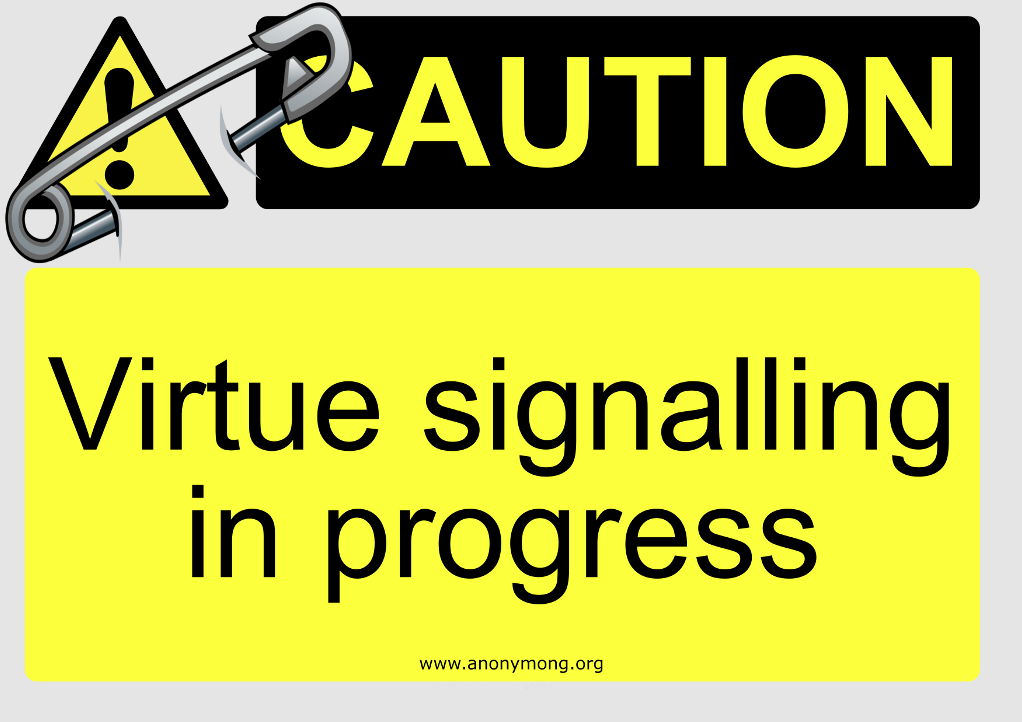
For there is this:
Public donations to pay off the national debt have hit their highest level in at least a decade amid growing concern about the UK’s soaring debt mountain.
Members of the public handed almost £700,000 over to the Government through six individual bequests and donations last year, according to Debt Management Office (DMO) figures obtained via a Freedom of Information request.
The amount for the 2023-24 financial year was the highest in at least a decade, with the biggest single payment to help pay off Britain’s £2.65 trillion debt pile coming from a £500,000 bequest, according to the DMO, which did not provide names of individual donors.
One way to think of this — an entirely correct way to think of it too — is that an entire 6 people last year thought that inheritance tax was too low. Which, out of the about 600k deaths (not looked it up but that’s right order of magnitude, it’s not 6 million and it’s not 60k) is not actually a lot. 0.001% in fact.
One of the grand insistences of economics is that watching what people do gives more information about their true beliefs than listening to what they say – revealed preferences, not expressed. So, by what people actually do we have 0.001% of the people leaving estates of any size whatever who think that the tax on estates is too small. This is not a large majority in favour of higher taxes upon estates being left.
But back to the far more important subject, me.
As far as the UK is concerned I did start this off. The reporting on how much people voluntarily leave to the government. Who pays extra that is – who makes a voluntary donation to government. Back in 2006 in fact, back in the depths of the Brown Terror:
LAST YEAR there were five people in Britain who thought that their taxes were too low. No, this isn’t the number of people who have called for higher taxes. Rather, it is those who were so convinced of the righteousness of state spending that they voluntarily sent extra money to the Treasury.
The Americans have been doing this since 1843. It’s always been possible to pay extra to HM Treasury — Stanley Baldwin actually handed over one fifth of his estate while he was still alive. Admittedly, he was Financial Secretary to the Treasury at the time and was asking for donations to aid in paying down war debt but still, props for money where mouth is.
Cheques, by the way, should be made out to “The Accountant, HM Treasury”, and sent to 1 Horse Guards Road, London SW1A 2HQ. A 2nd-class stamp is sufficient and you are encouraged to add a covering note so that your donation is spent in the way you like.
I wrote that piece for The Times simply because I thought it would be a cute thing to do — and I wanted the £200 that went with writing it. As ever with freelance journalism, my money is important.
I also know that that was the first piece that appeared in UK journalism on this point. For when I asked the Treasury they’d no idea at all how many had in fact paid extra. Took them months to find out too. The donations had happened before, but no one had been writing about it. At least, not since Baldwin’s generation.
His Majesty King Charles, in right of Canada, would also be happy to accept any unwanted sums of money above your mandatory tax rate here. Go wild, wealthy and patriotic Canadian multi-millionaires!
French M14 Conversion – the Gras in 8mm Lebel
Forgotten Weapons
Published May 16, 2016The French adopted the Gras as their first mass-issued metallic cartridge rifle in 1874, replacing the needlefire 1866 Chassepot. Quite a lot of Gras rifles were manufactured, and they became a second-line rifle when the 1886 Lebel was introduced with brand-new smokeless powder and its smallbore 8mm projectile. When it became clear that the quick and decisive war against Germany was truly turning into the Great War, France began looking for ways to increase the number of modern Lebel rifles it could supply to the front.
One option that was used was to take Gras rifles from inventory and rebarrel them for the 8mm Lebel cartridge (which was based on the Gras casehead anyway). These could be issued to troops who didn’t really need a top-of-the-line rifle (like artillery crews, train and prison guards, etc). Then the Lebel rifles from those troops could be redirected to the front.
The rebarreling process was done by a number of contractors, using Lebel barrels already in mass production. The 11mm barrel from the Gras would be removed, and only the front 6 inches (150mm) or so kept. A Lebel barrel and rear sight would be mounted on the Gras receiver, and that front 6 inches of Gras barrel bored out to fit tightly over the muzzle of the new 8mm barrel. This allowed the original stock and nosecap to be used (the 8mm barrel being substantially smaller in diameter, and not fitting the stock and hardware by itself). It also allowed the original Gras bayonet to be fitted without modification, since the bayonet lug was also on that retained section of barrel. In addition, a short wooden handguard was fitted. This was designated the modification of 1914, and an “M14” was stamped on the receivers to note it.
These guns are of dubious safety to shoot, since the retain the single locking lug of the Gras, designed for only black powder pressures. However, this was deemed safe enough for the small amount of actual shooting they were expected to do.


