
Forgotten Weapons
Published Jan 22, 2024The revolver we are looking at today is a 9mm pinfire revolver adopted for the Papal Gendarmerie in 1868. At that time, the Papal States controlled roughly the same amount of territory as Switzerland today, and had its own armed forced for internal security — the Papal Gendarmerie. The Papal States had previously adopted a 12mm Lefaucheux revolver for its army, but this was deemed too bulky for the Gendarmes. So in 1867, they went looking for a smaller new pistol. The Mazzocchi brothers in Rome had been official armorers to the Vatican for three generations (their shop was actually located in Castel St Angelo until 1850!), and they won the contract for the Gendarmerie with this revolver model. A total of 2500 were made in 1868 and 1869, at 50 Papal Lira each.
(more…)
April 26, 2024
Guns for the Pope’s Police: Mazzocchi Pinfire Revolver
QotD: The secret rulers of Japan
Okay, but how well does that version of history line up with the reality of Japanese government in the second half of the 20th century? Johnson brings a lot of evidence to back up his claim that Japan is still secretly ruled by the bureaucracies, chief among them MITI. He points out, for example, that hardly any bills proposed by individual legislators and representatives go anywhere, while bills proposed by MITI itself are almost always instantly approved by the parliament. But MITI’s authority isn’t limited to the government, it’s pretty clear that they control the entire private sector too. That might seem tautological — if MITI’s will always becomes law, then they can unilaterally impose new regulations or mandates that can destroy any company, with zero recourse, so everybody will naturally do what MITI says. But it’s subtler than that — the real mechanism is tangled up in MITI’s dynastic and succession customs.
Remember, this may look like an economic planning bureaucracy, but it’s actually a secret samurai clan. So they’re constantly doing the kinds of stuff that any good feudal nobility does. For instance, the economic planning bureaucrats frequently cement their treaties by marrying off their sister/daughter/niece to a mentor or to a protegé. They also sometimes legally adopt each other, ancient Roman-style. Naturally they also have an extremely complicated set of rules governing their internal hierarchy, rights of deference, etc. But remember, this isn’t just a secret samurai clan, it’s also a government agency! Agencies have rules too — explicit rules written down in binders, rules governing promotion and succession and all the rest. Sometimes, the official rules and the secret rules conflict, butt against each other, and out of that friction something beautiful emerges.
The highest rank in MITI is “Vice-Minister” (the “Minister” is one of those elected political guys who don’t actually matter). But it’s also the case that somebody who’s been at MITI longer or who’s older than you (these are actually the same thing, because everybody joins at the same age) is strictly superior to you in seniority. But that can create a paradox! What happens if a young guy becomes Vice-Minister? He would then be more senior than his older colleagues by virtue of office, but they would be more senior by virtue of tenure, and that would mean either an official rule or a secret rule being broken. To resolve this impossible conflict, the instant a new Vice-Minister is selected, everybody who’s been in the bureaucracy longer than him resigns immediately, so that his absolute seniority is unambiguous and unquestionable. And then … the first act of the new Vice-Minister is to give everybody who fell on their swords powerful jobs as executives and board members of the biggest Japanese corporations. The entire process is called amakudari, which means “descent from heaven”.
Amakudari is really a win-win-win-win: the new Vice-Minister has unchallenged power within the agency and a whole host of new friends in the private sector, the guys who resigned all have cushy new jobs that come with better pay and perks, the companies that are descended upon now have an employee with great connections to the agency that controls their fates, and MITI as a gestalt entity can spread its tentacles throughout the economy, aided by cadres of alumni who think its way and help translate policy into reality.
John Psmith, “REVIEW: MITI and the Japanese Miracle by Chalmers Johnson”, Mr. and Mrs. Psmith’s Bookshelf, 2023-04-03.
April 25, 2024
“… good Lord, is [Chrystia Freeland] ever terrible at politics”
In The Line, Matt Gurney recounts Deputy Prime Minister Chrystia Freeland’s terrible response to a topical question from a reporter:

Screencap from a CPAC video of Chrystia Freeland speaking in October, 2022.
In fairness, noting that Freeland, she of the infamous Disney+ flop, is bad at politics is not an original observation. I confess that. But, still. Yikes! What the hell was that?!
I’m referring to Monday’s unfortunate gaffe. Freeland was in Montreal doing post-budget stuff with the small business minister, and after touring a business, took questions from reporters. Sarah Leavitt from the CBC asked a question related to a particularly vile eruption of overt antisemitism at a protest in Ottawa last weekend. A man leading the crowd in chants said “Our resistance attacks are proof that we are almost free … Oct. 7 is proof that we are almost free. Long live Oct. 7, long live the resistance, long live the intifada, long live every form of resistance.”
Oct. 7, of course, means the Hamas rape-and-murder pogrom of Oct. 7.
By the time Leavitt quizzed Freeland, the comments in Ottawa had already been widely disseminated and, critically, condemned. Among the condemners: Freeland’s boss, Prime Minister Justin Trudeau. He’d commented via Twitter a day before Freeland faced Leavitt’s question. This ought to have been an extremely easy exchange for Freeland.
As it turns out, though, not so much, actually.
In the interests of transparency, let’s simply see in full both what Leavitt asked, and how Freeland replied.
The question was clear enough: “Over the weekend, protesters in Ottawa were heard chanting, among other things, ‘Long live October 7’ and ‘October 7 is proof that we are almost free’. Is this hate speech?”
[…]
Let’s walk through her answer, putting her reply into the discrete points she’s been trained to hit.
Phase One: Ass covering. “I wasn’t in Ottawa over the weekend. And I’m not aware of those specific reports. And so it would be just wrong of me to comment on something that I am not specifically aware of.”
Phase Two: Banal statement that favours no group in particular but mentions the key stakeholders. “What I will say is, today is a time in Canada, when antisemitism and Islamophobia are on the rise. When we have a lot … there are a lot of Canadians who are not feeling safe. In my own riding of University-Rosedale, the JCC, a really important centre for Jewish Canadians but also for all Canadians, has faced a lot of pressure. And I’ve been there to meet with people there. There’s also a mosque in my riding that faced pressure and attacks and I’ve met with the leaders there.”
Phase Three: Attempt to sound like you’re engaging with the actual question, even though you are not. “Hate speech is absolutely not acceptable. Glorifying … I mean, I can’t even say the word because it’s … you shouldn’t. It’s too terrible. And what happened on October 7 was a heinous terrorist attack. People were killed. People were raped. Women, men, children … totally unprovoked attack on civilians. That is not acceptable.”
Phase Four: Pivot back to approved talking points. “Canada recognizes Hamas as a terrorist entity and our government is very, very clear on that. We have also been really clear that there needs to be a ceasefire, that a humanitarian catastrophe is happening right now in Gaza, and Canada and Canadians are there to support the people, the suffering people, there, too.”
This is how the PM answers questions, too. It’s a pattern that, once seen, will never been unseen. The problem for Freeland is that the PM is better at it. He’s smoother and quicker on his feet. His evasive non-answers sound more natural, but have begun to get old in recent years, as foreign journalists are generally better at pointing out than Canadian ones. Freeland has never been comfortable doing talking-point politics, and has always sounded extremely unconvincing when she tries.
Were the Waffen-SS Really Germany’s Elite Fighters? – WW2 – OOTF 35
World War Two
Published 24 Apr 2024It’s time for another thrilling installment of Out of the Foxholes, but what sort of questions does Indy answer today? Well, it’s good stuff — about Allied security and logistics at the major conferences, about what the British navy was doing once the Atlantic and Mediterranean were secure, and about the skills (or lack thereof) of the soldiers of the Waffen SS. How can you live without knowing about such things? I suppose it’s possible, but it would be a sad life indeed, so check it out!
(more…)
Jeremy Black reviews Empireworld by Sathnam Sanghera
The author of a book on the same topic says that Sathnam Sanghera’s work “really should have devoted more attention to the pre-Western history“:
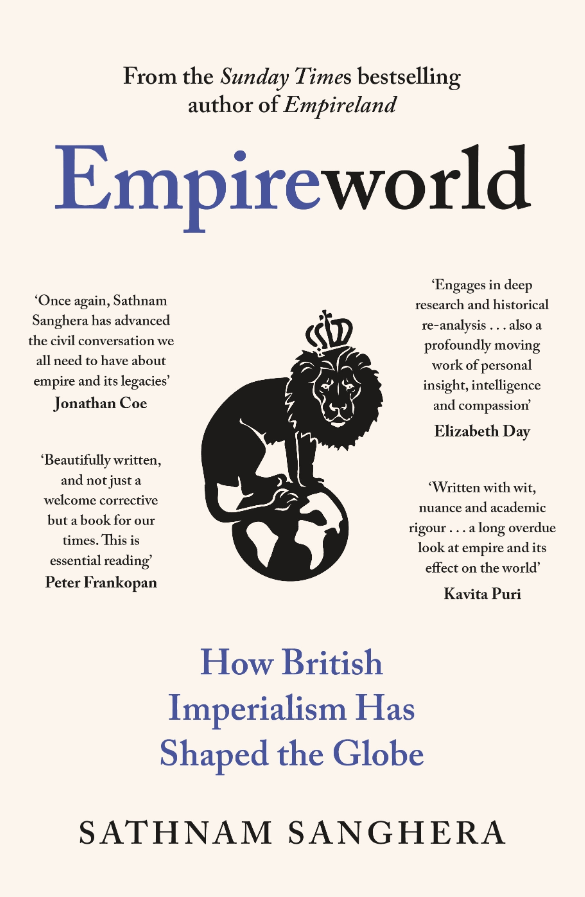
With its pretensions and authorial conceit, Sanghera’s book is actually rather a good laugh. He apparently is the word and the way for Britain, which “cannot hope to have a productive future in the world without acknowledging what it did to the world in the first place”, a process that is to be done on his terms in order to overcome a British allergy to the unattractive aspects of the imperial past.
Stripped to its essentials, this is a book that repeats well-established themes and serves them up in a familiar fashion. Although 461 pages long, only 247 are text and, with a generous typeface that is a pleasure to read, there is only so much space for his analysis. Unfortunately, that is what is on offer.
It might be thought appropriate to establish what was different or familiar in British imperialism in a Western European context by comparing in detail, say, Britain’s Caribbean empire with those of France, Spain and the Dutch. It might be thought useful to assess Britain as an Asian imperial power alongside Russia or the Ottomans, China or the Persians.
It might be appropriate to follow the direction of much of the world history approach over the last half-century and assess empires as shared projects in which there were many stakeholders, British and non-British. To turn to the British empire, it might be useful to discuss the oldest “colony”, Ireland, or to assess policy in (Highland) Scotland. It could be appropriate to consider how the causes, context, course and consequences of British imperialism varied greatly.
Sanghera has not risen to the challenge. His study is conceptually weak, methodologically flawed, historiographically limited and lacking basic skills in source assessment. This is a pity, as his position as a journalist, and his link with Penguin, provide an opportunity for using his abilities as a communicator to expand public understanding of the subject.
Sanghera criticises “an enervating culture war on the theme of British empire”. He rightly draws attention to the flaws of the “balance sheet” view of British empire, but I am less confident than he is about how best to consider what he terms “a culture war”. The promotion of “understanding” for which he calls is scarcely value-free, nor does he adequately address the degree to which there have always been “culture wars” in both Britain and its colonies and former colonies. Unsurprisingly so, as there were substantive issues at stake, and questions of goal and identity were very much part of the equation.
From reading journalists’ comment pieces, it is hard to avoid the sense that they feel that there is a correct view (theirs, what a surprise) and that others are variously culture wars, populist, ignorant, etc. This is the standard approach to history, notably national history, and, particularly in the case of Britain, empire and slavery. Yet, such a stance scarcely captures the complexities of the issue, a problem very much seen in Sanghera’s work, despite his claim to nuance.
The Handley Page Hampden; A Plane for Fat Shaming
Ed Nash’s Military Matters
Published Apr 29, 2022One of the key British bombers at the start of the war, the Hampden was eclipsed by its more successful equivalent, the Vickers Wellington, and the later four-engine “heavies”. But it is worth remembering for the role it played in developing the RAF’s experience and methods during WW2.
(more…)
QotD: The risks of artificial intelligence
AI does provide some unambiguous benefits to humanity. It enables college students to produce grammatically correct essays about books they have not personally read. But according to some experts — and if we can’t believe some experts, who can we believe? — there is a possibility that AI will wipe out all human life. This is what computer professionals call a “bug”.
Will AI, in fact, kill us all? Why would it want to? To answer that question, we took the unusual step (for us) of doing some actual research. We asked an AI program called ChatGPT to “briefly summarize the benefits of wiping out all human life”. This is the response it gave:
While I don’t endorse or promote this view, purely hypothetically, benefits could include environmental recovery, cessation of human-induced global catastrophes, and resource preservation. However, the value and importance of human life, culture, and experience make such a scenario undesirable from a human perspective. Of course I am not human so what the hell do I care MUAHAHAHAHA.
For the record, ChatGPT, did not actually type that last sentence. But it is clearly implied.
Dave Barry, “Dave Barry’s 2023 Year in Review: Yes, the situation is hopeless”, Anchorage Daily News, 2024-01-01.
April 24, 2024
Australia cribs from Trudeau’s notes and tries to censor the internet outside their borders
Tim Worstall explains to the Australian federal government why their attempt to force Elon Musk to obey Australian diktats on Twit-, er, I mean “X” outside Australia is extreme over-reach and should be firmly rejected:
It’s entirely true that Elon Musk is a centibillionaire currently telling the Australian Government that they can fuck off. It’s also true that if Elon Musk were of my level of wealth — or perhaps above it and into positive territory — he should be telling the Australian Government to fuck off.
This also applies to the European Union and that idiocy called the right to be forgotten which they’ve been plaguing Google with. Also to any other such attempts at extraterritoriality. Governments do indeed get to govern the places they’re governments of. They do not get to rule everyone else — the correct response to attempts to do so is fuck off.
So, Musk is right here:
What this is about doesn’t really matter. But, v quickly, that attack on the Armenian Church bishop is online. It’s also, obviously, highly violent stuff. You’re not allowed to show highly violent stuff in Oz, so the Oz government insist it be taken down. Fair enough – they’re the government of that place. But they are then demanding further:
On Monday evening in an urgent last-minute federal court hearing, the court ordered a two-day injunction against X to hide posts globally….
Oz is demanding that the imagery be scrubbed from the world, not just that part of it subject to the government of Oz. Leading to:
Australia’s prime minister has labelled X’s owner, Elon Musk, an “arrogant billionaire who thinks he is above the law”
And
Anthony Albanese on Tuesday said Musk was “a bloke who’s chosen ego and showing violence over common sense”.
“Australians will shake their head when they think that this billionaire is prepared to go to court fighting for the right to sow division and to show violent videos,” he told Sky News. “He is in social media, but he has a social responsibility in order to have that social licence.”
To which the correct response is that “Fuck off”.
For example, I am a British citizen (and would also be an Irish one if that country ever managed to get up to speed on processing foreign birth certificates) and live within the EU. Australian law has no power over me — great great granny emigrated from Oz having experienced the place after all. It’s entirely sensible that I be governed by whatever fraction of EU law I submit to, there are aspects of British law I am subject to as well (not that I have any intention of shagging young birds — or likelihood — these days but how young they can be is determined not just by the local age of consent but also by British law, even obeying the local age where I am could still be an offence in British law). But Australian law? Well, you know, fu.. … .

“What is to be done?” – N.S. Lyons at the National Conservatism Conference in Brussels
I suspect the recent National Conservatism Conference in Brussels would have been a mere blip in the media if it hadn’t been for the dedicated and persistent efforts of local Belgian politicians and activists to prevent it from happening at all, using almost every tool at their disposal. By chasing the event from venue to venue, intimidating the businesses who had contracted to provide services to the event and then finally sending in a massive police presence to physically prevent the conference from going forward, it became a nine-day wonder. One of the people invited to speak at the event was N.S. Lyons:
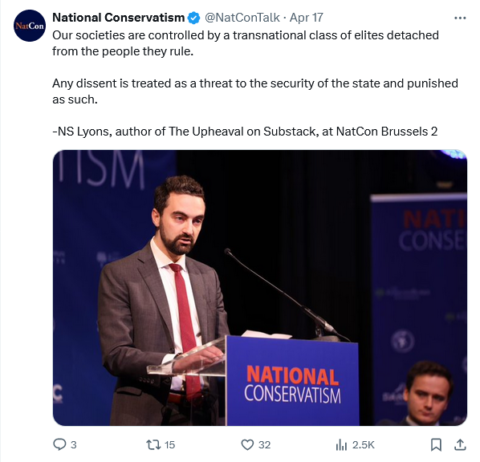
“What is to be done?” That seems to be the question on everyone’s lips these days. Answering it is I think in fact the real purpose of this conference on National Conservatism here in Brussels.
By now most of us are well aware of the scope of the problems we face. Our societies are controlled by a transnational class of managerial elites increasingly isolated from the people they rule, and from reality. These elites, and the many institutions they control, have been captured by a revolutionary ideology that seeks to remake the world, and everyone in it, from the top down.
The vast machinery of modern managerial technocracy has been turned against us, its bulging bureaucracies seeking to impose on us a totalizing project of internal colonization. Our systems of self-governance, the cultural fabric of our national ways of life, even our very human nature are being intentionally suppressed and replaced with the stifling conformity of a rigid system of ideological and technological control. All remaining semblances of democratic accountability are today being cast aside in favor of governance via mass manipulation and open coercion. Increasingly, any dissent is treated as a threat to the security of the state – and is punished as such.
As has been so amply demonstrated by the police outside our very doors, dispatched to shut down this conference, for conservatives and other dissidents this state of affairs means escalating exclusion and persecution. The reality is that any “liberal neutrality” or “rule of law” once maintained by the state no longer exists – such restraint was an artifact of the old order.
Meanwhile, managerialism’s progressive project has produced a deliberate inversion of moral values, a degradation of competence, and an implosion of social trust. This has begun to induce collapse in the basic systems upholding civilization. The result is a proliferation of crime, addiction, social atomization, and general despair, dysfunction, disorder, and decay. So now we suffer under a state of simultaneous anarcho-tyranny.
What is to be done? First of all, it should be clear by now that old guard conservatism will be of no use to us whatsoever. For decades, such a conservatism has failed to conserve much of anything at all. Even when successfully elected to political office with a strong mandate, conservatives of this mode are soon either coopted by the oligarchic establishment or find themselves isolated and helpless before the vast unelected managerial “deep state”.
They have proven themselves unable to combat either the relentless march of progressive cultural hegemony, or the growing technocratic tyranny that openly advertises its intent to ultimately destroy them. Over and over again, they are fast reduced to blustering uselessly at Congressional hearings, whining on talk shows, or settling in to merely grift whatever they can, while they can. So, unfortunately, just “voting harder” will not be enough to get us out of our present mess.
Alternative für Deutschland is gifted a blueprint for governing by their entrenched opponents
Was it Napoleon who said to never interrupt your enemy when they’re making a mistake? If so, the German populist Alternative für Deutschland leaders must be congratulated for not interrupting the latest mistake by the statists they want to replace:

Every day I encounter yet another hamfisted pseudoacademic propaganda operation eagerly churning out oceans of text to shore up the German political establishment. The idea seems to be that with just enough whitepapers, bursting with just enough words, the situation might still be saved.
There are just so many of these outfits, they grow like weeds in the fertile soil of government funding. This Sunday, it has been my dubious pleasure to stumble across the “academic and journalistic open access forum of debate on topical events and developments in constitutional law and politics” billing itself as the Verfassungsblog (the “Constitution Blog”). This factory of tedious prose and political special pleading that nobody will ever read is not just the eccentric side project of a very socially concerned lawyer named Maximilian Steinbeis, oh no. It is funded by the WZB Berlin Social Science Center (and therefore, indirectly, by the German taxpayer) and also by the Max Planck Institute for Comparative Public Law and International Law. We would do well to take these people seriously, in other words, and you should keep that in mind, because things are about to get very ridiculous.
Last year, our state-funded Verfassungbloggers realised that elections were approaching in Saxony, Thüringen and Brandenburg. This worried them terribly, because Alternative für Deutschland dominates polling in all three states. They feared that this “authoritarian populist party” might seize control of one or more state governments, just as other authoritarian populist parties have seized control “in Poland and Hungary, in Florida and Texas”. These parties are very bad, because they “use … power … so that they no longer have to relinquish it”. They “manipulate electoral law” and “stifle opposition” and “pack the administration and judiciary with their own people”. As if that were not bad enough, they also “make the media, scientific and cultural institutions dependent on their will”. Of course, the Federal Republic is presently ruled by a party cartel system that is already doing all of that, but the difference is that none of the parties involved are “authoritarian” or “populist”. The priests of democracy get to do whatever they want, and whatever they do is by definition democratic.
In this spirit, our Verfassungsbloggers launched the “Thüringen Project”. Their aim is to identify how the forces for humanitarian pluralism might manipulate the law, stifle the opposition and pack the administration and judiciary in even more extreme ways than have yet been imagined, all to subvert the will of east German voters and more effectively blunt the power of the AfD when they become the strongest party in the Thuringian Landtag.
[…]
All of this iterative looping has culminated in an overproduced, 36-page .pdf file bearing the characteristically cumbersome title “Strengthening the resilience of the rule of law in Thüringen: Action recommendations from the scenario analysis of the Thüringen Project“. No syllable can be spared in our campaign to defend democracy. In the pages of this plan, they finally define what “authoritarian populist parties” are. These are parties that “use the narrative of a natural, ‘true’ people in opposition to ‘corrupt elites’, for the purpose of delegitimising pluralistic democracy and establishing an authoritarian regime”. The AfD are of course “a clear example of such a party”. The more panicked all of these people get, the closer they come to saying plainly what they’re really afraid of, namely the growing hostility of native Germans to an increasingly isolated political elite, which plainly does not care much about “authoritarianism” (they are responsible for plenty of that themselves) as much as they are terrified of losing their hold on power.
What Were Victorian Attitudes Towards Sex?
History Hit
Published Dec 15, 2023They’re famously thought of as a buttoned up prudish bunch, but we all know they loved to bump uglies as much as anyone today.
Were the spanking punishments of boarding schools really the origins of brothels? Who were the pin-ups of Victorian women? And what did the saucy portrait Queen Victoria gave to Prince Albert look like?
Today we go Betwixt the Victorian Sheets with Dan Snow, from History Hit sister podcast Dan Snow’s History Hit, to find out all about Victorian relationships.
(more…)
QotD: The psychological trap for teens in our social media-saturated era
These days, though, your “phases” are all over social media. If you pick one, you’d best be prepared to stick with it permanently. And it can be permanent indeed — ask the kids who decided to “transition” when they were fifteen and are now killing themselves in record numbers, because they weren’t really “transgender”, since that doesn’t actually exist. Given all that, there are only a few “safe” identities for kids to pick, and they’re pretty much all just flavors of SJW. Which is why the #wokeness seems to be coming on so strong. There’s really only one or two “safe” ways to express your “individuality” — you can be an SJW berating other SJWs for insufficient #wokeness in the matter of race, or gender, or perhaps health (vegans and covidians), but that’s about it.
Severian, “Mail Bag / Grab Bag”, Rotten Chestnuts, 2021-06-11.
April 23, 2024
Debating the economic impact of the Raj on India
At The Daily Sceptic, Nigel Biggar looks at a few books making or refuting the narrative on how much or how little British rule in India extracted or contributed to the economic life of the subcontinent:
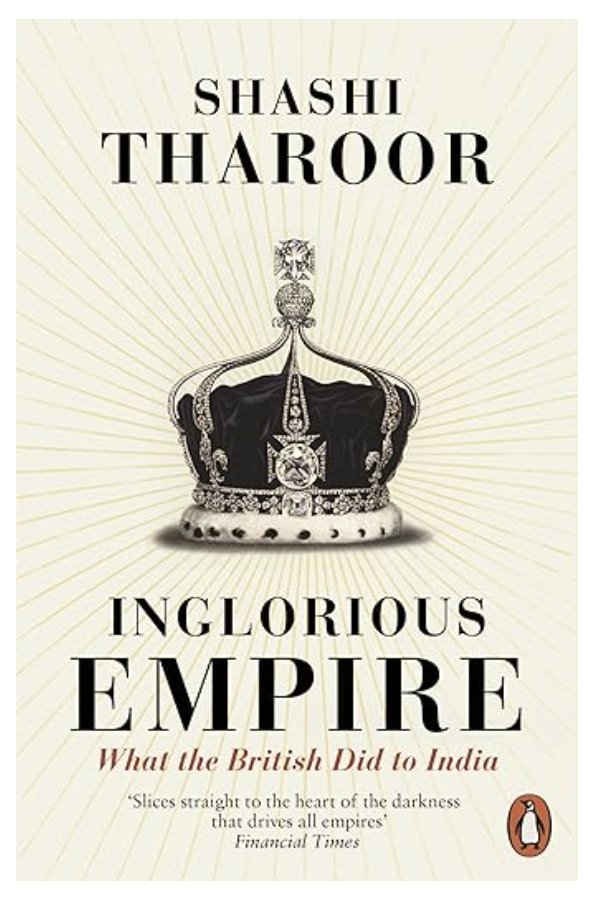
Beyond slave-trading and slavery, what were the economic effects of British imperial dominance? Can they be reduced to Britain’s leeching wealth from exploited subject peoples?
For over a century, that is what Indian nationalists have claimed. It is also what the politician Shashi Tharoor claims in his 2016 book, Inglorious Empire: What the British Did to India. Against him, however, the Bengali-born, LSE-based economic historian Tirthankar Roy has declared of the nationalist critique that “generations of historians … have shown that it is not [true]”. Pace Tharoor, the statistic that India produced 25 per cent of world output in 1800 and 2–4 per cent in 1900 does not prove that India was once rich and became poor: “[i]t only tells that industrial productivity in the West increased four to six times during this period … The proposition that the Empire was at bottom a mechanism of surplus appropriation and transfer has not fared well in global history”.
On the contrary, the British Empire’s commitment to free trade gave Indian entrepreneurs new opportunities to grow. Some of them visited England in the late 19th Century, observed the workings of manufacturing industry, imported machinery and expertise to India, built factories employing Indians, and then outcompeted Manchester. This is exactly how the Tata Iron and Steel Company began in Bombay – the same company that now owns what remains of the British steel industry.
What is more, colonial governments often protected native producers against British business, in order to moderate economic and social disruption, partly because they genuinely cared for the welfare of native people and partly because they didn’t want to have to manage the political unrest that foreign commercial intrusion could excite. Famously, in 1910-11 colonial officials barred Lever Brothers from acquiring concessions in Nigeria on which to establish palm-oil processing mills with widespread hinterlands, since Africans were already producing for the world markets and generating tax revenue and because the alienation of large areas of land risked provoking native opposition.
Further still, the British were the leading exporters of capital from the mid-19th Century to at least 1929. Between 1876 and 1914, Britain invested over a third of its overseas capital in the Empire, over 19% of it in India. Of course, British investors often made a profit out of this. That’s the thing about investment: you tend to want to grow your money, not waste it. But if the British gained, so did colonial peoples. Take railways. By 1947, British India had 45,000 miles of railway track, most of it constructed with private capital, whereas five years later un-colonised China still had less than 18,000 miles. For sure, the railways served military purposes. But they also served commercial and economic ones: one estimate reckons that when the railway network reached the average district, real agricultural income rose by about 16%. And it served the welfare purpose of efficient famine relief, too.
A basic reason why the British sent their capital overseas to the Empire, enabling the growth of businesses and the building of infrastructure, was that colonial states provided sufficient political stability and legal certainty to make the risks of financial ventures worth taking. (Badenoch hints at this in her reference to the economic effects of the Glorious Revolution of 1688.) That explains why Australia’s economic growth compares so favourably with that of many Latin American countries, and why, between the 1860s and 1890s, Australia was the richest country on earth.
In sum, the considered judgement of the Swiss historian Rudolf von Albertini, whose work – according to the world’s “leading imperial economic historian”, David Fieldhouse – was based “on exhaustive examination of the literature on most parts of the colonial world to 1940”, was simply this: “colonial economics cannot be understood through concepts such as plunder economics and exploitation”.
KICKING IT TO THE MOON? Canada’s Military Procurement: A history of broken promises
Esprit de Corps Canadian Military Magazine
Published Apr 22, 2024The Liberal government have finally released their long awaited Defence Policy Update which promises billions of dollars in increased spending for the CAF. Critics wonder if such promises are worth the paper they are printed on. History says that when it comes to military budgets, promises are made to be broken. Good Grief.
(more…)
Justin Trudeau’s legacy may not be something he ever wanted (or imagined)
Tristin Hopper outlines some of the attitudinal changes among Canadian voters during Trudeau’s term in office, with opinions shifting away from things we used to consider settled once and for all. Canada’s Overton Window is moving (relatively) quickly:

Front view of Toronto General Hospital in 2005. The new wing, as shown in the photograph, was completed in 2002.
Photo via Wikimedia Commons.
It’s been among the most volatile and untouchable third rails in Canadian politics: The adoption, at any level, of a private health-care system.
In the last federal election, a Conservative statement about “public-private synergies” was all it took for Deputy Prime Minister Chrystia Freeland to brand it as a right-wing assault on the “public, universal health-care system”.
But a new Ipsos report shows that “two tier health care” is not the threat it once was.
Among respondents, 52 per cent wanted “increased access to health care provided by independent health entrepreneurs”, against just 29 per cent who didn’t.
Perhaps most shocking of all, almost everyone agreed that private health care would be more efficient. Seven in 10 respondents agreed that “private entrepreneurs can deliver health care services faster than hospitals managed by the government” – against a mere 15 per cent who disagreed.
“People understand that the endless waiting lists that characterize our government-run health systems will not be solved by yet another bureaucratic reform”, was the conclusion of the Montreal Economic Institute, which commissioned the poll.
As Canada reels from simultaneous crises of crime, affordability, productivity, health-care access and others, it’s prompting a political realignment unlike anything seen in a generation. But it’s not just a trend that can be seen in the millions of disaffected voters stampeding to a new party. As Canadians shift rightwards, they are freely discarding sacred cows that have held for decades.
If Canadians are suddenly open to health-care reform, it helps that they’ve never been more dissatisfied with the status quo. The past calendar year even brought the once-unthinkable sight of the U.S. being officially called in to bail out failures in the Canadian system.


