
seangabb
Published Apr 28, 2024This seventh lecture in the course covers the career of Alexander the Great and its consequences for the world.
(more…)
April 29, 2024
Greek History and Civilization, Part 7 – Alexander
Comments Off on Greek History and Civilization, Part 7 – Alexander
“The Earth goes around the Sun, or so they would have you believe …”
Colby Cosh on a recent “grand theory” from Andrea Matranga, an Italian economist who outlined his thoughts in a paper accepted by the Quarterly Journal of Economics, summarized in the sub-hed “Hunter-gatherers were better off than Neolithic farmers, diet-wise — until Earth was hit by seasonal extremes caused by Jupiter’s gravity”:
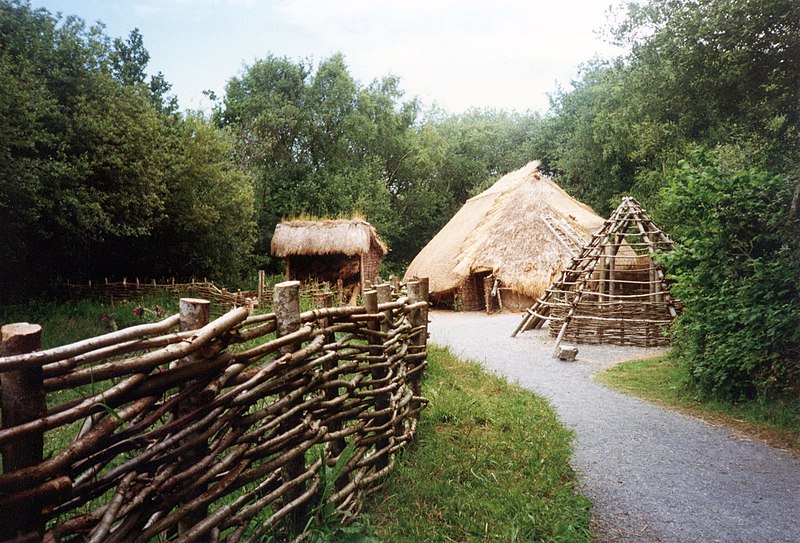
Reconstruction of a neolithic farmstead at the Irish National Heritage Park in Ferrycarrig.
Photo by Jo Turner via Wikimedia Commons.
Matranga’s own explanation for the invention of agriculture is: “Believe it or not, it is down to extraterrestrial forces”. Yes, that’s an actual quote from a cheeky Twitter thread in which Matranga summarizes his hypothesis colourfully. The real idea is that the period of the Neolithic Revolutions coincided with a time when seasonal temperature and rainfall differences were maximized by coinciding features of Earth’s orbit — features attributable mostly to Jupiter’s gravitational tug on us.
The Earth goes around the Sun, or so they would have you believe, and Earth’s rotational axis is tilted relative to the Sun, which creates the seasons. But the Earth’s motion has other subtle wobbles and shimmies caused by Jupiter: the eccentricity of its elliptical orbit grows and shrinks, and the rotational axis “precesses”, or wobbles, meaning that the face of the Earth pointing toward the Sun at our closest approach to it changes over time.
The implication of this is that over a period of millennia, and particularly in what we think of as the “temperate” zones, the magnitude of climate seasonality will itself change in a somewhat chaotic way. For some periods much longer than a human lifetime, seasonal changes might be almost beneath notice; a few millennia later, they become a dominant feature of human experience. And one hemisphere of the planet — say, the northern one — might end up with a lingering developmental advantage because it was favoured at the right moment by the precession of Earth’s axis.
Matranga pulls together a lot of math, astronomy and geography to show that the local Neolithic Revolutions coincide with maximum local seasonality, and then he builds some economic models of primitive society to suggest what effect this might have had on social organization and population evolution. Alfred Marshall would have told him to burn this part of his paper, but perhaps the equations are necessary for appearances. The crucial point is that Matranga has found a strong possible explanation for the Neolithic paradox — why, and when, humans in many places adopted a form of social organization that seems to have left most of them worse off on average.
For it’s not just the average that matters. In a world that was more or less the same year-round, hunter-gatherers didn’t have to worry about food storage: they could migrate cyclically within a small range, following wild game, to keep up with modest seasonal effects. But if the seasons then got more intense, food storage would become more important to the long-term survival of the group: one winter could now finish everyone off.
Comments Off on “The Earth goes around the Sun, or so they would have you believe …”
Battle Rifles of World War Two: Overview
Forgotten Weapons
Published Jan 26, 2024Today we are going to take a look at the three main battle rifles of World War Two — the M1 Garand, the SVT-40, and the Gewehr 43. We will also consider the SVT-38, Gewehr 41(W), and Gewehr 41(M). The United States, Soviet Union, and Germany were the three countries that fielded large numbers of semiautomatic full-power rifles in combat in WW2; how did they differ in their approaches to infantry firepower?
(more…)
Comments Off on Battle Rifles of World War Two: Overview
QotD: The draft
What frightened me was not going to Vietnam. What frightened me was going in the Army. The haircut, the uniform, the discipline: If I’d been allowed to go to Vietnam in my old clothes … The minute the draft disappeared, the whole hippie-dippy thing just went up in smoke.
P.J. O’Rourke, interviewed by Scott Walter, “The 60’s Return”, American Enterprise, May/June 1997.
Comments Off on QotD: The draft
April 28, 2024
The Battle of Berlin! – WW2 – Week 296 – April 27, 1945
World War Two
Published 27 Apr 2024The battle for the German capital rages on all week, as the Soviets get ever closer to the Reich Chancellery, under which lies Hitler’s bunker. Berlin is surrounded, but can it be relieved? There are also Allied advances in East Prussia, Czechoslovakia, and in Western Germany, but beyond that, it looks like the Axis lines have completely collapsed in Italy. The Allies are also advancing — and quickly — in Burma toward Rangoon, though not much at all on Okinawa, and it is the Japanese who are on the move in Western Hunan. It’s a real rollercoaster of a week.
Chapters
01:10 Recap
01:43 Soviets fight their way into Berlin
07:45 Berlin surrounded
10:28 Rokossovsky advances
12:48 Göring and Himmler betray Hitler
13:57 Fighting on the Eastern Front
15:23 Allied advance in the West
15:51 German collapse in Italy
17:31 4th Corps racing through Burma
19:36 The Battle of Western Hunan
21:40 Okinawa and the Philippines
22:59 Notes
23:59 Conclusion
(more…)
Comments Off on The Battle of Berlin! – WW2 – Week 296 – April 27, 1945
How Britain got out of the Great Depression (and no, it wasn’t WW2)
Tim Worstall, in refuting something being pushed by Willie Hutton, explains how the British government escaped from the Great Depression and set off a nice little boom in the mid- to late-1930s:
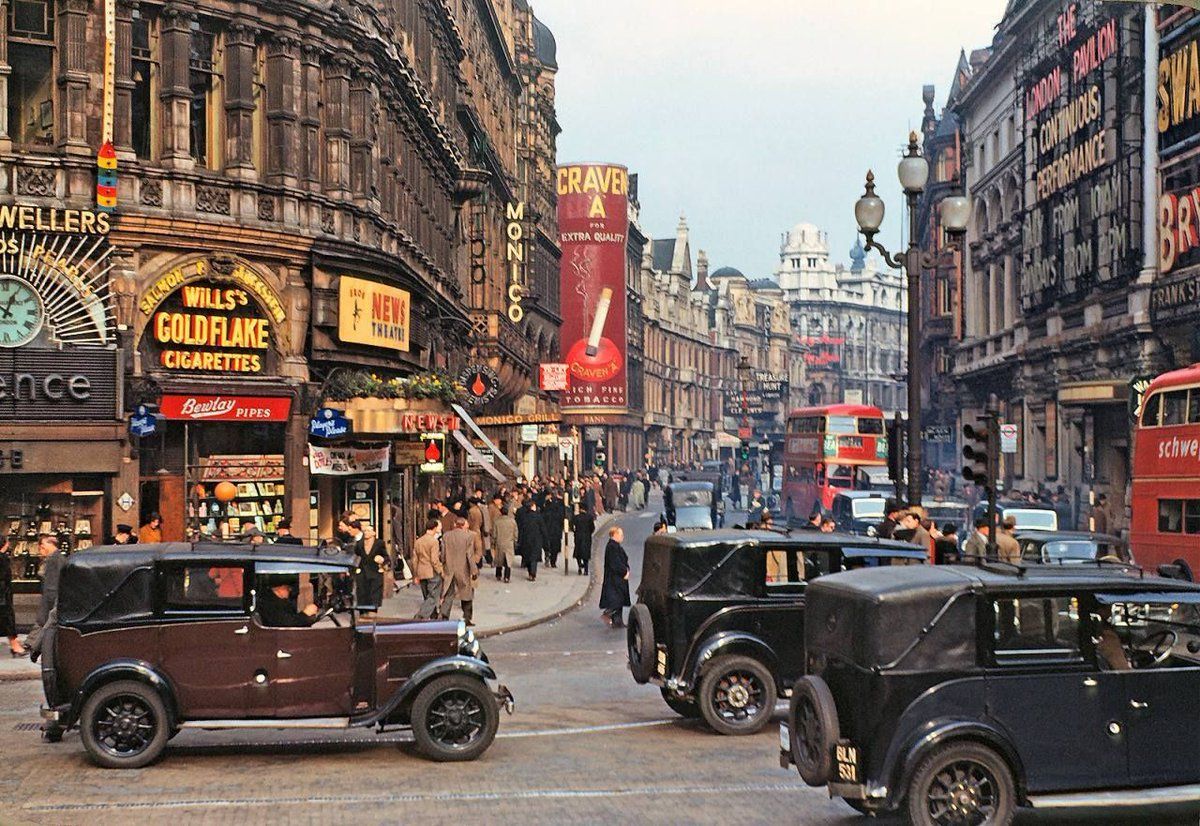
Piccadilly Circus in London, mid-1930s.
Colourized photo via Reddit.
Well, yes. Except that’s not actually what did drag Britain out of the Depression. What did was expansionary fiscal austerity. You know, that thing the Tories talked of in 2010 and which everyone laughed at? Somewhat annoyingly I was one of the very few (it’s annoying because I was clearly right in what I was saying) who pointed this out back then.
When we boil this right down it’s an argument about the effectiveness of monetary policy. Absolutely no one thinks that it has no effect. But there’s many who think that it has no effect at the zero lower bound: when interest rates are zero. That’s really the argument that leads to fiscal policy, that idea that government might tax less, or spend more, blow out that deficit and get the economy moving again. We’ve done all we could with monetary policy and we’ve still got to do something so here’s fiscal policy.
To put it as simply as possible. We’ve two major macroeconomic tools, monetary policy and fiscal. The first is interest rates, exchange rates and money printing and so on. The second is the difference between taxes collected and money spent by government — the government deficit or surplus (note, please, for purists, this is being very simple).
OK, either lever or tool can be used to loosen conditions — gee stuff up — or tighten them. Which we use when is somewhere between a matter of taste and necessarily correct given the circumstances. But clearly the total amount of geeing up out of a recession — or tightening to prevent inflation — or depression is the combination of the two sets of policies, applications of levers and tools.
It’s thus theoretically possible to tighten with one, loosen with the other and gain, overall, either tightening or loosening. Depends upon how much of each you do.
Britain in the 30s tightened fiscal policy. The opposite of what the Keynesians said, the opposite of what the US did and so on. Cut — no, really cut, not just slowed the increase in — government spending and thereby cut the government deficit (might, actually, have gone into surplus, not sure). This is, according to the Keynesian line, something that should make the recession/depression worse.
But at the same time they came off the gold standard — Churchill had taken us back in in 1925 at far too high a rate — and lowered interest rates. That’s a loosening of monetary policy.
As it happens, on balance, the monetary was loosened more than the fiscal was tightened and so we have expansionary fiscal austerity. Which set off a very nice little boom in fact. The mid- to late- 30s in Britain were economic good times. Driven, nicely driven, by a housebuilding boom — the last time the private sector built 300 k houses a year in fact (this is before the Town and Country Planning Act stopped all that). Mixed in was that the motor car was becoming a fairly standard bourgeois item and so housing spread out along the roads.
Comments Off on How Britain got out of the Great Depression (and no, it wasn’t WW2)
Look at Life – The Car Has Wings (1963)
Classic Vehicle Channel
Published Apr 19, 2020Transporting cars by sea, air and rail. This film features wonderful traffic archives.
Comments Off on Look at Life – The Car Has Wings (1963)
QotD: “I love Big Brother!”
I don’t relish the Winston Smith role. I’ll just pass on the rats in Room 101 and skip right to the mindless, thoughtless bliss of Big Brotherly love without having to have it beaten into me.
Actually, it seems that Orwell was mistaken. Oppression does not have to mean dismal living conditions, horrible food, telescreen propaganda and rusty rationed razor blades. Big government can control people far more effectively by giving them a small slice of comfort and domesticity. Allow them a modest home. Encourage them to accumulate trinkets and toys and the occasional status symbol. Allow commercial marketing to develop the propaganda that shapes opinion and mood and sets people on the desired path.
Commercial marketing is far more effective than state propaganda — “Drivers Wanted” has recruited more people than any poster featuring a stern and serious Uncle Sam. Keep them somewhat comfortable, keep them acquisitive rather than inquisitive, keep them entertained rather than informed — and no-one will be seriously tempted to pursue an alternative.
Jonathan Piasecki, private e-mail, 1999-07-07 (originally published, with permission, on the old blog, 2005-06-24).
Comments Off on QotD: “I love Big Brother!”
April 27, 2024
Climate science or climate “science”?
David Friedman is a very intelligent man and I wouldn’t want to face him in a debate, even on a topic I feel well-informed about. He’s not a scientist and hasn’t made a serious study of climate but he can read the reports and make up his own mind. He’s inclined to believe the data available indicates that the planet is warming but he isn’t convinced that this is enough to justify the kind of authoritarian controls that climate activists demand:
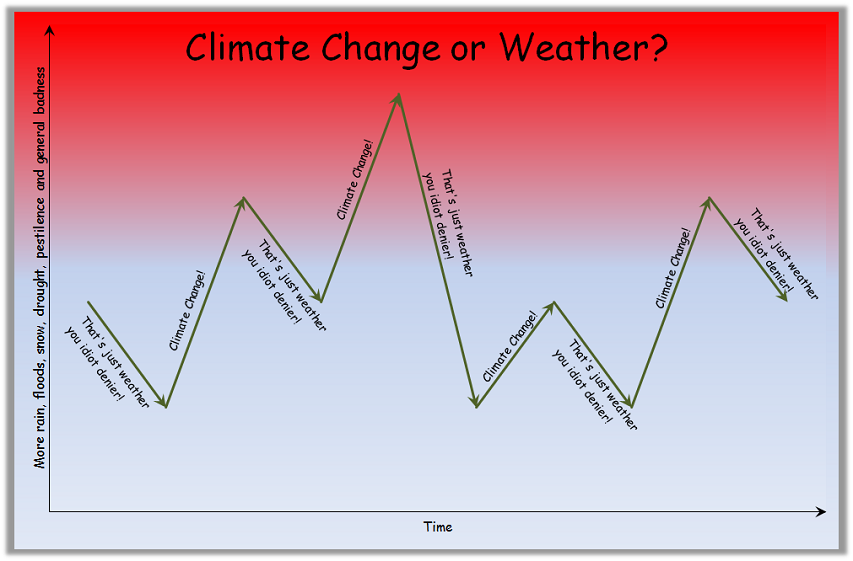
The argument for doing drastic things to prevent global warming has two parts. The first has to do with reasons to think that the earth is getting warmer and that the reason is human action, in particular the production of CO2. The second is the claim that changes we have good reason to expect if we do not take appropriate action to prevent them will have very bad consequences for us.
Much of the criticism I have seen of the argument has to do with the first half, with critics arguing that the evidence for global warming, at least the evidence that it is caused by humans and will continue if humans do not mend their ways, is weak. I do not not know enough to be certain that those criticisms are wrong; climate is a very complicated and not terribly well understood subject.1 But my best guess from watching the debate is that the first half of the argument is correct, that global climate is warming and human action is an important part of the cause. What I find unconvincing is the second half of the argument, the claim that climate change we have good reason to expect would have catastrophic consequences for humans.
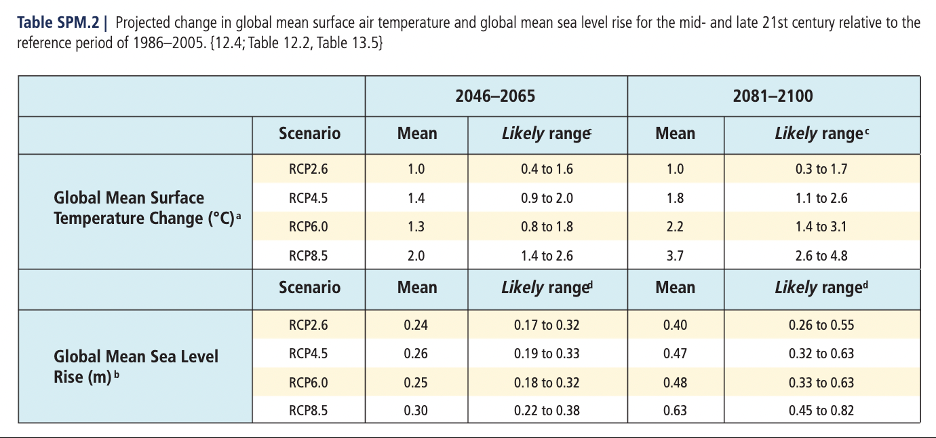
Obviously one can imagine climate change large enough and fast enough to be a very serious problem — a rapid end of the current interglacial, for example. If, as I believe is the case, climate is not very well understood, one cannot absolutely rule out such changes.2 But most of the argument is put in terms not of what might conceivably happen but of what we have good reason to expect to happen. I think the outer bound of that is provided by the IPCC models. They suggest a temperature increase of a few degrees centigrade over the next hundred years resulting in a sea level rise of less than a meter.3
Comparing a map of global temperature to a map of population density shows densely inhabited regions with average temperatures from about 10°C to about 30°C, with some of the most densely inhabited regions at the high end of the range. I could find no empty areas that are hotter than all populated areas, hence no areas that are depopulated only because of how hot they are. If people can currently live, work, grow crops over a temperature range of twenty degrees it is hard to imagine any reason why most of them couldn’t continue to do so about as easily if average temperature shifted up by two or three degrees, with a century to adjust to the change.
That raises the question with which I titled this post: Does climate change catastrophe pass the giggle test? Is the claim that climate change on that scale would have catastrophic consequences one that a reasonable person should take seriously?
[…]
A different version of the catastrophist argument is the claim that climate is unstable, that an increase of a few degrees could trigger a much larger increase. That might be plausible if current temperatures were so high that additional warming would raise them above any in the past. But although present temperatures may be higher than any in the past two thousand years, as discussed in an earlier post, the Earth is much more than two thousand years old.
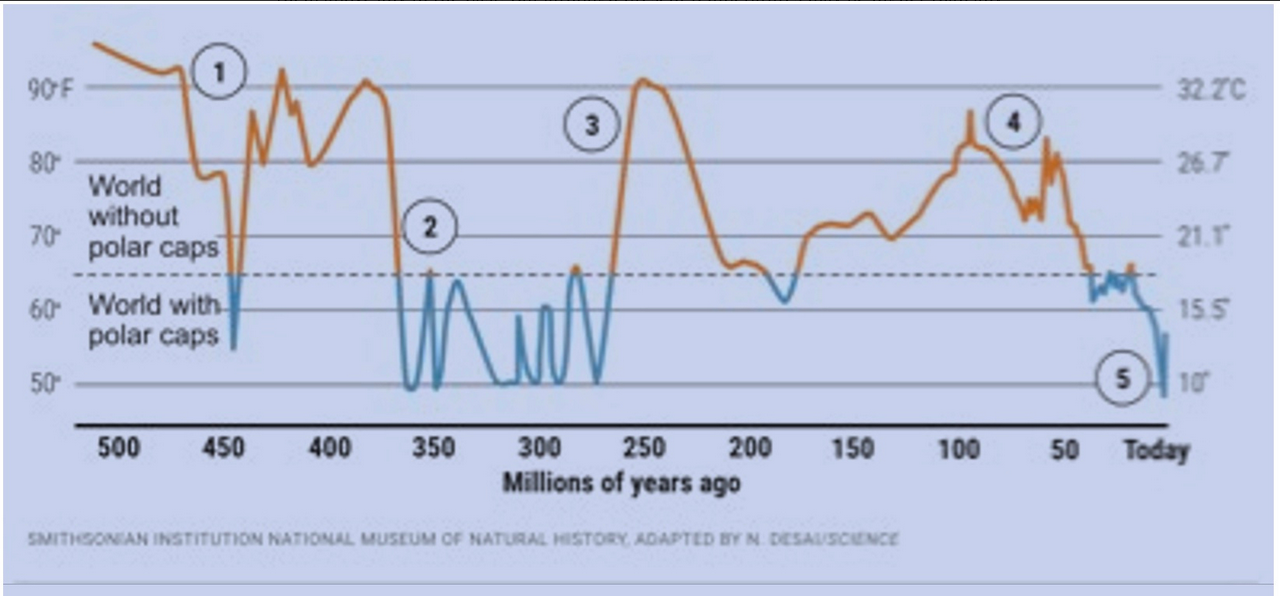
The graph below4 shows estimated global temperature over the past five hundred million years. While present temperature is high relative to the recent past it is cool relative to the more distant past, more than thirteen degrees below the high of the past hundred million years.
We are currently in an ice age, defined by geologists as a period when there is an ice cap on one or both poles. For most of the past five hundred million years there wasn’t.
The claim that we have good reason to expect climate change on a scale that will produce not merely problems for some but catastrophe for many is one that no reasonable person should take seriously.5
1. As some evidence, as of 2018 the temperature projections produced by the IPCC’s elaborate analysis did a somewhat worse job of predicting actual temperature than a straight line fit from the date when warming restarted after the midcentury pause to the date of each of the first four IPCC reports.
2. We cannot absolutely rule out catastrophic changes either caused by anthropogenic warming or prevented by anthropogenic warming. There is, in fact, some evidence, discussed in an earlier post, that the reason the next glaciation is not already starting is anthropogenic warming — not current warming due to the industrial revolution but warming that started some eight thousand years ago due to the invention of agriculture.
3. From Future Climate Changes, Risks and Impacts. RCP8.5 was originally designed as an upper bound on how high future CO2 emissions might be and assumed a level of world population growth that, so far, is not occurring, so should probably not be included.
4. The headline of the news story I found it in: “A 500-million-year survey of Earth’s climate reveals dire warning for humanity”.
If life gives you peaches, make cyanide from the pits.
5. The weaker claim that climate change will produce net costs for humans is, in my view, less obviously true than many believe. For reasons see my past posts on the subject.
Comments Off on Climate science or climate “science”?
“… when it comes to energy policy Germany is an undisputed champion of crazy”
eugyppius explains how Angela Merkel’s government reacted to the Japanese Fukushima disaster in a sane, measured, and sensible way … naw, I’m pulling your leg. They looked at all the options and then selected the dumbest possible reaction available to them:
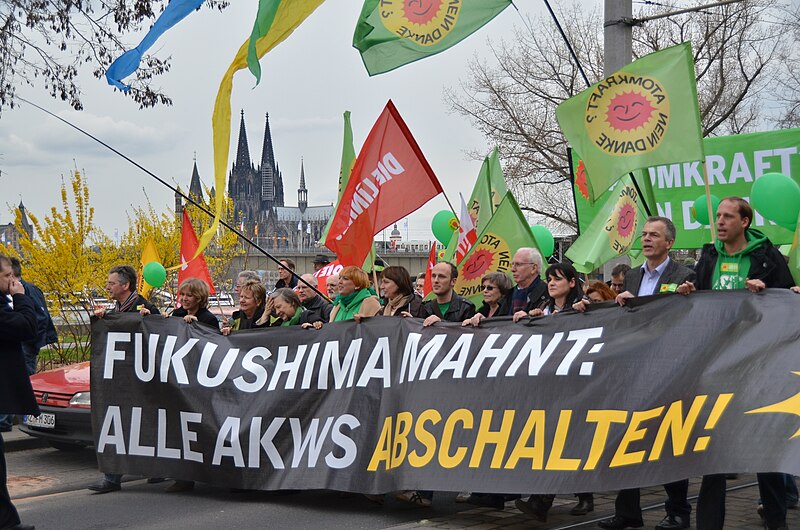
German anti-nuclear protest in Cologne, 26 March 2011.
Photo by Bündnis 90/Die Grünen Nordrhein-Westfalen via Wikimedia Commons.
All of our countries are crazy in various ways, but when it comes to energy policy Germany is an undisputed champion of crazy.
In 2011, a tsunami caused the Fukushima nuclear disaster. If you check a map, you’ll notice that Fukushima is in a country called Japan, which it turns out is a different country from Germany. The Fukushima disaster had zero to do with the Federal Republic, but then-Chancellor Angela Merkel felt the need to solve the problem of Fukushima by phasing out nuclear power in Germany, even though tsunamis and earthquakes are not a problem in Germany, because Germany is a country in Central Europe and not an island nation in Asia.
That is crazy enough, but it gets much crazier. Months before announcing the nuclear phase-out, Merkel’s government had passed energy transition legislation to secure Germany’s path towards a zero-emissions future. We resolved to ditch our most significant source of emissions-free power, in other words, just months after resolving an energy transition to emissions-free power. At this point you would be justified in wondering if Germany suffers from some kind of shamanistic cultural phobia of electricity in general, that is how crazy this is. These insane choices had the near-term consequence of increasing our dependence on Russian natural gas. Otherwise, they ensured that power generation in Germany would be vastly more expensive than necessary and also vastly more carbon intensive than necessary.
Now, crazy demands explanations, and observers have proposed various theories for the German climate nuclear crazy. Two of them deserve mention here:
1) The 1968 generation in Germany suffered from unusual radicalism, sharpened by moral anxiety over National Socialism, and resolved to outcompete all others in the project of self-abnegating virtue. Our culture developed a deranged anti-nuclear movement that in a fit of typical German thoroughness also came to embrace opposition to nuclear power. The Chernobyl disaster radicalised the pink-haired anti-nuclearists still further, and these cretins grew up to become news anchors, school teachers and book authors, effectively indoctrinating the next generation according to their parareligious delusions.
2) German politicians after the Cold War – especially Gerhard Schröder and Angela Merkel – harboured a subtle and not entirely unreasonable desire to strengthen ties with resource-rich Russia. They decided that the anti-nuclearists and the Green Party could be instrumentalised towards this end. The energy transition and the nuclear phase-out increased our dependence on Russian gas, and this was a feature more than it was a bug.
These are mutually supporting theories, but I don’t think either of them can fully account for the bizarre phenomenon before us. Germany energy crazy is a very deep problem and it will keep historians busy for many generations.
In 2022, Russia invaded Ukraine, and Germany under Merkel’s successor, Chancellor Olaf Scholz, decided along with the rest of the liberal West that Russia was bad, bad, bad and that evil Putin had to be punished with self-immolating sanctions, sanctions, sanctions. This new spasm of high-minded moralising further attenuated our energy situation, ushering in an entirely self-made energy crisis. The Greens, now in government, were determined to proceed with the last stages of the nuclear phase-out, even with our natural gas supplies in doubt. Only when they saw themselves staring into the abyss of political doom did they grudgingly agree to give our last nuclear plants a three-and-a-half month lease on life. We Germans and our energy policy had out-crazied everyone else, we had made ourselves the laughing stock of the entire world, that is how crazy we were.
Comments Off on “… when it comes to energy policy Germany is an undisputed champion of crazy”
Floating Fun: The History of the Amphibious Boat Car
Ed’s Auto Reviews
Published Aug 9, 2023A classic car connoisseur dives into the general history of amphibious cars and vehicles. When did people start to build boat-car crossovers? What made Hans Trippel’s Amphicar 770 and the Gibbs Aquada so special? And why don’t you see a lot of amphibious automobiles out on the road and water these days?
(more…)
Comments Off on Floating Fun: The History of the Amphibious Boat Car
QotD: Roman magistrates during the middle Republican period
Similar to the magistrates in the Greek polis, Roman magistrates should not be thought of as bureaucrats within a unitary governing institution. Rather each magistrate is an independent actor, granted certain powers to oversee the public interest in a specific field. This is perhaps even more true of Roman magistrates, who rarely function as “boards” the way Greek magistrates often do (none of the senior magistrates in Rome function as a board, they are all individual actors). Instead of having an chief executive (like a president or prime minister) to coordinate the different actions of government, the Romans in the Middle Republic instead rely on the Senate, which will be our topic for next week, though the Senate’s guidance is going to show up a fair bit here as well.
Each of these offices has a range of functions and some interesting powers and prerogatives, so it is worth discussing each one in turn.
Bret Devereaux, “Collections: How to Roman Republic 101, Part IIIa: Starting Down the Path of Honors”, A Collection of Unmitigated Pedantry, 2023-08-11.
Comments Off on QotD: Roman magistrates during the middle Republican period
April 26, 2024
Out – “GenZ”: In – “Waffen ZZ“
Peachy Keenan invites us to meet the new hotness, the Zoomerwaffen:
These crazy Zoomer kids are bringing back all the old trends: baggy jeans, the band Sublime, and casual, no-big-deal, fanatical anti-semitism. When I was in college, the only people who still hated Jews were Arabs and skinheads. In 2024, hating Jews is even cooler than having retarded pronouns!
“Never again” was the promise Jews made to themselves after the Holocaust and it held for almost 80 years, but it looks like we are in fact about to do it again. It’s starting, ironically, on the same elite college campuses that were the birthplaces of the “inclusion” movement of recent years. Our finest universities have spent the last 30-odd years “abolishing hate”, establishing “safe spaces”, and forcing tolerance down students’ throats until they gagged on it.
Columbia’s Hamas encampment is a safe space. Not for Jews, though.
But also we have to acknowledge that demands from Jewish students for special protections against hate speech, harassment, violence, and bigotry, while totally justified, tend to stick in the craw of other identity groups who have been the target of widespread vilification and hate on campus for years, right here in the United States.
The Zoomerwaffen are here and they are coming for the Jews — the same way their college came for the straight white males.
Zoomerwaffen SS officer Klaus Von Chad in his Amazon keffiyeh cheers as the American flag is taken down and burned.
Yes, some of the Zoomerwaffen even look like Nazis, apparently. These wild-eyed Ivy League coeds have taken a break from rizzing each other up and accidentally overdosing on fentanyl so they can goof around in keffiyahs, call for the slaughter of a persecuted religious minority, and ululate in their Lululemons as they are arrested for insurrection. (Insurrection is good now, Grandpa!).
I had to laugh when I saw Ilhan Omar’s unfortunate daughter arrested at Columbia for leading some anti-semitic protest. Bit on the nose, even for the Omar family, isn’t it? Ilhan’s little nepo meeskite got kicked out of her dorm and suspended from school, which means she can expect a job offer from MSNBC any minute now.
Since October 7th, Jews have been under attack everywhere and literally Hamas has replaced BLM as the coolest club in America for progressive, “love is love”, white kids.
Welcome to the Swiftie-to-Jihadi pipeline!


Comments Off on Out – “GenZ”: In – “Waffen ZZ“
The British Army from the start of the Cold War
Dr. Robert Lyman discusses the state of the British Army through the Cold War years down to today, with emphasis on the defence budget tracking against perceived threats to the UK and allies over that period:
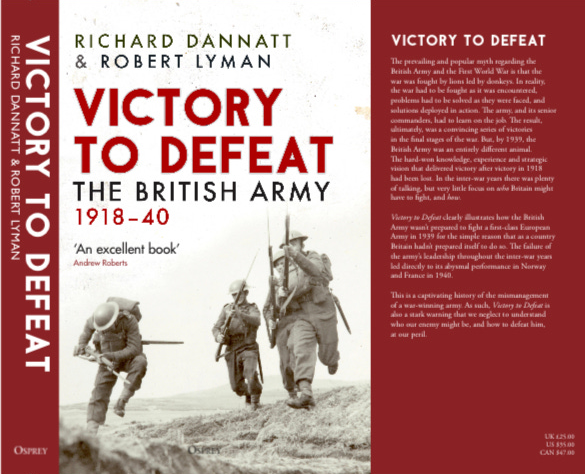
Last year General Lord Dannatt and I published an account of the British Army between 1918 — when it achieved a great victory — and 1940, when it did not. The book was written in part to challenge the UK to think seriously about what happens when our country neglects the requirement for an army able to fight at a high-intensity for a prolonged period against a peer adversary.
Part of our argument was to look at the amount of money the country spends on its defence as a barometer of the seriousness or otherwise of our political masters towards spending money on the primary duty of government, namely the security of its citizens. Our fear is that in the rampant feel-goodery that has plagued the West since 1991 the harsh realities of our unstable world have become forgotten. It has taken Putin’s invasion of Ukraine, and Russia’s subsequent bludgeoning of that benighted country for politicians to gradually wake up to the scale of the threat that this sort of instability offers to the world, not merely Europe or the West.
My fear, like that of many others, is that the wake-up call is taking too long and our country’s defences remain in a parlous state. We haven’t had an army able to deploy at divisional level or above in sustained all-arms manoeuvre for perhaps ten years or more. In other words, our ability to provide what our forefathers would have described as a robust “continental commitment” is almost non-existent.
In the book we trace the origins of the failure to think seriously about the need to have a deployable, expeditionary army, able to fight and operate alongside its allies in NATO on an all-arms battlefield. The reality is that the Cold War forced Britain to retain the ability to fight a general war in Europe, all the while finding the resources to undertake its other commitments across the world. Although worldwide events were dynamic from 1945 to 1989 with further conflicts for the United Kingdom in Malaya, Dhofar, Cyprus, Kenya, Borneo, the Falklands, and the long-running Troubles in Northern Ireland, it was the Cold War in Europe that principally drove the defence agenda and kept the budget at around 5 per cent of GDP. As the major bridge between the United States and Europe, the Royal Navy was heavily committed above and below the surface of the Atlantic Ocean to keep open the sea lines of communication to NATO’s dominant partner, while the British Army retained some 55,000 troops in four armoured divisions as part of NATO’s Northern Army Group and the Royal Air Force was also largely forward-based in West Germany as part of the Second Allied Tactical Air Force. These conventional deployments were all conducted under the nuclear umbrella of Mutual Assured Destruction. By the 1980s, with the West under the leadership of US President Ronald Reagan and British Prime Minister Margaret Thatcher and with increased spending on both conventional armaments and the highly experimental Inter-Continental Ballistic Missile Defence system, the strain of strategic military competition began to show on the political and economic stability of the Soviet Union. Despite the perestroika political movement for reform within the Communist Party of the Soviet Union and the associated openness of glasnost under General Secretary Mikhail Gorbachev, the cracks in the Berlin Wall that opened on 9 November 1989 led inexorably to the collapse of the Soviet Union two years later and the old flag of Russia being raised over the Kremlin on 26 December 1991. The Cold War was over, and an apparent New World Order had begun. The historian Francis Fukuyama declared – somewhat ambitiously – the end of history.
It was at this point that international leaders and their finance ministers in the West began to overlook the cautionary tale that the history of the 20th century might have taught them. With the Soviet Union gone and rump Russia apparently enfeebled, Western states eagerly embarked on military reduction and a peace dividend. In the United Kingdom, the “Options for Change” exercise saw a major slashing of defence capability, beneficially coincidental to help ameliorate a significant economic downturn. The British Army was reduced from 155,000 to 116,000 soldiers, notwithstanding the first Gulf War of 1990–91 which many wishful thinkers regarded as something of an aberration. However, despite that war and the subsequent deployment of large parts of the armed forces to Bosnia from 1992 and then to Kosovo in 1999, the new Labour government of Prime Minister Tony Blair continued with the implementation of its Strategic Defence Review of 1997–98. As a piece of policy work, this was considered an honest review of the United Kingdom’s defence policy and a progressive blueprint for future defence planning and expenditure. Endorsed by Tony Blair and the Chiefs of Staff, this review might have stood the nation in good stead for the future had the Chancellor of the Exchequer, Gordon Brown, fully funded its outcome. For his own reasons, he chose not to do so. The underfunding of the United Kingdom’s defence capability began to show its deficiencies a year after with the second Gulf War of 2003, and the situation was then exacerbated by a protracted campaign in Iraq for the British Army lasting until 2009 and an even more intense one in Afghanistan lasting until 2014.
Comments Off on The British Army from the start of the Cold War
Economic inefficiencies in the water market? Don’t worry, here’s the government to make it much worse
Tim Worstall discusses the economics of water markets in the US … that Senator Elizabeth Warren and Representative Ro Khanna seem determined to make far less efficient if their plans come to fruition:

Senator Elizabeth Warren speaking at the Iowa Democrats Hall of Fame Celebration in Cedar Rapids, Iowa, on 9 June, 2019.
Photo by Lorie Shaull via Wikimedia Commons.
Aficionados for truly stupid political interventions into matters economic will already be aware of the idiocies perpetrated by Senator Elizabeth Warren and Representative Ro Khanna. The two seem to end up as if someone rolled together the ideas of Professor Richard J Murphy and The Guardian opinion page then removed all the insight, subtlety and sensibility. True, not an arduous task removing those three but …
The basic water problem out in the Western US is that the wrong people currently own the water rights. We would therefore like to see more trade in those rights. Warren and Khanna are insisting upon further limitations upon the trade in those rights. This is rampant idiocy.
To set the scene, as folk moved out there they realised that water was not one of those things in great surplus in the area. So, those who got there first made sure that the property rights to the water were assigned to them. Nothing odd about this and rights to a scarce resource do need to be allocated. Otherwise we just end up with the commons problem and the resource is exhausted.
OK. And, y’know, quite a lot of things have changed in the century, century and a half since that Wild West was properly populated. But the descendants of those original farmers still own near all the water rights. Hmm, bit of a problem.
That’s OK, we’ve Coase to advise us here:
Ronald Coase (1960), “The Problem of Social Cost”
In the absence of transaction costs, if property rights are well-defined and tradable, voluntary negotiations will lead to efficiency.
It doesn’t matter how rights are allocated initially …
… because if they’re allocated inefficiently at first, they can always be sold/traded …
so the allocation will end up efficient anyway
Now, the distribution — who gets the cash from all of that — is dependent upon that first distribution. But that’s a minor problem compared to the efficient use of water.
So, we want lots of buying and selling. The idiots using $300 of irrigation water to grow $100 worth of alfalfa (pretty much my first English-world piece was on exactly this subject, near 30 years back) can instead sell that same acre-foot to a city, where the two households will happily each pay $500 a year for the half an acre-foot they require.
The asset — the water — has moved from a lower valued (actually, value destructive) use to a higher, the world is richer in aggregate. It doesn’t matter that the farmers get the money because Grandpappy shot all the Injuns. Even without the who gets the money we’re all richer — we’re getting $1k not $100 from the same acre-foot of water.
Coolio!
Enter Warren and Khanna:
With private investors poised to profit from water scarcity in the west, US senator Elizabeth Warren and representative Ro Khanna are pursuing a bill to prohibit the trading of water as a commodity.
Idiots. Damn fools. Politicians, but I repeat myself triply.
Now, do note they’re not trying to insist that water cannot be bought and sold — not because they don’t want to, they do, but because as Federal politicians they’ve no power whatever over within state markets. However, as Federal politicians they can claim power over commodity markets — the speculators will come from around the country, over state lines and interstate commerce is Federal.
So, as with onion futures, they want to ban water futures.
Comments Off on Economic inefficiencies in the water market? Don’t worry, here’s the government to make it much worse


