
Quick, ask the Boomers what was so great about The Sixties™. I hope you’ve got a few months to spare, but if you boil it all down, it’s “the spirit”. They really thought they were fundamentally transforming the world, and may God have mercy on all our souls, they were right. Same thing with the WWII generation, the Progressive Era, whatever. Even those who wax nostalgic for the 80s will talk about the feeling of the age — “the last golden Indian summer of America”, as someone quoted in the comments yesterday, and doesn’t it break your heart?
Not to get all Classical Rhetoric up in here, but for prior generations, things like “The Beatles” are synecdoche. They’ll go to their graves insisting that The Beatles were “the greatest band ever”, but if you press them on it, most of them are honest enough to admit that Ringo et al weren’t such great shakes, musically. At their best, The Beatles’ songs are musically simplistic and lyrically gibberish; at their worst, they’re “Rocky Raccoon”. The Beatles are “great” because they were innovators, not so much musically but because they were so goddamn pretentious. They wanted to be not mere entertainers, but artistes, and we indulged them, and that combo — pretentiousness and indulgence — became The Spirit of the Sixties.
Thus if you answer “The Beatles” to the question “What’s so great about The Sixties?”, it’s a synechdoche for “the spirit of the age”.
Severian, “Why the 90s Was the Worst Decade Ever”, Rotten Chestnuts, 2021-07-04.
October 20, 2024
QotD: The “Spirit of the Sixties”
October 19, 2024
The worst month for legacy media … so far
Ted Gioia has a (paywalled) post on the awful, terrible, bad, no-good month for the mainstream media. I think the headline needs an appropriate meme:

These events all happened in the last few days.
They are NOT unconnected:
- SEPTEMBER 24: The Financial Times reports that a Substack launched two years ago by Bari Weiss is now worth $100 million, and has just raised $15 million from investors.
- OCTOBER 1: One week later, journalist Taylor Lorenz announces that she is leaving the Washington Post to launch an online periodical on Substack. She plans to hire other writers and offer in-depth coverage of tech and internet culture.
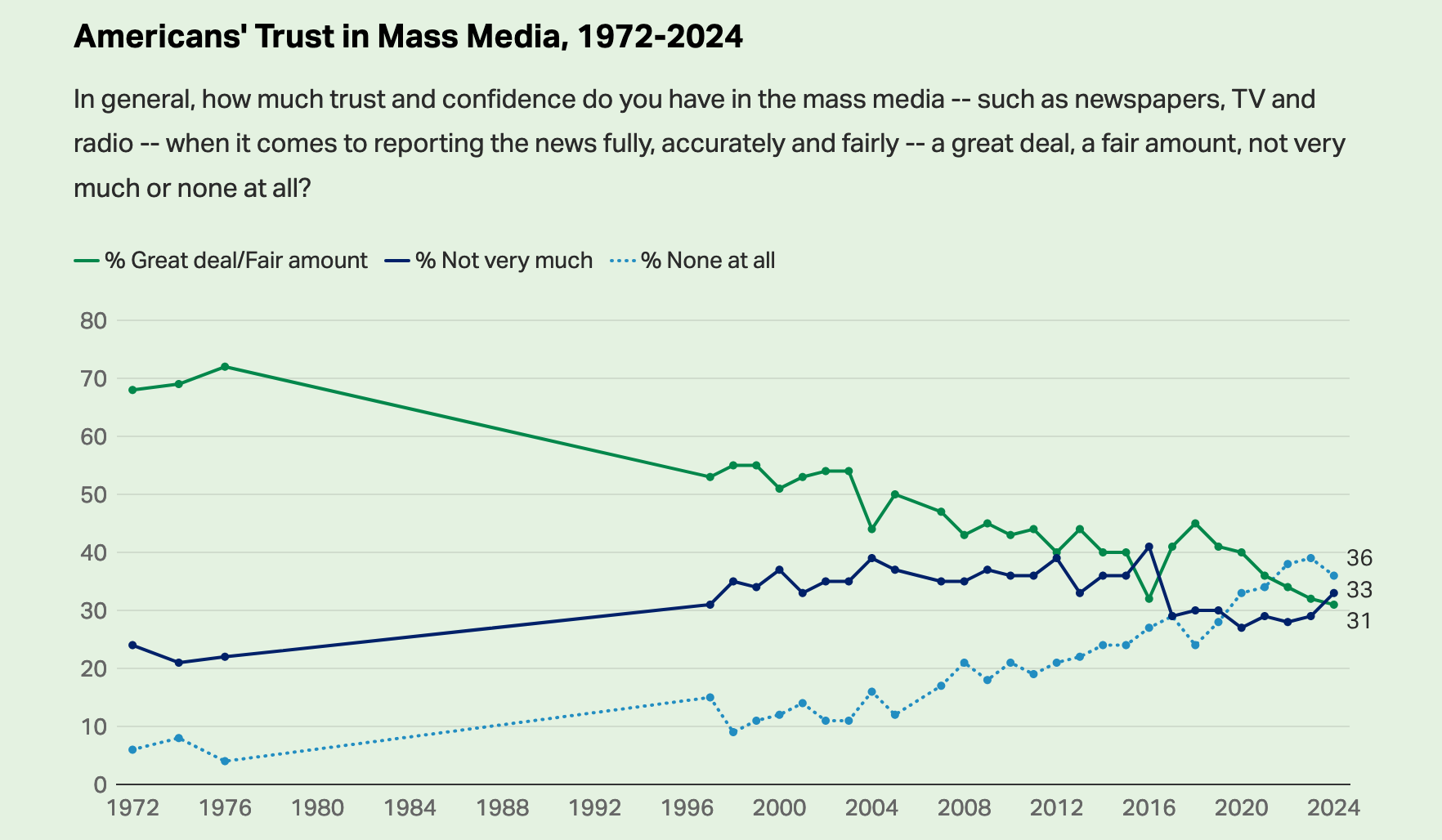
- OCTOBER 14: Gallup announces the results of a new poll showing that trust in mass media has reached an all-time low.
Source – Gallup
- OCTOBER 15: The Wall Street Journal reports that bestselling novelist James Patterson is launching on Substack. He has sold 480 million books since publishing his first novel in 1976, but now will sell subscriptions to readers at a price of six dollars per month.
- OCTOBER 15: That same day the New York Times reports that the “queen of legacy media” Tina Brown — formerly editor of The New Yorker and Vanity Fair — is now launching on Substack. She is also charging six dollars per month.
Changing gender balance in occupations and in higher education
At Postcards from Barsoom, John Carter ruminates on the likely downward path of many institutes of higher learning as current gender balance changes continue:
An occupation that flips from male to female dominance invariably suffers not only diminished prestige, but also a decline in wages … which, once again, makes sense in the context of sexual psychology. A man’s income is one element (and a big element) of a woman’s attraction to him, but the reverse is not true; if women are paid less, this does not really hurt their value in the sexual marketplace at all, and so they will push back against it much less than men would. This is probably what lies behind the tendency of women to be less forceful when negotiating salaries.
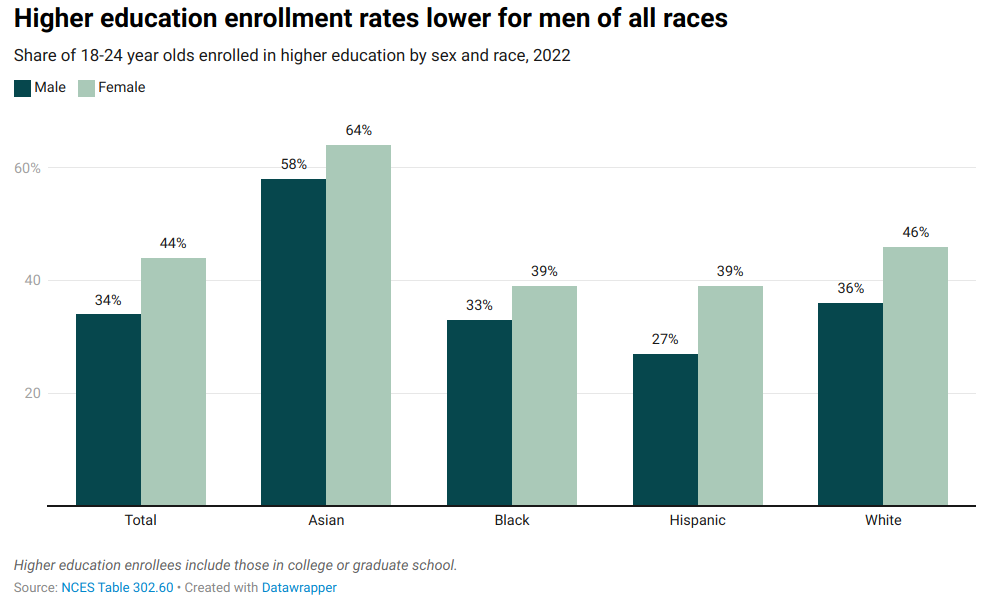
To the point: ever since the 1970s, women have overtaken and gradually eclipsed men within higher education. There is a gap in enrolment, consistent across racial groups:
[…]
Across all programs, at all academic levels, American universities recently reached the threshold of 60% of the student body being female.
This will be a disaster for academia.
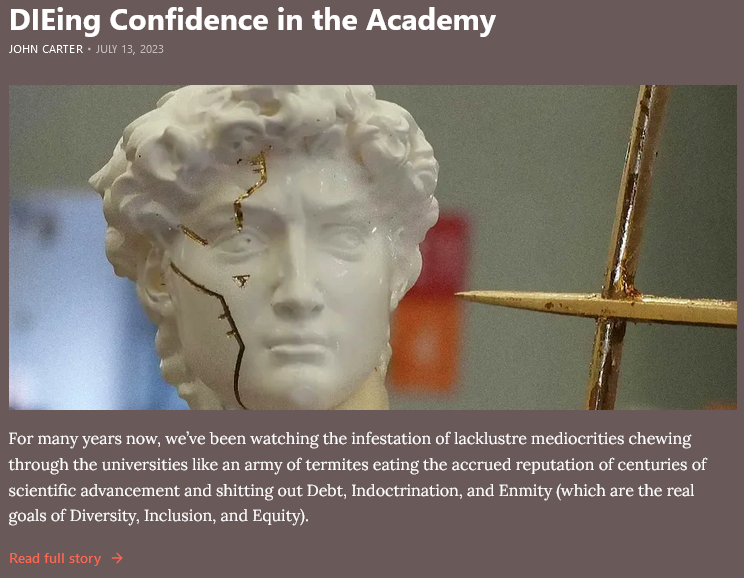
Indeed, it’s already a disaster. About a year ago, I analyzed a Gallup poll which revealed that the confidence of the American public in the trustworthiness and overall value of the academic sector had declined precipitously over the course of the 2010s.
In that article I examined several factors contributing to this DIEing confidence in the academy: the explosive growth in tuition fees, even as continuous relaxation of academic standards dilutes the actual value of a degree; the deplorable state of scholarship, with endless revelations of fraud, a seemingly irresolvable replication crisis, and the torrent of psychotic nonsense that passes for ‘research’; the increasingly frigid social environment enforced by the armies of overpaid, sour-faced administrators. Almost all of these, however, are related in some way or another to the feminization of academia.
And it is probably going to get much worse before it gets better.
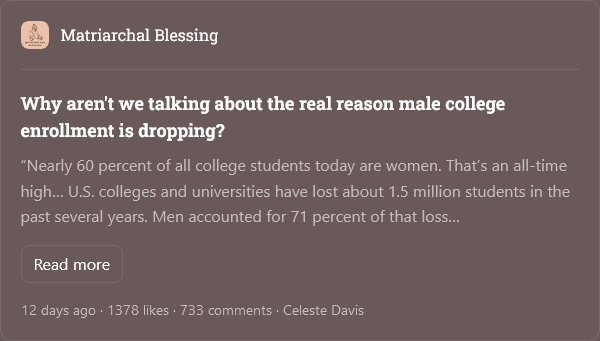
As discussed in this recent article by Celeste Davis of Matriarchal Blessing, research on male flight indicates that a 60% female composition represents the tipping point beyond which men perceive an environment as feminine, which then leads to a precipitous decline in male participation. Davis appears to be some sort of feminist3, but I want you to look past that and give her article a read; it is very thorough, well-researched, and thought-provoking (and also the direct inspiration for this article).
[…]
Universities are belatedly starting to notice that male enrolment is dropping fast, particularly among white men (I wonder why…), and are starting to make noises about maybe thinking about perhaps looking into ways of trying to recruit and retain more men (albeit, not specifically white men).
This seems unlikely to succeed.
Even if universities are successful in setting up programs to increase male recruitment, they will be fighting an uphill battle against the sexual perception that has already set in. Once something is coded as being a feminine hobby, it is extremely difficult to change that code. While it’s very easy to list examples of professions that have switched from male to female dominance, off the top of my head I have a hard time coming up with examples of the reverse. This suggests that female dominance tends to be sticky. There’s no reason to expect this will be any different with academia, either within individual programs, or across the sector as a whole.
This is an entirely different problem from the one faced by female entryism. In the initial phases of female entry, the primary difficulty faced by women is that it is simply more difficult to compete with men – in the case of athletics, effectively impossible. Women must therefore either work extremely hard, or the work must be made easier for them. In practice, since the 1970s we’ve seen both of these, with “working twice as hard as the boys” predominating in the early years, and assistance from special programs predominating later on.
By contrast, the central obstacle faced by anyone trying to attract men to a female-dominated environment is that men are deeply reluctant to enter. As a third of young men told Pew when asked why they didn’t attend or complete university: they just didn’t want to. It isn’t because they can’t compete with women. They can, usually with ease, but competition is pointless because it will gain them nothing. Special programs to assist men are beside the point; if anything, they work against you, because the implicit message with any special program for men is that they need help to compete with women … thereby making competition even more pointless. “You beat a girl but you needed help to do it”, is going to impress the girls even less than beating a girl unaided.
Trope Talk: Train Fights!
Overly Sarcastic Productions
Published Jun 28, 2024Everyone pack your bags, do your hand-stretches and file this one under “trope talks that could easily be bingo cards”! Today let’s talk about that oh-so-spectacular staple of setpieces, the marvelous Train Fight!
(more…)
QotD: From blackberry picking to Bible verses
It’s pretty trite by now to point out that Biblical metaphors that would have made perfect sense for an agricultural society are opaque to a modern audience for whom vineyards are about the tasting room and trimming your wick extends the burn time of your favorite scented candle. There’s probably whole books out there exploring the material culture of first century Judaea to provide context to the New Testament.1 But at least pruning is a “known unknown”: John 15:2 jumps out as confusing, and anyone who does a little gardening can figure out the answer. Plenty of things aren’t like that at all. Even today, few people record the mundane details of their daily lives; in the days before social media and widespread literacy it was even more dramatic, so anyone who wants to know how our ancestors cleaned, or slept, or ate has to go poking through the interstices of the historical record in search of the answers — which means they need to recognize that there’s a question there in the first place. When they don’t, we end up with whole swathes of the past we can’t really understand because we’re unfamiliar with the way their inhabitants interacted with the physical world.
Jane Psmith, “REVIEW: The Domestic Revolution by Ruth Goodman”, Mr. and Mrs. Psmith’s Bookshelf, 2023-05-22.
1. Are they any good? Should I read them? I’ve mentally plotted out a structure for one of my own, where each chapter is themed around the main image of one of the parables — oil, wine, seeds, fish, sheep, cloth, salt — and explores all the practicalities: the wine chapter would cover viticulture techniques but also land ownership (were the vintners usually tenants? what did their workforce look like?), seeds would cover how grain was planted, harvested, milled, and cooked, etc. The only problem is that I don’t actually know anything about any of this.
October 18, 2024
Justin Trudeau “has, yet again, outsmarted himself for the short-term win”
A rare appearance of a Matt Gurney column outside the paywall at The Line explains why the Prime Minister couldn’t resist the temptation to attack Pierre Poilievre on the national security file, despite the fact that it gives Poilievre a strong counterattack:
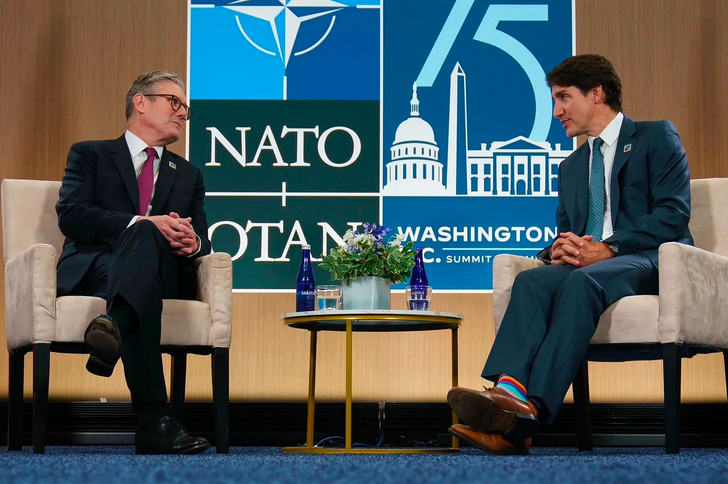
Prime Ministers Starmer and Trudeau at the NATO summit in Washington.
Image from Justin Trudeau’s X account.
What Justin Trudeau did on Wednesday from the witness standing at the foreign interference inquiry — when he made his dramatic announcement of having seen a list of Conservatives who are compromised by or vulnerable to foreign interference — makes a kind of sense.
It does. It was an effective attack on Pierre Poilievre, who has stubbornly led with his chin for months. The reaction of many of my Conservative friends was telling. They knew Trudeau landed a hit, and they were pissed. They were ready for it — I think their counterattack was as good or better. But this whole story, or at least this little snippet of it, starts with Trudeau taking a swing, and not missing.
[…]
In that context, Trudeau’s decision to tease the possibility of some unnamed Conservatives being involved in the machinations of foreign interference makes sense. He saw Poilievre’s chin and decided to shove his fist into it. It’s politics. I get it.
But, once again, I’m not sure that the PM thought this through all the way. Our PM has a habit of occasionally letting his combative instincts get the better of him. The man has a weakness for showy, dramatic gestures, and loves to try and seize the big moments. Sometimes they blow up in his face. I think this one will, too. It is, I suspect, less a punch to the face, and more of an elbow-to-the-boob. It’ll cause more problems than the gesture was worth.
[…]
Trudeau doesn’t get a lot of opportunities to look like a tough leader these days, and he got two this week. His eviction of six Indian diplomats that Canadian intelligence believes were involved in guiding violent crimes in Canada, aimed at politically connected members of Canada’s large Indian diaspora, was one (and I am not yet cynical enough to believe the timing was politically motivated). The second, of course, was Trudeau’s bombshell testimony. Given the shellacking he’s been taking of late, it probably felt amazing [to] go on the attack yesterday.
The problem for the prime minister is that, today, having had his dramatic moment, there’s no follow through. He dropped the mic and then Poilievre did what he was always and obviously going to do: the opposition leader picked that mic right back up again and started talking into it.
Here’s part of Poilievre’s statement (full statement is here):
My message to Justin Trudeau is: release the names of all MPs that have collaborated with foreign interference. But he won’t. Because Justin Trudeau is doing what he always does: he is lying. He is lying to distract from a Liberal caucus revolt against his leadership and revelations he knowingly allowed Beijing to interfere and help him win two elections. … If Justin Trudeau has evidence to the contrary, he should share it with the public. Now that he has blurted it out in general terms at a commission of inquiry — he should release the facts. But he won’t — because he is making it up.
If Poilievre’s decision to forgo a security clearance is overly complicated and technocratic, then Trudeau’s decision to attack him for it suffers the same drawbacks. By comparison, Poilievre’s approach, here, is better, simpler, and most crucially, it’s right: Release the names!
If MPs from any party have been compromised, the public deserves to know.
I don’t say that lightly or impulsively. There are absolutely downsides to releasing the names, including the very real risks to compromising our investigations and destroying the reputations of people who may have committed no crime. This sucks. But there are greater downsides to not releasing the names — until the Canadian public knows them, our entire democratic system is suspect. To put it another way, if it is inappropriate to release the names in full, then it is equally if not more inappropriate for a prime minister to publicly tease those names during his testimony, while hiding behind oaths of national security in order to avoid handing over the receipts. Protections of “national security” are intended to protect real sources and reputations — not to serve as a launchpad to lob allegations at foes while dodging accountability and transparency.
Operation Keelhaul: The Allies’ Final War Crime
World War Two
Published 17 Oct 2024After the war, millions of Soviet citizens are left over in Germany. Some of them are traitors, some are prisoners, some women and children. Stalin wants them back and the Western Allies are happy to help.
(more…)
Accidentally creating an epidemic of food allergies, from the best of intentions
Jon Miltimore discusses how the unintentional outcome of professional organizations making recommendations to the public without proper scientific understanding created so many of the allergies that now plague youngsters:

“Peanuts, LEAP study (Learning Early About Peanut allergy)” by jlcampbell104 is marked with Public Domain Mark 1.0  .
.
In 1992, with the help of a grant from the National Institutes of Health, The New England Journal of Medicine published a report on a rare phenomenon: fatal or near-fatal anaphylactic reactions in young people due to food allergies.
Examining a period of 14 months, researchers identified thirteen cases, twelve of which involved asthmatic youths. Six of the thirteen anaphylactic reactions resulted in death, and each case had involved a young person with a known food allergy who had unknowingly ingested the food.
“The reactions were to peanuts (four patients), nuts (six patients), eggs (one patient), and milk (two patients), all of which were contained in foods such as candy, cookies, and pastry,” researchers wrote.
The paper said nothing about banning these foods, but concluded that “failure to recognize the severity of these reactions and to administer epinephrine promptly increases the risk of a fatal outcome”.
Nevertheless, food bans followed, and the Centers for Disease Control and Prevention (CDC) began to encourage educators to “consider possible food allergies” during food preparation.
By 1998, the New York Times was reporting on the rise of peanut allergies and the measures school districts were taking to stop them.
“Prodded by parents warning of lethal allergies, by the contentions of some researchers that peanut allergies are on the rise and, not least, by a fear of litigation, growing numbers of public and private schools across the country, including many of New York City’s most selective independent schools, have banned peanut butter from their cafeterias,” wrote Anemona Maria Hartocollis.
“The Biggest Misconception”
When the Times published its article in 1998, the American Academy of Pediatrics (AAP) was not yet issuing recommendations about peanuts or food allergies in infants. But as public concern grew, they decided they had to offer guidelines of some kind.
“There was just one problem,” Marty Makary, a Johns Hopkins University surgeon, noted in a recent Wall Street Journal op-ed. “Doctors didn’t actually know what precautions, if any, parents should take.”
Instead of remaining mum, the AAP followed the lead of the United Kingdom’s Committee on Toxicology and recommended that mothers avoid peanuts during pregnancy and lactation, and that children avoid peanuts until the age of 3.
The decision to make such a sweeping decision in the absence of compelling scientific evidence was a mistake, allergists say, and runs counter to basic immunology.
Dr. Gideon Lack, an allergist at King’s College London, says the collective effort to cocoon children from peanuts and other foods is responsible for what has been described as a “food allergy epidemic”.
The data suggest Lack is right.
In the 25 years since the AAP issued its recommendation, the US (like the UK, which also advised peanut avoidance) has experienced an explosion of food allergies, especially peanut allergies. Data from Mount Sinai Hospital System in New York show that peanut allergies more than tripled in the decade and a half following the AAP’s guidance. In 1997, peanut allergies affected 1 in 250 children in the United States. By 2002, this rate had risen to 1 in 125, and by 2008, it reached 1 in 70 children.
Anecdotally, I only remember one kid in my middle school who had food allergies … and poor Rusty had ’em all. He was known as the “Kid with a thousand allergies” and had to be so careful of what he ate and even what he touched. but this was the mid-1970s and there weren’t formal school guidelines on what we could bring in our school lunch bags or use scented things like deodorant. (It was the 1970s, and a lot of us were just hitting puberty and many of my classmates were new Canadians from poorer countries … we needed the deodorant!)
Belton Repeating Flintlock: A Semiautomatic Rifle in 1785
Forgotten Weapons
Published Jul 1, 2024In 1785, Joseph Belton (an American inventor) and William Jover (an English gunmaker) sold 560 repeating flintlock rifles to the British East India Company. The guns were a very remarkable design which used a detachable magazine tube of 7 rounds stacked in series with a seven sequential touch holes. When the first round was fired, the flintlock ignited a piece of “portfire” slow match that would burn for about one minute. Pulling the trigger would move the portfire rearward one touch hole at a time, firing each in sequence as long as it remained burning. In this way, Belton advertised the gun as being able to fire 21 rounds in a single minute (using three preloaded magazine tubes). If the portfire burned out, it could be replaced and the flintlock reprimed and recocked. This was a truly impressive technological feat in 1785!
Belton had been working on firearms designs since 1758, and he actually got an order for 100 roman-candle-type repeaters from the American Continental Congress in 1777 — but there were pricing disputes and the order was never fulfilled. The British military examined the guns, but declined to purchase any. The 560 guns made for the East India Company (200 muskets, 160 carbines, and 100 pairs of pistols) were shipped from England in 1786, half to Madras and half to Bengal. Unfortunately, no further record of their performance has been found and we don’t know how well they worked in practice. This example is one of the muskets, with a .665″ bore and a 39 inch barrel.
(more…)
QotD: Californian wine
Lawrence Osborne, The Accidental Connoisseur: An Irreverent Journey Through the Wine World, 2004.
October 17, 2024
Democratic Germany considers banning 2nd-largest political party “to save democracy” of course
It’s totally a normal democratic urge to try to outlaw the second-largest political party in Germany and not in the least bit “authoritarian”, right?
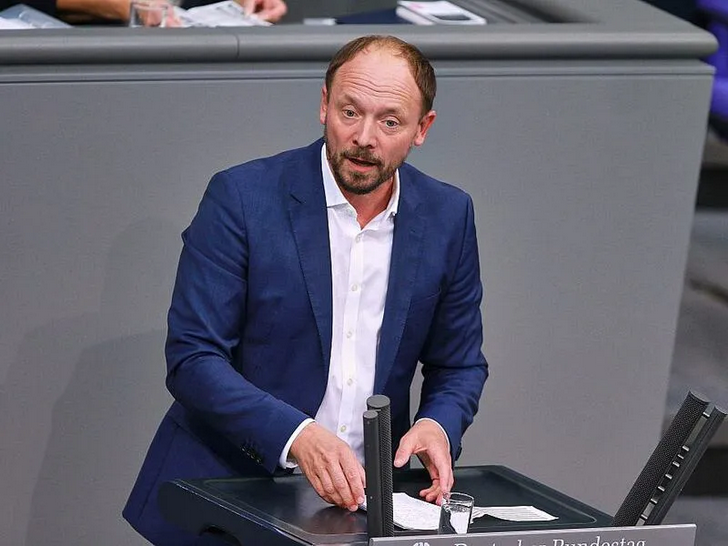
This man is named Marco Wanderwitz. He is a member of the nominally centre-right Christian Democratic Union, and he’s been in the German Bundestag – our federal parliament – since 2002. He reached perhaps the apex of his career late in the era of Angela Merkel, when he was made Parliamentary State Secretary for East Germany. Wanderwitz has been complaining about Alternative für Deutschland for years, and his screeching only gained in volume and shrillness after he lost his direct mandate in the last federal election to Mike Moncsek, his AfD rival. Above all, Wanderwitz wants to ban the AfD, and he has finally gathered enough support to bring the whole question before the Bundestag. Thus we will be treated to eminently democratic debate about how we must defend democracy by prohibiting the second-strongest-polling party in the Federal Republic.
Now, I try not to do unnecessary drama here at the plague chronicle, so I must tell you straightaway that this won’t go anywhere. Even were the Bundestag to approve a ban, which it won’t, the whole matter would end up before the Federal Constitutional Court in Karlsruhe, where I suspect it would fail in any case. Basically, the AfD are accumulating popular support faster than our ruling cartel parties can summon their collective will for overtly authoritarian interventions, and as long as this dynamic continues, the AfD will scrape by.
A great many influential people nevertheless really, really want to outlaw the opposition and effectively disenfranchise 20% of the German electorate. Our journalistic luminaries in particular have become deeply radicalised over the past three years. They got everything they ever wanted in the form of our present Social Democrat- and Green-dominated government, only to have their political dream turn into an enormous steaming pile of shit. Because the establishment parties, including the CDU, have no answers to the crises besetting Germany, they have had to watch popular support for the AfD grow and grow. All their carefully curated talkshow tut-tutting, all their artfully coordinated diatribes about “right wing extremism”, all their transparently hostile reporting, has done nothing to reverse the trend. If establishment journalists were running the show, the AfD would’ve long been banned and many of their politicians would be in prison.
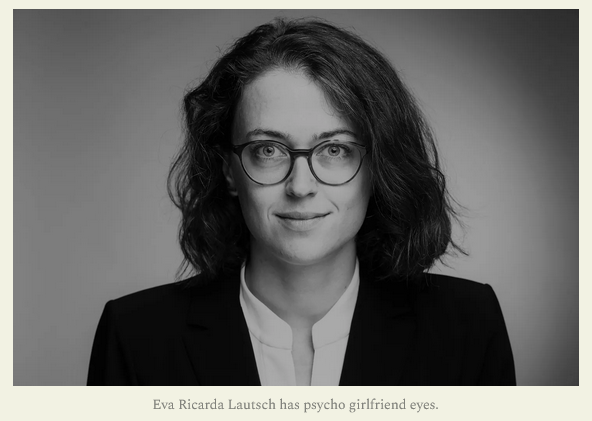
Today, Germany’s largest newsweekly, Die Zeit, has published a long piece by political editor Eva Ricarda Lautsch, in which she explains to 1.95 millions readers exactly why “banning the AfD is overdue“. The views she expresses are absolutely commonplace among elite German urbanites, and for this reason alone the article is sobering.
Let’s read it together.
Lautsch is disquieted that many in the Bundestag fear banning the AfD is “too risky”, “too soon” and “simply undemocratic”, and that “the necessary political momentum is not materialising”.
The problem … is not the lack of occasions for banning the AfD. Sayings like “We will hunt them down,” Sturmabteilung slogans, deportation fantasies: we have long since become accustomed to their constant rabble-rousing. And this is to say nothing of the most recent and particularly shocking occasion – the disastrous opening session of the Thuringian state parliament a week ago, in which an AfD senior president was able to effectively suspend parliamentary business for hours. Those with enough power to generate momentum don’t have to wait for it; what is missing across the parties is political courage.
What really distinguishes Lautsch’s article (and mainstream discussion about the AfD in general) is the constant grasping after reasons that the party is bad and unconstitutional, and the failure ever to deliver anything convincing. That “we will hunt them down” line comes from a speech the AfD politician Alexander Gauland gave in 2017, after his party entered the Bundestag with 12.6% of the vote for the first time. As even BILD reported, he meant that the AfD would take a hard, confrontational line against the establishment. He was not promising that AfD representatives would literally hunt down Angela Merkel, although the quote immediately entered the canonical list of evil AfD statements and has been repeated thousands of times by hack journalists ever since. As for the “Sturmabteilung slogans“, the “deportation fantasies” and the “opening session of the Thuringian state parliament” – I’ve covered all of that here at the plague chronicle. They are lies and frivolities, and what’s more, they are so obviously lies and frivolities that it is impossible to believe even Lautsch thinks very much of them. These are things that low-information readers of Die Zeit are supposed to find convincing; they aren’t real reasons.
Historian Reacts to Canada and the Scheldt Campaign
OTD Military History
Published 8 Oct 2024My reaction to the @LEGIONMAGAZINE’s video on the Battle of the Scheldt. This campaign was one of the toughest ever fought by Canada in World War 2.
Canada and the Scheldt Campaign from Legion Magazine
• Canada and the Scheldt Campaign | Nar…
(more…)
Failing upward into the federal civil service
Woke Watch Canada charts the rise and rise of Kimberly Murray from failure to higher-paid failure to the federal civil service on a six-figure annual salary:

Kimberley Murray – Image from APTN News
Kimberly Murray has just wasted $10 million dollars of Canadian taxpayers’ hard-earned money with the blessing of two successive Ministers of Justice, David Lametti and Arif Virani.
By June 2022 — after five years as Executive Director at the Truth and Reconciliation Commission, and a one-year stint as Executive Lead at the Survivors’ Secretariat looking for allegedly missing children — Kimberly Renée Murray had failed to produce the name of a single verifiably-missing residential school child.
Despite this abysmal record of six years looking for the name of a verifiably missing child without being able to find one, Kimberly Murray was appointed by Order in Council as a federal civil servant under the Public Service Employment Act as special adviser to the Minister of Justice at a salary in the range of $228,900 – $268,200 to continue her fruitless search:
Appointment of KIMBERLY RENÉE MURRAY of Toronto, Ontario, to be special adviser to the Minister of Justice, to be known as Independent Special Interlocutor for Missing Children and Unmarked Graves and Burial Sites Associated with Indian Residential Schools, to hold office during pleasure for a term of two years, effective June 13, 2022.
Her Excellency the Governor General in Council, on the recommendation of the Prime Minister, under paragraph 127.1(1)(c) of the Public Service Employment Act, appoints Kimberly Renée Murray of Toronto, Ontario, to be special adviser to the Minister of Justice, to be known as Independent Special Interlocutor for Missing Children and Unmarked Graves and Burial Sites Associated with Indian Residential Schools, to hold office during pleasure for a term of two years, and fixes her remuneration and certain conditions of employment as set out in the annexed schedule, which salary is within the range ($228,900 – $268,200), effective June 13, 2022.
During the two years of her mandate, while going through her $10 million dollar budget (and according to one of her interviews, knowingly exceeding Treasury Board guidelines), Kimberly Murray failed in her primary mission — i.e., to produce the name of at least one verifiably-missing child.
Despite this spectacular failure, and her admission to the Senate Committee on Indigenous Peoples on 21 March 2023 that there are no missing children, the current Minister of Justice, Arif Virani, re-appointed Kimberly Murray for a further six months by Order in Council on 28 May 2024, this time at a salary in the range of $254,000 – $297,800.
Historian Answers Google’s Most Popular Questions About Ancient Sparta
History Hit
Published Jun 26, 2024Were the Spartans actually the best warriors? Did they really throw their babies off cliffs? Did they … HUNT their slaves? Ancient Greek historian Roel Konijnendijk answers your most googled questions about the Spartans.
00:00 Intro
00:35 When did the Spartans live?
01:00 Were the Spartans Greek?
01:30 Were the Spartans a professional army?
03:00 Were the Spartans the best warriors?
04:46 How did the Spartans train?
06:43 Did the Spartans throw babies off cliffs?
07:42 Did the Spartans practise eugenics?
09:55 Did the Spartans steal food?
10:21 Were the Spartans vegetarian?
11:18 Were the Spartans better than Athens?
12:54 Did Sparta have a navy?
13:15 Why didn’t Sparta have walls?
14:22 Did the Spartans hunt their slaves?
15:30 Did the Spartans get their slaves drunk?
16:42 Did the Spartans have a king?
17:57 Was Sparta a democracy?
19:13 Why did the Spartans fight at Thermopylae?
19:45 Why did the Spartans only send 300?
21:30 Were the Spartans betrayed at Thermopylae?
22:42 Did the Spartans beat the Persians?
24:00 Were the Spartans muscular?
25:40 Did the Spartans have long hair?
26:25 Did the Spartans have same sex relationships?
28:27 Were the Spartan women equal?
(more…)
QotD: Soldiers and warriors
[…]
But why? The etymologies of the words can actually help push us a bit in the right direction. Warrior has a fairly obvious etymology, being related to war (itself a derivative of French guerre); as guerre becomes war, so Old French guerreieor became Middle English werreior and because that is obnoxious to say, modern English “warrior” (which is why it is warrior and not “warrer” as we might expect if it was regularly constructed). By contrast, soldier comes – it has a tortured journey which I am simplifying – from the sold/sould French root meaning “pay” which in turn comes from Latin solidus, a standard Late Roman coin. So there is clearly something about pay, or the lack of pay involved in this distinction, but clearly it isn’t just pay or the word mercenary would suit just as well.
So here is the difference: a warrior is an individual who wars, because it is their foundational vocation, an irremovable part of their identity and social position, pursued for those private ends (status, wealth, place in society). So the core of what it is to be a warrior is that it is an element of personal identity and also fundamentally individualistic (in motivation, to be clear, not in fighting style – many warriors fought with collective tactics, although I think it fair to say that operation in units is much more central to soldiering than the role of a warrior, who may well fight alone). A warrior remains a warrior when the war ends. A warrior remains a warrior whether fighting alone or for themselves.
By contrast, a soldier is an individual who soldiers (notably a different verb, which includes a sense of drudgery in war-related jobs that aren’t warring per se) as a job which they may one day leave behind, under the authority of and pursued for a larger community which directs their actions, typically through a system of regular discipline. So the core of what it is to be a soldier is that it is a not-necessarily-permanent employment and fundamentally about being both in and in service to a group. A soldier, when the war or their term of service ends, becomes a civilian (something a warrior generally does not do!). A soldier without a community stops being a soldier and starts being a mercenary.
Incidentally, this distinction is not unique to English. Speaking of the two languages I have the most experience in, both Greek and Latin have this distinction. Greek has machetes (μαχητής, lit: “battler”, a mache being a battle) and polemistes (πολεμιστής, lit: “warrior”, a polemos being a war); both are more common in poetry than prose, often used to describe mythical heroes. Interestingly the word for an individual that fights out of battle order (when there is a battle order) is a promachos (πρόμαχος, lit: “fore-fighter”), a frequent word in Homer. But the standard Greek soldier wasn’t generally called any of these things, he was either a hoplite (ὁπλίτης, “full-equipped man”, named after his equipment) or more generally a stratiotes (στρατιώτης, lit: “army-man” but properly “soldier”). That general word, stratiotes is striking, but its root is stratos (στρατός, “army”); a stratiotes, a soldier, for the ancient Greeks was defined by his membership in that larger unit, the army. One could be a machetes or a polemistes alone, but only a stratiotes in an army (stratos), commanded, presumably, by a general (strategos) in service to a community.
Latin has the same division, with similar shades of meaning. Latin has bellator (“warrior”) from bellum (“war”), but Roman soldiers are not generally bellatores (except in a poetic sense and even then only rarely), even when they are actively waging war. Instead, the soldiers of Rome are milites (sing. miles). The word is related to the Latin mille (“thousand”) from the root “mil-” which indicates a collection or combination of things. Milites are thus – like stratiotes, men put together, defined by their collective action for the community (strikingly, groups acting for individual aims in Latin are not milites but latrones, bandits – a word Roman authors also use very freely for enemy irregular fighters, much like the pejorative use of “terrorist” and “insurgent” today) Likewise, the word for groups of armed private citizens unauthorized by the state is not “militia”, but “gang”. The repeated misuse by journalists of “militia” which ought only refer to citizens-in-arms under recognized authority, drives me to madness).
(I actually think these Greek and Latin words are important for understanding the modern use of “warrior” and “soldier” even though they don’t give us either. Post-industrial militaries – of the sort most countries have – are patterned on the modern European military model, which in turn has its foundations in the Early Modern period which in turn (again) was heavily influenced by how thinkers of that period understood Greek and Roman antiquity (which was a core part of their education; this is not to say they were always good at understanding classical antiquity, mind). Consequently, the Greek and Roman understanding of the distinction probably has significant influence on our understanding, though I also suspect that we’d find distinctions in many languages along much the same lines.)
Bret Devereaux, “Collections: The Universal Warrior, Part I: Soldiers, Warriors, and …”, A Collection of Unmitigated Pedantry, 2021-01-29.


