
Feral Historian
Published 8 Sept 2023This film reminds me of several topics from nuclear deterrence to the impact of social media to that kid I went to high school with who tried to build a reactor in his mom’s shed. Yeah, this is a rambly one.
00:00 Intro
01:02 Summary
02:25 Social Media
04:35 Deterrence
06:51 Radioactive Boy Scout
09:50 Modern Security State🔹 Patreon | patreon.com/FeralHistorian
🔹 Ko-Fi | ko-fi.com/feralhistorian
November 29, 2025
The Manhattan Project (1986 film) and Deterrence
Comments Off on The Manhattan Project (1986 film) and Deterrence
QotD: Are there no prisons? Are there no asylums?
When the Trump administration proposed imprisoning homeless people who don’t voluntarily go to shelters, and the predictable howls of outrage arose, I remembered the most interesting fact I’ve ever learned about imprisonment rates.
The US is often pilloried for having a high level of imprisonment per capita relative to other countries. The US is also quite unusual in having shut down most of its insane asylums many decades ago.
My perspective on these facts changed a great deal when I learned that if you aggregate rates of imprisonment with rates of commitment to mental institutions, the US stops looking like an outlier.
The low-level mentally ill didn’t go away when we closed the asylums. Nor did they magically become more able to function in society when we pushed them out the doors. Instead, they now land in our prisons.
Another implication of all this is that it’s not “structural racism” or any other specific evil that gives the US high imprisonment rates. It’s an inevitable consequence of the social decision to make it very difficult to involuntarily commit people to asylums.
I’m not going to argue today about whether that decision should be reversed. I have an opinion about that, but this post is about facts and consequences, not value claims or what “should” be.
Let’s return to the homeless. It is now common knowledge that homeless people are almost never simply poor or down on their luck. Almost all have serious issues with mental illness or drug addiction, or both. Many refuse to go to shelters because they don’t want to — or are not capable of — complying with a homeless shelter’s behavioral restrictions.
While I don’t have firsthand knowledge or controlled studies to back me up, it seems obvious that the shelters are acting as a filter — the least damaged and most functional homeless go to them, leaving the crazies to inhabit the streets.
Thus, throwing homeless people who won’t go to shelters in prison is an exact functional equivalent of involuntary commitment to a mental asylum.
My question for people who object to imprisoning the mentally ill and drug-addicted homeless is: what do you propose we do instead? Are we prepared to reopen the asylums and lower the bar for involuntary commitment?
I don’t think there’s a third alternative anymore. Donald Trump, whatever his other failings might be, has an acute sense of the zeitgeist; popular tolerance for having the streets of our cities inhabited by crazy people is collapsing. It turns out we can only tolerate so many news stories about naked screaming nut-jobs on the subway.
I’m not going to propose an answer to the question I just raised, because I’m conflicted about it myself. My goal is to start people thinking about the right question, which is a very large one.
What is the humane way to treat people who are too damaged or broken to be functional members of society, and who inflict large costs on others if they’re not separated from society?
If it’s not prisons or asylums, what are we going to do? And given how ineffective psychiatric treatment is at anything beyond management of symptoms, is “prison” vs. “asylum” even a meaningful distinction?
ESR, The social media site formerly known as Twitter, 2025-08-13.
Comments Off on QotD: Are there no prisons? Are there no asylums?
November 28, 2025
Social media isn’t completely a depressing waste of time
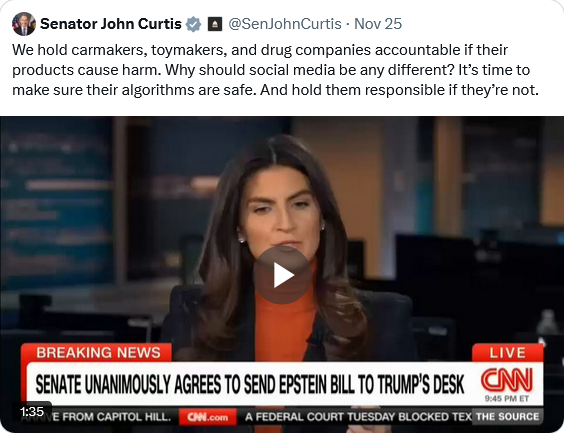
On the social media site formerly known as Twitter, Devon Eriksen reacts to a political hack who wants to impose regulations on social media that would allow him to shut down people who criticize him and other swamp creatures:
We all know what’s really going on here.
Utah senator John Curtis, and other political hacks like him, are getting their boomer asses handed to them on social media.
They long for the days of television, when they could control the narrative by having a cozy relationship with the networks, and so they could lie to you without fear of contradiction by some autist named @DataRepublican whose existence is solely defined by her full-time hobby of sniffing out lying dirtbags.
So they want to pass a bunch of laws to make the internet behave like television. To filter it all through a set of major website choke-points that they can control by threatening the corporate entities that run them.
Long, complicated, and vaguely defined liability laws are a tool to do that.
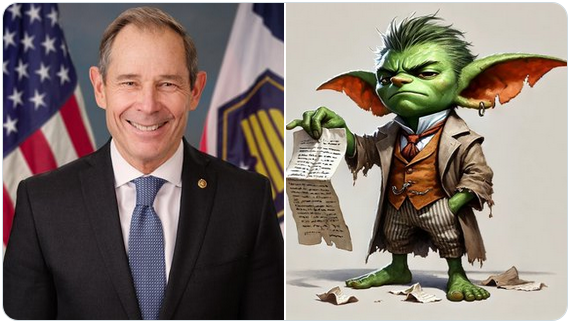
Basically what they do is allow John Curtis to put any website out of business if people say mean things about him on it, such as pointing out that he looks like some kind of deranged and malevolent goblin that just crawled out of a swamp.
The problem he has right now is that when I say stuff like that on Twitter, I’m the one who said it.
Not Twitter.
There’s nothing he can do to me. Because even if I get hit by a unmarked sedan tomorrow in a totally unrelated accident, there’s a million more people like me who are only too happy to point out that John Curtis looks like a deranged and malevolent goblin that just crawled out of a swamp.
So he wants legal tools to punish Twitter for what I said.
So how does he go about that? What is a deranged and malevolent goblin, with a “business management” degree, and a history of changing political parties when convenient, to do?
Why, muddy the waters with vague platitudes about “safety”, of course.
Except we’ve heard that song before, and we’re not interested. So let us laugh at him, remind him that he looks like a deranged and malevolent goblin that just crawled out of a swamp, and mock until he goes back to doing what he normally does, which is shilling for the “Fairness For High Skilled Immigrants Act”.
And then we can eventually replace him with someone who cares about fairness to actual fucking Americans.
Update, 29 November: Welcome, Instapundit readers! Please do have a look around at some of my other posts you may find of interest. I send out a daily summary of posts here through my Substack – https://substack.com/@nicholasrusson that you can subscribe to if you’d like to be informed of new posts in the future.
CZ247: Experimental Swivel-Action SMG
Forgotten Weapons
Published 16 Jul 2025The CZ247 was developed for Czechoslovakia’s post-war submachine gun trials, where it was pitted against the ZB47. It was a simple blowback 9x19mm SMG with a number of interesting elements, most notably the ability to fire with the magazine either vertical or horizontal. In theory, this made the gun more compact for use in a jungle sort of environment (vertical) or to allow a shooter to get much lower to the ground when shooting prone (horizontal). In practice, it really isn’t very important, and requires a bit of extra complexity in the gun’s design. The CZ247 also has a neat safety mechanism for preventing unintended firing and a stripper clip guide built into the stock (both of which would be incorporated in the vz.48 SMG that was eventually adopted).
When the CZ247 failed to win the military trials, CZ got government permission to sell it on the export market. A contract for 10,000 guns was quickly obtained from Egypt, but before the guns could be shipped the export permission was cancelled by the government. Czechoslovakia opted to support Israel in its declaration of independence in 1948, and the government decided to not send weapons to Egypt which might be used against Israel. This left the guns sitting in CZ warehouses, and the basically all stayed there for a few decades. Eventually most were sold to Nigeria in 1967 and Ethiopian in 1977 — and as a result they show up occasionally in African and Middle Eastern conflict zones to this day.
Thanks to CZ for giving me the opportunity to take this example out to film and also to shoot for you!
(more…)
Comments Off on CZ247: Experimental Swivel-Action SMG
QotD: Life is not a race to some arbitrary “finish line”
I wrote:
The hostility to inheritance also comes from a mistaken sense of fairness. As Robert Nozick argued in Anarchy, State and Utopia (I quote from memory), people wrongly think life resembles an athletics race, where the racers compete to hit the finishing line. As a result, those “lucky” athletes endowed by nature/god whatever with stronger muscles etc must be handicapped by having weights in their shoes, for example. Just as a child of rich parents must be deliberately held back to give poor kids a more “fair” chance of winning. But as Nozick said, life isn’t like that. It is about people exchanging goods, services and ideas with one another. There’s no fixed end-point to which we are all racing.
Also, the idea that there is some “prize” that humans compete for implies that someone or some entity has created that “prize” in the first place. But that’s smuggling in a sort of communitarian assumption into the actions of individuals. In an open society, the prizes on offer are varied and multiply constantly.
I should add that the second section of Nozick’s renowned book dissects and ultimately rejects forced redistribution for egalitarian or other forms of “patterned” notions of justice, and he robustly defends what he calls an “entitlement” concept of justice.
One of the approaches that the late Prof. Nozick used was the thought experiment, such as the example referenced above about a fictitious athletics race in which the entrants are hampered/favoured to make the race more “even”, and then assuming that society in general should be like this. A race, held by people who know the rules and seek to abide by them, is not like an open society. “Open” is the key word here: there is no single end to which persons are heading, such as winning the race.
And yet a lot of the metaphors one comes across around discussions around equality, including equality of opportunity as well as outcome, seem to borrow, perhaps unwittingly, from this “race competition” worldview. To give another example, I remember reading some months ago about a university professor (Warwick) who suggested that when parents read stories to their children, this is a form of privilege. This also plays to the idea that life has a fixed end-measure of success, so that anyone giving a value to someone else is giving the latter an unfair “head start” on someone else. It would require a State to exercise totalitarian control of our actions from the moment we wake up to go to sleep lest our actions unfairly advantage/hamper someone in the “race” they are considered, by this worldview, to be on. (It also, by the way, shows that today’s Higher Ed. is full of certifiable fools and worse.)
Johnathan Pearce, “The assault on inheritance and the assumptions that drive it”, Samizdata, 2025-08-21.
Comments Off on QotD: Life is not a race to some arbitrary “finish line”
November 27, 2025
We’re not quite at the point that we get trigger warnings for trigger warnings, but …
On her blog, Sarah Hoyt discusses the continued expansion of trigger warnings in fan fiction, but not because the readers demand it:

Image from According to Hoyt
… I’ve noticed a creep up of trigger warnings in fanfic. Some of these would be incomprehensible to non-Jane-Austen fans and are actually not so much trigger warnings as sub-genre warnings. There are subgenres some fans (sometimes I’m some fans) hate, like “Lizzy is not a Bennet” or “Bingley is evil” or … whatever. That’s fine. It saves me the trouble of reading a fanfic that’s going to annoy me. Unless I’m in the mood to be annoyed, in which case I will read it so I can grit my teeth and mentally yell at the writer. (Bingley is evil is a problem because it usually turns into a revenge-fest on EVERYONE. Everyone is evil. Etc. I don’t think there’s ever a time I want to read that. You find yourself wanting to take a shower for the soul. With a wire scrub brush.)
We make fun of trigger warnings, often, but it’s a real measure of how stupid things have gotten. When I’m having to read a trigger warning for say “kissing without consent.” or “violence against children” (Okay, you’ll think that last makes perfect sense, until you find out it’s because a kid gets slapped once in the novel) or “verbal violence” or –
And you start wondering, on the serious, if the ideal novel for these people has no plot at all, just people sitting around having a nice meal and talking.
This is disturbing, because the whole point of a novel is to make you feel emotions and experience things you either can’t in your real life, or which wouldn’t be safe to experience in your real life, followed by resolution and catharsis. That’s what a novel offers you. The opportunity to be the someone else far away experiencing “Adventure” (which as we all know is really a series of unpleasant events.)
Anyway, I’ve slowly come to the conclusion all this demand for warnings and screeching about offense isn’t by real readers.
No, seriously. Real readers know that no one can insulate them against all surprises in a book (or blog) and that in fact the point of reading is to get out of your head and experience different things, different events, different emotions and different points of view. You might disagree vehemently with them (I actually do with most of the really old science fiction. Really, scientists in charge? Who thinks that’s even safe? Oh, yeah, the Soviet Union. But even they didn’t DO IT. They just paid lip service. They might have killed a lot more people if they’d done it, at that.) but that forces you to think about why you disagree and how you’d do it differently. If you’re of a certain frame of mind, you [might] end up becoming a novelist and writing your response to what you disagree with. Though if you are worth spit, even then, your “response” will be less of a response and more of this whole new thing it became, with the response buried somewhere inside it. And if you’re not of that frame of mind, you’ll still end up a more considered and self-reflective thinker than you were before. For one, while you might think that the other POV is stupid, if you read a whole novel with it, you’ll be aware that thought went into it, and might even have to confront that the worst stupid takes a lot of thought and self deception.
Anyway, the point is, I don’t think the offense-monsters read. Because the whole point of their screeching is to shut down the thinking and prevent ANYONE ELSE from being exposed to the material, and maybe thinking.
That’s not what they say, of course. They say “I’m offended”. And “I’m hurt”. And “You’re mean because you offended me”.
But what they really mean is “this you cannot think” “This you cannot see” and “this you cannot read” and “this you cannot write”. And “this you cannot say”.
They have, you see, completely surrendered their very core to the herd. They have given up their right to think and feel and be, in favor of belonging completely to the herd. (They used to have a term for this and said it as though it were praiseworthy: “mind-kill”.) So being exposed to contrary things hurts, and they have no defense, because they have taught themselves not to think and/or reason through things.
The pain they feel at the slightest hint of disagreement is true. It is also a symptom of what they have done to themselves, and has nothing to do with being mentally or emotionally healthy.
Just like the pain of withdrawal of a chronic alcoholic denied alcohol is real, and continued and too fast withdrawal might kill him, however continuing to feed his drinking habit will also kill him, faster.
To give them trigger warnings, apologize for any offense and handle them with kid gloves is not only bad for them but bad for society in general.
Comments Off on We’re not quite at the point that we get trigger warnings for trigger warnings, but …
Lack of talent is no obstacle to music success … even before Auto-Tune
One of the reasons I like Ted Gioia’s Substack is that even when I’m not overly interested in the topic of any particular post, I usually learn something:
I’ve tried to identify the turning point — the moment when the rules changed. By my measure it happened one night in 1958.
Let’s revisit that fateful day …
One Friday evening in 1958, record producer George Avakian sat down in front of his TV set, and watched an episode of the popular detective show 77 Sunset Strip. This chance incident would have surprising ramifications in the music business for decades to come.
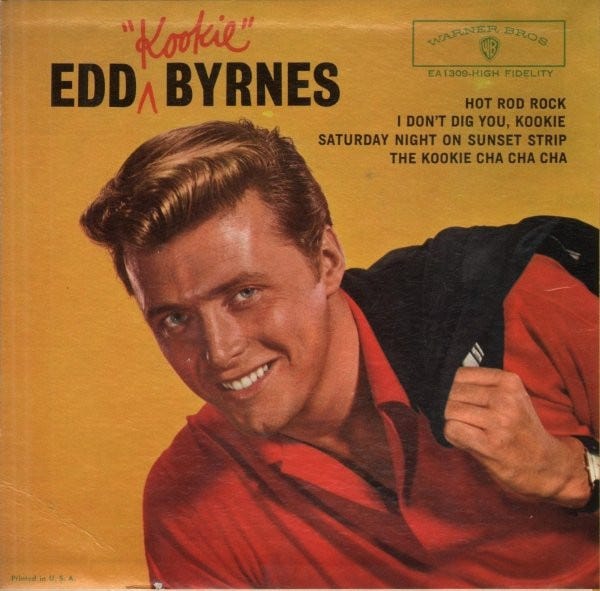
A few minutes into the episode, the record producer decided that one of the actors on the show looked and talked like a rock star. His name was Edd Byrnes and he played a hipster character named Kookie.
Kookie parked cars at a Hollywood nightclub in the show, and acted very cool. He had the right look and said witty hipster-ish things. The TV audience loved him, especially younger viewers.
Check Kookie out and decide for yourself.
There was just one tiny problem. Byrnes wasn’t a musician.
But Avakian didn’t worry about this. “I was sure that kids would like his talk and his looks, especially a way he had of looking out of the corner of his eye,” he later recalled. “And — the real clincher for his popularity with kids — parents would loathe him.”
They didn’t have Auto-Tune back then, but studio engineers had a few tricks to fix vocal imperfections. They knew how to splice together different takes, or make slight alterations in tape speed.
But when Byrnes did an audition for the label, it was bad. It was scary bad. This promising rock star had no sense of pitch. He had no range. He couldn’t even stay in rhythm with his accompanist.
No technology could fix this mess.
Record producer Avakian was no fool. During an illustrious career, he worked with Louis Armstrong, Duke Ellington, Miles Davis, Dave Brubeck, Sonny Rollins, and Keith Jarrett, among others. He had collaborated with genius, and now he had someone on the opposite end of the spectrum.
Maybe this situation is commonplace nowadays, but back in 1958 the record business believed in something called musical talent. Avakian’s bold decision to ignore that variable marks a historic moment in our culture.
Anybody else would have walked away from this looming disaster. They would have feared not just commercial failure but a tainted reputation. You don’t want to be the exec to greenlight a recording by somebody with zero musical ability.
But in a moment of brilliant insight, Avakian decided that Kookie didn’t need to sing, he could just rap. Of course, rapping wasn’t even a concept back in those days. But it sorta existed without a name. Deejays at radio stations often introduced a song by speaking in a hip tone of voice over the intro to a song.
Kookie would do the same. He would speak or rap his part, while somebody else did the actual singing. Connie Stevens, another Hollywood talent with the right look — and a slightly better voice — could handle the actual vocals.
Comments Off on Lack of talent is no obstacle to music success … even before Auto-Tune
Carney – “Who cares?”
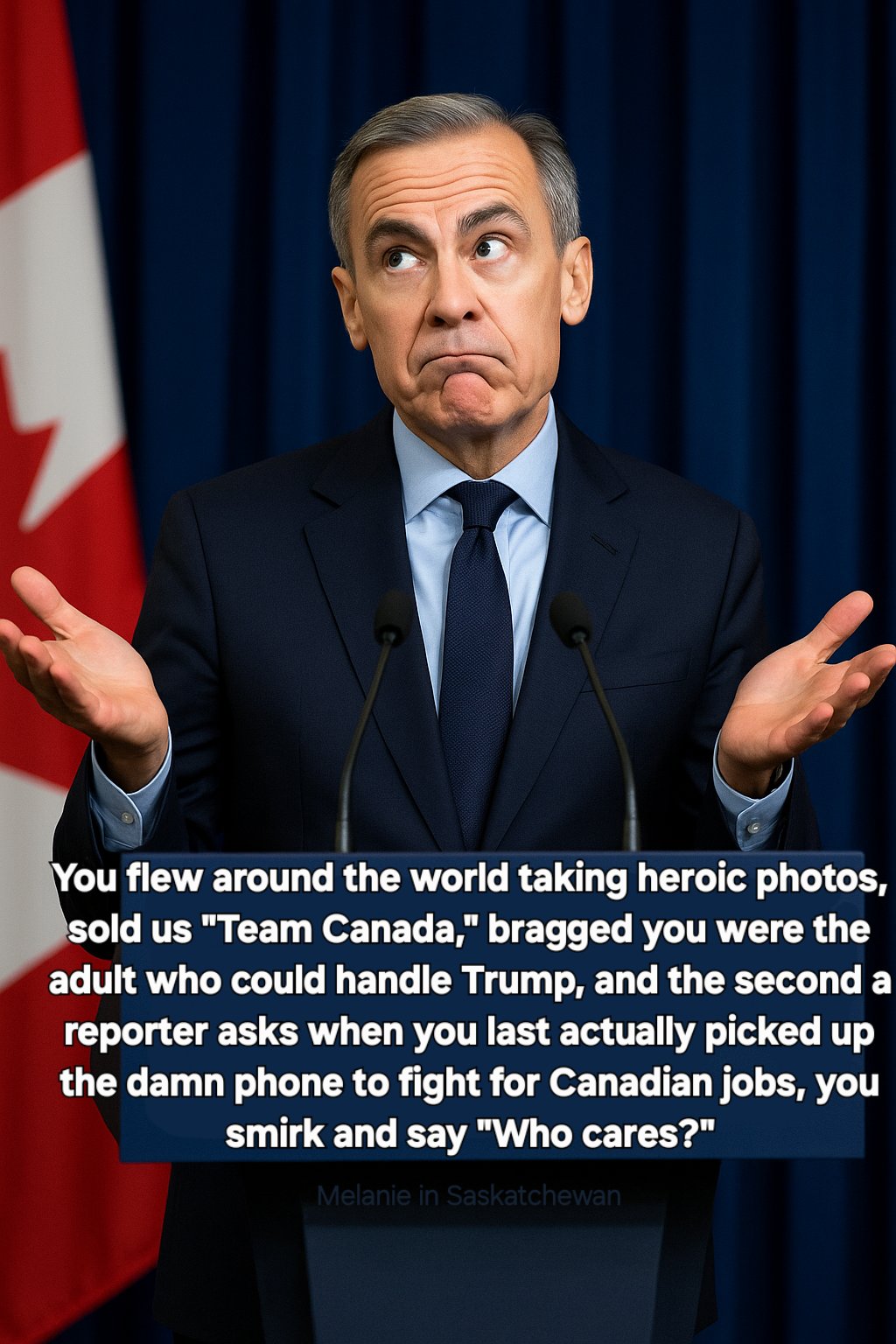
On the social media site formerly known as Twitter, Melanie in Saskatchewan reacts to Prime Minister Mark Carney’s shrugging-off the economic concerns of ordinary Canadians with a casual “Who cares?”
Dear @MarkJCarney
“Who cares?”
That’s what you actually said when asked when you last bothered talking to Trump about the tariffs that are currently body-slamming Canadian jobs.
“Who cares? … It’s a detail.”
Really Mark? Let’s meet some of those “details”, Prime Minister.
The single mom juggling three gig jobs because the factory that used to pay her mortgage “paused investment” and then paused her entire livelihood: she’s just a detail.
The Windsor autoworker whose night shift got cancelled forever while you were busy perfecting your thoughtful squint for the cameras: tiny detail.
The steelworker in Hamilton burning through EI while the mill runs skeleton crews and you call the carnage a “temporary adjustment”: just a little detail.
The small-shop owner deciding which of her three employees to fire this month because 25% tariffs turned her cross-border contracts into suicide notes: who cares, right? Detail.
The rail worker staring at empty tracks where trains full of Canadian auto parts and steel used to roll: super minor detail.
The Saskatchewan electrician watching Nutrien build its next billion-dollar terminal in Washington State instead of BC because at least the Americans aren’t at war with their own economy: I guess that’s barely worth mentioning.
The welders and millwrights being told the next big plants are going up in Ohio and Texas, not Ontario or Alberta, because Canada’s too busy arguing about jurisdiction to actually fight for work: pfft, details.
The family parked on gurneys in an ER hallway at 3 a.m. because we never trained enough doctors and now the ones we have are bolting: honestly, who has time for that detail?
All those kids with degrees doing DoorDash because private-sector job growth is wheezing and every company is frozen waiting for the next Trump tweet or Trudeau shrug: whatever, details.
You flew around the world taking heroic photos, sold us “Team Canada”, bragged you were the adult who could handle Trump, and the second a reporter asks when you last actually picked up the damn phone to fight for Canadian jobs, you smirk and say “Who cares?”
Message received, loud and clear.
Those people I mentioned above? They care.
Every single one of them cares when the shift vanishes, the mortgage renews, the mill goes quiet, the doctor quits, the plant gets built south of the border, and their kids ask why Mom’s crying at the kitchen table again.
But you don’t care.
And the worst part? You didn’t even bother to lie about it.
You lied to every single Canadian to get elected, yet you don’t care.
Well Mark … we sure as hell do care.
And you WILL care.
When your greasy grifting ass is voted to the curb and we undo all the harm you’ve caused Canadians to fatten your coffers. You cant stand living in Canada and can’t wait to move back to the UK … remember?
We sure will.
Just watch us.
Sincerely,
One of the millions of Canadians tired of being your rounding error.Melanie in Saskatchewan
Also published on her Substack.
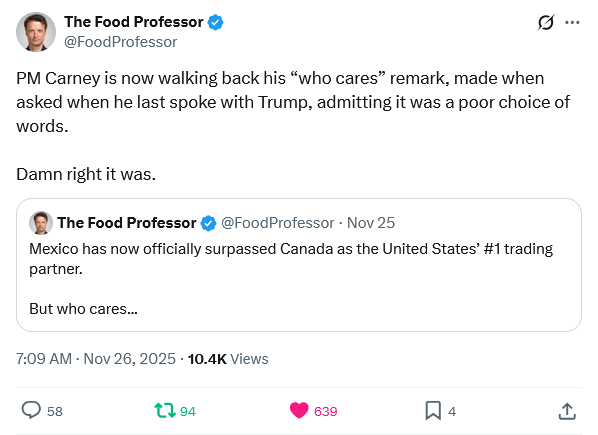
Apparently even the most detached of politicians can occasionally be persuaded to acknowledge an unforced error:
Comments Off on Carney – “Who cares?”
Operation Catapult: The Royal Navy’s day of infamy?
Lindybeige
Published 28 May 2025Operation Catapult took place on July 3rd 1940 at Mers El Kebir on the Algerian coast. It remains a point of controversy in the relations between the British and the French. Who was to blame for the sinking of the French ships and deaths of French sailors? You be the judge.
Erratum: Acting Rear Admiral Onslow, captain of the aircraft carrier Hermes, was not “Rodney” Onslow as I named him, but Richard Francis John Onslow, M.V.O., D.S.C. (29 March, 1896 – 9 April, 1942).
(more…)
Comments Off on Operation Catapult: The Royal Navy’s day of infamy?
QotD: Honor, homage, and fealty in Game of Thrones
To refer to a distinction introduced in Wayne Lee’s talk [here] – Tywin cannot rely on force (do it because I will kill you if you don’t), he has to use power (do it because you think you ought). Because the apparatus of the state here is very limited, that power is largely generated through personal relationships – you ought to fight for your liege because you have a personal relationship with him. You see him fairly often, you swore loyalty to him (in person!!), he (or his ancestors) have helped resolve your problems in the past and most importantly, because he has kept faith with you in the past.
Which is a way of saying that this system runs on trust and reputation, and that runs both ways. Even as Tywin watches his vassals for signs of disloyalty, his vassals are watching him. Is he true to his word? Can I trust him? Because if the answer is no – I best start hedging my bets. And that bet-hedging is going to come in ways Tywin does not want – I might refuse to come out and fight, or redirect my efforts to fortifying my own holdings, or even switch over to another liege. And in the very early seasons, key characters – most notably Tywin and Tyrion – know this and act accordingly. Tywin talks a good game about lions and sheep, but when it comes down to it, he knows his reputation matters – what the sheep say about the lion matters a great deal, it turns out. Robb Stark’s failure to handle the Karstarks, Tullys and Freys is his eventual undoing. Tyrion berates Cersei on returning to King’s Landing for her actions which might call the Lannister reputation into question (“that bit of theatre will haunt our family for a generation”.)
What is unusual here is how frequently key characters deviate from the norms these societies need to function – Westerosi nobles are stunningly treacherous for people who rely on systems based in trust for survival. In a system which runs on trust and reputation, elites tend to value trust and reputation. They produce literature extolling it (as, indeed, do most “mirrors for princes” – guidebooks on how to be a good ruler – from the Middle Ages do; see, for instance, Book 3 of Dhouda’s Liber Manualis (9th cent.), which goes on and on about trustworthiness) and refine its practice. The sort of eye-popping treachery so common in Game of Thrones was far rarer in the actual historical Middle Ages for exactly the reason Game of Thrones would lead you to believe: it is almost always self-defeating.
The problem here comes in the later seasons and how they re-contextualize all of this concern. That problem has a name, and it is Cersei. Cersei breaks all of these rules. Even early on, she has her soldiers (who recall – are not paid mercenaries, but likely vassals of her house who can very much take their skills elsewhere if they don’t like their current employer) demonstrate her own capricious untrustworthiness on Lord Baelish (she has also, I will note, mistaken violence for power). She humiliates Barriston Selmy in court, a spectacle her own future vassals might have remembered. She incinerated her own family – by blood and marriage – along with her erstwhile allies. Cersei is endlessly treacherous, often foolishly and obviously so, and yet …
And yet it doesn’t matter. The Lannister bannermen in the penultimate episode mount the walls to fight a doomed battle for her anyway. Not only is that behavior inexplicable, it hardly seems possible. Who, after all, is raising and leading these men? Who is coordinating supplies and grain shipments to the capital? Remember, the reason for this distributed system of political leadership is that the central state does not have the administrative apparatus to raise armies or feed cities on its own – it has to outsource that to vassals. Vassals that Cersei has murdered or alienated, almost to a man. Cersei is defeated because dragons are unstoppable monsters, but she should have been defeated because she would have simply been incapable of raising an army at all.
Bret Devereaux, “New Acquisitions: How It Wasn’t: Game of Thrones and the Middle Ages, Part III”, A Collection of Unmitigated Pedantry, 2019-06-12.
Comments Off on QotD: Honor, homage, and fealty in Game of Thrones
November 26, 2025
The Korean War Week 75: Insurgency Behind The Lines! – November 25, 1951
The Korean War by Indy Neidell
Published 25 Nov 2025While there is no battle action this week, there is still a lot of fighting, as the UN forces must constantly watch their backs against the thousands of guerrillas in the hills of South Korea. At the truce talks, the Communist side accepts the UN proposal for a demarcation line — Item 2 on the agenda — but for it to be valid the other three items remaining on the agenda must be dealt with within 30 days, which seems very optimistic to most. There is also the question of post-armistice inspections teams; are they a good idea? Or will they simply provide the other side with much-needed actionable intelligence?
Chapters
00:00 Intro
00:45 Recap
01:08 Guerilla Actions
03:19 Hanley’s Numbers
05:37 The Demarcation Line
08:04 Inspection Teams
10:36 Ridgway’s Opinion
12:06 The Agenda
12:48 Summary
13:04 Conclusion
13:57 Call to Action
(more…)
Comments Off on The Korean War Week 75: Insurgency Behind The Lines! – November 25, 1951
The RCAF needs either F-35s or Gripens … not both
Although the Trump provocations are a unique situation for the Royal Canadian Air Force to find itself dealing with, the long-delayed decision on what the replacement for our current CF-18 fleet can’t be realistically put off for much longer. The government has committed to paying for the first 16 aircraft of an 88-plane order, but many pundits are crying out for the government to cancel the remaining portion of the order and instead purchase different aircraft … the leading contender being the Swedish Gripen. This might be the worst of all worlds for the RCAF, in needing to support two different airframes with zero parts compatibility. This two-fleet “solution” would make life much more difficult for RCAF training and logistics, but it’d be a performative eLbOwS uP to Trump, so there’s a strong chance it’ll happen despite military and economic reality. Bryan Moir makes the argument for the Gripen on his Substack:
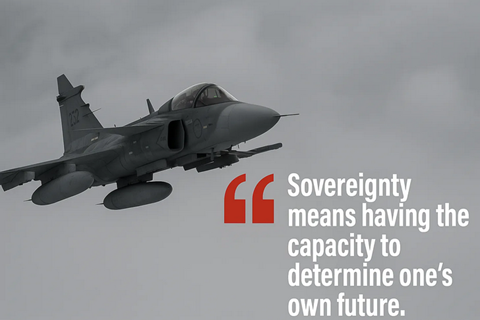
Mark Carney loves the big phrases. “Build Canada strong.” “Rewire the economy.” “Generational investments.”
It’s good branding. But slogans don’t build nations — decisions do. And right now, one decision matters more than the rest:
Will Canada assemble the Saab Gripen fighter on Canadian soil — or will we lock ourselves into permanent military dependence through the F-35?
Let’s start with the truth no one in Ottawa wants to say out loud.
The F-35 is a 56% aircraft in a 100% environment.
The F-35 fleet’s mission-capable rate sits at 55–56%. That means a country buying 16 aircraft can expect maybe eight airborne on a good day. Eight jets to defend the Northwest Passage, the Arctic archipelago, and a coastline longer than Russia’s.
This isn’t speculation; it’s physics, logistics, and accounting.
Meanwhile, the United States fields 54 F-35s at Eielson AFB in Alaska — backed by billions in supporting infrastructure: software hubs, spares depots, rapid part cycling, and multiple layers of maintenance and training.
They can sustain the F-35 in the Arctic.
Canada cannot.
And pretending that we can — or worse, pretending that it doesn’t matter — is not national defence. It’s denial.
Gripen was designed for the world Canada actually lives in.
Gripen’s core design features are the ones Canada pretends the F-35 also has:
- Cold-weather resilience
- Short runway and road-base operations
- Minimal crew requirements
- Quick turnarounds
- Low maintenance footprint
- Sovereign sustainment
Gripen isn’t just compatible with Canada.
It was built for countries whose geography forces them to be independent.
The importance of “a bicycle shop in Bermuda” to Mark Carney’s financial affairs
It’s no secret that Prime Minister Mark Carney is a rich man. When he entered politics, he put his financial holdings into a blind trust to satisfy the federal government’s ethical and conflict of interest rules. But through this arrangement, he still owns significant positions in companies whose fortunes can (and are) affected by the actions of his government. On Monday, this was discussed at some length by a Parliamentary committee in Ottawa, as reported on his Substack by Dan Knight:

On November 24, in a basement room of West Block, MPs spent two hours asking a very simple question that everyone in Ottawa is suddenly pretending is complicated:
If Mark Carney gets richer when Brookfield does better, and Brookfield is running big climate and infrastructure funds out of what one MP described as a bicycle shop in Bermuda, how on earth is that not a problem for the Prime Minister of Canada?
The man in the hot seat was Justin Beber, Chief Operating Officer of Brookfield Corporation. His job was to calm everyone down. Instead, under oath, he calmly confirmed just about everything the government would rather you didn’t think about too hard.
He started with the corporate biography. Brookfield, he reminded the committee, is a massive global investor headquartered in Toronto. It has more than 600 direct employees in Canada, more than 15,000 workers in its operating businesses, and it paid over $750 million in federal tax last year, not counting provincial and local taxes. All of that is true. None of it changes the basic conflict: the sitting Prime Minister still has long-term compensation that rises when Brookfield, and certain Brookfield funds, succeed.
Conservative MP Michael Barrett went straight there. He asked Beber whether, when Brookfield’s value increases, the value of stock options and deferred share units also increases. Beber said yes. Then Barrett asked whether that changes if those options and units are placed in a blind trust. Beber said no. It does not. The economic reality is exactly the same: if Brookfield’s share price goes up, those instruments are worth more, whether they are in Mark Carney’s brokerage account or parked with a trustee behind frosted glass.
[…]
Cooper spelled out why it matters. Carney, he said, knows what kind of public policy could improve the success of the fund. The fund’s success determines his future bonus pay. Without knowing who the investors are or all of the fund’s positions, Canadians have no way to see where those incentives may line up — or collide — with the national interest. These are not theoretical conflicts. They are simply invisible ones.
Eventually, after some confusion over terminology, Beber did confirm that Transition Fund I has invested in 20 companies and that their names are listed in the ethics annex. Only one of those firms, Entropy, is in Canada. The rest of the portfolio, and the roster of big-money investors behind it, sits offshore, beyond any serious public scrutiny, while the Prime Minister’s upside rides on how well those bets pay off.
The tax side of the story is just as revealing. Bloc MP Luc Thériault put it bluntly: tax avoidance is not a conspiracy theory, it is a business model so widespread that the OECD and G20 built an entire 15 percent global minimum tax regime to deal with it. He cited Canada Revenue Agency estimates of tens of billions of dollars in lost federal revenue each year, including billions attributable specifically to tax avoidance. He asked Beber whether Brookfield engages in tax avoidance. Beber refused to use the term. “We practice tax planning”, he said, like “any other company”. He repeated that Brookfield pays all taxes that are “due and payable” in the jurisdictions where it operates.
That phrase sounds reassuring until you remember who writes the rules that decide what is “due and payable”, and who benefits when the system can be routed through Bermuda via something that, on paper, looks like a bicycle shop.
[…]
At some point, the pattern becomes impossible to ignore. The Prime Minister of Canada left a giant global investor with standard executive incentives, kept his vested long-term instruments, retained a carried interest in a $15 billion Bermuda-run climate fund that will operate into the 2030s, and knows exactly which sectors that firm is betting on. His government is now pouring public money and regulatory support into many of those same sectors. The firm uses structures justified as “tax transparent” that just happen to run through low-tax jurisdictions, including one address a Conservative MP described as a bicycle shop in Bermuda. The man running the firm’s operations will not say the Prime Minister’s potential upside is small. He will not say the global minimum tax is being met in practice. He will not disclose who the fund’s other investors are.
You do not need to be an expert in securities law to see the conflict. You do not need to be an expert in global taxation to see why a bicycle-shop registration in Bermuda is not about cycling. You just need to watch what they are desperate not to talk about directly: the hard link between public power in Ottawa and private profit offshore, wrapped in legal jargon, buried in annexes, and shielded from sunlight by a blind trust and a lot of very careful answers.
Comments Off on The importance of “a bicycle shop in Bermuda” to Mark Carney’s financial affairs
A Tray in a Day | Paul Sellers
Paul Sellers
Published 11 Jul 2025Not every project needs to be complicated, and many can be a machineless exercise that develops hand skills and simplifies the project all the more.
People often shun plywood as a legitimate option over solid wood, but where solid wood might otherwise expand, contrary to the grain in solid wood oriented at 90º, plywood will be a perfect choice because of its stability, strength, and longevity.
I say a tray-in-a-day, but six in a day is highly possible, especially when you use only hand tools and no power equipment. Enjoy!
——————–
(more…)
Comments Off on A Tray in a Day | Paul Sellers
QotD: Racism and social justice
This very American problem is poisoning the world through the dominance of US popular culture and the influence of the wealthy US universities. On this side of the Pond we have our own problems. We really don’t need a whole raft of America’s too. But white privilege is such a wonderful tool for creating and exploiting division that our leftists can’t leave it be. It’s a social A-bomb just lying there waiting to be detonated.
The Left is an immoral political movement. It seeks to divide. It seeks to promote hatred between classes and other groupings in society in order to create problems that can only be “solved” by employing legions of leftists with no otherwise marketable skills to direct us to the “correct” path. The extent to which it’s already achieved its real, unstated aim of creating a well-paid cadre of apparatchiks is visible in the present pandemic. The only jobs that are safe are of those employed by the state and rewarded by reference to almost anything other than economic contribution. Those thus paid for are “essential workers.” Those who pay for them are not. Anyone who points this scam out is monstered by a leisured army of social “scientists” and their graduates in the media — also paid for by us “inessential” saps.
Judge them by the outcomes of their policies and governance and the theorists and politicians of the Left are clear failures. The squalor in which poor black Americans live is almost invariably presided over by them just as a Labour council in Britain is a promise of continued poverty for all but its apparatchiks. If the poor are your voters, the more poverty the better. If the oppressed are your voters, the more (real or imagined) oppression the merrier.
The perfect symbol of Leftist politicians in this respect is the character of Senator Clay Davis in The Wire — perhaps the greatest TV show ever made and (among many other marvellous things) a searing indictment of American racial politics. It’s a show that couldn’t be made today because it reeks of white privilege. By the way, the fact that this concept would have prevented The Wire being made is by itself a small proof that it’s a wicked one.
Tom Paine, “Checking my privilege”, The Last Ditch, 2020-06-02.
Comments Off on QotD: Racism and social justice


