
Forgotten Weapons
Published 19 Jul 2025The Handy Gun was introduced by Harrington & Richardson in 1924. H&R took their Model 1915 single-barrel break-action shotgun and cut it down into a handgun. It got a pistol grip and an 8″ barrel, and was offered in both .410 and 28 gauge (the .410 model also able to fire some .44-caliber single-bullet cartridges). A 12″ version was also made, to be legal in a few states that had length restrictions. It was advertised specifically for personal protection, probably exploiting the common belief that one need not aim a shotgun at close range.
In 1931 H&R attempted to pivot the Handy Gun into the target pistol space, introducing .22LR and .32 S&W models with rifled barrels. These didn’t sell very well, as there were many other, better options for target pistols. A detachable wire stock was introduced in 1933, but this didn’t help much either.
Ultimately the National Firearms Act of 1934 conclusively killed off the Handy Gun (along with similar products from other companies, like Ithaca’s “Auto & Burglar”). That law categorized smoothbore pistols as “Any Other Weapons”, and subjected them to NFA registration with a $200 tax on their manufacture and a $5 tax on their transfer. This overhead destroyed demand for the gun, and the company simply ceased to offer it commercially. It did continue to be sold in Canada until World War Two however as Canadian law did not restrict it at that time. Total production was about 54,000.
(more…)
December 2, 2025
H&R Handy Gun: A Smoothbore Pistol Killed Off by the NFA
QotD: Brutalism “is to architects what propaganda was to communist leaders: It serves to make them feel powerful”
When a country is intent on committing suicide, as is Britain, it celebrates the very things that have led, or are leading, to its demise. Whether this is because it thinks it no longer has a right to exist and the world would be better off without it, or whether it is because, when something appears inevitable to us, we welcome it to disguise our impotence to halt it, I do not know. But the fact is that London is about to have a museum devoted to the kind of architecture that has turned so much of Britain’s urban landscape into a visual nightmare, a scouring of the retina.
I have long suspected, but cannot prove with an indisputable argument, that this architecture has played its part in the brutalization of daily life and social behavior in the country. Certainly, it has dehumanized the appearance of many towns and cities; its harsh surfaces and willfully austere and jagged designs leave the mere human being feeling that he is about as welcome as an ant on a kitchen counter — which, indeed, he now much resembles.
This architecture is to architects what propaganda was to communist leaders: It serves to make them feel powerful, not despite the fact that so many people detest it, but because so many people detest it. They are like the doctors of old, who, if they could not cure their patients, could at least make them take the most repellent and noxious medicine, on the grounds that a little bit of what revolts you does you good.
The projected museum is in a former school in the north of London, designed in 1968. Here is fairly typical commentary on the building:
Despite decades of wear and some unfortunate interventions, the raw concrete structure has remained a cherished example of socially driven modernist design.
It is to be noticed that the cherishing done here is independent of anyone who cherishes; as for “socially driven modernist design”, we might read “totalitarian”. Indeed, the building exudes totalitarianism, as raw reinforced concrete exudes ghastly stains after a short time.
Le Corbusier, one of the founders of this kind of architecture, was indeed a fascist in the most literal sense, though he had no real objection to communist totalitarianism, either. What he most hated was what he called the street, that is to say the place where people behave spontaneously and without direction from above, and where they are not corralled into functions imposed on them by all-wise socially driven architects. It was for this reason that he and his acolytes preferred to build urban wildernesses of the kind that have now been built the world over, but especially in Britain.
The architects who have been given the task of renewing the school building where the museum dedicated to architectural brutalism is to be housed have “noted its distinct geometry, as well as its symbolic presence reflecting the ideals of the school’s broader 1960s Brutalist architecture conceived in an era of social progress”.
Apologists for such architecture write a pure Soviet langue de bois — or perhaps I should say langue de béton, since concrete rather than wood is their favorite material:
Consultation with the school, families and local stakeholders has underpinned the project from the outset, ensuring that the building’s next chapter remains tied to its founding ethos centered on architecture as a tool for collective learning and expression.
Does anyone, after the death of the late, not much lamented, Leonid Brezhnev, have thoughts that correspond to, or are couched in, words such as these? By their language shall ye know them.
Theodore Dalrymple, “Architects of Our Own Destruction”, New English Review, 2025-08-08.
December 1, 2025
If they’re behind bars, they can’t easily re-offend
In City Journal, Tal Fortgang makes the case for keeping repeat offenders in prison (which used to be the norm) rather than allowing the small minority of violent criminals to rejoin society ever more easily and more speedily:
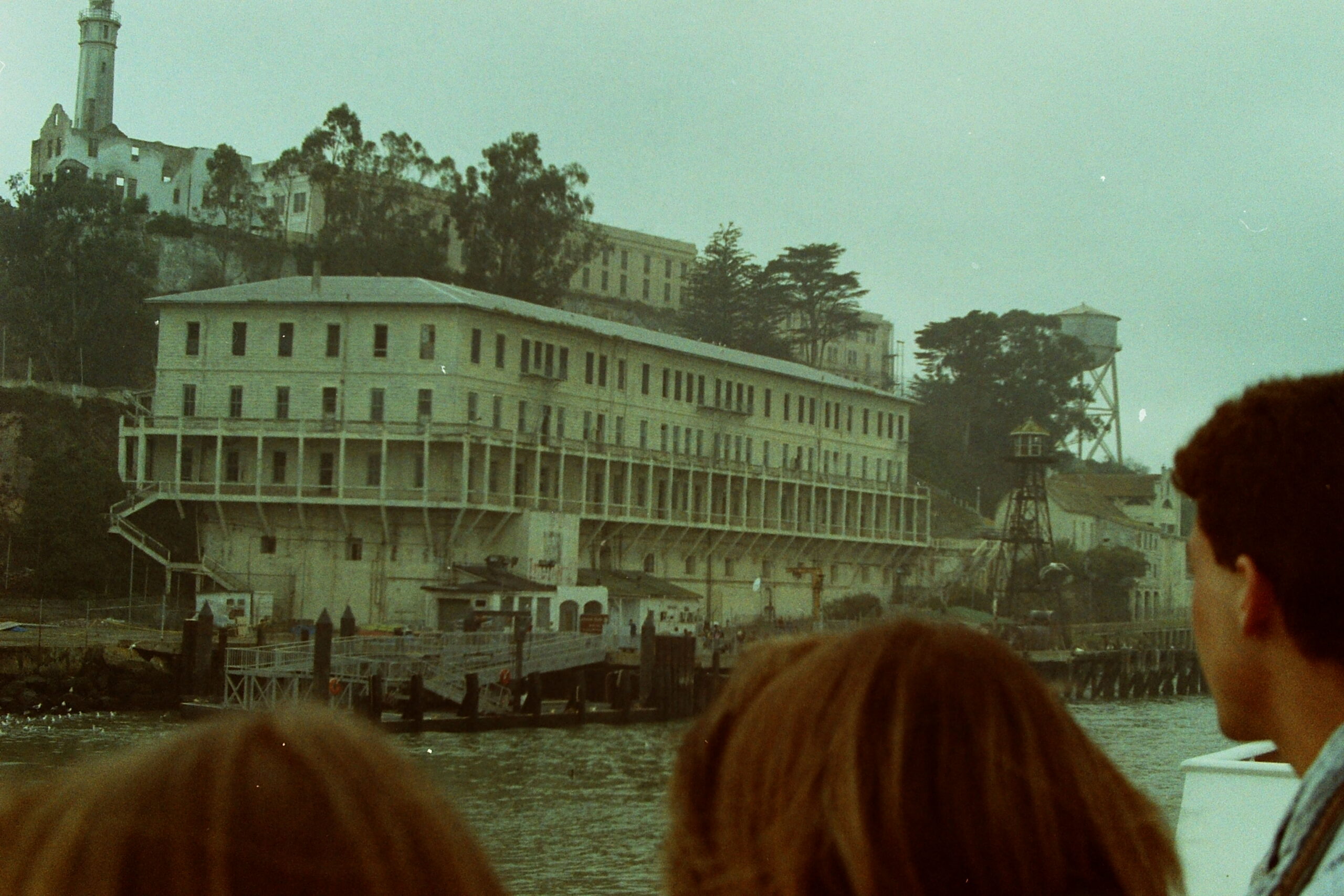
Approaching the dock at Alcatraz on a foggy January afternoon, 1991.
Photo by Nicholas Russon
It’s fashionable to blame America’s high incarceration rates on social injustice — and law enforcement — rather than lawbreaking. If policymakers would just provide disadvantaged people with sufficient resources and economic opportunity, on this view, the crime problem could be solved. That utopian vision gained traction during the mad summer of 2020, when activists, rioters, and the mainstream press, reacting to the death of George Floyd in Minneapolis, sought to replace law enforcement with programs that target the root causes of antisocial behavior. “As a society,” wrote activist Mariame Kaba in the New York Times, “we have been so indoctrinated with the idea that we solve problems by policing and caging people that many cannot imagine anything other than prisons and the police as solutions to violence and harm”.
The truth is otherwise. As Hyland’s case exemplified, violent crime is overwhelmingly the work of a small group of repeat offenders — that is, it is highly concentrated. The remedy, as [political scientist James Q.] Wilson argued half a century ago in his classic book Thinking About Crime, is not social engineering but incapacitation: keeping the violent few from striking again.
Most people are not teetering on the edge of felony, waiting to become, in the Left’s favored euphemism, a “justice-impacted individual”. The overwhelming majority of Americans never engage in serious criminal behavior, let alone commit violent felonies like murder or armed robbery. But those who do are likely to do so again, the evidence shows. Indeed, crime’s concentration is one of the most well-established findings in social science. In 1972, University of Pennsylvania criminologist Marvin Wolfgang reported that just 6 percent of males in a birth cohort accounted for 52 percent of all police contacts. (Violent crime, in particular, is overwhelmingly committed by young males.) Thirty years later, a similar study in Boston found that 3 percent of males were responsible for more than half of their cohort’s arrests after age 31.
The pattern holds across time and place. In 2014, data showed that three-quarters of state prisoners — the core of America’s incarcerated population — had at least five prior arrests. Nearly 5 percent had 31 or more, a larger share than those imprisoned after just a single arrest. In 2022, the New York Times reported that “nearly a third of all shoplifting arrests in New York City … involved just 327 people,” or 0.004 percent of the population, who had been “arrested and rearrested more than 6,000 times”. And in Oakland, a gun-violence-prevention group found that about 400 individuals — 0.1 percent of the city — were responsible for most of the city’s homicides. Violence is concentrated geographically as well. It occurs primarily in poor minority neighborhoods, whose members make up most of its victims.
These figures may even understate how concentrated antisocial behavior is. Wolfgang found that the offending minority committed dozens of crimes for every one that led to arrest. Fifty years later, a similar study reported that delinquent youth “self-reported over 25 delinquent offenses for every one police contact … with some youth reporting upwards of 290 delinquent offenses per police contact or arrest”. Combined with the fact that more than 60 percent of violent crimes reported each year go unsolved, the implication is clear: by the time a violent offender ends up in prison, he has likely committed multiple violent acts and many lesser offenses. Again, these patterns are most common among young men “who exhibited more psychopathic features”, the 2022 study’s authors noted, and “who displayed temperamental profiles characterized by low effortful control and high negative emotionality”. As a massive study from Sweden concludes: “The majority of violent crimes are perpetrated by a small number of persistent violent offenders, typically males, characterized by early onset of violent criminality, substance abuse, personality disorders, and nonviolent criminality”.
Update, 2 December: Welcome, Instapundit readers! Please do have a look around at some of my other posts you may find of interest. I send out a daily summary of posts here through my Substack – https://substack.com/@nicholasrusson that you can subscribe to if you’d like to be informed of new posts in the future.
Why Uncle Sam entered the Vietnam War – W2W 055
TimeGhost History
Published 30 Nov 2025The Vietnam War didn’t begin with American boots on the ground. It began with a promise — and a break. After the French defeat at Dien Bien Phu in 1954, the Geneva Accords split Vietnam at the 17th parallel. Ho Chi Minh led the North. In the South, Ngo Dinh Diem struggled to hold a fragile new state together while armed sects, crime syndicates, and political rivals challenged his rule. Washington saw Vietnam as the next battleground of the Cold War, and threw its support behind Diem — believing he could stop the spread of communism in Southeast Asia.
But as elections for reunification approached, tensions rose. Diem refused the vote. The North rebuilt. The South descended into repression, unrest, and quiet rebellion. Former Viet Minh fighters slipped into the shadows. Secret networks formed. Targeted killings began. By 1958, the storm clouds of a new war gathered — one the United States could no longer afford to ignore.
This episode explores how the U.S. found itself pulled into Vietnam, how Diem rose to power, why the reunification election collapsed, how American aid reshaped the South, and how the first sparks of insurgency ignited a conflict that would define a generation.
Join us as we trace the origins of a war long before the Marines landed at Da Nang — to understand why Uncle Sam entered the Vietnam War in the first place.
(more…)
The United States is not – and should not be – the arbiter of all the world’s conflicts
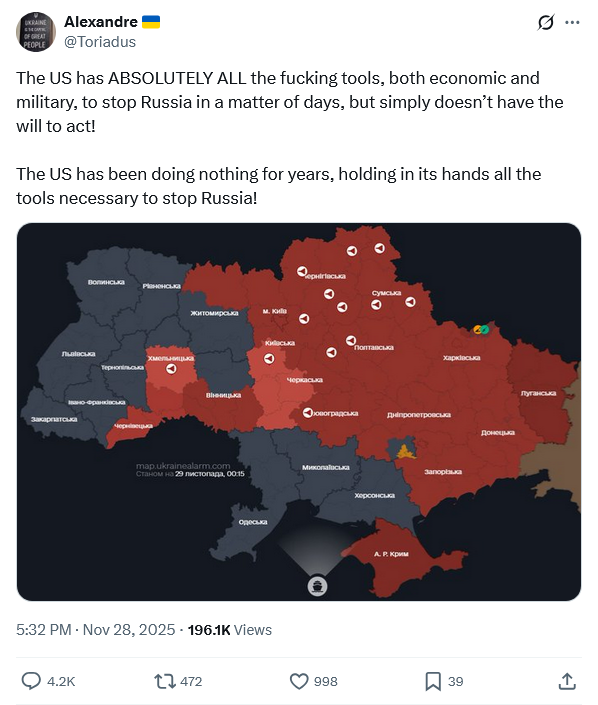
On the social media site formerly known as Twitter, Devon Eriksen responds to a demand that the United States intervene directly in the Russia-Ukraine war:
America is not special. It’s just a country.
Yes, it’s the best country, but it is not the god of all other nations.
A lot of people like to point this out when saying that America doesn’t have special rights, but those same people very rapidly and conveniently forget that phrase when they want something from America.
Because no special rights means no special obligations.
We don’t have to rob our own citizens to keep African AIDS patients alive, or feed nations that overbreed while they are unable to feed themselves.
We don’t have to stop the genocide in East Ethnicklashistan.
We don’t have to accept refugees from anywhere, much less from the worst failed states on the planet.
We don’t have to cooperate with, fund, host, or even participate in the United Nations.
And we don’t have to take sides in ethnic conflicts on the other side of the planet.
The assumption that any conflict is between the good guys and the bad guys, and that the US must help the good guys is the assumption that America is god, responsible for bringing peace, justice, and prosperity to the planet.
Are you ready to be ruled by us as if we were gods?
No?
Then don’t demand justice from us as if we were gods.
The responsibility of America, as just another nation, is to look after the interests of Americans.
Look, we all know that Russia is dogshit at warfare, because wars are not won by being tough. They are won by being organized, coordinated, trained, and equipped.
And Russia is an extraction economy, not a high-trust, high-tech first world state.
So, yes, we could easily beat Russia in a war. That does not mean it is in our best interests to do so. Lots of costs, no benefits.
And while we are wealthiest nation in the history of … everything … we still have a severe overspending problem, mostly because we’ve been the wealthiest nation for a long time, and have developed some bad problem with political corruption, and throwing money at ever grifter with a sob story and an outstretched hand.
I know you think your cause is just. I’m not trying to tell you it isn’t, because I don’t need to decide if it is or not.
It doesn’t matter.
America’s responsibility is to Americans, and if that responsibility is not being discharged, taken care of, thoroughly handled, then support of any other side quest, regardless of its merits, is dereliction of duty.
Update, 2 December: Welcome, Instapundit readers! Please do have a look around at some of my other posts you may find of interest. I send out a daily summary of posts here through my Substack – https://substack.com/@nicholasrusson that you can subscribe to if you’d like to be informed of new posts in the future.
Feeding the Robber Barons of the Gilded Age
Tasting History with Max Miller
Published 24 Jun 2025
Two majestic tiers of grapes, mandarin oranges, and raspberries suspended in pink champagne gelatin topped with whipped cream
City/Region: United States of America
Time Period: 1877The Gilded Age, a period of late 19th century United States history when a handful of people got mind-bogglingly wealthy off of industrialization, conjures up images of the social elite in New York. High society families had more money than most of us could imagine, and they spent it in the most ostentatious ways. One of those ways was by throwing parties that could cost up to the equivalent of millions of dollars in today’s money. These parties would host lavish feasts with dozens of dishes, like this gelée macédoine, which would have been served in a sweet course alongside plum puddings, mince pies, and fruit cakes.
I’m not normally a fan of gelatin, but this was really nice. It wasn’t rubbery at all and the champagne flavor really comes through. It takes a while to make, but feels fancy and is delicious. You could also use the recipe as a base and swap out other types of wine or use other flavorings like liqueurs or spices. If you do add spices (cinnamon was popular at the time), put them into the syrup, and be sure to use a cloth jelly bag or nut milk bag to strain the gelatin mixture. This will ensure a clear jelly.
If you don’t have a gelatin mold, you can use a bundt cake pan, or really any bowl of pan that you have.
Gelée Macédoine. This is made with any kind of jelly; however, jelly made with Champagne or sherry is preferable. Any of the delicate fruits of the season, such as grapes, cherries, peaches, strawberries, raspberries, mulberries, currants (on their stems), plums, and orange sections, or preserved fruits, such as brandied cherries, peaches, etc., are tastefully imbedded in the jelly, so as to show their forms and colors to best advantage.br/>
— Practical Cooking, and Dinner Giving by Mrs. Mary F. Henderson, New York City, 1877
QotD: Young Cyrus, before he became “the Great”
And then … the most important single moment in Cyrus’s education, the moment when it becomes clear that he has actually set his sights appropriately high. He gets bored of the hunts. Cyrus deduces, correctly, that the hunts he is sent on, and all the other little missions, are contrived. Each is a problem designed to impart a lesson, a little puzzle box constructed by a demiurge with a solution in mind. In this respect, they’re like the problems in your math textbook. And like the problems in your math textbook, getting good at them is very dangerous, because it can mislead and delude you into thinking that you’ve gotten good at math, when actually you’ve gotten good at the sorts of problems that people put in textbooks.
When you’re taught from textbooks, you quickly learn a set of false lessons that are very useful for completing homework assignments but very bad in the real world. For example: all problems in textbooks are solvable, all problems in textbooks are worth solving (if you care about your grade), all problems in textbooks are solvable by yourself, and all of the problems are solvable using the techniques in the chapter you just read. But in the real world, the most important skills are not solving a quadratic by completing the square or whatever, the most important skills are: recognizing whether it’s possible to solve a given problem, recognizing whether solving it is worthwhile, figuring out who can help you with the task, and figuring out which tools can be brought to bear on it. The all-important meta-skills are not only left undeveloped by textbook problems, they’re actively sabotaged and undermined. This is why so many people who got straight As in school never amount to anything.
The section covering his childhood and education concludes with a dialogue between Cyrus and his father Astyages as the two ride together towards the border of Persia. Astyages recapitulates and summarizes all of the lessons that Cyrus has been taught, and adds one extra super-secret leadership tip. Cyrus wants to know how to attract followers and keep their loyalty, and his father gives him a very good answer which is: just be great. Be the best at what you do. Be phenomenally effective at everything. People aren’t stupid, they want to follow a winner, so be the kind of guy who’s going to win over and over again, and if you aren’t that guy, then maybe choose a different career.
Cyrus asks and so Astyages clarifies: no, he doesn’t mean be great at making speeches, or at crafting an image, or at appearing to be very good at things. He doesn’t mean attending “leadership seminars”, or getting an MBA, or joining a networking organization for “young leaders”. He means getting extremely good at the actual, workaday, object-level tasks of your trade: “There is no shorter road, son … to seeming to be prudent about such things … than becoming prudent about them”. In Cyrus’s case, this means tactics, logistics, personnel selection, drill, all the unglamorous parts of running an ancient army. People aren’t stupid. If they see that he is great at these things, they will flock to his banner. And then, one more ingredient, the final step: make it clear that you care about their welfare. “The road to it is the same as that one should take if he desires to be loved by his friends, for I think one must be evident doing good for them.”
There you have it. Two simple #lifehacks to winning undying loyalty: be the best in the world at what you do, and actually give a damn about the people under you. Our rulers could learn a thing or two from this book. So ends the education.1 The rest of this book, and the bulk of it, is Cyrus putting these lessons into practice by very rapidly conquering all of the Ancient Near East. It’s telegraphed well in advance that the final boss of this conquest will be the mighty Neo-Babylonian empire founded by Nebuchadnezzar,2 but before he takes them on Cyrus first has to grind levels by putting down an incipient rebellion by his grandfather’s Armenian vassals,3 then whipping the neighboring Chaldeans into line, then peeling away the allegiance of various Assyrian nobles, then defeating the Babylonians’ Greek allies and Egyptian mercenaries, before finally taking on the Great King in his Great City.
John Psmith, “REVIEW: The Education of Cyrus, by Xenophon”, Mr. and Mrs. Psmith’s Bookshelf, 2024-01-08.
- There’s actually one other noteworthy bit of advice that Astyages gives:
“Above all else, remember for me never to delay providing provisions until need compels you; but when you are especially well off, then contrive before you are at a loss, for you will get more from whomever you ask if you do not seem to be in difficulty … be assured that you will be able to speak more persuasive words at just the moment when you are especially able to show that you are competent to do both good and harm.”
This is decent enough advice, but what makes it especially fun is that Astyages also applies it to the gods! Maybe it’s his own pagan spin on “God helps those who help themselves”, but Cyrus takes this advice and takes it a step further. He learns to interpret auguries himself so that he will never be at the mercy of priests. Then when he needs an omen, he performs the sacrifices, decides which of the entrails, the weather, the stars, and so on are pointing his way, loudly points them out, and ignores the rest.
Henrich notes in The Secret of our Success that divination can be an effective randomization strategy in certain sorts of game theoretic contests. But the true superpower is deciding on a case-by-case basis whether you’re going to act randomly, or just make everybody think you’re acting randomly.
- Yes, that Nebuchadnezzar.
- Somewhere in the middle of In Xanadu, Dalrymple recounts an old Arab proverb that goes: “Trust a snake before a Jew, and a Jew before a Greek. But never trust an Armenian.” The tricksy Armenian ruler more than lives up to this reputation. But when Cyrus outwits and captures him, his son shows up to beg for his life, and what follows is one of the more philosophically charged exchanges in the entire book. They go multiple rounds, but by the end of it the Armenian crown prince has put Cyrus in a logical box as deftly as Socrates ever did to one of his interlocutors, and Cyrus lets the king off with a warning. The prince goes on to combat anti-Armenian stereotypes by serving Cyrus faithfully to the end of his days.
November 30, 2025
The plight of most young western men
At Postcards from Barsoom, John Carter explores the dangerous psychological rift in western thought that casts young men into a literal no-win situation and yet blames them for not succeeding:
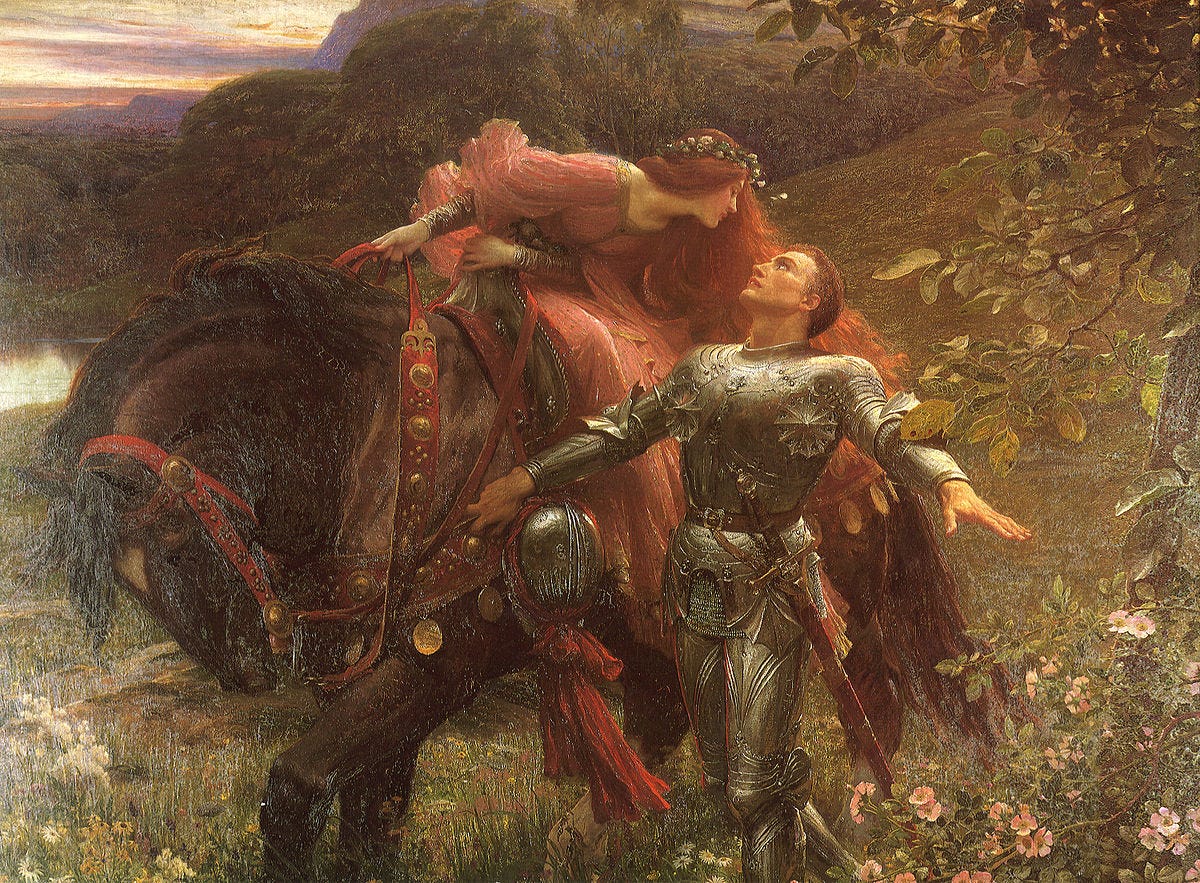
La Belle Dame Sans Merci by Frank Bernard Dicksee, 1901
A great deal of Discourse revolves around the desultory state of the broken modern young man. We wring our hands about porn brained incels, and about the incel’s mirror image in the sociopathic gym bro fuckboy. We talk about how men need to man up, put down the console controller, get out of the basement, talk to real girls, and wife them up. At the same time, we do everything we can to make this as difficult and unappealing as possible. Male sexuality is relentlessly demonized, and this is at the root of great deal of social dysfunction.
Our society has established new social norms that make talking to girls in the wild, or even looking at them, tantamount to a sex crime. Buying a girl a drink at the bar is an imposition, an implicit expectation that she will at the very least say thank you, and this is essentially sexual harassment. As a result of this men do not buy girls drinks anymore. Glance at a girl’s cameltoe as she places her yoga pants between you and the mirror to do hip thrusts while you’re trying to focus on your deadlift, and get put on blast on TikTok as a perv. As a result men carefully avoid looking at girls, and girls wonder why they don’t get attention. Office romances are right out: ask Betty from accounting if she’d like to get a coffee, and you’re rolling the dice between getting lucky and getting a talking to from HR (if you’re lucky). Friend-group romances are discouraged: they bring too much drama.
The only romantic avenue still permitted is the dating apps. The de facto proscription of every other venue was so abrupt and thorough that I can’t help but wonder if MeToo was engineered by Match Group, in order to do to dating what Uber did to taxis. Just like Uber took an occupation that was able to provide a reasonable living standard for working class guys and turned it into piece-work for an imported third-world precariat, so Tinder wiped away thousands of years of accumulated social technologies optimized for the purpose of bringing young men and women together into stable, loving, and fecund matrimony, and replaced it with a winner-take-all meat market in which a small minority of the best-looking men swipe their way through a digital harem of emotionally crippled cum-dumpsters, while women retaliate by using their matches to get free meals and ghosting as soon as the cheque comes without so much as a thanks for the company. Commoditizing romance left everyone more lonesome and miserable than ever, but would you look at that market cap.
The decay set in long before Tinder, however.
Feminists have gotten a great deal of mileage out of Freud’s Madonna-whore complex. This is the idea of a Manichean division of femininity: the chaste purity of the innocent nurturing mother, contrasted with the wanton looseness of the degraded prostitute. The Madonna is embodied by the Virgin Mary, whose only begotten child was conceived immaculately, which is to say without actually having sex. Both archetypes are caricatures that fail to capture the full range of feminine sexuality, but a traditional, god-fearing society effectively forced women to choose between one or the other. Either she represses her instincts and lives a passionless life of quiet misery, or she becomes a fallen woman.
Unlike much of Freud’s oeuvre, which largely consisted of the author’s barely concealed fetishes, the Madonna-whore complex has held up fairly well in the era of evolutionary psychology. Freud’s explanation for the phenomenon – that it is rooted in the Oedipal desire to rut with your own mother – is of course nonsense (except possibly insofar as it may have applied to him). Its origin is more plausibly in the predicament of paternal uncertainty which has bedevilled men since before the dawn of mankind, and which leads to a trade-off between short- and long-term mating strategies with easy women on the one hand (with whom paternity is always in question, and in whom investment should therefore be kept to a minimum, but since they’re easy you can sow your seed in lots of them), and chaste women on the other (with whom paternity can be more reliably determined, and in whom greater investment is therefore warranted). It doesn’t matter that we have paternity tests now: evolved instincts don’t care about your technology.
In the aftermath of the sexual revolution female sexuality was freed from these ancient constraints. Women are permitted to dress as they please, date who they want, have sex with as many partners as they desire. Any attempt to dissuade women from such behaviour is attacked as slut shaming, a ploy by the patriarchy to control their bodies.
Promiscuous premarital sex was once a one-way street to single motherhood. The pill and legal abortion reduced that risk considerably, which provided the justification for eliminating sexual restraint in the first place. Male sexual psychology presents its own problems, however. Revealing attire invites male attention, and often not from the males whose attention a woman wants to attract. Women enjoy male attention, and so dress to attract it. Sexually excited men are liable to behave badly. Badly behaving men result in women getting hurt. Obviously, if a man behaves badly, society will punish him … but the wise course is to avoid putting temptation in his way in the first place. Those ancient restrictions on female sexuality weren’t there to oppress women: they were there to protect women from themselves.
Women may have chafed under the chastity belt of the Madonna-whore complex, but it caused problems for men too. Men don’t generally want either a frigid Victorian schoolmarm or a drunken slattern for a wife: he wants the happy medium between the two, purity in the streets but a prostie in the sheets, a girl who enjoys sex and is good at it, but only has it with him. The Madonna-whore complex is a schizoid separation of these two conflicting desires, which then leads to the romantic frustration of both sexes: men have to choose between two equally unappealing options, and women are required to deny one or the other aspect of their own sexuality.
Just like men, women tend to want two, somewhat contradictory things from the opposite sex. First, they want men to protect and provide for them: to build what needs building, fix what needs fixing, pay for dinner, buy them pretty jewellery. In other words, they want men to sacrifice their time and energy of their behalf. At the same time they want men who are dominant, strong, confident, and at least potentially dangerous, for the obvious reason that men must compete with other men, and men who do not possess these traits make terrible protectors and providers in comparison with men who do. The necessary tension is that dominant, aggressive men are generally much less interested in protecting and providing: a man who won’t submit easily to other men, won’t submit to women either; a man who can force other men to submit to his will, can also force a woman to do the same. This mirrors the tension in male desires: a girl who’s a good lay might not be the most impeccably virginal of innocent maidens.
We can’t call women whores anymore in order to enforce virginal purity, but bad romantic decisions still carry bad consequences, and women also need to be protected from those consequences (and can’t ever be held responsible for them). The emphasis has therefore shifted from policing female sexuality to policing male sexuality. The result of this is the emergence of the simp-rapist complex.
The only way to create a safe environment for women whose behaviour is entirely unrestricted is to ruthlessly suppress precisely those masculine traits of dominance and aggression that women find attractive in the first place. All of these traits get included into the broad category of “rape culture”. Even looking at a woman without her expressly stated positive consent becomes a problematic act. Men who violate these norms become, according to this standard, “rapists”.
Update, 1 December: Welcome, Instapundit readers! Please do have a look around at some of my other posts you may find of interest. I send out a daily summary of posts here through my Substack – https://substack.com/@nicholasrusson that you can subscribe to if you’d like to be informed of new posts in the future.
North Africa Ep. 10: Rommel’s Desert Cannae – The Trap at Mechili
World War Two
Published 29 Nov 2025This episode, Rommel sets up a “Cannae, modern style” at Mechili, a three-pronged encirclement with Wechmar pressing from the west, Schwerin/Ariete and MG 8 driving up from the south, and Olbrich’s panzers meant to close the center. A Ghibli, fuel chaos and delays upset the timing, but Ponath cuts the Derna road and captures Generals Neame and O’Connor. And after failed breakout attempts against Fabris, the Bersaglieri and Streich, Gambier-Parry surrenders about 1,700 men and Mechili falls, opening the road to Tobruk.
(more…)
Canada’s growing Islamist problem
At Juno News, Joe Adam George points to the problems Britain is having with their well-established Muslim extremists and says Canada has exactly the same issues here:
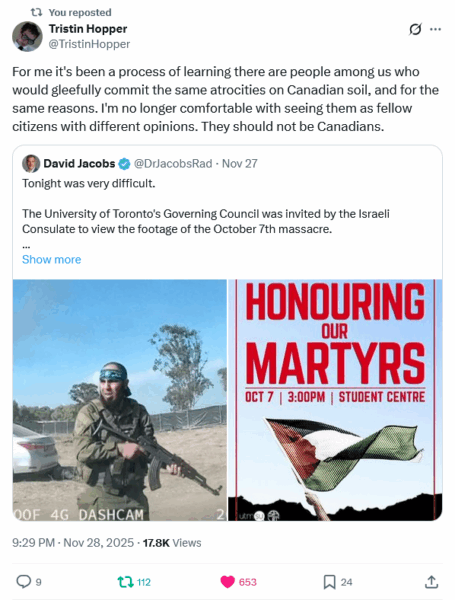
When 35-year-old Jihad al-Shamie terrorized a Manchester synagogue last month on Yom Kippur pledging allegiance to ISIS, few were shocked by what investigators later uncovered. He attended a Salafi-inspired mosque where extremist rhetoric was routine. His father had praised Hamas’s October 7 attackers as “Allah’s men on earth”. Years of indoctrination taught him that violence was virtue, resistance was glory, and terror was faith.
What unfolded in Manchester is a warning to Canada, where similar currents of Islamist radicalism have been manifestly gathering strength. Across Canadian cities, extremist narratives are taking root among young people through community networks, activist circles, and online echo chambers.
A prominent Shia mosque in Windsor, Ontario, recently held a memorial service for slain Hezbollah leader Hassan Nasrallah — for the second year running — where youths eulogised the notorious terrorist as a “hero” and “martyr”. The Toronto Metropolitan University’s arts faculty funded a research paper which argues that Canada’s designation of Islamist groups as terrorist organizations is deeply flawed because of “systemic Islamophobia” and racism. Such episodes do not merely glorify violence; they sanctify terrorism and rebrand militancy as a necessity.
Earlier this year, Canada’s spy agency, the Canadian Security Intelligence Service, warned it was “increasingly concerned” about the threat of ISIS-inspired attacks. That concern is well-founded. The Royal Canadian Mounted Police reported a staggering 488 per cent rise in terrorism-related charges between April 2023 and March 2024, much of it driven by ISIS-motivated youth radicalisation. In the same period, antisemitic incidents surged by more than 670 per cent. An ISIS-inspired teenager was arrested in Montreal in August for terrorism offences. These are not isolated events but symptoms of a cultural shift — where extremism masquerades as activism and hate is sold as justice.
Since the breakout of the Israel-Hamas war, unrestrained radicalisation has seeped into mosques, schools, charities, and universities — often protected by Canada’s own liberal frameworks. Islamist networks have mastered the art of exploiting the Charter of Rights and Freedoms to propagate radical ideologies while deflecting scrutiny. Wrapped in the language of “human rights” and “anti-racism”, they advance intolerance behind a façade of moral virtue.
As former FBI agent and counter-terrorism expert Lara Burns noted, it’s a tactic that echoes the Muslim Brotherhood’s “sabotage strategy” in North America — infiltrating institutions to steer public debate and soften attitudes toward Islamist causes.
Campaigns to institutionalize so-called “anti-Palestinian racism” (APR) is turning Canada’s classrooms and government offices into laboratories for grievance politics. Marketed as anti-discrimination, APR in reality brands any criticism of Palestinian militancy as racism, giving extremists a moral shield and silencing dissent. Even Canada’s Islamophobia czar, Amira Elghawaby, has been accused of abusing her taxpayer-funded post to conjure up Islamophobia and APR where none existed. During a visit to London in June, she reportedly met officials shaping the UK’s own Islamophobia legislation — a troubling sign of cross-pollination between partisan ideologues.
Drawers for dummies
Rex Krueger
Published 24 Jul 2025Compass Rose Toolworks: https://www.compassrosetools.com/
Check out my Courses: https://rexkrueger.retrieve.com/
Patrons saw this video early: patreon.com/rexkrueger
Follow me on Instagram: @rexkrueger
QotD: US illegal immigration, or, creating a new helot class
I see many comments to the effect that restricting illegal immigration will cause all sorts of shortages in agriculture and construction. I call bullshit on this for two simple reasons. Before the Great Replacement became enshrined into law in 1965 we had few immigrants of any sort and somehow we managed to pick our own cotton and build houses. We did it the old fashioned way – white and black Americans worked. High school kids would work the fields at harvest time. Black people didn’t have welfare so they did unskilled and even skilled work – bricklayers, lathe-and-plaster work, etc. Is there any reason we can’t do this today?
None whatsoever. The Democrats (which includes the Republicans) don’t know the word “helot“, of course, but that’s what all this boils down to: They’re importing a helot class. It’s probably futile, attempting to pinpoint the exact moment in time when America transformed into AINO, but my best guess is “The moment the phrase ‘jobs Americans won’t do’ was uttered for the first time”. Who the fuck are you, to declare that work, any work, is beneath you?
That’s probably the main reason America became a word-bestriding colossus: Our bone-deep belief in the fundamental dignity of labor. Well within my lifetime, “He’s a hard worker” was considered high praise, at least among people who were still Americans (as opposed to AINO-ites). He might not have anything else going for him, but he pulls his weight, and that’s enough.
What’s more, the LEFT understood this, well within my lifetime. I never tire of pointing out that you could read well-written, well-supported, logically airtight articles against illegal immigration in the pages of The Nation and Mother Jones, right up to the very end of the 20th century. The poor negroes, for instance, can’t “break the cycle of poverty” — a phrase never heard anymore — because all the jobs once available to them have been taken from them by illegals.
But somehow, the Left convinced themselves that the only “jobs” worth having involve clicking a mouse; everything else is an insult to their special wonderfulness. And since the Left control everything, that became one of the defining assumptions of AINO culture — if you can’t do it with a laptop, it’s for peons. Compared to “the laptop class”, the Ancien Regime were kind, tolerant social reformers.
Severian, “Friday Mailbag”, Founding Questions, 2025-01-31.
Update, 1 December: Welcome, Instapundit readers! Please do have a look around at some of my other posts you may find of interest. I send out a daily summary of posts here through my Substack – https://substack.com/@nicholasrusson that you can subscribe to if you’d like to be informed of new posts in the future.
November 29, 2025
Eliminating fathers – a long-term goal of early Feminists
Janice Fiamengo laments a recent British change to family law that “family courts will no longer work on the presumption that having contact with both parents is in the best interests of a child”. This is merely the latest move in a long-running legal and political struggle to alienate fathers from their children:
“Even today most people will refuse to believe that one of feminism’s main aims is, and always was, to give women the power to rid their families of men.” — William Collins, The Empathy Gap (2019)
“‘The person who is least likely to abuse a child is a married father,’ notes Canadian Senator Anne Cools. ‘The person who is most likely is a single, unmarried mother.'” — quoted in Stephen Baskerville, Taken Into Custody: The War Against Fathers, Marriage and the Family (2007)
[…]
It is a truism that feminists seek to destroy the father-led family and have long worked to do so through anti-father propaganda, legal chicanery, and evidence-free allegations of abuse.
Those who have not read feminists’ own words on this subject may have difficulty appreciating the depth of their desire to deny fathers any legally- or socially-recognized familial role.
Elizabeth Gould Davis’s The First Sex (1971) provides a compelling example. Written at the height of the Second Wave of feminism, and published three years before the author’s death by suicide, it was a popular female-supremacist treatise. In it, Davis rhapsodized about goddess worship and female power in the ancient world, detailing a time when societies allegedly recognized and revered women as the superior sex.
In these societies, according to mythographer Robert Graves, “Men feared, adored, and obeyed the matriarch” (quoted p. 121). In thrall to women, men were peripheral, their roles as fathers non-existent: “[The woman] took lovers, but for her pleasure,” writes Davis, “not to provide her children with a father, a commodity early woman saw no need for” (p. 121). In this matriarchal sexual utopia, “Sexual morals were a matter of personal conscience, not of law” (p. 116), and the sole familial bond was between the mother and her offspring.
A chapter on “Mother-Right” made the case for a return to such a system, explaining that fathers contribute nothing good to their children’s lives. “The father is not at all necessary for a child’s happiness and development” (p. 117). Even children allegedly know this to be so: “In nearly every child’s experience, it is the mother, not the father, who loves all the children equally, stands by them without regard to their worth or lack of it, and forgives without reservation” (p. 118).
The father’s irrelevance is rooted, Davis explained, in men’s inability to love. “Maternal love was not only the first kind of love. For many millennia it was the only kind” (p. 119). Man has merely “learned to appreciate and be grateful for woman’s love, even though he was not emotionally equipped to return it in kind” (p. 119). She quoted Freudian psychoanalyst Theodor Reik to support her view that when men speak of love, they are actually speaking of a mere ‘scrotal frenzy'” (p. 119).
This rhapsody to female power and assertion of male uselessness continues for hundreds of pages in Davis’s ludicrous yet impressively-detailed book. Many feminists at this period made similar claims, attacking fatherhood and calling for the destruction of the patriarchal family. Author and activist Kate Millett, for example, argued in Sexual Politics (1970) that women’s oppression could not be ended without a transformation of “patriarchy’s chief institution […] the family” (p. 33).
In the same year, feminist radical Shulamith Firestone excoriated the patriarchal nuclear family as the “most rigid class/caste system in existence” (The Dialectic of Sex, p. 15). Two years earlier, would-be killer Valerie Solanas had expressed the sentiment crudely in her SCUM Manifesto: “The effect of fathers, in sum, has been to corrode the world with maleness. The male has a negative Midas touch — everything he touches turn to shit” (p. 45).
These were not simply sad cranks penning screeds in cat-piss-scented rooms (though many of them were mentally ill). They were acknowledged leaders of a movement that would, within a few decades, shape and control the core institutions of western civilization.

Exploring Hand Tool Woodworking | Paul Sellers
Paul Sellers
Published 28 Nov 2025Most of the woodworkers I come to meet have lost any working knowledge of just how efficient and effective hand tools are in daily woodworking, and yet I have used them to make my living for 60 years. Not only have they lost the skills and knowledge, but they have lost belief in themselves and the ability to use them.
With our team, I have spent three decades training hundreds of thousands of woodworkers worldwide to use the methods I was raised with as an apprentice, and they are discovering that hand tools are not outdated or outmoded.
Watch this video and ask yourselves, if you couldn’t use tools just like these in your day-to-day woodworking.
——————–
(more…)
“There comes a point where government waste stops looking like incompetence and starts looking like treason”
Canadians must be literally the most passive and forgiving people on Earth. It’s the only thing that can account for how we are governed by incompetents or idiots, yet keep re-electing them despite all the clear signs of failure and opportunistic crony looting of the public purse:
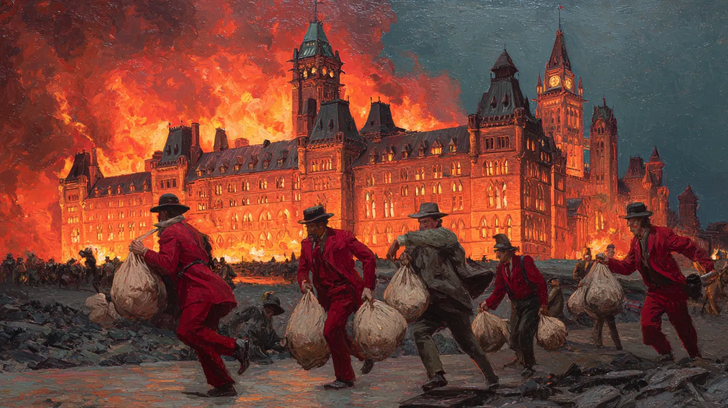
Image from Blendr News
There comes a point where government waste stops looking like incompetence and starts looking like treason. Canada has long passed that point. What we are witnessing now is not mere mismanagement or bureaucratic drift — it is the systemic looting of a nation by the people meant to serve it. Billions vanish with no oversight, no accountability, and no shame. The numbers have grown so grotesque that one struggles not to call this what it is: organized theft.
Take Stellantis. Ottawa handed the automaker $15 billion — the largest corporate subsidy in Canadian history — and the industry minister didn’t even read the contract before approving it. This, despite Stellantis shifting Jeep production to the U.S., delaying its employment targets at the Windsor battery plant, and refusing to appear before Parliamentary Committee hearings. Honda received a major subsidy without full Treasury Board review. Volkswagen hid its cost estimates. Northvolt was showered with subsidies and then slipped into insolvency. Each scandal blurs into the next until you realize the pattern is not incompetence but a business model.
Then there’s the LNG project in British Columbia. The main industrial partner is an American firm. The terminal will be built overseas, floated to Nisga’a land, and subsidised by Canadian taxpayers. In other words: Canadians take the risk while the profits flow abroad and the jobs go to Korea or Japan.
Or consider Telesat. They received $2.14 billion to connect rural Canadians to high-speed internet — with no obligation to connect a single home, no penalties for failure, no clawbacks if the project collapses, and no enforced timelines. Three years later, the network still does not exist. Meanwhile, Starlink already worked, already served rural communities, could have done it for half the cost, and offered immediate deployment — but was rejected because Elon Musk is “polarizing”.
ArriveCAN? $54 million spent on an app worth $80,000, much of it funnelled to GC Strategies, a boutique firm that admitted it didn’t actually build anything. Then the Sustainable Development Fund — the so-called green slush fund — where $400 million flowed into Liberal-friendly firms.
The State tells us its creed is “responsible governance”. Yet almost every act defies that claim. What we have instead is a system run by well-dressed operators who treat the public purse as their own. Canada is now a nation run by criminals, for criminals.


