Quotulatiousness

August 14, 2021

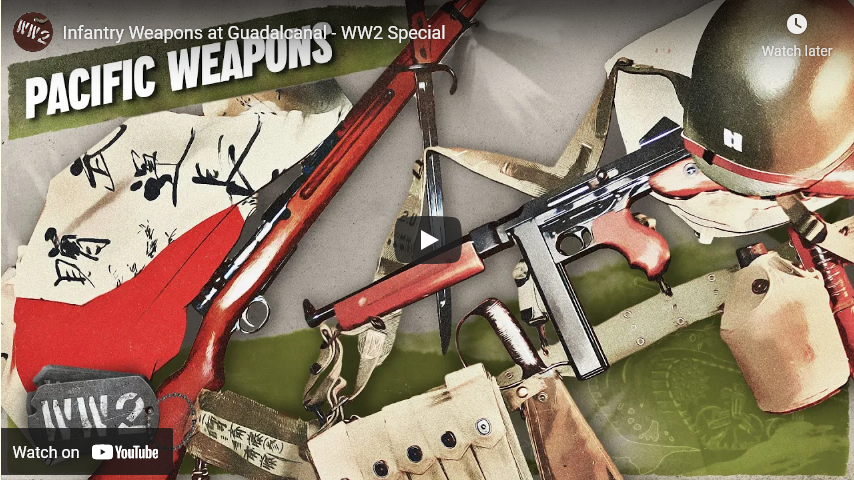
Infantry Weapons at Guadalcanal – WW2 Special

Filed under: History, Japan, Military, Pacific, USA, Weapons, WW2 — Tags: , , , , , , , — Nicholas @ 04:00

Update: The folks at the World War Two channel have taken down this video due to technical errors in the script. Here’s their explanation.

World War Two
21 hours ago
Video on Infantry Arms at Guadalcanal retracted. Indy explains why:

Hi everyone. Indy here. As most of you know, I do the research and writing for all of the regular weekly episodes here. I host many of the specials as well, though I do not do the research for most of them- occasionally so, if it’s something that’s really in my field of expertise, like geopolitics, strategy, personal stories, communications, and international relations. The research for the other specials is done by a variety of specialists in their fields or historians, so we can maintain the quality you’ve come to expect from us. I understand, though, that many of you have serious issues with the research for the Guadalcanal infantry special. Our apologies for that- the research was done by an historian, a PhD [student], actually, and we also ensured it was double fact-checked, but obviously some serious mistakes slipped through. Live and learn. I will say that I think it is important that you continue to tell us when you take issue with something we present, since we strive to make the most complete and accurate documentary series possible, so although some of them are hard to read we appreciate such feedback from our community.

And this is from the researcher who worked on the script:

Marlon Londoño
18 hours ago
Hey guys! This is Marlon, the PhD student in question who helped with the researching and writing of the episode. Just to give a little background, I’m a volunteer researcher who helps with the channel over the summer while I’m not teaching/researching/taking coursework. I’m a military historian and my main academic focus is on social and cultural military history (i.e. what people’s wartime experiences were like and why. I’m especially interested in how people justify wartime violence and oftentimes the types of weapons they use play a role in that mental process, so that’s the context in which I usually think about weapons on the battlefield).

I’m sorry that I let a lot of you down with the mistakes about the Garand and Arisaka, among others. To be honest, I was surprised to learn they were myths. But I certainly know now, and I don’t think I’ll be forgetting any time soon 😅 One thing that I firmly believe as a researcher and educator is that nobody has a monopoly on the truth, least of all me. I tell that to my students on the first day of class each semester. I certainly don’t presume that the degree I’m pursuing makes me infallible or instantly qualified for anything. And this was a classic example of just how wrong I can be sometimes!

For what it’s worth, I love war history just as much as anyone else in the community, and I’m sorry that my research wasn’t as rigorous as it might otherwise have been. I hope you all might be willing to give any future episodes of mine a second chance, and of course I’m all ears for any mistakes that you want to point out!
August 13, 2021

Spycraft and the Special Operations Executive – WW2 – Spies & Ties 07

World War Two
Published 12 Aug 2021

Astrid talks about spying all the time, but what was it actually like for people on the ground? We look through the lens of the British Special Operations Executive (SOE) to find out!
(more…)

August 12, 2021

QotD: Ignoring the warnings

… on Dec. 7, 1941, a U.S. Army Air Force lieutenant was spending his first-ever shift with a radar unit atop some Hawaiian high ground. Radar was brand new technology, and the U.S. was still figuring out how to best use it. The poor lieutenant watched on a scope as a big blob of something approached the naval base. He assumed it was a bunch of friendly planes coming in from the U.S. — what else would it be, right? Besides, even if he had been worried, there was no established protocol to sound an alarm. Forty-some-odd years before the release of Ghostbusters, the poor lieutenant was living the iconic tagline — when there’s a big mass of planes flying toward your base, who ya gonna call? And so the lieutenant and his men could only watch Japan’s massively successful attack on the U.S. fleet, an attack that caught the American defenders totally unprepared, with sailors asleep in their racks and senior officers golfing or breakfasting. There had been some intelligence warnings that Japan was up to something, but no one guessed that an attack on Hawaii was imminent. Not even the guys who quite literally saw it coming.

Let’s jump forward a few decades: in 1973, Israeli military intelligence was fully aware of a huge build-up of men and weapons on its borders with Syria and Egypt. The mobilizations were impossible to hide — tens of thousands of troops, tanks, artillery, the whole apparatus of modern warfare was lining up across Israel’s borders. But Israel’s top military intelligence officer concluded that the build-up was intended to apply political pressure ahead of negotiations, not actually to prepare for an assault. Israel was militarily superior, after all, and had handily defeated the combined Arab armies before, including just six years prior. The Arabs simply wouldn’t dare try again. Right?

Wrong. They dared, Israel was caught totally by surprise, and the Jewish state came shockingly close to defeat and likely destruction.

Ideally, these kinds of mistakes — mistakes of preparedness, mistakes of erroneous conclusion — are studied, learned from and then never repeated. In the real world, of course, we tend to make the same mistakes over and over.

Matt Gurney, “How the COVID crisis broke our leaders’ minds”, The Line, 2021-04-23.

August 11, 2021

The Symphony That Defeated the Wehrmacht – WAH 040 – August 1942, Pt .1

Filed under: China, Europe, Germany, History, Japan, Military, Russia, USA, WW2 — Tags: , , , , , , — Nicholas @ 04:00

World War Two
Pubished 10 Aug 2021

The Big Action at the Warsaw Ghetto continues, while The Japanese carry out retaliations against the Chinese for aiding American airmen. Dmitri Shostakovich’s “Symphony no. 7” premieres in the besieged city of Leningrad.
(more…)

Tank Chats #119​ | Churchill Mark VI and VIII | The Tank Museum

Filed under: Britain, History, Military, Weapons, WW2 — Tags: , — Nicholas @ 02:00

The Tank Museum
Published 19 Mar 2021

The Tank Museum’s Historian David Fletcher discusses a tank in the Museum’s collection which entails a certain level of controversy. Is it a Churchill Mark IV, or Mark VI? David believes it to be a Mark IV 75mm, with a number of updates, hence the disparity. David also covers the Mark VIII variant with the 95mm close support howitzer. Join him to find out more.
(more…)

August 8, 2021

Guadalcanal – Allies Take the Initiative – WW2 – 154 – August 7, 1942

Filed under: Britain, Germany, History, Japan, Military, Pacific, Russia, USA, WW2 — Tags: , , , , , , — Nicholas @ 04:00

World War Two
Published 7 Aug 2021

The Axis Forces are on the move on the Eastern Front and in the Caucasus, but this week the Allies begin an offensive of their own: this week come Allied landings and attacks on Guadalcanal and nearby islands, the first American offensive against the Japanese.
(more…)

August 7, 2021

The Black Markets of World War Two – WW2 – On the Homefront 012

World War Two
Published 6 Aug 2021

With the scarce food supply brought about by war, many turn to the black market and its astronomic prices as supplements. It is a place for opportunists and patriotic protesters, but mainly it’s a means to survive.
(more…)

August 6, 2021

Shostakovich: Stalin’s Composer? – WW2 Biography Special

Filed under: Germany, History, Media, Russia, WW2 — Tags: , , , , , — Nicholas @ 04:00

World War Two
Published 5 Aug 2021

Leningrad’s Dmitri Shostakovich has risen from a child prodigy to be one of the Soviet Union’s most celebrated composers, having rescued his career from Stalin’s interference along the way. Desperate to defend Russia after the German invasion, he fights back, not with a rifle, but with music.
(more…)

August 5, 2021

QotD: September 1939 was pretty much the optimal moment for Germany to go to war

Filed under: Britain, Europe, France, Germany, History, Military, Quotations, Russia, WW2 — Tags: , , , , , — Nicholas @ 01:00

The German economy was already in poor condition, and it was the looting of Austrian gold and Czech armaments that gave it a temporary boost in what was effectively still peacetime. (The later looting of the Polish and French economies never made up for the costs of a full world war being in progress.)

Demographically German military manpower was at a height in 1940/41 that gave it an advantage over the allies and potentially the Russians, that would quickly evaporate within a few years. (Demographics was an important science between the wars, and many leaders – like Hitler and Stalin – made frequent references to it. The Russians in particular would start having more manpower available starting in 1942 … perhaps not a coincidence that Germany invaded in 1941?)

The Nazi air forces had a temporary superiority over the Allies in 1939 that was already being rapidly undercut as both the British and the French finally started mass production of newer aircraft. (By mid-1940 British aircraft production had overtaken the Germans, even without the French. If the war had not started in 1939, by 1941 the Luftwaffe would have been numerically quite inferior to the combined British and French air forces, even without the surprisingly effective new fighters being brought on line by the Dutch and others.)

German ground forces, while not really ready for war in September 1939 (half of their divisions were still pretty much immobile, and they had only 120,000 vehicles all up compared to 300,000 for the French army alone), were nonetheless in a peak of efficiency considering the Czechs and Poles had been knocked out, and the British and French were struggling to get new equipment into service. The Soviet short-term decision to ally with the Germans to carve up Eastern Europe (Stalin knew this was only a temporary delay to inevitable conflict), also allowed the Germans an easy victory and much greater freedom of action. Again, by 1941 British conscription and production, and French (and Belgian, and Dutch, etc.) upgrades and increases in fortifications, would have come a lot closer to making the German task next to impossible. (Even then it was the collapse of French morale after the loss of Finland — leading to the collapse of the French government – and Norway, that really defeated France, not vastly inferior divisions or equipment.)

A byproduct of an Allied ramp up might also have seen Belgium rejoin the allied camp in 1941, or at least make significant planning preparations to properly add its 22 divisions and strong border fortifications to allied defences if Germany attacked. (Rather than the hopeless mess that happened in 1940 when the allies rushed to rescue the temporary non-ally that had undermined the whole interwar defensive project …) Again, the Germans managed to find a sweet spot in 1939-40 that temporarily undermined long-standing interwar co-operation, and one that was not likely to last very long.

Similarly a delay of war would have allowed allied negotiations with the Balkan states to advance. The same guarantee that was given to Poland had been given to Yugoslavia, Rumania and Greece. (It is usually forgotten that Greece – attacked by Italy – and Yugoslavia – voluntarily – joined the British side at the worst possible moment in 1941. (Only to be crushed by the Germans … but with the interesting by-product of effectively undermining Germany’s chances of defeating the Soviets and occupying Moscow in the same year …)

Nigel Davies, “If the War hadn’t started until December 1941, would it?”, rethinking history, 2021-05-01.

August 4, 2021

Oil – Hitler’s Only Chance to Win the War? – WW2 Special

Filed under: Economics, Germany, History, Military, Russia, WW2 — Tags: , , , , — Nicholas @ 04:00

World War Two
Published 3 Aug 2021

Well, we all know by know that the Wehrmacht is driving into the Caucasus to try and take the Soviet oilfields, but how bad is their oil situation, actually? And how will they get it out of the ground if the Soviets sabotage the fields and wells? What exactly is the plan? Let’s find out.
(more…)

Tank Chats #118​ | Churchill Mark IV & V | The Tank Museum

Filed under: Britain, History, Military, Weapons, WW2 — Tags: , — Nicholas @ 02:00

The Tank Museum
Published 12 Feb 2021

The Tank Museum’s Historian David Fletcher discusses the Churchill Mark IV, a British heavy infantry tank used throughout the Second World War. Armed with a 6 pounder gun, this Churchill is known for its thick armour and great ability to climb steep inclines. The chat also covers the Mark V variant, which incorporated a 95mm Howitzer for close support roles.
(more…)

August 1, 2021

Not a Step Back! – Wehrmacht Closes in on Stalingrad – WW2 – 153 – July 31, 1942

World War Two
Published 31 Jul 2021

Operation Edelweiss opens with a blast, and as the Wehrmacht closes in on Stalingrad, Stalin issues that famous order. There aren’t just big actions in the East, the Japanese have landed in New Guinea, the Allies try one more offensive at El Alamein, and the Americans have locked in on Guadalcanal.
(more…)

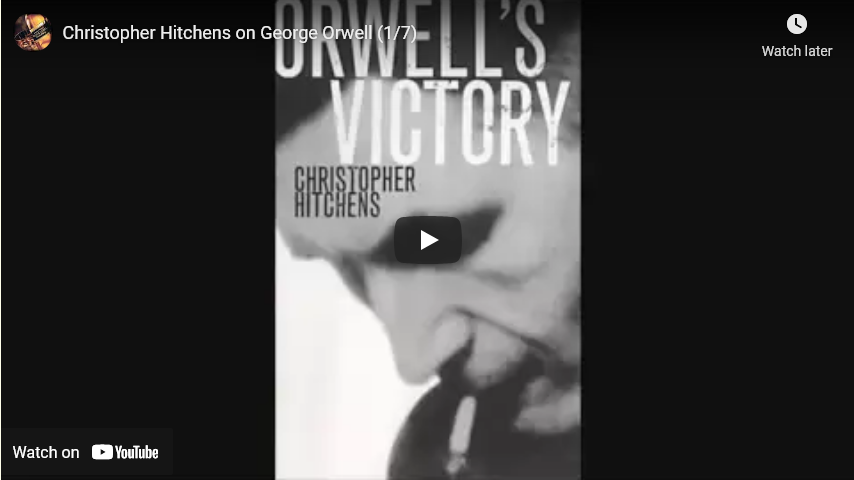
Christopher Hitchens on George Orwell

DailyHitchens
Published 22 Jan 2010

Aug 7, 2009. Christopher Hitchens talks with EconTalk host Russ Roberts about George Orwell. Drawing on his book Why Orwell Matters, Hitchens talks about Orwell’s opposition to imperialism, fascism, and Stalinism, his moral courage, and his devotion to language. Along the way, Hitchens makes the case for why Orwell matters. For more videos, updates and info on Christopher Hitchens, please visit http://www.dailyhitchens.com

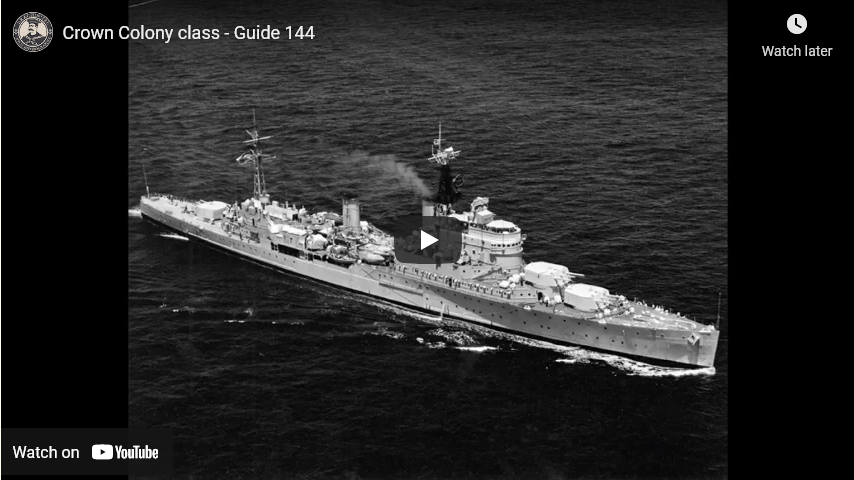
Crown Colony class – Guide 144

Filed under: Britain, History, Military, Weapons, WW2 — Tags: , , , — Nicholas @ 02:00

Drachinifel
Published 28 Sep 2019

The Crown Colony class cruisers of the Royal Navy, and many others, are today’s subject.

Want to support the channel? – https://www.patreon.com/Drachinifel​

Want a shirt/mug/hoodie – https://shop.spreadshirt.com/drachini…​

Want a medal? – https://www.etsy.com/uk/shop/Drachinifel​

Want to talk about ships? https://discord.gg/TYu88mt​

Want to get some books? www.amazon.co.uk/shop/drachinifel

Drydock Episodes in podcast format – https://soundcloud.com/user-21912004

QotD: Rudolf Gaida’s convoluted military career

Filed under: Europe, History, Military, Quotations, Russia, WW1, WW2 — Tags: , , , , , — Nicholas @ 01:00

Rudolf Gaida, 1882-1948. Born in Montenegro (then a part of Austria-Hungary). Trained as a pharmacist in Bohemia. Conscripted into the army medical corps, July 1914. Deserted to a Montenegrin regiment, pretending to be an officer, 1915. Captured by the Russians, 1917. In May 1918, with the rank of Captain, he served in the Czechoslovak Corps, and favoured fighting the Bolsheviks. Colonel commanding the Czech forces in Central Siberia, July-October 1918. Supported Admiral Kolchak’s seizure of power at Omsk, November 1918. Promoted Major-General by Kolchak, November 1918. Commanded Kolchak’s Northern Army, June-July 1919, with the rank of Lieutenant-General. Dismissed by Kolchak, July 1919. Attempted unsuccessfully to seize power at Vladivostok, November 1919. Returned to Czechoslovakia, 1920. Chief of the Czech General Staff, 1926. Cashiered for trying to take part in a fascist putsch. Imprisoned for “Banditry”, 1931. Headed the Czech Fascist organization, 1939-45. Arrested as a collaborator, 1945, and subsequently shot.

Footnote in Martin Gilbert’s World in Torment: Winston S. Churchill 1917-1922, 1975.

« Newer Posts — Older Posts »

Powered by WordPress