A rather amusing little squib from Best of Cain (via American Digest):
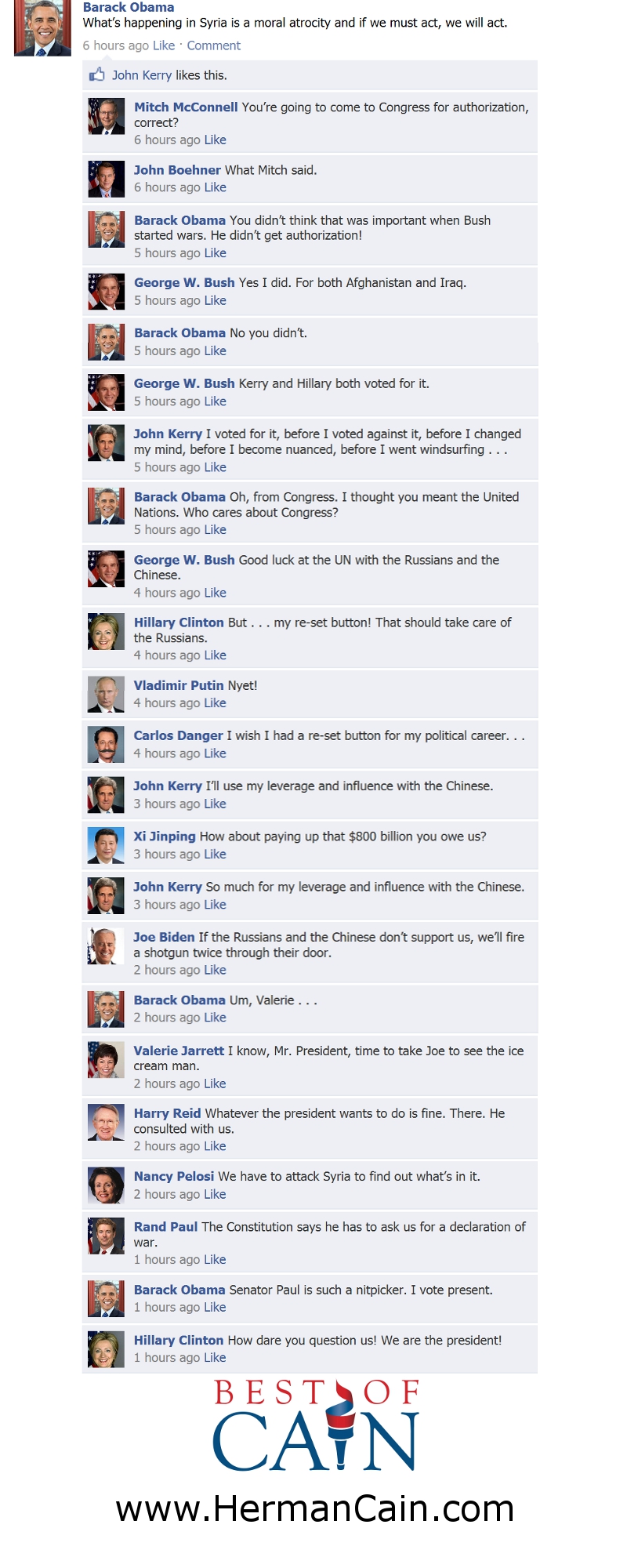

A rather amusing little squib from Best of Cain (via American Digest):
Coyote Blog links to a Daily Mail article on the woman who wants to run your life (and Obama wants to help her):
I am a bit late on this, but like most libertarians I was horrified by this article in the Mail Online about Obama Administration efforts to nudge us all into “good” behavior. This is the person, Maya Shankar, who wants to substitute her decision-making priorities for your own […]
If the notion — that a 20-something person who has apparently never held a job in the productive economy is telling you she knows better what is good for you — is not absurd on its face, here are a few other reasons to distrust this plan.
- Proponents first, second, and third argument for doing this kind of thing is that it is all based on “science”. But a lot of the so-called science is total crap. Medical literature is filled with false panics that are eventually retracted. And most social science findings are frankly garbage. If you have some behavior you want to nudge, and you give a university a nice grant, I can guarantee you that you can get a study supporting whatever behavior you want to foster or curtail. Just look at the number of public universities in corn-growing states that manage to find justifications for ethanol subsidies. Recycling is a great example, mentioned several times in the article. Research supports the sensibility of recycling aluminum and steel, but says that recycling glass and plastic and paper are either worthless or cost more in resources than they save. But nudgers never-the-less push for recycling of all this stuff. Nudging quickly starts looking more like religion than science.
- The 300 million people in this country have 300 million different sets of priorities and personal circumstances. It is the worst hubris to think that one can make one decision that is correct for everyone. Name any supposedly short-sighted behavior — say, not getting health insurance when one is young — and I can name numerous circumstances where this is a perfectly valid choice and risk to take.
Techdirt‘s Mike Masnick says that even congressmen have (limited) access to ongoing Trans-Pacific Partnership negotiation documents, but that even the NDP’s trade critic can’t get that level of information here:
Don Davies is a Canadian Member of Parliament who notes that he’s been denied access to information about the ongoing TPP negotiations, of which Canada is supposedly a member:
“The TPP is a sweeping agreement covering issues that affect many areas of Canada’s economy and society — including several areas of policy that have never been subject to trade agreements before,” said Davies. “By keeping Parliament completely in the dark on negotiations the Conservatives also leave Canadians in the dark and, for an agreement of this magnitude that is abnormal and unacceptable.
“If the US can allow its legislators to see the TPP text, there is no reason that Canada can’t,” Davies said.
In this case, it’s doubly ridiculous. Davies is a member of the NDP party, which is not in power, but his role is as the Official Opposition Critic for International Trade. In other words, he’s basically the trade policy expert for the NDP, and as such, you’d think he should at the very least be included in the details of ongoing negotiations. Yet again, though, it seems that the main negotiating parties involved in the TPP have realized that the best way to get across an agreement they like is to keep it as secretive and non-transparent as possible, especially from critics. This is the exact opposite of how democratic governments are supposed to work.
Of course, the addition of Canada to the TPP has always been done in a way to keep our neighbor up north as a silent partner to the US’s position. You may recall that the US didn’t let Canada join until well into the negotiating process, and as part of the invite, Canada was told that it had to accept all negotiated text without question, even though it wasn’t allowed to see it yet. And, related to that, they had to agree to future texts during some meetings where they weren’t allowed to attend.
Sir Humphrey points out that the Syrian situation actually shows how thin the US Navy’s resources have become:
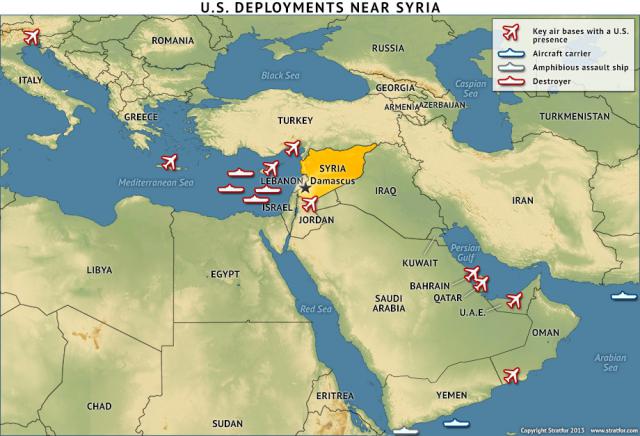
This crisis has been dominated by impressive images of US warships firing cruise missiles, and maps showing large warships steaming menacingly in the Eastern Med. Publicly we know that four USN escorts are currently in the region, each armed with a significant quantity of missiles. What is so striking though is how this illustrates just how thinly stretched the USN is these days. Until the end of the Cold War, the Med was practically a British, then US lake. Dominated by naval bases, and home to large numbers of carriers, escorts and other vessels, any crisis would quickly have seen an almost overwhelming concentration of US firepower.
Today, the 6th Fleet has no permanently assigned escorts, and is instead reliant on other vessels transiting the area. At present it seems that three US vessels were in the area (although it is unclear I they were taken off other tasks) and one more has joined them. This is the totality of the US escort fleet in the Med (and quite possibly Europe as a whole). It is telling that there is no carrier deployed in the AOR, and that the next nearest escorts and Carrier are deployed in the Gulf. Although they could move, this would leave the Arabian Gulf without a carrier, and it is questionable whether any commander would be willing to see a CVN conduct a Suez transit right now, particularly if strikes against Syria are occurring. Partly this is a result of fewer ships, and also an impact of sequestration, where planned deployments were cancelled. The harsh reality though is that US naval power has been heavily emasculated — claims of the Med being a US lake are simply no longer true.
The worry is that this problem is only going to get worse with time; the USN faces a major challenge in keeping hull numbers up, and more importantly maintained to a reasonable level. The challenge of handling major budget cuts is that this sort of presence will inevitably be reduced. So, perhaps closer attention should be paid to how the US is meeting the response, as this is likely to be the sort of thing we’ll see in future — not overwhelming numbers of ships and aircraft, but a small number of escorts, taken off other tasks in order to do the job. One lesson is clear — the USN remains an immensely potent navy, but its ability to project the sort of power that the world is used to is perhaps far less than many realise.
Zero Hedge passes on a bit of analysis from Stratfor:
In the event of a punitive strike or a limited operation to reduce Syrian President Bashar al Assad’s chemical weapons delivery capability — for instance, by targeting key command and control facilities, main air bases and known artillery sites — the United States already has enough forces positioned to commence operations.
Four Arleigh Burke-class destroyers — and probably a nuclear-powered cruise missile submarine — are already within Tomahawk cruise missile range of Syrian targets. In addition, the United States can call upon strategic bombers based in the continental United States as well as B-1 bombers from Al Udeid Air Base in Qatar. In such an operation, the United States would be able to carry out standoff attacks beyond the range of Syrian air defenses, while B-2 bombers could stealthily penetrate the Syrian air defense network to drop bunker-busting bombs with minimal risk.
Considering that al Assad’s forces have a number of ways to deliver chemical weapons, ranging from air power to basic tube and rocket artillery, an operation that seeks to degrade the regime’s ability to launch chemical weapons would necessarily be far wider in scope and scale. This means tactical aviation would have to play a key role in such a campaign, which in turn would entail the deployment of significant enabler aircraft such as aerial refueling tankers and intelligence, surveillance and reconnaissance assets.
In addition, as reported the other day, the French carrier Charles de Gaulle has been ordered to move east from Toulon and the British are reported to have a nuclear submarine in the region as well.
Update: The Iranian Farsnews site says the US military will be in for a serious defeat if they attack Syria.
Syria’s supersonic and anti-ship missiles as well as the Lebanese Hezbollah movement will inflict astonishing damage on any invading force, specially the US Navy’s giant warships, an expert said, adding that the missile capability is working as a deterrent to a US naval attack on Syria.
“The supersonic and long-range anti-ship Yakhont missiles of the Syrian army and the Lebanese Hezbollah (resistance movement) are serious deterrents to a US naval attack by its warships in the Mediterranean Sea,” Dr. Mostafa Zahra, a military analyst and strategic studies expert, told FNA on Monday.
He said that Syria’s Iskandar high-precision ballistic missiles and its anti-ship Scud missiles will also target the US warships in case of a US naval invasion of Syria, reminding that the American military vessels are not equipped with any weapons system to intercept or divert the Syrian anti-ship missiles.
Did you hear that, Great Satan? “Astonishing damage“. You’d better back off now, infidel.
TL;DR – it’s not because they’re Dickensian monsters.
I wrote about this last spring in regard to Wal-Mart and Costco. Upper-middle-class people who live in urban areas — which is to say, the sort of people who tend to write about the wage differential between the two stores — tend to think of them as close substitutes, because they’re both giant stores where you occasionally go to buy something more cheaply than you can in a neighborhood grocery or hardware store. However, for most of Wal-Mart’s customer base, that’s where the resemblance ends. Costco really is a store where affluent, high-socioeconomic status households occasionally buy huge quantities of goods on the cheap: That’s Costco’s business strategy (which is why its stores are pretty much found in affluent near-in suburbs). Wal-Mart, however, is mostly a store where low-income people do their everyday shopping.
[…]
In other words, Trader Joe’s and Costco are the specialty grocer and warehouse club for an affluent, educated college demographic. They woo this crowd with a stripped-down array of high quality stock-keeping units, and high-quality customer service. The high wages produce the high levels of customer service, and the small number of products are what allow them to pay the high wages. Fewer products to handle (and restock) lowers the labor intensity of your operation. In the case of Trader Joe’s, it also dramatically decreases the amount of space you need for your supermarket … which in turn is why their revenue per square foot is so high. (Costco solves this problem by leaving the stuff on pallets, so that you can be your own stockboy).
Both these strategies work in part because very few people expect to do all their shopping at Trader Joe’s, and no one expects to do all their shopping at Costco. They don’t need to be comprehensive. Supermarkets, and Wal-Mart, have to devote a lot of shelf space, and labor, to products that don’t turn over that often.
[…]
That’s not the only reason that the Trader Joe’s/Costco model wouldn’t work for Wal-Mart. For one thing, it’s no accident that the high-wage favorites cited by activists tend to serve the affluent; lower income households can’t afford to pay extra for top-notch service. If it really matters to you whether you pay 50 cents a loaf less for generic bread, you’re not going to go to the specialty store where the organic produce is super-cheap and the clerk gave a cookie to your kid. Every time I write about Wal-Mart (or McDonald’s, or [insert store here]), several people will e-mail, or tweet, or come into the comments to say they’d be happy to pay 25 percent more for their Big Mac or their Wal-Mart goods if it means that the workers are well paid. I have taken to asking them how often they go to Wal-Mart or McDonald’s. So far, no one has reported going as often as once a week; the modal answer is a sudden disappearance from the conversation. If I had to guess, I’d estimate that most of the people making such statements go to Wal-Mart or McDonald’s only on road trips.
Sippican Cottage on modern public schools:
I grew up in the same town as Horace Mann. I know all about public schools. The concept is as dead as a Pharaoh. The idea that universal literacy and a coherent public attitude toward citizenship would result in a better life for the country as a whole was a sweet one, and it worked for a while, until they “fixed” it. They’ve been fixing the hell out of it for over half a century now. They fixed it the way a veterinarian fixes dogs, to my eye.
Here’s Wikipedia‘s list of Horace Mann’s reasons for public schooling:
(1) the public should no longer remain ignorant
(2) that such education should be paid for, controlled, and sustained by an interested public
(3) that this education will be best provided in schools that embrace children from a variety of backgrounds
(4) that this education must be non-sectarian
(5) that this education must be taught by the spirit, methods, and discipline of a free society
(6) that education should be provided by well-trained, professional teachers. Mann worked for more and better equipped school houses, longer school years (until 16 years old), higher pay for teachers, and a wider curriculum.
Let’s take them in turn, and see how Old Howlin’ Horace’s ideas have turned out in what’s called the public schools, but aren’t anymore.
1) Is that cursive? I don’t read cursive.
2) The public seems completely uninterested in what happens in public school, or they wouldn’t send their kids there. Anyone really interested in public schools is horrified by what they find out. Talk to a teacher about what they’re required to do in there — after they’ve had a few drinks. I have. One I spoke to referred to themselves as a “tard farmer.” Do you want to sent your children to a “tard farm”? We don’t.
3) My children are from a variety of backgrounds, all by themselves. We didn’t turn either of them away. Tell my Irish grandmother and wife’s Calabrian grandfather that all white people are the same. Bring a weapon to defend yourself. A “back-up piece” is probably a good idea if you’re talking to my grandmother, by the way.
4) Public Schools aren’t non-sectarian. They teach their own religion, and persecute any vestige of any other, except for momentary alliances with subcultures that will help them persecute what they feel is the dominant culture outside the school.
5) Parents are not allowed to enter a public school, even to walk their children to the door. Children are routinely persecuted for any behavior that deviates one iota from the what a militant vegan on a recumbent bicycle prefers. That’s not the spirit, method, or discipline of a free society.
6) Teachers are well-trained and professional — just not in delivering an education to children. They are trained to be vestal virgins in a weird temple that forgot where they put the statue of the deity of mammon they worship. If public school worked, everyone who graduated from it would be capable of teaching in one.The teachers in public school are as much at the mercy of this weird situation as the students. A teacher recently told us she has to keep a dossier on every child in the class, every day. That’s the Stasi, not Goodbye, Mr. Chips. They said that it’s not possible, really, so they have to make stuff up to finish it. All that time is subtracted from what little time they have for the kids in the first place. The teachers don’t know where all these weird directives come from any more than you do. They just don’t want to get fired for forgetting to rat out little Timmy if he chews his Pop-Tart in to a recognizable weapon-like shape. They go along to get along.
Update, 28 August: ESR posted a brief entry I have to quote in full.
Hunger Games for real
“Students can only have one serving of meat or other protein. However, rich kids can buy a second portion each day on their own dime.” This is from coverage of Michelle Obama’s national school-lunch regulations.
Protein-starving the peasantry so it will remain docile and biddable is a tyrant’s maneuver thousands of years old. I was unaware until today that this has become official policy in the American public school system.
How clever of them to sell it as a healthy-eating measure! That’ll get all the gentry liberals on board; of course, their kids will be buying that second serving.
Brendan O’Neill on MLK’s most famous speech:
Tomorrow is the fiftieth anniversary of Martin Luther King’s “I Have a Dream” speech, made on the Mall in Washington, DC on 28 August 1963. Re-reading the speech 50 years on, the most striking thing about it is how much faith it puts in the American Dream. Where today it is positively hip to be disdainful of all things American, to look upon America as a land of shopping addicts and fat rednecks, King and his listeners were passionately devoted to the idea of America and an American project. Using tellingly capitalistic lingo, King said of those gathered that “we refuse to believe that the bank of justice is bankrupt. We refuse to believe that there are insufficient funds in the great vaults of opportunity of this nation.” King said that his dream, of racial equality, was “deeply rooted in the American Dream”.
Not for King the fashionable disgust for America’s obsession with consumerism and wealth. On the contrary, he said blacks were sick of living on “the lonely island of poverty” and longed to wade in America’s “vast ocean of material prosperity”. Not for King any sneering at America’s promise of wealth and opportunity to its citizens — “now is the time to open the doors of opportunity to all of God’s children”, he said. Not for King any mocking of the founding fathers of America, who have in recent years been judged by radical Leftists to have been racist and evil (in the words of The Nation magazine just last month, Thomas Jefferson was a “slave-owning rapist”). Instead, King extolled the “magnificent words of the Constitution and the Declaration of Independence” and talked about all men’s “inalienable rights of life, liberty, and the pursuit of happiness”.
In the run-up to the fiftieth anniversary of King’s speech, there’s been a great deal of debate about what has changed, especially for America’s blacks. But perhaps the most sweeping, dramatic change has been in attitudes towards the very idea of America. Today, cheap anti-Americanism is the glue that holds so-called liberals and radicals together. Tapping one’s toe to the Green Day song “American Idiot” while laughing knowingly at the fallacy of the American Dream is what passes for being edgy these days. Both within and without America, many Leftish activists and serious thinkers view America as dumb, fat, polluting, reckless and unwittingly hilarious, founded by narcissists and drunks, a “greedy and overweening power”, as the New Statesman said in the immediate aftermath of 9/11.
The Instapundit (Glenn Reynolds) on the special privileges enjoyed by the people who are supposed to be “serving” the public:
All over America, government officials enjoy privileges that ordinary citizens don’t. Sometimes it involves bearing arms, with special rules favoring police, politicians and even retired government employees. Sometimes it involves freedom from traffic and parking tickets, like the special non-traceable license plates enjoyed by tens of thousands of California state employees or similar immunities for Colorado legislators. Often it involves immunity from legal challenges, like the “qualified” immunity to lawsuits enjoyed by most government officials, or the even-better “absolute immunity” enjoyed by judges and prosecutors. (Both immunities — including, suspiciously, the one for judges — are creations of judicial action, not legislation).
Lately it seems as if these kinds of special privileges are proliferating. And it also seems to me that special privileges for “public servants” that have the effect of making them look more like, well, “public masters,” are kind of un-American. Even more, I’m beginning to wonder if they might actually be unconstitutional. Surely the creation of two classes of citizens, one more equal than the others, isn’t the sort of thing the Framers intended. Why didn’t they put something in the Constitution to prevent it?
Well, actually, they did. Article I, Section 9 of the Constitution prohibits the federal government from granting “titles of nobility,” and Article I, Section 10 extends this prohibition to the states — one of the few provisions in the original Constitution to impose limits directly on states. Surely the Framers must have considered this prohibition pretty important.
Zero Hedge pulled a quick summary of US, French, and British naval units in light of the rumours of some kind of attack on Syria:
- A U.S. military source said on Friday the U.S. Navy was increasing its number of cruise missile-carrying destroyers in the Mediterranean to four from three by delaying the return to the United States of the Arleigh Burke class destroyer USS Mahan.
- The aircraft carrier USS Harry S Truman, by far the most powerful warship in the region, left the Mediterranean last weekend, passing through the Suez Canal into the Red Sea.
- Defence experts say the carrier could still strike Syria from south of Suez. As well as the strike aircraft carried by the Truman, several of her escort ships are also capable of firing Tomahawk land attack cruise missiles.
- Since earlier this year, the United States has also had F-16 jets in Jordan, where they remained after a major military exercise this year at the request of the Jordanian government. It also has a major air base at Incirlik in Turkey that could easily house multiple aircraft as part of a wider military campaign.
The French aircraft carrier Charles de Gaulle is still in or near Toulon, while the Royal Navy is said to have at least one Trafalgar or Astute class submarines in the Mediterranian. The RN no longer has in-service aircraft carriers, so any British air support would have to be from the RAF, possibly based in Cyprus (but subject to local government approval).
Update: This report says that the USS Ramage is also being retained in the Mediterranean along with the USS Mahan.
Update, 27 August: It was just mentioned (no link) that the Charles de Gaulle has been ordered to leave port, bound for the Eastern Mediterranean.
In a discussion of the plight of Sears in the major appliance market, Coyote Blog mentions an earlier Sears mis-step in a different market:
Oddly, I witnessed a similar Sears private label fracas when I worked for Emerson Electric over a decade ago. For years and years, Emerson (not the folks who make the cheap radios and TVs) manufactured many of the Sears Craftsman hand tools and power tools. Sears got tough one year, and negotiated a better deal of some sort with someone else, and an entire division of Emerson saw its sales basically going to zero. So Emerson bought a bunch of orange paint and plastic, went to Home Depot, and cut a deal for a private label tool line at Home Depot (Emerson separately owns the Rigid tool company, so a lot of the items were branded Rigid). Emerson ended up in potentially better shape (I did not stay long enough to see how it turned out), partnered with a growing rather than a declining franchise.
Strategy Page on the upcoming “negotiations” over the Israeli-Palestinian situation:
Why are the Palestinians participating in yet another round of American- sponsored peace talks with Israel? It’s mostly about money. This round was forced on the Israelis and Palestinians by the U.S., which threatened to withhold aid (1.3 billion a year to Israel about half as much to the Palestinians) if the two did not at least go through the motions. Many knowledgeable observers see another round of talks as pointless. Arabs and Palestinians have not changed their “kill all Jews” attitudes towards Israel and the Israelis have still not agreed to just disappear. Because of the continued Arab intransigence over Israel, opinion polls show that most Israelis are opposed to any peace deal with the Palestinians that involves withdrawing Jews from the West Bank or Jerusalem and believe the peace talks will fail.
The Americans want the talks for domestic political reasons. The Israelis don’t mind having another opportunity to force the Palestinians to admit all their hypocrisy and anti-Semitism. The Palestinians don’t care about that because they are in big trouble. The current Fatah leadership (Hamas, which runs Gaza, is not participating) is in a desperate situation. Fatah is committed to pushing for “statehood” in the UN, but has been told by the U.S. that such a move will mean withdrawal of $600 million a year in American aid. Israel said it will withhold $100 million a year in customs taxes it collects for Fatah. Backing away from the UN statehood effort would be very embarrassing. The “peace talks” provide a credible excuse to back off.
Given the heat Fatah has been taking from Palestinians over more than a decade of increasing corruption and poverty, losing $700 million a year in aid would put Fatah out of power and probably out of business. So Fatah will go through the motions to calm down the Americans and Israelis while a new strategy is developed and sold to Palestinians. The current one got going in 2000, when Fatah turned down the best peace deal it was probably ever going to get (and would probably accept today) because the Palestinian radicals threatened civil war if Fatah took the Israeli offer. In retrospect that was a hollow threat, but at the time it seemed a good idea to turn down the peace offer and start a terrorist campaign against Israel. That failed, and was largely defeated by 2005. But it all made the Palestinian radicals stronger and too many Palestinians unemployed, broke and angry. It also allowed Islamic radical group Hamas to take control of Gaza, where 40 percent of Palestinians lived. To make matters worse the great Palestinian patron Saddam Hussein lost power, and his life, cutting off another source of cash. Palestinian children are still taught to honor and praise Saddam, which has become something of a media liability. Other Arab allies have become less supportive and more insistent that the Palestinians make peace with Israel and stop being professional victims and career beggars.
In this week’s Goldberg File, Jonah Goldberg talks about Bradley Manning’s stated desire to transition to be Chelsea Manning:
What is the best time to announce that you want to be treated like a woman? Not wanting to be a woman myself, I can only speculate. But a few possibilities come to mind. First of all, if you are, in fact, a woman. Then there might be a whole panoply of times and situations when making such a request makes sense. Like when a bunch of steak-head dudes try to include you in their fart humor. Or when they challenge you to a chicken-wing-eating contest.
So I’m talking to you dudes right now. When would it make the most sense for a guy to ask to be treated like a woman? When you’re redeeming your coupon at a day spa, maybe? Certainly, if you’re the cowardly sort, when hostage-takers on your flight announce they will release the women and children. Maybe when you’re the only “man” in your Fifty Shades of Grey book club? Or perhaps when the testosterone in the air at BronyCon stings your nostrils. Again these are only guesses. And I’m just going out on a limb here — but my gut feeling is that one circumstance you can cross off your list, one moment when you don’t want to announce you want to be treated like a dame, is when you’re about to spend 35 years in a men’s prison.
Don’t get me wrong. Some dudes can pull it off. For example, this guy (Click it! It’s funny!). But Bradley Manning just doesn’t seem like the kind of fellah that could discriminate successfully among potential suitors and sundry other gentleman callers.
Let me be clear up front, if Bradley Manning wasn’t a treasonous buffoon who materially damaged the United States of America, I’d take it a little easier on him. In fact, I’m a little squishier on this stuff than Kevin Williamson is — and he’s a libertarian.
[…]
That said, I do think that such beliefs can be very, very strongly held. I also think that as we learn more about how humans develop in utero, gender-identity confusion can have a very hard-wired component. A man thinking he’s a woman — or thinking he was supposed to be born as a woman (or vice versa) — isn’t the same thing as dabbling in Marxism in college or thinking that Van Halen was better with Sammy Hagar. It is not purely a conscious choice or matter of taste. As such it deserves some sympathy, respect, and even a little social space.
But you know who else deserves space, sympathy, and respect? The majority of Americans who don’t think the factory installed their parts wrong. For instance, the push to make unisex bathrooms or let gender-confused girls use boy’s rooms and vice versa is quite simply madness.
The vast majority of Americans — straight, gay, black, white, young, old, Christian, Muslim, Jew, Jedi, and atheist — believe that the humans with the dangly bits should use the boys’ bathroom. And yet out in California, the DOJ just settled a suit saying that this very old arrangement must now be revised to accommodate a minority of one person.
Of course I believe in individual rights and liberties. I’ve always believed democracy without guaranteed individual rights is just a clever way to organize a mob (as I like to say, in a pure democracy, 51 percent of the people get to pee in the cornflakes of 49 percent of the people). But we’re talking about a civilization here, and in a civilization you don’t hold the entire culture hostage to the ever-changing whims and desires of a handful of people.
In Reason, Cathy Young looks at the unlikely fandom for Russian President Vladimir Putin among American social conservatives:
Russian President Vladimir Putin, the career KGB officer who has presided over the rollback of his country’s post-Communist freedoms and revived Cold War-style anti-Americanism, is an unlikely hero for American conservatives. Yet the Kremlin strongman has lately found some fans on the right who see him as a defender of Christian values — most recently, in the imbroglio over Russia’s new legal ban on gay “propaganda.” It is a sad misjudgment that does a disservice to the causes of conservatism, freedom, and religion alike.
Spokesmen for several right-wing groups including the American Family Association have praised the Russian law, which prohibits any pro-gay speech or expression that could be accessible to minors. Veteran columnist Pat Buchanan has joined the Putin cheerleading squad. And, shockingly, the usually thoughtful author Rod Dreher, who blogs for The American Conservative, has added his own “1.5 Cheers for Putin.”
While condemning anti-gay violence and authoritarianism in Russia, Dreher praises Putin’s willingness to speak up for Christianity and laments that “post-Soviet Russia, for all its grievous flaws, is . . . more conscious of its Christian history and character than the United States.”
This is a truly grievous misunderstanding of the reality of religion and politics in 21st Century Russia. Russia today is outwardly far more religious than most of Western Europe, but it’s a religion of state more than church: Orthodox Christianity has taken Communism’s place as the new official ideology, with church membership an official badge of patriotism and loyalty.



Powered by WordPress