
The Women’s Liberation Movement wanted many things in 1970, but one of the most important was freedom from “unpaid domestic servitude at home”.
Again, this is Straight Outta Engels, from 1884. Even back in 1970, we could all yell “Read another book!” Someone ought to rewrite The Origin of the Family, Private Property and the State with a few quidditch matches in it; it’d be on the bestseller list until the sun’s a cinder.
Half a century later, most women are still waiting for their freedom. Women still do far more domestic and care labour than men.
I find this extremely hard to believe. So I checked their source, which is a very scientific-sounding site called “The Conversation”. You’ll just have to click it for yourself, since I can’t figure out how to screenshot just the little graphic they have, but if you do, you’ll notice a couple things straight off:
First, this data is from Australia. Which is bullshit, because look, y’all, I’ve seen the Mad Max movies, and nobody’s doing any domestic labor in Australia. Their main settlement is ruled by Tina Turner, for fuck’s sake, and the Prime Minister runs around in a thong and a hockey mask. Sweet cars, though, I’ll give them that.
The other thing you’ll notice is that the “Australian Bureau of Statistics” — I’m pretty sure that’s the motorized hang glider guy — has obviously been having fun with the scalar functions in whatever post-apocalyptic version of Excel they’ve got down there. The bars for “did no unpaid domestic work” look dramatic … but they represent a mere seven point difference. (And do you see what I mean? Apparently 29% of Australian men, and 22% of Australian women, do no unpaid domestic labor whatsoever. By my math, that’s a quarter of the country stewing in its own filth. I know, I know … I’m amazed it’s that low).
The bars for “5-14 hours”, though, show a fractional difference: Women do a whopping 0.3% more. And again, this is Australia, but even if we assume that “unpaid domestic labor” is stuff like “wiping the blood from the somehow intact windshield of the last of the V-8 interceptors”, 5-14 hours is what you might call “the outer limits of normal for a working stiff”. Admittedly I live in a two-bedroom apartment, not a house, but I’m a bit of a neat freak, and “an hour a day” is about all I do. Vacuum the floors and scrub the toilets on Sunday, that’s two hours tops. I’ll be generous and say I spend another 3-4 doing the squeegee thing to my shower walls after I bathe, and loading the dishes in the washer, and giving the counters a quick wipedown once or twice a week, etc.
The real difference comes in the “15-29 hours” and “30 hours or more” categories, and you have to be very, very Smart indeed to find that “problematic”, since those are stay-at-home moms. In other words, they do that “unpaid domestic labor” by choice. Because “the care and feeding of the next generation”, not to mention “the deep, primal satisfaction one gets from seeing a little life grow that you helped create” don’t really count as pay.
Since the 1960s, more and more women have taken up paid employment, but a problem remains: how would their unpaid domestic work be replaced?
Gosh, that IS a problem! And as the Australians have shown us, the answer seems to be “just stew in your own filth”. It’s a solution America’s single gals, at least, seem to have embraced with kamikaze-level enthusiasm. Back in the days, I’d always insist on taking a girl back to my place, because condoms don’t cover the entire body and her place was always, and I do mean always, a certifiable biohazard. I’d rather do a striptease in Chernobyl’s reactor core than do anything in an American woman’s bedroom, and their bathrooms are pits of unspeakable Lovecraftian horror.
Severian, “SJWs Always Project”, Founding Questions, 2022-08-08.
June 25, 2026
QotD: Division of domestic work, 1970s onward
June 24, 2026
The importance of proper maps on strategic thinking
CDR Salamander considers the use of maps — appropriate maps — to be critical for both military and civilian strategists. And the most common kind of map most people encounter is one of the worst, because it conceals more than it reveals:
If I am ever invited into someone’s personal study, office, or library — especially someone who puts themselves forward as a national security type — one of the things I not-so-subtly look for is maps, charts, or better yet, a globe.
Yes, I will judge you. It matters.
I have seen exceptionally credentialed and powerful uniformed and civilian leadership here and in Europe have an almost comical ignorance of the world in which they hold access to levers of almost unimaginable power. From a complete disinterest bordering on criminal unawareness of the bottom topography of the Baltic and Taiwan Strait, to not knowing where the Cape of Good Hope is, or even what a Great Circle Route is.
That kind of ignorance gets people killed.
They got their positions of power and influence for a whole host of reasons, but an understanding of geography and the ability to read a map was probably not one of them.
[…]
If someone says, “When you look at a map of the world …”, more likely than not, what will pop into your mind will be what is at the top of the post, the Mercator Projection.
That may be one of the contributing factors to inadequate strategic thinking in the modern age.
Of course, any attempt to represent a three-dimensional object on a two-dimensional format is going to create some problems.
You need multiple perspectives, and often the one that best serves in helping you understand the challenge of the moment.
As we continue to argue the point here, we don’t need a new force design, or national strategy, we need a national understanding.
We need to understand the fact we are a maritime and aerospace power, and those are the two domains where the majority of fighting in any war against the People’s Republic of China is going to take place.
It has a unique set of challenges that have nothing to do with politics, people, culture or anything from man; it has to do with the interface of land, water, time, and distance.
As we learned and then forgot from WWII, any war in the far reaches of the Pacific requires range, scale, and the logistics system that appreciates both and can sustain the fight forward.
[…]
What are the top-5 even the novice should get?
- AUKUS is a must-succeed. Don’t balk. Don’t stutter. Don’t be difficult. Make it work. It reinforces our left flank. Australia and the Philippines are our shield and redoubt.
- Taiwan is the stopper that keeps the PRC relatively contained. If you lose that, Guam is your new front line.
- A strong Japan and South Korea must be made stronger and closer. They are our right flank.
- What does the PRC want? Once you accept that they want everything from the line drawn from Alaska to New Zealand to their coast under their uncontested control, but are more than happy to let us have everything on the other side, then you understand what they have been doing for decades in the small island nations in the Southwest Pacific.
- People grow up with maps that emphasize Europe and the North Atlantic. This projection breaks that mental fixation, putting Europe and the North Atlantic in a minor corner of the map, almost an afterthought that barely catches the eye.
A slightly more recognizable version [of the Spilhaus Projection] is below.


The Korean War Week 105 – Destroy Suiho Dam! – June 23, 1952
The Korean War by Indy Neidell
Published 23 Jun 2026Since the beginning of the war UN air power has studiously avoided hitting North Korea’s hydro-electric complex, since the power the dams provide is mainly for civilian use, but that changes this week! Meanwhile on the ground, the focus has turned to capturing Communist POWs for information, but that task has suddenly proved impossible now that the UN POW camps are firmly back in UN control, and it seems the Communists now prefer even death to capture.
00:00 Intro
00:29 Recap
00:59 Taking Prisoners
03:18 The Shropshires
05:54 Ammunition Shortage
08:41 Targeting Power Plants
14:55 Summary
15:10 Conclusion
15:58 Call to Action
June 23, 2026
American Gods: Land and Egregores
Feral Historian
Published 20 Feb 2026American Gods (Neil Gaiman, 2001) is, among other things, a layered examination of the role of mythologies, religion, national identities, and some underlying “American-ness” that bends them all into something new. By necessity this meanders a bit (I’m not going to get into Gaiman’s failings as a human being much) but it gives us a lot to think about.
I mention a couple outside references in here, links below if you want to dig into it.
Lilly Wachowski on the role of the Red Pill in The Matrix: https://screenrant.com/the-matrix-mov…
George Lucas on the Rebellion, and Viet Cong (people often quote the line but miss the context) : • JAMES CAMERON’S STORY OF SCIENCE FICTION |…
00:00 Intro
01:56 The Setup
04:48 Spirit of America
07:57 White and Red
10:50 New Gods and the State
12:51 Author, Intent, and Meaning
(more…)
June 22, 2026
ADATS – Air Defense Anti-Tank System; Canada’s high tech cold warrior
Polyus
Published 19 Jun 2026While designed mainly in Switzerland, over the years its identity became distinctly Canadian. It was produced in Toronto by Oerlikon Aerospace Canada and was operated by Canadian forces from 1988 to 2011. This is the story of the Air Defense Anti-Tank System, or ADATS
ADATS was a very interesting and highly advanced air defense system designed to fight a cold war that never materialized. It was operated for a little over 20 years, so it was by no means a flash-in-the-pan. Unfortunately, Canada has since given up its short ranged air defense capability and all of the human expertise that was built up over the years. Hopefully in the future a new system can be acquired and Canada can again expand its sovereign air defense capabilities.
This video was made without the use of Artificial Intelligence (No AI). Long live people power!
0:00 Introduction
0:29 European Background
2:09 Technical Details
4:05 Engagement Sequence
5:38 Comparison to other Systems
6:06 Canadian Adoption
7:48 American Testing
8:32 Thai Adoption
8:57 Advanced Variants
10:23 ConclusionMusic:
“Denmark” – Portland Cello Project
“Your Suggestions” – Unicorn Heads
Progressive intellectual arrogance
John Konrad tries to explain the apparently universal intellectual snobbery of progressives, which has brought pretty much every western country into the era of the expert:

Why is the left so arrogant?
Because they put their trust in a global elite. Not directly, but through the media and the universities the elite manipulate.
My dad always said it the other way around: privilege comes with responsibility. But responsibility is hard. Responsibility requires knowledge.
And in a world growing more complex and unpredictable by the year, understanding what’s happening around you takes more and more of it.
Twenty years ago you could walk through Manhattan around noon on a Sunday and watch half the city reading the Times. The thing was massive, but a fast, educated reader could come away with a decent picture of the whole world in a few hours.
Then two things happened.
Craigslist gutted newspaper revenue, and DEI mandates swapped great reporters for morally indignant j-school hacks. The quality and accuracy of information cratered.
At the same time, the internet roared to life and the world got radically more interconnected overnight.
So the elite grew less informed exactly as complexity exploded.
To cope, they borrowed a trick from NASA. There aren’t enough hours in the day to be the best rocket scientist and the best navigator and the best flight surgeon all at once. So mission control compartmentalized. The best person in each silo got a desk. Thruster problem? Everyone turns to the engine expert. Someone’s hurt? Everyone turns to the flight surgeon. The rocket guy never had to learn a thing about medicine.
The elite copied the model. They switched their brains off for anything outside their lane. Everyone specialized inside their own bubble.
But compartmentalization runs on trust. Put one bad actor in mission control, and the moment everyone turns to him, bad things happen.
To guard against that, they doubled down on credentialism. They learned to trust only the experts minted by certain colleges and blessed by certain think tanks.
And the bad actors had a field day. Fraud, disinformation, theft, all of it could happen inside a silo, unseen. And it did.
Then came a mission control director who told them not to worry. Everything was fine. They didn’t know what was going on, but he did, and he was smarter than all of them. He said so, right there in the meetings.
Everyone loves a brilliant, competent boss, especially a charismatic one who seems kind, because it means they no longer have to worry. He’s got it handled. Just trust him.
And trust Obama they did.
But he had nothing handled except his own aura. And he let Marxist actors run loose inside the silos that mattered, education and HR chief among them.
The right was skeptical, so they kept reading, kept hunting for alternative sources, kept trying to make sense of the complexity themselves. Nobody cracked it completely. But they started seeing the big red anomaly lights blinking across the dashboard.
So the smart people on the right kept building broad knowledge while the left stayed siloed. Ten years passed, and the left’s elite fell far, far behind.
They’re starting to see that Obama was a fool. But they’re stuck. You can’t cram ten years of missed homework into a few months. And they’re rich and powerful and have no interest in going back to school.
They have two options. Admit they were wrong and put in months, maybe years, of hard work to take responsibility for their actions. Or keep acting like sheep. If the rewards weren’t there, some might choose the work.
But the system is so riddled with fraud, so many hollowed-out silos kept on life support, that there’s more than enough money sloshing around the NGOs to fund their posh lives.
They have the privilege with none of the responsibility. It’s a comfortable place to sit. They don’t want to change.
But holding that position requires one thing: they have to believe their mission control director has it all under control and is smarter than anyone on the right.
The bottom line is the have to be arrogant. Or the whole house of cards comes down.
QotD: When the US switched to the All-Volunteer Force in 1973
This of course forms the context for the creation of the All-Volunteer Force (AVF), the effective conversion of the United States military into a professional, fully standing military, which I’d argue is the single most dramatic shift in the civil-military relationship in American history, the full impact of which is not yet clear. For almost 200 years, the United States military had been an essentially civilian force which relied on conscription. For the decades prior to the creation of the AVF in 1973, conscription had been a fact of life. While the United States had demobilized substantially after WWII, there had been at least some conscription in every year from 1940 to 1972 except for 1947. In every year between 1950 and 1972, conscription had never been lower than at least 80,000 new conscriptions a year.
This was a huge change. For such a major change, I find that it draws surprisingly little attention. The 50th anniversary of the AVF passed with relatively little fanfare in 2023. I’ve mentioned For the Common Defense (1984, 1994, 2012) as the dominant textbook for introductory American military history: the shift to the All-Volunteer Force is dealt with in a single page (page 568, for the curious). The textbook I’ve seen most recently used for US Naval history (and which I used), J.C. Bradford and J. F. Bradford, America, Sea Power and the World (2016, 2023), doesn’t even give it that much: the shift is discussed in a single paragraph on page 351 (308 in the 2016 edition).1
The likely impacts of the shift to an AVF were studied prior to implementation in the Gates Commission, a report that had a preordained conclusion – it was convened to provide Nixon the cover to do the thing (end the draft) he had promised to do already in his campaign – and which honestly I find disappointing in its approach, which is mostly “happy talk” designed to justify what Nixon had already decided to do. It is striking to me, for instance, that the Gates Commission did not include a single historian to perhaps discuss how the shift towards fully professional militaries had gone for republics in the past. Instead, the focus is on the economics of the shift, with fairly blithe assertions that the civil-military relationship would remain unchanged despite the fairly obvious implausibility of that given the shift from “everyone serves” to “only a small portion of society serves”.2
As I’ve noted elsewhere, the Romans also seem to have thought that they could professionalize their army without reducing its ability to scale up in an emergency or altering the civil-military relationship and for quite a few decades that more or less worked, while the old norms held. But as those old norms decayed, the institution increasingly became what you’d expect from its institutional structure: a permanent political faction, advocating for its own interests, often with violence, to the point that the emperor Septimius Severus’ advice to his sons as he lay dying in 211 was, “Be harmonious, enrich the soldiers, and scorn all other men”,3 a fairly open admission that the soldiery was not just a political constituency, but the most important one. It took time for those norms to shift, but when one is building or rebuilding institutions, the long-term is the term that matters.
I do not think necessarily that this is the direction the All-Volunteer Force must go. It has two and a half centuries of strong norms pushing it away from this direction. But careful maintenance of the civ-mil bargain is made all the more necessary when the military is effectively fully professional. For my own part, all cards on the table, while I greatly value the service of the United States’ military personnel (there’s that third part of the bargain!) and think they serve honorably, I am quite skeptical of the long-term implications of the All-Volunteer Force. Its creators assumed that fully professionalizing the military would not impact the civil-military relationship and that it would always be possible to shift back to a mass-conscript army in the event of a major war, but historical examples suggest it is not so easy.
But the All-Volunteer Force is not the direction from which I see now the principal threat to the civ-mil bargain.
Bret Devereaux, “Collections: The American Civil-Military Relationship”, A Collection of Unmitigated Pedantry, 2025-07-04.
- In that book’s defense, the Navy has a really big set of reforms associated broadly with CNO Elmo Zumwalt that happen at basically the same time and are connected and it opts to focus on those. I will note that the position of the paragraph has changed because the updated 2023 version of the book has opted to grapple more extensively and more successfully with this period as one of increasing diversity in the navy, with a chapter by Kristy N. Kamarck on that specific topic. It is a marked improvement over the first edition, though I think both FtCD and the Bradford and Bradford remain too hagiographic, too willing to sweep the military’s problems under the rug and only comment on military diversity when they can tell the story as a happy tale of progress.
- Especially as that small portion tends to be concentrated, a thing the Commission essentially refuses to consider as a first principle of their analysis; they assume cheerfully that the AVF will naturally continue to reflect a cross-section of the United States. In some ways that is true, but in other ways it is very much not – there certainly are “military families”, where service tends to “run in the family” in the United States now – and the emergence of those patterns would have been a pretty obvious thing to expect, given that the same trend is extremely visible in the Roman army of the early empire.
- Dio 77.16
June 21, 2026
Explaining our failure to expand beyond Earth to an alien
Devon Eriksen pens an ultra-short story in response to Senator Elizabeth Warren’s claim that “we” need to take a lot more money from Elon Musk to benefit “everyone”:

This-individual has an outstanding query for you-individual.
Yes, Dee-six-twenty-four-prime? Ask your question.
When we-collective initialized language-idea-exchange with you-collective, you-collective had no settlements on the surface of other planets in your-collective own star system.
Yet you-collective possessed advanced chemical propulsion technology sufficient to leave your-collective native gravity well. For over a hundred cycles around your-collective star, you-collective possessed this.
Why did you not use it?
Well, all that technology was worth a lot of money.
Value-consideration-tokens, yes. Continue.
So we decided to take it away from the really talented geniuses who built, break it up for parts, sell the parts, and throw a big free stuff party.
A … free stuff party?
Yeah, for like, average dudes. The kind of guys who don’t know calculus or anything. The ones you’d want to have a beer with. We thought we’d buy them some stuff.
Instead of leaving your home planet?
Yeah.
This-individual understands, now. Conclusions have been submitted to collective-thought-matrix. Please line you-collective up in an orderly fashion for processing, classification, and reassignment and/or biomass reclamation.

June 20, 2026
“Get off your high horse”
Devon Eriksen responds to a post from a Japanese man who claims not to understand American racism:

“United States, Canadian and Japanese Flags on Seventh Avenue” by Jim, the Photographer is licensed under CC BY 2.0 
 .
.
NOBUNAGA🇯🇵🏯_夏樹蒼依 @japan_nobunaga
Honestly, racism is one of those things many Japanese people struggle to understand.
If we see a white person, we think, “Oh, they’re white.”
If we see a black person, we think, “Oh, they’re black.”
If there were blue people, we’d probably think, “Oh, they’re blue.”
And that’s about as far as it goes.
If someone is nice, we think they’re nice.
If someone is an asshole, we think they’re an asshole.
If we like them, we like them.
If we don’t, we don’t.
We grow up being told not to cause trouble, not to fight, and to get along with the people around us.
Maybe that’s why judging someone by their race feels so foreign to a lot of Japanese people.
We’re usually too busy judging people by whether they’re good people or not.
This is what we, in America, call a “Luxury Belief System”.
That means something you can believe, and advertise your belief in, precisely because your privileges shelter you from the negative consequences of believing it.
You, @japan_nobunaga, live in a nation that is 99% Japanese, just like you.
You have plenty of time to evaluate gaikokujin as individuals. There are only a few of them around, and they probably aren’t going to stab you while you are trying to figure out the content of their character.
So you have the luxury of telling everyone “look at me, I am not a racist, I am an enlightened being who makes no judgments about wolves” … because you do not live near any wolves, and run no risk of being bitten.
In America, we have another saying … “Get off your high horse”.
This does not mean a literal horse.
But it is meant to make you think about how the daimyo‘s son, on his expensive thoroughbred stallion, does not understand why the peasants have muddy boots.
If you get down off the horse, and walk, you will understand why the farmer’s boots are muddy.
There were some dissenting comments to the original post:
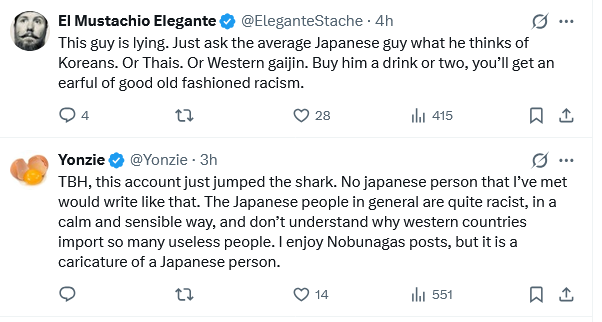
I’ve heard similar stories of Japanese racism toward other East Asian peoples, never mind what they said (and probably still do say) about American black servicemen.
June 19, 2026
US history is unique, it does not map onto the histories of other nations
I’ve noticed this pattern myself, but I hadn’t considered that a lot of Americans don’t just use the patterns of their national history when looking at other western nations:
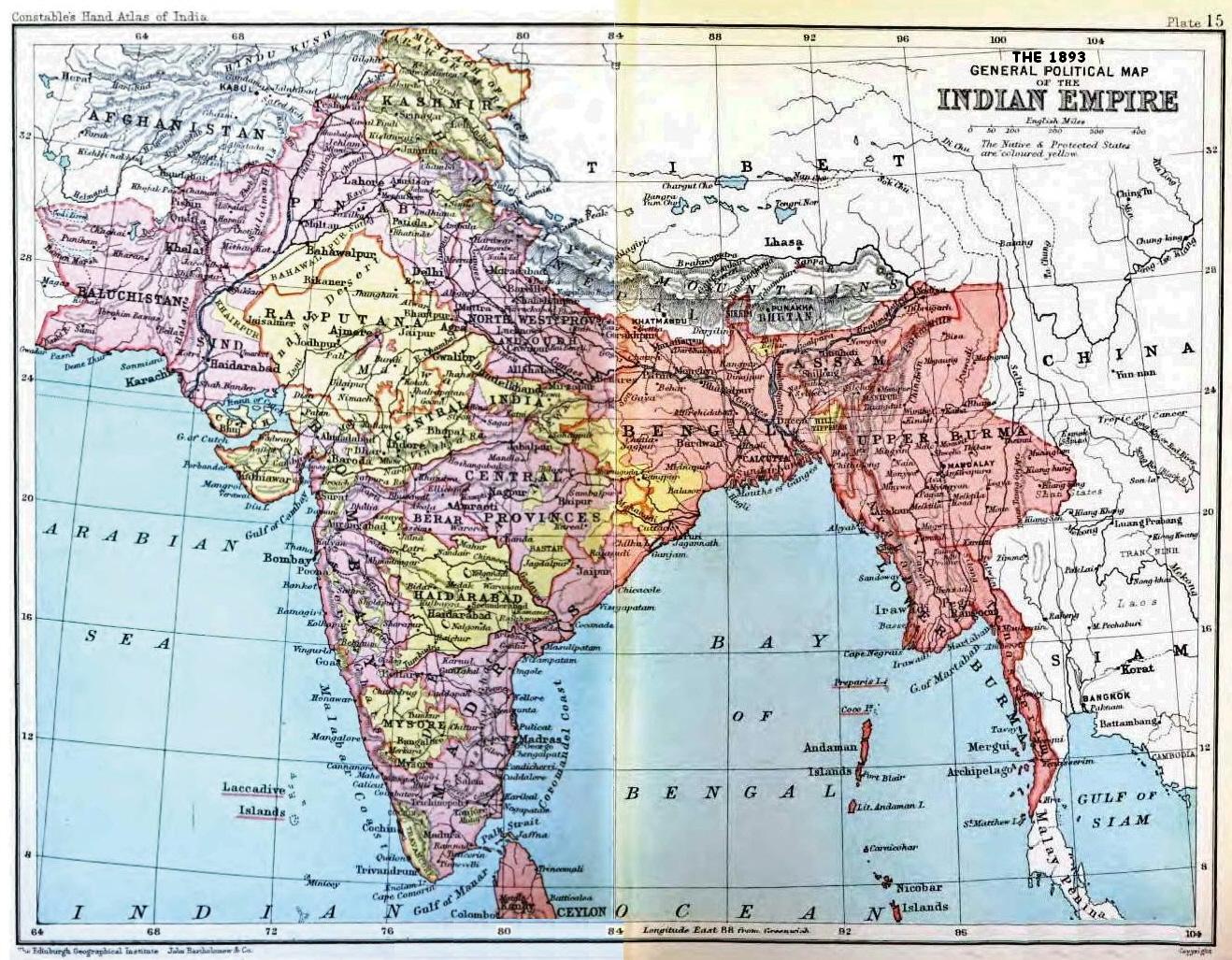
“Political Map of the Indian Empire, 1893” from Constable’s Hand Atlas of India, London: Archibald Constable and Sons, 1893. (via Wikimedia Commons)
Not every place in the world can be examined through the historical template of the United States.
One of the reasons conversations about India are so difficult for folks in the West to untangle is that many of the frameworks Americans use to understand power, intergroup dynamics, identity, and historical injustice do not map onto India. Not at all.
For Americans who have adopted a critical lens, the template derived from American history is fixed. A dominant demographic majority group seeks to preserve power while marginalized demographic minorities fight for recognition and inclusion. Because this template is so fixed in the imagination, there is a tendency to view and interpret dynamics and events in other countries in exactly the same way. I have seen it myself. “We’ve all seen how this works”, someone will say, and proceed to apply the American template to a different place.
And the history of the Americas (both North and South) is dominated by European (white) Christian colonization. As a result, Americans are familiar with the legacies of European empire and Christian missionary expansion. By contrast, the history of Islamic conquest and rule, which shaped large parts of Asia, Africa, and Europe for centuries, occupies far less space in the American imagination. So too does the contemporary influence of petrodollar-funded religious institutions, transnational Islamist movements, and the global circulation of Islamist narratives.
This does not mean these forces explain everything. It does mean that many Americans have little historical or conceptual framework for understanding how they might shape politics, memory, education, or intergroup relations in places like India.
India’s history is not the same as that of the Americas.
For centuries, India experienced successive waves of colonization. The first came through a series of Muslim invasions and dynasties, culminating in the Mughal Empire. The second came through British colonial rule, predated by British mercantile and missionary efforts. Yet unlike many colonized societies, the civilizational majority was never fully displaced, converted, or absorbed. Hindu traditions, practices, languages, stories, temples, and collective memories survived.
This is perhaps the single hardest aspect of India for many Americans to grasp because it has no real analogue in American history: the Hindu demographic majority is also the historically colonized population.
For many Western observers, this creates immediate suspicion because it violates the assumptions embedded within our familiar frameworks. The expectation is that majorities defend power while minorities challenge it.
As a result, contemporary debates about textbooks, public memory, historical figures, temples, and national identity are often seen and interpreted by folks in the West through frameworks that retrofit Indian history into contemporary American critical analysis through the reductive binaries of majority/minority, right/left, which are memeable and digestible, but obscure much more than they reveal about power, history, equity, policy, foreign influence, etc.
When Hindus argue that violent and painful aspects of Mughal conquest have been whitewashed in public education, they are frequently accused of attempting to rewrite history to justify the alleged “Hindu right wing” suppression of a minority group today. (Please do read my analysis of religious-based violence in India. It’s not what you think it is. Link.)
Yet Americans themselves are familiar with the process of revisiting historical narratives to advance truth and reconciliation. We have debated how slavery is taught, how Indigenous history is taught, how immigration is taught, and how women and minority groups have been represented in textbooks and in classrooms. We generally accept that historical narratives evolve as new evidence emerges and as previously marginalized perspectives are taken seriously.
What makes India different is that the group seeking rigorous reconsideration of historical narratives is often the majority population. For many Western observers, this creates immediate suspicion. The assumption is that majorities seek dominance while minorities seek justice.
But history does not always work that way.
The result is that efforts by Hindus to recover historical memory are often denounced as nationalism (which is falsely equated with white or Christian nationalism in the United States) before they are examined on their own terms. Questions about historical representation become questions about political motives. Efforts to revisit narratives become “evidence of extremism” or, even more bizarre, “anti-intellectualism”. And figures who have occupied a central place in Hindu memory for centuries are presented as newly invented symbols of contemporary political power.
The result is that the Indian voices most readily amplified in Western media are often those whose analyses are already legible within familiar Western frameworks. Their arguments are immediately understandable, which lends them “credibility”. Perspectives that do not fit those frameworks are frequently dismissed as “Hindu nationalist” before they are seriously considered.
One need not agree with every argument made in these debates to recognize that they are, in fact, debates. The question is not whether history should be examined. The question is whether everyone is permitted to participate in that examination without having their motives presumed in advance.
June 18, 2026
Rules for you young plebs, but not rules for us
The generation that defined itself as “the youth generation”, “the hippies”, etc., are now nailing down every possible way to have fun so that youngsters can’t do what they loudly and proudly did at the same age:

Part of the crowd on the first day of the Woodstock Festival, 15 August, 1969.
Photo by Derek Redmond and Paul Campbell via Wikimedia Commons.
We’re banning raves, because we don’t want you having fun where we can’t watch you. By the way let me tell you about Woodstock.
We’re cracking down on underage drinking. It’s bad for you. Yeah of course we hit up the pubs at your age it was great.
We’re banning smoking, but just for you — the smoking age will go up one year every year. Oh yes of course, we used to be able to smoke inside everywhere, it was great really.
We’re banning flavored vapes. We don’t have any evidence they’re bad for you, you just like them too much.
We’re banning dodgeball during recess, someone might get hurt. Yeah we really enjoyed dodgeball too.
We’re banning flirting, because it might make the girls uncomfortable.
We’re locking you in your room for the next two years. Yes we know you’re in no danger from the virus, but we’re worried that you’ll get us sick. By the way you have to take this needle if you want to leave your room again. Yes, twice. Well there will be boosters too. No, we aren’t worried about side effects, that doesn’t effect us at all.
We’re closing the frat houses, because we don’t want you having fun without our permission. Please join these officially sanctioned university clubs instead.
We’re bringing in labor from the third world to work the service jobs, so you can’t have a summer job.
You need to go to university to get a good job. By the way we’re raising the price of tuition. Oh look we’re raising it again. Don’t worry there are loans. At interest.
Actually we’re giving the good jobs to the foreigners we just imported, to make up for our racist past. We are very good people. No of course we aren’t sacrificing anything. You just have to take one for the team.
Also, we’re giving the foreigners the houses. We needed to increase real estate prices. For our pensions, you see. Sadly no, you’ll probably never be able to afford one yourself. By the way don’t forget to pay your taxes. Need to support those pensions somehow! Eh? No, we’re giving ourselves tax breaks of course. Seniors discount you know.
Oh by the way, that one thing you still have, now that we’ve banned joy and kicked every ladder out from under you? That social media stuff you kids like? You guessed it! We’re banning that too! Just for you though, we’re still going to watch AI videos on Facebook. It’s for your safety, you see. We’ve noticed that you’re all getting rather irate, and we think it would be better for your mental health if you shut up for a while. Why don’t you just go outside?
Eh? No of course we aren’t going to stop Ahmed and his twelve illiterate cousins from raping your sister, that would be culturally insensitive, which would make us feel very bad, and we can’t have that.
Update: Added missing URL.
QotD: James K. Polk – a dark horse?
The truth is that Polk’s political opponents knew very well who James K. Polk was — and why they should fear him. Yet almost two centuries later, despite solid standing in modern presidential polls and a portrait that currently graces the Oval Office, Polk’s legacy is entwined in mischaracterizations.
The Myth of the Dark Horse
Many will tell you that Polk was a dark horse. No, he was not.
Born in North Carolina in 1795, Polk aspired to the presidency at least from his first election to the Tennessee House of Representatives at the age of twenty-eight. He always had what every budding politician craves: the unqualified support of the era’s greatest hero. Although some vilified Andrew Jackson, Old Hickory was a political force that could not be denied. With Jackson’s encouragement, Polk entered politics and then married Sarah Childress, whom Andrew and Rachel Jackson treated as a daughter.
Prior to his nomination, Polk had served seven terms in Congress, including two as Speaker of the House; he had been governor of Tennessee; and he had tried to unseat the sitting vice president to become President Martin Van Buren’s running mate in 1840. To be sure, there were defeats along the way. Polk lost his first try for the Speakership and two gubernatorial campaigns in Tennessee, a state as bitterly divided as any between Jackson’s Democrats and emerging Whig forces.
But Polk never lost sight of the prize. Even in defeat, he continued to correspond with Democratic leaders across the country. His presidential nomination in 1844 at a convention divided over the annexation of Texas may well have been — as one of his most ardent supporters advised — four years ahead of schedule. After all, former president Van Buren, who had lost his reelection campaign in 1840, again sought the nomination in 1844. But Polk was not a dark horse suddenly surging from the back of the field. He was in the arena and one of the most astute and well-connected politicians of his day.
Walter R. Borneman, “James K. Polk and the 5,106 Votes That Changed America”, Coolidge Review, 2026-02-20.
June 17, 2026
Why California’s high speed train system will probably never be finished
This is an older post from March, but nothing in it has significantly changed … the legal and regulatory structure of Californian governance will ensure that what work gets done on the high speed rail infrastructure will only be done at the slowest speed yet at the highest possible costs:

The California high-speed rail authority, literally owns thousands of parcels of land that are in various stages continued litigation, tenant improvements, eviction, and constant maintenance.
For example, there are many homes and apartment complexes in the plant path that have been purchased years ahead of construction. Removing those tenants is a slow and expensive process. (let’s ignore the extra stress on housing that all of these destroyed properties are causing)
In some cases, these are low rent apartments with a lengthy eviction process. During that process, the state of California is the landlord and has to maintain the property codes the same as any other landlord. This means repairs, adding smoke detectors, fixing roofs, vegetation management, landscaping, paying off tenants to leave early, boarding up Windows, constant trash cleanups, towing vehicles etc.
But the High Speed Rail Authority doesn’t just have to maintain these properties at normal cost. Every single bit of that work has to be done at California prevailing wage rates. The work can only be done through qualified contractors that have passed through a long series of idiotic mazes to qualify to perform the work.
An average rate per hour (charge rate) for a worker to perform any service on these properties is approximately $200 an hour for labor only. The cost go up for specialized work, like electricians, plumbers, or machine operators.
Properties that are literally worthless are being maintained at huge expense just so the next round of homeless transients can break into the property and cause more damage. For reasons I can’t explain, the process to finally demo and remove the structures takes years.
I’m only mentioning the tip of the iceberg regarding my firsthand knowledge.
Completely separate from those outlandish costs are the inflation caused by the construction. The prevailing word on the street is that nothing is getting done. The truth is that a lot is getting done and none of it efficiently.
The amount of concrete being poured daily and monthly to build gigantic overpasses for both the rail and roadways is not understood. In these work areas, every concrete mixing company is fully scheduled out and cannot offer building materials for other basic services such as building a house often times for weeks when the average lead time for many of these services used to be one day. And that’s just the schedule, never mind the huge cost increases from straining the supply chain and labor pool.
The amount of concrete and steel that has gone into the structures so far is massive.
Dozens and dozens of new water wells have been dug just for dust control. Thousands upon thousands of acres of highly productive tree fruits and nuts have been torn up and shredded.
Utility scale solar fields have been uprooted and sometimes relocated at extravagant costs.
Every type of business you can imagine has gone through either a closure, relocation, or a long-term tenant agreement with the rail authority. In some cases, it’s just a buyout where the business closes its doors forever. The owners get something all of the workers get nothing.
Don’t get me started on how thick the layers of bureaucracy are for these minute tasks that occur on all of these properties.
The inefficiency is far beyond your wildest dreams. In many cases, this is not related to fraud in any way it’s just absolute ignorance, red tape, and failed leadership.
The Korean War Week 104 – Order Restored at Koje-do – June 16, 1952
The Korean War by Indy Neidell
Published 16 Jun 2026The saga of Koje-Do POW camp comes to its end this week after Bull Boatner’s troops crack down hard and finally take full control there. Operation Counter continues with fighting for Hill Eerie, and South Korean President Syngman Rhee is stirring up so much trouble that the US is considering intervening in South Korean politics to stop him.
00:00 Intro
00:40 Recap
01:11 Operation Counter
03:31 The Chinese Account
05:22 Koje-Do
10:46 Rhee Again
12:50 US Presidential Election
15:58 Summary
16:25 Conclusion
18:13 Call to Action
June 15, 2026
European World Cup tourists in the US
On the social media site formerly known as Twitter, Larry Correia notes that Europeans’ reactions to visiting the United States changes once they get out of the big cities:

The posts from World Cup Europeans seeing actual America has been great. The shock and awe is hilarious.
I think it’s because their perspective has been based on TV shows (overwhelmingly set in LA or NYC, which get everything wrong about the rest of the nation because the writers are usually provincial liberal dorks who despise the rest of the country) and when they do come here as tourists it is to the same handful of tourist places. Which are always artificial, weird, and crowded.
It turns out that when you get away from our big stupid blue cities, and all the societal decay that comes from liberals not being able to govern worth a shit, America is actually really awesome.
I’ve been to 45 US states. I’ve enjoyed all of them. Even the blue ones, once I’m away from the parts that are entirely paved where lawless crazy people are allowed to shit in the streets and threaten everyone. It’s just a collapse of leadership, and democrats being inept, not giving a fuck as long as they’re still getting paid, or actively rooting for society’s destruction because they’re deluded morons who think they’re going to build a socialist utopia from the ashes.
America has managed to isolate that retarded shit tier philosophy mostly to our big blue city liberal enclaves, where lawless dumb shit can rule, while the rest of us live relatively normal lives, and our politics are primarily based on keeping those assholes away from our stuff as much as possible.
But the cool Europeans have been trapped on a continent where that philosophy rules EVERYWHERE. They’ve got nowhere to escape from their mediocre control freaks. Their shocking discovery that normal sane people can still just do things, and make things, and build, and have fun, and be safe, and raise their kids, is what’s making this whole thing fun.
I don’t follow soccer, futbol, whatever. But I am cheering on some Europeans right now. 😀
Update: Fixed broken link.


