
The United States Constitution is the highest law of the land. Its Amendments, it therefore follows, are the highest of the high. Read the Second Amendment for yourself. It forbids the government from infringing on the individual right to own and carry weapons. Now look up the word “infringe” in a decent dictionary. Not a single federal, state, or local gun law of any kind, from 1917 until today, is Constitutional.
L. Neil Smith, “Ballistic Exceptionalism”, Libertarian Enterprise, 2020-09-20.
June 15, 2026
QotD: “… shall not be infringed”
Comments Off on QotD: “… shall not be infringed”
June 14, 2026
The “Dissolution of the Universities” draws ever closer
On the social media site formerly known as Twitter, Steve McGuire reacts to more news about the conscious dumbing-down of modern university programs:
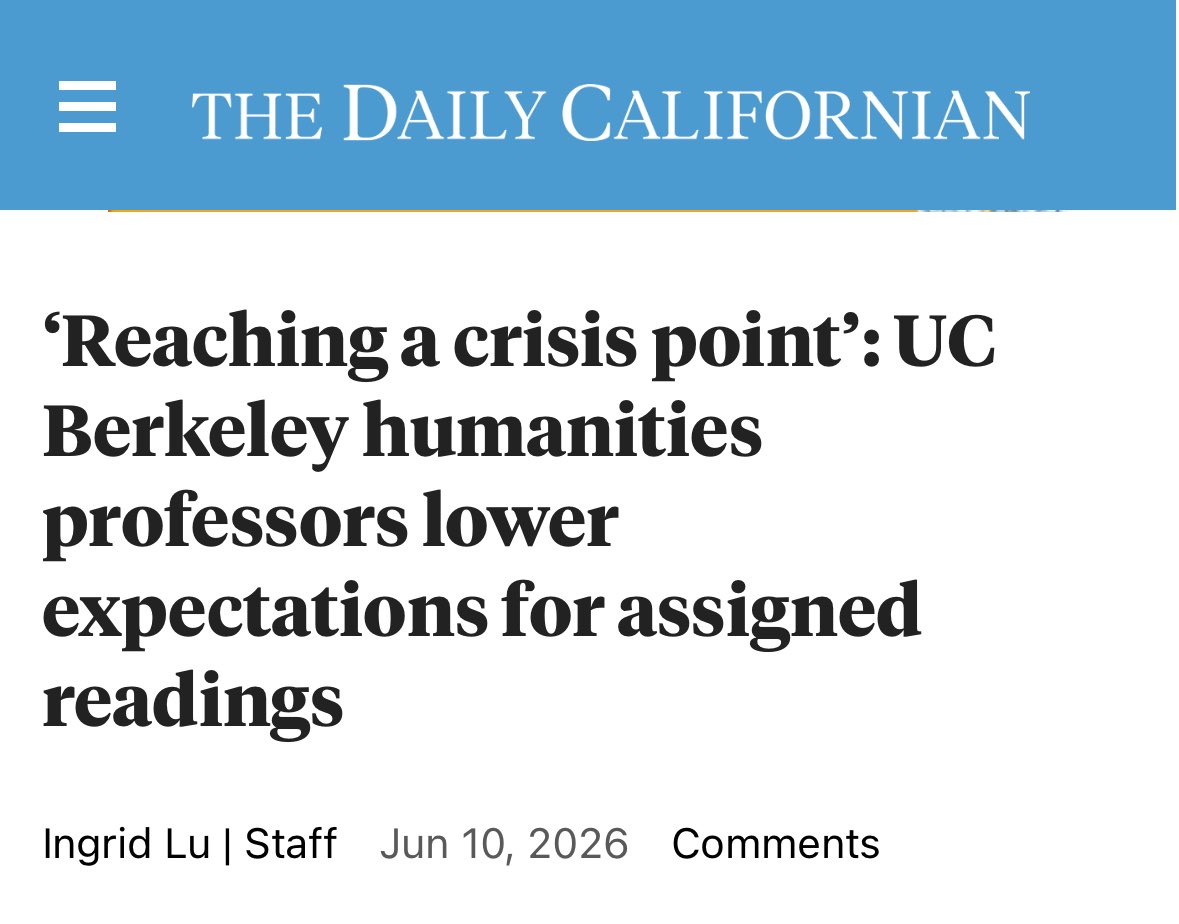
A Berkeley history professor said he’s gone from assigning 100 pages of reading per week to 35.
Another “said the earliest version of the … course he taught required seven full books, while his most recent iteration exclusively consisted of excerpts”.
“We are now reaching a crisis point where if the number (of pages) goes down further, it’s unclear to me whether my discipline of history can really be taught”, the first one said.
To which John Carter responds:
The academic death spiral is something to behold.
Demographics are steadily reducing the size of the student body, squeezing finances and driving bankruptcies.
At the same time, standards collapse is destroying the quality of the students the universities admit.
We’re already at the point where it’s common knowledge that a degree signals essentially nothing about intellectual ability. AI is exacerbating this, since cheating is so easy now.
Kids are already starting to forgo university, since they don’t think the cost of the credential is justified. That cuts even more deeply into the number of students universities can attract.
Universities respond by reducing standards even further (thereby accelerating brand destruction), by reducing tuition (which cuts even more deeply into budgets), and by firing professors in low-enrollment majors (reducing program variety, especially in the small seminars that are generally the most rewarding experiences for students).
[…]
“How can this be reversed?”
It can’t. There are pathways for individual institutions to revive themselves, even to prosper, but the sector as a whole is cooked. The death spiral is driven by prestige collapse as well as the demographic cliff, and intellectual prestige is inversely correlated to the size of the student body. More students means lower standards. That is especially true with a demographic cliff.
The only way to survive this crisis is ruthless elitism. Stop trying to edutain the fat middle of the bell curve, and refocus on the right tail. Become a place where the smartest people gather, and from which anyone who isn’t a 2-sigma outlier is excluded. This makes the school an arena in which intellectual iron can sharpen against iron. Elitism restored, prestige follows.
Next, eliminate the 500 person intro lectures. Admin loves these, since the high student:teacher ratio makes them cash cows. But they’re functionally no better than watching YouTube videos. Refocus on small seminars. This offers value that the Internet can’t.
Schools that take this path will restore or build reputations that will enable them to survive. However, they won’t be large. There is no future in which huge institutions keep tens of thousands of professors and administrators on payroll.
Update, 15 June: Welcome, Instapundit readers! Have a look around at some of my other posts you may find of interest. I send out a daily summary of posts here through my Substack – https://substack.com/@nicholasrusson that you can subscribe to if you’d like to be informed of new posts in the future.
“99% of Canadians are decent, law-abiding people”
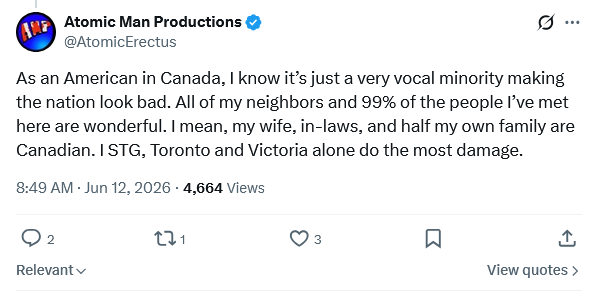
John Konrad explains why, despite agreeing that the vast majority of Canadians are “decent, law-abiding people”, he wants to see the US/Canadian border closed:
Yes. 99% of Canadians are decent, law-abiding people. Friendly neighbors. Good trading partners. Nobody serious disputes that.
I DO NOT CARE
CLOSE THE BORDER
Public safety is not built around the 99%.
We do not have laws, police, and prisons because most people are good. We have them because a small minority can inflict enormous harm on everyone else.
The argument for border enforcement is not that Canadians are bad people. It is that even a small failure rate matters when the consequences are catastrophic.
Free and open borders are a wonderful thing provided both countries are willing and able to identify, remove, and deter the small percentage of dangerous actors who exploit them.
If one side stops filtering effectively, the burden shifts to the other.
And yes, that creates unfairness. When enforcement breaks down, restrictions fall hardest on the innocent majority: families, commuters, truckers, tourists, and businesses. No one should pretend otherwise.
But there is also unfairness in asking another country to absorb preventable risks because difficult enforcement has become politically inconvenient.
A secure border is not an insult to a neighboring nation. It is a hedge against failure.
That is their sovereign choice.
But the United States also has a sovereign responsibility: to reduce risks to its own citizens.
If a partner cannot or will not reliably filter threats, then verification at the border becomes the default. Not because the majority deserves punishment, but because governments exist to manage tail risk, not assume it away.
Open borders require mutual trust.
Trust requires performance.
But the real threat is not the 1% of evil bad actors. The real threat is the 1% of far left lunatics in your government who are facilitating and funding the 1% of criminals.
YOU. The ninety nine percent are the only ones who can demand election reform. YOU are the only check left on their power.
So I absolutely endorse punishing YOU as incentive to demand change now.
A full and total stop of VISAs, temporary and permanent, will cause real stress to your economy, it will make international and domestic travel more difficult, will unfairly hurt Canadians studying in USA, it will hurt many Americans too.
But it’s worth temporary extreme pain is a small price to pay for long term stability.
You are a frog slowly boiling in water. We have asked you to jump out of them pot but you refuse. You just croak “elbows up”
So our choice as Americans is to watch you die slowly or remove you from the pot and chop a leg off so you don’t jump back in.
I believe the latter is the only option. And I believe it’s the lore humane option knowing that the leg will grow back just fine.
Comments Off on “99% of Canadians are decent, law-abiding people”
June 13, 2026
Hating on Elon Musk, the world’s first trillionaire
It shouldn’t be surprising that so many people are doing what they can to raise resentment against the very rich in general, and Elon Musk in particular. Stoking resentment of the better off has always been a viable short-term political play, and it’s not every day we see wealth of this scale:

Reddit meme
For all these dumbasses claiming if they had Elon’s money they’d end world hunger, cause world peace, educate everyone, or whatever, blah blah blah … No you wouldn’t. You’re full of shit and everyone knows it, because that’s not how the world works.
Throwing money at a problem doesn’t fix it. The entire history of government demonstrates that. Saying vapid nonsense just makes weak, unimaginative people with a childlike grasp on reality feel better about themselves for caring harder, while accomplishing nothing.
Meanwhile, the guy you hate revolutionized EVs and self driving cars, brought affordable reliable internet to every corner of the Earth, and is making the dream of colonizing space real. And the process of doing all that has given hundreds of thousands of people jobs.
While you posture about how you’d give everybody an imaginary unicorn, he’s done stuff that’s actually changed the world for the better.
And you don’t get it. You can’t get it. Because you’re just too fucking small.
And even the Globe and Mail, which used to consider itself the most respectable and influential newspaper in Canada goes for the “hate the rich” market:

But some people just can’t help themselves and ginning up the hate and envy is all they can do:
For the left, it’s important that you do more than view billionaires with skepticism. You have to actually hate them. You have to blame them for every ill that befalls you, and you must actively resent their wealth.
One way that the left accomplishes this is by framing their gains as somehow your losses.
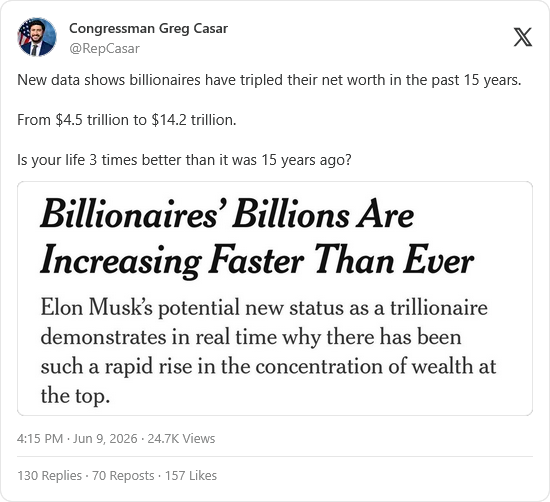
Congressman Greg Cesar (D-TX) decided to try that on X Tuesday with this banger.
Now, it’s interesting that he talks about their wealth being three times what it was 15 years ago, but doesn’t account for what the rest of us are dealing with. Instead, he engages in an apples-and-oranges comparison.
For starters, the increase in net worth for billionaires has nothing at all to do with whether your life is three times better than it was back then. There are too many variables. Someone who was unemployed and homeless and got a job, built a life back up, and then started a successful business is a lot more than three times better off, right?
Plus, it doesn’t account for differences in the cost of living or anything else.
Instead, a better metric is whether the median household net worth in America has increased a similar amount. So, I went to Google, then got its AI to generate a graph for me showing what’s happened over that timeframe.
While that’s not three times, it is 2.5 times the median net worth 15 years ago, and since this caps at 2022, it may well have increased even more.
In other words, the net worth of ordinary Americans seems to be mostly keeping up with that of the billionaires.
Cesar’s question, though, is disengenuous because the cost of living has gone up about 53 percent over that timeframe. So while net worth has increased, so has the cost of living. Not enough to completely drain away the gains in net worth, but enough that people aren’t living three times better than they were.
But that’s the point, isn’t it?
It’s not enough that, on average, Americans are much richer than they were 15 years ago, and by about the same amount as the billionaires, because that won’t foster the necessary resentment the left needs to push through their policies. You have to resent their wealth, and that’s less likely if you realize you’ve gained as much as they have by percentages. You have to feel like their wealth has been taken from yours, otherwise you’re less likely to look at wealth redistribution as a good thing.
And wealth redistribution is what it’s always about.

QotD: Ecce BCG
Of course BCG stands for “Basic College Girl”, and thus she can be found at any institution of “higher” “learning”, but the most Basic ones of all go to colleges you’ve never heard of. Jonah Goldberg is a good example, and while I know he’s technically male, his act is classic BCG. He famously — or infamously — went to Goucher College, which is the kind of school that likes to pretend it’s a mini-Ivy, when in fact it’s the kind of school bright-enough but directionless young nouveau riche kids go to when they just can’t kick that drug habit.
[…]
Achieving shockingly high rank right out of the gate is another tell, and I know what you’re thinking, because of course I thought it too: Mark Meadows is 63 years old, and in the world we grew up in, there’s only one way for a straight-out-of-college girl to become a “close confidante” of a 63 year old man. In my experience, though, BCGs aren’t socially savvy enough to figure that out.
Yeah yeah, I know, but y’all, as primal as that is, these BCGs are just weird. They have no social skills whatsoever. Two data points. First, from Hutchinson’s wiki page:
Identified as a “White House legislative aide”, Hutchinson was the subject of a nationally-syndicated AP photograph in which she was shown dancing to the song “Y.M.C.A.” alongside White House press secretary Kayleigh McEnany at the end of Trump’s September 21, 2020, campaign rally in Swanton, Ohio.
That is not grownup behavior. No woman who ever hoped to be taken seriously in politics would be caught dead doing that, as recently as 15 years ago. They have absolutely zero idea how they come off to other people.
Second data point: I once taught a night class in one of my Flyover State tours. I had this girl there who was just dying to get to Capitol Hill. She was involved in every possible Poli Sci club, the pre-law club, the Young Legislators (or whatever FNG shit it was), and so on. She emailed me once to say she’d be coming to class late, because she was representing Student Senate (or whatever) in some big to-do the college was hosting for the Governor.
When she shows up to my class, she’s wearing this tight red cocktail dress that would’ve looked trashy on a Vegas waitress. It was slit at the sides and back. and at the midriff. It had sequins, I shit you not. It was all I could do not to bust out laughing. You went to a reception. With the Governor. Wearing that.
They have no savvy at all, y’all. None whatsoever. The invitation she got read “formal attire”, so she wore what she wore to the sorority formal. You could practically still see Chad Thundercock’s handprints on her ass.
And that’s the fourth and most diagnostic criterion: utter, complete, hilarious fucking cluelessness. About everything.
Severian, “Alt Thread: Diagnosing the BCG”, Founding Questions, 2022-06-30.
Comments Off on QotD: Ecce BCG
June 11, 2026
“That’s the fun thing about the fall of the West; everybody gets a swing of the sledgehammer”
Devon Eriksen responds to a fairly common boomer-ish post:
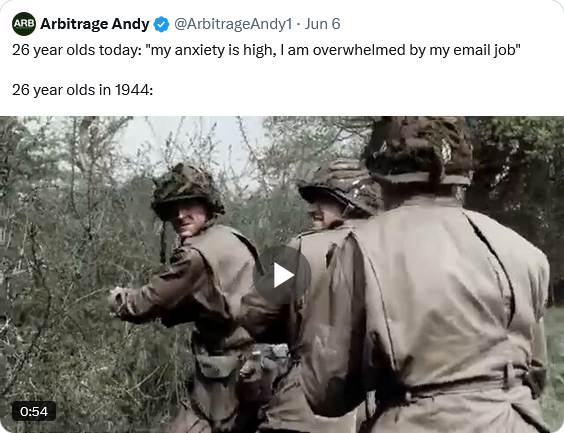
I don’t know if @ArbitrageAndy1 is a Boomer, but here he gives us a mashup of two classics from the Boomers’ greatest hits, “Younger Generations Suck”, and “The Television Never Lies to Me”.
It’s a jaunty little tune, and you can sing in it the shower, but the lyrics don’t actually make much sense.
Back in the real world, which younger generations actually have to live in, and where the television seldom tells the truth, WW2 was fought, on both sides, by guys even younger than 26.
And they were terrified.
The stress of combat against a peer adversary is overwhelming. It’s unendurable. But you endure anyway, because there you are, it’s happening to you, and you’re not getting out of it.
So you actually do have those little moments that Boomers would describe as stress meltdowns if they happened at work. You have them, and you do what you need to do anyway. Sometimes at the very same moment while you are melting down.
When you’re in this kind of war, there’s something terrible in front of you. In reality, that terrible thing is just as young and scared and overwhelmed as you are, but it sure doesn’t feel that way to you.
However, you also have something behind you, and something around you.
Behind you, you have a tribe that accepts and appreciates you. They know they sent you to hell, but they did it because hell was necessary, not because hell was fine. No one is gaslighting you pretending that everything is okay and that any problems you have are personal character flaws.
Around you, you have bros. They’re exactly where you are, doing exactly what you are doing, and they know how much it sucks. You’ve entrusted your lives to each other, and carried each other through things you don’t wanna talk about in your letters home.
Under intense stress and fear and exhaustion, your horizons shrink. You might have signed up for duty and patriotism and high ideals, but when you’re fighting, you fight to save the man next to you. And he fights to save you.
This is a very different experience than being isolated in a society that’s turned against young people, especially young men, especially young White men.
I won’t pretend it’s as difficult as fighting the Waffen SS. But young men fought the Waffen SS together.
They have to face the dissolution of the West alone.
That’s why they are anxious. Everything around them is not just going to shit.
It’s being systematically and deliberately turned into shit by powerful people who want them dead and replaced by someone else who will work cheaper and doesn’t expect to have a share of political power and a nice house and a retirement pension.
But I suppose Andy can still go ahead and dunk on them for clicks and a twenty-three dollar check from Twitter. That’s the fun thing about the fall of the West. Everybody gets a swing of the sledgehammer.
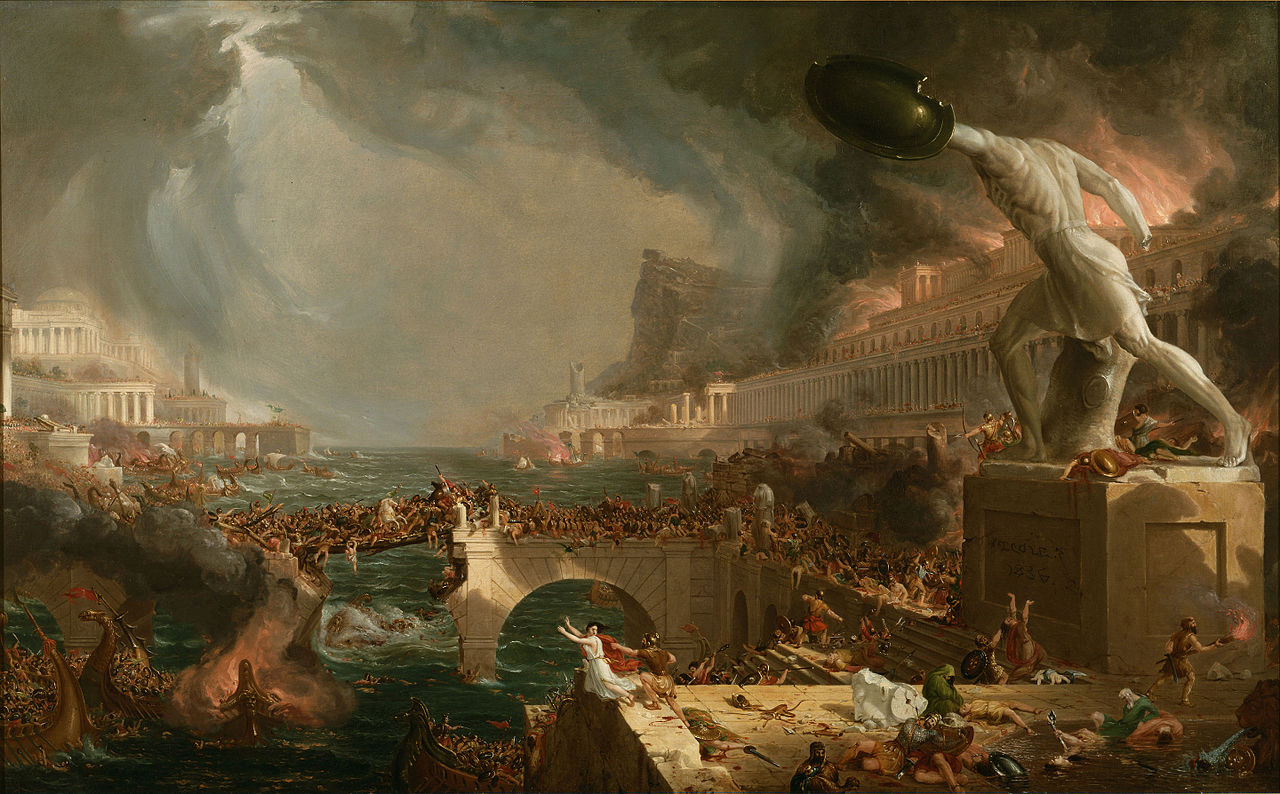
The Course of Empire – Destruction by Thomas Cole, 1836.
From the New York Historical Society collection via Wikimedia Commons.
June 10, 2026
The Korean War Week 103 – The Outpost War – June 9, 1952
The Korean War by Indy Neidell
Published 9 Jun 2026The US 45th Division launches Operation Counter in the field this week, to take some enemy outposts, Bull Boatner finishes his plans for his operation to take total control at Koje-Do POW Camp, and in the US, the Presidential primary season finishes, though it’s still anybody’s guess who the actual Democratic and Republican candidates will be.
00:00 Intro
01:21 Recap
01:52 Primary Season
05:18 Operation Counter
09:20 Communist Artillery
12:09 Boatner
20:10 Summary
20:20 Conclusion
Comments Off on The Korean War Week 103 – The Outpost War – June 9, 1952
“Don’t talk to the police”
On the social media site formerly known as Twitter, Canadian lawyer Ian Runkle (aka “Runkle of the Bailey”) jokingly suggested that he needed to make a change to his normal billing practice:
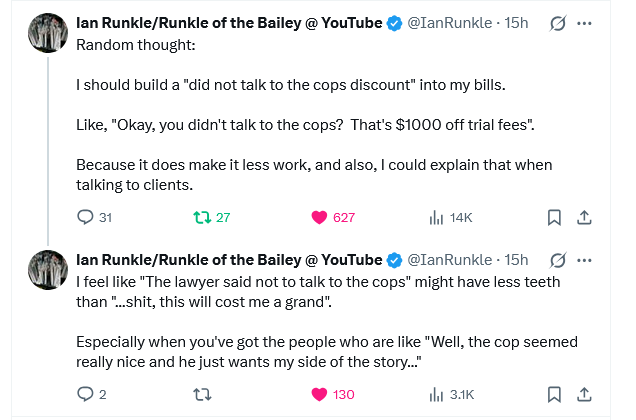
This rustled the jimmies of Jake Sun:
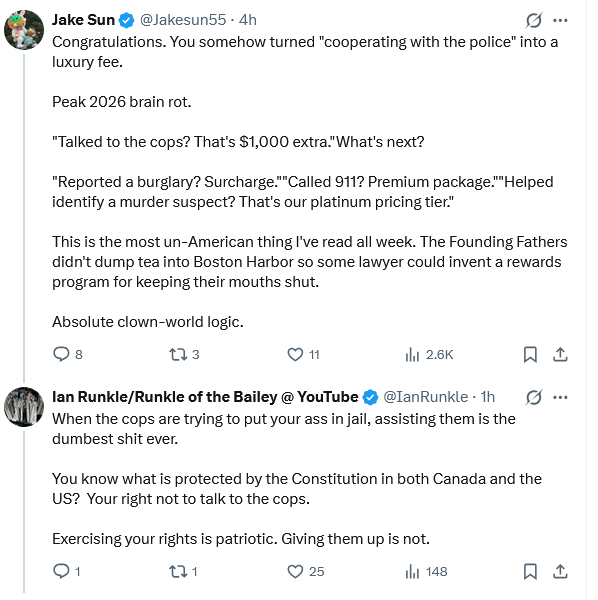
Which led to a more extended discussion from Ian:
Okay, ignoring the whole Canadian vs. American thing, let’s talk about this notion that it is somehow un-American to advise people not to speak to the cops.
Cause holy shit that’s funny.
First, when the cops want to put you in jail, cooperating with them and making that easier for them is a real dumb move. If you’re sitting in the interrogation room it’s not because the cops are looking to help you find a burglar or because you’re calling 911. It’s because they want to put you in jail, potentially for years. Wanting to help them at that point is as dumb as it gets.
Second, your right not to talk to the cops is enshrined in the Constitution in both Canada and the U.S. In other countries, likely not as much, which means that being able to tell the cops “Fuck you, no” is absolutely American, both because it is a thing in America and because exercising your Constitutional rights is an American and patriotic thing to do.
Third, if we’re talking about the United States specifically, we’re not talking about a country founded on respect for and obeisance to authority. The slogan was never “Give me Liberty, if the government allows it”. No one asked for a permit to throw tea in the harbour. The U.S. was not founded on the principles of obedience and deference to authority, but instead the rights of the individual against authorities are fundamental to the American experience.
America is not and never was about “Yes, sir.” It’s far more about “Fuck you, I won’t do what you tell me.”
Comments Off on “Don’t talk to the police”
World War 2 Mincemeat Pie for the Battle of the Bulge
Tasting History with Max Miller
Published 16 Dec 2025Raisin-forward army mincemeat pie made in a quarter sheet pan
City/Region: United States of America
Time Period: 1945During World War II, and really any war, soldiers far from home longed for a taste of home, especially during the holidays. Field kitchens would go to great lengths to break the monotonous menus and bring a little holiday cheer to the troops with things like turkey, stuffing, and pies.
This mincemeat pie is not bad, but it does lack the spices and citrus that really say “Christmas” to me. The corned beef and bouillon cubes add more of a savory note than a real meaty flavor, and raisins are the star of this pie.
No. 822. MINCEMEAT FORMULA NO. 1
Yield: 100 servings, 2 sheet pans, 16 1/2″ x 24″ x 1 1/2″.
Bouillon cubes……36 cubes
Water, boiling……9 quarts (9 No. 56 dippers)
Corned beef, canned……4 pounds
Fat……2 pounds (1 No. 56 dipper)
Apple nuggets, dehydrated……2 1/2 pounds (3 1/4 No. 56 dippers)
Sugar, granulated……3 pounds (1 1/2 No. 56 dippers)
Raisins……7 pounds (5 1/3 No. 56 dippers)
Cinnamon…… 3/4 ounce (3 mess kit spoons)
Pepper……(1/3 mess kit spoon)
Nutmeg……1/4 ounce (1 mess kit spoon)
Salt……(1/3 mess kit spoon)
Dissolve bouillon cubes in boiling water.
Add remaining ingredients. Simmer on a slow fire for approximately 45 minutes or until apples and raisins are tender. The addition of gravy coloring or caramelized sugar will improve the appearance. Remove from fire and cool. Pour into pastry-lined sheet pans.
Cover with a top crust and make in hot oven 40 to 45 minutes or until crust is golden brown.
Note. This mix should be prepared just prior to using.
— TM 10-412 US Army Technical Manual. Army Recipes by the U.S. War Department, 1945
Comments Off on World War 2 Mincemeat Pie for the Battle of the Bulge
June 9, 2026
Road to Rangoon, Ep. 1 – Slim’s Hammer and Anvil
HardThrasher
Published 8 Jun 2026The Road to Rangoon Ep1: Hammer & A Hard Place — The Battle for Burma Begins By the start of the monsoon rains in 1944, British and Indian forces of General Sir William “Bill” Slim’s XIVth Army had been pegged back inside India. Five months later, after the battles of Imphal and Kohima, the Fourteenth Army had not only retaken the ground it had lost, but inflicted catastrophic losses on the Imperial Japanese Army.
The question was: what now? There would be no more forces coming from Europe, no additional fire power or support, and apparently no belief in the men by the Imperial General Staff in London or the US Army high command in Washington. Could the DUKE forces push into Burma through monsoon rains, jungle, mountains, disease, impossible supply lines and against an enemy willing to die for each yard of ground? Could Slim, Mountbatten, Oliver Leese, the US-led Northern Combat Area Command — NCAC — turn victory in India into the reconquest of Burma?
In this opening episode of “The Road to Rangoon”, we begin the story of the epic advance that would throw the Imperial Japanese Army out of Burma (modern day Myanmar) and become familiar with some of the places, names and concepts that will shape our story.
We look at the geography of Burma and eastern India, the aftermath of Imphal and Kohima, the state of the Japanese Burma Area Army under General Kimura Heitarō, the role of XIVth Army, XV Corps and NCAC, and the Allied plans that became Operation ROMULUS, Operation CAPITAL, Operation DRACULA and EXTENDED CAPITAL. This is the story of how the Burma Campaign moved from defence to attack — and how Slim planned one of the most ambitious offensives of the Second World War.
(more…)
Comments Off on Road to Rangoon, Ep. 1 – Slim’s Hammer and Anvil
“… prior opportunities for mental health evaluations were missed”
So shocking a crime, yet the reaction of the elites really does seem to boil down to “black on white violence is just something we have to put up with” or, even worse, “it’s the fault of systemic racism, homophobia, transphobia, etc., etc. …”. This was originally posted last year, but nothing significant has changed:

In the 6 weeks since the gruesome murder of Iryna Zarutska, we’ve had time to learn what politicians and the courts and the media think her death means.
And that’s this: Nobody is responsible. Brutal black-on-white violence is either a depersonalized fact of nature, like bad weather, or it’s a sort of just retribution by the oppressed against a racist society. We’re to avert our eyes, to forget the psychotic mumbling “I got that white girl! I got that white girl!” He’s just crazy. The mumbles don’t mean anything, and if they mean something it means that white people deserved it.
But it does mean something very definite. It means that white girls like Iryna can no longer trust that society will make any systematic effort to deter Black psychotics from murdering them.
An LLM, asked to summarize, says “prior opportunities for mental health evaluations were missed”. That agentless, passive language is perfect; no one did anything. No one is responsible, and no one, not even the murderer, can be held accountable.
The purpose of a system is what it does. The purpose of our justice system is to allow grisly murders to happen, as long as the victim sorts into an oppressor class and the perpetrator to sort into an oppressed one. If Iryna’s death hadn’t been caught live on video all our institutions would have colluded to make us forget it.
Institutions like the Community Relations Service. Which for 60 years until President Trump just defunded it, strongarmed white victims of racial hate crimes into keeping silent or uttering anodyne denials that race hatred could be a factor.
Blacks, 13% of the population, commit at least 60% of serious index crimes, murder and rape and felony assault. The actual percentage is probably higher, since there’s increasing evidence that Black crime is underreported by police and officials as a way of managing racial tensions downwards. In a fair system, this would predict that a solid majority of the state and federal prison population is Black. The actual percentage is about 33%
Blacks are privileged. They’re under-arrested, under-indicted, under-imprisoned, and (despite popular mythology) less likely to be killed during a police stop than a white person is.
It’s exactly by treating Blacks as a privileged class, licensed to act from racial hatred and mumble “I got that white girl!”, that we got to the point where. Iryna Zarutka bled to death on live video.
The grimmest fact about her murder other than the horrific death itself is that six weeks later, nobody is talking about black privilege.
It’s time to start having that conversation, and it’s time to start using the term “black privilege” for the combination of systematic averaion and viciousness that led to Iryna Zarutska dying, innocent and alone and abandoned by the system that should have protected her.
Comments Off on “… prior opportunities for mental health evaluations were missed”
Stop buying stadiums for billionaires!
ReasonTV
Published 6 Feb 2026Sports subsidies suck.
If sports is a trillion dollar industry, with billionaire team owners and millionaire players, and hundreds of thousands of enthusiastic fans, and weird pervert mascot creatures, why is the government giving them your money?
Comments Off on Stop buying stadiums for billionaires!
June 8, 2026
Milton Friedman – accessory to Grand Theft Taxation
I’ve only read a small part of Milton Friedman’s work, but I have great respect for him and think that overall, he was a very strong proponent for smaller, less intrusive government. But there’s one terrible thing that he was instrumental in implementing that almost outweighs everything else:

Milton Friedman’s greatest regret.
The federal government discovered the perfect crime in 1943: make employers collect taxes before workers ever see their paychecks. You think you earn $60,000 per year, but you actually earn $75,000 and hand over $15,000 to politicians without ever touching it. The psychological difference is enormous.
Before payroll withholding, Americans wrote quarterly checks directly to the Treasury. Picture yourself sitting at your kitchen table, writing a $3,750 check to the IRS every three months. The pain was immediate and visceral. Politicians faced constant pressure to justify every dollar because citizens felt the extraction in real time.
Withholding transforms this concrete loss into an abstract accounting entry. Your employer becomes an unpaid tax collector, and you never experience the actual cost of government. Worse, most people celebrate their tax refunds as government generosity rather than recognizing them as interest-free loans they provided to politicians. The Treasury collects your money throughout the year, spends it immediately, then returns your own cash and receives gratitude.
This system enables the explosion in government spending you witness today. Defense contractors billing $640 for toilet seats, agricultural subsidies for corn syrup, and congressional salaries for 535 people who rarely show up to work. When taxation feels painless, voters stop demanding accountability for how their money gets spent.
Milton Friedman helped design withholding as a wartime emergency measure and later called it his greatest regret. Free market economists recognized that the psychological pain of direct taxation creates political pressure for fiscal restraint. The temporary always becomes permanent in government hands, and the emergency justification disappears while the extraction mechanism remains forever.
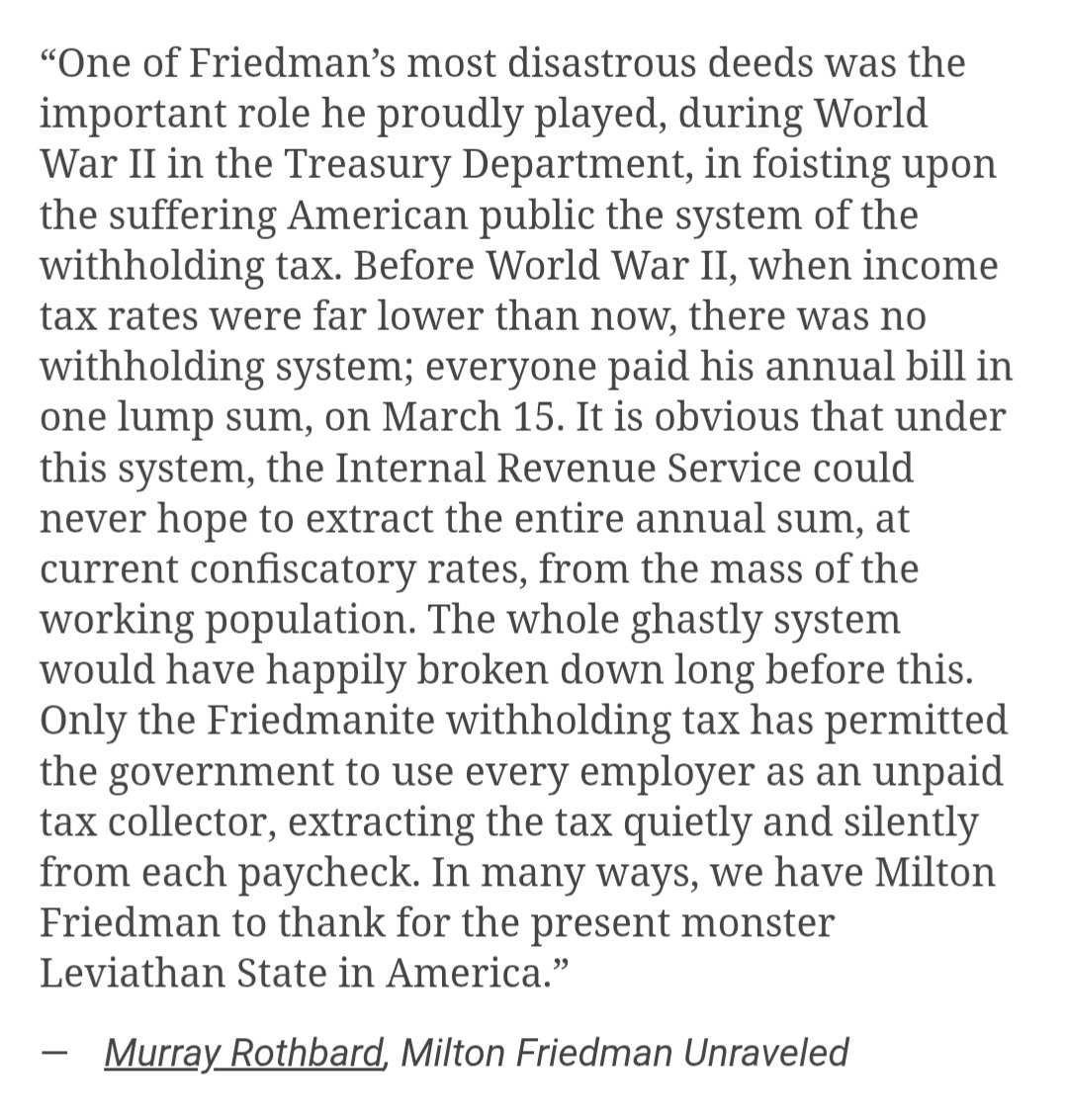
Libertarian economist Murray Rothbard was far more scathing about Friedman:
Comments Off on Milton Friedman – accessory to Grand Theft Taxation
A Brief History of Nuclear Weapons in Canada
Polyus
Published 6 Jun 2026 #aviationlovers #canadianaerospace #PolyusStudiosCanadians themselves were largely opposed to nuclear weapons but their utility in a full out conflict was impossible to ignore. And so up until fairly recently the Canadian government’s position on the matter was deliberately ambiguous. Promoting peace while supplying the means of war. Now with the luxury of hindsight we can see the true extent to which these weapons played a central role in the defense of this country during the Cold War.
Like it or not, Canada was a threatening and potent nuclear-armed force during a 9 year period between 1963 and 1972. The posturing was offensive in Europe, and defensive on Canadian soil. The last defensive weapons were relinquished in 1984. Nuclear weapons were adopted as part of its network of alliances, when it became obvious that the Soviet missile threat could only be defeated by deterrence. Politically the nuclear question was a hot potato, John Diefenbaker tried to keep the weapons out, Lester Pearson let them in, and Pierre Trudeau kicked them back out again.
This video was made without the use of Artificial Intelligence (No AI). Long live people power!
0:00 Introduction
1:20 Uranium mining in the North
2:31 Tube Alloys and the Manhattan Project
4:10 Post war fears of Soviet army and Canadian build up in Europe
6:04 Air threat from Soviet bombers
8:05 The case for nuclear weapons
9:28 Cancellation of the Arrow in favour of nuclear weapons
10:55 Defensive nukes
13:39 Offensive nukes
16:15 Nuclear capable platforms
16:59 Types and numbers of deployed weapons
18:30 Legacy and impact of these weapons
19:55 ConclusionSupport me on Patreon – / polyusstudios
Music:
Denmark – Portland Cello Project
Your Suggestions – Unicorn Heads
Comments Off on A Brief History of Nuclear Weapons in Canada
“Friedrich Nietzsche predicted our culture more than a century ago”
On the social media site formerly known as Twitter, Creative Deduction give Nietzsche credit for predicting how western cultures would change to the state we find ourselves in today:

Friedrich Nietzsche predicted our culture more than a century ago.
A society where victimhood confers status; where weakness is celebrated as virtue; where grievance brings moral authority; and where the highest aspiration is not greatness, but comfort.
He regarded it as a symptom of civilisational decline. In place of the old aristocratic values of strength, courage and self-overcoming, Nietzsche saw the rise of what he called “slave morality” — a worldview that elevates weakness, suffering and resentment into virtues. The modern celebration of victimhood, where people compete to present themselves as the most oppressed, is this mentality. Rather than striving to overcome hardship, many now seek status and moral authority through claims of injury and grievance.
Nietzsche was deeply contemptuous of those who pursue safety and comfort above all else. He mocked the “last man”, the small-souled creature who wants nothing more than a warm bed, entertainment and protection from anything difficult or dangerous. For Nietzsche, struggle was not an unfortunate condition to be eliminated, but the very source of meaning, growth and greatness. Without resistance, there is no self-creation.
The modern welfare state would have horrified Nietzsche. By shielding people from the consequences of their actions and removing the necessity of struggle, it does not liberate — it enfeebles. It creates populations that are materially secure but existentially empty, dependent on the state rather than on their own strength and initiative. Nietzsche believed that genuine human flourishing requires the willingness to endure hardship and take responsibility for one’s life. A society that makes comfort its highest value and victimhood its highest status inevitably produces weak, resentful people who have forgotten how to live.
Comments Off on “Friedrich Nietzsche predicted our culture more than a century ago”


