
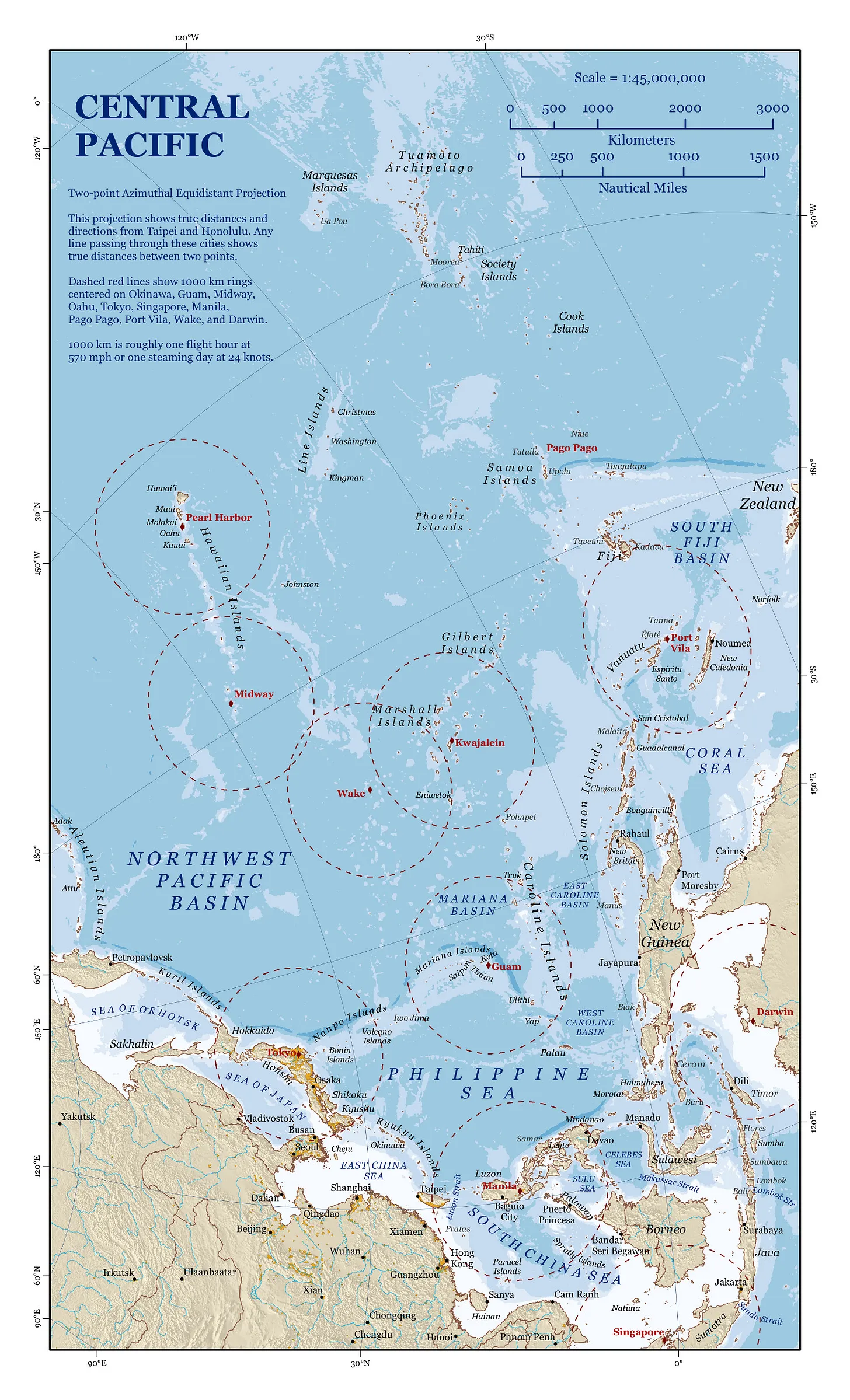
CDR Salamander provides a helpful guide to seeing the world, specifically their Pacific front, by turning your map sideways. I hope you won’t look back on this from a slightly later date when the maps get all flaggy and arrow-y:
I first saw this map three years ago, and it recently resurfaced in my thoughts.
I remain convinced that a lot of the problem with trying to get everyone to fully understand the challenge in the Western Pacific is that to a large part, we think in a “north-up” orientation.
I don’t think that is all that helpful.
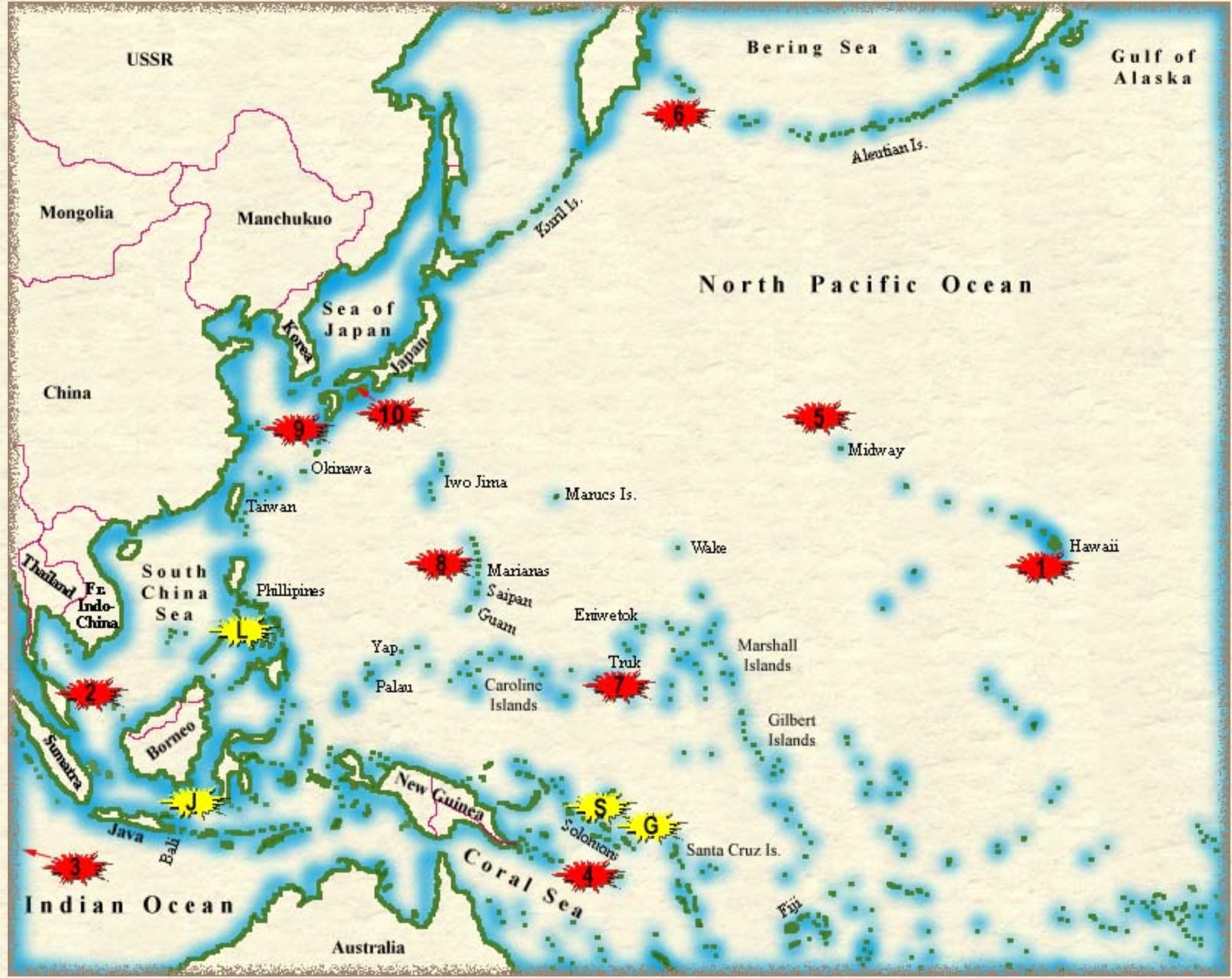
Just a few days ago, we had another Pearl Harbor Day anniversary and we’ve all seen the maps, usually centered on Hawaii, where the Imperial Japanese Navy’s Kidō Butai comes at the Pacific Fleet from stage left off the map. Then we fought battles in the Coral Sea, Midway, and so on.
To the lay eye — or to those who don’t have time to dig into the reasons — a traditional north-up map looks disjointed; things seem all over the place.
No, not really. Let’s bring back that first map.
[Click to embiggenate]
For both Imperial Japan in the early-mid 20th century and Communist China today, the most important part of this map is the access to the resources in or going through the bottom-right hand corner.
Today’s greatest bone of contention — not unrelated to the most important part of the map mentioned above — is Taiwan, right at the mouth of the funnel.
If we need to bring a fight there, that is one hell of a fight to get there if the People’s Republic of China (PRC) wants to prepare a proper welcome for us.
For the PRC, the primary military threat to plan for comes across the Pacific into a funnel that terminates at its most important SLOC. It’s the United States of America, and the US has a series of islands leading right into the heart of the PRC’s. It starts in Hawaii — Midway, Wake, Guam — and then to U.S. allies: the Philippines, Japan, and Australia.
They’re planning a layered defensive fight. Their actions make that clear.
Make no mistake, we may say we are going to “defend Taiwan”, but to do that we will have to fight an aggressive war across the Pacific, into the enemy’s prepared funnel.
Update, 13 December: Welcome, Instapundit readers! Please do have a look around at some of my other posts you may find of interest. I send out a daily summary of posts here through my Substack – https://substack.com/@nicholasrusson that you can subscribe to if you’d like to be informed of new posts in the future.



[…] SEEING THE BATTLE FIELD FROM THE ADVERSARY’S POINT OF VIEW: Re-orient your map to understand China’s view of the world. […]
Pingback by Instapundit » Blog Archive » SEEING THE BATTLE FIELD FROM THE ADVERSARY’S POINT OF VIEW: Re-orient your map to understand Chin — December 13, 2025 @ 04:00
Taiwan should be able to defend itself (how are those tactical nukes coming along) and and both the US and Taiwan not set up the condtions prior to WWII that led to Japan and the USA going to war.
Comment by Evi L. Bloggerlady — December 13, 2025 @ 04:50
If Taiwan has developed a truly independent nuclear deterrent, true. On the other hand, if they got unofficial assistance from US secret squirrels, the launch codes may be under US control. If that’s the case, I can see a situation where President Newsom would decide not to release the controls …
Comment by Nicholas — December 13, 2025 @ 10:38
Hey. Any idea where I could order a walk map like that?
Comment by Jeremy — December 13, 2025 @ 07:45
CDR Salamander said he first saw it a few years ago, so I’d expect to find it available somewhere, but I’m afraid I don’t have any leads for you.
Comment by Nicholas — December 13, 2025 @ 10:35
Judging from the orientation of this map, “defending Taiwan” does indeed appear to be a trans-Pacific offensive operation, not a purely defensive one. Do you see any changes in US doctrine or that of its allies beginning to adapt to this geographic reality?
Comment by akuntansi — December 16, 2025 @ 03:24
If there’s any formal changes in US doctrine, I’d expect to see them prefigured in the most recent National Security Strategy of the United States of America (November, 2025). I haven’t read the document yet, so I can’t point to anything specific, I’m afraid.
Comment by Nicholas — December 16, 2025 @ 09:37