Quotulatiousness

July 3, 2024

The profound, utter, inescapable uselessness of the legacy media

Filed under: Cancon, Government, Media, Politics, USA — Tags: , , , , — Nicholas @ 03:00

As an early and enthusiastic blog reader and eventually a blog creator, I’ve always sought interesting aspects of stories in the news — even when I disagreed with the source or the presentation, it’s always a good thing to approach any topic “in the round” whenever possible. Getting all your information from one viewpoint or even one source is a good way to gaslight yourself. Once upon a time, while the TV networks tended to be as bland as they could (because going too far toward sensationalism would be a good way to get in bad with the regulators who control your broadcasting privileges), newspapers were not under such strong moderation. You could find very progressive, mildly progressive, centrist, and even mildly conservative voices with relative ease. At least, that’s what a rosy view of media history suggests — I think you have to go back before World War II to find really vigorous debates among the major newspapers.

Here in Canada, the mass media were already overly deferential to the government of the day — unless it was a Conservative government, of course — and after the internet and social media ate all the profit out of their business, they turned as one to the government to bail them out. In return, they became even more deferential to official story lines unless the foreign press forced their collective hand to present a more complete story. Over the last few years, as the surviving mainstream media shed jobs, many journalists have “crossed the lines” and become much more like their distant predecessors in the media: diggers of dirt, tellers of uncomfortable truths, and impartial mockers of government incompetence (Canada’s The Line is an excellent example of this … even when I don’t link to them, I almost always find their articles interesting and informative.)

All that throat-clearing out of the way, here’s Chris Bray asking what you have learned from the mainstream media lately:

When was the last time you read something in the mainstream news media — an op-ed piece, a major revelation that some clever and persistent investigative reporter dug up, a sharp bit of news analysis — that surprised you? When was the last time you read something in the news that changed your understanding of a major issue? When was the last time something in the “news” reframed an issue in your head with an argument you hadn’t anticipated, or with new evidence that you hadn’t heard before? “Man, I’d never thought of it that way,” you say, tossing the New York Times down on the coffee table.

Related, when was the last time a report or a panel discussion on television news surprised you and made you see something differently?

My impression is that the public sphere is now made up almost entirely of people saying things that we already know they’re going to say. “Jennifer Rubin will now analyze the presidential debate.” You don’t need to hear that. There’s no need to listen to any of it, ever. Andrea Mitchell is for [current thing]. Of course she is. If you know what [current thing] is, what’s the point of an Andrea Mitchell?

It’s all so dull.

There are at least a couple hundred prominent media and academic figures in the United States who could die tonight without anyone noticing, as long as there was a tape or a computer program of some kind to go on posting the received wisdom of the day under their names.

QotD: Mental health and social media

Filed under: Media, Politics, Quotations, USA — Tags: , , , , , — Nicholas @ 01:00

I question the idea that modern life has increased the total amount of lunacy in the world. Thanks to the Internet in general, and social media in particular, the volume of the world’s lunatic population has been amped well past 11 … but I think this is less a case of “Twitter creating lunatics” than “online anonymity letting people fly their freak flags openly”. Deliberately avoiding sex and politics, an example: On a road trip recently, I started flipping channels in my hotel room, and I came across a show called Dr. Pimple Popper. I swear, this is absolutely a real thing that exists. Here’s this woman, a dermatologist I guess, rooting around in cysts and boils and tumors and whatnot for the cameras, and … that’s it.

Not only is there an audience for this — which I never would’ve believed — there’s enough of an audience for it that it’s on basic cable. See what I mean? Somehow, the marketing guys determined that yes, there are enough people out there who want to see cysts being cauterized that we can make an entire show out of it. How could they figure it out? Beats me, but unless some suits at TLC had a contest to see what’s the silliest, grossest thing they could actually get broadcast, I’m betting that there was a group of Internet weirdos out there discussing it, and the marketing boys just ran with it.

Applying that to the topic at hand, my guess is that, since it’s so easy for people to be Massively Online these days, the kind of folks with that particular type of mental problem pretty much live on Twitter, where — as anyone who has waded into that cesspit for more than five minutes knows — the Twitterati absolutely cannot distinguish “talking about doing something” from “actually doing something”.

Severian, “Friday Mailbag”, Rotten Chestnuts, 2021-06-04.

July 2, 2024

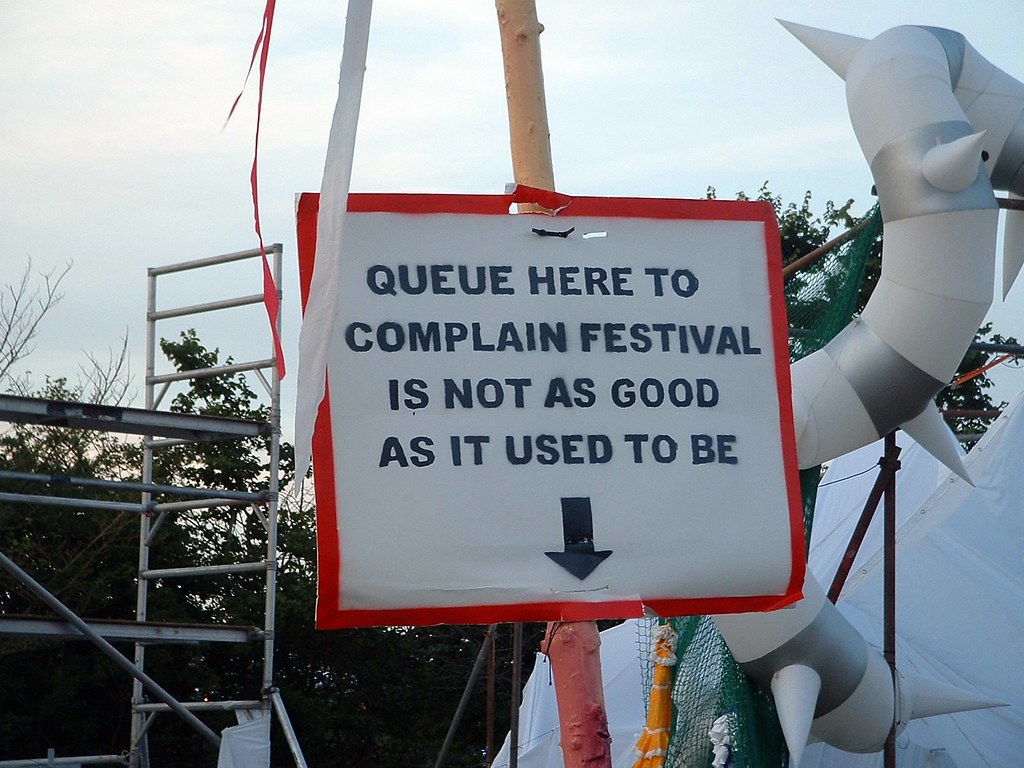
The virtue-signalling Olympics … aka “Glastonbury”

In Spiked, Brendan O’Neill documents the awesomely awful human beings at the Glastonbury music festival this year (like most years):

“Sign of the times @ Glastonbury Festival” by timparkinson is licensed under CC BY 2.0 .

Virtue-signalling reached its nadir on Friday night. It was at the Glastonbury music festival. Of course it was. A swaying crowd of the time-rich, turbo-smug thirtysomethings who make up Glasto’s clientele passed around an inflatable dinghy filled with dummies designed to look like migrants crossing the English Channel. As some band you’ve never heard of sang a song about “beautiful immigrants”, the audience hoisted the blow-up boat above their heads and basically crowd-surfed it. What a gauche display of phoney virtue. What an orgy of hollow vanity. Surely it would have been cheaper to rustle up a banner saying, “Aren’t we fucking wonderful?”.

It will surprise not a living soul that the boat was the handiwork of Banksy, every posh twat’s favourite graffiti artist. Banksy has never once seen a moneyed, mostly white audience that he didn’t want to titillate with platitudes about Tory scum and cruel capitalism, so it was only natural he would gravitate towards Glastonbury. He knows it’s rammed with people called Archie and Poppy who lap up his unsubtle stencils about the rat race that is neoliberal society and how dreadfully frightful war can be. So who better to dragoon into his boat stunt than these folk who likewise love advertising to the world how much they care about migrants and stuff?

Let’s leave to one side how unbelievably crude it is for a rich graffitist and Brits who can afford to fork out £355 to listen to crap music for five days to celebrate boat journeys that often end in death. One wonders if any of the audience members who cheered illegal immigration later retired to one of Glasto’s luxury yurts, which contain not only “proper flushing toilets” but also toilet attendants. You can hire one for £5,000, which, ironically, is around the same amount of money dirt-poor migrants are forced to stump up to criminal gangs for a seat on one of their perilous crossings that the righteous of Glasto think it’s a hoot to sanctify.

No, even worse than the sight of the well-off of Worthy Farm using the wretched of the Earth to burnish their moral credentials is the fact that if any Channel-crossing migrant were to rock up to Glastonbury they’d be cuffed and shoved in the back of a paddy wagon faster than you could say “What time’s Dua Lipa on?”. Glastonbury is one of the most fortified zones in Britain. It is surrounded by a fence that is 4.12m high and 7.8km long and which has numerous “unique high-security features”, including an “external roadway to prevent tunnelling”, a “45-degree overhang to prevent climbing” and “zero nuts and bolts to stop the fence being tampered with”. “No borders!”, cry the virtuous of Glasto while surrounded by a border fence that the screws of Alcatraz would have envied.

The Chevron decision

Filed under: Bureaucracy, Business, Law, Politics, USA — Tags: , , , — Nicholas @ 03:00

On his substack, Glenn “Instapundit” Reynolds discusses the recent US Supreme Court decision on “Chevron deference” and how it is going to impact the administrative state (and their business victims) going forward:

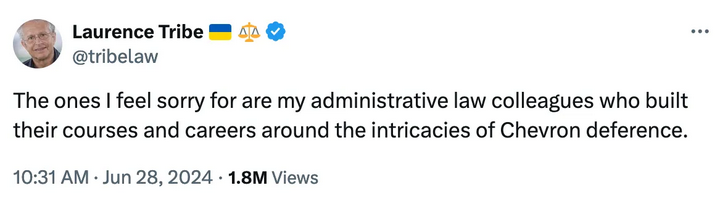
Goodbye, Chevron deference. Larry Tribe is already mourning the Supreme Court’s overturning of NRDC v. Chevron, in the Loper Bright and Relentless cases, as a national catastrophe:

Oh, the humanity!

Well, speaking as a professor of Administrative Law, I think I’ll bear up just fine. I’ve spent the last several years telling my students that Chevron was likely to be reversed soon, and I’m capable of revising my syllabus without too much trauma. It’s on a word processor, you know. As for those academics who have built their careers around the intricacies of Chevron deference, well, now they’ll be able to write about what comes next. And if they’re not up to that task, then it was a bad idea to build a career around a single Supreme Court doctrine.

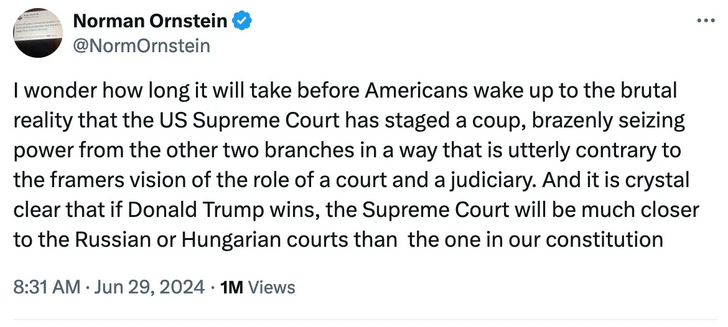
And that wasn’t the only important Supreme Court decision targeting the administrative state, a situation that has pundit Norm Ornstein, predictable voice of the ruling class’s least thoughtful and most reflexive cohort, making Larry Tribe sound calm.

Sure, Norm, whatever you say.

But how about let’s look at what the Court actually did in Chevron, and in the Loper Bright and Relentless cases that overturned it, and in SEC v Jarkesy, where the Court held that agencies can’t replace trial by jury with their own administrative procedures, and in Garland. v. Cargill, where the Court held that agencies can’t rewrite statutes via their own regulations. I don’t think you’ll find the sort of Russian style power grab that Ornstein describes, but rather a return to constitutional government of the sort that he ought to favor.

At root, Chevron v. Natural Resources Defense Council is about deference. Deference is a partial abdication of decisionmaking in favor of someone else. So, for example, when we go out to dinner, I often order what my son-in-law orders, even if something else on the menu sounds appealing. I’ve learned that somehow he always seems to pick the best thing.

Deference doesn’t mean “I’ve heard your argument and I’m persuaded by it”, (though something like that is misleadingly called “Skidmore deference”, but isn’t actually deference at all). Deference means “even if I would have decided this question differently, I’m going to go with your judgment instead”.

Under Chevron deference, when an agency interprets a statute it administers (e.g., the EPA and the Clean Air Act), a court will uphold its interpretation so long as it is (generously assessed) a reasonable one, even if it is not the interpretation the court would have come up with on its own. As you might imagine, this, at least potentially, gives agencies a lot more leeway, particularly when, as is often the case, Congress has drafted the statute ambiguously.

With Chevron overturned, courts will now apply their own judgment instead of deferring to agencies. Of course, this isn’t as big a deal as Larry and Norm seem to think, because Chevron has been dying the death of a thousand cuts for a while. Under the “major questions doctrine”, courts already decline to defer to agency interpretations where the issue has major social or economic ramifications.

July 1, 2024

Fifty ways to leave your leader

Okay, I exaggerate in the headline … Mitch Heimpel only offers a list of eight factors that matter when it’s time for a political party to take their leader out behind the barn, so to speak:

Caucus revolts have gotten more common in Canadian politics of late.

They’ve always been commonplace in Westminster politics. In recent years, they’ve dethroned three prime ministers in the U.K. They’re almost as common as general elections for removing prime ministers in Australia. They’re a sign of a healthy parliamentary system … sort of. Our system runs on confidence. Prime ministers are supposed to be responsive to pressure from the backbench.

Canada has been something of an exception to this, and not always to our national benefit. Though less so lately. We’ve seen sitting governments in revolt (Jason Kenney in Alberta, 2022) We’ve also seen opposition leaders taken out by frustrated caucus (Erin O’Toole federally in 2022, Patrick Brown as Ontario Progressive Conservative leader, 2018.) The Chrétien-Martin feud was more of a civil war than a revolt.

Still, despite the examples above, these events remain relatively rare in Canada, compared to many of our Westminster peers, because of how centralized power has become in leaders’ offices (especially in the PMO). Our normal, as described in Jeffrey Simpson’s The Friendly Dictatorship, is how our system evolved, not how it was meant to be.

Now, since there are signs (see here and here and here) that at least some Liberals are musing about taking a shot at Prime Minister Justin Trudeau, it’s perhaps a good time to set some ground rules for caucus revolts. This is what we’ve learned not just from recent Canadian experience, but also from what our British and Australian cousins have learned over the years.

[…]

If things are going so badly that the caucus wants to revolt, you probably do need to make changes. Showing you’re listening, demonstrating accountability at the senior levels and demonstrating change can take the wind out of a caucus revolt before it gets out of hand.

The above are general rules — exceptions can obviously apply. And as noted at the beginning, Canada doesn’t have much experience with these situations. That’s why Australia and the U.K. are so instructive. But things do seem to be changing in Canada, and certainly, things seem to be changing in the Liberal caucus. The above rules are offered free of charge to mutineers and loyalists alike. Good luck!

The Anglosphere “imported American racial progressivism, and then commenced to import American-style racial problems. Thanks, America.”

Filed under: Business, Education, History, Media, Politics — Tags: , , , , , — Nicholas @ 04:00

At Postcards From Barsoom, John Carter discusses meritocratic racial quotas in employment and higher education as a “Universally Disagreeable Compromise”:

Graphic for Rhode Island College’s Office of Diversity, Equity and Inclusion.

The race question has been a fault line in American society from its inception. In the aftermath of the hypermigration of the early twenty-first century, it has only become more complicated and divisive, not only in America, but throughout the Anglospheric world. The rest of us imported American racial progressivism, and then commenced to import American-style racial problems. Thanks, America.

The question seems to ultimately revolve around who shall receive the economic spoils. The “equity” that is endlessly referenced by diversity commissars is literally the home equity held by the white middle class, which the diverse and their champions openly intend to expropriate and redistribute.

The most contentious battlegrounds are in academic admissions and corporate hiring, in which the imperative is to minimize the number of White men, and maximize everything that isn’t White men. How the everything else is maximized is of no particular account. A team composed entirely of black men is just as “diverse” as a team which also features Black lesbians, Arab homosexuals, and Thai ladyboys. It is the presence of White men that makes organizations less diverse: a team composed entirely of Black men, with the exception of a solitary White male token, is less diverse than the all-Black team.

For generations now we have suffered under the affirmative action regulations imposed under the banner of Civil Rights. For proponents, Civil Rights are a civic religion, and they guard the advantages won by adherence to their faith jealously. For the victims of affirmative action – which includes both those rejected from employment or university, as well as those subjected to the incompetency of affirmative action admits and hires – affirmative action is a hateful absurdity.

The underlying problem, which to this day only Internet edgelords will openly discuss, is human biodiversity. The various ancestral groups are, in fact, different, in ways that go beyond the merely cosmetic, to include general levels of cognitive aptitude, along with specific behavioural proclivities. To a certain degree this is due to upbringing, but only to a certain degree; upbringing can bring a child as close to his genetic potential as possible, but cannot push him beyond it. The best that nurture can do is to allow nature to flower; it cannot change nature. The natural outcome of this is that, under a purely race-blind, meritocratic dispensation, there will be noticeable and ineradicable differences in the representation of various races within any given profession.

Whether or not one supports a purely meritocratic approach to admissions and hiring then tends to depend a lot on whether one belongs to a group that is likely to do well, or poorly, under such a system. East Asians tend to support a more meritocratic approach, because their high test scores, good study habits, and strong work ethic mean that they will be extremely competitive. Blacks, on the other extreme, are far more skeptical of meritocracy, intuiting that a ruthlessly meritocratic approach would tend to see them pushed out of the professions at the expense [or rather, to the benefit] of Whites, Asians, and Indians.

The current system is practically the worst possible system. The official narrative is built upon the foundational lie that we are all the same under the skin, and that any difference in group-level socioeconomic outcome can only be the result of bigotry, racism, systemic racism, implicit bias, and the historical consequences of slavery or colonialism. This lie has driven our society quite insane, leading in particular to the demonization of Whites – a large fraction of whom buy into the narrative of ethnomasochistic guilt with religious zeal, and another large fraction of whom reject this framing of their racial character as sick and ugly. To a large degree the culture wars are driven by this very division. In the American context, this division maps quite closely to Constitutionalists vs Civil Rights adherents, i.e. it is a holy war between the two dominant civic religions. It is not accidental that this also maps to Republican (i.e. those who wish to preserve the Old Republic built by the Constitution) vs Democrat (i.e. those who wish to complete the transformation of the Republic into something [like] the Our Democracy they’ve been growing in the soil of Civil Rights).

As William M Briggs has pointed out ad nauseum, the prohibition of “disparate impact” and “discrimination” under the Civil Rights regime is an absolute nightmare for corporate America. On the one hand, to discriminate on the basis of race (or any other identity) is plainly illegal; on the other, to not discriminate is invariably to open oneself to charges of discrimination, as the various statistical differences between racial groups work themselves out in aptitude tests, SATs, grade point averages, or job performance. This places employers in the Kafkaesque position of being required to discriminate without being seen to discriminate. They must put their thumbs on the scale to ensure equal outcomes, without being caught doing so.

For Whites especially, this has been a very bad deal. Because no organization will ever be sued for taking on too many officially victimized minorities, there is no upper limit to the number of diversity hires; but if the student body or corporate org chart falls below a given group’s fraction of the population, lawsuits are almost guaranteed. This then produces an inevitable ratchet effect which systematically excludes White people from their own society, with corrosive effects on competence, morale, and confidence in institutions. It doesn’t help that, because we are still officially meritocratic, the leadership classes subject us all to constant gaslighting: we are discriminated against openly by people who brag about discriminating against us while insisting in the same breath that there is no discrimination. It is not surprising that many of us are ready to burn these people at the stake.

Welcome to the “Omnicause” (aka “the Fatberg of Activism”)

Helen Dale first encountered the Omnicause as a university student council member:

For my sins — in 1991 — I spent a year on the University of Queensland Student Union Council. Yes, I was elected, which means I was a volunteer. It ranks up there among the more pointless activities I’ve undertaken. I was 19, that’s my excuse.

Because I’m conscientious, I took it seriously. I turned up to the monthly meetings. I researched the motions to be debated and voted on in advance. I tried to say not-stupid-things when I thought it was worth making a comment. One side benefit: I learnt meeting procedure.

I also had my first encounter with the Omnicause.

Every single student union council meeting had a Palestine motion, sometimes more than one. These were long, detailed, and competently drafted. They routinely dominated more typical student union fare: budgetary allocations to fix the Rec Club roof, say, or complaints about tuition fees. I wondered what the union’s employed secretarial staff thought of typing up and then photocopying pages upon pages of tedious detail about Middle Eastern geopolitics. I remember picking up copies of both minutes and agendas and boggling at the amount of work involved.

There, in miniature — in sleepy meetings in hot rooms where dust particles danced in stray sunbeams as those of us reading law or STEM subjects tried to make sense of it all — was the Omnicause we now see in campuses all over the developed world. My earliest memories of it involve Aboriginal activists describing Australia as a “settler-colonial state” which had been “invaded” — just like Israel. Australia also had no right to exist.

During one meeting, a Palestine-obsessive buttonholed an engineering student known for his commitment to conservation, bending his ear about the Nakba. I misunderstood the exchange, and congratulated my Greens fellow councillor on recruiting a new party member.

“I’m not sure we want her,” he said. “She doesn’t know or care about the environment, just this Israel thing.”

Already, in 1991, the infant Omnicause had learnt to crawl. It was possible to see — albeit dimly — what would happen to genuine conservationists as single-issue lunatics took over their movement and rotted its political party from within. Darren Johnson — whom I’d call a “Green Green” — and his cri de coeur captures the process well:

    Terrible haircut I know, but here’s me in the Hull Daily Mail running for the Green Party in 1990. I stood on a platform of male rapists in female prisons, hormone drugs for 10yos and rebranding women as uterus-owners. No, don’t be silly, it was housing, environment & poll tax.

Darren Johnson, recall, was the UK Green Party’s former principal speaker, its first-ever London councillor, twice its London mayoral candidate, and is a former chair of the London Assembly.

The Omnicause: what writer Hadley Freeman calls “the fatberg of activism”. This is a genuine flyer, by the way. I admit to suspecting the work of Mole at the Counter, General Boles, Famous Artist Birdy Rose, or Burnside Not Tosh — so I checked.

The Greens in both Australia and the UK have become a vector for much of the worst nonsense: trans and Gaza and chucking orange paint around an art gallery near you have displaced saving the Fluffy Antechinus1 or improving biodiversity, quite apart from anything else. Trans, in my view, is also part of the Omnicause, albeit a junior partner. Like Palestine, it’s capable of colonising major political movements focussed on something else entirely, as this (justifiably angry) supporter of Scottish independence points out.


    1. This animal does not exist, although the Antechinus does.

June 30, 2024

California’s politics are so weird that Justin Trudeau is frantically taking notes

Filed under: Government, Law, Liberty, Media, Politics, USA — Tags: , , , , , — Nicholas @ 05:00

Chris Bray pays attention to California politics … and we should all pray for his long term mental health: that place is insane!

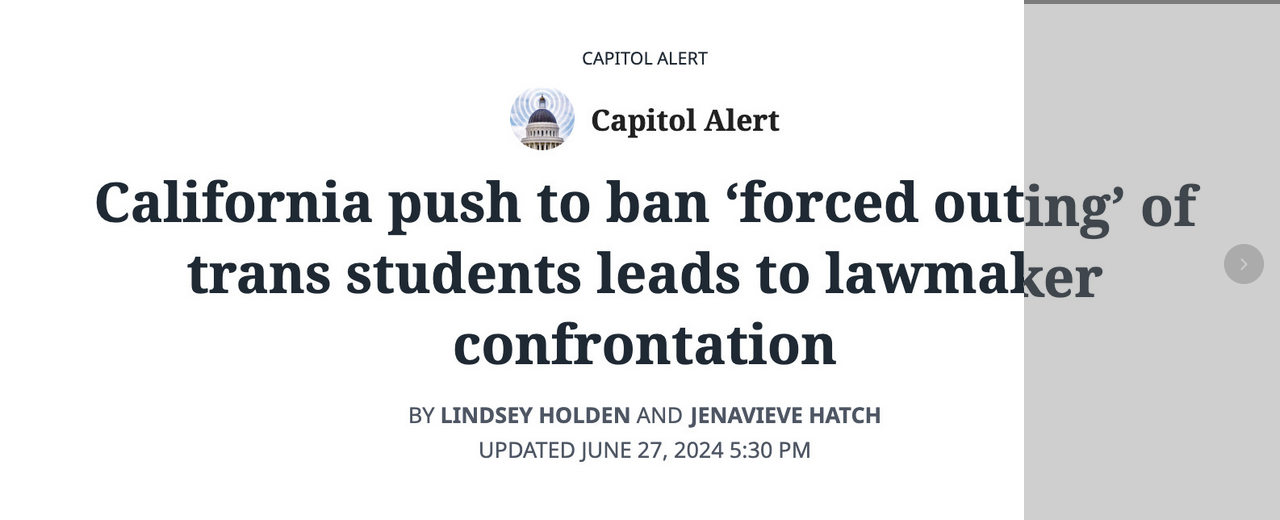
What’s happening in California isn’t politics in any conventional sense. No debate is underway, and no policy choices are being hashed out. We’re in the land beyond. In Our Democracy™, declarations are made, and then they are to be received in a spirit of quiet submission. Your failure to submit is disallowed, and the reason it’s been disallowed is that it’s been disallowed. Were it allowed, it would not be disallowed, but it is, in fact, disallowed, so therefore it is not allowed, you see? All “political” discussion is a circle, eating its own tail. I’ve been trying to figure out how to explain this, but the Sacramento Bee just did it for me. (Paywall-evading version here.)

The Bee is explaining — or “explaining” — what happened on the floor of the state Assembly yesterday, when a Republican was not permitted to argue against a bill, and a Democrat stood up to threaten him for trying. I encourage you to read the whole self-refuting thing. What happened, it turns out, is that the Republican was preventing debate by engaging in debate, which meant that he had to be silenced and threatened so debate could continue, which required that no one express opposing views, which is an act of anti-debate aggression. Debate is agreement, and not agreeing is preventing debate.

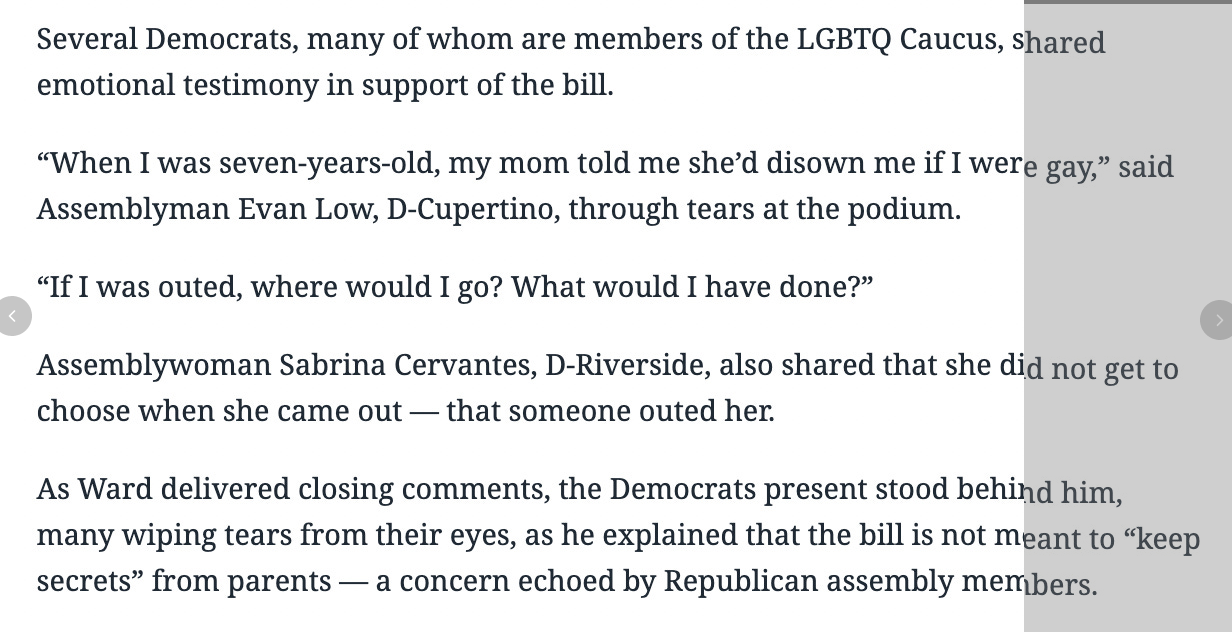
The “forced outing” debate was a discussion about AB 1955, which proposes to forbid schools to inform parents of discussions between children and school officials about sexual orientation and sexual behavior. It’s important that parents not be told about sexually themed discussions happening between children and the adults in their schools, because not telling mommy and daddy about sexual discussions is being safe and warm. But watch the casual turn of logic in the last paragraph of this screenshot:

  1. Evan Low said the bill is important because it’s good that parents not be told, and the bill makes sure parents aren’t told.
  2. Sabrina Cervantes said she didn’t have this bill when she was young, which would have forbidden telling, so someone told.
  3. Democrats explained that the bill is not meant to keep secrets from parents.

See, AB 1955 isn’t about keeping secrets from parents — it’s about not allowing schools to tell parents. Not being allowed to tell parents is different than keeping secrets from parents. The story doesn’t go on to explain the distinction between keeping secrets and not telling, but under Jacobin cultural rules, the distinction is that shut up. The distinction is presumptive, and so doesn’t require explanation.

Now, here’s the way the Bee characterizes Assemblyman Bill Essayli’s arguments during the debate that he derailed by not agreeing:

    Essayli has exhibited a consistent pattern of publicly disparaging advocacy groups and fellow lawmakers in an attempt to garner attention for conservative causes. On Thursday, he interrupted colleagues’ testimony and expressed frustration over Wood cutting his microphone and shutting down his comments when they veered away from AB 1955 and toward the issue of forced outing, in general.

His comments about the forced outing bill weren’t about the bill — they were about forced outing. What a bastard! Mister Speaker, he’s not debating the highway funding bill, he’s debating highway funding. Again, why does this distinction make sense? Because shut up. It makes sense declaratively: X is true because they said X.

And Essayli has a “consistent pattern” of saying disparaging things, which the Bee knows through mindreading is a maneuver to “garner attention” rather than an attempt to express his views. He disagreed, which is a very cynical and manipulative thing to do during a debate. He has a pattern of it!

And also Essayli is so rude that he interrupted colleagues when they spoke, and then had the nerve to object when his microphone was turned off. It’s rude to stop someone from speaking, and it’s rude to object to being stopped from speaking. You should never interrupt people, and you should always allow other people to interrupt you. They’re playing partisan Calvinball under the dome, and all moves lose.

June 29, 2024

“No sane person can possibly believe that this man is capable of being president now, let alone for another four years”

Filed under: Media, Politics, USA — Tags: , , , , , , , , — Nicholas @ 04:00

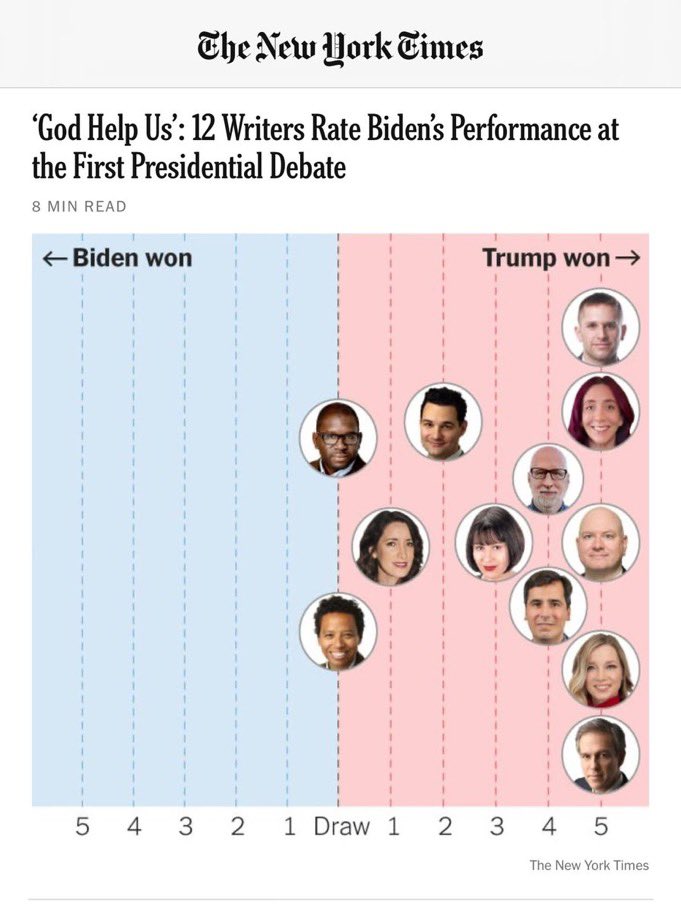
Joe Biden’s performance in the first Presidential debate on Thursday night was so bad that even his strongest supporters in the media have turned on a dime and are now contemplating his replacement:

This is not a hard column to write. In fact, I wrote it twice already! But last night’s debate performance by Joe Biden is the end of his campaign. It’s over. Done. No sane person can possibly believe that this man is capable of being president now, let alone for another four years. No sane person can vote for him.

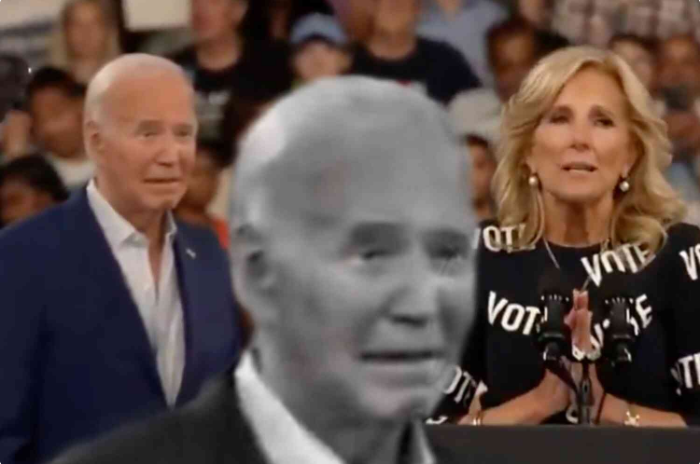
And watching him barely capable of finishing a sentence, staring vacantly into the middle distance, unable to deliver a single coherent message even when handed an ideal question, incapable of any serious rebuttals to Trump’s increasingly deranged lies … well, the first thing I felt was intense sadness. This was elder abuse — inflicted, in part, by his wife.

The second thing I felt was rage. His own people chose to do this. That alone reveals a campaign so divorced from reality, so devoid of a rationale or a message, so strategically incompetent, it too has no chance of winning. It is an insult to all of us that a mature political party would offer someone in this physical and mental state as president for the next four years. And it has always been an insult. That the Democrats would offer him as the only alternative to what they regard as the end of liberal democracy under Trump is proof that they are either lying about what they claim are the stakes or are utterly delusional. If Trump is that dangerous, why on earth are you putting forward a man clearly in the early stages of dementia against him? Have you decided to let Trump win by default because you’re too scared to tell an elderly man the truth?

And if they have not told him the truth on this, what else are they afraid to tell him?

The mainstream media also bears responsibility for once again being an arm of the DNC establishment, running countless stories about Biden’s acuity and sharpness from inside sources, while attacking the few journalists who actually dared write the most obvious truth about this election: Biden has deteriorated rapidly in the last four years, he is unrecognizable from the man who ran in 2020, and we’ll be lucky if he is able to function as president for the next six months, let alone four years.

I watched MSNBC after the debate. It was like watching State TV in Russia. It took them an hour to acknowledge what the world had just seen, as they danced pathetically around what was staring them in the face. They are literally administration spokespeople — Jen Psaki has the exact same job she always had — waiting for instructions on what to say out loud. And they have all lied through their teeth for months about Biden’s fitness, only to refuse any accountability. Joe Scarborough recently declared on his show:

    Start the tape right now because I’m about to tell you the truth: and F— you if you cannot handle the truth. This version of Biden — intellectually, analytically — is the best Biden ever.

To which the only response is: No, F— you, Mr Scarborough. And fuck all the lies you have told.

But there is a huge, gleaming, hopeful silver lining, as I’ve noted many times before. For the first time this year, we have a chance of keeping Trump out of the Oval Office with a new nominee from a younger generation. No, I don’t know who — except it obviously cannot be Kamala Harris, who would lose by an even bigger margin than the ambling cadaver. But that is what politics is for! There is time for a campaign before a convention that could now be must-see television. A future campaign already has a simple message that vibes with the moment and instantly puts Trump on defense: it’s time for the next generation to lead. We are choosing between the past (Trump) and the future, between the old and the young, between the insane versus the coherent.

All it takes is a credible Democrat of stature to say they are running against Biden. Then all the bets are off. He or she need not criticize Biden, and, in fact, should lionize his service. But they can say they’re running because beating Trump is the first and most important objective, and, at this point, it is obvious that Biden simply cannot beat Trump.

Does anyone have that courage? The person who shows it will instantly become the front-runner. Go for it.

In The Free Press, Bari Weiss points the finger at all of the American media and the apparatchiks of the Biden administration who have been loudly and consistently proclaiming that Biden was in great mental shape, running rings around his advisors, and fit, rested and ready to debate Trump:

Rarely are so many lies dispelled in a single moment. Rarely are so many people exposed as liars and sycophants. Last night’s debate was a watershed on both counts.

The debate was not just a catastrophe for President Biden. And boy—oy—was it ever.

But it was more than that. It was a catastrophe for an entire class of experts, journalists, and pundits, who have, since 2020, insisted that Biden was sharp as a tack, on top of his game, basically doing handstands while peppering his staff with tough questions about care for migrant children and aid to Ukraine.

Anyone who committed the sin of using their own eyes on the 46th president was accused, variously, of being Trumpers; MAGA cult members who don’t want American democracy to survive; ageists; or just dummies easily duped by “disinformation”, “misinformation”, “fake news”, and, most recently, “cheapfakes”.

Cast your mind back to February, when Robert Hur, the special counsel appointed by the Department of Justice to look into Biden’s handling of classified documents, came out with his report that included details about Biden’s health, which explained why he would not prosecute the president.

“We have also considered that, at trial, Mr. Biden would likely present himself to a jury, as he did during our interview of him, as a sympathetic, well-meaning, elderly man with a poor memory,” Hur wrote. “It would be difficult to convince a jury that they should convict him — by then a former president well into his eighties — of a serious felony that requires a mental state of willfulness.”

Can anyone doubt that characterization after watching Biden’s debate performance?

Yet Eric Holder told us that Hur’s remarks were “gratuitous”. The former attorney general tweeted: “Had this report been subject to a normal DOJ review these remarks would undoubtedly have been excised”. Dan Pfeiffer, a former Obama adviser, said Hur’s report was a “partisan hit job”. Vice President Kamala Harris argued: “The way that the president’s demeanor in that report was characterized could not be more wrong on the facts, and clearly politically motivated, gratuitous”. The report does not “live in reality”, said White House Press Secretary Karine Jean-Pierre, stressing that the president was “sharp” and “on top of things”.

“So, as the pundits say, everywhere is warming faster than everywhere else”

Terry Etam on the totalitarian controls being imposed on citizens in Canada where under yet another censorship bill being pushed out to ensure that nobody says anything that contravenes some yet-to-be-determined “internationally recognized methodology”:

And then, as a final but impressive gasp of inept state control, witness Canada’s frantic flailing to control the situation by …

Send in the goons: Canada cracks down on any speech it doesn’t like, with sweeping rules measured against undefined regulations, and enters the historical pantheon of legendarily badly run states

We’ve all heard about bill C-59 by now, the government of Canada’s crackdown on any comments related to emissions reduction mitigation efforts that do not adhere to “internationally recognized methodology”. It’s a Soviet-style attempt to crack down on any talk about what companies are doing to reduce emissions, or anything they do that is an attempt to reduce “the environmental, social and ecological causes or effects of climate change”.

The apes in charge, and their sycophants, say hey, it’s not censorship at all, you can talk about emissions reduction all day long, so long as it meets some undefined international standard, and the onus of proof is on anyone making the statement to show that they are not violating some “internationally recognized methodology” that does not exist.

This whole fiasco is of course a one way street; the freedom to say anything that cements the climate emergency narrative remains gloriously unchecked. For example, energy commentator David Blackmon recently catalogued on LinkedIn the number of countries/regions that claim to be warming faster than the global average: Canada, Mexico, Latin America and Caribbean, Arctic, Asia, Africa, the US, Europe, Russia, Australia, China, and Finland all claim to be warming faster than the global average. The high priest of modern politicized science, Scientific American, says that oceans are also warming 40 percent faster than expected, and that oceans absorb up to 90 percent of the warming caused by human carbon emissions, and SA also notes that the South Pole is warming “three times faster than the global average”. So, as the pundits say, everywhere is warming faster than everywhere else.

Extrapolating from this, in keeping with necessary mathematical precedents such as how averages work, then the few remaining regions not mentioned must be plummeting in temperature, because that’s how averages work. And I mean plummeting, if it alone is offsetting the above-average gains in the rest of the world. Strange indeed how not a single headline can be found to that effect.

The speech police have no problem with such math crimes, because the asinine claims are put forth under the banner of “science”. It must be concluded then that math is not one of the “internationally recognized methodologies”.

No matter. The point is, as always, to silence discussions and ram through whatever ideological junk they can while still clinging to power like a bee holding onto an accelerating windshield.

Welcome to Canada, where if global embarrassment were an Olympic sport we’d be wearing perma-gold. Joke’s on us though; we elected these people. We should now clearly understand why Canada’s status as an investment haven is plummeting like a shot duck. (Do not point me towards legendary genius Warren Buffett who says he is comfortable investing in Canada; Buffett buys existing businesses, with moats, and the government of Canada is working to build those moats as fast as it can. Remember this investing rule for the foreseeable future: existing infrastructure is getting more valuable, because building anything gets harder by the day.)

It is probably unfair to single out Canada for such withering criticism when other western countries are on similar energy suicide missions. Australia, England, Germany … all under the spell of radicals that will accept nothing other than total nihilistic energy “victory”, a crown that seems to mean de-industrialization and subjugation of citizens in autos they don’t want, doing things they don’t want to, and not being permitted to say what they want to. (New Zealand was in that club as well, but has recently repealed a ban on oil & gas exploration when it dawned on them that fields decline, and do not produce at flat levels in perpetuity without investment. Yes, western governments really have enacted such legislation while simultaneously holding an astonishing ignorance about how energy really works.)

As far as Canada’s hydrocarbon sector goes, the most important thing to do at this stage is to keep our heads [down] and carry on providing the energy the world desperately needs. And that means every single person, right down to Guilbeault’s Greenpeace and the soup throwing fools of Just Stop Oil. If the feds are going to outlaw emissions talk, let them … the rotten foundations of their world can’t stand for much longer.

No one should stand taller than one that provides reliable and affordable energy for the globe’s citizens. Go back to work, and patiently wait until the inevitable happens, the day when governments are no longer able to pretend they can’t see reality. It’s going to be epic.

QotD: The kooks and conspiracy theorists have a better track record than CNN

Filed under: Media, Politics, Quotations, USA — Tags: , , , — Nicholas @ 01:00

Right wing Americans need their own version of consciousness raising and appreciating the “different ways of knowing” marginalized white Americans and right wingers have.

We’ve been trained by generations of left wing television, schooling, and academia to defer and treat the most noxious and stupid bleatings of uninformed women, non-whites, gays, and religious minorities as sacrosanct pieces of insight we’re supposed to wrestle with … whilst at the same time we’ve been treated to presume any white male over a certain age with unusual mannerisms or a disregard for left wing shibboleths is dangerously low status and deranged, when in reality it is the opposite.

Looking at the past 50-60 years, the Grumpy Granddads, hilly-billy mystics, and aging conspiracy theorists have consistently been more right than the mainstream.

If in 2002 you had to pre-commit to believing everything Alex Jones said, or everything CNN said for the next 20 years … You’d have been a fool to pick CNN. Indeed if you took their diet and medical advice you’d probably be dead.

The Archie Bunkers and Deryl Gribbles have consistently been years ahead of the mainline right for seeing the truths of the regime.

Now obviously like Greek heroes consulting the oracle at Delphi, or spirit questers visiting shamans … you have to assume you won’t understand half of what they say, most of it will fly over your head, and a good chunk probably isn’t even meant for you but the other spirits in the room …

But the signal to noise ratio of our hermits and kooks are thousands of miles beyond whatever left wing diversity chicks are getting from the native grifters they entertain at their campus events or the black “we wuz” consciousness raisers they shovel money at.

The old white shamans have been resisting the government since decades before you were born and they remember the all the little episodes official history likes to forget.

Like a young a adept consulting an old sage or a seeker consulting an old monk do not say “I don’t believe that” instead say “Hmm …” or “I am not yet that far down the path”.

Kulak, “The Myth of the Stupid Right”, Anarchonomicon, 2024-03-28.

June 28, 2024

QotD: “The personal is political”

Filed under: Politics, Quotations, USA — Tags: , , , — Nicholas @ 01:00

The idea of the personal being the political is not new. The phrase comes from an essay by feminist Carol Hanisch in the 1960’s. The idea is that personal experience is intertwined with larger social and political structures. One’s personal choices reveal one’s politics. Consequently, one should make personal choices that are consistent with one’s politics. The political person should live the life they advocate, so that means not doing business or associating with the wrong people.

Today, this has moved from simply not buying stuff from a business owned by a bad thinker to committing one’s life to destroying the bad thinker and anyone foolish enough to not share the same hatred. The whole woke movement is a blood lust, an effort to cause real harm to people by denying them the ability to live. Climate activism, as expressed in that essay, is about destruction. Everything the writer sees as keeping him from reaching personal fulfillment must be destroyed.

It is not a politics of self-interest, as the so-called conservative would imagine. The modern leftist is like a bear protecting her cubs. Any perceived threat is met with overwhelming aggression. You see it in the language. They conflate ideas and statements with actions. Holding a contrary opinion makes them feel unsafe, as that opinion is viewed as violence. They need safe spaces, by which they mean the removal of anything and anyone that contradicts their sense of self.

This is the real cause of what is behind the social media purges. From the perspective of a radical, everything in their space is theirs and an extension of their self. When a contrary opinion, or even an oblique reference to one, shows up in their twitter timeline, it feels like a home invasion to them. Those women posting about how they are literally shaking or sobbing because their favorite cable show had a bad person as a guest are not exaggerating. They were physically effected by the experience.

It’s an important thing the alt-right got wrong about their on-line activities. They still assume the reason they get thrown off these platforms is because their ideas are so powerful. In reality, their ideas are meaningless. The reason they are removed from the platforms is the same reason one would kill a snake. It’s not that the snake poses a threat to the ecosystem. It is that the snake is a personal threat. The person kills the snake because they can’t feel safe until they know it is dead.

The Z Man, “It’s Personal”, The Z Blog, 2019-11-12.

June 27, 2024

The Toronto Star wants Ontario to adopt Scottish booze regulation (but ignore the failure)

Filed under: Britain, Cancon, Government, Law, Liberty, Media, Politics, Wine — Tags: , , , , , — Nicholas @ 05:00

The Toronto Star always loves a good moral crusade, and if it also happens to fly in the face of whatever Premier Ford wants to do, then so much the better:

The Toronto Star is looking to Scotland to teach it how to reduce alcohol-related deaths. In an article titled “How Scotland started to kick its alcohol problem — and what Ontario could learn from it“, it pushes back on plans to liberalise Ontario’s state monopoly on alcohol retail, saying:

    Ontario officials say they are fulfilling a 2018 election promise to increase “choice and convenience for shoppers and support Ontario retailers, domestic producers and workers in the alcohol industry”.

    But Scotland has cut alcohol-related hospital admissions by 40 per cent and deaths by almost half. While in Ontario, alcohol-related admissions have risen by a third and deaths by almost half, according to the Canadian Centre on Substance Use and Addiction.

How did Scotland supposedly achieve this public health miracle?

    The key part of Scotland’s landmark policy was aimed at reducing drinking by introducing minimum unit prices to make drinking more expensive.,/p>

Ontario already has minimum pricing and Scotland doesn’t have a state alcohol monopoly, so it is not obvious what lessons Ontarians are supposed to be learning, but put that to one side for a moment and consider the main claim.

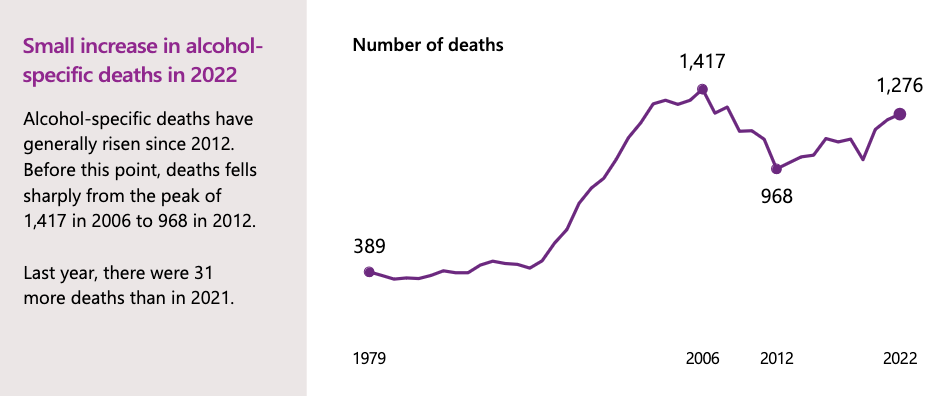
Anyone who has been following events in Scotland knows that alcohol-specific deaths have risen since minimum pricing was introduced in 2018 and have generally risen since 2012 following a significant downturn in the years prior.

It is that drop between 2006 and 2012 that the Toronto Star must be referring to when it claims that deaths fell by “almost half” (actually a third). But the Scottish government didn’t pass any anti-alcohol legislation in those six years and it certainly didn’t have minimum pricing. The newspaper mentions that the drink-drive limit was cut, but that didn’t happen until 2014 and the evidence is clear that it had no effect on road accidents.

Since the Toronto Star doesn’t mention when the decline in alcohol-specific deaths took place, it is leading its readers to believe that it coincided with the introduction of minimum pricing and the lowering of the drink-drive limit. I call that lying.

It is strangely fitting that Canadians are being lied to about the “success” of Scotland’s alcohol strategy since the Scottish public were conned into accepting minimum pricing, in part, on the basis of lies told about the “success” of minimum pricing in Canada. The neo-temperance academic Tim Stockwell, who is quoted in the Star article, published a series of studies in the 2010s making some absurd claims about minimum pricing that were parroted by campaigners in the UK.

California’s Trudeau

Filed under: Books, Media, Politics, USA — Tags: , , , , , — Nicholas @ 04:00

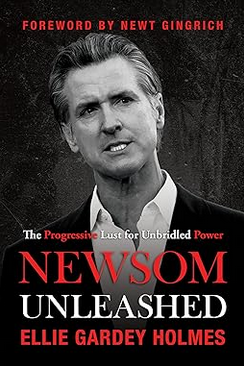
In the New English Review, Bruce Bawer reviews Newsom Unleashed: The Progressive Lust for Unbridled Power by Ellie Gardey Holmes, a biography of California’s own Justin Trudeau:

I’ve been appalled by Gavin Newsom for years, but to read Ellie Gardey Holmes’s powerful and unflinching new book Newsom Unleashed: The Progressive Lust for Unbridled Power is to find one’s contempt for this hideous creature skyrocketing. If he has any redeeming qualities, any special gifts, any attributes that might illuminate an admirable and recognizably human side, there’s no sign of them here. This is a man who, despite having no discernible talent for governance or anything else, was lucky enough to be born into one well-off family – his great-grandfather co-founded the Bank of Italy, which later became the Bank of America – and to be, from earliest childhood, a sort of honorary member of an even richer family, the Gettys, his father being best friends with oil magnate Gordon Getty, who was like a second father to young Gavin.

Both men, his biological father and his second father, used their considerable influence from the beginning to help Gavin rise to power. Indeed, as surely as any Kennedy or Bush, Gavin Newsom was born into a political machine and bred to be a politician. After he and Getty played a big role in helping Willie Brown to get elected mayor of San Francisco, Brown named Newsom to the city’s Parking and Traffic Commission. Soon he was promoted to the Board of Supervisors, a post he held from 1997 to 2004. “Because of his lack of qualifications,” writes Gardey Holmes, “Newsom entered office entirely indebted to Willie Brown”. Observers referred to him, in fact, as “an appendage of Willie Brown”. Quick sidebar in the midst of this tale of political advancement: when his mother was dying, Gavin was pretty much AWOL, although he was present when she underwent assisted suicide – which, at the time, was illegal in California. Others had been prosecuted for their participation in such actions; Gavin was not, a foreshadowing of many other occasions on which he would be treated as exempt from the rules governing the behavior of ordinary mortals.

In 2003 he was elected mayor. One of his first acts was to authorize the issuing of marriage licenses for same-sex couples, even though he had no power to do any such thing. He even performed some of the marriages himself. This cynical move (which even California’s two Democratic Senators, Dianne Feinstein and Barbara Boxer, opposed) was a cheap stunt, carried out at the expense of gullible gays, whose marriages were soon enough ruled invalid by the state Supreme Court – but it had the desired effect. It made him a national figure and it won him the esteem of the mainstream media. Bob Simon told him on 60 Minutes that he might well have “set a record for instant fame in this country”.

From the beginning of his life in “public service” – that laughable term – Newsom’s vanity and ambition were flagrantly palpable. Although the New York Times described him during his mayoralty as the subject of “local adoration”, some San Francisco insiders resented his brazen focus “on self-aggrandizement and personal publicity” and his relative indifference to the city’s growing problems on a variety of fronts. Routinely, he stole credit for other people’s initiatives and acted as if he were exempt from the rules. A police officer drove him to his wedding in Montana in his official SUV – a definite no-no.

After two terms as mayor he had his eye, naturally, on the Governor’s Mansion – but polls convinced him to run for Lieutenant Governor instead. He spent two terms in that job, too, but hated it: he had no real power, no real staff, no real budget, and he felt disrespected by his boss, Jerry Brown. The initiatives he did support were destructive “progressive” bilge of the first water: for example, he was the only statewide elected official to support Proposition 47, which converted many felonies to misdemeanors, helping to set off the still ongoing rash of shoplifting that has made San Francisco, particularly, an international joke. For the most part, however, instead of addressing the state’s problems he put his energies into enhancing his national profile. He became a fixture on shows like Real Time with Bill Maher. He also wrote – or at least signed his name to – a book calling for the transformation of government by means of “digital technology”; the book’s argument didn’t make much sense, and even Stephen Colbert, usually a reliable left-wing shill, dismissed it as “bullshit”.

And then, inevitably, in 2019, Newsom became governor, thanks in no small part to massive donations from the Gettys and Pritzkers and his role as “the darling of the upper class”. California was already on the skids, but Newsom accelerated the process. He pulled National Guard troops from the southern border, saying that “[t]he border ’emergency’ is a manufactured crisis and California will not be part of this political theater”. He even had the state sue President Trump over his border emergency declaration, which according to Newsom was nothing but an expression of “division, xenophobia, [and] racism”. Instead of canceling one of the state’s notorious boondoggles – the program to build a staggeringly expensive high-speed rail line from San Francisco to San Diego – he shortened the planned route, so that the trains would run only between Merced and Bakersfield. This made the rail line an even more ridiculous proposition, but Newsom’s priority was not to provide a useful means of public transportation but to keep the state from having to return the federal money appropriated for the project to a government run by Donald Trump, who from the beginning of his governorship Newsom singled out as his personal enemy – an action that profoundly enhanced his popularity among California Democrats. Indeed, instead of seriously dealing with California’s jobs and education crises, Newsom focused relentlessly on attacking Trump. A hundred days into his governorship, he bragged childishly that California was “the most un-Trump state”.

QotD: Televised debates

Filed under: Humour, Media, Politics, Quotations, USA — Tags: , , — Nicholas @ 01:00

As televised liberal-conservative dust-ups go, this one doesn’t quite hold a candle to the celebrated Bill Buckley vs. Gore Vidal cat fight during the 1968 Democratic National Convention. After wordsmith Vidal insisted that, no, really, the author of God and Man at Yale was a “pro-crypto-Nazi”, Buckley (who famously signs his letters in National Review, “Cordially …”) stopped speaking in his native Latin and declaimed: “Now listen, you queer, stop calling me a crypto-Nazi or I’ll sock you in you goddamn face and you’ll stay plastered”. That’s good stuff — and it was on broadcast TV for god’s sake.

Nick Gillespie, “Bob Novak: ‘That’s Bullshit … Goodnight, Everybody!'”, Hit and Run, 2005-08-05.

« Newer Posts — Older Posts »

Powered by WordPress