
World War Two
Published 25 Jul 2026By March 1939, appeasement has failed.
Hitler’s Germany has moved from threats and persecution inside the Reich to the destruction of Czechoslovakia, the seizure of Memel, and renewed pressure on Poland. No shots have yet been fired between the great powers — but Europe is now locked on a course toward war.
In this episode of Death of Democracy, Spartacus Olsson reports from Berlin at the end of Q1 1939: the “Israel” and “Sara” decree, Schacht’s dismissal, Göring’s Central Office for Jewish Emigration, Hitler’s genocidal Reichstag threat, the launch of Bismarck, the coerced occupation of Prague, the Memel ultimatum, and Britain’s guarantee to Poland.
This is the moment when the Munich illusion collapses. Hitler is no longer pretending to unite Germans. He is dismantling states.
July 26, 2026
How to Provoke a War – Death of Democracy 25 – Q1 1939
July 25, 2026
The last few hundred years of Anglo-German relations
The history of Britain and Germany has certainly had some peaks and valleys since the first “German” king was crowned in London in 1714. Prussia and Britain managed to team up most memorably in 1815 to defeat Napoleon in the Waterloo campaign, but things got much less clear after the Franco-Prussian War that heralded the rise of a unified German state. As long as Prince Bismarck was the guiding hand behind German ambitions, Britain could look at Germany as a relatively reliable continental ally. After the accession of Kaiser Wilhelm II, however, things got rockier quickly. Bismarck got sidelined soon afterwards and the Kaiser decided that the one thing he really, really wanted was to build a navy to rival the British Royal Navy. That, in my opinion, more than anything else pushed Britain into exploring other diplomatic channels and eventually deciding to ally (in all but name) with France. The cover of Jan Rüger’s Great Powers shows the future conflict zone that ensured Britain would view Germany as a threat and not a potentially valuable ally:
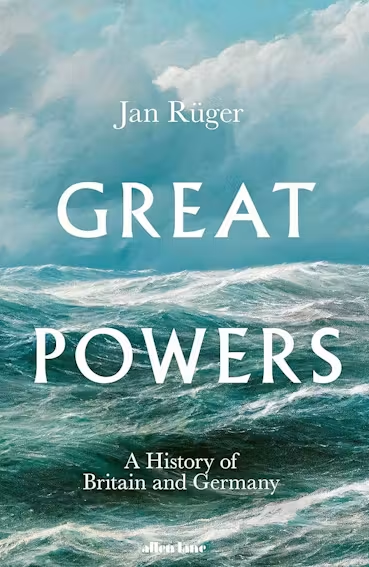
As an explicit criticism of the nonsense of great powers rising and falling as if “a timeless truth”, that offered for example by Paul Kennedy, Graham Allison, and Brendan Simms, Rüger, Professor of History at Birkbeck, emphasises the role of individuals and contingencies. His is a book that emphasises human agency, and at every level from that of nations to individuals.
[…]
For the period on which I am a specialist (and Rüger is not), the eighteenth century, there is a degree of nonsense. For example, George I did not have a “reliably anti-French stance” contributing to British “nation-building”. Instead, there was alliance with France from 1716 to 1731, the deployment of French troops into “Germany” to protect Hanover against Prussia and Austria was sought in 1727 (George II was similarly concerned in 1729), and so on. Nor were British interests successfully ringfenced to protect against their use for Hanoverian ends. Any detailed consideration of British foreign policy, or, indeed, the despatch of warships to the Baltic would suggest otherwise. Nor is Rüger correct to suggest that “at the heart of Britain’s national interest” was Britain choosing both Continental interventionism and trans-oceanic policies. Walpole’s determination to keep Britain out of European war, notably in 1733-35, and the beneficial consequences that flowed from this, demonstrates the contrary; as, indeed, did the earlier non-engagement, as in the Thirty Years’ War or against France in 1675-78. Rüger’s Whiggishness draws on a failure to understand the range of views in and on the eighteenth century.
From a German perspective, I would scarcely describe this book as a Bavarian or a Swabian viewpoint. Nor is there sufficient engagement with the extent to which Germany for long in Britain meant the Empire and thus included Austria. That only really ceased in the nineteenth century. Thus, there is on the part of Rüger a degree of anticipation that is misleading. Prussia takes far too central a position too early. This is linked to his misleading account of Prussia as a great power by the end of the Seven Years’ War. Not so, it was more significant by then than Bavaria and Saxony both of which had had their search for status crippled by defeat. However, Prussia also had had its vulnerability amply displayed, notably so to Russia. Furthermore, in terms of “reach”, Prussia in 1763 in no way matched Austria, Britain, France or Russia. Instead, it only became a great power as a result of developments from the 1860s. 1871 still seems to be the lens through which most Germans view their history. That includes Rüger, and is misleading.
So, lots to the good, particularly (but not only) for the post-1871 period; but with significant weaknesses, and notably so for the eighteenth century.
Civil War Gwyn & Campbell Carbines (aka Cosmopolitan, Union, & Grapevine)
Forgotten Weapons
Published 2 Mar 2026The first version of this carbine was the Cosmopolitan, designed and patented by Henry Gross in 1859 and manufactured by Edward Gwyn and Abner Campbell. It is a single-shot .52 caliber carbine that loads from the breech with a paper cartridge and a separate external percussion cap. After producing a batch of the guns, Gwyn and Campbell realized that the breechblock design could be much simplified, and they patented that simplification — essentially pushing Gross out of his own invention.
Several successive contracts for the carbines were fulfilled during the Civil War, with about 8,200 produced in total. It was not the most popular or most numerous cavalry carbine of the war, but it is rather remarkable for actually being reliable and delivered consistently on time.
(more…)
July 24, 2026
QotD: The first rule of strategic analysis
Do you know the first rule of good strategic analysis? When a war begins: shut up.
Wars are theatres of chaos, noise, confusion and premature certainty. The temptation to declare victory, defeat or historical turning point within the first few hours or days is not analysis. It is posturing. Yet the modern media cycle, with its appetite for endless commentary and instant verdicts, cannot tolerate silence. The result is a steady stream of confident assertions, most of which will age badly.
The current conflict between the alliance of the United States and Israel and Iran has followed this pattern almost perfectly. Within days, it was announced that America was winning; America was losing; Iran is winning; Iran had been neutralised; Iran remained undeterred; Trump doesn’t have clear plan; he does have a clear plan; this was the start of a forever war; it wasn’t a forever war; the war is a catastrophe for the US; the war is a triumph for the US.; that the war would soon be over; the war is over.
Obviously, these claims cannot be true simultaneously. Most of them will turn out not to be true at all.
Resisting the customary rush to instant judgement and adopting a more analytical frame of mind, what can we, discerning sceptics that we are, sensibly say six weeks into the war? Which claims survive contact with reality, and which are, for now, better treated as conjecture?
Michael Rainsborough, “A Sceptical Stocktake of the Iran War So Far”, The Daily Sceptic, 2026-04-21.
Update, 27 July: Welcome, Instapundit readers! Have a look around at some of my other posts you may find of interest. I send out a daily summary of posts here through my Substack – https://substack.com/@nicholasrusson that you can subscribe to if you’d like to be informed of new posts in the future.
July 23, 2026
The Korean War Week 109 – One Step From Peace! – July 21, 1952
The Korean War by Indy Neidell
Published 22 Jul 2026There’s only one thing left at the Panmunjom Peace Talks standing in the way of an armistice — Article 51. However, this article deals with the release of POWs and the two sides have very different interpretations of it. The UN is however, currently releasing all the civilian internees they hold. In the field, the fighting for Old Baldy flares up again as the Chinese attack, and an anti-guerrilla campaign comes to its end.
QotD: The development of the Main Battle Tank (MBT) and Infantry Fighting Vehicle (IFV)
The result is the modern “main battle tank” (MBT), typically between 45 and 75 tons, with a single powerful direct-fire cannon as its primary armament. That’s not to say design differences between militaries drop away; there are still decisions to be made: the level of emphasis between speed, armor and firepower for instance. Another major decision is whether a tank is designed with a three-person turret (one of whom is a dedicated loader) or a two-person turret with an autoloader (that is, a machine that does the loading for you). It used to be that now I’d have to go on about why going autoloaders aren’t simply obviously the best but given the live demonstrations of some of the drawbacks of Soviet/Russian carousel autoloaders going on right now [in Ukraine] I’ll just say that both options have advantages and drawbacks and move on. So there is variety within the idea of an MBT, but by and large most countries field just one type of MBT (or one family of MBTs for countries which can’t afford to retire older systems) and that covers their tank needs.
But of course nothing could easy so just as tanks were getting easier to keep track of, APCs get much more complicated. Even before they were fully enclosed, APCs had generally carried some kind of defensive weapon (usually a heavy machine gun), but you weren’t supposed to fight with it if you could avoid it. Beginning in the 1950s, designers – first in West Germany – began experimenting with the idea that an APC could be armed to not merely deliver the infantry (“dismounts”) but to actually fight when they got there. The thing is, there are a lot of situations where an infantry formation might want more firepower but where a tank would be overkill: armored vehicles lighter than tanks, or enemies with lighter fortifications, for instance. West Germany pioneered the idea by putting a 20mm autocannon on their APC, the Schützenpanzer Lang HS.30, enabling it to put out some meaningful firepower, albeit much less than a tank.
The USSR cottoned on to the idea and liked it, resulting in the Soviet BMP-1 and the subsequent BMP family of what we call “infantry fighting vehicles” (IFV). Initially resistant to the idea (American doctrine was that APCs move troops and should not fight if they could help it), the United States, noticing the effectiveness of these sorts of platforms, got into the act with the Bradley Fighting Vehicle (these days the M2 Bradley). And IFVs, especially the Bradley, look like tanks. And indeed, they are sometimes called on to do the kind of armored reconnaissance and infantry support jobs that in a previous era would have gone to a light tank.
But they are also notably not tanks in several key ways. The primary job of an IFV is to move infantry and support them against lighter targets; some IFVs do maintain some kind of anti-tank capability, but it tends to be more limited (e.g. the Bradley’s pair of TOW AT missiles). The requirement that an IFV needs to be fairly fast but also needs to fit a bunch of dismounts means they can’t carry the firepower or the armor of a tank, often using lighter aluminum armor rather than steel or heavy composites. Finally, the tendency is for IFVs to mount lighter primarily armaments – again, space and weight concerns – like the Bradley’s 25mm M242 Bushmaster chain gun. The BMP-3 is probably the most heavily armed IFV out there with a low-velocity 100mm rifled gun and a 30mm autocannon, which is still a far cry from the firepower of the high-velocity 125mm main gun of a contemporary T-80 or the 120mm high velocity gun of a M1A1 Abrams. Instead, most IFVs would rely on anti-tank missile systems to engage tanks (although IFV autocannons can cause a tank serious problems if they can engage the rear or side armor, which is thinner).
Note that the IFV did not mean the end of the APC just as the APC didn’t bring the end of soft-skinned troop transports. In the US military, the Bradley serves alongside lighter-but-still-IFV Strykers, the venerable M113 APC along with soft-skinned HMMWV (Humvees; to be in theory replaced with the Oshkosh L-ATV) and trucks of various kinds and uses. Likewise, the Russian army has its BMPs (which are IFVs), and BTRs (which are APCs) as well as soft-skinned vehicles – or at least it did until, I am now being told, they were all towed away by Ukrainian farmers. The real Iron Harvest.
The final category worth noting here are variations on the concept of the MRAP (Mine-Resistant, Ambush-Protected): infantry transport vehicles designed to resist the sort of dangers one encounters in counter-insurgency operations, mostly mines, IEDs and small-arms ambushes. In essence, these vehicles are a purpose-built version of the up-armored Humvees designed to operate in a very particular combat environment (insurgencies and particularly urban insurgencies). These sort of vehicles have gotten more visibility in the United States because many of them have been shifted into the hands of law enforcement, where their utility is questionable, to say the least.
Bret Devereaux, “Collections: When is a ‘Tank’ Not a Tank?”, A Collection of Unmitigated Pedantry, 2022-05-06.
July 22, 2026
QotD: Burnside’s Army of the Potomac
This was the country of the boisterous forty-niner, the hell-roaring lumberjack, and the riverman who was half horse and half alligator. Without rancor (and also without the slightest hesitation) it annihilated Indian tribes so that it could people a wilderness, asserting that the only good Indian was a dead Indian and remarking casually of its own pioneers that the cowards never started and the weak died along the road. As it faced the cathedral aisles of endless virgin forests it shouted for immediate daylight in the swamp, even if whole generations must be brutalized for it. It was the country that invented the bucko mate and the Shanghai passage, and if the skysails of its incredible clippers gleamed on the farthest magic horizon they were taken there by men under the daily rule of clubs and brass knuckles. This nation accepted boiler explosions as the price of steamboat travel and it would boast presently of a dead gandy-dancer for every cross-tie on the transcontinental railroad. It wore seven-league boots and scorned to look where it planted them, and each of its immense strides was made at immense human cost. And the army of this country, buckling down to it at last in a fight which had to go to a finish, was going to be very rough on enemy civilians, not because it had anything against them but simply because they were there.
Of genuine hatred this army had practically none. The wild young men who ruined ancestral portraits and pranced in the smoky streets wearing the embroidered undergarments of gentlewomen were expressing nothing but plain hooliganism, which somehow was the obverse side of the medal that had laid nine hundred corpses in front of the stone wall west of town. Both sides of the medal bespoke raw youth which cheered and guffawed by turns, whose noble best forever went arm in arm with its ugly worst.
Bruce Catton, Army of the Potomac: Glory Road, 1952.
July 20, 2026
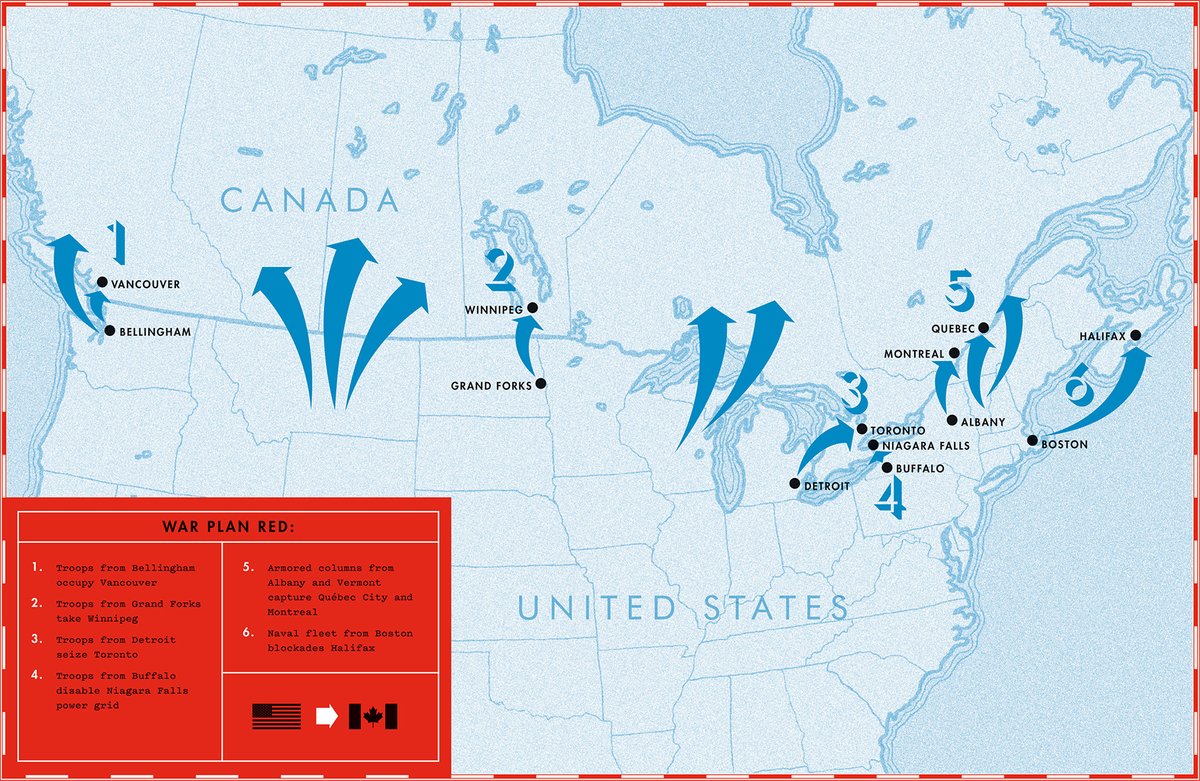
“Blame Canada”: evergreen. “Invade Canada”? It’s been done before
Upper Canadian Cavalier points out the obvious … that the United States absolutely could invade Canada and there’s not a lot the Canadian Armed Forces could do to stop them. But that would be the easy part:
“A mere matter of marching …”
The question of “could America ever invade Canada?” is wrong before it is even asked. Picture the MAGA politicos huddled in D.C. and the anon poasters spamming maps of how America could take Canada, as if it were even a question, as if the border were a wall and the wall the point. The whole conversation is midwits who never grasped what America already occupies.
Occupation is the crude instrument of the conqueror who arrives too late, who finds the ground already held by another and must break it by force, and that has never once been the American position in the north. The American position is that of the covert shareholder rather than the invader, and a shareholder does not knock down the door of a house whose deed already sits in his desk.
Empire in its highest form neither occupies nor marches, because it has learned to administer instead, and it does not plant a flag on the palace, since the flag is a confession that the palace was not yet yours. The genius of the modern Global American imperium has been to take without ever confessing, to hold Canada so completely that Canadians experience the holding as their own free choice. To reach for the army now would throw all of that away, trading a profitable and invisible dominion for a visible and bloody one, and teaching the empire at ruinous cost the difference between owning a country and holding it.
The republic was born reaching north with a bayonet, and it should remember how that went. In the winter of 1775 it sent Brigadier General Richard Montgomery and Colonel Benedict Arnold (yes, that Benedict Arnold) up through the snow to seize Quebec. The spirit of the country rose up in the snow to meet them, and Quebec killed Montgomery in a blizzard at the walls, the land itself passing sentence on the invasion before a single treaty could be signed.
That was first offensive act of the American project, it was a failed invasion of Canada that froze to death in the cold for its own arrogance. There is a symmetry waiting at the end of this essay that the reader should carry from the beginning, because a republic that opened its history reaching north may yet close its history the same way. America could invade Canada, but then it would not be able to conquer it, and in that attempt it would destroy the very thing that made its northern dominion worth having, because the soft empire cannot survive being seen and that invasion is nothing other than the act of trading quiet profits for overt pain and suffering.
Eight Great Powers Invade China: the Boxer Uprising 1900-1901
Real Time History
Published 20 Feb 2026After the defeat in the 1st Sino-Japanese War, the Qing Dynasty is under pressure: Some are calling for domestic reforms and ousting Western influence, while the Great Powers want to further open up China for their businesses. Violence erupts when the so called Boxer movement kills several Westerners.
(more…)
July 19, 2026
Rome’s Greatest Enemy: Bloodbath in Africa | EP 3
The Rest Is History
Published 9 Feb 2026Would the Roman general Publius Cornelius Scipio successfully march on Africa? What happened when Hannibal and Scipio — the greatest commanders of their age — came head to head at the Battle of Zama, in the ultimate showdown? And, what would be the fate of these two titans of the ancient world?
Join Tom and Dominic, as they discuss the Roman Republic’s audacious invasion of North Africa under the leadership of the dashing Scipio, and his clash with Hannibal.
00:00 Scipio’s night attack in Numidia
02:16 Hannibal as a commander
08:07 The rise of Scipio Africanus
13:05 The Roman invasion of Africa begins
21:56 The Battle of the Great Plains
25:29 Hannibal recalled from Italy
28:18 Preparing for the final showdown
33:02 The Battle of Zama begins
36:03 Could Hannibal have won?
40:25 Hannibal urges acceptance of defeat
42:40 Hannibal as a civilian reformer
44:22 Scipio after the war
46:45 Cato’s rise and the conservative backlash
49:29 Rome turns east after victory
52:32 The Hellenistic world after Alexander
56:45 Hannibal and Scipio compare great generals
58:31 Rome defeats Antiochus
1:00:18 Hannibal’s final flight and death
1:01:40 Scipio’s death and exile
(more…)
July 18, 2026
The current state of play in the Russo-Ukrainian War of 2022
I don’t make a habit of sharing reports from the ongoing fighting in Ukraine, as the war has ground on (how do you say “short, victorious war” in Russian?). It’s not that I’m not interested, it’s that trustworthy sources are vanishingly thin, and most coverage is either hyper-pro Ukraine or hyper-pro Russia … so assessing events is somewhere between difficult and impossible for those of us without our own satellite and espionage networks. kulak, on the other hand, has been paying attention and does have some insights that are worth considering:
One could be forgiven for thinking that there is something deeply wrong with the Russian State and Vladimir Putin in particular.
Every 1 to 3 months some new unprecedented Ukrainian asymmetric attack hits Russia’s homeland in ways almost tailor designed to provoke an escalation, outrage the populace, and leave the Russian Government humiliated at the loss of face.
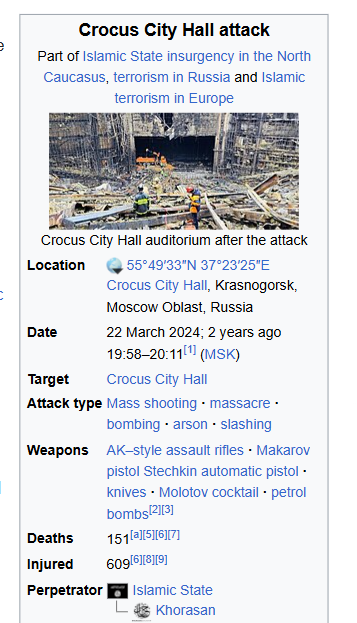
The “Crocus City Hall” (it’s a civilian music venue not an actual city hall) attack in Moscow was killed 151 and injured 600+ Civilian music fans in an “ISIS” terrorist attack … That everyone knows was funded, coordinated, and enabled by Ukraine (and the CIA). Right down to the assailants passing through Ukraine, and being on camera collecting their discarded firearm magazines (presumably because the manufacturer stamps would tie them to their backers) …
This was huge Russian News, and the specific band whose audience was targeted is also significant.
Piknik is a massive hit Russian 80s band. Now, Students of history will note that Russia was still communist in the 80s. They’ve been around forever, and are generally inoffensive and middle of the road (they were mainstream under the USSR)… They’re kind of a weird gothic slavic prog-rock blend of Phil Collins and the Tragically Hip. And they’re huge … Individual videos with 10s of millions of views on Youtube … As big as any hit western 80s band and lots of cultural fondness in the Russian imagination.
(Presumably it hits harder if you can appreciate Russian)
This matters because their core demographic are Russian boomers who are Nostalgic for their Soviet Childhoods, but are also established and content in Modern Russia … Ie. Putin’s Core demographic.
This would be like if you attacked a Hamilton performance or a Bono concert in the west. That’s the regime’s core supporters right there. That’s a knowledgeable and incisive cut that actual Muslim foreigners wouldn’t know or care to hit … But that Slavic Ukrainians and calculating CIA planners trying to apply pressure or destabilize Russia into escalation would know and salivate at.
Likewise Ukraine explicitly attacked Russia’s Nuclear Strategic Bomber fleet in Operation Spider Web, assets that were not used in the Ukraine war, and indeed were basically irrelevant to the conflict … But are core to Russia’s nuclear triad and the stability of the global nuclear balance of power … Again basically begging for a massive escalation and almost certainly making Russian Generals and Strategic planners break out in a cold sweat until they assessed the damage.
Beyond this there have been prominent assassinations of Russian Generals … In Moscow. And assassination attempts on Putin himself …
In addition to the destabilizing Ukrainian counter-invasion of Russia, and escalating strikes on Moscow itself.
The thing to understand is that none of these have been conventionally advantageous for Ukraine. The Invasion of Russia stretched their forces, the Assassinations if anything probably cycled in younger, more competent, hungrier generals, attacking Moscow Boomer civilians probably gave a massive morale spike to the outraged Russian populace … These strikes on Russia have infuriated Russians and made them call for blood.
This is in many respects THE OPPOSITE of what you’d normally want to do as a smaller country fighting a larger that hasn’t fully mobilized. Usually you want to exhaust a larger force that’s half committed or politically divided, without getting them to up their commitment or causing them to unify. Think of Vietnam … The Vietnamese wanted Americans to get tired of fighting them and get demoralized at the idea of ever “winning”, fight amongst themselves, then wind down and withdraw. If in 1972 Vietnamese terrorists had attacked the Superbowl and killed hundreds of American civilians on US soil … that’s actually one of the few things that could have united American in 1972 or gotten America to commit to another 5 years in Vietnam at that point.
It would have greatly damaged American prestige … Moscow or China might have liked that … But from Vietnam’s perspective where they want America to wander elsewhere, it’d lock in years of misery.
So that’s weird … but weirder has been Putin’s Reaction: Nothing. Basically no counter-escalation. Certainly nothing that’s made Zelensky sweat and hesitate at sending more drones at Moscow.
Indeed many sympathetic commentators both in Russia and the West have been screaming their frustration at Putin that he hasn’t suitably punished these insults to Russian Honor or restored Russian deterrence … Or merely enforced baseline international norms around targeting heads of state, civilians, and Strategic nuclear assets in a non-nuclear conventional war.
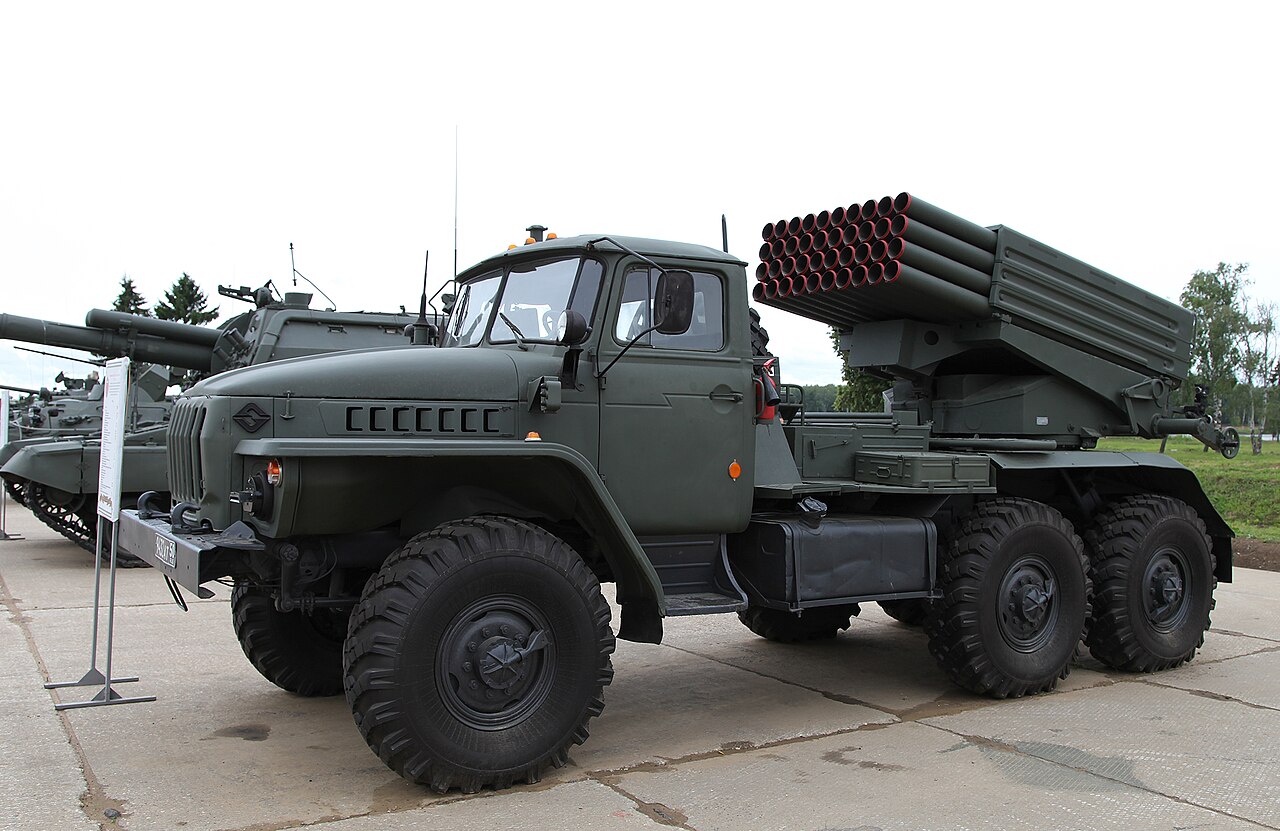
Russia has hundreds of these Tornado systems.
It’s not as if Russia lacks conventional options. Kiev is RIGHT THERE. Hell, If the Russians really wanted the Tornado MLRS (Multiple Launcher Rocket System) has a range of 200km, fires thermobaric warheads or White Phosphorus rounds, and could hit Kiev from Russian Ally Belarus …
Without even debating the extent of air-cover, and to what extent Ukrainian Air Defense is intact (or to what extent the US can supply them with interceptors) … Putin has the capacity to firebomb Kiev on the scale of Dresden if he wanted to, from the ground. He’s not lacking in conventional, nuclear, and every other kind of escalatory option.
And yet he’s not escalated … And his retaliations have been as close as possible to the bare minimum he could get away with to not be overthrown for treason.
So what the hell is wrong with Putin?

The Top WW2 Spy Was a Disabled Woman
World War Two
Published 16 Jul 2026Virginia Hall was one of the most extraordinary spies of World War II. An American operative for Britain’s Special Operations Executive and later the OSS, Hall built resistance networks in occupied France, coordinated intelligence, organized safe houses, helped escaped prisoners and airmen, and supported maquis fighters who sabotaged German operations during the liberation of France.
Known to the Gestapo as “the Limping Lady”, Hall worked with a wooden prosthetic leg she nicknamed Cuthbert. After escaping over the Pyrenees, she returned to France in 1944 in disguise, operating a radio, arranging parachute drops, and helping organize resistance forces against the German occupation.
This is the true story of Virginia Hall: the disabled American spy who became one of the most feared Allied agents in Nazi-occupied Europe — and one of the most important women in WWII intelligence history.
July 17, 2026
British logistics in the Falklands, 1982
A new post at the Operational Art of War considers the amazing achievements in logistical support that allowed the British to re-take the Falkland Islands so soon after the Argentine invasion in 1982:
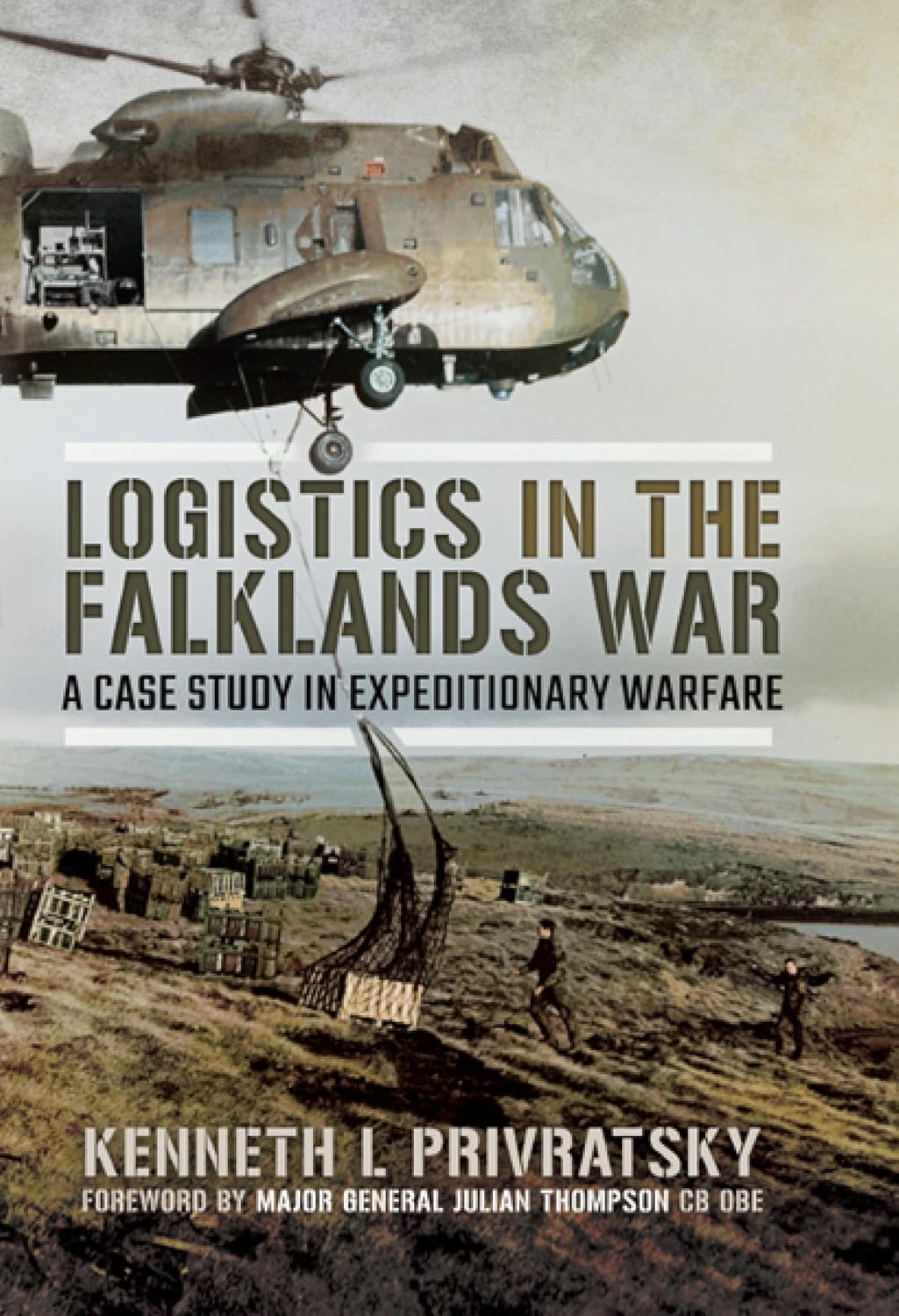
This post is largely highlights from a book I think everyone should buy, called Logistics in the Falklands War: A Case Study in Expeditionary Warfare by US retired MGen Privratsky.
[…]
I read the book as part of a long term project on the history of command and communications in the Falkland War. I couldn’t figure out how the British managed to pull off victory given the logistical challenges, so I purchased this book hoping to find answers.
Having now read the book I know WHAT the British did to win the war, but I have ZERO clue how they managed to make it work. The conditions and limitations they faced were so much worse than I thought.
I can honestly say this is the most interesting book I have read in years, which is a shock to me as I’m typically as bored by logistics as the next non-logistician. It was genuinely more engaging and entertaining than the battlefield accounts of that war.
The Logistics Challenges of the Falklands War
The task eventually given to the British task force was to retake the Falkland islands from the Argentines. This was a daunting task, both logistically and in terms of the actual ground combat.
Strategic Logistics
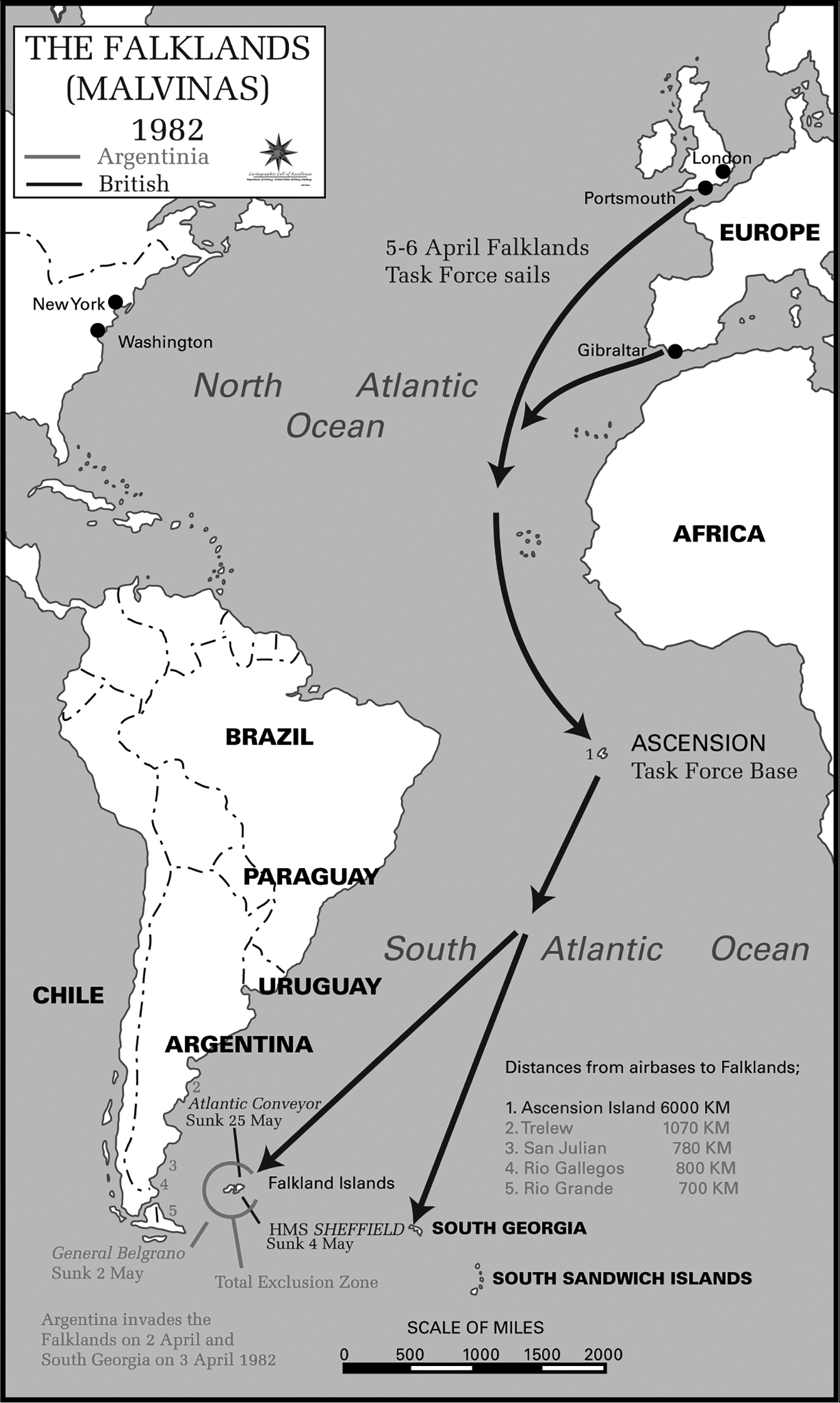
Strategic logistics is providing the lifeline of supplies, personnel, maintenance and health care between the home country and a staging area about 300km outside the combat zone. British strategic logistics involved a link from England to a small British held island half way between Brazil and Africa called Ascension. This link was 4,300 miles (6,900 km) by sea from Portsmouth. It had an airport and one jetty capable of handling one or two small commercial ships.
The next link was a further 3,600 miles (5,800 km) from Ascension to a logistics loitering area about 200 miles (320 km) short of the Falkland Islands. This was just a box drawn on a map in the middle of the ocean where the larger supply ships would loiter, outside the range of the Argentine air force.
[…]
Tactical Logistics
Tactical Logistics holds a few days’ supply (eventually the BSA/DSA held about 30 days supply ashore at San Carlos) but it’s main job is to move supplies, broken equipment, replacements and injured personnel between the BSA/DSA and the manoeuvre units.
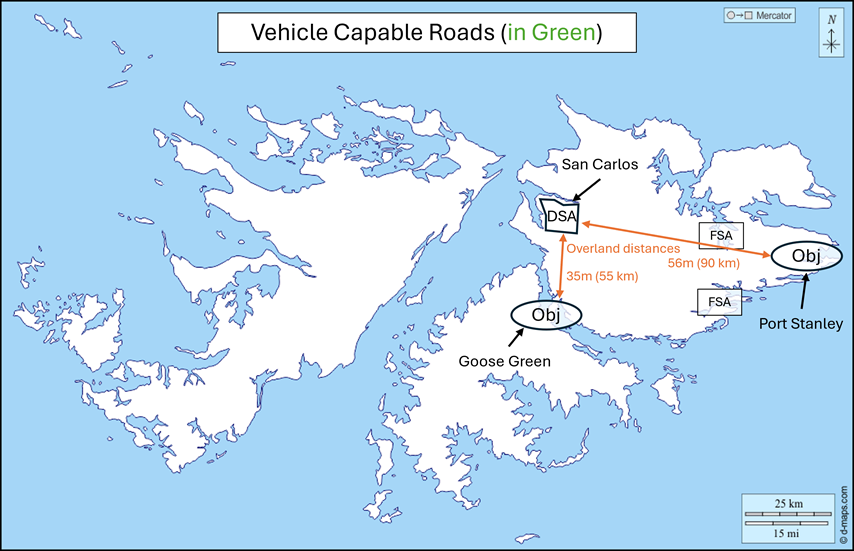
Normally the backbone of Tactical Logistics is trucks. Here there was a problem, as the image below is a comprehensive of all the paved and unpaved vehicle capable roads in the Falklands, excluding those in the vicinity of Port Stanley.
“Roads? Where we’re going Marty we don’t need roads.”
The details of tactical logistics take up several chapters of the book. The brief version is:
- The troops marched from the DSA to the Objective;
- For the attack on Port Stanley two days supply of Ammunition, Shells, fuel and shells were brought to the two Forward Support Areas (FSAs) along with skeletal field hospitals;
- Helicopters spent about 2 weeks bringing the artillery from the DSA to outside Port Stanley; and
- Limited emergency resupply of ammunition and casualty evacuation was available from the FSA to the troops in combat. However, most of the ammunition going brought and casualties evacuated rearward was done on foot over what can charitably be described as walking tracks.
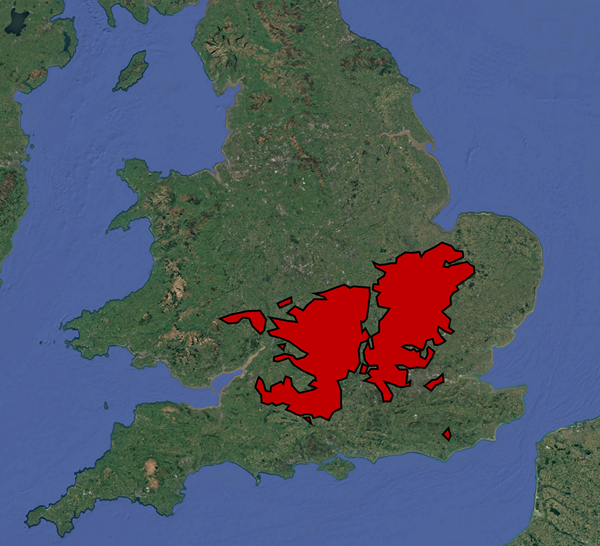
Tactical Logistics in the Falklands was so difficult because there were no roads and the distances involved were enormous. While the orange arrows above give a sense of the distances involved, the image blow shows the size of the Falkland Islands superimposed over England.
[…]
Conclusion
Prior to reading Logistics in the Falklands I couldn’t quite figure out how the British managed to pull a victory out the hat, given the challenges of projecting power literally on the opposite end of the globe. Having read the book I am now convinced the British military in 1982 was either the best improvisational armed force in history or under some kind of Divine mandate.1
- Maybe both.
QotD: Catapults in pre-gunpowder armies
The very oldest catapults, first invented by the Greeks were tension catapults (the gastrophetes and oxybeles), which functioned like large bows, with a bow-staff being bent backwards to store and then release the launching energy. This sort of design, common in pop-cultural depictions of catapults, is actually quite limited as with the materials available, there is a real limit to how much energy can be stored via tension. Fortunately for the Greeks, by the early fourth century, they had developed a better method.
Instead, the Greeks, Macedonians and Romans began using torsion catapults (where the energy is stored in wound-up sinews like a spring). While the devices used in field battles (and for city defense) were often smaller, arrow-launching devices, siege catapults could be very large; the standard engine for the purpose could fling a 1 talent stone (26.2kg) about 400m (though effectiveness was far higher if you could get closer to the wall, which as we’ll see will be a trend for most of this post); much larger engines did exist as well. That said, Roman catapults were mostly not for collapsing walls but for destroying towers and suppressing defenders in order to aid in escalade (usually by mole, rather than ladders or towers, though the Romans used those too).
And here once again the distinction between the “big army siege package” and the “small army siege package” matters quite a bit. Roman torsion artillery was complex, expensive and required lots of technical skill, and so sees far diminished use in the early Middle Ages where that technical skill is hard to come by. Vespasian, we are told, brought 160 torsion catapults to besiege Jotapata in 67 (Josephus BJ 3.166) while Titus brings a stunning 340 to besiege Jerusalem in 70 (Josephus BJ 5.356). By contrast, the construction of a single catapult is often a major event in a medieval siege (see Rogers, op. cit. 121-3 for some examples) and while later medieval catapults were often more powerful than the earlier Roman torsion devices, they were not that much more powerful.
Consequently, Hellenistic and Roman fortifications (especially city walls, like the Theodosian Walls we discussed last time) were designed with massed catapults in mind. As noted, the multiple walls ensured that the main curtain wall, the inner wall, was extremely difficult to target with catapults or indeed any kind of artillery: even if you knocked down the low wall and the outer wall, their rubble would mostly block shots at the base of the inner wall. Meanwhile, the inner wall was built to be practically immune to catapult fire anyway: up to 6m thick without any internal passages (the outer wall was much thinner, only 2m). That was more than enough to render the walls effectively immune to anything catapults can do; the walls in many places still stood up to Ottoman cannon in 1453. Finally, ancient city defenses were built assuming they’d often have their own stone and arrow throwing torsion artillery set up on the towers to return “counter-battery” fire. Not every city had the “complete package” that Constantinople, as the imperial capital head, of course, but some mix of thick walls, low out-walls and catapults designed for counter-battery fire were fairly standard defensive arrangements for Roman cities that could afford them and felt sufficiently threatened to invest the resources.
As we move into the Middle Ages, two paradoxical things happen. On the one hand, the ability for societies in Europe to deploy large numbers of finicky, high-tech torsion artillery decreases dramatically (and the machines that we do see tend to be the simpler, less accurate single-armed variety, what the Romans called the onager or “wild ass” because it kicked like one when it fired). On the other hand, by the sixth century, we start to see a clever new design of catapult, the traction trebuchet.
Originating in China in the 4th century BC, the traction catapult used muscle power directly to swing a long pole around a central frame. In terms of engineering complexity, it was a simpler device, and could be scaled up quite large so long as one could add more pullers (around 100 seems to have been normal for a large engine), but the range and power it offered as a result of the mechanical advantage offered by the long throwing arm were considerable. Given the number of pullers required, it is little surprise these were generally only used in small numbers in medieval Europe (again, often in reports it is merely a single device, described as a mangonel or a fenevol), but on the other hand, as I understand the physics, the range and striking power had the potential to be superior to a torsion catapult. Nevertheless, if we look at the kinds of fortifications emerging during this period, it certainly seems like in Europe, the concern that artillery might produce a breach in the wall (as opposed to merely degrading towers and the wall-walk) was fairly low.
Just to throw down a note here because we’ll come back to it, it is striking that while the small numbers of traction trebuchets in Europe seem to have represented a decline in the “catapult threat” to walls (recall last week’s contrast between castle walls and the much older Theodosian Walls), that was not the case in China, where walls continued to be made very thick – a design quirk that will matter quite a lot in a moment. I am not an expert on ancient and medieval Chinese siege tactics, alas, but my brief encounters with accounts of them often seem to describe traction catapults used en masse, in dozens or even hundreds, much more the way that the Romans used massed siege artillery. Likewise, Michael Fulton (Artillery in the Era of the Crusades (2018)) notes nearly a hundred Mamluk trebuchets (a mix of counter-weight and traction) at the Siege of Acre (1291); my sense is that such large siege trains were very rare within Europe. Presumably the ability to deploy so many engines was a consequence of greater state capacity in China and the Near East during this period as compared to fragmented, decentralized medieval Europe.
The late 12th century sees a major variation on the trebuchet design: the use of a counter-weight, instead of traction to provide the force; this innovation seems to have emerged in the West broadly defined, though it isn’t clear if that means in Europe or the Middle East (in any event both Christian and Muslim armies start using them at almost exactly the same time). This allows for much more energy to put into the shot, as the counter-weight can be very heavy and only slowly winched into place, allowing the work crew to spend more time “storing” energy in the counter-weight than they could with the quick pull of a traction trebuchet. Larger counter-weight trebuchets could also make use of animals to provide the power, or large wheels to make it easier to raise the counter-weight. The upper-limits on the size of projectiles were very high: Warwolf is thought to be the largest such trebuchet known, and threw a nearly 300lbs shot. That said, while counter-weight trebuchets hit harder (but fired slower), in function they do not seem to have been meaningfully different from traction trebuchets; they were used the same way in sieges.
What’s really striking is not the vast impact of catapults, but the muted impact of catapults. The counter-weight trebuchet was clearly good: the innovation makes its way all the way back to China, carried by the Mongols who presumably picked it up in the Middle East (ironically moving the opposite direction but at the same time as gunpowder, suggesting that at this point in the 13th century the two technologies were not considered mutually exclusive). Castle design does respond to catapults, but only in relatively modest ways: walls get somewhat thicker, but as Fulton (op cit.) notes, only by about half a meter or so (leaving even the newly thickened medieval castle walls somewhat thinner than the best old Roman defenses). In at least some areas, towers and keeps become more frequently rounded in shape, to resist catapult fire.
Certainly it was possible for catapults to open breaches in weaker walls to enable assault. The aforementioned Warwolf opened large breaches in the stone walls of Stirling Castle in 1304. But I note both Rogers (op. cit.) and Fulton (op. cit.) seem to confirm that while true breaches from trebuchets could happen, it was far more common that walls resisted trebuchet strikes and that the real work of the machines was degrading the wall defenses by striking off battlements and smashing towers, in order to enable escalade. Which is little surprise: that’s precisely what the Romans used catapults for too. While there is still some argument about the degree to which the counter-weight trebuchet was a revolutionary military technology, on the balance, the siege playbook changed only modestly to accommodate it, and castle design likewise shifted only in degrees.
And then Charles VIII of France (r. 1483-1498) decided to take a holiday on the Bay of Naples.
Bret Devereaux, “Collections: Fortification, Part IV: French Guns and Italian Lines”, A Collection of Unmitigated Pedantry, 2021-12-17.
July 16, 2026
How Few Remain: The Second War Between the States
Feral Historian
Published 13 Mar 2026Let’s take a look at Harry Turtledove’s How Few Remain and its many themes and historical extrapolations. And probably argue about the Civil War a little along the way.
If there’s enough interest, this may be the start of a dive into the entire sprawling series that follows.
00:00 Intro
01:37 A War Unfinished
07:09 Adapting and Evolving
10:12 Abraham Lincoln and Frederick Douglass
13:15 The Horace Greeley Letter
15:40 Freddie’s Louisville Adventure
18:07 Turtledove, Lost Cause, and Spoilers
(more…)


