
HardThrasher
Published 5 Aug 2026The Boeing B-29 Superfortress was the most advanced bomber of World War Two — but also one of the most troubled and expensive aircraft ever built, and was plagued with flaws.
Developed at extraordinary speed, the B-29 could fly higher, faster and further than earlier heavy bombers while carrying a formidable bomb load.
It introduced pressurised crew compartments, remote-controlled gun turrets, advanced fire-control systems and enormous Wright R-3350 engines. But it couldn’t hit a barn door with its guns, had urine in the brakelines and engines which kept exploding due to all the flammable metal in them.
This video explores how the B-29 was designed, why it cost more than the Atomic Bomb to develop and how the United States overcame these challenges to get it into the war.
And yes, this is purely an excuse for me to make videos about the bomber war in the Pacific, so yar booh sucks 😊
00:00 Introduction
01:47 MOAR, MOAR, MOAR
05:48 Origin Story
12:52 Built It And They Will Come
17:57 The Battle of Kansas
19:12 Root Causes – The Key Problems
23:59 So Wright It’s Wrong
32:39 ConclusionsSources
1. Pace, S., Boeing B-29 Superfortress, Crowood Press, 2003 p.53
2. Werrell, K.P., Blankets of Fire, US Bombers over Japan during World War II, Smithsonian Institution Press, 1996, p.82
3. Werrell, K.P., p.68
4. [Deleted Section]
5. Pace, S., p.23
6. Sixteenth Census of the United States, 1940–1940, NAID: 16660414
7. Werrell, K.P., p.75
8. Le May & Yenne, Superfortress – The Boeing B-29 and American Airpower in World War II, Westholme Publishing 2007 (original published 1988 by McGraw) p.78
9. Le May & Yenne, p.78
10. Werrell, K.P., p.80
11. Le May & Yenne, p.80
12. Werrell, K.P., p.67
13. Werrell, K.P., p.67
14. Werrell, K.P., p.80
August 6, 2026
B-29 Superfortress – A $3.7bn Trial By Fire
QotD: John Nicholson, a Muslim saint who really hated India
John Nicholson really, really hated India. This was unfortunate for him in one sense, since he spent nearly his entire life after the age of sixteen there, until he died — violently — while still a young man. But in another sense, it really worked out for him, since it afforded him the opportunity to live out his dream, which was to abuse Indian people. Clearly, he was a complicated man.
[…]
[The First Anglo-Afghan War (1838-1842)] began with the British efforts to replace Afghan Emir Dost Muhammad with a more pliant leader, which in a pattern seen from the days of Alexander onward, involved an invasion, an attempt at a pacification, followed by a grim and growing awareness that the place is full of some of the most brutal and fractious people on Earth and is simply ungovernable, which terminates in a costly retreat, the country itself returning to its customary barbarism, efforts to change it having had all the effect of flinging an encyclopedia into a chimp enclosure. For the British, this meant early success, then an overwinter occupation in which their position deteriorated, then a mass uprising, whereupon they negotiated with the locals for a peaceful exit upon surrendering their arms. The retreating British were of course betrayed and massacred. One man made it out.
Nicholson, serving as an adjutant officer with a native regiment, had earlier been taken prisoner, and endured horrific conditions as such. He watched as his Hindu soldiers refused — to a man — to convert to Islam, and were executed one after the other. After having been released, he discovered that his younger brother Alexander had been murdered and mutilated by the Afghans while retreating with the rest of the army. The entire effort had been a great traumatic waste.
One might expect that Nicholson would hate the Afghans and perhaps revise upward his estimation of the brave Indian soldiers who had served under him. But while he did indeed revile the Pashtun tribesmen (“the most vicious and bloodthirsty race in existence”) he actually seems to have disliked them slightly less than the Hindus, perhaps on the grounds that no one that eager to kill Indians can be all bad. Indeed, he seems to have learned there some harsh lessons concerning what it would take to actually accomplish anything in the subcontinent, doctrines he would apply fastidiously and thoroughly. In many ways, he went a bit more native than he would have cared to admit.
After the war, Nicholson was promoted and given a series of administrative jobs, where he became well-acquainted with the chaotic political situation in the Punjab region. Mostly under the control of the Sikh Empire, the area had long been contested ground between that new faith and Islamic invasions from the Mughals to the southeast and the Afghans through the Khyber Pass to the west, not to mention restive Hindu Rajputs and Marathas to the south. The unstable (then and now) region of Kashmir lay to the north, and the whole of the region was plagued by innumerable bandits and warlords. The BEIC ruled through direct administration, client kings, and various alliances, the latter two of which its political officers (“politicals”) had to interact with on a regular basis. It was very much a situation out of George R. R. Martin’s fever dreams, constant betrayals, perversions of every kind, and even a Ramsey Bolton-esque Sikh despot who flayed men alive for amusement.
Nicholson was in charge of the Bannu area, where he rapidly made a name for himself as a local administrator. The whole of the Bannu was infested with bandits of all kinds, from jihadis to Hindu cultists to normal brigands, and the people lived in constant fear of their depredations. Nicholson had no real interest in bettering lives, but he had even less interest in allowing any Indian, anywhere, to challenge his authority. So he set about fixing the problem as only he could.
Nicholson arrested and executed scores of bandits, rapidly processing them through his very efficient court system. The idea of impartially dispensing justice without respect to person or affiliation was quite new to the area, but Nicholson made sure the locals adjusted quickly, tolerating not even the slightest hint of disrespect from anyone, no matter who he was. When a local Muslim leader casually spit on the ground in front of him, Nicholson made him kneel and lick it up. Anyone who failed to display prompt obedience to his commands he had flogged immediately, and was the bane of servants, who were often the causal recipients of hurled cups and dishes. He was a very hands-on leader, not the least hesitant to get them dirty in a quite literal sense. At one point, when his local police were unwilling to pursue a dangerous gang leader, Nicholson rode alone to the man’s village, approached him on the street, and killed him with his sword after the suspect failed to submit to arrest. Nicholson kept his severed head on his desk pour encourager les autres.
Interestingly, such draconian brutality seems to have actually made Nicholson popular. He was harsh, unyielding, and wholly indifferent to their culture, but that very indifference made him unassailable to anything but his sense of duty. He was unbribable, as the people of India had absolutely nothing he wanted, and his complete contempt for their social norms meant that Hindu, Muslim, or Sikh, Brahmin or outcast, Aryan or Dravidian, all got the exact same treatment, prompt and thorough. His mad fearlessness meant that he was similarly immune to threats. Criminals, whoever they were, received savage punishment, but the law-abiding were left in peace; Nicholson had no desire to “improve” them or their society like his contemporary Macaulay. In a real sense, for the first time, the diverse people of the area were free, under Nicholson’s rule, to live as they wished without the violent misery that had previously characterized the region. It was a multicultural success story, festooned with the occasional decapitated head.
This being India, the people expressed their feelings towards him in particular ways. A body of wild Pashtun raiders, admiring Nicholson’s capacity for ruthless violence and his grim charisma, attached themselves to him as a personal guard, fedaykin to his Muad’Dib, serving without pay and loyal only to him. In a theologically fecund area with a strong tradition of syncretism and cults of personality, Nicholson naturally became the object of worship for a group of fanatical devotees. He in turn naturally despised this, having his worshipers flogged as public nuisances, but this only served to increase their devotion to their inscrutable, violent deity. In some parts of India, the Cult of Nikal Seyn survived as a Shia devotional movement, with Nicholson cast as a Muslim saint bringing justice to a war torn land. The last member died in 2004.
Librarian of Celaeno, “The Man Who Hated India”, The Library of Celaeno, 2026-05-04.
August 5, 2026
The Korean War Week 111 – Will Stalin’s Nightmare Come True? – August 4, 1952
The Korean War by Indy Neidell
Published 4 Aug 2026The UN conducts a massive bombing raid on the North Korean capital Pyongyang this week, and in the field, the bloody fight for Old Baldy continues. Behind the scenes, though, Presidential Candidate Dwight Eisenhower’s foreign policy guy John Foster Dulles is advocating for massive retaliation — in Korea and beyond — against all Communist states, to do more than simply “contain” them.
August 4, 2026
Madsen Model 1945: A Rather Unusual SMG
Forgotten Weapons
Published 9 Mar 2026At the end of World War Two, the Danish Madsen company wanted to replace its production of licensed Suomi submachine guns with a design of its own. The result was the Model 1945, a quite unusual design with a pistol-like slide. The nearest similarities would be the Polish PM-63 and the German VG1-5. The Madsen design also used an unusual hammer firing system. It was chambered for 9mm Parabellum, feeding from Suomi box magazines (not drums). Both a fixed wooden stock version (seen here) and a folding stock version were made, but only a few sales came through (apparently to Mexico and El Salvador).
Danish M1941 Madsen video: • Danish M1941 Suomi SMG
Madsen M1950 video: • Madsen M50: From the Korean War to Star Trek
(more…)
QotD: Limits to tactical flexibility in Roman Republican armies
And therein lies the rub: just as the commander doesn’t have a multitude of points where he can intervene in the battle but rather a limited set of key decision points, so too he does not have an infinite set of potential orders he (or his subordinates) might give at any given moment. Instead, the commander (or his subordinates) has a McDonald’s menu worth of options he can employ. He can order anything on the menu and expect the unit to respond accordingly but he cannot order anything not on the menu, nor can he order an altered version of a menu item (no Big Mac without cheese; Sir, this is not a Wendy’s).
Now generals could and did use drilling in the early stages of the campaign to add one or two “menu items” to their drill so as to be prepared for this or that problem. Indeed the general preparing some sort of surprise of this sort and then deploying it against an enemy is a standard topos of effective ancient generalship (although in many cases we may doubt the purported gimmick was actually used (e.g. Dionysius 20.1.6, Dio 10.5)). But that is the thing: such extra “menu items” have to be prepared in advance and often well in advance of the battle. Caesar, for instance, anticipating war elephants drills his troops in anti-war-elephant tactics before the Battle of Thapsus (46 BC, Caes. Bel. Afr. 84). Alexander’s phalanx seems to have been drilled to respond to scythed chariots as well (Arr. Anab. 3.13.5-6).
That said the bulk of the menu was likely to remain constant. After all these “menu items”, while they have simple names are often actually fairly complex to do and train when you are dealing with units of dozens or hundreds. Turning back to our example of Company, Right Wheel! we can get a sense of the complexity of training that maneuver by the way they did it. The “right guide” (the man on the extreme right) adopts a set pace (nine inch steps) while the “left guide” moves at the normal regulated speed (note this requires training your soldiers not only to step in time but to step at standard lengths) and every soldier in the middle regulates his motion by maintaining elbow contact with the man to his side. That’s a good method to get the result, but it isn’t an obvious or simple method: the fellow training the company to do this needs to already know how to do this.
Now in the modern period with mass printing, you could print drill manuals that had all of the commands and instructions on how to do them, but in the pre-modern period that kind of mass printing isn’t an option (and our military texts almost never go into this kind of granular detail) so your officers have to learn to train the behavior by observing it and participating in it themselves. Which means in turn a great deal of your “package” is set before the army is even mustered at the beginning of the campaign season because you are relying on a package of culturally embedded knowledge about how armies ought to function. And if your culture doesn’t have that tradition, inventing it from scratch is going to be hard and take time; and by “time” I mean “decades”. Effective drill for volley fire (the “countermarch”), for instance, answered a need that had existed for most of the 16th century, but the embryonic ideas for it only started emerging in the 1570s, the actionable plan on how to do it in 1594 and it was only then finally deployed in a major battle in 1600 at Nieuwpoort.
However, the time available for that kind of training is limited. Remember that drill works by repeating the same set of actions over and over again until they become almost instinctive. That takes a lot of time and repetition! That both means it is going to be difficult to find space for new “menu items” (especially with green troops that still need to learn the basics) but also that synchronized discipline itself is expensive. Our ancient sources stress how Roman levels of synchronized discipline required diligent and continuous drilling to create and maintain.
Doing that in turn would demand keeping the soldiers in question under arms for training for long periods when they were not fighting. In the Middle Republic this seems to have been accomplished through rolling recruitment: Rome was essentially always at war and always raising armies so there were always a goodly number of veterans to train and “break in” the truly green new recruits in any given draft (though again – and I owe this notion to Michael Taylor – there are some signs that the less intense conflict of the mid-second-century leads to some dulling of the Roman edge). As we transition through the Late Republic into the Early Empire, that is replaced by the slow professionalization of the Roman army, culminating in the force of long-service professionals created by Augustus. Being mobilized in peacetime, professional soldiers could be drilled extensively (assuming their cultural values are going to let them drill you; also be wary here of assuming standing forces of “military settlers” are professional in this way).
But all of that is extraordinarily expensive. Keeping those soldiers under arms, after all, means that they need to be fed, clothed and paid. Even in a system like the Middle Roman Republic where soldiers provided their own kit out of their own wealth (because Roman soldiers in the Middle Republic were recruited from the modestly well-to-do smallholding class), by drafting those men you have removed them from that economic activity. The expense of doing this would have been in most cases enormous and of course those are resources that could be deployed to any number of other uses, including simply raising a larger army of less disciplined, well trained troops. For, say, a Greek polis given the choice between having 450 men under arms all year round and excellently trained or having 5,000 hoplites under arms only in the one month where there is a battle to fight the clear answer is the latter. A lot of things need to line up before producing armies with high levels of synchronized discipline makes sense: the state needs a lot of resources, year-round security challenges and a tactical system which is effective and demands this kind of investment. So while developing synchronized discipline offered an army a degree of greater control and flexibility, it was prohibitively expensive.
Bret Devereaux, “Collections: Total Generalship: Commanding Pre-Modern Armies, Part IIIa”, A Collection of Unmitigated Pedantry, 2022-06-17.
August 3, 2026
Invasion of Iraq, 2003
Real Time History
Published 6 Mar 2026In March 2003, a US-led coalition invades Iraq. US President George W. Bush claims he must disarm Iraqi dictator Saddam Hussein of weapons of mass destruction and depose a brutal regime supporting global terror. But after a lightning capture of Baghdad and other Iraqi cities in the south, the war is far from over.
(more…)
QotD: The Hellenistic Age
When I was a child first getting interested in ancient history, the books I read followed a smooth narrative process. The story of the Greeks began with Athenian democracy and the victories at Marathon, Salamis, and Plataea that saved Western civilization from Persian conquest. Then there was the Athenian maritime empire, and its tremendous cultural achievements: the Parthenon, Socratic philosophy, the plays of Sophocles, Euripides, and Aristophanes. There was the Peloponnesian War and Thucydides’s chronicling of it. And then, in a tremendous climax, there were the awesome conquests of Alexander the Great, who destroyed the most powerful empire on Earth and conquered the known world by the age of 33, only to die young and have his empire swiftly broken up after his death.
… And then the story would promptly lurch 700 miles to the northwest and start over. Greeks? What Greeks? Now I was reading about the rise of a different city, Rome, and the achievements of its great republic. Instead of the Assembly and the ostracism, there was the Senate and the consuls. I would read about the Samnite Wars, the Punic Wars, the Gallic Wars, and finally the great civil wars that transformed Rome from a republic into the empire that men still think about a few times a week. In this story, the Greeks appear again, but only as enemies for Rome first to easily defeat, then be culturally influenced by. This fusion of Greek and Roman culture leads to European Christianity, the Renaissance, the cultural canon — in a word, the West itself.
Kid me didn’t think too much about it at the time. But as I grew, I and many others finally had a thought intrude: Wait a minute, what the heck was going on in Alexander’s old empire before the Romans got there?
And if you’re like me, asking that question is how you wind up reading Alexander to Actium.
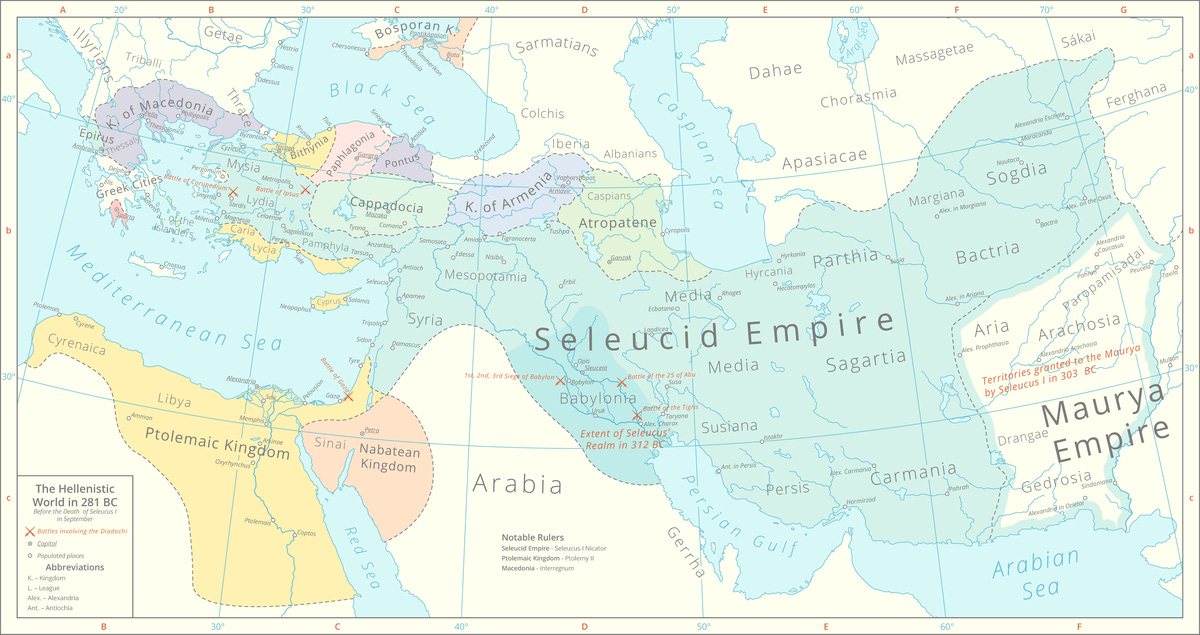
Alexander to Actium is classicist Peter Green’s gargantuan tome covering the period historians now call the Hellenistic era, the 293-year span following the death of Alexander the Great during which his vast but short-lived empire was divided up and ruled by ethnically Macedonian and Greek elites who left the stamp of Hellenic culture all across the eastern Mediterranean. The era begins with Alexander’s generals (the Diadochi, “Successors”) waging an epic forty years of war as funeral games for their dead master before finally settling into a more stable system with three great kingdoms centered on Macedon, Egypt, and Syria (plus lesser monarchies like Pergamon and Bactria). These kingdoms battled one another and Rome for another quarter-millennium, gradually losing land and power before they were extinguished, one by one. The last Hellenistic kingdom, Ptolemaic Egypt, made it until 30 B.C., when the legendary Cleopatra1 committed suicide and her realm became the personal possession of Octavian, the future Caesar Augustus. Long after their destruction, the Hellenistic legacy lingers most in religion: the Christian New Testament was written not in the Hebrew or Aramaic of Judea or the Latin of the Roman Empire, but in the koine Greek that had become the lingua franca of the educated eastern Mediterranean.
The ebb and flow of this 300-year historical epic is one that really deserves a trashy big-budget TV adaptation or three. The sordid acts of the Successors and their successors are so spectacular they could easily be made into a hybrid of HBO’s Rome and a popular show about dragons that shall remain nameless. I’m a little shocked one hasn’t been made already. To give just a small set of anecdotes from Green’s work:
- After an attempted army revolt following Alexander’s death, the general Perdiccas holds a “purification” ceremony for the army, which consists of rebel leaders being publicly trampled to death by elephants.
- Antigonus One-Eye, the man who came closest to reuniting Alexander’s empire, was very tall, very wide, very old, and had a very good nickname. Huge in size and huge in ambition, he dies fighting in battle at over 80 years old at Ipsus, a battle featuring 25,000 cavalry, 120 scythed chariots, and almost 600 elephants.
- Olympias, Alexander the Great’s mother, is so vindictive that when Philip II dies, she has a rival wife and her infant daughter roasted to death on a charcoal brazier even though they pose zero dynastic threat. When her own end comes during Macedon’s multiple civil wars, the soldiers of Cassander refuse to kill Alexander’s mother – so she is instead stoned to death by the families of those she had killed during past purges.
- Seleucus I, founder of the Syria-based Seleucid Empire, is happily married to his second wife Stratonice when he notices his son, Antiochus, is deeply enamored with her. No worry: Seleucus simply divorces Stratonice and has her marry Antiochus. This is actually a happy ending and works out for everyone, surprisingly.
- Lysimachus, king of Thrace, is happily married to his third wife, Arsinoe, when she tricks him into having his son by a first marriage executed so her own son can succeed. This sparks a war that kills Lysimachus and destroys his kingdom, somewhat botching the whole succession thing. But no worries: Arsinoe escapes to Egypt and makes out just fine by marrying its pharaoh – her brother.
- Cassander, king of Macedon, gets so irate at clever jabs from the wily Athenian politician Demades that he finally snaps and personally chops both Demades and his son to pieces while screaming insults at them.
- For about a decade during the various successor wars, Athens is ruled by a literal philosopher-king, the thirty-something Macedonian puppet Demetrius of Phaleron. One of his agenda items is building a gigantic mechanical snail to crawl through the streets of Athens leaving a realistic trail of slime behind; this is apparently some artful way of shaming the Athenians for being sluggish in standing up for Greek freedom.
- After Demetrius the Philosopher King is overthrown (by a different Demetrius, long story) the new tyrant takes advantage of divine honors granted to him to house his hoes in apartments at the back of the Parthenon. He tries to seduce a teenaged boy who instead commits suicide by jumping into a tub of boiling-hot water, and another time waives a fine against a prominent Athenian citizen in return for taking his son as a catamite. When you are legally a god, they let you do it.
- Aratus is a quite successful Greek general with the unfortunate problem of getting uncontrollable diarrhea before every battle.
- Escaped slave and rebel Drimakos defies authorities on Chios so successfully they simply reach a treaty with him: As long as he doesn’t steal too much and only accepts new slaves into his army who were severely abused by their masters (while sending the rest back), they’ll leave him alone. Drimakos lives to a ripe old age, then has his boy lover kill him and take his head in to claim a reward. Later, Drimakos’s spirit would supposedly appear to Chians in their dreams to warn of plots by their slaves.
- To show off their power, the Ptolemies commission a grand procession through Alexandria whose centerpiece is “a gaudily painted gold phallus, almost two hundred feet long … and tied up, like some exotic Christmas present, with gold ribbons and bows”. Green reasonably wonders how this mighty phallus was able to negotiate corners.
- The later Ptolemies could win some kind of ghastly award for their spectacular decadence. Ptolemy VIII Physcon (“the Obese”), who resembles a 2nd century BC Baron Harkonnen, seizes power after the death of his brother (also named Ptolemy) by marrying Cleopatra, who is also their sister. He then has her son, his nephew (also named Ptolemy), murdered during the wedding feast, then proceeds to seduce and marry his pubescent niece (also named Cleopatra). A decade later, riots forced Physcon and his niece-wife into exile, and his sister-wife proclaims her son by Physcon (another Ptolemy) as pharaoh, but the heir is apparently in Cyrene at the time, allowing Physcon to capture his unsuspecting son and send his dismembered corpse to the sister-wife as a birthday present. Meanwhile, the sister-wife’s daughter by her first brother (named Cleopatra, of course) gets married off to a Seleucid king and uses her sons as a series of puppets. The first puppet, Seleucus V, proves troublesome, so his mother murders him by using him for archery practice. The second puppet, Antiochus VIII, is more canny, and when his mother tries to murder him with a cup of poisoned wine, he notices something is up and forces her to drink the fatal cup herself. Antiochus VIII then fights a long civil war against his half-brother and cousin Antiochus IX, who is not a puppet but instead has the private hobby of playing with literal giant puppets. Got all that?
If learning the above is your idea of fun, then Alexander to Actium is a rich feast, enlivened throughout with Green’s flare for delicious details and legends that are possibly fanciful but too remarkable to leave out.
Blake Neff, “GUEST REVIEW: Alexander to Actium, by Peter Green”, Mr. and Mrs. Psmith’s Bookshelf, 2025-10-20.
- The Seventh, it turns out.
August 2, 2026
How to Make Aggression Sound Like Defense – Death of Democracy 26 – Q2 1939
World War Two
Published 1 Aug 2026By the spring of 1939, Hitler’s Germany is no longer merely threatening war, it is preparing to launch one while insisting that every act of aggression is really self-defense.
In this episode of “Death of Democracy”, we look at Germany in the second quarter of 1939: the launch of the battleship Tirpitz, the secret planning for Fall Weiss — the invasion of Poland — Hitler’s 50th-birthday military spectacle, the renunciation of the German-Polish Non-Aggression Pact and the Anglo-German Naval Agreement, the Pact of Steel with Mussolini’s Italy, and the diplomatic moves designed to isolate Poland before the coming attack.
But behind the military display, Nazi Germany’s economy is still on a knife’s edge. Rearmament, shortages, debt, plunder, and autarky have pushed the regime toward a brutal logic: conquest is no longer just ideology; it has become the regime’s chosen answer to the crisis it created.
Meanwhile, persecution inside the Reich continues to escalate. Jewish tenants are stripped of protection, the refugee ship St. Louis leaves Hamburg in a desperate search for sanctuary, and Ravensbrück opens as a concentration camp for women. As Germany exports terror into annexed Austria and Bohemia-Moravia, Britain and France finally begin to wake from appeasement — but dangerously late.
This is how aggression is made to sound like defense.
Never Forget.
August 1, 2026
Eugene Stoner’s Future Assault Rifle Concept (F.A.R.C.)
Forgotten Weapons
Published 6 Mar 2026After developing the AR-15 with Armalite, Eugene Stoner worked for a number of different companies. In 1972 he co-founded Ares Inc, where he and his partners worked on a wide variety of weapons platforms. Their work included rapid-fire cannons and full-fledged artillery as well as small arms. The first of those small arms was the Future Assault Rifle Concept — FARC. This was a gas piston, rotating bolt 5.56mm rifle design with a number of interested elements. The FARC-1 was a concept on paper only, leading to production of a few FARC-2 and FARC-3 prototypes. The project was cancelled in the wake of the end of the Vietnam War as funding for such things was much less readily available.
(more…)
July 31, 2026
QotD: Cuisine on campaign
Supposing, for a moment, a bit of imagination on the part of quartermasters and cooks, and a semi-intelligent rationing authority, a war might be conducted with a bit of style. There could be rivalry between regimental kitchens, or between the galleys in Her Majesty’s fleet. Food could be made a powerful inducement in the recruitment drives.
There are some little sparks like this, in history. In the Crimean War, Florence Nightingale, that extraordinary lantern-bearing angel, procured the voluntary help of Alexis Soyer, the leading London hotel chef of the day, to advise her on the organization of field hospital kitchens. These quickly became the place to eat — almost worth getting wounded. M. Soyer applied his very broad mind to analyzing the limitations of field cookery, then turning each limitation into a strength. (I recommend his Culinary Campaign in the Crimea, 1857.)
Morale is not a small thing in the conduct of war. A hot meal served in defiance of logistics in the cold wet of a hideous trench, comes to remind us of victory, in the very face of the enemy.
David Warren, “Non-idlers”, Essays in Idleness, 2020-11-11.
July 29, 2026
The Korean War Week 110 – The Democratic Candidate – July 28, 1952
The Korean War by Indy Neidell
Published 28 Jul 2026In Chicago, the Democratic Party chooses Adlai Stevenson as their candidate for the Presidential election to be held November 4th; he’ll square off against Dwight Eisenhower, the Republican candidate. Also, in the US, the steelworkers strike comes to an end. In Korea, torrential rains prevent action on the ground this week, though the UN continues its summer aerial bombing campaign of the north in the skies.
1960s British Army Recruitment Film | Cold War Training & Life Inside the Army
Militaria Collectors Network
Published 23 Mar 2026Step back into the 1960s and experience how the British Army trained the soldiers of the Cold War era. This rare archival recruitment film offers a fascinating look at military life, basic training, and the wide range of technical and career opportunities available to new recruits during a time of global tension and rapid modernisation.
From infantry drills and weapons training to engineering, communications, and education programmes, this film highlights how the British Army prepared men for both combat and skilled professions. Whether you’re interested in Cold War history, military training, or vintage government films, this is a unique glimpse into a defining period of British military history.
📽️ In this film:
– 1960s British Army basic training
– Infantry tactics and weapons familiarisation
– Technical trades and career paths
– Cold War-era military strategy and preparation
– Life as a British Army recruit
(more…)
QotD: Asymmetric warfare
Bret Devereaux, “Miscellanea: A Very Short Glossary of Military Terminology”, A Collection of Unmitigated Pedantry, 2022-03-25.
July 28, 2026
Adventures in Surplus! Type 38 Arisaka Carbine in World War One
Forgotten Weapons
Published 4 Mar 2026In the fall of 1914 it became apparent that the minor fracas in Serbia was going to stretch a lot longer than anyone had expected, and governments began scrambling to secure weapons production. Japan was one source of small arms for the Entente powers, and Britain purchased about 150,000 Arisaka rifles and carbines from the Japanese in late 1914 and early 1915. These were used to equip Royal Navy crews and Army raining and reserve units, but by late 1915 Enfield production had caught up and the guns were no longer needed.
In the fall of 1915, the British sent most of their Arisakas (about 128,000) to Russia, which had also been purchasing large numbers from Japan. There they were again used to arm second-line units, including troops occupying the Grand Duchy of Finland. When Finland declared its independence in December 1917, most of the Russian soldiers went home and left their weapons in Finland. As a result, the Arisaka was the second most common type of rifle available at Finland’s independence, and was used by the Civil Guard until about 1927.
This particular Type 38 Carbine was made at the Tokyo Army Arsenal in 1910, then sold to the British where it was given a set of unit marks on the stock. It was subsequently transferred to Russia, where a metal clip was added to prevent accidental magazine release. It stayed in Finland through the Finnish Civil War and afterwards, only being imported into the US recently by Postrock of Garden City, Kansas.
(more…)
July 27, 2026
The shambolic Fifth Crusade, or “Waiting for Fredot”
In The Critic, Anatoly Grablevsky reviews a new book on one of the less well-known attempts to wrest control of the Holy Land from the Islamic conquerors:
By the early 13th century, the military and geopolitical situation of the Crusader Kingdom of Jerusalem was dire. After the Third Crusade (1189-92) had failed to retake Jerusalem, the Frankish realm in the Holy Land was reduced to a thin coastal strip centred on the heavily fortified city of Acre. The rest of the Near East was in the hands of the Ayyubids, the successors of Saladin.
In response to Ayyubid encroachment, in 1213 Pope Innocent III called for a new holy war to reinforce the Kingdom of Jerusalem and reclaim the Holy City for Christendom. The bulk of the expedition was recruited in the Holy Roman Empire, whose young emperor, Frederick II, the wonder of the world himself, ostentatiously took up the cross. He was, however, in no hurry to join his countrymen in the east.
Learning from their bitter past experiences, this time around the Crusaders adopted a novel strategy. Instead of focusing their efforts on the Holy Land, the Christians targeted Egypt, the political and economic heartland of the Ayyubids.
The Crusader army’s first port of call was the coastal city of Damietta, which, after a lengthy siege, fell in 1219. This was a major victory for Christendom: Crusaders had not captured a city of Damietta’s size, wealth and strategic importance since the fall of Jerusalem in 1099.
The Ayyubid Sultan Al-Kamil, under pressure from Mongol attacks at the rear, now offered attractive peace terms that included the return of Jerusalem to the Christians. The Crusaders, overconfident and under orders from the absentee emperor, rebuffed Al-Kamil and instead decided to march on the Ayyubid capital of Cairo.
Here, the crusade took a shambolic turn. The Christians wasted precious months awaiting the arrival of Frederick II, but the emperor never bothered to show up (Smith might have called his book “Waiting for Fredot”). By the time the Crusaders finally began the march south, Al-Kamil had gathered his strength, and the Franks were quickly outmanoeuvred by the Sultan, who used his superior knowledge of the Nile’s flooding patterns to trap them against the river.
The Crusaders reacted by launching an all-out assault on their substantial wine provisions so that, when the Muslims attacked, the Christian army disintegrated in a drunken rout.
In the ensuing peace deal, Al-Kamil regained Damietta, in return for giving safe passage back to Europe to the Christian survivors.


