
World War Two
Published 17 Jan 2025This episode of Out of the Foxholes dives deep into your WWII questions. From LGBTQ+ persecution during and after the war, to the potential impact of diverting Battle of the Bulge troops to the Eastern Front, and Ukrainian collaboration with the Germans, we unravel the complexities of war. Join us as we tackle the secrets, strategies, and untold stories of WWII.
(more…)
January 18, 2025
The Battle of the Bulge, LGBTQ+ Victims & Atomic Secrets – WW2 – OOTF 038
Comments Off on The Battle of the Bulge, LGBTQ+ Victims & Atomic Secrets – WW2 – OOTF 038
January 17, 2025
QotD: Foraging for supplies in pre-modern armies
We should start with the sort of supplies our army is going to need. The Romans neatly divided these into four categories: food, fodder, firewood and water each with its own gathering activities (called by the Romans frumentatio, pabulatio, lignatio and aquatio respectively; on this note Roth op. cit. 118-140), though gathering food and fodder would be combined whenever possible. That’s a handy division and also a good reflection of the supply needs of armies well into the gunpowder era. We can start with the three relatively more simple supplies, all of which were daily concerns but also tended to be generally abundant in areas that armies were.
For most armies in most conditions, water was available in sufficient quantities along the direction of march via naturally occurring bodies of water (springs, rivers, creeks, etc.). Water could still be an important consideration even where there was enough to march through, particularly in determining the best spot for a camp or in denying an enemy access to local water supplies (such as, famously at the Battle of Hattin (1187)). And detailing parties of soldiers to replenish water supplies was a standard background activity of warfare; the Romans called this process aquatio and soldiers so detailed were aquatores (not a permanent job, to be clear, just regular soldiers for the moment sent to get water), though generally an army could simply refill its canteens as it passed naturally occurring watercourses. Well organized armies could also dig wells or use cisterns to pre-position water supplies, but this was rarely done because it was tremendously labor intensive; an army demanded so much water that many wells would be necessary to allow the army to water itself rapidly enough (the issue is throughput, not well capacity – you can only lift so many buckets of so much water in an hour in a single well). For the most part armies confined their movements to areas where water was naturally available, managing, at most, short hops through areas where it was scarce. If there was no readily available water in an area, agrarian armies simply couldn’t go there most of the time.
Like water, firewood was typically a daily concern. In the Roman army this meant parties of firewood forages (lignatores) were sent out regularly to whatever local timber was available. Fortunately, local firewood tended to be available in most areas because of the way the agrarian economy shaped the countryside, with stretches of forest separating settlements or tended trees for firewood near towns. Since an army isn’t trying to engage in sustainable arboriculture, it doesn’t usually need to worry about depleting local wood stocks. Moreover, for our pre-industrial army, they needn’t be picky about the timber for firewood (as opposed to timber for construction). Like water gathering, collecting firewood tends to crop up in our sources when conditions make it unusually difficult – such as if an army is forced to remain in one place (often for a siege) and consequently depletes the local supply (e.g. Liv. 36.22.10) or when the presence of enemies made getting firewood difficult without using escorts or larger parties (e.g. Ps.-Caes. BAfr. 10). Sieges could be especially tricky in this regard because they add a lot of additional timber demand for building siege engines and works; smart defenders might intentionally try to remove local timber or wood structures to deny an approaching army as part of a scorched earth strategy (e.g. Antioch in 1097). That said apart from sieges firewood availability, like water availability is mostly a question of where an army can go; generals simply long stay in areas where gathering firewood would be impossible.
Then comes fodder for the animals. An army’s animals needed a mix of both green fodder (grass, hay) and dry fodder (barley, oats). Animals could meet their green fodder requirements by grazing at the cost of losing marching time, or the army could collect green fodder as it foraged for food and dry fodder. As you may recall, cut grain stalks can be used as green fodder and so even an army that cannot process grains in the fields can still quite easily use them to feed the animals, alongside barley and oats pillaged from farm storehouses. The Romans seem to have preferred gathering their fodder from the fields rather than requisitioning it from farmers directly (Caes. BG 7.14.4) but would do either in a pinch. What is clear is that much like gathering water or firewood this was a regular task a commander had to allot and also that it often had to be done under guard to secure against attacks from enemies (thus you need one group of soldiers foraging and another group in fighting trim ready to drive off an attack). Fodder could also be stockpiled when needed, which was normally for siege operations where an army’s vast stock of animals might deplete local grass stocks while the army remained encamped there. Crucially, unlike water and firewood, both forms of fodder were seasonal: green fodder came in with the grasses in early spring and dry fodder consists of agricultural products typically harvested in mid-summer (barley) or late spring (oats).
All of which at last brings us to the food, by which we mostly mean grains. Sources discussing army foraging tend to be heavily focused on food and we’ll quickly see why: it was the most difficult and complex part of foraging operations in most of the conditions an agrarian army would operate. The first factor that is going to shape foraging operations is grain processing. [S]taple grains (especially wheat, barley and later rye) make up the vast bulk of the calories an army (and it attendant non-combatants) are eating on the march. But, as we’ve discussed in more detail already, grains don’t grow “ready to eat” and require various stages of processing to render them edible. An army’s foraging strategy is going to be heavily impacted by just how much of that processing they are prepared to do internally.
This is one area where the Roman army does appear to have been quite unusual: Roman armies could and regularly did conduct the entire grain processing chain internally. This was relatively rare and required both a lot of coordination and a lot of materiel in the form of tools for each stage of processing. As a brief refresher, grains once ripe first have to be reaped (cut down from the stalks), then threshed (the stalks are beaten to shake out the seeds) and winnowed (the removal of non-edible portions), then potentially hulled (removing the inedible hull of the seed), then milled (ground into a powder, called flour, usually by the grinding actions of large stones), then at last baked into bread or a biscuit or what have you.
It is possible to roast unmilled grain seeds or to boil either those seeds or flour in water to make porridge in order to make them edible, but turning grain into bread (or biscuits or crackers) has significant nutritional advantages (it breaks down some of the plant compounds that human stomachs struggle to digest) and also renders the food a lot tastier, which is good for morale. Consequently, while armies will roast grains or just make lots of porridge in extremis, they want to be securing a consistent supply of bread. The result is that ideally an army wants to be foraging for grain products at a stage where it can manage most or all of the remaining steps to turn those grains into food, ideally into bread.
As mentioned, the Romans could manage the entire processing chain themselves. Roman soldiers had sickles (falces) as part of their standard equipment (Liv. 42.64.2; Josephus BJ 3.95) and so could be deployed directly into the fields (Caes. BG 4.32; Liv. 31.2.8, 34.26.8) to reap the grain themselves. It would then be transported into the fortified camp the Romans built every time the army stopped for the night and threshed by Roman soldiers in the safety of the camp (App. Mac. 27; Liv. 42.64.2) with tools that, again, were a standard part of Roman equipment. Roman soldiers were then issued threshed grains as part of their rations, which they milled themselves (or made into a porridge called puls) using “handmills”. These were not small devices, but roughly 27kg (59.5lbs) hand-turned mills (Marcus Junkelmann reconstructed them quite ably); we generally assume that they were probably carried on the mules on the march, one for each contubernium (tent-group of 6-8; cf. Plut. Ant. 45.4). Getting soldiers to do their own milling was a feat of discipline – this is tough work to do by hand and milling a daily ration would take one of the soldiers of the group around two hours. Roman soldiers then baked their bread either in their own campfires (Hdn 4.7.4-6; Dio Cass. 62.5.5) though generals also sometimes prepared food supplies in advance of operations via what seem to be central bakeries. This level of centralization was part and parcel of the unusual sophistication of Roman logistics; it enabled a greater degree of flexibility for Roman armies.
Greek hoplite armies do not seem generally to have been able to reap, thresh or mill grain on the march (on this see J.W. Lee, op. cit.; there’s also a fantastic chapter on the organization of Greek military food supply by Matthew Sears forthcoming in a Brill Companion volume one of these years – don’t worry, when it appears, you will know!). Xenophon’s Ten Thousand are thus frequently forced to resort to making porridge or roast grains when they cannot forage supplies of already-milled-flour; they try hard to negotiate for markets on their route of march so they can just buy food. Famously the Spartan army, despoiling ripe Athenian fields runs out of supplies (Thuc. 2.23); it’s not clear what sort of supplies were lacking but food and fodder seems the obvious choice, suggesting that the Spartans could at best only incompletely utilize the Athenian grain. All of which contributed to the limited operational endurance of hoplite armies in the absence of friendly communities providing supplies.
Macedonian armies were in rather better shape. Alexander’s soldiers seem to have had handmills (note on this Engels, op. cit.) which already provides a huge advantage over earlier Greek armies. Grain is generally (as noted in our series on it) stored and transported after threshing and winnowing but before milling because this is the form in which has the best balance of longevity and compactness. That means that granaries and storehouses are mostly going to contain threshed and winnowed grains, not flour (nor freshly reaped stalks). An army which can mill can thus plunder central points of food storage and then transport all of that food as grain which is more portable and keeps better than flour or bread.
Early modern armies varied quite a lot in their logistical capabilities. There is a fair bit of evidence for cooking in the camp being done by the women of the campaign community in some armies, but also centralized kitchen messes for each company (Lynn op. cit. 124-126); the role of camp women in food production declines as a product of time but there is also evidence for soldiers being assigned to cooking duties in the 1600s. On the other hand, in the Army of Flanders seems to have relied primarily on external merchants (so sutlers, but also larger scale contractors) to supply the pan de munición ration-bread that the army needed, essentially contracting out the core of the food system. Parker (op. cit. 137) notes the Army of Flanders receiving some 39,000 loaves of bread per day from its contractors on average between April 1678 and February of 1679.
That created all sorts of problems. For one, the quality of the pan de munición was highly variable. Unlike soldiers cooking for themselves or their mess-mates, contractors had every incentive to cut corners and did so. Moreover, much of this contracting was done on credit and when Spanish royal credit failed (as it did in 1557, 1560, 1575, 1596, 1607, 1627, 1647 and 1653, Parker op. cit. 125-7) that could disrupt the entire supply system as contractors suddenly found the debts the crown had run up with them “restructured” (via a “Decree of Bankruptcy”) to the benefit of Spain. And of course that might well lead to thousands of angry, hungry, unpaid men with weapons and military training which in turn led to disasters like the Sack of Antwerp (1576), because without those contractors the army could not handle its logistical needs on its own. It’s also hard not to conclude that this structure increased the overall cost of the Army of Flanders (which was astronomical) because it could never “make the war feed itself” in the words of Cato the Elder (Liv 34.9.12; note that it was rare even for the Romans for a war to “feed itself” entirely through forage, but one could at least defray some costs to the enemy during offensive operations). That said this contractor supplied bread also did not free the Army of Flanders from the need to forage (or even pillage) because – as noted last time – their rations were quite low, leading soldiers to “offset” their low rations with purchase (often using money gained through pillage) or foraging.
Of course added to this are all sorts of food-stuffs that aren’t grain: meat, fruits, vegetables, cheeses, etc. Fortunately an army needs a lot less of these because grains make up the bulk of the calories eaten and even more fortunately these require less processing to be edible. But we should still note their importance because even an army with a secure stockpile of grain may want to forage the surrounding area to get supplies of more perishable foodstuffs to increase food variety and fill in the nutritional gaps of a pure-grain diet. The good news for our army is that the places they are likely to find food (small towns and rural villages) are also likely to be sources of these supplementary foods. By and large that is going to mean that armies on the march measure their supplies and their foraging in grain and then supplement that grain with whatever else they happen to have obtained in the process of getting that grain. Armies in peacetime or permanent bases may have a standard diet, but a wartime army on the march must make do with whatever is available locally.
So that’s what we need: water, fodder, firewood and food; the latter mostly grains with some supplements, but the grain itself probably needs to be in at least a partially processed form (threshed and sometimes also milled), in order to be useful to our army. And we need a lot of all of these things: tons daily. But – and this is important – notice how all of the goods we need (water, firewood, fodder, food) are things that agrarian small farmers also need. This is the crucial advantage of pre-industrial logistics; unlike a modern army which needs lots of things not normally produced or stockpiled by a civilian economy in quantity (artillery shells, high explosives, aviation fuel, etc.), everything our army needs is a staple product or resource of the agricultural economy.
Finally we need to note in addition to this that while we generally speak of “forage” for supplies and “pillage” or “plunder” for armies making off with other valuables, these were almost always connected activities. Soldiers that were foraging would also look for valuables to pillage: someone stealing the bread a family needs to live is not going to think twice about also nicking their dinnerware. Sadly we must also note that very frequently the valuables that soldiers looted were people, either to be sold into slavery, held for ransom, pressed into work for the army, or – and as I said we’re going to be frank about this – abducted for the purpose of sexual assault (or some combination of the above).
And so a rural countryside, populated by farms and farmers is in essence a vast field of resources for an army. How they get them is going to depend on both the army’s organization and capabilities and the status of the local communities.
Bret Devereaux, “Collections: Logistics, How Did They Do It, Part II: Foraging”, A Collection of Unmitigated Pedantry, 2022-07-29.
Comments Off on QotD: Foraging for supplies in pre-modern armies
January 16, 2025
Augustus and the Roman Army – the first emperor and the creation of the professional army
Adrian Goldsworthy. Historian and Novelist
Published 7 Aug 2024We take a look at Caesar Augustus, the first emperor (or princeps) of Rome and the great nephew of Julius Caesar. Ancient sources — and Shakespeare and Hollywood — depict him as politician and no soldier in contrast to Mark Antony. How true is this? More importantly, how did the man who created the imperial system and re-shaped society change the Roman army?
This video is based on a talk I gave in 2014 at the Roman Legionary Museum in Caerleon — a museum and adjacent sites, well worth a visit for anyone in or near South Wales.
Comments Off on Augustus and the Roman Army – the first emperor and the creation of the professional army
January 15, 2025
The Korean War 030 – Revived North Korean Army Strikes Wonju – January 14, 1951
The Korean War by Indy Neidell
Published 14 Jan 2025UN troops around Wonju get a gentle reminder that they’re not only fighting the Chinese. The North Koreans are back, and hammer the weak point in the UN lines all week. With UN forces still organizing a defence, and lots of holes in their formation, will they be able to hold on? Or will failure here undo all of Eighth Army Commander Matt Ridgway’s good work thus far?
Chapters
00:00 Intro
00:45 Recap
01:06 Disposition
02:00 The KPA Attack
05:38 Cracking an Almond
07:55 The New Eighth Army
10:50 At the UN
12:41 Summary
12:57 Conclusion
(more…)
Comments Off on The Korean War 030 – Revived North Korean Army Strikes Wonju – January 14, 1951
Desert Storm: The Gulf War 1990-1991
Real Time History
Published 6 Sept 2024When Saddam Hussein invaded Kuwait in the summer of 1990, he didn’t anticipate a massive international backslash and unanimous Security Council response. Soon a broad military Coalition under leadership of the United States assembled and kicked the Iraqi Army out of Kuwait. In the aftermath several Iraqi groups rose up against Saddam but the Coalition didn’t support a regime change.
CHAPTERS:
00:00 Intro
00:29 Saddam Hussein Victorious (but Broke)
03:49 Iraqi Invasion of Kuwait
06:02 The Coalition Against Iraq Forms
08:37 Operation Desert Shield
10:55 Operation Desert Storm
20:26 Iraqi Highway of Death
21:39 Iraqi Uprisings
(more…)
Comments Off on Desert Storm: The Gulf War 1990-1991
January 13, 2025
Forgotten War – Ep 7 – Imphal ’44 Pt1 – Planning Prevents
HardThrasher
Published 12 Jan 2025DO NOT PANIC IF YOU HAVEN’T WATCHED THE OTHER VIDEOS IN THIS SERIES YOU CAN START HERE
A video discussing the planning phase of the Battles of Imphal and Kohima at the start of 1944
Please consider donations of any size to the Burma Star Memorial Fund who aim to ensure remembrance of those who fought with, in and against 14th Army 1941–1945 — https://burmastarmemorial.org/
(more…)
Comments Off on Forgotten War – Ep 7 – Imphal ’44 Pt1 – Planning Prevents
The “Thucydides Trap”
At History Does You, Secretary of Defense Rock provides a handy explanation of the term “the Thucydides Trap”:
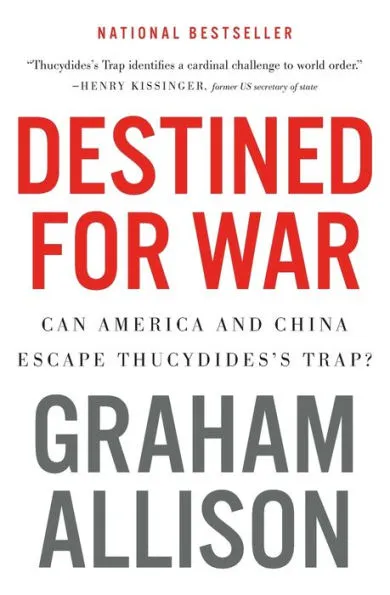
In the world of international relations, few concepts have captured as much attention — and sparked as much debate — as the “Thucydides Trap”. Brought to prominence by Harvard political scientist Graham Allison, the term suggests that conflict is almost inevitable when a rising power threatens to displace an established one, a dynamic often invoked to frame the strategic rivalry between the United States and China. Lauded as a National Bestseller and praised by figures like Henry Kissinger and Joe Biden, Allison’s Destined for War: Can America and China Escape Thucydides’s Trap? has become a staple of policy discussions and academic syllabi. Yet beneath the widespread acclaim lies a deeply flawed analysis, one that risks oversimplifying history and perpetuating a fatalistic narrative that could shape policy in dangerous ways. Far from an inescapable destiny, the lessons of history and the nuances of modern geopolitics suggest that the so-called “trap” may be more myth than inevitability.
The term “Thucydides Trap” is derived from a passage in the ancient Greek historian Thucydides’ work History of the Peloponnesian War, where he explained the causes of the conflict between Athens (the rising power) and Sparta (the ruling power) in the 4th century BC. Thucydides famously wrote
It was the rise of Athens and the fear that this instilled in Sparta that made war inevitable.
Allison defines the “Thucydides Trap” as “the severe structural stress caused when a rising power threatens to upend a ruling one”.1 More articles by Allison using this term previously appeared in Foreign Policy and The Atlantic. The book, published in 2017, was a huge hit, being named a notable book of the year by the New York Times and Financial Times while also receiving widespread bipartisan acclaim from current and past policymakers. Historian Niall Ferguson described it as a “must-read in Washington and Beijing”.2 Senator Sam Nunn wrote, “If any book can stop a World War, it is this one”.3 A brief search on Google Scholar reveals the term “Thucydides Trap” has been cited or used nearly 19,000 times. In 2015, Australian Prime Minister Malcolm Turnbull even publicly urged President Xi and Chinese Premier Li Keqiang to avoid “falling into the Thucydides Trap”.4 One analyst observed that the term had become the “new cachet as a sage of U.S.-China relations”.5 The term has become so prominent that it is almost guaranteed to appear in any introductory international politics course when discussing U.S.-China relations.
Allison wrote in his essay “The Thucydides Trap: Are the U.S. and China Headed for War?” in The Atlantic published in 2015, “On the current trajectory, war between the United States and China in the decades ahead is not just possible, but much more likely than recognized at the moment” forewarning, “judging by the historical record, war is more likely than not”.6 A straightforward analysis of the 16 cases in the book and previous essays might indicate that, based on historical precedent, there is approximately a 75 percent likelihood of the United States and China engaging in war within the next several decades. Adding the additional cases from the Thucydides Trap Website would still leave a 66 percent chance, more likely than not, that two nuclear-armed superpowers will go to war with one another, a horrifying and unprecedented proposition.7
With such alarm, it’s no surprise that the concept gained such widespread attention. The term is simple to understand and in under 300 pages, Allison delivers a sweeping historical narrative, drawing striking parallels between events from ancient Greece to the present day.8 International Relations as a field often struggles to break through in the public discourse, but Destined for War broke through, making a broad impact on academic and popular discourse.
1. Graham Allison, Destined For War: Can America and China Escape Thucydides’s Trap? (Boston: Houghton Mifflin Harcourt, 2017), 29.
2. Ibid., iii.
3. Ibid., vi.
4. Quoted by Alan Greeley Misenheimer, Thucydides’ Other “Traps”: The United States, China, and the Prospect of “Inevitable” War (Washington: National Defense University, 2019), 8.
5. Misenheiemer, 1.
6. “Thucydides’s Trap Case File” Belfer Center for Science and International Affairs, Harvard Kennedy School, accessed December 31, 2024
7. Graham Allison, “The Thucydides Trap: Are the U.S. and China Headed for War?” The Atlantic, September 24, 2015.
8. Misenheimer details what Thucydides actually said about the origins of the Peloponnesian War, 10-17.
Comments Off on The “Thucydides Trap”
January 12, 2025
Big Serge updates War Plan Red for a 2025 invasion of Justin Trudeau’s “post-national” “genocide” state
After the farcical attempt by outgoing PM Justin Trudeau to pretend that he somehow has changed his mind and now likes and wants to defend the country he’s described variously as a “post-national state” with no core beliefs, steeped in white supremacy and misogyny, and still engaged in “genocide”, Big Serge suggests the US invasion plan should change like this:
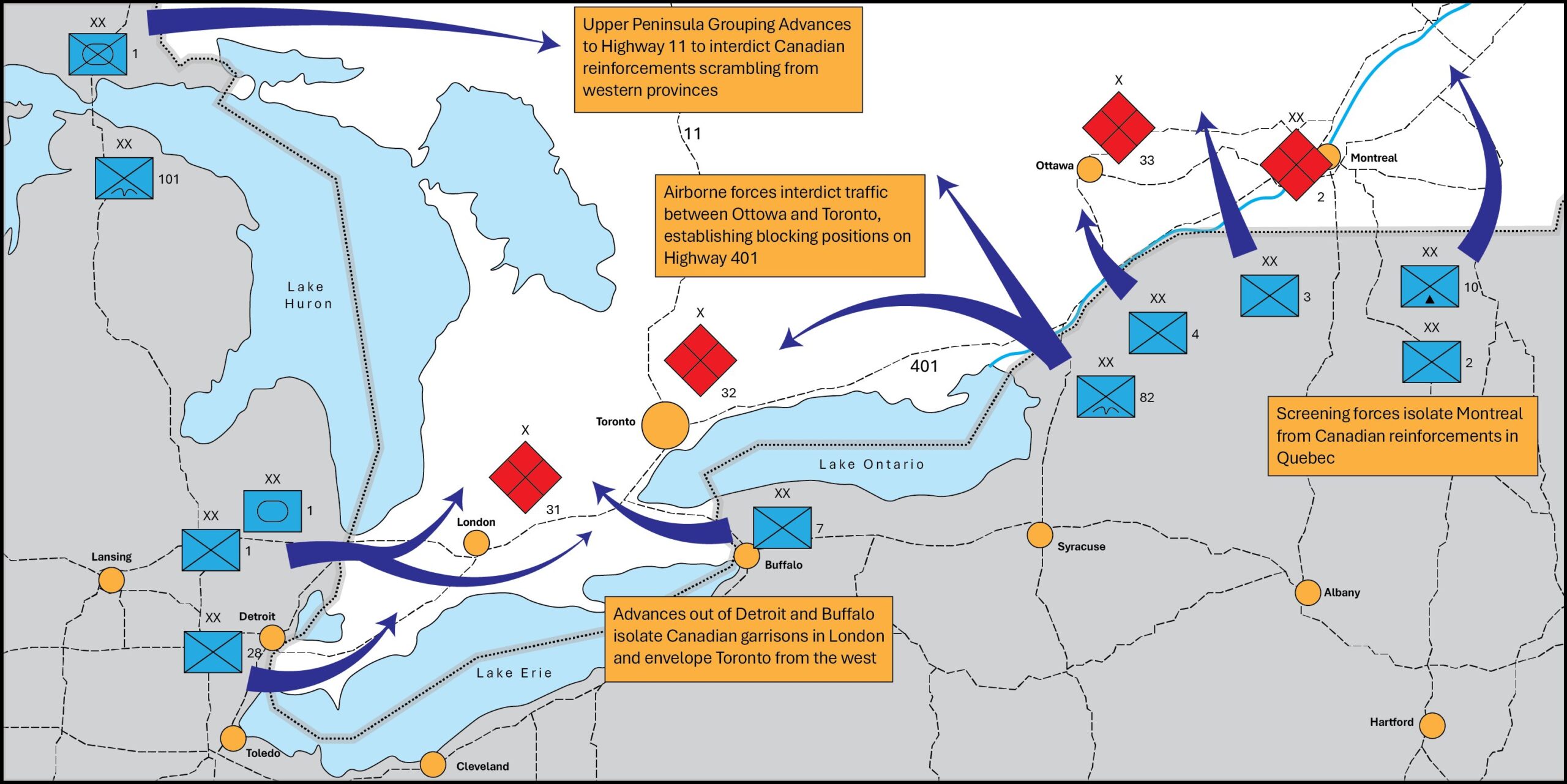
When Trump invades Canada, the key will be rapid advances in the opening 48 hours to take advantage of Canada’s odd force disposition.
The country’s political and economic center of gravity is the urban corridor from Toronto to Montreal, but a significant share of the Canadian Army is dispersed, with large garrisons in Quebec, Halifax, and the western provinces. Only handful of brigades are garrisoned in the critical theater.
The war will be won quickly and decisively, without massive destruction of Canadian cities, if American forces can establish blocking positions to isolate the urban corridor from peripheral Canadian garrisons. In this maneuver scheme, we utilize highly mobile elements including 1st Cavalry Division and airborne forces to block the highways into Toronto, while an eastern screening group isolates the urban centers from reinforcements scrambling in from Quebec.
We envision inserting HIMARS at operational depths via Chinook slings, saturating Canadian road traffic with rocketry. A mobile firebase (“Firebase Maple”) will be established north of Toronto near Lake Simcoe that will have a dominant position over the city’s northern approach.
With reinforcements unable to scramble into the critical theater and Toronto severed from the cities in the eastern corridor, the Canadian 31st and 32nd Brigade Groups will be isolated and destroyed. Unconditional surrender is anticipated within 14 days.
If there is a Canadian insurgency, we’re calling it the Maplejideen.
As an addendum, artillery airlifted onto Isle Royale in Lake Superior will support an advance out of Minnesota towards Thunder Bay, which will add an additional level of interdiction on Canadian reinforcements moving eastward by rail.
People are so mad about this!
And after much kerfuffle among the easily trolled, he suggests:
There’s no community note on this post which means it has been fact checked as true by real patriots.
As to why Trump would want to invade a frozen failed state on the brink of bankruptcy, even Big Serge doesn’t have an answer.
Waffen SS T-34s Go into Battle! – Prokhorovka Part 5
World War Two
Published 11 Jan 2025A shocking twist at Prokhorovka as the Germans unleash a new weapon — captured T-34s! As Das Reich tries to hold the line, these iconic Soviet tanks turn their guns on former comrades. On the other side of the Psel, Totenkopf‘s Tiger tanks lead the drive forward.
(more…)
Comments Off on Waffen SS T-34s Go into Battle! – Prokhorovka Part 5
Quebec within the British Empire after 1760
Fortissax, in response to a question about the historical situation of Quebec within Canada, outlines the history from before the Seven Years’ War (aka the “French and Indian War” to Americans) through the American Revolution, the 1837-38 rebellions, the Durham Report, and Confederation:
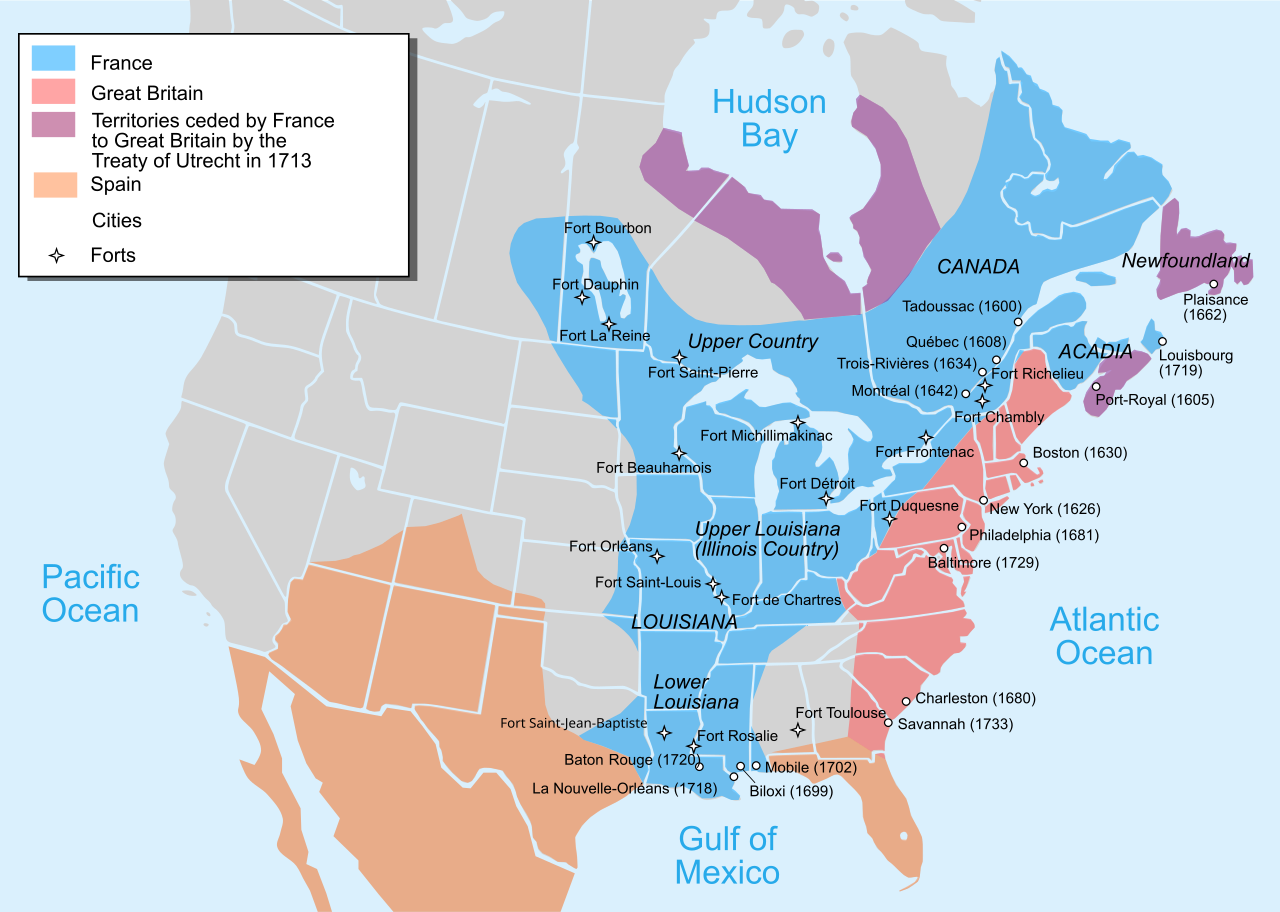
First and foremost, Canada itself, as a state — an administrative body, if you will — was originally founded by France. Jacques Cartier named the region in 1535, and Samuel de Champlain established the first permanent French settlement in North America in Quebec City in 1608. This settlement would become the largest and most populous administrative hub for the entire territory. Canada was a colony within the broader territory of New France, which stretched from as far north as Tadoussac all the way down to Louisiana. It included multiple hereditary land-owning noblemen of Norman extraction.
Much of the original territory of New France
During the Seven Years’ War, on 8 September 1760, General Lévis and Pierre de Vaudreuil surrendered the colony of Canada to the British after the capitulation of Montreal. Though the British had effectively won the war, the Conquest’s details still had to be negotiated between Great Britain and France. In the interim, the region was placed under a military regime. As per the Old World’s “rules of war”, Britain assured the 60,000 to 70,000 French inhabitants freedom from deportation and confiscation of property, freedom of religion, the right to migrate to France, and equal treatment in the fur trade. These assurances were formalized in the 55 Articles of the Capitulation of Montreal, which granted most of the French demands, including the rights to practice Roman Catholicism, protections for Seigneurs and clergymen, and amnesty for soldiers. Indigenous allies of the French were also assured that their rights and privileges would be respected.
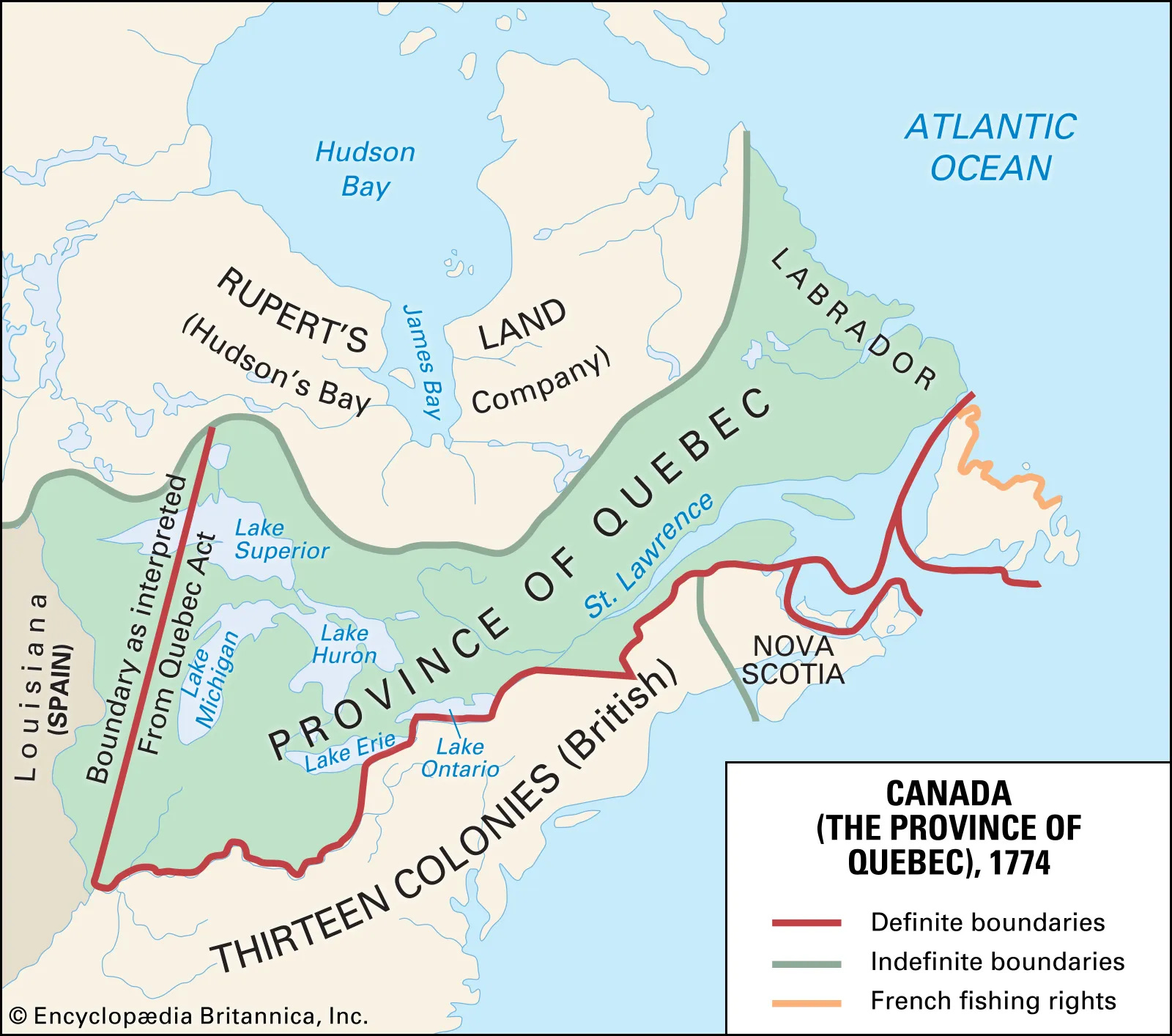
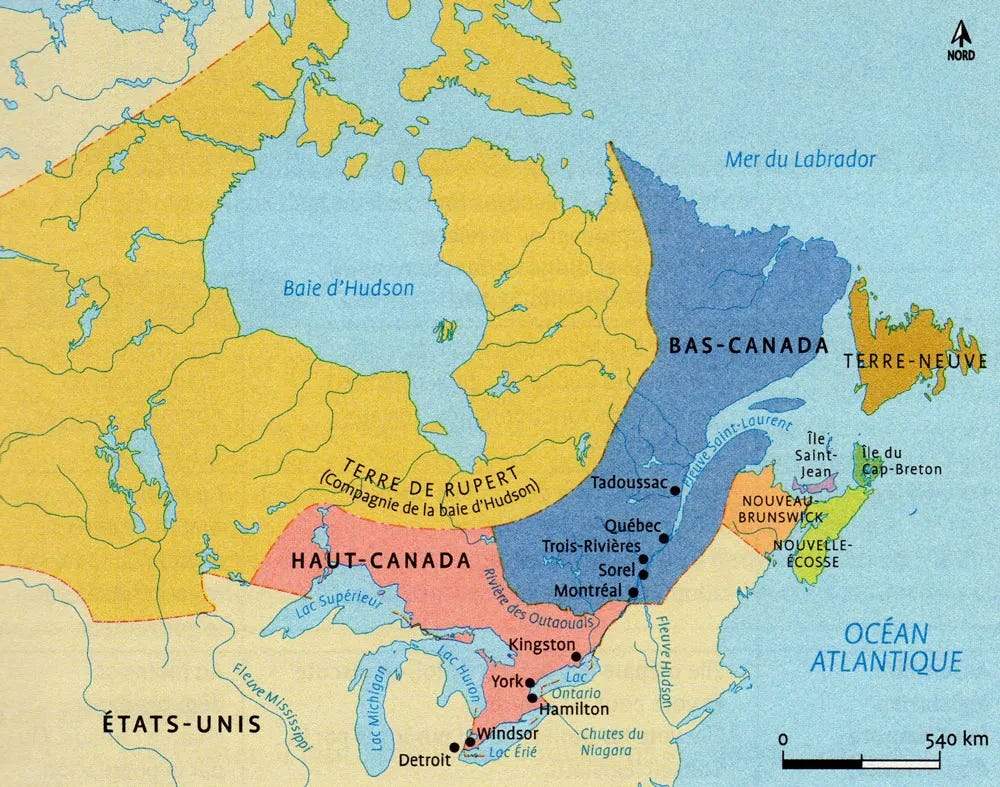
The Treaty of Paris in 1763 officially ended the war and renamed the French colony of “Canada” as “the Province of Quebec”. Initially, its borders included parts of present-day Ontario and Michigan. To address growing tensions between Britain and the Thirteen Colonies and to maintain peace in Quebec, the British Parliament passed the Quebec Act in 1774. This act solidified the French-speaking Catholic population’s rights, such as the free practice of Catholicism, restoration of French civil law, and exemption from oaths referencing Protestant Christianity. These provisions satisfied the Québécois Seigneurs (land-owning nobleman), and clergy by preserving their traditional rights and influence. However, some Anglo settlers in America resented the Act, viewing it as favoring the French Catholic majority. Despite this, the Act helped maintain stability in Quebec, ensuring it remained loyal to Britain during the American Revolutionary War and Quebec was fiercely opposed to liberal French revolutionaries.
British concessions, from the terms of the 1763 Treaty of Paris to the Quebec Act of 1774, safeguarded the cultural and religious identity of Quebec’s French-speaking Catholic population, fostering their loyalty during a period of significant upheaval in North America. Following this period, merchant families such as the Molsons began establishing themselves in Montreal, alongside early Loyalist settlers who trickled into areas now known as the Eastern Townships. These merchant families quickly ingratiated themselves with the local Norman lords and seigneurs.
The Lower Canada Rebellion arose in 1837-1838 due to the Château Clique oligarchy (an alliance of Anglo-Scottish industrialists and French noble landowners), in Quebec refusing to grant legislative power to the French Canadian majority. The rebellion was not solely a French Canadian effort; to the chagrin of both chauvinistic Anglo-Canadians and French Canadians, who in recent years believed it was either a brutal crackdown on French degeneracy, or a heroic class struggle of French peasants against an oppressive Anglo elite. It included figures like Wolfred Nelson, an Anglo-Quebecer who personally led troops into battle.
In response to the unrest following the rebellions of 1837-1838, Lord Durham, a British noble, was sent to Canada to investigate and propose solutions. His controversial recommendation, outlined in the Durham Report of 1839, was to abolish the separate legislatures of Upper Canada (Ontario) and Lower Canada (Quebec) and merge them into a single entity: the Province of Canada. This unification aimed to demographically and culturally assimilate the French Canadian population by creating an English-speaking majority.
However, the strategy failed for multiple reasons, and was given up shortly after. Lord Durham, having neither been born nor raised in the New World, underestimated the complexities of Canadian society, which was a unique fusion of Old World ideas in a New World setting. His assumption that French Canadians could be assimilated ignored their strong cultural identity, rooted in large families, which encouraged high birth rates as a means of survival. While Durham hoped unification would erode divisions, the old grievances between the British and French began to dissipate naturally.
The Province of Canada, whose unofficial capital was Montreal, where the two groups mixed
Despite Lord Durham’s intentions, French Canadians maintained their dominance in Quebec. Families averaged five children per household for over 230 years, a trend actively encouraged by the Catholic Church’s policy of La Revanche des Berceaux (the Revenge of the Cradles). This strategy aimed to preserve French Canadian culture and identity amidst the British short-lived attempts at assimilation. In Montreal, British industrialists expanded their influence by forging alliances with French landowning nobles through business partnerships and intermarriage. This blending of elites produced a bilingual Anglo-French upper class that became historically influential.
Such alliances drew on long-standing connections established as early as 1763 and later exemplified by the North West Company (NWC). The NWC in particular is interesting as a prominent fur trading enterprise of the late 18th and early 19th centuries, in that it embodied this fusion of cultures. Led primarily by Anglo-Scots, the company’s leaders frequently formed unions or marriages with French Canadian women, fostering vital ties with the French Canadian communities crucial to their trade. Simon McTavish, known as the “father” of the NWC, maintained alliances with French Canadian families, while his nephew, William McGillivray, and other leaders like Duncan McGillivray followed similar paths. Explorers such as Alexander MacKenzie and David Thompson married French women. These unions strengthened familial and cultural bonds, shaping the broader Anglo-French collaboration that defined this period.
This relative harmony between Anglo and French Canadians continued with the formation of the modern Canadian state in 1867 during Confederation. Sir John A. Macdonald deliberately chose George-Étienne Cartier as his second-in-command. This collaboration contributed to the emergence of Canada’s ethnically Anglo-French elite, who have historically been bilingual. This legacy is evident in the backgrounds of many Canadian politicians, such as the Trudeaus, Mulroneys, Martins, Cartiers, and countless others who have both Anglo-Canadian and French-Canadian roots.
In more recent history, this dynamic has been further solidified by the federal government, where higher-paid positions often require bilingual proficiency. Interestingly, about 20% of Canada’s population is bilingual, reflecting the ongoing influence of this historical coexistence.
The last cannon which is shot on this continent in defence of Great Britain will be fired by the hand of a French Canadian.
~ George Etienne Cartier
Comments Off on Quebec within the British Empire after 1760
QotD: Kaiser Wilhelm II
Following the all-too brief reign of Frederick III, his son Wilhelm II, grandson of the first German Emperor, took power in 1888 (known as the “year of the three emperors”). From the start, the young Wilhelm was determined not to be the reserved figure of his grandfather and still less the liberal reformer that his ill-fated father had wished to be. Instead, Wilhelm believed it was his right and duty to be directly involved in the country’s governing.
This was completely incompatible with Bismarck’s system, which had centralized power upon his own person. With uncharacteristic focus and subtlety, Wilhelm sought to reclaim the power that his grandfather had ceded to the chancellor. This was not to prove especially difficult; Bismarck’s position had always relied upon his indispensability to the emperor. Thus, when Bismarck offered his resignation (as he often did during disputes) Wilhelm merely accepted it. The last great man of the wars of unification had now disappeared from the balance.
While the German Empire never became a true autocracy, Wilhelm succeeded in creating what historian, and biographer of the Kaiser, John C. Röhl called a “personalist” system.1 The Kaiser had significant power over personnel. Promotions in the officer corps required his assent. Advancement within civil service (from which civilian ministers were appointed) was also dependent on his favor. By exercising this power, Wilhelm was able to ensure the highest levels of the German government were men agreeable to his point of view. Though they were not mere “yes men”, Wilhelm ensured that they were knowingly dependent on his favor for their position. The Kaiser — even to the end of the monarchy — exercised considerable “negative power” (as Röhl termed it.)2 While Wilhelm’s ability to actively make policy was limited, anything he disapproved of was simply not proposed.
Wilhelm II’s reign marked a departure from the more restrained leadership of his predecessors, as he sought to assert direct influence over the German Empire’s governance and military affairs. This shift toward a more “personalist” system, where loyalty to the Kaiser outweighed true statesmanship, weakened the effectiveness of German leadership and contributed to its eventual strategic missteps. The rigid adherence to the Schlieffen Plan and the technocratic focus on material advantages, such as firepower and mobility, overshadowed the need for adaptable strategic thinking. These failures in both leadership and military planning set the stage for Germany’s disastrous involvement in World War I, where an empire led by personalities rather than policies was ill-prepared for the complexities of modern warfare. Ultimately, Wilhelm’s influence and the culture of sycophancy he fostered played a pivotal role in leading Germany down the path of ruin.
Kiran Pfitzner and Secretary of Defense Rock, “The Kaiser and His Men: Civil-Military Relations in Wilhelmine Germany”, Dead Carl and You, 2024-10-02.
1. John C. G. Röhl, Kaiser Wilhelm II: A Concise Life (Cambridge: Cambridge University Press. 2014).
2. Negative power refers to the ability of an actor or group to block, veto, or prevent actions, decisions, or policies from being implemented, rather than directly initiating or shaping outcomes.
Comments Off on QotD: Kaiser Wilhelm II
January 11, 2025
We Produced a Video with 22 Students from the University of Zürich (Hoplite Revolution Debate)
SandRhoman History
Published 22 Sept 2024In this video, we will look at the core arguments in the hoplite revolution debate to provide you with 1) an overview of the debate itself, 2) a glimpse into warfare in ancient Greece, and 3) evidence of why historical revisionism is necessary. To achieve this, we will follow a similar overview used in a seminar we taught at the University of Zürich in the spring of 2024. Throughout the video, the participants of this seminar will contribute the expertise they have acquired by providing critical information about the ancient primary sources they analysed during the seminar.
Chapters:
00:00 Revisionism, really?!
04:21 19th Century Germany and Ancient Greece
05:39 A Hoplite Revolution?
11:53 Political Implications
16:19 Agonal Warfare (Fair War?)
22:49 Training and Discipline
25:53 Phalanx Formation
30:13 Exclusivity of Hoplites
33:04 Revisionist Battle
36:46 History is not the past.
(more…)
Comments Off on We Produced a Video with 22 Students from the University of Zürich (Hoplite Revolution Debate)
QotD: “Composite” pre-gunpowder infantry units
This is actually a very old concept. The Neo-Assyrian Empire (911-609 BC) is one of the earliest states where we have pretty good evidence for how their infantry functioned – there was of course infantry earlier than this, but Bronze Age royal records from Egypt, Mesopotamia or Anatolia tend to focus on the role of elites who, by the late Bronze Age, are increasingly on chariots. But for the early Iron Age Neo-Assyrian empire, the fearsome effectiveness of its regular (probably professional) infantry, especially in sieges, was a key component of its foreign-policy-by-intimidation strategy, so we see a lot more of them.
That infantry was split between archers and spear-and-shield troops, called alternately spearmen (nas asmare) or shield-bearers (sab ariti). In Assyrian artwork, they are almost always shown in matched pairs, each spearman paired off with a single archer, physically shielding the archer from attack while the archer shoots. The spearmen are shown with one-handed thrusting spears (of a fairly typical design: iron blade, around 7 feet long) and a shield, either a smaller round shield or a larger “tower” shield. Assyrian records, meanwhile, reinforce the sense that these troops were paired off, since the number of archers and spearmen typically match perfectly (although the spearmen might have subtypes, particularly the “Qurreans” who may have been a specialist type of spearman recruited from a particular ethnic group; where the Qurreans show up, if you add Qurrean spearmen to Assyrian spearmen, you get the number of archers). From the artwork, these troops seem to have generally worked together, probably lined up in lines (in some cases perhaps several pairs deep).
The tactical value of this kind of composite formation is obvious: the archers can develop fire, while the spearmen provide moving cover (in the form of their shields) and protection against sudden enemy attack by chariot or cavalry with their spears. The formation could also engage in shock combat when necessary; the archers were at least sometimes armored and carried swords for use in close combat and of course could benefit (at least initially) from the shields of the front rank of spearmen.
The result was self-shielding shock-capable foot archer formations. Total War: Warhammer also flirts with this idea with foot archers who have their own shields, but often simply adopts the nonsense solution of having those archers carry their shields on their backs and still gain the benefit of their protection when firing, which is not how shields work (somewhat better are the handful of units that use their shields as a firing rest for crossbows, akin to a medieval pavisse).
We see a more complex version of this kind of composite infantry organization in the armies of the Warring States (476-221 BC) and Han Dynasty (202 BC – 220 AD) periods in China. Chinese infantry in this period used a mix of weapons, chiefly swords (used with shields), crossbows and a polearm, the ji which had both a long spearpoint but also a hook and a striking blade. In Total War: Three Kingdoms, which represents the late Han military, these troop-types are represented in distinct units: you have a regiment of ji-polearm armed troops, or a regiment of sword-and-shield troops, or a regiment of crossbowmen, which maneuver separately. So you can have a block of polearms or a block of crossbowmen, but you cannot have a mixed formation of both.
Except that there is a significant amount of evidence suggesting that this is exactly how the armies of the Han Dynasty used these troops! What seems to have been common is that infantry were organized into five-man squads with different weapon-types, which would shift their position based on the enemy’s proximity. So against a cavalry or chariot charge, the ji might take the front rank with heavier crossbows in support, while the sword-armed infantry moved to the back (getting them out of the way of the crossbows while still providing mass to the formation). Of course against infantry or arrow attack, the swordsmen might be moved forward, or the crossbowmen or so on (sometimes there were also spearmen or archers in these squads as well). These squads could then be lined up next to each other to make a larger infantry formation, presenting a solid line to the enemy.
(For more on both of these military systems – as well as more specialist bibliography on them – see Lee, Waging War (2016), 89-99, 137-141.)
Bret Devereaux, “Collection: Total War‘s Missing Infantry-Type”, A Collection of Unmitigated Pedantry, 2022-04-01.
Comments Off on QotD: “Composite” pre-gunpowder infantry units
January 10, 2025
Rome – Part 6, The Second Punic War, 218-201 BC
seangabb
Published 22 Aug 2024This course provides an exploration of Rome’s formative years, its rise to power in the Mediterranean, and the exceptional challenges it faced during the wars with Carthage.
Lecture 6: The Second Punic War (218-201 BC)
• Carthaginian Expansion into Spain
• Hannibal Takes Over in Spain – War Declared
• Hannibal and the Invasion of Italy
• The Three Shattering Defeats
• Roman Strategy for Victory
• Compete and Overwhelming Roman Victory
• Rome Emerges as the Mediterranean Superpower
(more…)
Comments Off on Rome – Part 6, The Second Punic War, 218-201 BC
January 9, 2025
Forgotten Armies of the Vietnam War: Australia, Korea, China, USSR
NR: Sorry about this … RTH must have taken this video down at some point between me scheduling it to appear and today.
Real Time History
Published 16 Aug 2024The Vietnam War is mainly remembered as a conflict between the Vietnamese and the United States. But both sides received direct and indirect support from other countries.
(more…)
Comments Off on Forgotten Armies of the Vietnam War: Australia, Korea, China, USSR


