
Forgotten Weapons
Published 12 Feb 2025Various militias existed on the Falkland Islands since its earliest settlement, but the Falkland Islands Defense Force of today traces its roots to the 1892 Falkland Islands Volunteer Corps. This force was equipped with Martini Henry rifles. With the outbreak of World War One, the Falklands were a strategically important naval station, and the FIDF grew significantly in size and was fitted out with more modern arms. They expanded again in World War Two, with Lee Enfield rifles, Sten MkV SMGs, and Bren, Lewis’s and Vickers machine guns. Eventually in 1972 the force modernized, acquiring British L1A1 SLR rifles, L2A3 Sterling SMGs, and GPMGs (FALs and FN MAGs) and updating its Bren guns to 7.62mm. These were the standard arms at hand during the Argentine invasion in 1982, although the FIDF was not really an active participant in the resistance to the invasion. In fact, the British Marine party on the island was in the middle of being replaced when the invasion happened and twice the normal number of Marines were present. They armed themselves with most of the FIDF SLRs, leaving the FIDF with mostly just SMLE rifles.
After the war, the FIDF was reconstituted. It kept its SLRs until the early 1990s when they were replaced with 5.56mm rifles. Instead of adopted the British L85A1, the FIDF opted to purchase Steyr AUGs. The intention was to replace the GPMG with the heavy-barreled AUG, but this did not work out in practice. Instead, the GPMGs remained in service and the heavy-barreled AUGs were converted to standard rifles. In the post-war years the FIDF also began to acquire more specialty arms, starting with a Parker-Hale M85, a couple of Steyr HS-50s, and ultimately a batch of LMT 7.62mm rifles. They remain a small but quite well-equipped for today, offering valuable reconnaissance and local knowledge to the British Army garrison should conflict break out again.
Many thanks to the FIDF for giving me access to their armory to dig out these arms to film for you!
(more…)
June 30, 2025
Small Arms History of the Falkland Islands Defense Force
June 29, 2025
June 27, 2025
RAF Brize Norton apparently had almost no security for its planes at all
Domestic terrorists got into RAF Brize Norton, one of Britain’s main airbases, last week and committed damage that may range into the tens of millions of pounds … and were in and out with the RAF none the wiser:
So this was a serious attack; it’s also an intensely embarrassing one. The terrorists got in and out completely undetected; it appears nobody at Brize Norton was aware of the attack until the perpetrators had already escaped. This would be bad enough if they’d been Spetsnaz-trained infiltrators, flitting silently from shadow to shadow towards their targets. In fact, however, they were a couple of unwashed hippies from Palestine Action, and they “infiltrated” the base on electric motorbikes. It is absolutely staggering that they were able to get in, attack two valuable aircraft and then get out again without being intercepted.
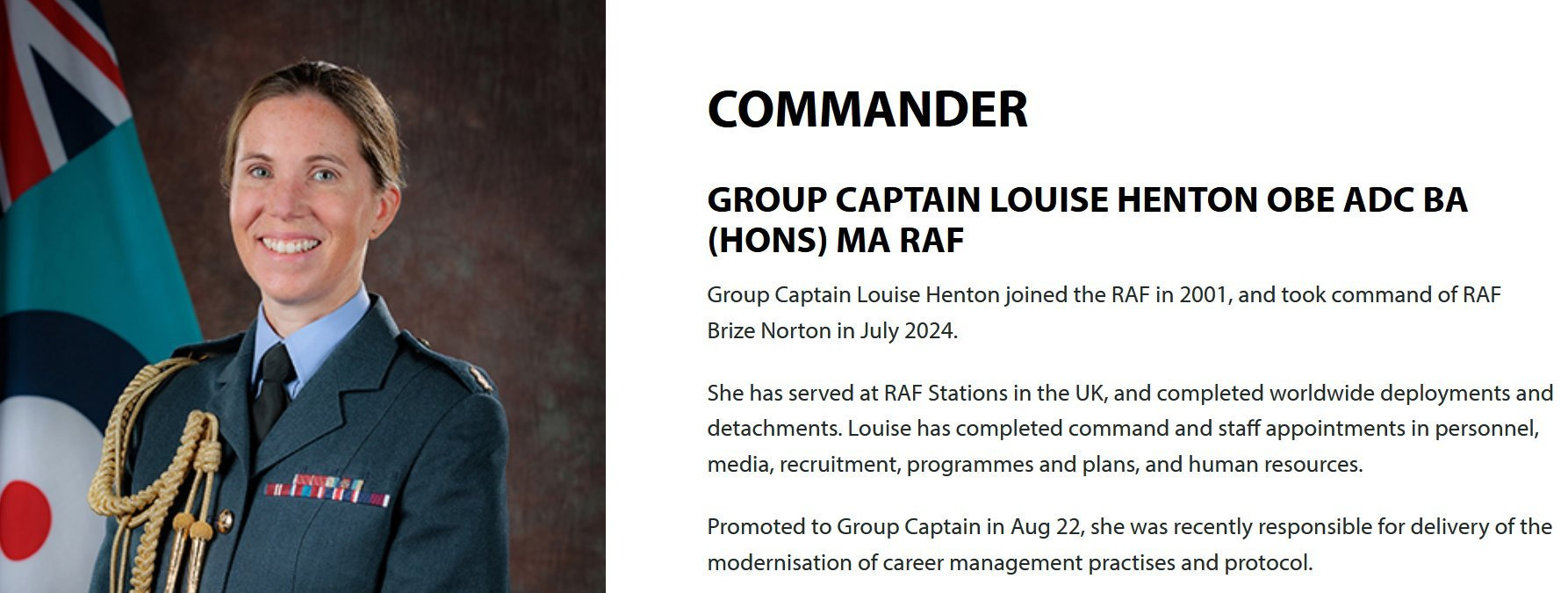
Or maybe it isn’t. This is the station commander of RAF Brize Norton:
Gp Capt Henton appears to have spent her entire career in non-operational roles. She also seems to have some very strange ideas about concepts such as masculinity and even patriotism. In a paper she wrote (which is available online) Henton appears strongly critical of traditional military culture, particularly that in the combat units she has never been part of. Is it just coincidence that, under the command of someone who is effectively an HR manager in a uniform, traditional military concerns such as security appear to have been badly neglected?
It’s undeniable that security at Brize Norton was neglected. One of the things I was trained in, as an Intelligence Corps operator, was protective security. We tended to focus on the protection of classified information, but the same principles apply to the protection of anything else (for example aircraft), and one of those principles is that if the security around an asset is weak in one respect — for example, physical barriers like fences — you can plug that gap by deploying other assets — for example, guards.
I used Google Street View to do a perimeter recce of Brize Norton, and took this screenshot looking from Station Road at the eastern end of the base’s runway:
This shot is taken from a public road, outside the base. The only perimeter security is a simple, easily climbed wooden fence less than six feet high. For a long stretch it has no “topping” — security jargon for razor wire or other anti-climb obstacles. There is also no perimeter security lighting along this section of the road. There aren’t even streetlights on the road itself. This is a massive weakness in physical security, which any terrorist can easily identify using open-source tools like Google Street View. The red ellipse I have drawn on the image highlights aircraft — seven of them, a mix of Voyagers and A400M transports — parked on the apron. They are less than three-fifths of a mile (900m in new money) from the perimeter fence, a distance that an electric scooter can cover in around 90 seconds. This level of physical security is completely unacceptable for the protection of such valuable assets, so it should have been supplemented with armed guards. It wouldn’t take all that many. A twelve-man guard under the command of a corporal could easily supply a pair of two-man prowler patrols, one on the apron and one randomly checking vulnerable points around the perimeter. That would have been enough to intercept and stop this attack.

India’s FAL: The 1A1 Inch/Metric Hybrid
Forgotten Weapons
Published 5 Feb 2025For political reasons, India decided to adopt the 7.62mm NATO cartridge when it needed to replace its No1 MkIII SMLE bolt action rifles with a modern self-loader. They chose the FN FAL as the rifle to adopt, but wanted a license to produce it domestically at the Ishapore rifle factory. FN insisted on the Indians buying Belgian tools as part of the agreement, which India was unwilling to do. So instead, Ishapore used the samples it had of both British L1A1 and Belgian FAL rifles to produce its own reverse-engineered drawings.
The resulting plans use a mixture of British (“inch”) and Belgian (“metric”) parts, and are not interchangeable with either standard pattern. As a result, the Indian 1A1 rifle is a clone of the FAL that is not actually parts compatible with the FAL. That did not prevent Ishapore from producing hundreds of thousands of them, with production apparently ending only in 2012.
Thanks to Sellier & Bellot for giving me access to this 1A1 example to film for you!
(more…)
June 26, 2025
NATO members “commit” to a new 5% defence spending target
As many predicted, just as Canada finally gets around to at least pretending to meet the 2% defence spending target we agreed to over a decade ago, those goalposts get moved:

So today the leaders of Nato convene for a landmark summit:
NATO countries agree to increase defence spending to 5%
That headline isn’t strictly accurate. Member states have apparently agreed to commit to a target of 5% by 2035, to mark the start of the fourteenth anniversary of the Ukraine war. Which means that, as always with Nato, they’ll all look butch at the photo-op, and then they’ll do bugger all. Even the “commitment” to a “target” is too much for Spain, which has secured an opt-out.
But hang on a minute: Nato has been at war — or at proxy-war — with Russia for three-and-a-half years now. So it’s been on a war-footing, supposedly, for seven-eighths of the length of the First World War. How’s that war-footing going? Per Nato’s head honcho, Mark Rutte (the woeful former Dutch PM — ask our pal Eva Vlaardingerbroek), earlier this month:
The Russian army is developing its war capabilities by multiple times more than that of NATO despite having an economy 25 times smaller, NATO’s secretary general has warned …
“The Russians, as we speak are reconstituting themselves at a rapid pace and producing four times more ammunition in three months than the whole of NATO in a year,” said Rutte.
That’s a rather confusing way of putting it; what he means is: the Russians (who, as Mark Levin assures us, “scare nobody”) produce more ammunition in three weeks than the whole of Nato does in a year. Can even Nato be that worthless?
Taking the Secretary-General at his word, if you’re wondering why the Pentagon has to divert ammo marked for Israel to Ukraine and then divert it back from Ukraine to Israel … well, let’s do what everybody else does and dredge up the only historical analogy anybody knows — not the First World War, but the Second (see Levin’s “Iranian Nazi regime”): We’re asked to believe that Nato needs longer than the US was in the Second World War for to move to a war-production footing.
To be sure, supply chains are always difficult: Iran’s threat to close the Strait of Hormuz could have seriously impacted McDonald’s need to recall the hash browns it sent to Montenegro and divert them to Kiribati.
Trump gets something very basic: Flying the highest of high-tech weaponry seven thousand miles to drop down a ventilation shaft opening the size of a dishwasher is the kind of brilliant, dazzling one-off only the United States can do. But what next? Almost all geopolitical conflicts start with a bit of shock-&-awe (Pearl Harbor, even the assassination of the Archduke) and then dwindle down to old-school wars of attrition – as the United States should certainly know after taking twenty years to lose to goatherds with fertiliser, and three years to lose to “a gas station masquerading as a country” (thank you, John McCain). In wars of attrition, old-fashioned unglamorous things become important, like the ability to manufacture bullets in a timely manner. The basic arithmetical calculations are not complex: Don’t get into a long war with an enemy whose stock of long-range ballistic missiles outnumbers your surface-to-air missiles.
So Trump had the narrowest window of opportunity, and used it.
On the other side, the last week-and-a-half mostly revealed the shallowness of the War Party. You’ll recall, for example, that Ted Cruz got into a spat with Tucker over the actual population of Iran. Last week, a UK podcast had a brief discussion on The US Army-Marine Corps Counter-Insurgency Field Manual, which notes the following (foot of page xxvi):
The troop demands are significant. The manual’s recommendation is a minimum of twenty counterinsurgents per 1,000 residents.
That’s roughly what the British had in Malaya. Which they won, by the way. Twenty-two years ago, a couple of weeks after the fall of Saddam, I stopped on the shoulder of the main western highway from Jordan to Baghdad to fill up from an enterprising Iraqi who’d retrieved some supplies from a looted petrol station and was anxious to sell them to any passing Canadian tourists. As he was topping off, I asked him how agreeable he found the western soldiery. He grinned a big toothless grin and pointed to a chopper that had just come up over the horizon to hover above our heads. Then he said: “Americans only in the sky.”
We did not win that one, you’ll recall. Instead, we created an Iranian client-state.
That’s why Ted Cruz’s breezy indifference when Tucker asked him the population of Iran was so revealing. The senator told Tucker that it doesn’t matter whether the population of Iran is eighty million or a hundred million. Really?
Because, per the Pentagon’s own field manual, the latter figure would require finding an extra 400,000 troops. Oh, wait. If it’s a Nato mission, the other members could muster 127 guys between them, so it would only require 399,873 extra Americans.
Even if the public were minded to put one-and-a-half million pairs of boots on the ground, it couldn’t do it. “Americans only in the sky” equals what an Australian prime minister told me, after a flying visit to the troops in Afghanistan, was “the Crusader fort mentality”.
It doesn’t work. The political divide in America is between, crudely, Trumpians and neocons. The former are anti-war; the latter are pro-war … but a way of war that doesn’t work.
A Basic Explanation Of The First Punic War
MoAn Inc.
Published 8 Jan 2025GEOGRAPHY NOTES
Messina is the modern name for Messana. Both are correct.
Acragas / Akragas was renamed as Agrigentum by the Romans. Most videos on YouTube use the name Agrigentum for convenience purposes … so again, both are correct.
Panormus is modern day Palermo.
Drepana / Drepanum is modern day Trapani.
Lilybaeum is modern day Marsala.!READ THE SOURCES FOR FREE!
Livy: https://www.perseus.tufts.edu/hopper/…
Polybius: https://www.perseus.tufts.edu/hopper/…
Cassius Dio: https://www.perseus.tufts.edu/hopper/…
(more…)
June 25, 2025
The Korean War Week 53 – Moscow Says ‘End the War!’ – June 24, 1951
The Korean War by Indy Neidell
Published 24 Jun 2025Soviet Ambassador Jacob Malik speaks to the world on UN radio, saying that the Soviet position on Korea is that ceasefire talks should begin among the belligerents. The Americans are thinking of how they can bring in more non-American UN units, even as South Korean President Syngman Rhee denounces the British and Commonwealth forces and says they should go home.
00:00 Intro
00:41 Recap
01:07 Jacob Malik Speaks
02:02 Chinese Change Plans
03:19 10th Corps Advances
05:37 More Non-American UN Units
07:52 Rhee Denounces his Allies
12:17 Summary
12:40 Conclusion
14:15 Call to action
(more…)
June 24, 2025
Praga I-23: Prototype Belt-Fed Predecessor of the ZB26
Forgotten Weapons
Published 3 Feb 2025Vaclav Holek’s first machine gun design for the Czech military was the Praga I, built in 1922 and based heavily on the Vickers/Maxim system. However, it became clear that the military wanted something lighter and more portable, and so the next year he heavily updated the design to this, the Praga I-23 (for 1923). It remains a belt-fed weapon chambered for the 8mm Mauser cartridge, but the locking system has been much simplified into a tilting bolt arrangement. The recoil operation from the earlier model is also gone, now replaced by a long stroke gas piston. Some elements of the Maxim remain in the belt feeding elements, but the overall gun is much more a light machine gun than the mounted heavy machine gun that was his first design.
A total of 40 of the Praga I-23 were ordered by the Czechoslovak military, and they were tested in 1924 (only 20 examples were actually delivered of the 40). The I-23 performed well, but it was again clear that it wasn’t quite what the military really wanted. Holek revised the design again to the model 1924, using a box magazine instead of a belt feed — and that is the gun that continued the path to the ZB-26.
Video on the Praga I machine gun that came immediately before this model: Praga I: A Blow-Forward Bullpup Semi-…
Many thanks to the VHU — the Czech Military History Institute — for giving me access to this fantastic prototype to film for you. The Army Museum Žižkov is a part of the Institute, and they have a three-story museum full of cool exhibits open to the public in Prague. If you have a chance to visit, it’s definitely worth the time! You can find all of their details (including their aviation and armor museums) here:
June 23, 2025
US strikes against Iranian nuclear facilities
One of the most frustrating aspects of internet culture today is the need for instantaneous “analysis” of military events. We all understand the desire for such insight, but the accuracy of information available in the immediate aftermath of any event is highly variable. Between the need to control the narrative on the part of the participant powers, the propaganda value of being “first” to report, and the impossibility of accurate damage assessment, it’s a wise move to discount almost everything you hear about a big event for some time. Chris Bray suggests that the old “72 hours rule” may be insufficient for something like the US bunker busting strikes against Iranian nuclear research facilities:
First, wait a while. Sean Hannity just announced that “a source” told him the attack was a complete success, and all of Iran’s nuclear sites were fully destroyed. I’d hesitate to believe that, is the gentle way to put it. I’d also hesitate to believe the stories being told from the other direction, and don’t forget that Trump’s attack on Qasem Soleimani produced a full week of OH NO WORLD WAR III JUST BEGAN stories in the establishment media. The likelihood is that none of what you’re hearing this week is fully true. Wait and watch. I hope that Iran and the US are backchanneling while engaging in belligerent public posturing, but by definition we’re not going to see the backchanneling. We’ll see. The 72 Hour Rule is in effect, here, at the very least.
Second, the ludicrous story in which Trump is violating law and political norms with unilateral military action is, as always, a deliberate performance of political amnesia. These are our political norms, for crying out loud.
We should probably fix that. But the people who tolerated an American war in Libya without direct congressional authorization, and who tolerated an American war in Yemen without direct congressional authorization, and who tolerated an American war in Syria without direct congressional authorization, aren’t actually going to impeach a president over military strikes in the Middle East undertaken without direct congressional authorization. It’s a show. The More Than a Week Rule requires us to view this action in the longer and generally quite unfortunate context of American foreign policy, and the politicians who are outraged by unilateral military action in the Middle East have zero standing on that score.
Third, and related, the 2001 Authorization to Use Military Force is still in effect, and still being stretched and massaged beyond its intent and meaning, but note that Congress still hasn’t repealed it. A Congress that wished to restrain presidential military action in the Middle East would probably start there, and they haven’t.
Glenn “Instapundit” Reynolds has a few thoughts on the matter:
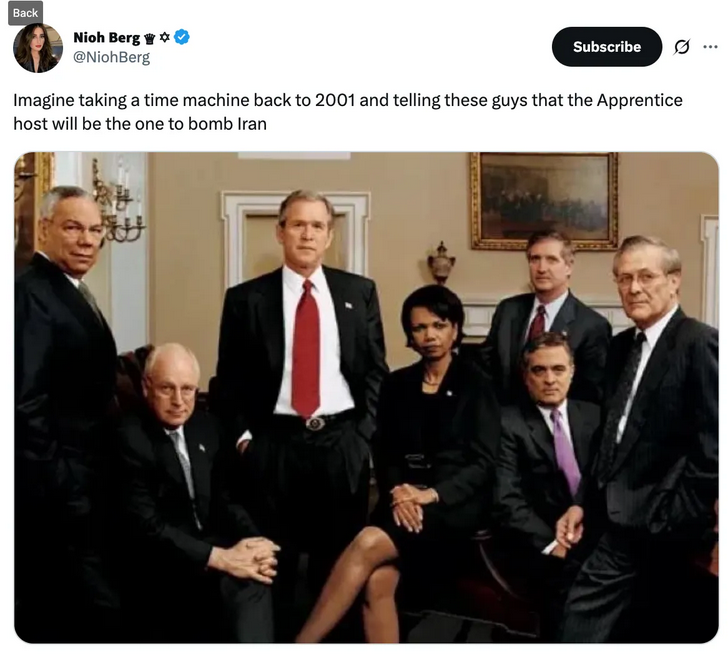
People have been singing about it since 1980, but yesterday’s bombing raids on Iranian nuclear facilities were the first bombing attack since the 1979 hostage seizure.
Despite numerous calls for action against the Islamic Republic, Operation Midnight Hammer was the first U.S. military action against important Iranian assets on Iranian territory. The bombs fell less than 24 hours ago, but here are a few preliminary takes.
Competence. The most striking thing about the attacks was the extreme competence displayed by the Air Force, the Defense Department under Secretary Pete Hegseth, the various intelligence assets involved, the State Department, and the entire administration. There were no leaks. (How did they avoid leaks? Basically, they didn’t tell any Democrats what was coming. Take note.)
Not only were there no leaks, but President Trump and the diplomatic apparatus kept the Iranians in the dark, giving the impression of waffling in the White House even as things were being lined up. They received unintentional help in this from Sen. Charles Schumer, who had been for some time pushing the “TACO” acronym — Trump Always Chickens Out — in the service of a storyline that Trump was all bluster and no follow-through. The Iranians, apparently dumb enough to believe Democrats and the mainstream news media (but I repeat myself) were snookered.
New Diplomacy: In dealing with the Iranians in the 1980s, Donald Regan told President Reagan that America had been repeatedly “snookered” by a bunch of “rug merchants”. The Iranians were in fact very good at leading Americans down the garden path, invoking (often imaginary) splits between “hard-line” and “moderate” Islamists in their government as excuses for delay and backtracking.
In truth, as Henry Kissinger once said, “An Iranian moderate is one who has run out of ammunition“. After these raids, and the many Israeli attacks that led up to them, all of Iran is out of ammunition.
Augustus and the empire – The Conquered and the Proud 14
Adrian Goldsworthy. Historian and Novelist
Published 15 Jan 2025This time we look at Augustus, the empire and the army. The man who built the Altar of Augustan Peace in Rome was also the last of the great conquerors, who added more territory to the Roman Empire than any other individual leader. How he did this, and how he kept the army under control, is the theme of this video.
QotD: Recruiting and organization under the “Marian reforms”
This is the most important one, but perhaps a bit less complicated than cohorts: the notion that Marius began the process of taking volunteers and proletarii at that and thus “professionalized” the Roman army. As with the equipment, this is at least something our sources do say … more or less.
Sallust reports that Marius, “after he saw that the spirits of the plebs were aroused, he swiftly loaded ships with supplies, pay, weapons and other requirements; with them he ordered Aulus Manlius, his legate, to set out. Meanwhile himself he enrolled soldiers, not according to the mos maiorum [‘the customs of the ancestors’] from the census classes, but making use of whoever wished to go, mostly the capite censi [‘those counted by heads’ = the propertyless poor or proletarii]” (Sall. Iug. 86.1-2, trans mine). Plutarch repeats this report, that Marius violated custom by enrolling men who didn’t meet the property qualification for military service (Plut. Mar. 9.1).
There are a few oddities here to start, though. First, Sallust quickly notes that this resulted in Marius having an army rather larger than what the Senate had actually authorized (Sall. Iug. 86.4) and that’s actually quite a neat detail that may explain part of what’s going on here because this has, in a way, happened before. In 134, Scipio Aemilianus was elected consul for the second time (illegally, again) with a mandate to end the frustrating Roman war against the Celtiberian stronghold of Numantia in Spain. The Senate, however, denied Scipio authorization to raise fresh troops, to which Scipio responded by enlisting some 4,000 volunteers to replenish his legion; Appian says this was done with the consent of the Senate, but Plutarch’s brief note on it sure implies Scipio Aemilianus is end-running around Senatorial efforts to stifle him (App. Hisp. 84; Plut. Mor. 201A-B). And this too was hardly the first time for this sort of end-run; Scipio Africanus (what is it with Scipiones!?) back in 205 agitated for his invasion of Africa to end the Second Punic War and was given the province of Sicily with authorization to go to Africa if he thought it necessary, but the Senate registered its displeasure by refusing to let him levy troops, at which point – wait for it – Scipio took volunteers, equipping and financing his force through the socii and even building a fleet that way (Liv. 28.45.9-12).
In short, the Senate sometimes tried to trim the sails of generals it was displeased with – and Marius reportedly had gotten elected on a campaign platform of “to hell with the Senate” (Sall. Iug. 84.1) – by limiting the size of their armies or refusing to allow them to conduct a levy. And since 205 (a century before Marius), popular generals had occasionally juked this effort by the Senate by instead calling for volunteers, which the Senate could not stop. Marius is not doing something new in taking volunteers to supplement an army through the levy.
He also doesn’t keep doing it. After Marius wins in Africa with his volunteer-supplemented army (the bulk of which of course were still recruited through the dilectus under Metellus), he returns to Italy to take over the war against the Cimbri and Teutones but he doesn’t keep up the volunteer force, instead taking command of his predecessor Rutilius Rufus’ normally levied army (Front. Strat. 4.2.2). In practice, Marius probably took volunteers in part for that first army because the Senate was diverting available levy manpower towards the early phases of the Cimbric War (or at least that was a convenient excuse to kneecap him) – a series of costly military disasters for Rome which likely soaked up much of the manpower the Senate was willing to raise. Once Marius has access to that “primary” stream of manpower generated through the dilectus, he uses it and seems to stop using volunteers.
But what of recruiting the capite censi? Well, that isn’t quite new either, although it surely wasn’t typical. For one, it wasn’t that the poor absolutely never served; Polybius notes that the capite censi served in the fleet (Polyb. 6.19.2). But we also see non-assidui (assidui being the term for those wealthy enough to be liable for normal conscription) in a range of other emergencies. Livy reports in 329 a “crowd of sellularii [men who work sedentary trades, literally, ‘stoolsmen’], a type least suited for military service, were called into the army” (Livy 8.20.4), though the historicity of this report is questionable given the early date. In 296, Etruscan entrance into the Third Samnite War causes a draft of “not only the freeborn or the iuniores took the oath, but cohorts were made of seniores and centuries of freedmen” (Livy 10.21.4). Gellius (16.10.1) quotes Ennius reporting the proletarii were pulled into the armies in 280, presumably in response to Pyrrhus’ victory at Heraclea. And during the Second Punic War the Romans pulled out all of the stops, recruiting debtors and men convicted of capital crimes (Livy 23.14.3), enrolling slaves into the army (called the volones; you free them first and then draft them, Livy 27.38 and 28.10, Val. Max. 7.6.1) and as noted above, taking volunteers more generally.
As an aside, if you are wondering why the Romans seem in some of these to skip recruiting freeborn capite censi and go straight to freedmen and enslaved people, I think there are two answers here for this period. First, many of the available freeborn poor are probably already in service in the fleet. Second, there probably aren’t that many of them. Recall our chart of Roman social classes – the capite censi in the third century is quite small, almost certainly outnumbered by enslaved persons in Italy. But the population of Italy was rising over the third and especially second century and without adding new farmland, those new freeborn Romans may have swelled the ranks of the capite censi, leading to a much larger propertyless class by the late second century or the first century.1 Consequently, there may have been a lot more capite censi worth recruiting by Marius’ day, when Rome no longer needed to keep a large navy at sea (not facing any naval powers in its wars) and the number of capite censi having risen.
Finally, Marius does not mark the end of the Roman dilectus! Evidently Roman conscription persisted at least to the end of the Roman civil wars, as Suetonius reports Augustus (perhaps when he was still Octavian) inflicting the traditional penalty of being sold into slavery for draft-dodging on a Roman eques who cut the fingers off of his two sons to make them ineligible for military service (Suet. Aug. 24.1). Indeed we have attestations of the dilectus in 55, 52, 50, 49, AD 6 and AD 9.2 Even once the army is fairly clearly primarily a volunteer force, at least notionally the ability to hold a levy when necessary to fill the ranks remained “on the books” and Trajan (r. 98-117 AD) holds at least one levy because he punishes a father for the same reason Augustus had done (Dig. 49.16.4.12). So the traditional dilectus remained a thing Roman leaders could do well into the empire. In practice it seems safe to assume the system by the mid-first century is substantially ad hoc, as the census straight up doesn’t happen from 69 BC to 28 BC, which would make it hard to actually enforce the property requirements. But the process doesn’t stop in 107 and there’s no reason to suppose from 107 to 69, with the census being regularly conducted, that most annual levies were not conducted along traditional property lines.3
So the most we might say is that a one-time crisis expedient in earlier periods slowly becomes a standard way to supplement legions and then the standard way to recruit them, with the old normal method of the dilectus instead becoming the unusual way to supplement in a crisis. It’s unclear exactly when that shift-over point happens, but it sure isn’t in the career of Gaius Marius, who sits clearly in the “volunteers as a crisis response” side of the issue.
And what of the notion that Gaius Marius introduced both citizenship as a reward for service as a regular bonus and also that he instituted the paying of soldiers at the completion of a campaign to render them loyal? Well on the latter point, the Romans had been distributing spoils to the soldiers at the end of a campaign as a lump-sum payment since the beginning. This is exceedingly well reflected in Livy’s accounting of the years from 201 to 167 (where we have a nice continuous burst of Livy), see for instance Livy ::deep breath:: 30.45, 31.20, 33.23, 33.37, 34.46, 34.52, 36.40, 37.59, 39.5, 39.7, 40.34, 40.43, 40.59, 41.7, 41.13, 45.40, 45.43.4 And the idea that Roman victories might seize land which would then be settled as Roman coloniae, creating new land for Roman settlers was also not new (Wikipedia has a convenient list of Roman coloniae). So Marius is simply promising to do a thing Roman commanders regularly did, essentially saying, “serve with me, because I’m going to win and victory will make us rich”. Which is exactly the reason volunteers rushed to serve with Scipio Africanus and Scipio Aemilianus: they anticipated a lucrative victory for such well-regarded commanders.
And by now you may well be asking, “but wait, then when does the system change?” Because after all, I said that by the early empire, we can pretty clearly see an army primarily composed of professional, long-service volunteers who receive substantial retirement bonuses and are permanently stationed on the frontiers. Who is responsible for that? And in response, I give you, this guy.
It’s Augustus. It was always Augustus. Or at least I should say that is my view, given the evidence. Older scholarship – I think here of Keppie (1984) in particular – tended to assume that because most of the big changes happened with Marius (but we’ve seen they don’t) that Octavian/Augustus probably made only minimal changes to the military system he inherited from Julius Caesar. I don’t think that’s correct. I think if we look at the evidence in more detail it becomes clear that Augustus is the “break” (though not a clean break by any means) and that in fact we need to start regarding Augustus as a military reformer of some significant scale rather than merely the codifier of a Caesarian military system (though he probably does that too).
Augustus, after all, institutes regular bonuses for discharge, establishing a treasury funded by a regular tax to meet the expense rather than simply promising that he would win a lot and so soldiers would get rich off of their share of the booty (Res Gestae 17). And it’s not hard to see the problem he’s responding to – the massive military buildup of the Roman civil wars had left Octavian, as the victor, with the red-hot potato of hundreds of thousands of soldiers who were promised the spoils of victory, including large numbers of men who didn’t win but who, if not settled down somehow would disrupt the state (RG 3). Earlier in the civil wars, Octavian had used proscriptions and land confiscations to solve this problem but as emperor, he needed a permanent solution, thus the establishment of the aerarium militare and its discharge bonuses (praemia). Before that, you simply had generals promising to feast their soldiers off of the property of the vanquished; the civil wars had only changed that in that the vanquished were now Romans. It also establishes a standard length of service, creating that professional, long-service army.
There’s a related issue which is the fate of the citizen equites and the velites. Caesar’s armies in Gaul seem to have neither, so the assumption was that the shift to recruiting proletarii meant that these wealth-based distinctions (the richest Romans serve as equites, the poorest as velites) dropped away, leaving a uniform heavy infantry legion. And in a schematic it makes sense: both roles are absorbed by the auxilia and indeed Caesar makes use of a lot of Gallic cavalry auxiliaries. But as François Gauthier recently pointed out,5 it’s not all clear that the velites really did vanish in the late-second/early-first century. Cicero still refers to to them writing in the 40s (Cic. Fam. 9.20; Brut., 271) and their apparent absence in Caesar’s writing may well just be an accident of Caesar’s avoidance of technical language. Caesar doesn’t generally talk about hastati or triarii much either; he prefers milites (“soldiers”). Likewise, it’s clear the citizen cavalry – the equites – survived Marius; as Jeremiah McCall notes, we have good evidence for citizen equites at least as late as the 90s BC and suggests the citizen cavalry probably vanished in the 80s as a result of the Social War and Sulla‘s Civil War.6 It surely did not happen in 107 or 104.
Meanwhile the auxilia as a mature part of the Roman army really only emerge under Augustus, and not even right at the beginning of his reign either. Roman armies needed cavalry and light infantry to function, so once again we may not be looking at a clean break but rather a period of transition as a result of some generals preference for (non-Italian) allied or auxiliary cavalry and light infantry and the formalization of that system not in 107 with Marius but again in 27 with Augustus.
Marius is also sometimes credited with the idea of extending citizenship to non-citizens who served, which is a catastrophic misreading of one episode in his career. For one, this gets read as meaning that Marius extended citizenship to all of the Italians in his army or that he made it standard to do so. Note for instance this line pulled from Wikipedia:
Finally, Marius granted citizens of the Italian allies (Etruria, Picenum, etc.) full Roman citizenship if they fought for Rome and completed a period of service in the Roman army.
[Dated] 6/25/2023, specified in the hope this page changes to be less wrong.
And that’s very much not right either. We have evidence for only a handful of citizenship extensions by Marius. In particular, of his army he extended citizenship to just two cohorts (c. 1,000 men) from Camerinum (Plut. Mor. 202D, Cic. Pro Balbo 46.). I can only assume this gets misunderstood because some writers don’t know their unit sizes, but Marius had 32,000 men in his army at Vercellae (101 BC), probably something like half of which were socii. These two cohorts were a comparatively tiny fraction. Marius also seems to have selected a very small number of his other socii veterans for citizenship (Cic. Pro Balbo 48), but there was no blanket grant of citizenship. Of course there wasn’t, this issue remained substantially unsolved until the Social War (91-87BC); if Roman levies had been calmly minting new citizens out of thousands of Italians through the 90s, there would hardly have been a cause for the Social War.
Instead, citizenship as a reward for service is an artifact of the imperial period and the auxilia. The Roman use of non-Roman, non-socii troops to supplement their armies was not new, but it emerged as a formalized, permanent part of the Roman army not during the civil wars – where such units where both ad hoc but also not nearly so numerous – but under the reign of Augustus, coming to form about half of the army by the end of his reign (Tac. Ann. 4.5; on the emergence of the auxilia, see I. Haynes, Blood of the Provinces (2013)). Indeed, as Haynes notes (op. cit. 49), it is actually only under Tiberius (r. 14-37) that we get direct evidence of citizenship grants to auxilia and the practice even then seems at least somewhat irregular (though it comes to be regularized).
In short that, the notion that Gaius Marius instituted the pattern of granting citizenship to serving non-citizens on discharge is simply wrong; that’s not in our sources. That doesn’t become consistent until Tiberius well over a century later. Gaius Marius did recruit volunteer capite censi into his army once but didn’t make a habit of it and as such isn’t a major reformer so much as a key step in a slow process of change which reaches its decisive point probably under Augustus, more than half a century after Gaius Marius died. He wasn’t the first to do either thing, whatever our sources say.
Bret Devereaux, “Collections: The Marian Reforms Weren’t a Thing”, A Collection of Unmitigated Pedantry, 2023-06-30.
1. For more on the dynamics of this, see N. Rosenstein, Rome at War (2004), as this is part of his central argument.
2. For textual references, see Brunt, Italian Manpower (1971), 636-7.
3. We do not know how that process would have accounted for the massive expansion of the Roman citizen class due to the Social War. But evidently it did!
4. These were happily already compiled by Brunt, op. cit., 394.
5. “Did velites Really Disappear in the Late Roman Republic?” Historia 70 (2021).
6. J.B. McCall, The Cavalry of the Roman Republic (2002), 100-113..
June 22, 2025
Day Four – The Meuse Must Hold! – Ten Days in Sedan
World War Two
Published 21 Jun 2025May 13, 1940: In today’s episode of our WW2 documentary, Ten Days in Sedan, the German Blitzkrieg reaches its climax. Guderian’s Panzers launch a daring river assault as the Luftwaffe pounds French lines into chaos. Away from Sedan itself, Rommel and Reinhardt strike further north, opening new fronts. France scrambles to counterattack, but the German bridgeheads are growing fast.
00:00 Intro
00:48 French Defences, German Air Assault
04:13 Guderian Crosses The Meuse
08:25 Hartlieb’s Houx Crossing
11:28 Rommel Crosses At Dinant
16:04 Einhardt Crosses At Monthermé
19:15 Summary & Conclusion
(more…)
Ljungman Updates: the AG-42 vs AG-42B
Forgotten Weapons
Published 31 Jan 2025In 1953, the Swedish military launched a program to refurbish and refit all of the Ag m/42 rifles in inventory. Aside from replacing broken parts and worn barrels, the program also made a number of improvements to the rifles:
- Auxiliary front magazine catch added
- Large gripping lugs added to bolt cover
- Rubber case deflector added
- Single-piece cleaning rod to replace the two-part original
- Rear sight geometry modified
- Rear sight range dial modified
- Dual-wire recoil spring in place of the original single wire type
These updates were made to virtually all rifles then in existence, and it is very rare to find original pattern Ag m/42 rifles today.
(more…)
June 20, 2025
Generations of Battleships – A Reasonable Guide to Classifying your Capital Ships
Drachinifel
Published 24 Jan 2025Today we take a look at my proposed system for classifying battleships!
00:00 – Intro
01:55 – Ship Generations
(more…)
June 19, 2025
The Guns of the South: Checkmate, Alt-Hist Plausibility Sticklers
Feral Historian
Published 24 Jan 2025Harry Turtledove’s The Guns of the South gives us a look at a victorious Confederate States as they grapple with the consequences of slavery, war, and the challenges of building a new nation. It also skewers a favorite activity of alt-history readers, the nitpicking of plausibility in the points of divergence, by dropping South African time travelers with AKs into the middle of the Civil War.
00:00 Intro
02:08 America Will Break
04:49 Right and Left
05:36 CSA at odds with AWB
08:08 Forrest
10:16 Technology
13:16 “Why then …”


