
Defense lines take up more ground than one has troops to occupy […] Little minds want to defend everything, sensible people see only the main thing, parry the big blows and tolerate a slight misfortune in order to avoid a greater one. He who will defend everything defends nothing.
Frederick II of Prussia, aka Frederick the Great
July 10, 2025
QotD: Frederick the Great on defence
Comments Off on QotD: Frederick the Great on defence
July 9, 2025
The Korean War Week 55: Ceasefire Talks Planned – But the War Isn’t Paused
The Korean War by Indy Neidell
Published 8 Jul 2025It’s huge news — the Chinese and North Koreans have agreed to hold peace talks with the American led UN forces, to begin next week! That’s all well and good, but everyone on every side now has to figure out exactly what they want from the talks and what they’re prepared to give up to get it. There are also plenty of people, like UN Commander Matt Ridgway, who don’t want to have peace talks at all just now. Still, a UN liaison party flies in to Kaesong at the end of the week to lay the groundwork. Exciting times.
Chapters
00:00 Intro
00:57 Recap
01:26 The Chinese Response
05:21 Instructions for Ridgway
09:30 The Negotiators
12:01 Summary
13:10 Call to Action
(more…)
Comments Off on The Korean War Week 55: Ceasefire Talks Planned – But the War Isn’t Paused
NATO secretary general Mark Rutte – Trump’s biggest European fanboy?
I don’t often encounter positive reactions to US President Donald Trump from the other side of the pond, but Paul Wells makes a case here for Mark Rutte, the current secretary general of the NATO alliance, being utterly sincere in his regard for his American “daddy”:

Mark Rutte, the NATO secretary general.
Photo from Paul Wells’ substack
I haven’t seen much commentary about Mark Rutte’s weekend interview with the New York Times. It’s quite an interview. If the NATO secretary general is faking his enthusiasm for Donald Trump, he’s really committing to the bit.
I’m going to quote Rutte’s remarks in greater detail than you sometimes get, because what really stands out over the 36-minute podcast that resulted from the Times interview is Rutte’s doggedness. He doesn’t simply treat the US president as a containable problem, as European security experts sometimes do, but as nothing less than a full NATO partner and, indeed, as the hero of the alliance’s revitalization.
“President Trump deserves all the praise,” he tells interviewer Lulu Garcia-Navarro, a longtime NPR foreign correspondent before she joined the Times, “because without his leadership, without him being re-elected president of the United States, the 2% this year and the 5% in 2035 — we would never, ever, ever have been able to achieve agreement on this.”
Does he regret that Trump posted what the AP and a lot of others called a “fawning” text message in which Rutte wrote to Trump, “Europe is going to pay in a BIG way, as they should, and it will be your win”? “Not at all, because what was in the text message is exactly as I see it.”
Is the integrity of NATO’s defense perimeter solid? “But it’s not that the Estonians are left to themselves. It would be the full force of NATO, including the full backup of the United States, which will come to the rescue. Putin knows this.”
Garcia-Navarro keeps pushing. Full backup of the United States, she says? You bet, Rutte says. In “everything I’ve discussed over the last six months with the new U.S. administration” there is “absolutely no shiver of a doubt that the U.S. is completely committed to NATO, is completely committed to Article 5,” the Alliance’s collective-defence principle.
Isn’t there a “fundamental disconnect” between the way Trump views the world and the commitments needed to make NATO work? Rutte answers: Nope! “President Trump put in place an excellent foreign-policy team, including Marco Rubio and Pete Hegseth,” he offers.
But “what we are seeing,” Garcia-Navarro insists, perhaps in reference to this or this, “is the United States pulling back from Europe.”
“I really have to correct you,” Rutte insists in turn. “The United States is not pulling away from Europe.”
Where does Rutte stand on the credibility and prospects of Russia-Ukraine peace talks? “With the risk that I’m again praising President Trump: He is the one who broke the deadlock with Putin. When he became president in January, he started these discussions with Putin, and he was the only one who was able to do this. This had to happen.”
Comments Off on NATO secretary general Mark Rutte – Trump’s biggest European fanboy?
WF-54: The Swiss FG-42 Scaled up to 7.5×55
Forgotten Weapons
Published 19 Aug 2024After World War Two the Swiss needed a new self-loading military rifle to replace their K-31 bolt actions. Two major design tracks followed; one being a roller-delayed system based on the G3 at SIG and the other being a derivative of the German FG-42 at Waffenfabrik Bern. Bern, under the direction of Adolph Furrer, had been experimenting with intermediate cartridges since the 1920s, and they used this as a basis to develop an improved FG-42 using an intermediate cartridge (7.5x38mm). The program began in 1951 and went through about a half dozen major iterations until it ultimately lost to the SIG program (which produced the Stgw-57).
Today we are looking at one of the later steps in the Bern program, the WF-54. By this point the intermediate cartridge had been discarded in favor of using the standard Swiss GP11 (7.5x55mm). The overall design was a bit simplified as well. The Bern program would continue for two more years after this rifle before ultimately losing out to the SIG 510 for Swiss military adoption.
(more…)
Comments Off on WF-54: The Swiss FG-42 Scaled up to 7.5×55
July 8, 2025
Korea: War Without End by Richard Dannatt and Robert Lyman
Taylor Downing reviews the latest co-operative work between former British Chief of the General Staff Lord Dannatt and Dr. Robert Lyman:
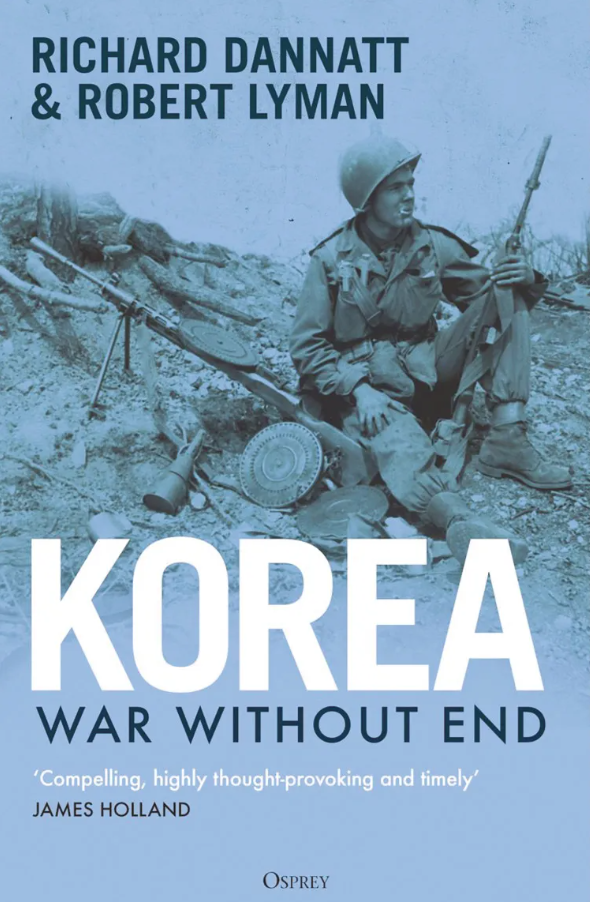
Their book has three premises. First, that the conflict in Korea is a forgotten one that very much deserves retelling. Second, that the war is very topical today partly because it shows how to fight (or not to fight) a conventional war in a nuclear age, and partly because it shows how politics must always take precedence over military ambition. And, third, the authors argue that the war was not a single conflict but was in fact two wars, quite separate but consecutive.
The “first” war is the story of the surprise invasion of South Korea by the North Korean People’s Army (NKPA), or the In Mun Gun, in June 1950 as their leader Kim Il Sung sought to reunite the Korean peninsula under Communist control without having any sense of the political response he would unleash. What followed was a rapid advance towards the southern city of Pusan in a form of Blitzkrieg that had not been seen since World War II.
This early phase covers the establishment of a US-led United Nations force for the first time in its history – only formed because the Soviet Union was boycotting the Security Council at the time. US troops finally slowed the NKPA advance and then, in a brilliant counterstroke masterminded by General Douglas MacArthur, an amphibious troop landing took place behind enemy lines at Inchon. This resulted in a complete reversal in the fortunes of the North Koreans and their retreat to pretty well their starting lines on the 38th Parallel that had divided the peninsula since 1945.
This, the authors argue, is where the war should have ended. The UN had achieved its aim of liberating the south from a Communist takeover. But instead a “second” war unfolded in which General MacArthur, convinced that he was fighting a crusade against world Communism, advanced rapidly through North Korea towards the Yalu River and the border with Communist or (as he called it) “Red” China. For him, victory had to include total defeat of the enemy. In scenes of remarkable hubris, MacArthur was convinced he had the war wrapped up and his troops would be home by Christmas. Instead, he provoked an attack by the Chinese People’s Volunteers on a massive scale, leading to the humiliating rout of US troops and a midwinter retreat back into southern Korea.
This “second” war had as its next phase the final standstill along lines roughly similar to the 38th Parallel and two years of stalemate, before an armistice was signed. The breakdown of the war into two separate conflicts is a fine way of interpreting the remarkable see-saw events of the first year of fighting. Seoul was captured and recaptured four times in nine months. Pyongyang was captured and lost, becoming the only Communist capital to have been taken in battle during the entire Cold War.
In the first stages of the conflict, UN troops, largely Americans who had been sent in from keeping the peace in Japan and who were entirely untrained and unprepared for combat, were thrown back so rapidly that many simply threw down their weapons and retreated. The NKPA, using the tactics the Japanese had used in their invasions of Malaya and Burma, completely outclassed the unprepared US forces.
Then, a few months later, the US-led advance made the Americans feel completely unstoppable as they headed north, only to be turned once more by the Chinese. Again, tactically outclassed and totally unprepared for mountain warfare in midwinter, where conditions were brutal, the UN forces collapsed. It is a remarkable story that very much merits the retelling.
Comments Off on Korea: War Without End by Richard Dannatt and Robert Lyman
QotD: Sixty years of intelligence service operations going sideways
There’s also another version of the Historian’s Fallacy in play with Intelligence work:
The historian’s fallacy is an informal fallacy that occurs when one assumes that decision makers of the past viewed events from the same perspective and having the same information as those subsequently analyzing the decision. It is not to be confused with presentism, a similar but distinct mode of historical analysis in which present-day ideas (such as moral standards) are projected into the past. The idea was first articulated by British literary critic Matthew Arnold in 1880 and later named and defined by American historian David Hackett Fischer in 1970.
Things that seem obvious in retrospect weren’t at the time. That’s the “formal” Historian’s Fallacy, if you like. But there’s another one, that we could call the “Narrative Fallacy” or the “Assumed Rationality Fallacy” or something (I stink at titles). Historians are, or at least should be, acutely sensitive to the danger of seeing patterns that aren’t really there (in a very real sense, “conspiracy theorists” e.g. McGowan are just Historians manqué. Coincidences are coincidental, and without training and practice and — crucially — an experienced hand to smack you upside the head for going farther than the available sources allow, it’s easy to run wild with them. So-and-So knew Joe Blow … yes, but that does not automatically mean that So-and-So conspired with Joe Blow).
Compounding it further: It’s indeed rational to assume rationality on your enemies’ part, so some catastrophic intelligence “failures” have come because analysts were unwilling to acknowledge that the enemy was, in fact, making a mistake. It’s a bit pricey, but I highly recommend James Wirtz’s The Tet Offensive: Intelligence Failure in War (here’s a preview page of a review at JSTOR, which points to a trade journal, American Intelligence Journal. Wirtz is a professor at the Naval Postgraduate School; I bet his book rattled a lot of cages that needed rattling). Breaking it out a bit further, and these categories are mine, not Wirtz’s:
In the case of Tet, there was top-level structural “failure” that hardly deserves the term “failure” — the NVA’s intelligence boys were no fools; they were bright guys doing their damnedest to put one over on the American intelligence crew, and they had some success at it. That’s only “failure” in the sense that in binary system, a win for them is a loss for you — you “failed” to win the game against a highly skilled, highly motivated opponent. The Americans didn’t fail to recognize that The Enemy Gets a Vote; they just didn’t realize how he’d voted.
But there was what I’ll call “Narrative” failure, and that’s all on the Americans. They seem to have decided that the North Vietnamese were not only losing the war, but knew themselves to be losing the war. So what the North Vietnamese saw as merely “the next phase of the plan”, the Americans saw as “increasing desperation”. Which led to other Narrative Failures. I might be misremembering the details, so check me on this, but I believe that the Americans were correct despite themselves about the attack on the big Marine base at Khe Sanh — it was indeed a diversion. But the Americans somehow concluded that it was a diversionary attack, specifically a “spoiling attack”, on something the NVA shouldn’t have known about in the first place — a top secret operation called “Muscle Shoals” (in Wiki under Operation Igloo White).
In reality, the Khe Sanh attack was a diversion against the main Tet operation, and it worked so well that it took a week or more, IIRC, for Westmoreland to come around. He insisted on interpreting the Tet “uprising” as yet a further diversion — a diversion in support of what he assumed was the main NVA operation, the attack on Khe Sanh!
Those are Narrative Failures. Twitter didn’t exist then, but we could nowadays profitably call them “Twitter Failures”. Whatcha gonna believe, your own lying eyes or the blue checkmarks in the Pocket Moloch?
All of which was aided and abetted by the third kind of failure, that “Assumed Rationality” failure. One CIA analyst, Joseph Hovey, not only predicted the Tet Offensive, but got large parts of it exactly right. But Hovey had a hard time believing his own analysis, because its central assumption was that the North Vietnamese were, in fact, making a mistake. The North Vietnamese did not, in fact, have the forces in place to do what they wanted to do. They were suffering a catastrophic Narrative Failure of their own, one endemic (it seems reasonable to say) to Communist regimes — since political officers are highly encouraged to submit exaggerated reports of unit strength and morale (and often lethally discouraged from reporting the opposite), the NVA thought they had far more, and far better prepared, forces than they actually did.
In an Alanis-level irony, US military intelligence had a better idea of the NVA’s strength than the boys in Hanoi did. (They confirmed this, in fact, when they nabbed a high-level NVA defector, who only “rallied” because the formation he was sent south to lead didn’t actually exist!). When faced with the possible conclusion that the Enemy is about to make a big mistake, it’s only rational to assume that something else is going on. Hovey knew that, of course, and that’s one of the main reasons his analysis went nowhere — being a conscientious professional, he noted at the outset that his analysis was premised on the NVA setting up to make a big mistake, which seemed extremely unlikely.
Given all that, if I had to guess, I’d bet that the KGB had a similar record, if the truth is ever known, because they had similar problems. They had a different, more systematic kind of Narrative Failure, I’d imagine — “Marxism-Leninism” vs. “bow-tied Ivy Leaguers running around cosplaying Lawrence of Indochina” — but it probably all washed out in the end. It’d be extremely interesting to hear about the Vietnam War from the KGB’s side …
Severian, “Friday Mailbag”, Founding Questions, 2023-04-15.
Comments Off on QotD: Sixty years of intelligence service operations going sideways
July 6, 2025
Day Six – Breakout – Ten Days in Sedan
World War Two
Published 5 Jul 2025May 15 1940 — Ten Days in Sedan, continues as our WW2 Blitzkrieg documentary follows Germany’s drive through France. Today French 2nd Army chief Charles Huntziger faces a pivotal choice: try and contain the German bridgeheads at Sedan, where Heinz Guderian is trying desperately to breakout, or pivot south to shield the Maginot forts he still trusts. His choice may just decide the fate of France.
(more…)
Comments Off on Day Six – Breakout – Ten Days in Sedan
Steyr-Solothurn S2-200: the Austrian MG30 and Hungarian 31M
Forgotten Weapons
Published 23 Sept 2024The S2-200 was developed by Louis Stange at the Rheinmetall company in Germany in the late 1920s. Because Germany was not allowed to be doing this sort of arms development at the time, Rheinmetall bought a controlling stake in the Swiss firm Solothurn AG, to make the product deniably Swiss. The gun itself is recoil operated, with a rotating locking collar connecting the bolt and barrel, rather like the Hotchkiss Portative. It was a design that had some early influence on the German MG34, although the German military declined to adopt it. Instead, it was taken into service in 8x56mm by both Austria (as the MG30) and Hungary (as the 31M). A third purchaser was El Salvador, which purchased 47 examples in 7x57mm caliber.
After the anschluss in 1938, the Austrian guns were integrated into the Wehrmacht, where they were primarily used by mountain troops. Hungary did later make a version in 7.92x57mm, designated the 43M.
(more…)
Comments Off on Steyr-Solothurn S2-200: the Austrian MG30 and Hungarian 31M
July 4, 2025
Another military procurement cock-up … this time it’s the C-19 rifles of the Canadian Rangers
The Canadian Rangers, one of the least-known parts of the Canadian Armed Forces, are a mainly Inuit reserve force operating in the Canadian north. They’d been equipped with WW2-era Lee Enfield rifles since the 1940s and the weapons were getting too old to perform the task so the CAF’s procurement folks settled on a Finnish rifle manufactured under license by Colt Canada. The Rangers, operating primarily as small patrols or as individuals, didn’t need the high firepower of a modern infantry rifle and the harsh climate they work in meant that a bolt-action rifle was desired. Bolt-action rifles are not new technology, so you’d think the CAF procurement would have been pretty straightforward, but no, they managed to miss something critical in the specifications they issued for the contract. And because the rifles met the published specifications, it’s on the CAF rather than the manufacturer to make sure that the weapons are safe to operate by the Canadian Rangers:

A Canadian Ranger handles the military’s new C-19 rifle. Shortly after the rifles were sent to Ranger units, red dye from the stocks started appearing on the hands of the soldiers when the weapons were exposed to wet conditions. (Credit: Canadian Armed Forces)
Canadian Rangers who use their new rifles in the rain are finding their hands covered in red dye because the stocks on the weapons can’t handle moisture, according to newly released military records.
The problem was discovered in May 2018 as the new C-19 rifles were initially being distributed to Canadian Ranger units as part of a $32.8-million contract with Colt Canada. The .308 C-19, which is equipped with a red stock, replaced the Lee Enfield .303 rifle that had been used by Canadian Rangers since 1947.
Under the contract, the new rifles were required to withstand extremely cold temperatures in the Arctic as well as moderate-to-high humidity in the coastal and forested regions of the country.
“Obviously from a health and safety perspective having dye released onto the skin is not a good situation,” Arthur Hall, who is with the Department of National Defence’s small arms program, noted in a May 9, 2018 email regarding the C-19.
Further complaints continued to come in from Ranger units who also found the stocks were cracking.
“The issue is that when exposed to moisture the red dye in the stock will run, and will discolour the hands of the user,” Luke Foster of the Directorate of Soldier Systems Program Management, pointed out in a July 3, 2018 email. “This is also an indication that the stocks are not properly protected from the elements.”
One report from an officer assigned to the Rangers noted he took his new rifle outside in the rain for only five minutes before returning indoors. Once back inside he noticed the weapon was dripping red dye. “I held the weapon for approximately 5-10 mins and it stated to stain my hand,” Captain T.M. Collier wrote in a May 9, 2018 email.
The documents, acquired by the Ottawa Citizen, were released under the Access to Information Act.
Department of National Defence officials, however, say it will be up to taxpayers to cover the costs of replacing the stocks on the 6,800 new rifles. That cost is estimated to be up to $10 million.
Comments Off on Another military procurement cock-up … this time it’s the C-19 rifles of the Canadian Rangers
QotD: US-Canadian conflict before Confederation
The Aroostook War (1838–1839) drew no blood. The conflict concerned the Maine-New Brunswick border and was resolved amicably by the Webster-Ashburton Treaty of 1842. A quarter of a century later the Fenian Raids (1866–1871) saw the Irish-American Fenian Brotherhood make multiple non-state sanctioned attacks in British North America in an effort to sway Britain to withdraw forces from Ireland.
The other far more consequential military struggles between the two North American friends and neighbours occurred first in the late eighteenth century, and second in the early nineteenth century. During the American Revolutionary War (1775-1783), which saw limited involvement of areas north of the 49th parallel, British North America thwarted a particularly serious invasion by the Americans in 1775 known as The Battle of Quebec.
It was fought during a snowstorm on December 31, 1775 (one of few battles fought in such miserable conditions during the revolutionary war). The American intention was to conscript the British colony, which today forms the province of Quebec (and also included parts of Ontario) into their struggle against the British. The Patriots of the Thirteen Colonies had earlier that year begun rebelling against British taxation and governance. They surmised that the French-speaking Quebec settlers, disaffected with the imposition of British rule as it was laid out in the 1763 Treaty of Paris (which ended the Seven Years War), would join the American cause. A significant miscalculation, to say the least.
The battle was fought on two fronts against a British garrison of 1800 soldiers led by British commander, Governor Guy Carleton. The combined total of American troops was only 1200. The first front was commanded by Brigadier General Richard Montgomery, who led his troops in an attack of the Lower Town from the south. The second assault occurred from the north and was led by Colonel Benedict Arnold (who would later become an infamous American traitor).
Montgomery and several officers were killed instantly on their initial advance. This sparked a retreat amongst his remaining soldiers. Arnold had slightly more luck. His army penetrated northern defences but were stymied in the narrow streets of Quebec. During fighting Arnold was wounded, after which he handed the command to Daniel Morgan. After hours of fighting, Morgan and his men were forced to surrender. The Americans lost the battle decisively ensuring Quebec would remain a loyalist stronghold.
The second of the two significant conflicts involving British North America and the Thirteen American Colonies was the infamous War of 1812 – a more well-known period of antagonism between proto-Canada and her American neighbours.
Here is a topline summary with some extra history concerning the U.S.-Canada border (the world’s longest undefended border), from Terry Glavin:
The War of 1812 — which the Americans still pretend they won — was officially concluded with the Treaty of Ghent in 1814. Then came the Rush-Bagot Pact of 1817 and the Convention of 1818, which set the border at the 49th parallel.1
The War of 1812 took place during Britain’s struggle against Napoleonic France. The two most famous Canadian battles from this tragic conflict were the Battle of Queenston Heights and the burning of York (now Toronto) – British troops would even the score of the latter by burning Washington D.C.
The war was unpopular. Like today, there were too many bonds between the Americans and proto-Canadians. But also like today, with Canada and the United States once again bickering over trade and various political interests, the disagreements were accompanied by a reluctance to engage in hostilities.
From Pierre Burton’s War of 1812:
At the outset, it was a gentleman’s war. Officers on opposing sides met for parlays under flags of truce, offered hospitality, exchanged cordialities, murmured the hopes that hostilities would quickly end.2
No matter what time period we are examining, we can never forget that Britons, Canadians and Americans are all first cousins. Yes we disagree from time to time, sometimes we even fight. But always over some unfortunate political dispute, and never for each other’s annihilation.
In 1812, for a variety of reasons, the Americans, especially a minority of hawkish elites in Washington, felt they had no other choice but to invade the north. Some of them felt it would be easy. An aggravating factor concerned Britain’s support of Indian tribes in the north west, at a time when the Americans were aggressively expanding into that region. But also, during their imperial contest with France, the British were impressing sailors in the American navy (forcing them to join British forces), because they considered them traitors of the British crown. Further, they blocked key trade ports under Napoleon’s control, disrupting trade between America and France.
Isn’t it curious how trade so often appears as the rift in Canadian-American relations? Further examples include: the Reciprocity Treaty of 1854 which allowed for free trade of natural resources between the American and British colonies. However, the Americans abrogated that treaty in 1866 partly out of frustration at perceived British support of the confederacy after the Civil War. A post-confederation trade war with the Americans ensued after Canada’s first Prime Minister John A. MacDonald adopted the National Policy in 1879, which imposed high tariffs to protect Canadian industry. Triggering the Americans to respond with tariffs of their own.
James Pew, “Canadians and our ties to Americans”, Woke Watch Canada, 2025-03-30.
1. Because of the day that’s in it – by Terry Glavin
2. Pierre Berton’s War of 1812.
Comments Off on QotD: US-Canadian conflict before Confederation
July 3, 2025
Bill Slim, the most forward-looking British commander of WW2
At The War Room, Dr. Robert Lyman explains how and why General (later Field Marshal) William Slim was able to turn around British and allied military fortunes in Burma and drive the Japanese out of India to their eventual defeat:
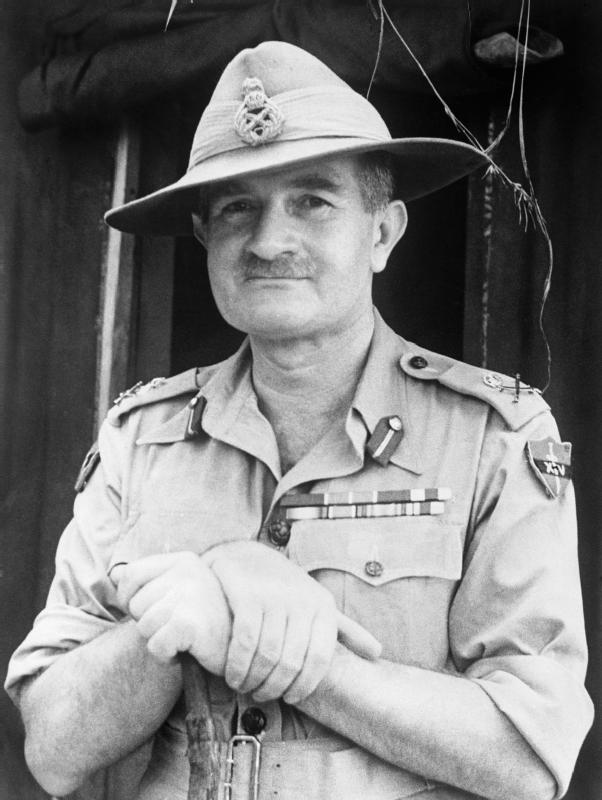
Field Marshal Sir William Slim (1891-1970), during his time as GOC XIVth Army.
Portrait by No. 9 Army Film & Photographic Unit via Wikimedia Commons.
“Burma and the Birth of Modern Warfare” is the subtitle to my 2004 book and PhD about General Slim’s command of the 14th Army in Burma during the last war, titled Slim, Master of War, a use of Sun Tzu’s description of a “heaven-born” commander. It may appear a rather grand claim, and perhaps it is, but the purpose of the subtitle reflects that fact that Slim’s conduct of operations in India and Burma in 1944 and 1945 represented an entirely new style of warfighting to that experienced by the British Army during the war. Instead of looking back to the lessons of World War One, Slim’s conduct of operations looked forward to reflect a style of warfare that would only be adopted as formal doctrine by the British Army in the 1980s. In the mid-1940s it remained alien to the vast bulk of similar British military experience and understanding.
My argument wasn’t that Slim was the best general who had ever commanded men in the history of warfare. That may or may not be true, but for the sake of my argument is irrelevant. My proposition, rather, is that:
Slim was the foremost British exponent in the Second World War of the “indirect approach” and that in his conduct of operations in 1944 and 1945 he provided a clear foreshadowing of “manoeuvre warfare”.
My idea, which first saw expression in my 2004 book, has been developed since then in my subsequent writings, including that of Japan’s Last Bid for Victory, which deals with the great events in the Assam and Manipur in 1944 (2011) and A War of Empires (2021). A major reason for the continuing amnesia in British military thinking about the warfighting characteristics of the Burma Campaign – apart from the fact that it is a long way to go for a staff ride – seems to be the fact that Slim’s style of warfighting remained largely alien to the British Army’s doctrinal precepts until the late 1980s. Until then, Slim’s strategic conceptions had been considered an aberration, and Slim himself regarded merely as the epitome of a fine military leader, and nothing more. Then, in a doctrinal revolution which began in the 1980s, the old firepower-based foundations – which themselves were largely a product of Montgomery’s approach to war in 1944 and 1945 – in which the supreme military virtue was the effective and coordinated application of force, were replaced. This revolution in doctrine and thinking about warfighting exchanged the old foundations with new ones based on an entirely different conception, that of manoeuvre at the operational level of war, in which notions of subtlety, guile and psychological dislocation came to be emphasised in an entirely new and refreshing way. My belief is that it was the effective and pragmatic employment of manoeuvre at the operational level of war by Slim in Burma that was the direct cause of the extraordinary victories the 14th Army achieved in 1944 and 1945 and which led to the two greatest defeats the Japanese Army suffered in the field in the Second World War, the first at Imphal-Kohima in India in 1944 and the second at Mandalay-Meiktila in Burma in 1945. My argument I suppose is that Slim’s exercise of command in Burma makes him not merely a fine example of a “manoeuvrist” commander but in actuality the template for modern manoeuvrist command.
[…]
First, the 14th Army was the only truly joint formation in the British armed forces during WW2. Nothing else, in North Africa, Italy or North-West Europe came close to it. Slim insisted on nothing less than full integration. Not only were headquarters joint, but operational and tactic delivery was also joint. At every level of command air and land headquarters were completely interlinked. I became convinced of this fact when I discovered that the RAF and the Army even shared messes! Strategic air transport, winning the air war, the operational reach and flexibility provided by air power underwrote Slim’s conception of battle, to the extent that the senior RAF officer in the theatre ruefully concluded in 1945, and I quote, that:
Slim was quicker to grasp the potentialities and value of air support in the jungles of Burma than most Air Force officers.
There was no snobbery and no shibboleths with Slim: if it worked, it was pressed into action.
[…]
Professor Dixon argues [in On the Psychology of Military Incompetence] that, unusually for a senior commander of his ilk in WW2, Slim was non-ethnocentric. He had no intrinsic prejudices about the virtues of one race over another. Slim, after all, was an officer of the Indian Army, and I have yet to come across any evidence that British regimental officers of the Indian Army regarded their soldiers in any way inferior to themselves. He was commonly known to those who served under him as “Uncle Bill” from the special affinity British troops had to him: the remarkable fact, however, was that at least 87% of his Army of several hundred thousand men recalled him as “Cha Cha Slim Sahib”: 14th Army was, after all, very largely Indian, Gurkha and West and East African. I certainly cannot think of any other Indian Army general who had such an impact on British troops. He became, of course, Chief of the Imperial General Staff following Field Marshal Montgomery, in 1948, which securely establishes this feat. On that note, I cannot conceive of “Uncle Bernard” when referring to Field Marshal Montgomery!
The Burma campaign was as much a struggle for mastery of logistics as it was a struggle for mastery on the battlefield, and it was about risk as much as it was about adherence to logistical principles. Slim had an implicit understanding of the constraints placed on warfare by the demands of logistics. Great efforts were made to increase the quantity of supplies to Burma. Railways were extended, roads built and surfaced, sunken ferries refloated and repaired, barges and rafts built for use on the numerous waterways. In this regard Archibald Nye, the VCIGS under Alan Brooke, regarded Slim’s mastery of logistics to be the most significant measure of his greatness as commander of 14 Army in Burma:
He never had enough to do what he had to do and this … is the measure of his greatness.
The practice of war in Burma by Slim was so startling in its modernity, and unlike any other pattern of warfighting by operational level British commanders in the war. My view of Slim as a commander can be interpreted at two levels. He was, first of all, a great commander and leader. Being a master of strategy, of logistics, of technical proficiency and so on are important in themselves when considering the nature of leadership in war, but by themselves they remain insufficient. Successful military command requires someone who can, through dint of personality and inspirational leadership, wield all of the components of fighting power together so that an extraordinary result transpires. What marks Slim out from the crowd was much more than just his winning of a succession of extraordinary battles. His strength lay in his ability to produce a decisive effect from scratch; to mould thousands of disparate individuals together into a single team with a single goal; to persuade a defeated army that it had the potential to turn the tables on their enemies; to master the complexities of terrain, climate and administrative deficiency so that self-help, resourcefulness and ingenuity could become as much prized as fighting skill. In these individual areas, and more, Slim proved the master. His genius for war was the consequence of his ability to bring together all of these elements to create an extraordinary result, the visible sign of which was the greatest defeat suffered by the Japanese on land during the Second World War.
Comments Off on Bill Slim, the most forward-looking British commander of WW2
Latvia’s Unique Charger-Loading Lee Enfield (CLLE) Cavalry Carbine
Forgotten Weapons
Published 14 Feb 2025During the Latvian War of Independence, the nationalist forces receiver a fair bit of support from the British, including some 20,000 P14 Enfield rifles. These were great for the Latvian infantry, but the Latvian cavalry wanted something shorter. So in the early 1920s, they ordered 2200-2350 (the numbers are unclear) carbines from BSA. These were assembled using old Lee Metford and Long Lee parts, 21 inch barrels, and modified with charger clip bridges per the British CLLE pattern.
These carbines remained in service until World War Two, as we know that replacement barrels were purchased from Tikkakoski in Finland in the late 1930s — and this example has one of those Tikka barrels installed. During the Soviet occupation of Latvia, the Latvian Army did not fight, and many of these carbines appear to have been put into reserve service with the Red Army (some appearing to have been retrofitted with Mosin-style sling slots). Others disappeared into the forest with anti-Soviet partisans, and very few survived after the war.
(more…)
Comments Off on Latvia’s Unique Charger-Loading Lee Enfield (CLLE) Cavalry Carbine
July 2, 2025
The Korean War Week 54 – The War is One Year Old – July 1, 1951
The Korean War by Indy Neidell
Published 1 Jul 2025Over a year has passed since North Korean forces crossed the 38th Parallel and invaded South Korea, and while the war has seen the advantage switch hands time and again, one thing it has not seen is any sort of cease fire or peace negotiations. However, that might change soon, as this week both the Chinese and the Americans indicate their willingness to sit down and talk. South Korean President Syngman Rhee, however, is against any cease fire talks that do not set out to meet a big variety of his demands, demands which which the other warring parties do not see as being in their own best interests.
(more…)
Comments Off on The Korean War Week 54 – The War is One Year Old – July 1, 1951
July 1, 2025
Tibet’s Last Stand: The Snow Lion vs. The Dragon – W2W 34
TimeGhost History
Published 29 Jun 2025The fate of Tibet is decided on the roof of the world as Mao’s China sets its sights on Lhasa. This episode traces the dramatic showdown between the snow lion and the dragon — from imperial legacies and British invasions to the last years of de facto Tibetan independence. Discover how realpolitik, Cold War indifference, and the carrot-and-stick tactics of Mao’s regime sealed Tibet’s fate. Watch as the Dalai Lama faces impossible choices, world powers look away, and the dream of independence is crushed beneath the weight of history.
(more…)
Comments Off on Tibet’s Last Stand: The Snow Lion vs. The Dragon – W2W 34
June 30, 2025
Day Five – Massive Allied Air Attack – Ten Days in Sedan
World War Two
Published 28 Jun 2025May 14 1940. The blitzkrieg continues in today’s episode of Ten Days in Sedan. British and French bombers roar over Sedan, braving curtains of flak and German fighters in a bid to smash Guderian’s hastily built bridges across the Meuse. Further north, French infantry and tanks battle against the German crossings at Houx, Dinant, and Monthermé. German general Erwin Rommel has a narrow escape as the French nearly blow him and his tank to pieces!
(more…)
Comments Off on Day Five – Massive Allied Air Attack – Ten Days in Sedan


